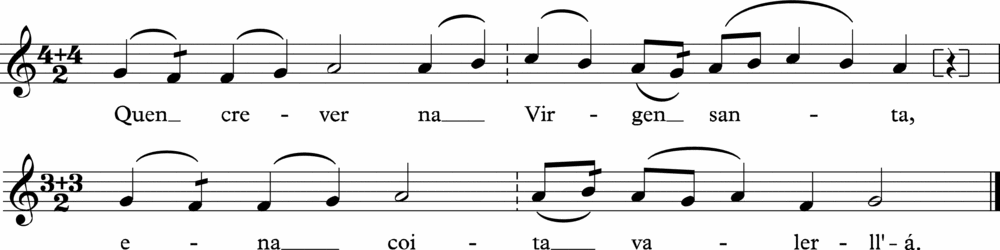
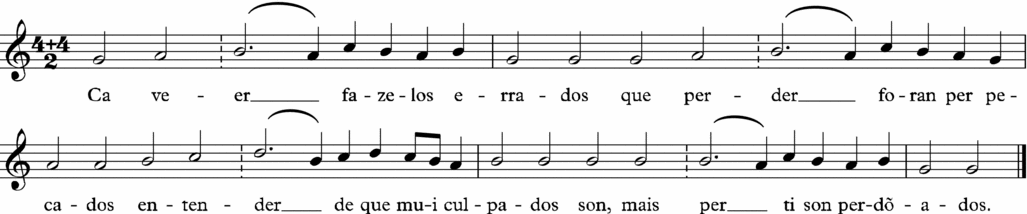
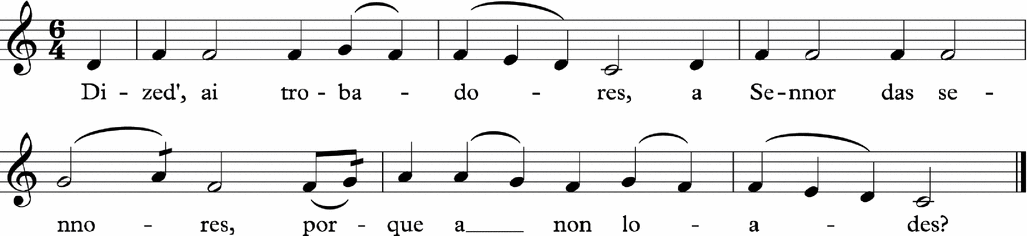
The collection of Marian songs known as the Cantigas de Santa Maria and composed on the initiative of the Castilian King Alfonso X, the Learned, is justly famous. As a musical corpus, it exceeds the number of surviving troubadour melodies in langue d’oc by roughly 50 per cent. Yet its riches have barely been explored from a musicological point of view. One of the reasons for this apparent lack of interest is the language of the songs, medieval Galician-Portuguese, which is alien to most Romanists and lies outside the mainstream of Spanish literature as promoted by the historical heirs of the Castilian-Leonese Kingdom. Another equally powerful reason is the fact that this repertory does not easily fit the current historical narrative concerning medieval European music.Footnote 1
In brief, this narrative tells us that in the thirteenth century everyone followed in the footsteps of France. Paris was the undisputed centre of cultural activity and the sole origin of musical novelty and fashion. The monumental organa of Notre Dame cathedral were circulated as unsurpassable compositional models for richly ornamented liturgy. The motet, a late Parisian by-product, created an intellectual rage among university-educated clerics, and gained the admiration of close urban laymen; the corresponding notational techniques were expounded and discussed, from the mid-century onwards, in various treatises authored by Europeans whose origins could lie as far from Paris as Scotland or Germany. Young graduates of Castilian, Leonese or Galician origin were certainly not isolated from these fashionable trends.
One could also say that the Cantigas de Santa Maria followed the precedent of French devotional song, as illustrated by the collection of miracles by Gautier de Coinci. The stories told by the Cantigas are mainly of international stock, translated from Latin. The manuscripts use layout conventions and musical notation akin to those experimented with beforehand in France. The collection seems therefore to confirm general historical expectations, notwithstanding its exceptional scope and impressive iconography.
Yet, problems arise in this neat narrative when the repertory is examined more closely. These songs, devised during the last two decades of King Alfonso's life (from c.1264 to 1284), exhibit musical forms that either never crossed the Pyrenees (the Andalusian rondeau) or became popular in Paris only a generation later (the virelai).Footnote 2 Moreover, the musical notation has strange features allowing it to record rhythms that would not be written in France until the early fourteenth century.Footnote 3 Yet, to paraphrase Jacques Handschin, the fact that Castile was, in the perspective of ‘linear’ historiography, always ‘behind’ the French evolution does not forbid that she could take initiatives of her own: we ought not to force the Cantigas into an evolutionary order that is not its own by maintaining that binary rhythm, for instance, could not possibly appear before it was duly recognised by (French) theorists.Footnote 4
Alfonso's biographer, Johannes Aegidius de Zamora, placed measured control of proportions (probably including rhythm, formal balance, or both) among the king's accomplishments in the composition of devotional song: ‘in the manner of [King] David, for the praise of the glorious Virgin, [Alfonso X] composed many beautiful songs measured with accordant sounds and musical proportions’.Footnote 5 The rhythm of the Cantigas, however, has been a matter of dispute.Footnote 6 In the 1920s, the Spanish Arabist, Julián Ribera (1858–1934), proposed that everything in the music of the Cantigas was Arabic, including the rhythmic patterning.Footnote 7 Higinio Anglés (1888–1969), a Spanish priest was one of the many Christian nationalists to be shocked by this thesis. Anglés was a disciple of Felipe Pedrell (1841–1922), a composer and folklorist who denied any influence whatsoever of Arabic music on popular Spanish song, and also studied in Germany in 1923–1924 with Wilibald Gurlitt (1891–1963) and Friedrich Ludwig (1872–1930), the latter being the leading expert on Notre Dame polyphony.Footnote 8 He reacted in 1927 to Ribera's assertion by transcribing a number of cantigas into pure Parisian modal rhythm.Footnote 9 At the time this was a modern performing solution for troubadour songs, developed and heatedly defended by Pierre Aubry and Jean Beck in the early twentieth century, and supported by Ludwig, who claimed the idea's paternity.Footnote 10
Though Ribera's exaggerated attribution of the Cantigas entirely to Arabic influence was mistaken, nonetheless the subsequent dismissals of any Arabic paradigms in the repertory similarly miss a critical element in their musicality and history. Instead, the interaction and melding of different traditions lend these songs much of their fascination and singularity, and without it Anglés's initial transcription fell flat. To understand why, let us first examine the Parisian rhythmic modes, and see how the Cantigas go beyond their purview.
Rhythmic modes
In Parisian motets written around 1260–80, mensural cum littera notation (adapted to syllabic text underlay) represented a short sound by a square punctum and a long one by a virga. Six rhythmic patterns, devised for superposition, were generally admitted:Footnote 11
• Two (modes V and VI) proceeding by equally spaced time units, divisible by three if slow, or grouped in threes if quick (a slow pulse would correspond to three beats). Attacks either coincide with the pulse (mode V) or subdivide it (mode VI).
• Two (modes I and II) proceeding by regular alternation of short and long sounds standing in a proportion of one to two. The pulse coincides either with the attack of the long (mode I) or with the short (mode II).
• Two (modes III and IV) in which a ternary short–long group alternates with a three-beat long. The pattern begins either with the three-beat long (mode III) or with the short (mode IV). Standard theory takes the larger value as a measuring-stick; hence the two-beat long is conceptualised by comparison as a particular kind of short (brevis altera). It is written accordingly as a short note; its position (the second of two breves meant to fill a ternary pulse) marks it for extension by an extra beat.Footnote 12

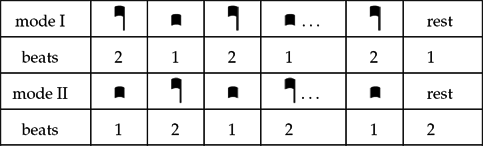

The use of these patterns could be flexible, and the subdivision of the breve, or short, into semibreves ( ) would add extra variety.Footnote 13 ‘Any given modal pattern may occur within the musical context of another or other patterns’, Gordon Anderson observed, while urging musicologists to be ‘more flexible in definition of mode within the theoretical framework as illustrated by the whole range of theoretical writings as well as by the musical monuments themselves’.Footnote 14 As far as the mensural notation of rhythm had become independent of the early sine littera system for denoting modal patterns, practitioners of mensural polyphony begun to experiment with new combinations and eventually test the limits of the system. Modal mixture or mutation became a distinct possibility.Footnote 15 Consideration of both central polyphonic repertory before c.1280 and statements by contemporary theoristsFootnote 16 reveals the use of the following variants, arrived at by conflation or division of durational values (extensio or fractio modi):Footnote 17
• mode Ia – 3–2–1 . . . beats (extended first mode or alternate third mode)Footnote 18
• mode IIa – 1–2–<1–2–> 1–2–3 . . . beats (Lambertus: fifth mode)
• mode IIIa – 6–1–1–2–2 . . . semibreves (Lambertus: sixth mode)
Among the ‘secondary modes’ to which Walter Odington referred c.1300, we find variant IIa above and also a mixture of first and second modes, notated L B B L (with a dot for divisio modi put between the breves, though practice did not necessarily follow theoretical prescription).Footnote 19 The Paris version of Anonymous VII additionally allows the mixture of third mode with either the second (L B B + B L) or the fifth (L B B + L).Footnote 20
Thus, before the Parisian system of rhythmic modes began to crumble in the final years of the thirteenth century, we can consider that at least twelve patterns, all based on ternary metre, were in use. The Castilian adoption of Notre Dame polyphony as attested by several manuscripts,Footnote 21 as well as intense diplomatic, feudal and family ties to northern France,Footnote 22 the long stay of King Alfonso himself in southern France in 1275 where he went to meet the Pope and his encounter with the French king, Philippe III, at Bayonne at the end of 1280,Footnote 23 make it very probable that these rhythmic practices were known in the king's entourage.Footnote 24
Rhythmic variety
In the course of his research on the music of the Cantigas, Anglés eventually realised that a transcription using exclusively modal rhythm not only amounted to oversimplification, contrasting with the rhythmic variety found in popular song, but also often meant ignoring the shapes and implied meaning of the original notation. As a consequence he largely abandoned the Parisian model but, unlike Ribera, did not seek an alternative historical paradigm: in keeping with his roots in musical nationalism and his contemporary ideological context, he assumed that the rhythm recorded by the manuscripts testified to the originality and musical genius of the Spanish people.Footnote 25
More than twenty years passed between the publication of a complete musical transcription by Anglés in 1943 and the corresponding third volume of his edition, the facsimile of the Escorial codex, called ‘de los músicos’ (siglum E), in 1964. The scholarly community could finally compare the results of Anglés's labour, the circulation of which had been postponed by the war, with his main source. Two problems were evident: first, he had chosen to interpret the notation as a fully fledged mensural system, unsupported by any French theorist and relying upon a debatable belief in spontaneous popular creativity; second, some transcriptions sounded somewhat contrived when followed strictly – for instance, when a single two-beat element interrupts a ternary flow, or vice versa.
To complicate matters, young musicologists had begun to cast doubts on rhythmic transcriptions of medieval song: troubadour manuscripts normally lacked rhythmic cues, and smart polyphonic writing required a special kind of intellectual training and musical literacy, a world apart from the social context and function of courtly song.Footnote 26 Concern with the rhythmical aspects of medieval song became intellectually suspect, and, hence, a dubious thesis argued in Spanish was decidedly not going to change their minds. The work of Anglés was accordingly put in the margins of historical discourse. Nevertheless, the editors of musical anthologies, when perplexed by the notation of the sources, found it handy, and, eventually, early music performers found it irresistible to play from in spite of its occasional oddity.Footnote 27 This was so because Anglés followed his favourite source closely and the Cantigas as originally written contain more rhythmically shaped, easily graspable melodies than any other medieval monophonic repertory.
All three manuscript sources for the music carry rhythmic information, albeit to different degrees. The first (Madrid, BNE MS 10 069) was once in Toledo, hence its siglum, To. It includes 128 songs, and represents the first stage attained by the compilation: one hundred songs, plus prologue, epilogue and appendices. The remaining codices originated in Seville and are found in the Royal Monastery of El Escorial, north of Madrid. The lavishly illustrated MS. T. I. 1 is generally referred to as códice rico, or by the siglum, T. It contains 193 cantigas and was meant to be the first volume of a two-volume luxury set. The other, MS. b. I. 2 (siglum E) is called códice de los músicos, because every tenth song is headed by an illumination representing one or more musicians. It contains 407 cantigas (apparently 416, but nine are given twice) and represents therefore the final stage of the collection. The Toledo codex was copied no later than 1275; and the Escorial codices written (or at least initiated) towards the end of King Alfonso's reign, around 1280–4.Footnote 28
The notation in the manuscripts of the Cantigas de Santa Maria belongs to two different types. One (in To) was locally devised; the other (in E and T) is a pragmatic adaptation of pre-Franconian French models. The basic note-shapes are, in To, the square and the oblique punctum ( , ); in T and E, the virga and the square punctum (
 , ). The musical reality represented is normally the same. The notation in To is best described as semi-mensural, for there are, among the basic neumes, only five or six with a mensural meaning. The Escorial notation includes up to fourteen mensural signs. There are in addition slight but sometimes crucial differences between the T and the E notation: the former is sometimes more informative or consistent in its distinction of two kinds of ligatures (
 as opposed to
 ), and more reliable (or less original) in its use of the cum opposita proprietate stem (
 , etc.).Footnote 29
In Anglés's edition and in reproductions of the manuscripts, we can easily observe that the rhythm of the Cantigas de Santa Maria is generally of the simple modal type, with frequent extensio modi or modal mixture (e.g. CSM 4, 8, 21, 23, 29, 45, 67, 77, 82, 83, etc.).Footnote 30 Additionally there are special patterns like the sixth mode of Lambertus (CSM 288), and also cases of florid isosyllabic rhythm combined with rhapsodic prefixes, as in Galician-Portuguese troubadour song (CSM 190, 230). One can even find many examples of quadruple metre recalling Arabic musical precedent (e.g. CSM 109). It should be observed in passing that Alfonso X had a close personal acquaintance with, and interest in, Arabic culture, and that during the last decades of his reign his court was centred in Seville, where Andalusian traditions, heavily influenced by centuries-long exchanges with the Middle East, were still alive among Jews, Mozarabs and converted Muslims.Footnote 31
I proposed long ago that the rhythmic variety in the Cantigas is due to the confluence of diverse musical practices and that one of these, possibly the most important, has its origin in Arabic culture, as Ribera first suspected.Footnote 32 The Arabic rhythmic tradition has some similarities with the French modal system, but it includes a few unusual, characteristic features: the large scale of some rhythmic cycles and periods, the use of syncopation, dotted rhythm and quinary metre, and the importance given to quaternary metre. Here I will revisit the topic in a more systematic way, adding some new observations.
Parisian versus Arabic paradigms
Shai Burstyn remarked that a pre-condition of musical influence is cultural compatibility: ‘Europe was oblivious to origin and context of those items whose aesthetic flavor it found compatible with its own. [. . .] The overriding importance of pattern over detail [. . .] provides a bridge with the compatible attitudes towards the composition, performance, and transmission of Eastern music.’Footnote 33 In pervasive rhythmic patterning, both European and Eastern music found a common ground. However, contrary to thirteenth-century French mensurally notated polyphony in which we can find a limited number of rhythmic modes in ternary metre, from the tenth century onwards Arabic rhythmic theory encompassed different kinds of metre, and, starting from a limited number of patterns, allowed them to be infinitely varied.Footnote 34
In Arab-Islamic culture, instrumental music was inseparable from song, and the identity of a song and its learning process were primarily based on its rhythmic patterning. The names and definitions of rhythmic patterns underwent changes, but the general principles of Arabic rhythmic theory, rooted in the Baghdadi tradition, were clearly shared by different authors at different times and places between the tenth and twelfth centuries. Neither the theory nor the corresponding practice need be confined to the Near East: both travelling musicians and copies of encyclopedias and treatises dealing with music found their way into the Iberian Peninsula, where Islam dominated from the year 711.Footnote 35 A commentary by al-Bataliawsī of Badajoz, who lived mostly in Valencia around the year 1100, testifies to the assimilation in the Andalus of the Arabic rhythmic paradigm.Footnote 36
I will now engage the Parisian and the Arabic paradigms with one another, and also with the Cantigas, in order to ascertain their differences and respective pertinence in this repertory.
Ordo and period
A useful concept in Arabic musical theory, deriving from the writings of al-Fārābī, is the distinction between (simple) cycle and compound cycle or period. A rhythmic cycle (dawr) is a short repeatable scheme, normally ending with a rest or protraction.Footnote 37 A rhythmic period (īqā’) is the combination of two identical or diverse cycles; this combination is meant to offer a higher level of rhythmic replication. The relationship between cycle and period is inspired by the role of the hemistich in a single line of poetry.Footnote 38
In medieval Latin theoretical vocabulary, a period would be called an ordo; it can have as many repeated components as is deemed suitable. Western musical theory distinguishes the abstract modal pattern from its methodical arrangement in a regular series or ordo, a distinction similar to that used in prosody between foot and poetic metre. Modal patterns appear in ordines that normally replicate a single pattern and are delimited by a final rest. Occasionally, as in the third irregular mode of Anonymous IV, a standard pattern may be combined with a variant pattern, arrived at by the subdivision of a beat.Footnote 39 But all ordines must normally fit ternary metre and internal variety is uncommon. In Arabic theory, on the contrary, all metres are possible, internal variety is expected and cycles of different character and length can be combined into a single, repeatable period. Different periods can, in turn, be combined in the same song.
Let us assume a cycle of three equally spaced percussions, with a disjunction at the end, using the slash to signal the percussion or attack, occupying one beat, and the dot the signal non-percussed beats:
/. /. /. . .
(a total of four pulsations or eight beats); then the same, but filling-in the second pulsation with an extra stroke:
/. / / /. . .
Combining both cycles, we will get a typical rhythmic period:
/. /. /. . . /. / / /. . .
A slowly paced period, formed of two closely related cycles, can be the basis for creative composition or performance through subdivision and filling of the disjunction time and other variation techniques.Footnote 40
If we take the two above heavy cycles, combine them in reverse order and fill the first disjunction with a single attack, we get the following period:
/. / / /. /. /. /. /. . .
which is found in CSM 25, 194, 246 and 424 (and in the popular tradition as well).Footnote 41 They also use a version of the period with the last disjunction filled in with unaccented rhyming syllables. If the fourth pulsation is then subdivided, the result is found in the initial phrase of cantiga 100: Santa Maria, ‘strela do dia. If further subdivision is allowed, we get its second phrase: mostra-nos via pera Deus e nos guia (Ex. 1).
CSM 100 (refrain): notational figures in codex T.

The combination of cycles within a period may also involve change of metre: the first phrase of CSM 107, for instance, juxtaposes two eight-beat cycles, but while the first divides them into four two-beat longs (ornamented, with an exception), the second groups the beats as 3+3+2. This metrical scheme, accounted for by al-Fārābī, would be long-lived in Iberian music.Footnote 42 The second phrase juxtaposes two heterogeneous six-beat cycles, both described by al-Fārābī;Footnote 43 it displays syncopation at the cadence, recalling many later Spanish examples (Ex. 2).
CSM 100 (refrain): transcription.
CSM 107 (refrain): notational figures in codex E.

CSM 107 (refrain): transcription.
Quickly paced related periods include (in CSM 269, for instance):
/. / / /. / / /. /.
Al-Fārābī mentions a similar one, only with the cycles reversed, and a song by Juan del Encina uses the same pattern as CSM 269, but displacing the first long to the end.Footnote 44 The range of possibilities opened by adding extra attacks and subtracting them is large. I have elsewhere explored the issues of syncopated and dotted rhythms in the Cantigas and their obvious relation to Arabic models; the continuation of CSM 100 features one of these dotted rhythms (Ex. 3).Footnote 45
CSM 100, initial lines of the first stanza in codex T.

That similar rhythms penetrated the Hispanic popular tradition is attested by the romance Enfermo estava Antioco as presented in the sixteenth century by Estevan Daza. Dotted rhythms in the midst of slow, equal notes are also typical of the melodies associated with the romance Paseavase el rey moro, and are additionally found in Quién ubiesse tal ventura, published by Diego Pisador.Footnote 46
Rhythmic modes V and VI
In Arabic theory, regularly spaced beats are considered the basis of any patterned rhythm. This idea, already present in Ishāq al-Mawsilī, was taken over by al-Fārābī and reappears in the late tenth-century dictionary of scientific terms, the Mafātīh.Footnote 47 Avicenna claims that all of the ancient songs of Persia and Khorāsān were composed of notes of equal duration, and Ibn Haldūn implies that this same simplicity was characteristic of the light, primitive songs of the nomads, including the Arabs, who called it Hazaj.Footnote 48 Even if this designation came to encompass some rhythmic variations as well, the theorists acknowledge compositions made up entirely of regularly spaced attacks (conjunctive rhythm), the only difference being their tempo: either relatively slow (‘heavy’ or ‘light-heavy’) or quick (‘light’). These correspond to the Parisian fifth and sixth modes, except that the metre is not predetermined.
In Parisian as well as in Arabic theory, the end of a phrase is marked by a pause. In Arabic writings, this is also called a disjunction, or separator, and often involves the prolongation of the last sound. Thus, in effect, besides the basic time-unit (the durational value maintained between percussions, attacks or articulations), a second rhythmic value is created. The corresponding duration can double or triple the basic time-unit. This allows a performance in double or triple time, or their combination.
The theory applies to poetry as well as song and instrumental music, with due adaptation. Avicenna explains that some patterns sound fine in instrumental music, but not in poetry.Footnote 49 Similar adjustments were required if applied to another linguistic context. Unlike Arabic, the Galician-Portuguese used by Alfonso X in his poetry is a non-quantitative language. Such poetry is based on syllable-count and rhyme, but text-accent can play a structuring role both in and before the rhyme, which is not normally true of other Romance languages.Footnote 50 This is worth keeping in mind when the music is analysed. Rhythmic patterning could be adjusted to crucial accents in the overlaid text; or these be aligned with resounding attacks, expected in unwritten percussive dynamics.Footnote 51
In the Cantigas de Santa Maria, a slow, even-spaced rhythm is found in several melodies, notated mostly with longs; these are sometimes subdivided, that is, replaced by short melismas expressed in ligatures – a form of ornamentation that leaves syllabic articulation unaffected. Anglés, inspired by the notation, chose to call this style just ex omnibus longis.Footnote 52Cantigas 106, 111, 322, 327, 335, 341 and 358 consist, schematically, of musical phrases of seven or eight long notes each (depending on the position of the rhyming accent, which always falls on the seventh long: 7 or 7’). These longs can be grouped by twos or threes; the ornamental subdivision of the long is, however, clearly marked as binary by the use of cum proprietate/sine perfectione ligatures, as already observed by Anglés. The underlying pattern is not therefore a Parisian fifth mode. Rather, the Arabian paradigm applies instead.
The quick manner of conjunctive rhythm, which Anglés called ex omnibus brevibus, is found in several cantigas: 249, 266, 302, 334 and 361, all of them with lines of seven or eight syllables, with the accent falling on the seventh (7 or 7’). The label notwithstanding, there are cases of subdivision or conflation of breve-units. It can be argued that if the underlying scheme were a strict Parisian sixth mode, we would see only short notes, and phrases would preferably end with an accented breve. However, the ordines are imperfect: phrases end with either an unaccented short, following an accent, or a long note. The latter serves to mark a final accented rhyming syllable. It assumes the function of a separator by prolongation, as in the Arabic paradigm. The corresponding pattern B B B B B B L (B stands for breve, L for long) is not unknown to French music, but it also coincides with the first variation of the First Light-Heavy compound cycle (with a final two-beat long) according to al-Fārābī.Footnote 53 The distribution of internal accents in the overlaid text or the presence of modified binary ligatures (CSM 266) may suggest binary grouping throughout, which would exclude modal rhythm. An underlying ternary pulse is nonetheless sometimes suggested by a stroke following a final virga, and under these circumstances it is possible to alternate between three binary and two ternary groupings in accordance with the text; for example, méus amígos vós diréi [. . .] cá por así o achéi (CSM 361). In short, both paradigms, with due adaptation, may apply, as the larger metrical framework is not clearly given and may change from cantiga to cantiga.
Other cantigas are even less predictable. The rhythm can be conjunctive at the start, but prolongation can be attributed, in masculine-rhyming lines, to both rhyming syllables, thereby producing a disjunctive pattern, that is, one mixing short and long sounds. This may or may not coincide with a standard musical pattern. A binary example can be found in CSM 79: B B B B L L (four single beats and two double). It corresponds to one of the variations of a conjunctive rhythmic cycle, expounded by al-Fārābī.Footnote 54 Other cases are cantigas 323 and 378, in which musical variety takes precedence over strict textual correspondence: the cycle, also binary, is composed of four shorts and three or four longs (depending again on the terminal or penultimate position of the rhyming accent).
We can conclude that the Arabic paradigm is generally more fitting than the Parisian one to explain series of longs, or their juxtaposition with series of breves. Although the Arabic theoretical framework was also flexible enough to absorb any practical use of undifferentiated note series, namely imperfect sixth-mode ordines, which could apply by analogy to some cases of notation ex omnibus brevibus, it was not necessarily adhered to in these cases.
Rhythmic modes I and II
The French model can be invoked to explain what can be easily recognised as second-mode patterning (B L. . .), seen in cantigas 85, 164, 332 and others; but it must be said that most Arab authors acknowledge exactly the same pattern, under different names (Ramal or Light Ramal being the most usual). Al-Bataliawsī of Badajoz explicitly states that his contemporaries used it in the Andalus: ‘[the Light Ramal] uses two attacks and two attacks [and] between [each set of two attacks] there is a separation’.Footnote 55
Since the Parisian second mode and the basic form of the Ramal coincide, only slightly unusual, related patterns may indicate that one of these paradigms prevails. Yet notational evidence is often ambiguous. King Alfonso's personal invective in cantiga 260 was transcribed by Anglés under the second rhythmic mode, with an anacrusis and elongation of both rhyming syllables (Ex. 4).Footnote 56 His solution is justified, since in the passage  occurring several times in codex E, the fourth-mode hypothesis (1+2+3, 1+2+3 beats) fails to account for the alternation of punctum and virga to represent the same kind of breve.Footnote 57 The result departs, however, quite clearly from second-mode patterning; the closest Parisian pattern is variant IIa above (Lambertus's fifth mode, described previously), but this would also suppose an atypical anacrusis and extensio modi over the penultimate syllable. This song could have been inspired instead by the Ramal paradigm, with due adaptation; but assuming that no long exceeds two beats (the notation allows it), its exact form can be arrived at, according to al-Fārābī, by juxtaposing a cycle of the Second Light and a cycle of the Fifth Light.Footnote 58
CSM 100, beginning of the first stanza.
CSM 260 (beginning): notational figures in codex E.

Some rhythmic hesitation, or change of mind, can sometimes be discerned in the sources, e.g. in cantiga 86, copied in all three extant musical manuscripts, To, T and E. The first melodic phrase, which juxtaposes two rhythmic cycles, will suffice as an illustration. In codex To, both cycles can be interpreted (in the stanza) as instances of the Ramal or (imperfect) second rhythmic mode (see Fig. 1). On the contrary, in codex T, the first segment apparently corresponds to a pattern documented in many theoretical sources including al-Fārābī in the tenth century and Safī al-Dīn in the thirteenth, and still widespread in many Arab countries: 1+2+1+2+2 beats, only with double attack (1+1) at the disjunction.Footnote 59 The second segment amounts to the same pattern with an elongated final instead (see Ex. 5). The notation in codex E adds a beat to the fifth syllable so that a smooth ternary pulse is reinstated; the result corresponds to Lambertus's fifth rhythmic mode (variant IIa above), with fractio modi at the end of the first segment.
CSM 260 (beginning). Interpretation of rhythmic values according to Anglés (grouped in 6/4 bars instead of 3/4 in his edition).
The return of the initial melodic phrase of CSM 86 in the middle of the stanza in codex To. (Here, only the single-note figures and have mensural meaning, respectively short and long.)
Rhythmic interpretation of CSM 86 (incipit) in codex T, with notational variants in E.
While the standard Ramal is evidently part of the basic building blocks of Arabic rhythm, the first mode (L B. . .) is, on the contrary, more prominent in French than in Arabic theory. Yet, as far as practice is concerned, this may be illusory. Theory has its own constraints. Contrary to Latin authors and their modern commentators who have mensural polyphony as their horizon, those writing in Arabic did not include coordination between a metrical pulse and the elements of a durational pattern in the definition of a rhythmic cycle. The concept of Ramal therefore encompasses the first rhythmic mode: the pulse may indifferently fall on the first beat or on the second. The initial short note in B L B L etc. may become an upbeat, as in cantiga 61, or disappear.Footnote 60 The first-mode version could not be presented as the basic form of the cycle or resulting period because this must end with a long note, implying dropping out the last attack. Therefore it is regarded as a modified pattern, and is featured in treatises as a result of variation techniques and under different guises. Al-Fārābī describes it either as long–short–long–short (a variation of the Light Ramal) or as long–short–long–short–long, the long being worth two shorts (Sixth Light, seventh variation);Footnote 61 but Avicenna allows a longer disjunction, making it compatible with ternary metre.Footnote 62
Theoretical ambiguity is paralleled in the Cantigas by notational ambiguity concerning the beat-value of the final long in a L B L B L sequence; for instance, in CSM 213, where the pattern is used with a prefix (two shorts or a short–long group). The phrases, however, often end with two longs, followed by an upbeat of two shorts, suggesting a juxtaposition of 3+3 and 2+2+(1+1) beats, alternating with the standard ternary metre (Ex. 6a). Dionisio Preciado has assigned Cantiga 166 to this category, although two final longs are only found in codex T (Ex. 6b). He has interpreted this as an instance of the popular petenera rhythm, which left its mark in several Spanish sources from the Renaissance.Footnote 63
CSM 213, codex E: incipit.

CSM 166, codex T: last phrase of refrain and first phrase of initial stanza.

This rhythmic profile is used, for instance, in the sixteenth-century Romances Por Antequera suspira, Retrayda está la infanta and Rosafresca, transcribed from popular tradition exclusively with two-tempora longs, which imply, in modern notation, regular alternation between 6/4 and 3/2 metre (Ex. 6c).Footnote 64 The alternation also occurs in several popular-inspired polyphonic villancicos by Juan del Encina, which have been associated with what Anglés called a ‘mixed modal rhythm’.Footnote 65
The Romance Rosafresca, according to Francisco Salinas.
By this expression he meant, in the wake of Ludwig, a systematic mixture of Parisian modal patterns, especially of the first and second modes, which results in new rhythmic patterns of the type
/ /. /. / (B L L B)
or the reverse
/. / / /. (L B B L).
Anglés claimed that this mixture of first and second mode was applied to as many as 86 cantigas.Footnote 66 He was not aware of the fact that these ‘secondary’ patterns, acknowledged by Odington but apparently of limited used in France,Footnote 67 were in fact current in Arabic music. According to al-Fārābī, both patterns can be arrived at by juxtaposition of variant cycles of the Light Ramal.Footnote 68
The cantigas clearly exemplifying the first pattern (B L L B) are CSM 43, 108 and 331, although it can also be found in many others (among them CSM 55, 57, 199, 234, 310 and 369).Footnote 69 Al-Fārābī also describes this pattern with a two-beat long added at the end.Footnote 70 Avicenna combines it with one to three longs (of two-tempora).Footnote 71Cantiga 76 suggests that the last long of three could be converted into a double upbeat: in codex T, the refrain has the same pattern with a second-mode prefix (B L, B L L B) and is followed by figures equivalent to L L B B or L L L, resulting in what may be interpreted as a combination of 6/4 and 3/2 bars; the copyist of codex E attempted to postpone the mixture to the end of the phrase (Ex. 7).
Rhythmic interpretation of CSM 76 (refrain) in codex T, with notational variants in E.
From the many cantigas exemplifying the second pattern (L B B L) – some of them only in the first half of a rhythmic period (CSM 92, 96) – I examined seventeen, though I have excluded nine (CSM 34, 46, 104, 199, 232, 300, 328, 345 and 398) that have a first-mode prefix and one (CSM 114) with a second-mode suffix. Five out of the remaining seven (CSM 9, 183, 234, 236, 286, 295 = 388, 354) have a double upbeat. No less than twelve polyphonic compositions by Encina also use this pattern: six of them (Lee numbers 22 = 29, 24, 34, 35, 36, V) with a first-mode prefix, another (41) with a first-mode suffix.Footnote 72
Similarity with the Cantigas is reinforced by the presence of a double upbeat in three songs (20, 24, 41) and four (20, 24, 36, 46) which use 3/2 metre at the end of at least one phrase.Footnote 73 One can surmise that the tradition that inspired Alfonso X and Juan del Encina retained some continuity between the thirteenth and sixteenth centuries. A phrase consistently ending in 6/4 metre is clear in two cantigas (354, 398); three others (234, 236, 295 = 388) may have used either 3/2 or 6/4, or both, or even a 2/2 bar at the end. The patterns used in CSM 9 (e.g. 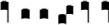 ) could well be regarded as corresponding to a combination of the latter two bars.Footnote 74
In short, regular Parisian first and second modes correspond to Ramal rhythm; their combination, resulting in coherent patterns, frequently used in the Cantigas, was widespread in the Islamic world; hemiolic changes of metre, documented in a few cantigas, also fall outside the Parisian paradigm. Although the influence of the latter is hard to disentangle from instances of Ramal, notational revisions may betray its mark.
Rhythmic modes III and IV
In French Ars antiqua theory, the clear qualitative distinction between long and short notes accompanies a puzzling ambiguity concerning their actual value: the notation does not distinguish between two-beat and three-beat longs, and a breve was just a short note, either quick/regular (one beat) or extended/altered (two beats). Eventually this ambiguity transferred to the concept of semibrevis, which applies to any subdivision of the breve.
Anglés observed that the Escorial codices of the Cantigas use either a virga and two puncta, or a virga, a punctum and a virga, to represent the third rhythmic mode (conceptually: long, short, extended short, corresponding to 3+1+2 beats).Footnote 75 The latter notational version is at odds with the French model, yet it can be understood as deriving from the identification of the brevis altera with the longa recta, since both occupy two beats.
In the trouvère repertoire the notation sometimes suggests the third rhythmic mode,Footnote 76 but mode four is normally seen more as a theoretical construct for the sake of symmetry than as a practical alternative.Footnote 77 In song it is notated as two puncta, followed by a virga (conceptually: short, extended short, long, corresponding to 1+2+3 beats). Anglés, in the last volume of his edition, published in 1958, acknowledged the presence in the Cantigas of the fourth mode occurring in conjunction with the third or other modes, but never by itself;Footnote 78 the notation of the few passages that he associated with the fourth mode is the standard one, although a virga might hypothetically have been used to represent the extended breve. The fourth mode seems to have been regarded simply as one possible aspect of either the second or the third mode.
A comparable conceptual ambivalence existed in Arab musical theory; in fact, one could describe cycles of 2+2+1 or 2+1+2 beats (Second-Heavy and Heavy Ramal) counting respectively two heavy attacks and a light one (without any disjunctive beat) or one heavy attack and two light attacks (the second of which followed by a disjunctive beat). The Second-Heavy cycle was, nevertheless, usually described as two light attacks and a heavy one (1+2+2 beats): the second short would be extended, exactly as a Parisian brevis altera. Al-Fārābī, in his later writings, singles out in this category a subdivided form of 1+1+1+2 beats, which he regards as the original one. The fast version (Second Light-Heavy or Mākhūrī) could just accelerate the movement or differentiate more clearly between shorts and long, implying either only a slight retention of the second short, or a 1+2+3 beat pattern equivalent to the Parisian fourth mode. Al-Fārābī also describes variants of the Ramal equivalent to the Parisian third mode (3+1+2) and to an extended form of the first mode akin to the alternate third mode (2+1+3).Footnote 79
This context allows us to understand al-Bataliawsī when he states: ‘Singers have disagreed about [the Second-Heavy]. Some tap it as four attacks: three equal and the fourth heavier than them [. . .] Some tap it as four equal attacks, neither light and fast, nor heavy and held back’ (both refer to al-Fārābī's subdivided variant: a disjunction beat after the fourth equal attack in medium tempo is implied). ‘As for Ishāq ibn Ibrāhīm al-Mawsilī, he used to tap it as three attacks: two equal and held back and one heavy [. . .] The second light heavy is faster than [the second heavy]: two light attacks and one heavy attack. It is called the Mākhūrī, and is the opposite of the Ramal [. . .] The Ramal is one heavy attack followed by two faster attacks.’Footnote 80
The notation of the Cantigas should be approached with all these possibilities in mind: five-beat or six-beat patterns, used in simple or compound cycles; varieties of Parisian rhythmic modes, varieties of Second-Heavy, Mākhūrī and Heavy Ramal cycles. The Escorial manuscripts may indicate binary subdivisions of the long by their use of cum proprietate/sine perfectione ligatures; in addition, the Madrid codex, when available for comparison, is extremely helpful by its differentiation between two and three-tempora longs or different kinds of breve, allowing us to identify third-mode patterns, either defining the metrical framework (CSM 38, 58) or embedded in otherwise regular binary metre (CSM 25). The remaining ambiguities are not to be seen as notational failures; they probably mirror an inherited conceptual framework where beat-long disjunctions or prolongations did not interfere with the basic identity of a rhythmic pattern, defined by the number and resonance quality of its individual articulations. Without a thorough study of all the cantigas that may correspond to the rhythms discussed above – a group that includes some of the most difficult cases in the entire collection – the underlying paradigms cannot be identified and their respective influence weighted one against another.
Conclusion
Julián Ribera (1922), Higinio Anglés (1958) and David Wulstan (2001) are so far the only scholars to attempt a comprehensive listing of rhythmic profiles in the Cantigas and to present the overall results in detail or numerically.Footnote 81 Since these authors have different approaches to the repertory, the statistics do not coincide. According to both Ribera and Anglés, simple, recognisable rhythmic patterning occurs in more than half of the melodies: they count 266 or 233 songs, respectively. Ribera puts in the Ramal category eighty-three cantigas; the corresponding categories in Anglés are the first mode (forty cantigas) and the second mode (forty-two cantigas). The third mode (possibly in combination with the fourth) applies to fifteen songs in Anglés; the corresponding Arabic pattern in Ribera is applied to twenty-two. He attributes binary metre to as many as 159 melodies. Anglés reckons eighty-six cantigas in a combination of first and second modes, and forty-nine to fifty-one in pure binary metre. According to Wulstan, the corresponding categories apply to 331 cantigas: fifty-six in first mode, eighty in second mode, eighteen in third (or fourth) mode, 118 in a combination of first and second mode, and fifty-nine in ‘duplet rhythm’. The discrepancy has mainly to do with Wulstan's refusal to acknowledge mixture of binary and ternary metre, ubiquitous in Anglés's edition.
In spite of the fact that the notation of the Cantigas admits different interpretations, commentators agree that the simple rhythmic patterning discussed in this article applies to, at the very least, half of the collection. There is much more work to be done to establish the exact degree of correspondence between the Cantigas and contemporary rhythmic theories, but from the preceding discussion we may conclude that, while a sizable portion of the Cantigas can be thought of in terms of rhythmic modes, very few patterns point unequivocally to French models, as these may coincide with established Arabic patterns; in most cases (first and second mode, potential forms of the third mode, notation ex omnibus brevibus) both French and Arabic paradigms could apply. In many other cases, encompassing both binary and ternary metre (notation ex omnibus longis, mixed modes, mixed metres, binary and quinary patterns), the Arabic rhythmic paradigm is clearly either more fitting than the Parisian one, or the only one to apply: there are plenty of occasions when rhythmic patterns in the Cantigas can only be explained with reference to an Eastern-influenced tradition.
While acknowledging the influence and significance of French models, it has been shown that – owing to a Paris-centred historiographical ideology – this significance has previously been overstated, while the Arabic heritage of the Cantigas has been minimised. The fact that rhythm was a central feature in Andalusian musical praxis, a primary characteristic of any song already at the learning stage, may have led Alfonso X and his collaborators to record in the metrically devised Cantigas their immense vocabulary of rhythmic shapes. I would venture to propose that in so doing they did not normally choose between alternative paradigms, even if in some cases rhythmic variants may betray interpretative tension. The limited vocabulary of Parisian rhythmic modes was instead filtered and assimilated through the more developed, all-encompassing Arabic rhythmic tradition prevailing in freshly conquered Andalusia.
Allowing that patterned rhythm and its free combinations may have been more often applied to comparable European monophonic repertoires than is currently admitted, at the time the French lacked the willingness or proper context to adapt their mensural notational systems to the diverse realities of monophonic song – exceptions notwithstanding.Footnote 82 It fell to the copyists of the Escorial codices at Alfonso's court, under unrelenting pressure from the king, to go beyond the limitations of pre-Franconian notation, meant to be interpreted within the context of the rhythmic modes, in order to cope with these realities. The resulting tension between a Parisian notational technique and a rhythmically varied, foreign musical object remains a source for contention in the musical interpretation of the manuscripts.
However limited the French influence may have been in supplying rhythmic models for the Cantigas, it had an essential role in their preservation. It is true that ‘in the last decade of his reign King Alfonso had every reason to be annoyed by the overweening power of France’,Footnote 83 yet in the end, Paris provided him with the notational tools that, once adapted to its new cultural context, would allow the rhythm of the Cantigas to survive, in the Escorial codices, with enough precision to be sung to the delight of future audiences.