Implications
During lactation, sows frequently mobilise body reserves to maintain milk yield. Increasing the energy density of the diet will reduce the extent of back-fat and BW loss. Non-starch polysaccharide-hydrolysing enzymes have been shown to increase the digestibility of pig diets. In this study, feeding a multienzyme complex to sows during lactation did not reduce back-fat or BW loss or influence the growth of progeny; however, feed and energy intake was increased during week 3 of lactation. Feeding a high-nutrient-density diet was found to increase energy intake of sows and to enhance growth rate and weight gain of progeny. Results from this study indicate that NSP-degrading enzymes offer minimal benefit to sows and their progeny when fed before and during lactation, whereas increasing the nutrient density of sow diets during lactation may increase piglet BW and growth to weaning.
Introduction
Many cereals including wheat, barley and some legumes such as soya bean contain up to 15% non-starch polysaccharides (NSP) in their outer or inner cell walls (Sterk et al., Reference Sterk, Verdonk, Mul, Soenen, Bezençon, Frehner and Losa2007). These NSP are poorly digested by pigs as they lack enzymes for their degradation (Bach Knudsen and Jorgensen, Reference Bach Knudsen and Jorgensen2001). Many NSP can reduce nutrient digestibility by encapsulating starch and proteins and increasing the viscosity of the digesta (Kim et al., Reference Kim, Simmins, Mullan and Pluske2005). The addition of enzymes such as xylanase to pig diets may facilitate the hydrolysis of the main NSP of wheat (arabinoxylans), thus increasing the utilisation of available raw material (Diebold et al., Reference Diebold, Mosenthin, Piepho and Sauer2004).
Both xylanases and β-glucanases have been found to significantly increase the digestibility of wheat- and barley-based diets; however, the exact mechanism by which this takes place remains open for debate (Bedford and Schulze, Reference Bedford and Schulze1998). In contrast to chicken, NSP-hydrolysing enzymes in pigs appear to have a dual role, functioning both to reduce viscosity of the digesta and weakening the cell wall of cereals (Bedford and Schulze, Reference Bedford and Schulze1998). The incubation time of enzyme and substrate within the pig gastrointestinal tract is sufficient to allow for some cell wall dissolution (Bedford and Schulze, Reference Bedford and Schulze1998); however, this is unlikely to be the case in poultry where incubation time is much shorter.
Exogenous enzyme addition to cereal diets have been shown to improve both nutrient digestibility and growth performance in pigs (Yin et al., Reference Yin, McEvoy, Schulze, Hennig, Souffrant and McCracken2000). Exogenous enzymes with xylanase activity increased digestibility of nutrients during lactation in sows; however, a similar response was not seen during gestation (de Souza et al., Reference de Souza, Lindemann and Cromwell2007). One such enzyme complex is Rovabio® Excel (Adisseo, France), which is a concentrated enzyme solution consisting primarily of xylanase and β-glucanase derived from the fermentation broth of Penicillium funiculosum (West et al., Reference West, Corzo, Dozier Iii, Blair and Kidd2007).
Excessive mobilisation of body reserves is a common occurrence in sows during lactation and is primarily driven by sub-optimum feed intake and increased energy demand to support milk production (Lawlor and Lynch, Reference Lawlor and Lynch2007; Aherne and Williams, Reference Aherne and Williams1992). Increasing feed intake of lactating sows reduces back-fat depth and BW losses, as well as increases litter weight gain (Eissen et al., Reference Eissen, Apeldoorn, Kanis, Verstegen and de Greef2003).
To test the hypothesis that NSP-hydrolysing enzymes promote conservation of sow body condition during lactation, particularly when fed in conjunction with a low-nutrient-density diet, a multienzyme complex (Rovabio® Excel) was supplemented to sows fed a low- or high-nutrient-density diet.
Material and methods
Animal welfare
The pig study complied with European Union Council Directive 91/630/EEC (outlines minimum standards for the protection of pigs) and European Union Council Directives 98/58/EC (concerns the protection of animals kept for farming purposes) and was approved by, and a licence obtained from, the Irish Department of Health and Children. A total of 200 crossbred (Large White × Landrace) sows were used in a 39-day study to evaluate the effects of feeding an NSP-hydrolysing enzyme multicomplex (Rovabio® Excel, Adisseo France S.A.S) in conjunction with a high or reduced nutrient diet during lactation on sow body condition, feed intake and progeny performance.
Experimental procedures
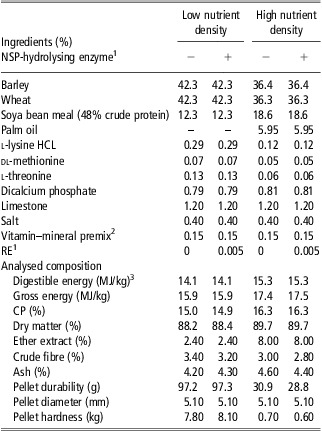
Eight sows were selected each week for 25 weeks (n = 200), blocked by parity (1 to 6 to accurately reflect parity distribution within commercial pig herds) and BW (heavy v. light), into groups of four and within block randomly assigned to one of the four treatments. Treatments were as follows: (1) LND: low energy (13.14 MJ of DE/kg), low CP (15%) diet; (2) LND + RE: low energy, low CP diet with 50 mg/kg NSP-hydrolysing enzyme (Rovabio® Excel, Adisseo France S.A.S); (3) HND: high energy (14.5 MJ of DE/kg), high CP (16.5%) diet; and (4) HND + RE: high energy, high crude diet with 50 mg/kg NSP-hydrolysing enzyme (Rovabio® Excel). Diets were formulated with barley, wheat, soya bean, synthetic amino acids, minerals and vitamins. Palm oil was included in the HND diets as an energy source (Table 1). There were 50 sows per treatment.
Composition of experimental diets (as-is basis)

NSP = non-starch polysaccharide; RE = Rovabio® Excel.
1NSP-hydrolysing enzyme; RE (Adisseo France S.A.S) was pre-mixed with 5 kg of barley before addition to the bulk of the diet to ensure thorough mixing of the enzyme.
2Vitamin–mineral premix provided per kg of complete diet: Cu, 15 mg; Fe, 70 mg; Mn, 62 mg; Zn, 80 mg; I, 0.6 mg; Se, 0.2 mg; vitamin A, 10 000 IU; vitamin D3, 1000 IU; vitamin E, 100 IU; vitamin K, 2 mg; vitamin B12, 15 μg; riboflavin, 5 mg; nicotinic acid, 12 mg; pantothenic acid, 10 mg; choline chloride, 500 mg; biotin, 200 μg; folic acid, 5 mg; vitamin B1, 2 mg; vitamin B6, 3 mg.
3Digestible energy (MJ/kg) was calculated from equation number 22 in Noblet and Perez (1993) using predicted values.
Experimental animals
Sows were housed in dry sow accommodation and fed a dry sow diet (13.1 MJ of DE/kg, 9 g/kg lysine) at an allocation of 30 MJ of DE per day as a liquid mix (3.7 l of water/kg feed) from service to day 109 of gestation. Feed allocation was controlled by a computerised feeding system (Big Dutchman, Vechta, Germany). At day 109 of gestation, sows were moved to conventional NPD-type farrowing crates. The farrowing unit consisted of eight independent rooms each containing 10 crates. Rooms were ventilated by a ceiling-mounted exhaust fan (Steinen, Nederweert, the Netherlands) with air entering through a second chimney and being mixed with room air at entry by a recirculation fan. Heating was provided by steel heat pads (Nooyen, Deurne, the Netherlands) on each side of the sow with hot water pipes on the underside. Water temperature was varied by a thermostatic mixing valve and reduced so that the pad surface temperature was ∼40°C during the 1st week after farrowing and was reduced by 2°C each week to 32°C in the 4th week.
The feeding period commenced ∼5 days before farrowing (day 109 of gestation/day 0 of experimental period) and continued to the day of subsequent service. Sows were fed 2 kg of experimental diet daily as two equal amounts of dry pelleted feed at 0830 and 1600 h from day 109 of gestation until the 1st day post farrowing. Feed allowance was incrementally increased by 500 g/day in the first few days post farrowing. Sows were provided ad libitum access to feed by day 7 post farrowing. Sows had access to feed from a trough above which was mounted a self-feed feed hooper (Daltec A/S, Tybovej 1, Egtved, Denmark) and unlimited access to water through a single-nipple waterer (Arato, Köln, Germany). Care was taken to minimise feed wastage and any soiled or stale feed was removed, dried and weighed.
At farrowing, litters were standardised for size within treatment. Commercial creep feed (Startrite 88, Nutec, Kildare, Ireland) was provided to each litter from 14 days of age until weaning (∼28 days of age) and feed consumption was recorded. Feed was initially provided in small quantities in floor-mounted round feeders (Rotecna Maxi Hopper Pan T Hook, Agramunt (Lleida) Spain) at regular intervals to ensure that the feed was maintained as fresh as possible. All progeny received the same diet in pellet form (2 mm). The creep diets were composed of 16.5 MJ of DE/kg, 95 g/kg crude fat, 240 g/kg CP, 22 g/kg crude fibre, 68 g/kg crude ash and 16.5 g/kg lysine.
Experimental variables examined
Feed intake of sows was recorded from day 109 of gestation to farrowing on a weekly basis throughout lactation and from weaning to service. Daily energy intake (MJ DE/day) was calculated by multiplying the predicted DE content of the diet (MJ DE/kg) by the daily feed intake (kg/day) of the sows. Sows were individually weighed on day 109 of gestation, at weaning and at service. An empty post-farrowing weight was estimated by using the following equation: sow BW at day 109 of gestation−(total number of piglets born × 2.28) (NRC, 1998).
Back-fat depth measurements (mm) were taken using ultrasound technology (Renco lean meter, Minneapolis, MN, USA) at the P2 position, which is 65 mm down the left side from the midline, at the level of the head of the last rib. Back-fat depth was measured on day 109 of gestation, within 24 h of farrowing, at weaning and at service. The number of days post weaning for the sow to return to oestrus was also recorded (weaning to service interval).
At farrowing, individual birth weight of piglets in all the litters was recorded. The number of piglets born alive and stillborn per litter was also recorded. Individual BW of piglets and litter consumption of creep feed were recorded at weaning. Pre-weaning mortality and the number of piglets weaned per sow were also noted.
Feed analysis
Diets were manufactured with stringent quality-control measures to avoid cross-contamination of the NSP-hydrolysing enzyme between diets. Thorough mixing of the NSP-hydrolysing enzyme was ensured by first premixing the enzyme (50 mg/kg) with 5 kg of barley meal before incorporation into the remainder of the diet. The commercially available exogenous enzyme complex (Rovabio® Excel) used in this study had xylanase and β-glucanase activities of 22 000 and 2000 units/g of product, respectively. The enzyme preparation was added to diets at the level of 50 mg/kg (1100 and 100 units of xylanase and β-glucanase, respectively). Gross energy and enzyme activity were measured in diets both before and after pelleting. One unit of xylanase activity is defined as the amount of enzyme required to reduce the viscosity of a 0.25% wheat arabinoxylan solution to give a decrease in relative fluidity of one arbitrary unit per min per ml under assay conditions (pH 5.5 and 30°C). One unit of glucanase activity is defined as the amount of enzyme required to release sufficient oligomers from a barley β-glucan solution, which has a bound chromophore soluble in ethanol, to give an optical density of 0.820 at a wavelength of 590 nm under the conditions of the assay (20 min at pH 4.6 and 30°C). The recovery of enzyme activity in the diets was estimated by xylanase viscosity activity. The chemical composition of experimental diets is outlined in Table 1. Diets were pelleted to 5-mm diameter after steam conditioning at 50°C to 55°C.
Representative samples of feed were taken from each treatment before feeding. Before analysis, samples were ground through a 2-mm screen in a Christy Norris hammer mill. Dry matter content was determined by oven drying for 4 h at 103°C. Ash content was determined by incineration in a muffle furnace (Gallenkamp, London, UK) at 550°C overnight. CP content was determined as N × 6.25 by a LECO FP-2000 analyser (Leco Instruments Ltd, Stockport, Cheshire, UK). Fat content was determined according to the method described by Usher et al. (Reference Usher, Green and Smith1973) by extraction with perchlorethylene in a Foss Let 15300 (A/S N. Foss Electric, Hillerod, Denmark). Crude fibre content was measured by a Fibertec semi-automatic system (Tecator, Hoganas, Sweden). Digestible energy (DE) of the diets was calculated from equation number 22 in Noblet and Perez (Reference Noblet and Perez1993) using analysed values.
The quality of the manufactured pellets was also assessed, including pellet durability, diameter and hardness as previously described by McMahon and Payne (Reference McMahon and Payne1991). In brief, pellet size was determined by measuring the diameter of pellets using Vernier calipers. Durability was measured using the Holmen Pellet Tester (Holmen Chemicals, Basingstoke, England). Hardness was measured using a Kahl spring hardness tester (Amandus Kahl Nachf, Reinbek, Germany) and expressed in kg and was determined in triplicate for each sample.
Statistical analysis
All data were analysed as a 2 × 2 factorial design with two levels of nutrients (high protein, high energy or low protein, low energy) and two levels of enzyme (0 or 50 mg/kg). Data were analysed as a one-factor ANOVA using the Mixed procedure of SAS (SAS, 2000). Each sow represented an experimental unit for all variables tested. The model included terms for block, nutrient density of diet, enzyme level and nutrient density of diet × enzyme level interaction in a factorial analysis. Sow was included as a random variable in the model. Piglet birth weight was included as a covariate in the model for the analysis of piglet average daily gain (ADG) and weaning weight. Statistical significance and tendencies were set at P ⩽ 0.05 and P < 0.10, respectively, for all statistical tests.
Results
Sow feed and energy intake
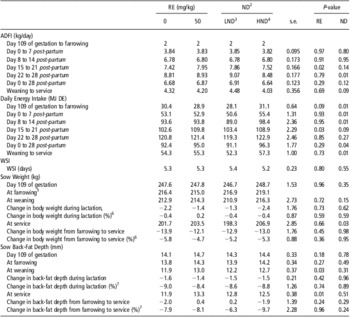
The main effects of nutrient content of the diet and the level of Rovabio® Excel on sow growth performance is outlined in Table 2. The inclusion of 50 mg/kg Rovabio® Excel in sow diets increased average daily feed intake (ADFI) by 0.5 kg/day during week 3 (day 15 to 21) of lactation (P < 0.05). The addition of Rovabio® Excel in the diet had no effect on ADFI at any other stage during the study.
The main effects of nutrient density of the diet and level of REFootnote 1 on growth performance of sows from d 109 of gestation to service

1 RE, Rovabio® Excel, NSP hydrolysing enzyme (Adisseo France S.A.S).
2 LND, low nutrient density diet – low energy (13.1 MJ of DE/kg), low crude protein (15%) diet.
3 HND, high nutrient density diet – high energy (14.5 MJ of DE/kg), high crude protein (16.5%) diet.
4 ND, nutrient density of the diet.
5 An empty post-farrowing weight was estimated by using the following equation; sow body weight at day 109 of gestation – (total number of piglets born × 2.28) (NRC, 1998).
6 Change in body weight was calculated as a % of body weight of the sow at farrowing.
7 Change in back-fat depth was calculated as a % of sow back-fat depth at farrowing.
During week 4 (days 22 to 28) of lactation, ADFI was greater (P < 0.01) for sows fed the LND diet compared with sows fed the HND diet. Likewise, ADFI tended to be increased (P = 0.09) in sows fed the LND diet compared with sows fed the HND diet during the weaning to service interval. However, ADFI was not influenced by the nutrient content of the diet at any other period during the study.
Daily energy intake tended to be lower for sows fed Rovabio® Excel between day 109 of gestation and farrowing (P = 0.09), but was higher for these sows during week 3 (days 15 to 21) of lactation (P < 0.05) compared with sows receiving no enzyme in their feed. There was a nutrient density × Rovabio® Excel interaction for daily energy intake during the weaning to service interval (P < 0.05). During this period, the addition of Rovabio® Excel resulted in an increase in daily energy intake in sows fed the LND diet (50.3 v. 54.3 MJ DE; LND v. LND + RE), but it caused a reduction in daily energy intake in sows fed the HND diet (58.3 v. 56.3 MJ DE; HND v. HND + RE). The inclusion of Rovabio® Excel in sow diets had no effect on the daily energy intake of sows at any other period between day 109 of gestation and re-service (P > 0.10). Feeding the HND diet to sows increased daily energy intake throughout the study (P < 0.01) with the exception of week 3 (days 15 to 21) when daily energy intake tended to increase by feeding the HND diet (P = 0.09) and week 4 (days 22 to 28) when there was no difference in daily energy intake between sows fed the HND and LND diets (P > 0.10). Overall, throughout the lactation period (days 0 to 28), daily energy intake was higher for sows fed the HND diet (P < 0.01).
Sow reproductive performance and body condition
The nutrient density of the diet or the inclusion of Rovabio® Excel in the diet had no effect on the rate at which sows returned to oestrus (P > 0.10; Table 2). Likewise, sow weight and the magnitude of change in sow weight were not affected by Rovabio® Excel inclusion in the diet during any period of the study (P > 0.10). Sows fed the HND diet were heavier at service than sows fed the LND diet (P < 0.05); however, there was no difference in BW change between farrowing and service. Sow weight and the magnitude of change in sow weight were not affected by nutrient density of the diet during any other period of the study (P > 0.10).
The back-fat depth of sows fed Rovabio® Excel was higher at weaning and at service (P < 0.05) compared with sows that received no enzyme inclusion in their diets. However, the magnitude of change in back-fat depth during lactation and between farrowing and re-service was not significantly influenced by the inclusion of Rovabio® Excel in the diet (P > 0.10). Sow back-fat depth or the magnitude of change in sow back-fat depth was not affected by the nutrient content of the diet at any stage in the study (P > 0.10).
Piglet performance
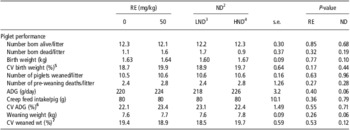
There was a tendency for a nutrient density × Rovabio® Excel interaction for the number of piglets weaned/litter (P = 0.06; Table 3). The addition of Rovabio® Excel resulted in a tendency for an increase in the number of piglets weaned from sows fed the LND diet (10.3 and 10.8 piglets); however, it caused a reduction in the number of piglets weaned from sows fed the HND diet (10.7 and 10.4 piglets). Rovabio® Excel inclusion in the sow diets had no effect on any of the other piglet performance parameters measured. Piglets from sows fed the HND diet tended to be heavier at birth than piglets born to sows fed the LND diet (P = 0.10). ADG and weaning weight of piglets from sows fed the HND diet tended to be greater than for piglets from sows fed the LND diet (P = 0.06). The nutrient density of the sows’ diet had no effect on the number of piglets born alive or dead/litter and within litter variability in birth weight and ADG (P > 0.10).
The main effects of nutrient density of the diet and level of REFootnote 1 on piglet growth performance

ADG = average daily gain.
1 RE, Rovabio® Excel, NSP hydrolysing enzyme (Adisseo France S.A.S).
2 ND, nutrient density of the diet.
3 LND, low nutrient density diet – low energy (13.1 MJ of DE/kg), low crude protein (15%) diet.
4 HND, high nutrient density diet – high energy (14.5 MJ of DE/kg), high crude protein (16.5%) diet.
5 CV birth weight (%); coefficiency of variation in the birth weight of progeny.
6 CV ADG (%); coefficiency of variation in ADG of progeny.
7 CV weaned wt (%); coefficiency of variation in the weaning weight of progeny.
Discussion
The DE of diets was not measured in this study. DE intake values were therefore estimate values based on the feed intake of the sow and the calculated energy value of the diet. Using an estimate of DE intake as opposed to actual DE intake is a limitation of this study.
Loss of BW in sows during lactation occurs regularly as a result of high milk yields and relatively small appetites (Lawlor and Lynch, Reference Lawlor and Lynch2007; Aherne and Williams, Reference Aherne and Williams1992). Increasing feed intake of lactating sows reduces back-fat depth loss and BW losses, as well as increasing litter weight gain (Eissen et al., Reference Eissen, Apeldoorn, Kanis, Verstegen and de Greef2003). One way to increase energy intake during lactation is to increase the energy density of the diet by adding fat (O'Grady and Lynch, Reference O'Grady and Lynch1978). In this study, the HND diet was achieved by adding ∼6% palm oil. Supplementary dietary fat fed to sows during lactation has been found to increase milk energy by increasing the fat content of the milk (O'Grady et al., Reference O'Grady, Elsley, MacPherson and McDonald1973; Babinszky Reference Babinszky1998). The current findings indicate that feeding a HND diet to sows during late gestation and lactation results in increased energy intake during this time period. Feed intake was depressed in week 4 of lactation as a result of feeding the HND diet but the energy intake was not affected. In addition, sows fed the HND diet gave birth to piglets that tended to be heavier at birth, grow faster and be heavier at weaning compared with piglets from sows fed the LND diet. A study feeding high energy and high protein diets to lactating sows reported that increased protein intake but not energy intake increased litter weight at weaning. (Brendemuhl et al., Reference Brendemuhl, Lewis and Peo1987). In numerous experiments, litter weight gain was not affected by feed intake, as sows that were restrictively fed during lactation tended to mobilise more body reserves to compensate for the shortfall in nutrients arising from reduced feed intake (Prunier et al., Reference Prunier, Dourmad and Etienne1993). For this reason, one would expect that restricted sows should have greater weight and back-fat depth loss during lactation. Back-fat depth loss and BW, however, were not affected by the nutrient density of the diet during this study. This is most likely because the energy and protein content of both the LND and HND diets exceeded the NRC (1998) requirements for lactating sows, and thus the LND diet was not sufficiently restrictive. In addition, all sows, regardless of treatment, had exceptionally high feed intake during lactation, allowing the majority of the sow's energy requirements to be met, thus avoiding the necessity to mobilise body reserves. Indeed, sows in this study did not lose more than 6 kg of BW, whereas losses as great as 20 kg are more frequently found on-farm (Clowes et al., Reference Clowes, Aherne, Foxcroft and Baracos2003).
The provision of creep feed to the suckling piglets in the last 2 weeks of lactation may have affected sow BW loss as well. Excessive body reserve mobilisation may have been prevented because of reduced demand for milk production. Such a minimal change in body condition may have precluded any potential benefit that may have arisen from enzyme supplementation or dietary nutrient enrichment.
The addition of NSP-hydrolysing enzymes to sow diets, xylanase in particular, has been shown to increase total tract and ileal protein and DM digestibility during lactation but not during gestation (de Souza et al., Reference de Souza, Lindemann and Cromwell2007). In this study, a response to the multienzyme complex (Rovabio® Excel) was observed during week 3 of lactation when there was an increase in both feed and energy intake by sows. However, this increase in feed intake in response to exogenous enzymes was transient and was not observed before or after week 3 of lactation. The provision of creep feed to piglets in the last 2 weeks of lactation may account for why the feed intake response to the exogenous enzyme observed during week 3 did not persist up to the end of lactation. Creep feed intake is generally low in the initial week of its introduction; however, it has been shown to increase sharply in the subsequent week/week before weaning (Kavanagh, Reference Kavanagh1995). This may indicate that Rovabio Excel may have a place in increasing sow feed intake where there is a high demand for milk by piglets in late lactation and where creep feeding is not practised. Sows fed Rovabio® Excel had greater back-fat depth at service and a tendency for greater back-fat depth at weaning. However, the magnitude of change in back-fat depth during lactation and from farrowing to service was relatively small and was not affected by exogenous enzyme inclusion in the diet. These findings indicate that the addition of Rovabio® Excel to sow diets during lactation is unlikely to aid in the prevention of excessive mobilisation of body reserves to meet energy demands. Weight change during lactation was not very large, thus precluding from detecting a possible effect of dietary enzyme inclusion. It is noteworthy, however, that sows from this study, regardless of treatment, had uncharacteristically high feed intake during lactation, and consequently did not experience excessive loss of body condition commonly seen during this period of high nutrient demand. Perhaps, if sow feed intake was lower and more reflective of what is normally seen on-farm, the magnitude of response to Rovabio® Excel may have been more pronounced.
Extended weaning to service interval is often associated with excessive loss of BW and condition during the preceding lactation (Trottier and Johnston, Reference Trottier and Johnston2001). Weaning to service interval can be reduced by increasing feed intake during early to mid-lactation (Koketsu et al., Reference Koketsu, Dial, Pettigrew and King1997). The addition of Rovabio® Excel to sow diets, while increasing feed intake during mid-lactation, did not affect weaning to service interval; however, as sows returned to oestrus on average 5.2 days after weaning, any improvement on this would have been unlikely. Research has shown that increasing nutrient intake during the weaning to service interval can reduce the days to oestrus (Brooks et al., Reference Brooks, Cole and Rowlinson1975). In this study, supplementing the LND diet with Rovabio® Excel increased energy intake during the weaning to service interval. However, when fed in conjunction with the HND diet, Rovabio® Excel had a negative effect on energy intake. The response to Rovabio® Excel inclusion in the diet was most evident during mid-lactation when the enzyme inclusion increases sow feed intake. The response to Rovabio® Excel in this study was transient and may have been masked by feeding creep feed to piglets during the last 2 weeks of lactation.
In conclusion, feeding a HND diet to sows increased energy intake before farrowing, during lactation and in the period between weaning and re-service. However, these findings are based on estimate values rather than on actual DE values. Progeny of sows fed HND diets before and during lactation tended to be heavier at birth and at weaning and had greater ADG than progeny from sows fed LND diets. The supplementation of LND diets with Rovabio® Excel increased daily energy intake during the weaning to re-service period. Rovabio® Excel supplementation to sow diets increased feed intake during mid-lactation only and had no effect on BW and back-fat depth loss between farrowing and service. The response of sows to Rovabio® Excel supplementation during lactation was small and no growth benefits were observed in their progeny. However, it could be speculated that the response of sows to Rovabio® Excel might have been muted in this study because of the exceptionally high feed intakes achieved and the consequential minor sow body condition changes observed during lactation and the feeding of creep feed to piglets before weaning. Further research is needed with sows that are experiencing mobilisation of body reserves more reflective of what is routinely seen on-farm to fully evaluate the efficacy of Rovabio® Excel.
Acknowledgement
The authors gratefully acknowledge financial support provided by Adisseo France S.A.S. for the purpose of conducting this study.