Congenital anomalies of the coronary arteries are rare. Patients can be asymptomatic, or may present with overt myocardial ischaemia and sudden cardiac death. Early diagnosis, with timely intervention, often, however, ensures good long-term outcome. We present angiographic images of an adolescent patient with one such anomaly.
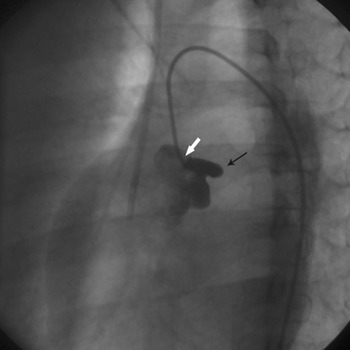
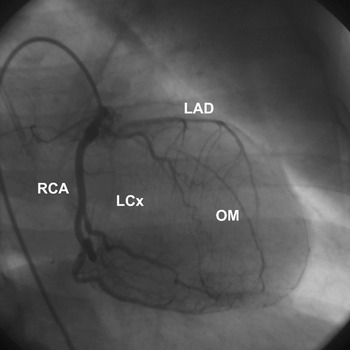
A 13-year-old male was admitted for acute pulmonary oedema following exertion at a football game. Previous history of breathlessness during sporting activity was attributed to malingering. High levels of creatine phosphokinase and elevation of the ST segment in the anterior leads were noted. Echocardiography revealed an ejection fraction of 30%. Coronary angiography was performed after stabilization with inotropic and ventilatory support. The left anterior oblique view (Fig. 1) revealed a normally located orifice of the main stem of the left coronary artery (white arrow), but the arterial trunk ended blindly (dark arrow). An injection in the right coronary artery, when viewed in the right anterior oblique projections (Fig. 2), showed retrograde filling of the anterior descending artery (LAD) and circumflex (LCx) arteries through collateral flow via the septal perforating and obtuse marginal (OM) branches, confirming that the atresia was proximal to the bifurcation of the main stem of the left artery. Surgical intervention was refused by his parents. Recovery of the patient was probably due to presence of extensive collateral circulation.
Figure 1

Figure 2

Atresia of the main stem of the left coronary artery is an extremely rare congenital coronary anomaly. Of necessity, the right coronary artery perfuses the entire heart, with retrograde flow through collateral vessels into the branches of the left coronary artery, located in their normal anatomic positions. This lesion differs from atresia of the left coronary artery itself,Reference Angelini and Angelini1 in that the orifice and the proximal trunk are normally formed.