Introduction
Finland, like most industrial countries, is rapidly greying. It is estimated that the new cohorts reaching working age will not be large enough to fill the gap in the workforce left by retiring baby-boomers. The working-age population is shrinking and the retired population is growing. This is a difficult equation to solve: there are serious doubts whether the labour force will be able to guarantee sustainable pensions in the future. One proposed approach to addressing this challenge is to increase employment among older people and to extend working lives (European Commission, 2018).
Given these challenges and the policy drive to defer retirement, it is important to have a better understanding of the retirement process. The literature suggests that decision-making on retirement involves three phases: thinking about the possibility of retirement (retirement thoughts), making plans about retirement (retirement intentions) and making the transition to retirement (actual retirement) (Beehr, Reference Beehr1986; Feldman and Beehr, Reference Feldman and Beehr2011). Several studies have examined the intention–action part of the process (e.g. Henkens and Tazelaar, Reference Henkens and Tazelaar1997; Dwyer and Hu, Reference Dwyer, Hu, Mitchell, Hammond and Rappaport2000; Solem et al., Reference Solem, Syse, Furunes, Mykletum, De Lange, Schaufeli and Ilmarinen2016), but neglected the first phase.Footnote 1 If retirement is viewed as a process, it can be assumed that retirement thoughts are connected with retirement plans, which in turn are connected with actual retirement – a perspective that has not been used in prior studies.
The accuracy of retirement intentions as a measure of actual retirement timing is particularly important for policy purposes. If intentions accurately reflect actual retirement, intended retirement age can be used as a proxy for the future development of actual retirement age. Moreover, understanding which factors affect retirement behaviour makes it easier to tailor and target policy actions. However, retirement decisions are not only affected by policy actions, but they are also largely shaped by opportunities and constraints at an organisational level. Therefore, information is needed on the link between conditions in the workplace and the willingness and ability of older workers to stay on.
Limited empirical research exists on how retirement intentions relate to subsequent behaviour (Anderson et al., Reference Anderson, Burkhauser and Quinn1986; Henkens and Tazelaar, Reference Henkens and Tazelaar1997; Disney and Tanner, Reference Disney and Tanner1999; Dwyer and Hu, Reference Dwyer, Hu, Mitchell, Hammond and Rappaport2000; Solem et al., Reference Solem, Syse, Furunes, Mykletum, De Lange, Schaufeli and Ilmarinen2016; Böckerman and Ilmakunnas, Reference Böckerman and Ilmakunnas2017; Munnell et al., Reference Munnell, Sanzenbacher and Rutledge2018). Moreover, despite their assumed importance, the impact of work factors on retirement has received only scant attention (Blekesaune and Solem, Reference Blekesaune and Solem2005; Zappalá et al., Reference Zappalá, Depolo, Fraccaroli, Guglielmi and Sarchielli2008; Herrbach et al., Reference Herrbach, Mignonac, Vandenberghe and Negrini2009; Shacklock et al., Reference Shacklock, Brunetto and Nelson2009; Hellemans and Closon, Reference Hellemans and Closon2013; Oakman and Wells, Reference Oakman and Wells2013; Ten Have et al., Reference Ten Have, van Dorsselaer and de Graaf2014; Virtanen et al., Reference Virtanen, Oksanen, Batty, Ala-Mursula, Salo, Elovainio, Pentti, Lybäck, Vahtera and Kivimäki2014; Frins et al., Reference Frins, van Ruysseveldt, van Dam and van den Bossche2016), particularly in the context of retirement as a decision-making process (Henkens and Tazelaar, Reference Henkens and Tazelaar1997; Tuominen et al., Reference Tuominen, Karisalmi, Takala and Kaliva2012; van Solinge and Henkens, Reference van Solinge and Henkens2014; Carr et al., Reference Carr, Hagger-Johnson, Head, Shelton, Stafford, Stansfeld and Zaninotto2016).
Furthermore, the sets of work factors examined in these studies have varied widely and the results reported have been mixed. It is especially noteworthy that none of these studies have used all the major dimensions of Karasek's (Reference Karasek1979; Karasek and Theorell, Reference Karasek and Theorell1990) demand–control model of work stress. Research applying the demand–control model emphasises the effect of psychological (and sometimes physical) demands and time demands as predictors of higher work stress, while scheduling flexibility and job autonomy are recognised as factors that reduce work stress (Beehr et al., Reference Beehr, Glaser, Canali and Wallwey2001; Shultz et al., Reference Shultz, Wang, Crimmins and Fisher2010). Providing older workers with a less stressful work environment is assumed to encourage them to continue working (Shultz and Adams, Reference Shultz, Adams, Shultz and Adams2007). Moreover, previous studies have typically used quite narrow sets of personal and family-related factors and therefore omitted to consider many important determinants of retirement behaviour (for a review, see Wang and Schultz, Reference Wang and Schultz2010).
Even though many of the above studies conclude that retirement intentions predict actual retirement fairly well, it is justified to question the accuracy of intentions as an indicator of actual retirement, as there are many possible reasons why intended retirement timing might differ from actual timing.
Firstly, surveys typically require that respondents indicate their intended retirement age more or less spontaneously, whereas the actual retirement decision will only be reached after thorough consideration. Secondly, respondents may have insufficient or outdated knowledge of the pension system, which will mean that intentions are falsely grounded. Thirdly, after the survey respondents may see unexpected changes in their lives due to health problems or job loss, for example, and again intentions will be distorted. These are assumed to be major underlying causes why actual retirement deviates from intended retirement (Anderson et al., Reference Anderson, Burkhauser and Quinn1986; Dwyer and Hu, Reference Dwyer, Hu, Mitchell, Hammond and Rappaport2000; Munnell et al., Reference Munnell, Sanzenbacher and Rutledge2018). However, these are rarely controlled for; even studies explicitly concerned with differences between intended and actual retirement behaviour have not controlled for these factors (Solem et al., Reference Solem, Syse, Furunes, Mykletum, De Lange, Schaufeli and Ilmarinen2016).
In many cases the factors influencing pension plans differ from the factors that determine the actual timing of retirement (Henkens and Tazelaar, Reference Henkens and Tazelaar1997; Tuominen et al., Reference Tuominen, Karisalmi, Takala and Kaliva2012; van Solinge and Henkens, Reference van Solinge and Henkens2014). It is therefore reasonable to investigate the determinants of retirement plans and actual retirement separately. At the same time, it is equally important to study the factors that contribute to the difference between retirement plans and actual retirement. Earlier studies have examined either determinants of retirement intentions and actual retirement or determinants of the difference between these two, but not all these dimensions together (Tuominen et al., Reference Tuominen, Karisalmi, Takala and Kaliva2012; van Solinge and Henkens, Reference van Solinge and Henkens2014; Carr et al., Reference Carr, Hagger-Johnson, Head, Shelton, Stafford, Stansfeld and Zaninotto2016; Solem et al., Reference Solem, Syse, Furunes, Mykletum, De Lange, Schaufeli and Ilmarinen2016; Munnell et al., Reference Munnell, Sanzenbacher and Rutledge2018).
Our case study is Finland. During the study period 2008–2016, Finland had a flexible retirement age: people could retire on a full old-age pension between ages 63 and 68. The age limit for early old-age retirement (with a reduced pension) was 62 years. For those who continued working after age 63, pension accrued at an accelerated rate of 4.5 per cent of annual earnings. Public-sector employees form a special group in that most of them have a fixed occupational (under 63) or personal retirement age (between 63 and 65).
Full disability pension was available for persons under 63.Footnote 2 Another option for older long-term unemployed persons was the unemployment pathway to retirement. This is an arrangement in which the long-term unemployedFootnote 3 receive extended unemployment benefits until they are entitled to a full old-age pension at age 62. However, they can also postpone retirement and stay on unemployment benefit through to age 65.
This study expands on the existing literature on retirement decision-making and factors contributing to older workers’ propensity to continue working. First, following Feldman and Beehr (Reference Feldman and Beehr2011), retirement is viewed as a three-step decision-making process, from thoughts of retirement through retirement plans to actual retirement. This study adds a new dimension to the empirical examination of the retirement decision-making process: it explores the connection between thoughts of retirement and retirement intention, before proceeding to the connection between retirement intentions and actual retirement, and so covering the whole chain of the process. Second, the key factors underlying intended retirement age and actual retirement age are investigated using an exceptionally comprehensive set of personal/family-related and, more importantly, work-related variables. The latter differ from those used in previous investigations in that they are based on the main dimensions of Karasek's demand–control model (Karasek, Reference Karasek1979; Karasek and Theorell, Reference Karasek and Theorell1990), complemented with variables describing workplace norms and attitudes towards older workers. Thirdly, this study aims to identify the factors that influence how older workers’ retirement intentions correspond with actual retirement. Unlike many earlier studies, the present investigation takes into account unexpected changes occurring after intentions are reported, such as changes in health or labour market situation.
Conceptual framework and previous empirical evidence
Theoretical considerations
Retirement can be considered a process rather than a single event (Beehr, Reference Beehr1986). This study applies the retirement process model proposed by Beehr (Reference Beehr1986) and Feldman and Beehr (Reference Feldman and Beehr2011). Their three-phase model of retirement decision-making describes how workers gradually approach retirement. It distinguishes between retirement preferences (thoughts about retirement), retirement intentions and the act of retiring, and describes a process of increasing decisiveness.
The first phase in the retirement process is thinking about the general possibility of retirement, or having a (possibly quite abstract) idea of a preferred time for retirement. This can include considerations of whether or not to continue working until statutory retirement age, without giving any concrete thought to the question of specific timing. It sets a general time-frame. Given this time-frame, the second phase proceeds to more detailed retirement planning, to assessing and deciding when it is time to let go. These plans translate into intended retirement age. In the third and final phase, the person actually retires: articulated plans to retire at a certain age are expected to take the form of actual retirement.
• Hypothesis 1: Retirement thoughts are connected with retirement intentions, and retirement intentions are connected with actual retirement. Thoughts of early retirement are conducive to earlier retirement intentions, and earlier retirement intentions are conducive to earlier actual retirement, and vice versa.
Retirement planning and decision-making involve subjective evaluation of the costs and benefits of retiring. It is assumed that an individual will choose to retire at the optimal age, when the benefits of retiring exceed those of continuing to work (Feldman and Beehr, Reference Feldman and Beehr2011). Different disciplines stress different factors in these cost–benefit considerations. Economics deals with the relative preference for income and leisure, measured mainly in financial terms. The central question is the affordability of retirement (e.g. Becker, Reference Becker1965; Rust and Phelan, Reference Rust and Phelan1997). Health status is also thought to affect the preference for leisure (e.g. Dwyer and Hu, Reference Dwyer, Hu, Mitchell, Hammond and Rappaport2000). In sociological analysis, the main concern is with the effects of social circumstances, such as family situation, and social norms regarding the appropriate retirement age, for example (e.g. van Dam et al., Reference van Dam, van der Vorst and Heijden2009). Retirement timing may also be influenced by the spouse's recent retirement or attitudes towards retirement (Henkens and Tazelaar, Reference Henkens and Tazelaar1997; Munnell et al., Reference Munnell, Sanzenbacher and Rutledge2018). Factors that either attract or repel people from continuing to work, such as individual attitudes towards working, job demands, and organisational norms and policies, play an important role in psychology (e.g. Stephens and Feldman, Reference Stephens and Feldman1997). The current study applies the views of all these three disciplines.
It can be assumed that cost–benefit considerations also affect retirement plans. The difference compared to the decision on actual retirement is that retirement plans are based on assumptions regarding factors that affect costs and benefits. Some of these factors may change or new information may emerge after the plans are made. Following the reasoning of Dwyer and Hu (Reference Dwyer, Hu, Mitchell, Hammond and Rappaport2000), actual retirement behaviour can diverge from planned behaviour for two reasons: first, new information becomes available (e.g. changes in health, labour market situation or family circumstances) and, second, the plans were based on incomplete information in the first place.
The following reviews the existing evidence on the effects of different factors on retirement. Where possible, the evidence concerning retirement intentions, actual retirement behaviour and the difference between the two are presented separately. Moreover, hypotheses are presented concerning the effect of each factor on the timing of retirement. Modifying the classification of Wang and Schultz (Reference Wang and Schultz2010), factors affecting the retirement process are divided into two categories, personal/family-related and work-related characteristics.
Personal/family-related characteristics and retirement
Basic personal characteristics
Gender, age, education, socio-economic status and employment sector are used as control variables (see Table 1). Gender is not expected to have an effect on retirement (Riekhoff and Järnefelt, Reference Riekhoff and Järnefelt2017). Older age is expected to be positively connected with actual and planned retirement age and with the difference between the two (van Solinge and Henkens, Reference van Solinge and Henkens2014; Solem et al., Reference Solem, Syse, Furunes, Mykletum, De Lange, Schaufeli and Ilmarinen2016). Higher education and higher socio-economic status are expected to be associated with later retirement, and it is also assumed that lower education and lower socio-economic status are connected with earlier-than-intended retirement (Radl, Reference Radl2013; Solem et al., Reference Solem, Syse, Furunes, Mykletum, De Lange, Schaufeli and Ilmarinen2016; Böckerman and Ilmakunnas, Reference Böckerman and Ilmakunnas2017). A public-sector personal retirement age is expected to be conducive to late retirement (e.g. Järnefelt and Nivalainen, Reference Järnefelt, Nivalainen and Järnefelt2016).
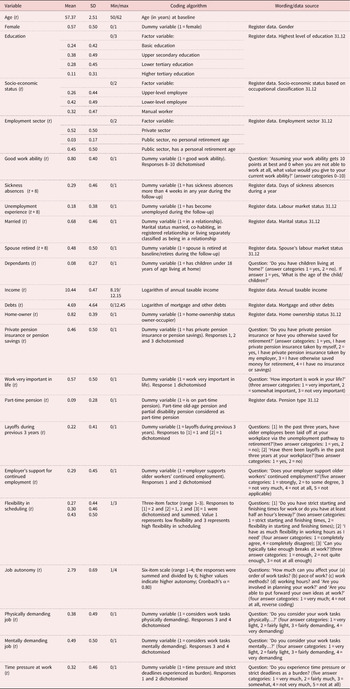
Means, standard deviations (SD), coding algorithms and wording of survey questions/data source for independent variables

Notes: t = 2008. Min/max: minimum/maximum
Health and stability of labour market status
Health is known to be a central factor in explaining retirement timing. Those in better health usually both intend to and actually retire late (Harkonmäki et al., Reference Harkonmäki, Martikainen, Lahelma, Pitkäniemi, Halmeenmäki, Silventoinen and Rahkonen2009; Topa et al., Reference Topa, Morlano, Depolo, Alcover and Morales2009; van Solinge and Henkens, Reference van Solinge and Henkens2014). It also seems that it is more difficult for those with poorer health to make accurate retirement plans, and consequently they often retire earlier than intended (Solem et al., Reference Solem, Syse, Furunes, Mykletum, De Lange, Schaufeli and Ilmarinen2016; Munnell et al., Reference Munnell, Sanzenbacher and Rutledge2018).
Adverse changes in health can cause unexpected restrictions that make it harder to remain in employment. Another frequent negative shock affecting retirement timing is that of being made unemployed. Consequently, it is reported that both are conducive to earlier-than-planned retirement (Anderson et al., Reference Anderson, Burkhauser and Quinn1986; Disney and Tanner, Reference Disney and Tanner1999; Dwyer and Hu, Reference Dwyer, Hu, Mitchell, Hammond and Rappaport2000; Munnell et al., Reference Munnell, Sanzenbacher and Rutledge2018). In this study, we use three variables to investigate the effect of health and stability of labour market status on retirement timing. Current state of health is measured based on self-rated work ability, and change in health status based on sickness absences during the follow-up. Becoming unemployed during the follow-up is also controlled for.
Family situation
Factors relating to an individual's family situation reflect the social circumstances (normative context) surrounding the individual and therefore affect retirement decisions. The spouse's labour market attachment is of particular importance, as couples have a tendency to retire at roughly the same time. Moreover, the spouse's positive attitude towards retirement has been observed to increase early retirement, and the spouse's recent retirement is a significant factor in explaining earlier-than-intended retirement. (Henkens and Tazelaar, Reference Henkens and Tazelaar1997; Henkens and van Solinge, Reference Henkens and van Solinge2002; Kim and Moen, Reference Kim and Moen2002; van Solinge and Henkens, Reference van Solinge and Henkens2007; Hospido and Zamarro, Reference Hospido and Zamarro2014; Munnell et al., Reference Munnell, Sanzenbacher and Rutledge2018.) The presence of a partner in the household can in itself be of importance, and those with no partner both plan to and actually retire late (van Solinge and Henkens, Reference van Solinge and Henkens2014; Damman et al., Reference Damman, Henkens and Kalminj2015). On the other hand, having a partner does not have a bearing on the difference between actual and intended retirement age (Solem et al., Reference Solem, Syse, Furunes, Mykletum, De Lange, Schaufeli and Ilmarinen2016; Munnell et al., Reference Munnell, Sanzenbacher and Rutledge2018).
In the family context, caring responsibilities also matter: the presence of children, for example, increases the household's financial burden and is consequently associated with late retirement (Henkens and Tazelaar, Reference Henkens and Tazelaar1997; Damman et al., Reference Damman, Henkens and Kalminj2015). In this article, we use three variables to study how family situation affects retirement timing: marital status, having a retired spouse at baseline/spouse retires during follow-up period, and presence of dependants. We were unable to find a measure for the spouse's attitudes towards retirement, but spouse's retirement is assumed to signal a positive outlook on retirement, and vice versa.
Economic factors
Retirement is also affected by economic factors such as income, debts or wealth. A stronger financial situation enables early retirement from an economic point of view. However, the connection between financial situation and retirement is not clear. Some studies have found that those in a stronger financial situation both plan and actually retire early (van Solinge and Henkens, Reference van Solinge and Henkens2014; Damman et al., Reference Damman, Henkens and Kalminj2015), while others suggest that a higher income predicts late retirement (Szinovacz et al., Reference Szinovacz, Martin and Davey2014; Fisher et al., Reference Fisher, Ryan, Sonnega, Vuori, Blonk and Price2015). In addition, private pension insurance or pension savings increase the financial freedom to retire. They advance both early retirement plans and actual early retirement (e.g. Tuominen et al., Reference Tuominen, Karisalmi, Takala and Kaliva2012). In this article, we study the effect of economic factors on the retirement decision using four variables: annual taxable income, mortgages and other debts, wealth (based on home ownershipFootnote 4), and private pension insurance or pension savings.
Individual factors connected with work
Retirement is affected by personal values and psychological work attachment: people for whom work is very important are more likely to delay their retirement plans and actual retirement (Zappalá et al., Reference Zappalá, Depolo, Fraccaroli, Guglielmi and Sarchielli2008; Tuominen et al., Reference Tuominen, Karisalmi, Takala and Kaliva2012). In this study, we use the measure ‘importance of work’ to take into account work attachment.
• Hypothesis 2: Personal and family-related factors have an effect on retirement timing. Good work ability, being single, having dependants and importance of work are connected with later planned and actual retirement, while sickness absences, unemployment, having a retired spouse/spouse's recent retirement and a better financial situation are connected with earlier planned and actual retirement.
• Hypothesis 3: Good work ability is conducive to later-than-intended retirement. Deteriorating health as indicated by sickness absences, becoming unemployed and spouse's recent retirement are connected with earlier-than-planned retirement. Being married does not affect the connection between retirement plans and actual retirement.
Work-related characteristics and retirement
Workplace norms and attitudes
Workplace norms and attitudes are reflected in organisational customs with regard to older workers. Organisational downsizing, for example, increases both early retirement intentions and actual early retirement (Henkens and Tazelaar, Reference Henkens and Tazelaar1997). In Finland, the unemployment pathway to retirement creates an incentive for employers to lay off older workers, which can cause insecurity among remaining employees and therefore increase early retirement intentions (Järnefelt and Nivalainen, Reference Järnefelt, Nivalainen and Järnefelt2016). Workplace attitudes also include organisational support for older workers’ employment, which has been observed to delay both retirement intentions and actual retirement (Zappalá et al., Reference Zappalá, Depolo, Fraccaroli, Guglielmi and Sarchielli2008; van Solinge and Henkens, Reference van Solinge and Henkens2014). However, there is also evidence that social support or support from management does not affect intended or actual retirement (Henkens and Leenders, Reference Henkens and Leenders2010; Berglund et al., Reference Berglund, Seldén and Halleröd2017). We use two measures to study the effect of organisations’ norms and attitudes on retirement timing: whether there have been layoffs and layoffs targeting older workers, and whether the employer supports older workers’ employment.
Organisational policies
Being on a part-time old-age pension reflects not only a personal choice to work reduced hours but also organisational policies (the employer's willingness to implement part-time work arrangements). Part-time pensions offer more freedom and can ease work pressure, and may therefore help older workers to stay on at work. On the other hand, a part-time pension can be part of a gradual process of retirement and therefore be conducive to early retirement (Desmette and Gaillard, Reference Desmette and Gaillard2008; Machado and Portela, Reference Machado and Portela2014; van Solinge and Henkens, Reference van Solinge and Henkens2014). Here, we look at how part-time retirementFootnote 5 affects the timing of full-time retirement.
In addition, organisations have the ability to modify work characteristics, such as levels of job control. Higher job control relieves work stress (Karasek, Reference Karasek1979) and hence contributes to retirement behaviour. One aspect of job control is flexibility in scheduling. Most studies have found that flexible work arrangements do not affect retirement intentions or actual retirement (Herrbach et al., Reference Herrbach, Mignonac, Vandenberghe and Negrini2009; van Solinge and Henkens, Reference van Solinge and Henkens2014), although Virtanen et al. (Reference Virtanen, Oksanen, Batty, Ala-Mursula, Salo, Elovainio, Pentti, Lybäck, Vahtera and Kivimäki2014) reported that higher work time control was associated with later retirement. The other aspect of job control is job autonomy, which has been reported to increase both late retirement plans and actual late retirement (Blekesaune and Solem, Reference Blekesaune and Solem2005; Hellemans and Closon, Reference Hellemans and Closon2013; Ten Have et al., Reference Ten Have, van Dorsselaer and de Graaf2014; Carr et al., Reference Carr, Hagger-Johnson, Head, Shelton, Stafford, Stansfeld and Zaninotto2016). We examine the impact of job control using two compound measures: flexibility in scheduling and job autonomy.
Job characteristics
Job characteristics include high job demands, such as sustained physical or psychological effort, and time pressure at work. Job demands have been studied in relation to occupational stress (Karasek, Reference Karasek1979; Shultz et al., Reference Shultz, Wang, Crimmins and Fisher2010), but there is little research into their impact on retirement. Moreover, the evidence regarding the effect of job demands on retirement is inconclusive. Some studies suggest that mental job demands or time pressure at work increase early retirement intentions but play no role when it comes to actual retirement (mental demands: Salonen et al., Reference Salonen, Arola, Nygard and Koivisto2003; Tuominen et al., Reference Tuominen, Karisalmi, Takala and Kaliva2012; time pressure: Carr et al., Reference Carr, Hagger-Johnson, Head, Shelton, Stafford, Stansfeld and Zaninotto2016; Frins et al., Reference Frins, van Ruysseveldt, van Dam and van den Bossche2016), while others have found no association between mental or time demands with intended retirement timing (Zappalá et al., Reference Zappalá, Depolo, Fraccaroli, Guglielmi and Sarchielli2008; Ten Have et al., Reference Ten Have, van Dorsselaer and de Graaf2014). Physical job demands have been found to have no effect on either retirement intentions or actual retirement (Tuominen et al., Reference Tuominen, Karisalmi, Takala and Kaliva2012; van Solinge and Henkens, Reference van Solinge and Henkens2014; Carr et al., Reference Carr, Hagger-Johnson, Head, Shelton, Stafford, Stansfeld and Zaninotto2016), although it has also been reported that higher physical demands increase actual early retirement (Salonen et al., Reference Salonen, Arola, Nygard and Koivisto2003; Blekesaune and Solem, Reference Blekesaune and Solem2005; Berglund et al., Reference Berglund, Seldén and Halleröd2017). We include three job demand characteristics in our model: physically demanding job, mentally demanding job and time pressure at work.
• Hypothesis 4: Employer's support for older workers’ continued employment and higher job control are related to later planned and actual retirement. Part-time pension, layoffs and layoffs targeting older workers, and higher job demands are associated with earlier planned and actual retirement.
Knowledge gaps in previous empirical evidence
Health, financial situation and social (family) context, attitudes, organisational norms and policies, and job characteristics have been shown to affect retirement behaviour. Some conditions restrict older workers’ ability and willingness to remain employed (changes in health, becoming unemployed, spouse's retirement). However, the evidence for different factors varies across different studies, and as yet no study has used a more comprehensive set of explanatory factors. Moreover, there is hardly any research that has examined intended retirement and actual retirement and the difference between the two. Tuominen et al. (Reference Tuominen, Karisalmi, Takala and Kaliva2012), van Solinge and Henkens (Reference van Solinge and Henkens2014) and Carr et al. (Reference Carr, Hagger-Johnson, Head, Shelton, Stafford, Stansfeld and Zaninotto2016) do investigate retirement intentions and actual retirement, but not the determinants of the connection between the two, while Solem et al. (Reference Solem, Syse, Furunes, Mykletum, De Lange, Schaufeli and Ilmarinen2016) and Munnell et al. (Reference Munnell, Sanzenbacher and Rutledge2018) look at the difference between actual and intended retirement, but not the determinants of retirement intentions and actual retirement.
Only a few studies examine the effect of work-related factors on retirement in the context of the retirement decision-making process, and those that do use mixed sets of work-related factors. For example, while van Solinge and Henkens (Reference van Solinge and Henkens2014) control for a fairly large set of work factors related to job characteristics and for workplace norms and attitudes, they omit to consider certain dimensions of job demands (mental demands and time pressure) and job control (job autonomy) that are meaningful not only theoretically (Karasek, Reference Karasek1979) but that have also proved important in empirical studies (Tuominen et al., Reference Tuominen, Karisalmi, Takala and Kaliva2012; Carr et al., Reference Carr, Hagger-Johnson, Head, Shelton, Stafford, Stansfeld and Zaninotto2016). These studies, in turn, lack some of the theoretically important controls applied by van Solinge and Henkens (Reference van Solinge and Henkens2014) (flexibility in scheduling).
The above studies focusing on work factors have controlled only a limited set of personal and family-related characteristics and thus leave out many factors that influence retirement behaviour. Most importantly, they omit to consider changes in health and labour market situation after intentions are reported, which can make it impossible to retire as planned. This also applies to Solem et al. (Reference Solem, Syse, Furunes, Mykletum, De Lange, Schaufeli and Ilmarinen2016), who are particularly interested in the difference between actual and intended retirement age. In this study, we address the shortcomings outlined above and control for various characteristics, as indicated above (Hypotheses 2–4).
Data, measures and method
Data
We address our research questions using linked survey and register data. The data on retirement thoughts and retirement intentions come from Statistics Finland's 2008 cross-sectional, interview-based Quality of Working Life Survey (QWLS). Based on a sample of 4,392 individuals, the survey is representative of the working-age population in Finland.
Our focus in this study is on employees aged between 50 and 62 (at the time of the survey). They numbered 1,389 persons. We measured retirement thoughts with a QWLS question enquiring how often a person had thought about retirement before the age of 63 (never, sometimes, often). Retirement intentions were measured with a QWLS item in which respondents were asked to indicate the age at which they expected to retire full time. Even though retirement thoughts were asked in the same survey with intended retirement age, the question clearly refers to the past and thus represents a separate stage in the retirement process.
QWLS contains no information on actual retirement. However, we linked the QWLS data to comprehensive longitudinal register data from Statistics Finland and the Finnish Centre for Pensions. Using information from pension registers, we observed actual retirement during the eight-year follow-up from 2008 to 2016.Footnote 6 Retirement status was measured at the end of each year.
Since the question of retirement intentions related to full-time retirement, only actual retirement on a disability or an old-age pension was treated as retirement. Actual retirement includes getting a full disability pension (8.5%), an early old-age or an old-age pension (91.5%). For these persons, actual retirement age in years and months was obtained from the pension registers. Intentions were measured in full years, so for purposes of comparison the actual age of retirement was truncated to the nearest full age. In addition to those who retired during the follow-up period, persons who were at least 63 years at the end of 2016 but had not yet retired were also included in the data. Persons with missing information on retirement thoughts (N = 3) or retirement intentions (N = 53) were excluded from the sample. Altogether, the final data set contained 803 respondents, of whom 750 retired during the follow-up period.
In addition to information about retirement thoughts and retirement intentions, QWLS includes questions relating to the respondents’ values and health. The data also include comprehensive assessments of working conditions at an individual level. The questionnaire has been validated in numerous QWLS since 1977 (see Statistics Finland, 2019). In addition to the timing of actual retirement, the register data that was merged with QWLS data include multiple personal/family-related characteristics and information on the respondents’ financial situation.
Measures
Intended and actual retirement age
Retirement intentions were investigated by asking: ‘At what age do you reckon you will retire on a full-time pension?’ Answers were given in full years. Data on actual retirement age were drawn from pension registers from 2008 to 2016. In Finland, a widely accepted appropriate retirement age is 63 years. For the analyses, both intended and actual retirement age were therefore divided into the following three classes: 55–62, 63 and over 63 years. In cases where the person was at least 63 years at the end of 2016 but had not yet retired, their retirement age was defined as being over 63.
Correspondence between actual and intended retirement age
The correspondence between actual and intended retirement age was measured in terms of the difference between actual and intended retirement age (in years). Table 1 presents the independent variables, their means, standard deviations, coding algorithms, and the wording of the survey questions and data source.
Method
First, we used descriptive analysis to examine the connection between retirement thoughts and retirement intentions and between retirement intentions and actual retirement. Next, the variables describing intended and actual retirement age were used as dependent variables in multinomial logistic models.
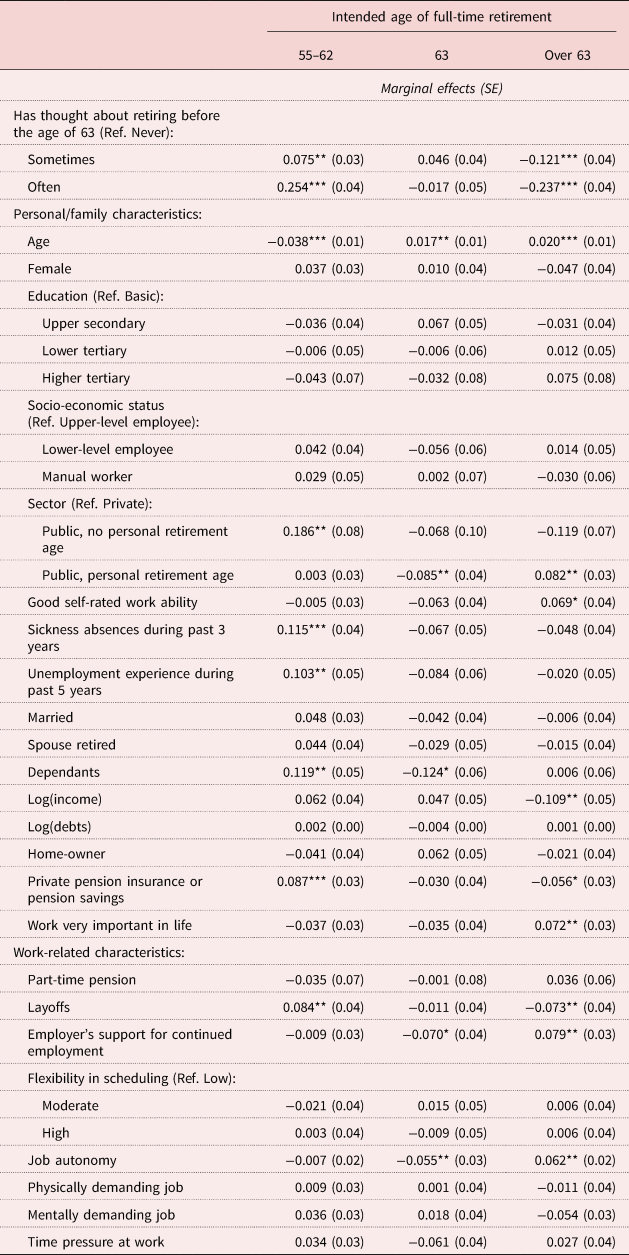
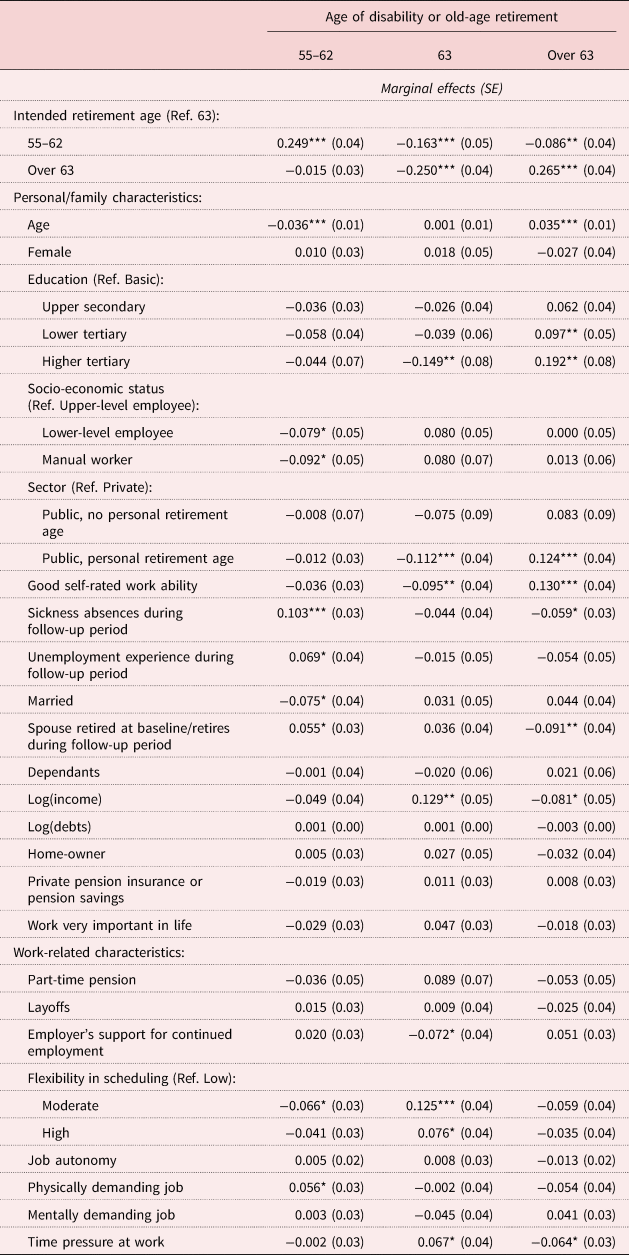
Since it would be difficult to interpret the estimated parameters and odds ratios of the multinomial logistic model (they are relative to the base outcome), average marginal effects are reported in Tables 4 and 5 (see e.g. Wulff, Reference Wulff2015).Footnote 7 The marginal effect gives the absolute change in the probability of the event in case the explanatory variable changes by one unit (in case of dummy variables from 0 to 1). The use of marginal effects also allows us to present the results concerning the base outcome (in this case intended or actual retirement at age 63). The tables also show the standard errors (SE) of the marginal effects. Test statistics for the modelling techniqueFootnote 8 and for the chosen model (model: χ2) and the overall model fit (McFadden's pseudo R 2) are presented in Tables 4 and 5.Footnote 9 The parameter estimates, SE and odds ratios with their 95 per cent confidence intervals are presented in the online supplementary material (Tables S1 and S2).
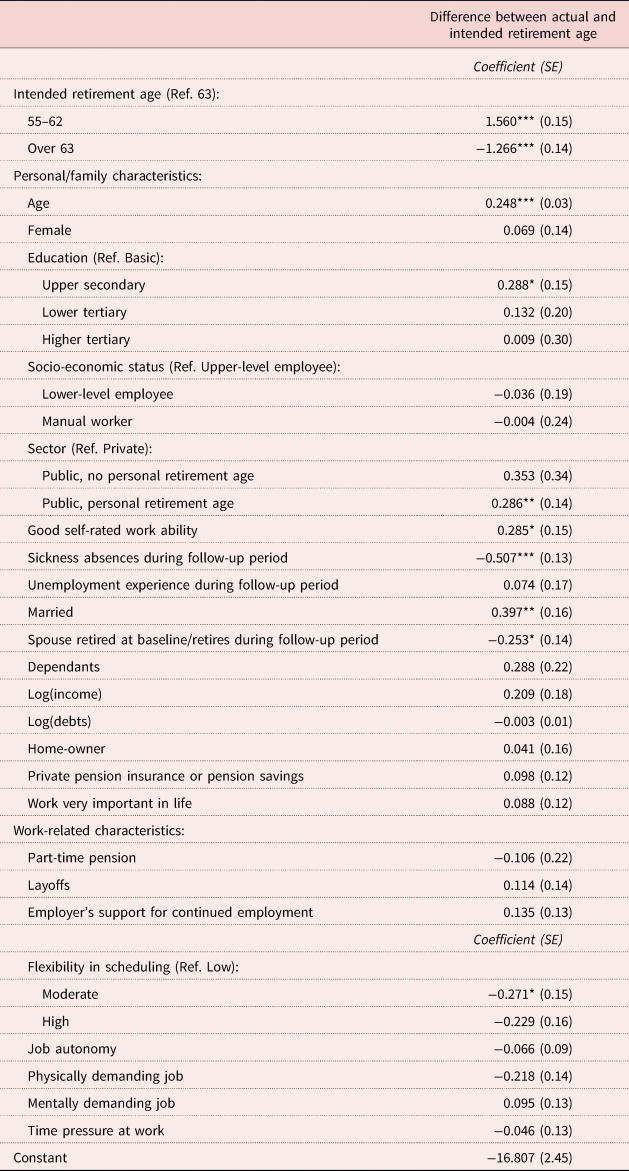
Moreover, a separate ordinary least squares regression (OLS) model explaining the difference between actual and intended retirement age was run. In this case, individuals with missing retirement age (N = 53) were excluded from the analysis. The coefficients, SE and the model fit (R 2) are presented in Table 6.
Retirement thoughts were used as an independent variable in the model explaining intended retirement age, and intended retirement age was used as an independent variable in the model explaining actual retirement age and the difference between intended and actual retirement age (cf. Disney and Tanner, Reference Disney and Tanner1999; Solem et al., Reference Solem, Syse, Furunes, Mykletum, De Lange, Schaufeli and Ilmarinen2016). Individuals with missing information on covariates were included in the lowest categories in case of dummy variables (except for the variable ‘socio-economic status’, where those with missing information were excluded) and dropped in case of continuous variables (N = 4; for coding of the variables, see Table 1). Item non-response was, however, very low (at most 2.9% or N = 23). Statistical significance was set at 10 per cent for all analyses, a common threshold in the literature (cf. Dwyer and Hu, Reference Dwyer, Hu, Mitchell, Hammond and Rappaport2000; Damman et al., Reference Damman, Henkens and Kalminj2015; Berglund et al., Reference Berglund, Seldén and Halleröd2017; Riekhoff, Reference Riekhoff2018).
Descriptive analysis of retirement thoughts, retirement plans and actual retirement age
We start by analysing, firstly, the connection between early retirement thoughts and intended retirement age and, secondly, the connection between intended and actual retirement age. Intended and actual retirement ages are divided into three classes: 55–62 years (early retirees), 63 years and over 63 years (late retirees).
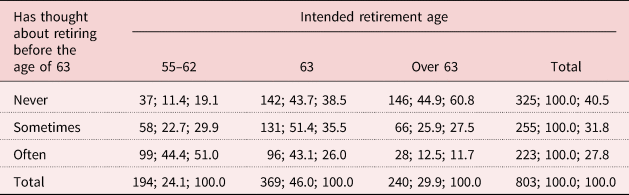
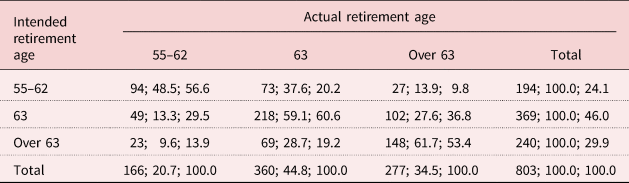
About 40 per cent of the respondents had never thought about retiring before age 63 (Table 2). Some 30 per cent had sometimes thought about early retirement, and just under 30 per cent had often thought about retiring before age 63. As for retirement plans, 24 per cent intended to retire early, 46 per cent to retire at age 63 and 30 per cent after age 63. The most common actual age of retirement was 63 years: about 45 per cent retired at 63. Just over 30 per cent retired after and 20 per cent before that age (Table 3).
Connection between retirement thoughts and intended retirement age

Note: In each cell, the first entry is the number of observations, the second the percentage share of row total and the third the percentage share of column total.
Connection between intended retirement age and actual retirement age

Note: In each cell, the first entry is the number of observations, the second the percentage share of row total and the third the percentage share of column total.
There is a clear connection between retirement thoughts and retirement plans (Table 2). Of those who had never thought about retiring before age 63, almost 45 per cent intended to continue working past age 63, and only 10 per cent planned to retire early. Among those who had often thought about early retirement, the situation is exactly the opposite: more than 44 per cent intended to retire early, and only 10 per cent planned to continue working past age 63. The most common intended retirement age among those who had sometimes thought about early retirement was 63 years.
Table 3 shows the extent to which retirement plans actually materialised. There is a clear association between planned and actual retirement age: depending on the group, 50–60 per cent retired at the intended age. The connection is strongest among those who intended to continue working past age 63: 61.7 per cent of these persons retired after age 63. For those who intended to retire at age 63, the connection is nearly as strong. The association is weakest among those who intended to retire before age 63, but even in this group 48.5 per cent retired at the intended age.
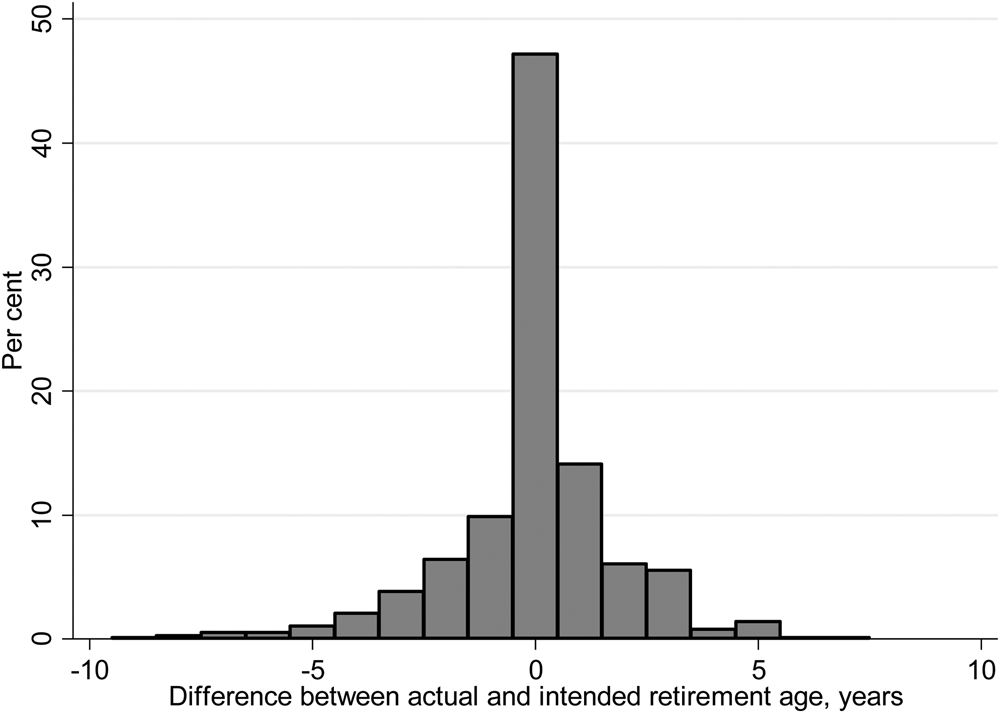
The connection between intended and actual retirement age is presented differently in Figure 1: here the difference is shown in years. The difference varies between −9 and 7 years, that is, people retire up to 9 years earlier and 7 years later than intended. For almost half of all respondents the difference is 0, that is, they retired at the exact age they intended to. In practice, the mean of the distribution is zero. This means that people have a pretty good idea of their actual retirement age when asked about their retirement intentions. It seems that retirement plans materialise with quite high accuracy.
Difference between actual and intended retirement age.
Note: The figure only includes those who actually retired during the review period.

Determinants of retirement age
Below we examine the determinants of intended and actual retirement age using multinomial logistic models. As in the descriptive analysis, retirement age is divided into three classes: 55–62, 63 and over 63 years. Both intended and actual retirement age are explained with different individual, family-related and work-related characteristics (see the ‘Conceptual framework and previous empirical evidence’ section and Table 1). Tables 4 and 5 show the average marginal effects (and their SE) of the multinomial logistic models (see the Method section).
Determinants of intended full-time retirement age, multinomial logistic model, average marginal effects and standard errors (SE)

Notes: N = 799. Ref.: reference category. Variables related to the Quality of Working Life Survey and education, socio-economic status and employment sector measured in 2008 (t). Layoffs measured in (t − 3), sickness absences measured in (t − 3) and unemployment experience measured in (t − 5). Variables: married, spouse retired, log(income), log(debts), home-owner and part-time pension measured in (t − 1). Log likelihood = −711.82. Restricted log likelihood = −848.37. Model: χ2(62) = 273.10***. McFadden's pseudo R 2 = 0.161. Independence of irrelevant alternatives (IIA): χ2(32) = 21.34. Pooling: χ2(31) = 127.20***.
Significance levels: * p < 0.1, ** p ⩽ 0.05, *** p ⩽ 0.01.
Determinants of disability or old-age retirement age, multinomial logistic model, average marginal effects and standard errors (SE)

Notes: N = 799. Ref.: reference category. Variables related to the Quality of Working Life Survey and education, socio-economic status and employment sector measured in 2008 (t). Layoffs measured in (t − 3). Sickness absences measured during the follow-up period (t + 8), unemployment experience measured during the follow-up period (t + 8) and spouse's retirement measured during the follow-up period (t + 8). Variables: married, log(income), log(debts), home-owner and part-time pension measured in (t). Log likelihood = −652.71. Restricted log likelihood = −841.83. Model: χ2(62) = 378.25***. McFadden's pseudo R 2 = 0.225. Independence of irrelevant alternatives (IIA): χ2(32) = 32.74. Pooling: χ2(31) = 147.54***.
Significance levels: * p < 0.1, ** p ⩽ 0.05, *** p ⩽ 0.01.
Determinants of intended retirement age
We begin with the factors behind intended retirement age (Table 4). As expected (Hypothesis 1), the frequency of thoughts about early retirement is an independent predictor of intended retirement age. The more a person has thought about retiring before age 63, the more likely they are to plan early retirement, and the less interested they are in continuing to work past age 63, and vice versa. In fact, retirement thoughts are the most important factor in explaining early and late retirement plans. Other things being equal, those who have often thought about retiring before age 63 have a 25.4 percentage point higher probability of early retirement intention than those who have never thought about early retirement. Accordingly, the late retirement intention probability is 23.7 percentage points lower. The model fit improves when retirement thoughts are added as an explanatory variable (with thoughts: pseudo R 2 = 0.161; without thoughts: pseudo R 2 = 0.123; the model including retirement thoughts exhibits a significant increase in chi-square: χ2(4) = 64.16, p = 0.000).
Background characteristics show expected effects: older individuals and public-sector workers with a personal retirement age more often plan to continue working past age 63. Intended retirement age does not vary by gender, education or socio-economic status.
In line with expectations (Hypothesis 2), good self-rated work ability increases the intention to work longer (marginal effect (me) = 0.069; SE = 0.04; p < 0.1). Furthermore, those in poorer health (measured by sickness absences) and those who have experienced unemployment are more inclined to retire early. On the other hand, contrary to expectations (Hypothesis 2), those with dependants plan to retire early. It is difficult to speculate the reason for this result. Somewhat surprisingly, being married, having a retired spouse or being on a part-time pension have no connection with retirement intentions.
As hypothesised (Hypothesis 2), those with a higher income less often plan to continue working past age 63. Financial security in the form of private pension insurance or pension savings increase early retirement intentions. Other financial indicators have no impact on intended retirement age. Instead, as expected, a work-centred life is associated with later retirement intentions.
Our findings confirm that work-related factors are important to intended retirement age. This particularly applies to workplace norms and attitudes towards older employees (Hypothesis 4). Layoffs in the workplace increase intentions to retire before age 63 and reduce intentions to continue to work past that age. Moreover, if the employer supports older people's continued employment, there is greater interest in continuing to work longer.
In line with Hypothesis 4, higher job autonomy is associated with higher late retirement intentions. At the same time, somewhat at odds with expectations, scheduling flexibility is not related to intended retirement age. This is, however, consistent with earlier evidence (cf. van Solinge and Henkens, Reference van Solinge and Henkens2014). Finally, contrary to Hypothesis 4, our results do not provide evidence that physical or mental job demands or time pressure at work are associated with earlier retirement intentions. Our result concerning the physical demands of work is consistent with previous findings, but the results concerning mental demands and time pressure differ from earlier studies in which these are connected with earlier planned retirement (cf. Tuominen et al., Reference Tuominen, Karisalmi, Takala and Kaliva2012; Carr et al., Reference Carr, Hagger-Johnson, Head, Shelton, Stafford, Stansfeld and Zaninotto2016).
Determinants of actual retirement age
We now turn to the determinants of the actual age of retirement on a disability or an old-age pension (Table 5). We begin with the connection between intended and actual retirement age. In line with Hypothesis 1, the results show that there is a clear link between these ages. Those who intended to retire between ages 55 and 62 are more likely to retire in that age range. The intention to retire at age 63 increases the likelihood of actual retirement at this age. Likewise, a person who planned to continue working past age 63 exhibits a higher probability of retiring after that age. In fact, intended retirement age is the strongest factor predicting actual retirement age. Other things being equal, those who intended to retire before age 63 have a 24.9 percentage point higher likelihood of retiring early than those who intended to retire at age 63. Likewise, those who intended to retire after age 63 have a 26.5 percentage point higher likelihood of retiring late.
The model fit improves significantly when intentions are added as an explanatory variable (with intentions: pseudo R 2 = 0.225; without intentions: pseudo R 2 = 0.157; the model including retirement intentions exhibits a significant increase in chi-square: χ2(4) = 113.33, p = 0.000). The finding that intentions have predictive power regarding actual retirement behaviour in addition to their correlation with observable characteristics supports the suggestion of Disney and Tanner (Reference Disney and Tanner1999) that intentions (partly) reflect the effect of unobserved characteristics, such as preference and motivation.
In line with expectations, older individuals and public-sector employees with a personal retirement age are more likely to retire late. Gender does not affect retirement timing. Somewhat unexpectedly, manual workers are less likely to retire early (me = −0.092; SE = 0.05; p < 0.1). While this contradicts most previous evidence, it is in line with Riekhoff (Reference Riekhoff2018), who speculated that manual workers have little flexibility regarding their retirement decisions, while higher-status jobs afford greater freedom in this respect. Higher education, on the other hand, increases the likelihood of working longer, as expected. Hence, socio-economic status and education appear to control for different factors.
Consistent with Hypothesis 2, those with good work ability more often continue to work longer. Furthermore, as expected, sickness absences during the follow-up period contribute to early retirement. Apart from retirement intentions, sickness absences are the single most important factor explaining actual retirement before age 63. Unemployment during the follow-up period also increases the odds of retiring early (me = 0.069; SE = 0.04; p < 0.1). Contrary to expectations, being on a part-time pension or having dependants is not connected with actual retirement.
Against expectations (Hypothesis 2), being married decreases the likelihood of early retirement (me = −0.075; SE = 0.04; p < 0.1). On the other hand, as expected, having a spouse who was retired at baseline, or who retired during the follow-up period, increases the likelihood of early retirement (me = 0.055; SE = 0.03; p < 0.1) and decreases the propensity of continuing at work longer. In line with retirement intentions and Hypothesis 2, a better financial situation (measured in income) enhances actual retirement at age 63 and lowers the odds of continuing to work longer. Other financial measures have no impact on actual retirement age. Unlike retirement intentions and against Hypothesis 2, the importance of work in life is not associated with actual retirement age.
Our findings support the expected importance of work-related factors with regard to actual retirement age. However, some of the factors that explained retirement intentions do not have an effect on actual retirement timing, and vice versa. In particular, whereas higher job autonomy was associated with a later planned retirement, no connection was found with actual retirement age. This is contrary to Hypothesis 4 and previous findings (cf. Carr et al., Reference Carr, Hagger-Johnson, Head, Shelton, Stafford, Stansfeld and Zaninotto2016). Instead, in contrast to retirement intentions but in line with Hypothesis 4, higher work control in the form of moderate and high (me = 0.076; SE = 0.04; p < 0.1) flexibility in scheduling increases the odds of continuing to work until age 63. Most earlier studies have found no effect.
Unlike retirement intentions but supporting Hypothesis 4, job demands play a role in actual retirement. Having a physically demanding job increases the likelihood of early retirement (me = 0.056; SE = 0.03; p < 0.1). Those who experience time pressure at work more often tend to retire at age 63 and less often continue to work longer (me = −0.064; SE = 0.03; p < 0.1). This is consistent with some earlier studies (physical demands: Blekesaune and Solem, Reference Blekesaune and Solem2005) but differs from others which have found no effect (physical and time demands: Carr et al., Reference Carr, Hagger-Johnson, Head, Shelton, Stafford, Stansfeld and Zaninotto2016). As in the case of retirement intentions, mental demands do not affect actual retirement.
As seen with retirement intentions, workplace norms and attitudes towards older people matter (Hypothesis 4). However, only employers’ support for older workers’ continued employment is important for actual retirement: if the employer supports the opportunities of older people to continue at work, actual retirement at age 63 decreases (me = −0.072; SE = 0.04; p < 0.1). Despite their importance in retirement plans, layoffs taking place before the survey are not directly connected with actual retirement age.
Since layoffs and the employer's support were significant predictors of retirement intentions but had no connection (layoffs) or a weaker connection (employer's support) with actual retirement, it was suspected that these variables might have an indirect effect on actual retirement via retirement intentions (mediation effect). Further analysis showed that layoffs indeed have a negative indirect effect and employer's support for older workers’ employment a positive indirect effect on actual retirement after the age of 63. The mediation analysis is presented in the online supplementary material.
Correspondence between actual and intended retirement age
This section looks at factors contributing to the difference between actual and intended retirement age. The difference is measured in years. The coefficients of the OLS regression model in Table 6 show that those who plan to retire early actually retire later than planned. The opposite is true for those who intend to retire late: they end up retiring earlier than planned. This corroborates a previous finding (Solem et al., Reference Solem, Syse, Furunes, Mykletum, De Lange, Schaufeli and Ilmarinen2016). Since these classes of intended retirement age were good predictors of the classes of actual retirement age, there appears to be some variation within these age ranges.
Factors affecting the difference between actual and intended retirement age, coefficients and standard errors (SE) of linear regression (ordinary least squares) model

Notes: N = 747. R 2 = 0.354. For variables, see Notes in Table 5.
Significance levels: * p < 0.1, ** p ⩽ 0.05, *** p ⩽ 0.01.
In line with expectations, older workers and public-sector employees with a personal retirement age retire later than they anticipated. Against expectations, the difference between actual and planned retirement age does not vary with education (with the exception of upper secondary education at p < 0.1) or socio-economic status (cf. Solem et al., Reference Solem, Syse, Furunes, Mykletum, De Lange, Schaufeli and Ilmarinen2016).
As expected (Hypothesis 3), health plays a significant role in the difference between actual and intended retirement. Better health (measured as good work ability) delays actual retirement (coefficient = 0.285; SE = 0.15; p < 0.1). Those with deteriorating health (sickness absences), on the other hand, retire earlier than planned. Apart from retirement intentions, deteriorating health is the strongest predictor of earlier-than-intended retirement, and the strongest predictor of the deviance between actual and intended retirement age in general. On the other hand, contrary to Hypothesis 3, becoming unemployed during the follow-up period is not associated with earlier-than-intended retirement. The potential reasons for this are discussed in the Conclusions section.
At odds with Hypothesis 3, married persons continue to work longer than they intended. This result mainly reflects the effect of the spouse's stronger labour market attachment, since having a recently retired spouse is controlled for and has a negative impact (coefficient = −0.253; SE = 0.14; p < 0.1). This deviates from earlier studies which found that being married has no impact (e.g. Solem et al., Reference Solem, Syse, Furunes, Mykletum, De Lange, Schaufeli and Ilmarinen2016), but is in line with others which report that spouse's retirement has a negative effect (Munnell et al., Reference Munnell, Sanzenbacher and Rutledge2018).
Work-related factors do not play a marked role in the deviation between actual and intended retirement age. Job control in the form of scheduling flexibility is the only important work-related characteristic. However, the direction of the effect is somewhat surprising: those with moderate flexibility in scheduling retire earlier than planned (coefficient = −0.271; SE = 0.15; p < 0.1). The explanation for this is not clear.
Conclusions
Given the pressures from population ageing and the recognised need to extend working lives, it is crucial that we better understand the retirement process. In this article, we have broken down this process into the three phases of thoughts of retirement, retirement intentions and actual retirement, examined their interconnections, and explored factors affecting planned and actual retirement age and the difference between the two. We were particularly interested in the role of work-related factors, but also considered the effect of health, financial situation, social (family) context, and conditions that may restrict older workers’ ability and willingness to stay on at work. It is very rarely that all of these are covered in a single study.
Our results support Feldman and Beehr's (Reference Feldman and Beehr2011) model of retirement as a three-step process. There is a clear connection between retirement thoughts and retirement intentions, and between retirement intentions and actual retirement. Retirement thoughts have a clear independent effect on retirement plans. More frequent retirement thoughts are conducive to early retirement plans, and vice versa. Furthermore, retirement plans have an isolated effect on retirement patterns. Those who plan to retire early also tend to retire early, and vice versa. In fact, even after controlling for other factors, intended retirement age is the strongest predictor of actual retirement age. Therefore, it can be thought to represent the effect of unobservable characteristics on retirement, such as preferences and motivation. Moreover, the results indicate that retirement plans materialise with quite high accuracy.
As for individual characteristics, our results strongly support the importance of health for retirement timing (cf. van Solinge and Henkens, Reference van Solinge and Henkens2014; Munnell et al., Reference Munnell, Sanzenbacher and Rutledge2018). Good health (better work ability) was connected with late retirement, while poor health (sickness absences) was conducive to early retirement. This applied both to retirement intentions and actual retirement age, and to the difference between actual and intended retirement age.
A health shock (sickness absence) occurring after intentions were reported was a particularly powerful explanation for why actual retirement took place before the intended age (cf. Dwyer and Hu, Reference Dwyer, Hu, Mitchell, Hammond and Rappaport2000; Munnell et al., Reference Munnell, Sanzenbacher and Rutledge2018). However, baseline health also makes a difference: those with better health planned to work longer and in fact continued to work even longer than planned. This is a new finding as earlier studies have reported that those in poor health retire earlier than planned, but not the other way round (cf. Solem et al., Reference Solem, Syse, Furunes, Mykletum, De Lange, Schaufeli and Ilmarinen2016; Munnell et al., Reference Munnell, Sanzenbacher and Rutledge2018).
Our results reaffirmed the importance of financial resources to retirement timing (see e.g. van Solinge and Henkens, Reference van Solinge and Henkens2014). Those in a more secure financial position were less likely both to prefer and to actually continue to work longer. On the other hand, the results provide new evidence (cf. Tuominen et al., Reference Tuominen, Karisalmi, Takala and Kaliva2012; van Solinge and Henkens, Reference van Solinge and Henkens2014; Carr et al., Reference Carr, Hagger-Johnson, Head, Shelton, Stafford, Stansfeld and Zaninotto2016) on the scarring effect of unemployment on extending working lives: unemployment increased early exit from work. However, somewhat surprisingly, becoming unemployed after intentions were reported was not conducive to earlier-than-intended retirement. This contradicts the results of Munnell et al. (Reference Munnell, Sanzenbacher and Rutledge2018), for example, and might have something to do with the Finnish system where older unemployed workers can receive extended unemployment benefits until retirement. The unemployed can retire from age 62, but have the right to stay unretired and draw unemployment benefits until the age of 65.
There were also some individual-level differences in the determinants of retirement plans and actual retirement. Contrary to intentions, a high education was connected with actual late retirement. Moreover, married persons were less likely to retire early, and they ended up retiring later than intended.
The effect of education on retirement is well documented, but in contrast to our findings, earlier studies have found that married persons – independent of the spouse's employment status – retire earlier (e.g. van Solinge and Henkens, Reference van Solinge and Henkens2014) and that being married does not affect the correspondence between retirement plans and actual retirement (e.g. Solem et al., Reference Solem, Syse, Furunes, Mykletum, De Lange, Schaufeli and Ilmarinen2016). Moreover, it has been evidenced that spousal retirement is predictive of earlier-than-planned retirement (Munnell et al., Reference Munnell, Sanzenbacher and Rutledge2018). Our results also suggested that a recently retired spouse had the effect of advancing retirement, but that this effect was weaker than that of a non-retired spouse. Hence, it seems it is more a case of an employed spouse keeping the other spouse working longer than planned rather than a retired spouse drawing the other half into earlier-than-planned retirement. To some degree this might reflect the effect of spousal attitudes towards retirement. The effect of family circumstances on retirement obviously merits further research.
As for the potential of organisations to delay retirement and extend working lives, it seems that work ability and health are the only relevant personal characteristics that the employer can influence. Key in this regard are a health-promoting work environment in general, and high-quality preventive occupational health care in particular.
The role of employers in advancing late retirement effectively boils down to work-related characteristics. Our results suggest that older employees are responsive to their employer's encouragement when they consider staying on. In workplaces where the employer supports the continued employment of older workers, employees preferred to retire late. With regard to actual retirement, the employer's support works both directly and indirectly via retirement intentions (mediation effect). Moreover, the results show that older workers also react to negative signals coming from their employer's actions. Layoffs targeting older workers led to higher intentions of early retirement and to lower intentions of late retirement and thus indirectly advanced earlier retirement (mediation effect). These results concerning the encouraging effect of employer support (van Solinge and Henkens, Reference van Solinge and Henkens2014) and the discouraging effect of layoffs (Henkens and Tazelaar, Reference Henkens and Tazelaar1997) are not new, but to our knowledge they have not been reported in one single study. The finding regarding the indirect effect of both factors on retirement is also new. The indirect effect accentuates the importance of workplace norms and attitudes towards older workers.
Our study provides empirical evidence on the importance not only of the social atmosphere within the organisation, but also organisational policies regarding job control. In line with earlier studies (Hellemans and Closon, Reference Hellemans and Closon2013; Carr et al., Reference Carr, Hagger-Johnson, Head, Shelton, Stafford, Stansfeld and Zaninotto2016), we found that job autonomy enhanced late retirement in the form of increased intentions to retire late. Moreover, flexibility in scheduling had a significant direct role in preventing early retirement. This supports the scarce existing evidence (Virtanen et al., Reference Virtanen, Oksanen, Batty, Ala-Mursula, Salo, Elovainio, Pentti, Lybäck, Vahtera and Kivimäki2014). The results verify that it is important for older employees to feel they have control over their work when they plan and decide when to retire.
We also found that job demands play a role in retirement timing. Those with physically demanding jobs had a tendency to retire early. This corroborates Blakeseune and Solem's (Reference Blekesaune and Solem2005) findings but deviates from the results of Tuominen et al. (Reference Tuominen, Karisalmi, Takala and Kaliva2012), van Solinge and Henkens (Reference van Solinge and Henkens2014) and Carr et al. (Reference Carr, Hagger-Johnson, Head, Shelton, Stafford, Stansfeld and Zaninotto2016), who found no effect. Moreover, those who experience time pressure at work were less likely to continue working. As far as we know, this is a new finding (cf. Carr et al., Reference Carr, Hagger-Johnson, Head, Shelton, Stafford, Stansfeld and Zaninotto2016). Therefore, reducing job demands, particularly the physical requirements of the job, and time pressure at work are important considerations when attempting to enhance late retirement.
Overall, our study provides more consistent evidence than earlier research on the effects of both job demands and job control on retirement (cf. Tuominen et al., Reference Tuominen, Karisalmi, Takala and Kaliva2012; van Solinge and Henkens, Reference van Solinge and Henkens2014; Carr et al., Reference Carr, Hagger-Johnson, Head, Shelton, Stafford, Stansfeld and Zaninotto2016). One possible reason for this is that the measures we used (time pressure, job autonomy and scheduling flexibility) are internally fairly consistent with those employed in research on work stress (Shultz et al., Reference Shultz, Wang, Crimmins and Fisher2010). Indeed, more systematic research is needed into the effects of job control and demands on retirement.
This study has several noteworthy strengths. The data are of high quality and consist of a representative sample of older workers in Finland. Most importantly, we have been able to examine the relationship between intended retirement age and actual retirement during an eight-year follow-up. Furthermore, the data include a comprehensive assessment of working conditions, which meant we could control for a large set of work-related variables. The Finnish context also provides an interesting setting for studying retirement intentions and actual retirement since at the time of the study people were free to choose when to retire within the statutory range of 63–68 years, or even at a younger age in the public sector or in case of disability.
Some limitations also warrant mention. Although we were able to ascertain actual retirement eight years after the respondents had reported their intentions, working conditions were measured at the time of QWLS. Therefore, we were unable to capture potential changes in working conditions before actual retirement. This, however, is not uncommon in the literature (e.g. van Solinge and Henkens, Reference van Solinge and Henkens2014). Secondly, many of our work-related variables were captured with single-item measures. It is possible that multi-item scales, particularly those relating to job demands, could provide better coverage of the constructs of interest (e.g. Oakman and Wells, Reference Oakman and Wells2013). These limitations may be one reason for the weak significance of job demands when explaining retirement; in particular, job demands may already have been altered according to the abilities of older workers before retirement.
Overall, this study sheds important new light on the retirement process. Pension policy rules and individuals’ circumstances set the basic framework for retirement, but organisations can significantly affect retirement timing via their policies and norms regarding older workers. Our results suggest that adjusting job demands according to the individual's work ability, supporting older workers and modifying job characteristics to allow for greater job control, all contribute to a supportive organisational environment that will help to extend working lives. Organisations looking to improve the retention of their older workers should consider integrating these goals in their policies.
Supplementary material
The supplementary material for this article can be found at https://doi.org/10.1017/S0144686X20000756.
Ethical standards
Ethical approval was not required.