GHANA'S 2008 ELECTION – A SHOWCASE FOR AFRICA?
Successive democratic elections in Ghana in 1996, 2000, 2004 and 2008 resulted in two peaceful transfers of power between the major political parties (in 2000 and 2008), as well as in continuing improvements in the performance of Ghana's formal institutions, notably the Electoral Commission (EC), the judiciary and security forces. There was also a demonstrable increase in the oversight function of civil society organisations and the media. The outcome of the parliamentary and presidential elections of December 2008 was hailed by stakeholders, the national and international media, diplomatic missions and international scholars alike as another step forward in consolidating multiparty democracy in Ghana, and as a model for the whole of Africa (Gyimah-Boadi Reference Gyimah-Boadi2009; Loetzer & Mönikes Reference Loetzer and Mönikes2009: 95; Whitfield Reference Whitfield2009). Yet persistently inflated voters' registers and block voting remained a concern, at least with respect to the strongholds of the two major contesting parties.Footnote 1 Some observers of the 2008 election have deplored the ‘growing ethnicisation’ of Ghanaian politics, considered to be a heavy burden on the country's on-going democratisation process. This is in spite of a long-standing tradition within Ghanaian political culture of frowning on ethnic appeals, and various provisions within the constitution and the electoral law (Political Parties Act of 2000) designed to prevent ‘tribalism’ (Loetzer & Mönikes Reference Loetzer and Mönikes2009: 77–8).Footnote 2
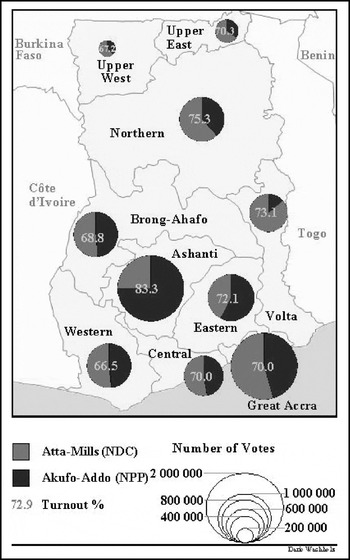
There exists a long-standing controversy about block voting, and how important swing voting has been in Ghana's Fourth Republic (1992–2009). The size of the core voting population in Ghana had been considerable, at least in the 1996 and 2000 elections (about 82% of the voting population; see Lindberg & Morrison Reference Lindberg and Morrison2005: 565). Nevertheless, swing voters brought about the first democratic alternation of power in 2000, thus challenging assumptions that voting volatility in transitional regimes is higher than in relatively consolidated African democracies like that of Ghana. There are no robust data available to test whether the percentage of swing voters has changed since the early 2000s. Ghanaian core and swing voters cannot be distinguished by structural factors, like level of education, the rural–urban divide, income and occupation, possibly apart from ethnicity.Footnote 3 In any case, strong block voting in two regions persisted. Ashanti (NPP) and Volta Regions (NDC) (Fridy Reference Fridy2007: 282, 286–9; Morrison & Hong Reference Morrison and Hong2006: 235, 239) have never voted against the political tradition associated with their region – the Busia-Danquah tradition in Ashanti, and the Nkrumahist tradition in Volta – following the demise of the Ewe unification movement in the 1950s. This pattern has been repeated since the first fully democratic election in 1996, a trend which was confirmed once more in 2008. Together both regions represented a significant proportion (26·6%) of all registered voters (12,472,758) in Ghana in 2008. Ashanti has the second largest proportion of voters at 18·5%, behind Greater Accra with 20·2%. The Volta Region accounts for 8·1% (EC website; see also Fig. 1).Footnote 4
On-going concern is reflected in claims and counter-claims about electoral fraud. Although the total number of votes involved was possibly quite small in 2008, the closeness of the result meant that vote massing could well have jeopardised the legitimacy of the entire process. The most recent election proved again that Ghana is virtually a two-party system (see Fig. 1), possibly because of the peculiarities of its British-style electoral system (multiple single-member constituencies; see Morrison & Hong Reference Morrison and Hong2006: 631–2), reinforced by competing Ghanaian political traditions based on ideology and related socio-economic divisions between ‘Nkrumahists’ and ‘Busia-Danquahists’. Expectations that one of the smaller opposition parties could break through as a third force were again disappointed (EU EOM 2009; Loetzer & Mönikes Reference Loetzer and Mönikes2009).
Ghana 2008, presidential run-off election. Number of valid votes, share of each candidate, and turnout (%) by region.

The history of Ghana's electoral processes shows that, at least in popular perception, ethnicity matters more than any other socio-economic variable (Fridy Reference Fridy2007: 281, 302; Tonah Reference Tonah, Rosenthal and Bogner2009). Fortunately, during this (and previous) elections this did not result in large-scale election violence as in other African states like Kenya, Zimbabwe or Nigeria. Many voters view the two major parties, the National Democratic Congress (NDC) and the New Patriotic Party (NPP), as representing mainly Ewe and Ashanti interests respectively (Loetzer & Mönikes Reference Loetzer and Mönikes2009: 64, 78). However, in reality, the relationship between ethnic politics and partisanship is far more complex. Factors other than ethnicity, notably socio-economic issues, dominate actual voting patterns in Ghana (Fridy Reference Fridy2007; Lindberg & Morrison Reference Lindberg and Morrison2008; Nugent Reference Nugent2001b).
Nevertheless, persistent block voting in the Ashanti and Volta Regions is a reality. Its effects are compounded by a level of electoral malpractice designed to stack up additional votes in areas of strength. Vote rigging in regional party strongholds could acquire a decisive importance, possibly representing an even more important ‘third force’ than the smaller opposition parties or the factor of invalid votes.Footnote 5 The sheer number of votes that can be mobilised by each group may serve as a useful indicator. The difference between valid votes in the first and second rounds in the Ashanti Region amounted to 241,284 (2·7% of the national total and 12·6% of regional valid votes in the second round respectively), and in the Volta Region to 68,184 (0·8% of the national total, or 9·3% of regional valid votes). Both parties attributed the increases to extraordinary mobilisation efforts in the election campaign before the final round. However, there are strong indicators that a significant part of the increase is due to electoral malpractice, as will be shown in the following sections. By comparison, the candidate of the largest of the small opposition parties, Paa Kwesi Nduom of the Convention People's Party (CPP), gained 113,494 votes in the first round of the 2008 presidential election. In the final round a mere 40,586 votes tipped the scale in favour of Atta Mills.
Against the background of growing conflicts due to a new nationalism (cf. Kohnert Reference Kohnert2009) informed by the politics of belonging in Africa in general, and recent electoral violence in Kenya and Nigeria in particular, the praise for the peaceful 2008 election in Ghana is understandable. However, despite the impression of a generally free and fair election, serious malpractices and electoral fraud seemingly occurred. Again the most contested results came from Ashanti and the Volta Region. Not all allegations were investigated sufficiently.Footnote 6 The international community inside and outside Africa was at pains to have a positive example to hold up, a model for Ghana's African peers to emulate. Rare were slightly critical remarks like those of the EU Electoral Observers, for example with respect to the implausibly high turnout in five Ashanti constituencies, and the lack of transparency in the transmission of aggregated figures (EU EOM 2009: 29). The EC, which would have been responsible for in-depth investigations, shied away – for unknown reasons – from opening this can of worms. Possibly it lacked both time and resources for a thorough investigation, or thought it wiser not to touch these questions because they would not affect the overall results. The fact that the EC has not honoured an earlier promise to release detailed polling station results suggests a preference for sweeping embarrassing anomalies under the carpet.Footnote 7 However, although comprehensible in view of the tense political situation at that time, this neglect could seriously distort the picture of what actually took place, and threaten Ghana's political stability and democratic consolidation in the medium and long run. This is the more so because it was apparently not the first time that the EC disregarded probable election rigging in the Ashanti, Volta and Northern Regions, where similar unusually high turnout figures of over 90% of registered voters were recorded in the 2004 presidential election.Footnote 8 Could it be that officials and international observers of the Ghanaian 2008 election alike were blinded by the quest for an African success story? Whatever the truth of the matter, the outcome is fraught with perils for the future. Because both the NDC and the NPP believe that the other side perpetrated fraud in their strongholds and got away with it, it is highly likely that they will try to do so on an even greater scale in 2012. This raises the prospects of electoral violence and the delegitimation of the electoral process, unless the matter is dealt with in an open and impartial manner.
DIPLOMATIC AND TECHNOCRATIC BIAS IN ELECTION OBSERVATION IN GHANA'S 2008 ELECTION?
The peaceful and largely transparent outcome of the 2008 election was to a large extent due to the strong commitment and active engagement of Ghana's media and civil society, which monitored and commented on the electoral process with great zeal. Think tanks, advocacy groups, religious and professional organisations, and NGOs, comprised an impressive platform of independent coverage of the polling process, assisted by advanced technology, meant for regular updates of local and regional results, parallel vote tabulation via mobile phone text messages and local radio stations (Gyimah-Boadi Reference Gyimah-Boadi2009: 145–6; Loetze & Mönikes 2009: 80–2). The contribution made by the Coalition of Domestic Election Observers (CODEO) was of singular importance. All the actors concerned were mindful of what could go wrong, in light of the recent Kenyan experience.Footnote 9 The overall evaluation by international election observers, whose presence was similarly enhanced by the Kenyan crisis and early problems with the voters' register, reflected these positive inputs.Footnote 10 But other considerations were also at work. Overriding concerns about political stability in the sub-region, and conflict prevention in view of the volatile political situation in neighbouring Côte d'Ivoire and Togo, may have enhanced the tendency to accentuate the positive. Thus, a certain diplomatic bias cannot be denied for the Ghanaian case.Footnote 11 An additional technocratic bias,Footnote 12 notably a disregard for Ghanaian election history as well as informal politics, and a focus exclusively and excessively on formal procedures of multiparty democracy, apparently blinded impartial observers to the realities on the ground.
One case in question is the long-standing controversy about the inflated voters' register and its connection with the unusually high turnout figures in the run-off election in numerous constituencies of the Ashanti, Volta and Northern Regions in the 2004 and 2008 presidential elections.Footnote 13 Kuenzi and Lambright (Reference Kuenzi and Lambright2007: 684–5) have observed in general a positive relationship between electoral experience and voter turnout in multiparty elections in sub-Saharan Africa, but this is complicated by the fact that turnout was also higher in Africa's less democratic regimes, compared with the democratic ones. In Ghana, similarly high turnout figures were reported for the 1996 and 2004 presidential elections in the Ashanti and Volta Regions (EC website). In the 2000 presidential election, the first democratic polls which brought an alternation of power (this time from NDC to NPP), turnout was relatively low. Nevertheless, allegations about electoral irregularities, a bloated voters' register, and patterns of voter turnout, notably in the Volta and Ashanti Regions, were already rife.Footnote 14 Controversies over the integrity of the voters' register have become a regular feature in Ghana's elections, and have led in some cases to political crisis. For example, the 1992 election was marred by opposition allegations (mostly unsubstantiated) about a ‘stolen verdict’, followed by its boycott of the December legislative polls. In the 2000 election the voters' register had been grossly inflated, especially in the Greater Accra, Ashanti and Volta Regions. The reasons given focused on double registration in different regions, fraudulent registration of minors and the deceased as major problems, resulting in an estimated 1·5 million ‘ghost voters’ (Smith Reference Smith2002: 624–31). Even during the 2008 election campaign, out of a total of 12,822,474 registered voters, 349,496 entries were removed by the EC because they were considered as irregular (see also EU EOM 2009: 14–16). The EC had expected to register an additional 800,000 voters since 2006, the year of the last update of the register, which corresponded to estimates of the number of citizens who had attained voting age. However, the 2008 provisional register listed nearly an additional 2 million voters (Ichino & Schündeln Reference Ichino and Schündeln2009: 5). Again the highest increase in registered voters during the limited registration exercise of the EC (from 31 July to 13 August 2008) was to be observed in the Ashanti Region: 374,451 new voters were recorded, an increase of 330·7% over the 2006 exercise. The provisional voter population for the region increased however by only 18·7% to 2,381,214 voters compared with the 2006 electoral roll.Footnote 15 For the whole of Ghana the total increase of the number of voters was 16·7% to 12,822,474.Footnote 16CODEO (2009: 34) concluded in a statement issued on 4 August 2008 that violence during voter registration and irregularities had been ‘widespread’. In view of a persistently bloated register, notably in Ashanti and Volta Region, the abnormally high turnout figures are even more difficult to credit.
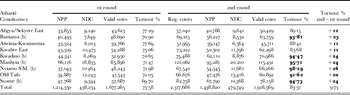
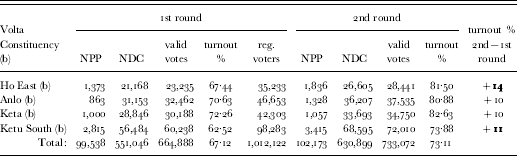
Although barely credible turnout figures were criticised in the final report of the EU Election Observation Mission (2009: 29), this critique was not as exhaustive as it could have been. In fact, a total of nine constituencies in Ashanti, two to four in Volta, and one each in the Central, Eastern and Upper West Regions, showed questionable results, with Ashanti by far the greatest suspected culprit (Tables 1, 2).Footnote 17 A similar pattern was to be observed in the 2004 presidential election when, for example, at least five constituencies in Ashanti produced dubious turnout rates, most of which were problematic in 2008. The same was true of at least three constituencies in the Northern Region, including two reporting 95%, as well as three in the Volta Region.Footnote 18 It is certainly not by chance that these inconsistencies recurred mainly in those regions where the influence of block voting remains most entrenched. Registration fraud and concomitant inflated turnout figures are probably more likely in party strongholds than in competitive areas (Ichino & Schündeln Reference Ichino and Schündeln2009: 10, 16).
Ghana presidential election 2008: Ashanti region, results of doubtful validity (a): 1st round (7.12.08) & run-off (28.12.08) (c)

Notes (a) constituencies with results of ‘doubtful validity’ are those with turnout over 95%, or over 90% and overwhelmingly for one candidate, or an increase in turnout of over 10% between 1st and 2nd round. Second round turnout of over 90%, and differences between first and second round turnout over 10%, are in bold.
(b) these constituencies' results are questioned also by EU EOM 2008.
(c) for the 1st round the Table gives preliminary results.
Source: Electoral Commission of Ghana (EC); compilation by the authors.
Ghana presidential election 2008: Volta region, results of doubtful validity (a) 1st round (7.12.08) & run-off (28.12.08) (c)
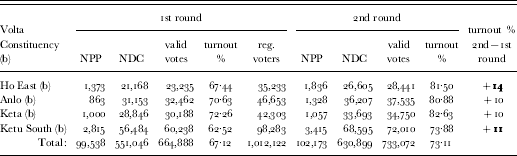
Notes (a) constituencies with results of ‘doubtful validity’ are those with turnout over 95%, or over 90% and overwhelmingly for one candidate, or an increase in turnout of over 10% between 1st and 2nd round. Differences between 1st and 2nd round turnout over 10%, are in bold.
(b) these constituencies' results are questioned also by EU EOM 2008.
(c) for the 1st round the Table gives preliminary results.
Source: Electoral Commission of Ghana (EC); compilation by the authors.
It is open to question whether the questionable results were cross-checked by the EC or other responsible authorities, and what actions have since been taken to remedy the situation. It is conceivable – but not very likely – that the unusually high turnout figures truly reflect the strong engagement of voters in the constituencies concerned. The worst-case scenario is that a perception of impunity, influenced by ethnicity in already volatile constituencies and in certain regions, will encourage enhanced electoral fraud in future elections. Those who commented favourably on the elections pointed out that the Election Commissioner, Dr Afari-Gyan, scored a tremendous achievement in producing a legitimate result. At the height of the disputed run-off, his strategy appears to have been to call the bluff of the NPP by accepting disputed results from Ashanti and then pointing out that these were not enough to overturn the majority that had been chalked up by Mills. When the NPP insisted that the Tain constituency, where there had been no voting, could still affect the outcome, he called their bluff again and agreed not to declare the result until the election had been rerun there. No doubt, this was evidence of deft footwork, but the point remains that the final result was arrived by glossing over allegations of significant electoral fraud. The precedent that has been set is a dangerous one, and there is no guarantee that a future Commissioner will be as fleet of foot in future.
In the next two sections, we examine the elections in Ashanti and the Volta Region in closer detail. These were the regions where the most serious allegations were made, but it is important also to consider the atmosphere in which the polls were conducted. A successful election does not merely hinge on an accurate tally of how voters cast their ballots: it also has to be seen to be fair. Election crises tend to occur when a psychology of mistrust becomes deeply rooted. In these two regions, there was abundant evidence for this mistrust in 2008, which does not bode particularly well for the future.
THE CASE OF ASHANTI REGION
There was never any doubt that the chances of the NPP being re-elected in 2008 hinged on retaining the absolute loyalty of the Ashanti Region as a vote bank, as party officials readily admitted. One consideration was whether the NPP could retain the sympathy of voters in parts of the region that were more recent converts to the party cause. In Ashanti, there have historically been two weak links. One is at the geographical margins, reflecting deeper historical dynamics of ‘Greater Asante’. In the 1996 presidential poll, the NDC won a majority in three constituencies in northern Ashanti and two in the south. In the first round of the 2000 presidential election, only Ejura Sekyedumase and New Edubiase resisted the NPP. In the second round, John Kufuor only failed to carry the latter constituency for the NPP. If support for the government were to erode, however, an adverse swing was always possible in these marginal constituencies. Secondly, Ashanti has witnessed considerable levels of immigration, from the Volta Region but more particularly from the north. The Zongo communities have tended to vote NDC. Hence the Asawase parliamentary seat in Kumasi was captured by the NDC in 2004, despite its poor showing elsewhere.
A real concern for the NPP campaign team was that Ashanti voters might not turn out to vote for an Akyem presidential candidate, even if they remained broadly disposed to the NPP as a party. Hence turnout was always regarded as a prime consideration. Nana Akufo-Addo brought prominent Ashantis into his campaign in order to reassure voters that the party remained firmly rooted in its tradition as an Ashanti/Akyem alliance. The team staged big rallies in Kumasi and larger urban centres, in an attempt to persuade voters that it retained enthusiastic support in the region. The fundamental question of how many Ashanti voters there actually were was dogged by controversy from the start. Before the reopening of the voters' register, the NDC complained that the figures for thirteen Ashanti constituencies were massively inflated. In April, the EC set up an independent committee to investigate this claim. Dr Afari-Gyan initially lent credence to NDC fears when he confirmed that the increase in the number of voters in Ashanti was not credible, but in June he revised his assessment. He announced that the incorrect figures, which were the result of a printing error, only existed in hard copies of the register that had been sent to parties, and were not replicated in the EC's own database. Although this supposedly meant that there should be no further cause for concern, the NDC believed that any error was deliberate, and would be brought into play later on. The problem was compounded when the register was reopened to allow those who had attained full voting age to add their names. The NDC alleged that there had been systematic attempts to pump up the numbers in Ashanti, through a combination of double and under-age registration. Therefore, the opposition parties remained extremely sceptical about the figures. During the campaign, Rawlings not surprisingly returned to the claim that there was a plot to rig the election, centred on Ashanti. The fact that some large question marks remained over the process disposed many opposition supporters to believe the worst.
The election campaign in the region witnessed a few incidents of violence, but some of these involved rival candidates for NPP parliamentary nominations, as was the case in Bekwai. On the whole, the campaign passed off with little trouble. In the first round of voting in 2004, Kufuor had captured 1,235,395 out of 1,679,664 votes, which translated into 73·6% of the votes in Ashanti. In the first round in 2008, Akufo-Addo won 1,214,350 out of 1,677,285 votes, amounting to 72·4%. By contrast, Mills had won 398,362 (23·7%) of the votes in 2004, whereas in 2008 this had increased to 438,234 votes, or 26·1% (see Table 1). In other words, regional turnout had dipped slightly, but this was to the disadvantage of Akufo-Addo. Mills, on the other hand, had seen his total number and share of the Ashanti vote increase. The NDC had also managed to take its number of parliamentary seats back to three – New Edubiase, Ejura Sekyedumase and Asawase – while two NPP rebel candidates had won as independents.
All of this was understandably a matter of considerable alarm to the NPP campaign team. Akufo-Addo supporters privately complained that the relatively low turnout in Ashanti had cost Akufo-Addo a first round victory, which he only narrowly missed with 49·1% of the national vote. There was also some dissatisfaction at the failure of Kufuor to play a more active role on the campaign trail, which may have been rooted in his historically strained relationship with elements of the Ashanti political elite (Elischer Reference Elischer2008), and his earlier support for Alan Kyerematen as the party candidate. In the run-up to the second round, Kyerematen, who had briefly resigned from the party, was brought in to head the campaign in Ashanti in the belief that he held the key to a higher turnout – despite being a Fante. A special appeal was made to Ashanti voters to prevent Rawlings from staging a comeback on the coat tails of Mills. The Mills campaign meanwhile hoped to make modest gains in Ashanti, while consolidating the swing elsewhere.
In the final analysis, Akufo-Addo achieved what he was hoping for in Ashanti during the second round. The total vote in Ashanti rose to 1,880,372, with Akufo-Addo taking 1,401,421 (74·5%) and Mills 478,749 (25·5%). Akufo-Addo had therefore conjured up another 187,071 votes and increased his overall share, whereas Mills had increased his numbers by a mere 40,515. If the balance of forces had remained the same in the other regions, the additional votes (just over 1% of the national total) would have pushed Akufo-Addo over the winning line. As it happened, the gains in Ashanti were wiped out by the swing to Mills in all the other regions, including Brong-Ahafo that had gone to the NPP in round one. The question that arises is whether the NPP campaign team genuinely improved its performance in the second round, or had resorted to illegitimate tactics. It has to be said that the results in certain constituencies look extremely suspicious. At Manhyia, where the recorded turnout was 95·7%, the NPP vote rose from 66,116 in the first round to 95,281 in the second (+24%). At Nhyiaeso, where the alleged turnout was 98·3%, it rocketed from 37,043 to 54,545 (+26%); and in Suame it climbed from 47,768 to 67,790 on a 95% turnout (+24%; see Table 1). The total turnout figures for Ashanti (83·3%) were out of line with the figures for the rest of the country (72·7%). Interestingly, the turnout in Akufo-Addo's own region, Eastern Region, stood at only 72·2%. Given the closeness of the contest, these increases could well have been enough to determine the overall result.
Perhaps voters in Ashanti genuinely feared a return of the NDC more than other Ghanaians. Yet recorded increases in electoral participation, leading to very questionable turnout figures at the constituency level, should have caused concern among international observers. It is unlikely that massive fraud occurred at the level of individual polling stations, given the strong presence of CODEO and international electoral observers. However, there may have been manipulation and intimidation in those polling stations or constituencies where NDC polling agents withdrew on polling day. The transmission of results from the constituency level to the Electoral Commission headquarters provides much broader scope for electoral rigging. This is confirmed by evidence in other countries, where elections have taken a violent turn in the post-poll period. The claim that two different sets of results were received in the EC ‘strong room’, with the second revealing much higher figures than the first, has never been properly explained. What is even more suspicious is that the regional office of the EC appears to have deliberately held back from declaring a number of Ashanti results.Footnote 19 By releasing the NPP's bombs at the end, the NDC claimed, it was possible to claim victory at the last gasp: that is, once it was known how many votes were still required to concoct a victory. There is some plausibility to this reading of what happened, because a relatively comfortable Mills majority suddenly evaporated as the last results came in. It was not enough as it happened, but the NPP came close to snatching victory at the last gasp. Interestingly, the constituencies that declared late included those where there was an implausible turnout: notably Nhyiaeso (98·3%), Kwadaso (94·5%), Manhyia (95·7%) and Suame (94·7%).
The NDC complained bitterly about these figures, and for some hours the entire election teetered on the brink of crisis. But after the Tain result was declared, Afari-Gyan announced on 3 January 2009 that the EC had investigated and concluded that the NDC had failed to produce sufficient evidence in the shape of complete polling station returns for the disputed constituencies. In reality, this was a mammoth task, especially when some polling agents had not been present at the final count. Although the NDC was still deeply unhappy, it had been declared the overall winner and decided to live with the Ashanti anomalies rather than provoke a crisis. Nana Akufo-Addo, on the other hand, was urged by Kufuor to accept defeat with good grace rather than resorting to the courts or direct action on the streets. The NPP's own complaints about the Volta Region were similarly dismissed. Since then, the EC has shown no inclination to revisit the issue of electoral malfeasance. It has offered no explanation of the turnout figures, no reason for the late declaration of certain Ashanti results, and has failed to mount a complete set of results on its website that would enable Ghanaians to judge for themselves. These are serious shortcomings that might come back to haunt the country in the future.
THE CASE OF VOLTA REGIONFootnote 20
Before going into detail, it bears repeating that irregularities in the form of abnormally high registration rates in some constituencies, bloated voters' registers, abnormal increases in voter turnout in the run-off election (notably in southern constituencies dominated by the Anlo-Ewe), rigging and ethnic block voting have a history in the Volta Region.Footnote 21 This is a history which has coloured NPP perceptions of the likelihood of being able to contest on a level playing field.
The hope of NPP activists in the Volta Region for a reversal of their historic fortunes was based on a number of considerations. In the 2004 election, the party succeeded in winning a parliamentary seat in Nkwanta North for the first time.Footnote 22 The NPP strategy was accordingly focused on minority areas, where they aspired to win at least four constituencies: Nkwanta North again, Nkwanta South, Krachi East and Krachi West, as well as Ketu North in the southern part of the region where the regional minister was running. NPP officials boasted of their impartial record of concern for the welfare of the whole region: for example, they pointed out that their government had built a Polytechnic College in Ho which ought to significantly redress the perception of marginalisation. Their party offices were very well frequented and their public meetings well attended, all of which gave the impression that they had managed to make inroads in the region. Nevertheless, there was a common belief that public money had been diverted by a corrupt national government to other regions that were better endowed with basic infrastructure like roads, schools and hospitals.
The NPP exploited the advantage of incumbency in the Volta Region. For example, apart from the usual distribution of large numbers of T-shirts, they provided school books in the villages, traditional presents to the chiefs and queen mothers, and – at least according to usually reliable local informants – also cash as an incentive to vote for the ‘right’ candidate. Some money was allegedly used to bring registration officers ‘on board’.Footnote 23 The deal was said to involve the registration of anyone brought by the party with no questions asked, including ‘minors’, and to place potential opposition voters on a ‘wrong’ list of voters. This was precisely what happened in Hohoe during the registration process, where two employees of the Regional Electoral Commission (REC) were arrested by police on the grounds of manipulating voters' lists.Footnote 24 According to information released by the police, the accused confessed to having taken money from NPP. However, no complaint about the registration process was brought to the knowledge of the EU observers, though they especially asked for it in the villages. Other fraudulent practices concerned ballot papers meant for NDC strongholds that would be rendered useless by printing mistakes and subsequently be rejected by NPP party agents. This happened in a few places (e.g. in Nkwanta District), but its net effect was only to delay the voting process, and not to hinder it completely. In addition, the NPP organised so called ‘party youth’ in a number of constituencies like Krachi East, with the aim of harassing opposition and election officials. This happened specifically in Dambai.
In the final analysis, the REC was able to secure an acceptable election process. Apart from Buem Constituency (Jasikan District), all constituency result sheets were signed by representatives from both parties. In Jasikan, NPP agents failed to turn up for the tabulation process. The Returning Officer claimed that NPP party officials told them to stay away. The results in the Volta Region showed a NDC landslide, to no one's great surprise. Apart from Nkwanta North, all the other parliamentary constituencies went to the NDC. There were only minor incidents, as in Krachi East, where the car taking the ballot boxes to the regional office was attacked and the boxes stolen. Since the Presiding Officer carried the signed result sheets, the REC was able to announce the results.
Not much was seen in the local arena regarding the upcoming run-off between the presidential candidates, by contrast with the heated discussions on TV, radio and in the newspapers about electoral rigging in the Volta and Ashanti Regions. NPP officials claimed that the election in the Volta Region had been marred by fraud, and stressed that their party agents had been harassed and had not been allowed to take up their duties. Some of these allegations were repeated by NPP officials at the constituency level. What casts some doubt on the claims is that NPP agents had signed all result sheets except one at the tabulation centres. It would have been easy for the REC in Ho to clarify matters, but the EC answered solely in general terms and did not refer to any concrete allegation. This was left to the press, but because journalists' movements were quite restricted due to financial constraints, many cases were not investigated. In the end, the claims became part of the stock of NPP propaganda to discredit the NDC in the run-off.
Two days before the second round, a group of about a hundred so-called ‘Macho Boys’, that is NPP sympathisers, were brought in from Accra. When asked about their role in the election, the mainly young men claimed to be working as polling staff. However, they had no idea about election procedures. The EU observers met them close to Kpando town, where they were lodging, and had a long discussion with a large number of them. On voting day they were brought to polling stations, where they often met local party agents who refused to be replaced by them. The context was one in which the national party organisers believed that their agents in the region were likely to be susceptible to pressure, whereas outsiders would perform a better job. Not surprisingly, the accredited agents from the region took exception. Only two agents per party were allowed inside a polling station at any given time. Some of the ‘Macho Boys’ first came to their assigned polling station by late afternoon. Their names on the party's list of officially authorised party agents had often been replaced or overwritten. This was why many Presiding Officers did not allow them inside the polling station. Others, who had been allowed inside, later refused to sign the result sheets. Evidence procured by REC as well as a number of oral admissions to the EU observers suggested that NPP party agents told them not to sign, though they could give no concrete reason for their refusal.Footnote 25 The constituency result summary sheets were not signed by NPP agents in three cases: Ho Central, North Dayi and Keta. In Anlo, these outsiders were chased away by townspeople in a fraught atmosphere. There was a deep-rooted perception in the region that the ‘Macho Boys’ had been brought in to interfere with the democratic process. The background was that a prominent chief, known for his critical stand vis-à-vis the government, had been killed a few weeks before, and the government was blamed. The police explained that they escorted the young men out of town because of security concerns, while the REC claimed that this was not their responsibility. In short, the ‘Macho Boys’ caused a lot of ill-feeling and were the source of many rumours in the Volta Region, although in the end their presence did not have much effect since the procedures in place were working.Footnote 26 Nevertheless, compared with the first round, when the NPP secured 9·2%, their share rose to 13·94% in the second round, while NDC came down from 88·64 to 86·06%. What is open to speculation is the much higher turnout in the second round, namely 739,669 total votes as compared to 679,396 in the first round, amounting to an increase of 60,600 in the number of votes cast. Some of the increase in specific constituencies would warrant closer investigation by the REC or EC.Footnote 27
Although Mills was of Fante origin, people in the Volta Region still associated the party with former president Rawlings, the NDC's grey eminence who has a partly Ewe background. The reason given for why a change of government was necessary was that the power had to be taken away from ‘those people in Kumasi’ who allegedly did not care about Volta Region – the fairly poor road conditions were often invoked as evidence.Footnote 28 An indicator of NPP's view of its prospects in the second round, as seen by the party's ‘National Campaign Coordination’, was the failure of national party officials to put in a showing during the pre-election period. Clearly, the region had been written off. It appears that the operative strategy was to disturb the election procedures and – if the situation should permit – to use this in order to hinder the official announcement of the final presidential results, should these not be in favour of the NPP.
Three days before voting took place, the government closed the border with Togo, on suspicion that a number of Ewe people from Togo had registered and would vote in the interest of their kinsmen. The furious reaction by NDC officials showed that this distrust was not completely misplaced.Footnote 29 Significantly, no other border was closed. Every time the NDC regional office was visited by the EU observers, the latter encountered allegations about the rigging of the election by NPP (and vice versa). Sometimes, the claims were quite obscure. For example observers were told that the houses of NDC sympathisers in Dambai had been marked by NPP youth, as in Rwanda, in order to deal with them after the election. However, when EU officials tried to verify the allegations on the spot, NDC officials were not able to provide any evidence. In Kete-Krachi the observers were told that many Muslim youth members who were regarded as potential NDC voters had been imprisoned due to unrest in the town. In reality however it proved to be an internal quarrel in the Zongo Muslim Community between the Muslim youth and so-called traditionalists.
In short, (perceived) ethnicity continued to be a major underlying factor in the 2008 election in the Volta Region. This clearly played a part in the block voting. But it also underlined contrasting images of political virtue: whereas the Volta Region has been stereotyped within NPP circles as a superstitious, almost barbarous place where it is practically impossible to secure a fair deal, NDC activists in the region see themselves as the strongest bulwark against Ashanti hegemonic pretensions. These discourses need to be taken seriously because, as the Kenyan example shows, an escalation of political tensions can lead to their operationalisation in as yet unrealised ways. The traditional structures and their role in the election have so far been left out of most analyses. As in other African societies, traditional authorities play a greater role than is generally taken into consideration by election observers.Footnote 30 The question is whether and how far other ethnic groups could become embroiled in ethnic cleavages within the framework of future elections. Whether the NDC and NPP will honour the Code of Conduct for political parties as well as the formal legal precautions against instrumentalisation of ethnicity in politics in the next election remains to be seen. But there are some worrying signs.
* * *
Undoubtedly, Ghana's process of democratisation is more advanced than in many other countries in sub-Saharan Africa. Already in 2000, swing voting was significant enough to produce a change of government. In addition, it has become more difficult for individuals and political parties to cheat massively in Ghana's elections, despite persistent voting irregularities and widespread abuse of incumbency. The EC has carved out a reputation as an independent, fair and credible institution. Significantly, the elite and large sections of the population were prepared to accept results declared by the EC when it mattered. Nevertheless, neglected or unrecognised electoral fraud and a history of impunity in already volatile constituencies and regions of decisive importance for the general outcome of the polls could encourage large-scale electoral fraud in future elections. This poses a threat and is a destabilising factor in Ghana's democratisation process.
The Achilles' heel of election administration in Ghana has been the dubious voters' register and the irresolute attitude of the EC and other responsible authorities when it came to checking improbably high voter turnouts and apparent electoral malpractice connected with block voting in several constituencies in Ashanti and the Volta Region. Surprisingly, neither of the main political parties insisted on rigorous in-depth investigation once their complaints were rebuffed by the EC. Could it be that the instrumentalisation of ethnicity played a major part in vote rigging, in view of the fact that ‘ethnic cleavages’ constitute a deeply engrained emic view of the rule of politics in Ghana, and that each of the concerned hoped to profit from it eventually at the expense of the other?
Certainly, diverse constitutional and other legal provisions mentioned above prevented straightforward ‘ethnic voting’. However, in a society where informal institutions and ethnicity in politics and economy are paramount (Fallon Reference Fallon, Purkayastha and Subramaniam2004; Lentz & Nugent Reference Nugent2000; Meagher Reference Meagher2007; Nugent Reference Nugent2001b; Tonah Reference Tonah, Rosenthal and Bogner2009), formal political rules operate under severe constraints. An in-depth study of the 2004 election revealed that in most cases local influences dominated voters' decisions, including primordial cleavages, regional political traditions, and the influence of traditional chiefs (Boafo-Arthur Reference Boafo-Arthur and Boafo-Arthur2006: 365–6). A piecemeal but painstaking democratisation of the fabric of informal politics including chieftaincy (which seems to be deeply involved in block voting), and a meaningful decentralisation policy from below (Crawford Reference Crawford2009), would be required to lay a sustainable base for a functioning democracy at the grass-roots level, which could eventually lead to a more responsive government. A precondition for downward accountability is to simultaneously empower local governments and citizens. Past experience shows that ‘decentralisation from above’ cannot do the job. It prevents a genuine devolution of power, which would require among other things a realignment of the structures of traditional authority in line with basic democratic requirements (Crawford Reference Crawford2008, Reference Crawford2009). In short, there is nothing which could replace political struggle for real democracy from below.