The Scottish dimension of the 1772–3 credit crisis has attracted most of the attention paid to this episode, mainly due to Adam Smith's almost explicit references in Book II of the Wealth of Nations. Footnote 1 The troubles of the ambitious and experimental Ayr Bank form the central events of a multifaceted financial crisis that included the stoppage of numerous bankers in London, Edinburgh and Amsterdam (Ashton Reference Ashton1959, pp. 136–7; Wilson Reference Wilson1941, pp. 169–88), and was underlined by the on-going difficulties of the East India Company culminating in the Regulating Act of 1773 (Sutherland Reference Sutherland1934 and Reference Sutherland1952, pp. 222–9). The 1772 episode as a whole has been identified as one of the first endogenous crises which arise from economic growth rather than war or government policy (Hoppit Reference Hoppit1986), and is notable for displaying an early instance of a lender of last resort in action (Kindleberger Reference Kindleberger2000, p. 162).
Beginning with Smith's analysis of the perils of over-issuing a paper currency beyond what the natural trade of a country will allow, the Ayr Bank affair has been traditionally presented as a cautionary tale of managerial incompetence, overtrading and monetary fallacy. This picture is reinforced by The Precipitation and Fall of Messrs Douglas, Heron and Company (henceforth: Precipitation), the 1778 report by the Committee of Inquiry set up by the bank's partners. Although this echoed several of Smith's arguments, it focused mainly on what its authors perceived as the culpable mismanagement of the bank's outgoing Directors. Modern work has convincingly presented the debacle as being a significant early episode in the development of Scottish banking at a time of notable economic expansion (Checkland Reference Checkland1975a, pp. 124–35; Hamilton Reference Hamilton1956; Munn Reference Munn1981, pp. 36–9). The prominence of Smith and the Precipitation, together with a few other printed contemporary sources such as the memoirs of Sir William Forbes (Reference Forbes1860) and the Scots Magazine, have however tended to over-influence modern treatments of the affair by being used as the main sources of primary information on the affair. There is a particular reliance on the Precipitation, a source which, rather than being the definitive account as has sometimes been described (Saville Reference Saville1995, p. 163), could also be approached as a piece of pamphlet literature representing the opinion of a part (and not necessarily the major part) of the bank's partners. Apart from possibly propagating inherent biases, the prominence of these few printed sources has tended to limit modern literature to following primary sources only up to the Precipitation's publication date of 1778. As the bank never went bankrupt but paid all its creditors in full over several decades, the story of one of the first unwindings of a major financial institution has thus remained untold. Furthermore, there has been occasional confusion surrounding the admittedly convoluted events which surrounded the bank's stop of payments in June 1772, as well as a propagation of second-hand and even apocryphal figures concerning the financial details of its unwinding.
This article will attempt to re-establish the narrative of this important affair on contemporary manuscript evidence surviving in Scottish archives, and to extend it four decades beyond its traditional 1772–8 timeframe. It will furthermore argue that although the bank's business model was flawed and its position in June 1772 precarious, its fate was sealed only after the ill-advised attempt to stay afloat by raising £450,000 in life annuities at an interest rate between 12 and 14 per cent. Although the bank's books have not survived, it is possible to quantify this narrative through the financial records and voluminous correspondence of George Home of Branxton, the lawyer who served as factor and manager for the bank between 1773 and 1793.
I
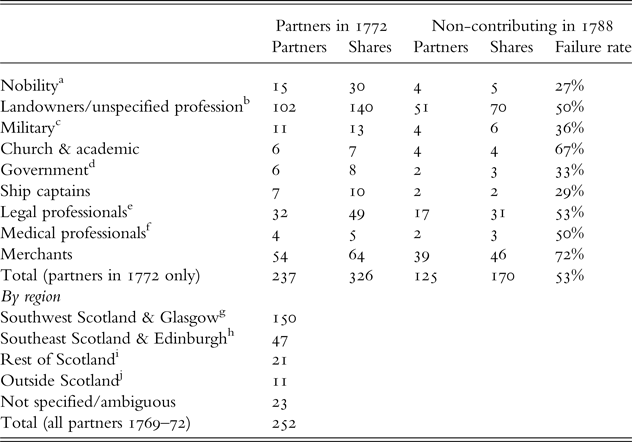
The co-partnership of Douglas, Heron and Co., commonly known as the Ayr Bank, was established on 6 November 1769 for a nominal term of 21 years, with £96,000 of subscribed (but not paid-up) capital. Though unincorporated, the Ayr Bank was nonetheless a joint-stock company enjoying the advantages of share transferability and a separate legal personality from its 136 founding partners.Footnote 2 The latter were an impressive selection of the contemporary Scottish elite, including the Dukes of Queensberry and Buccleuch, the latter only recently returned from his Grand Tour in the company of Adam Smith,Footnote 3 the Earls of Dumfries and March & Ruglen, and Archibald Douglas of ‘Douglas Cause’ fame. Apart from the landed interest which comprised about half the membership and capital of the firm, merchants, lawyers and physicians were also well represented. By the time of the 1772 crisis, the partnership had grown to 237 individuals with a nominal capital of £163,000, just over £100,000 of which was paid up. Membership was very stable with only 15 of the founding partners not appearing in the 1772 lists. Table 1 presents the demographics of the co-partnership over its short life as a going concern. Although categorisation by profession should not be taken as mutually exclusive, it is still accurate to state that ‘the basis of Douglas Heron's credit was land’ (Munn Reference Munn1981, p. 30).
Ayr Bank demographics according to occupation (top) and geographical location (bottom)

aIncludes knights and baronets with titles awarded before 1772.
bincludes all those with unspecified professions in the lists, or known to have possessed country estates.
cStated military rank in 1769 or 1772.
dIncludes those with stated professions in the lists, but who had or were to have noted governmental functions, e.g. Ilay Campbell, Lord Advocate 1783–9.
eWriters, writers to the signet and advocates.
fPhysicians, surgeons and druggists.
gDumfries-shire, Ayrshire, Kirkcudbrightshire, Renfrewshire, Wigtownshire, Lanarkshire, Dunbartonshire.
hEast & West Lothian, Midlothian, Berwickshire, Selkirkshire.
iArgyll, Angus, Aberdeenshire, Perthshire, Fife, Stirlingshire.
iLondon and rest of England, Ireland, Isle of Man.
Sources: 1769 membership, SM, 34, pp. 304–5; 1772 membership, GD224/178/1/9; 1788 non-contributors, GD224/178/8.
Although the Ayr Bank was not the first Scottish country bank, it was the largest and best supported that had hitherto appeared. Its mission statement was unabashedly ambitious, starting with its Pro Bono Publico motto. Convinced that ‘the business of banking, when carried on proper principles, is of great public utility, particularly to the commerce, manufactures, and agriculture of a country’,Footnote 4 the founders made no secret of what they regarded as the unreasonable meanness of the chartered Edinburgh banks. By 1769, the two ‘public’ banks established under Act of Parliament (the Bank of Scotland) or Royal Charter (the Royal Bank of Scotland) had been joined despite some initial resistance by the British Linen Bank and a growing number of country banks (Munn Reference Munn1981, pp. 10–16). Scottish banks were in some respects better placed to assist business compared with their English counterparts, since they were not subject to the same Bank of England monopoly restrictions that limited English private banks to six partners at most, and by extension to limited capital as well. Even so, it was felt in some quarters that Scottish banking had not kept pace with the growth of the economy, which following the final defeat of Jacobitism and victory in the Seven Years War had entered a significant expansionary phase. Growth soon outstripped the meagre quantities of specie in circulation, and was hampered by the reluctance of the Edinburgh public banks to lend enough paper money as a substitute, or to discount inland bills of exchange. The growth of Glasgow as a major entrepôt in the North American tobacco trade was particularly noteworthy, particularly after Scottish firms won the lucrative monopoly contract with the French Farmers-General (Hamilton Reference Hamilton1963, pp. 255–6; Price Reference Price1973, pp. 608–9). The American tobacco trades were a particularly capital-intensive business (Price Reference Price1980, p. 124) and like all international trading in the period depended heavily on bills of exchange to effect their payments. Even in 1774, after the Ayr Bank project had collapsed so spectacularly, the author of the unsigned manuscript Case for Messrs Douglas Heron & Co. (hereafter: Case) reiterated the complaint that in 1768–9 the public banks ‘withdrew their credits they had formerly allowed … within a very narrow compass, whereby the improvements in agriculture were in a great measure stopped and the manufacturers very much distressed’.Footnote 5 Although Smith noted this credit contraction approvingly, and in general rejected bank lending as a way to finance capital-intensive projects,Footnote 6 the conviction that the Ayr Bank's motives were benign and its function useful for the country long survived the affair in some quarters.Footnote 7
The bank has been justly called ‘experimental’ for establishing a branch network (Clapham Reference Clapham1944, p. 163). The centralisation of banking in Edinburgh had left large parts of the country chronically under-banked.Footnote 8 Southwest Scotland, where over half of the Ayr Bank's partners were based, was only served by two small private banks in Ayr and Dumfries respectively. The new co-partnership therefore opened full branches in these two towns, as well as five more agencies around the country. The two existing local banks were bought out in 1771.Footnote 9 Rather than act strictly as a provincial bank however, the company underlined its ambition to compete with the public banks by opening a third full branch in Edinburgh. Notwithstanding its latter reputation for irresponsibility and some contemporary complaints from its competitors,Footnote 10 at the time the bank was quickly accepted as an integral part of the business landscape of Scotland, and was indeed instrumental in the establishment of the note exchange system that put an end to the ‘note picking’ wars (the amassing of other banks' notes for sudden presentation for specie) between Scottish banks (Munn Reference Munn1981, pp. 24–5).
There are two explanations in the literature as to why the venture failed despite these considerable resources, namely overtrading and culpable mismanagement. The first, of which Smith is the original exponent, focuses on paper money reflux due to excessive issuance, i.e. the too rapid return of banknotes to their issuer in demand for specie. This is supposed to have led in turn to the expedient of raising money in London through the redrawing of bills of exchange. Contemporaries made much of the ‘fictitious’ nature of such bills, which did not correspond to real commercial contracts, but were merely fiat financial instruments.Footnote 11 The bank's expansion is also deemed to have been imprudent from a credit as well as a monetary perspective, through the granting of generous cash accounts and the establishment of an overly enthusiastic bill discounting operation. It has been claimed that these loans were of dubious quality, the bank supposedly achieving the rapid growth of its business by taking over what ‘was left [of] the bad loans by the established banks’ (Kindleberger Reference Kindleberger2000, p. 44), and that this abundant credit was mainly employed in conspicuous consumption and land speculation (Forbes Reference Forbes1860, p. 39).Footnote 12
The second view is couched in allegations of managerial dishonesty. The Precipitation, with its repeated assertions of wrongdoing by the outgoing directors, is the source of this tradition. Indeed, the Committee of Inquiry who compiled it eventually took legal action against former directors, cashiers and trading counterparties,Footnote 13 although with no apparent success.Footnote 14 Some modern treatments have been influenced by these arguments, using terms like ‘looting’ (Brady Reference Brady1973, p. 29) or observing that ‘the affairs of the bank [seemed to be] run by a small clique’ (Munn Reference Munn1981, p. 36).Footnote 15
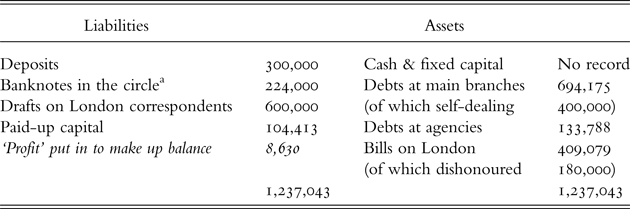
There is much truth in all this. The bank certainly expanded rapidly, quickly growing a balance sheet of £1.2 million with a leverage close to 12 at the time of the crisis (Table 2). Although some contemporary English private banks displayed comparable leverage, in absolute terms their balance sheets were typically five to ten times smaller, while their ratios of cash reserves over total assets were high, typically 30–50 per cent.Footnote 16 Banknote circulation likewise reached £224,000 just before the collapse, supposedly two-thirds of the total paper money circulation of Scotland (Munn Reference Munn1981, p. 31).Footnote 17 Furthermore, some of the bank's practices would certainly raise more than one eyebrow among modern practitioners, such as lending to trading companies partly owned by partners, or employing partners' companies as London correspondents, thus subjecting the bank to conflicts of interest. Although self-lending was not a vice unique to the Ayr Bank during this period, nor indeed one specific to Scottish banking,Footnote 18 the bank had taken the practice to new extremes. It is also true that in order to finance this credit expansion the bank issued drafts on London correspondents, which it paid off by purchasing or redrawing longer-term bills on London, a practice known as ‘swivelling’. This was by no means a dishonest or foolhardy operation in itself, but a long-established technique for the long-distance transfer of credit in the absence of a modern-style interbank market (Ashton Reference Ashton1955, p. 186; Neal Reference Neal1990, pp. 5–9). The problem in this particular case was the sheer scale and associated cost of the operation, which eventually comprised half the bank's liabilities and was reportedly costing it at least 3 per cent per annum over interest revenues.Footnote 19
Ayr Bank balance sheet at the time of its stop of payments, 22 June 1772
Amounts in pounds sterling. Author's estimated figures in italics.
a1773 estimates (NAS GD224/178/2/22). The Precipitation (written in 1778) rounds this to £220,000.
Source (unless otherwise noted): Precipitation, pp. 86–7.
That said, there is also exaggeration and bias in the traditional account. There is no evidence that loans were non-performing to any noticeable degree prior to the panic, or that the collateral backing them was particularly poor. The Precipitation is furthermore markedly selective with the record, by presenting only one side of the internal correspondence of the firm, showcasing the complaints by the Edinburgh branch about the credit practices of the main Ayr office without including any of its retorts or justifications.Footnote 20 Its objections to the bank's lending practices had more to do with their allegedly unauthorised nature (something that has been disputed by Munn Reference Munn1981, p. 31) than with the quality of the loans, although it did convincingly point out the poor diversification of risk arising from allowing debtors to act as guarantors for each other.Footnote 21 The Precipitation itself was controversial with partners, several of whom published their own pamphlets attacking its methodology and conclusions, and was only approved by the General Meeting with much difficulty at the third attempt.Footnote 22 Indeed, the Committee who compiled the report was itself unpopular enough to have been superseded by a proprietor vote in 1774, and needed to be re-established after legal action by the Duke of Buccleuch and other partners.Footnote 23 There is no particular reason to give credence to the claims of innocence from those partners who were accused by the Committee, but there is certainly more than a slight impression that the Precipitation was more of a piece of pamphlet literature than the groundbreaking impartial report as the traditional narrative would have it. At the very least, the dispute makes it even more imperative to re-examine the primary record as it survives.
The experimental nature of the bank with its novel branch structure, coupled with what might be termed its poor corporate governance, may have been as important causes for its failure. As the Case put it, far from diversifying risk as branch banking is supposed to do,
Each branch was put under the management of nine directors who were not under the control of the directors of the other branches, so that this company in fact consisted of three different banks though they operated upon the same Capital. Each of the branches accordingly issued notes, lent money, and discounted bills as if they had been operating upon the whole capital, whereas they ought to have limited their operations to a third part thereof; so that in a very short time after they opened, the bills and bank notes they issued very far exceeded the proper proportions corresponding to their capital.
Ultimately, the biggest weakness of the bank's business model was that its leading directors were neither financiers nor of any other mercantile background, but rather ‘young gentlemen of the law, many of them of genius and spirit, but not conversant in matters of trade’.Footnote 24 Although it was not altogether unknown for legal professionals to engage in banking in this period (Pressnell Reference Pressnell1956, pp. 36–44), the Directors' pleas of ignorance and lack of training for the job they were asked to perform are as convincing as any unproven accusation of wrongdoing levelled against them.Footnote 25
The company was by no means blind to its approaching peril. In February 1771, its growing London debt had led at least one correspondent to refuse to accept any more of its drafts.Footnote 26 The situation had grown serious enough by May 1772 to induce the General Meeting to order a retrenchment, but events were to show that it was already too late to reverse course.Footnote 27
II
The crisis broke out in London on 10 June 1772 when Alexander Fordyce, the leading partner of the bank of Neale, James, Fordyce and Down, absconded after being caught wrong-footed in his Exchange Alley speculations.Footnote 28 By the 22nd ‘a universal bankruptcy was expected, and the stoppage of every banker looked for’.Footnote 29 Although the Bank of England quickly intervened by advancing credits to selected bankers, and by facilitating a City-led rescue of the important private bank of Glyn & Hallifax,Footnote 30 by year end the crisis had spread to Amsterdam bringing down the major bank of Clifford & Sons. Ripples were felt as far afield as the North American colonies (Sheridan Reference Sheridan1960).
It is tempting to assign causal relationships to these events and talk of financial contagion (Kindleberger Reference Kindleberger2000, p. 124). Indeed, contemporaries were quick to do so, describing Fordyce's failure as the spark that ‘set fire to the mine’,Footnote 31 and marvelling at the speed with which news of it was brought to Edinburgh by ‘a gentleman who came down in 43 hours’.Footnote 32 James Boswell famously described the shock as just that: ‘like a company connected by an electrical wire, the people in every corner of the country have almost instantaneously received the same shock’.Footnote 33 Contagion relationships are, however, easier to state than to prove. The bank's directors were quick to disavow any significant credit exposure. In a letter to the Edinburgh banks of 15 June, they asserted that they were ‘entirely covered in their Engagements which are to the extent of £22,000 with the Houses that have failed in London, having actual Value in their hands for all those Bills’.Footnote 34 Although there is nothing new in bankers decrying ‘ill-grounded reports raised by foolish or malicious people’ concerning their credit,Footnote 35 this account of their exposure should not necessarily be dismissed as mere bluster. The bank's connections with Alexander Fordyce were at best tenuous. He was certainly not its London correspondent as he has been described.Footnote 36 Of the many failures of June 1772, only Charles Ferguson & Co. had served as correspondent, but exposure to them only came to £1,650.Footnote 37 Conversely, none of the over 500 claims made to the Commission of Bankruptcy against Alexander Fordyce and his partners came from the Ayr Bank.Footnote 38 Even taking into account his substantial losses arising from stock-jobbing, debts contracted by him separately, and debts not admitted by the commission, there is no evidence that the bank was a direct counterparty in any of Fordyce's transactions.
One demonstrable link between the bank and the originator of the panic in London is the latter's cousin, John Fordyce, Receiver General for Scotland. Like other officers of the Revenue in this period (Pressnell Reference Pressnell1953, pp. 378–97), he was also a banker active in both London and Edinburgh, and was involved in swivelling with several of the failed firms of June 1772.Footnote 39 Alexander Fordyce sometimes served as his London banker, although he was never quite his ‘London branch’ as he has been described (Saville Reference Saville1995, p. 161). After the crash, John Fordyce claimed £59,513 from the estate of his bankrupt cousin, which was part of £72,000 granted by Parliament in July 1770 for payment of the government's debts in Scotland.Footnote 40 The Ayr Bank's directors, needing to keep remitting large sums by bills on London as part of their financing operations, proposed to pay the government's creditors in Scotland in their ubiquitous banknotes in exchange for John Fordyce's drafts upon his cousin. These they could then either remit to their correspondents, or have discounted for cash. This ability to obtain bills accepted by a reputable London banker (as Alexander Fordyce was very much at the time) was prized by the Ayr Bank directors. They accordingly made repeated use of it despite the reported reluctance from some of the government's creditors to accept their banknotes. The outstanding sums in June 1772 were however no more than £11,200. The bank eventually received sufficient dividends and compositions from the various bankrupt parties (including both Fordyces) for its loss from that quarter to have come to only £1,387.Footnote 41 The true nature of the impact of the crisis on the asset side of the Ayr Bank's balance sheet was that the failure of so many London houses (and not just Alexander Fordyce) led to £180,000 of bills the bank had purchased for its financing operations to become dishonoured. Part of this was ultimately recoverable, either through the stopped houses paying out again (as in the case of Glyn & Hallifax), or through bankruptcy dividends and compositions (as in the case of the two Fordyces and Charles Ferguson & Co.). There is little doubt, however, that the bank's assets suddenly lost a portion of their value.
As public fear over the extent of such losses grew, ‘the common people ran in crowds to draw specie for their notes’, and the bank admitted on 16 June that ‘these two days past, [it] had an immense demand for specie from the lower class of people in exchange for notes’.Footnote 42 No account of the bank's cash reserves has survived, but contemporary informed opinion estimated that £50,000 was paid out in one fortnight.Footnote 43 This is corroborated by the same 15 June letter to the two public banks quoted above, in which the bank requested a six-month loan of £20,000 from each to ‘efficiently stem the Evil’. £40–50,000 is probably an underestimate of the extent of the problem the bank faced. By comparison, the bridge loan to Glyn & Hallifax in London came to £89,139 for the one month of its stop of payments. That firm's books have not completely survived and it is possible that further assistance was forthcoming (Fulford Reference Fulford1953, pp. 32–4), but it remains unlikely that a London private bank restricted to six partnersFootnote 44 could have built the same credit exposure as a three-branch public bank with 237 partners and leveraged 12 times.
In the event, the Edinburgh banks rejected the plea, and the Ayr Bank was forced to suspend payments in specie on 24 June. Although serious, a stop was not necessarily fatal in itself, as the experience of Glyn & Hallifax showed. Convertibility had moreover been a point of principle rather than an unbreakable rule in specie-starved Scotland (Checkland Reference Checkland1975a, p. 185; Rothbard Reference Rothbard1988). Rather more worryingly, the London crash denied the bank its habitual route of refinancing its liabilities through the redrawing of bills of exchange, since so many of its counterparties had either failed or were forced to retrench. Added to this general stagnation of credit was the revival of anti-Scottish feeling which swept London in the wake of Fordyce's flight.Footnote 45 Although hostile letters to the press or satirical prints did not in themselves harm institutions like the Ayr Bank, resentment at the ‘deluge of Scotch paper for English gold’Footnote 46did reflect a market-wide unease about the quality of Scottish bills, particularly as ‘the foundation of them [was] very little understood’.Footnote 47 Unfamiliarity with Scotland's legal system, and thus the security of Scottish collateral, made it difficult for anyone north of the Tweed to raise money in England long after the crash. In May 1773, George Home wrote from London:
The demands for money are so universal, and such undoubted security can be got in England for every sum to be lent, that they will not hear of Scots security … Although [this] is generally understood to be unquestioned, great objections are made to our Law of Deathbed and to our heritable bonds not being deviseable by will.Footnote 48
As late as May 1774, it was observed that one ‘could sooner raise money upon the credit of any capital merchant in the City of London than on that of all the 16 [Scottish] Peers’ together.Footnote 49
This inability to refinance the bank's London liabilities was more serious than devaluing assets, or even the drama of a bank run and stop of payments. With £600,000 of its bills due to mature shortly, and with new drafts on its correspondents becoming protested,Footnote 50 the company had only a short time before it was forced into bankruptcy.
III
Thoughts turned to a rescue of some sort. The Edinburgh banks did not have the resources to refinance the immense Ayr Bank balance sheet, even if they had been thus inclined. The only institution capable of providing the sums required was the Bank of England. Despite press rumours to the contrary,Footnote 51 it was not influenced by the prevalent anti-Scottish rhetoric and offered to double the size of its discount facility to £300,000. The deal fell through over the terms attached to it, however, namely a commitment to reduce note circulation by £50,000 every six months, mortgages on estates worth £150,000, and the personal bonds of the Dukes of Buccleuch and Queensberry, Archibald Douglas and Patrick Heron.Footnote 52
Unfortunately there survives no insider correspondence to explain why this offer was rejected. The terms were certainly thought to be very severe by outsiders. David Hume referred to the Duke of Queensberry's proposed commitment as ‘madness’ and ‘not very wise in him’,Footnote 53 and a hostile letter in the English press gleefully related how ‘the Scotch patriotism of two Dukes … vanished into thin air’ when the magnitude of the undertaking was supposedly revealed to them.Footnote 54 It is nonetheless hard to imagine a worse alternative than the one finally settled upon: issuing life annuities in London. Annuities were a well-established debt instrument in the eighteenth century for both the Treasury and private individuals, and among their other attractions they allowed borrowers and investors to circumvent usury statutes that limited legal interest to a maximum of 5 per cent per annum (Campbell Reference Campbell1928; Poterba Reference Poterba, Goetzmann and Geert Rouwenhorst2005). Typically they ran for one or two nominated lifetimes and as such tended to be very long-dated, but were often contracted to be redeemable at the option of the issuer. In the distressed credit conditions prevailing in the summer of 1772, they were the only possible way to raise money privately in the large amounts that the Bank required and at short notice. The downside of course was that in these same conditions the interest rate required by investors would reach very high levels.
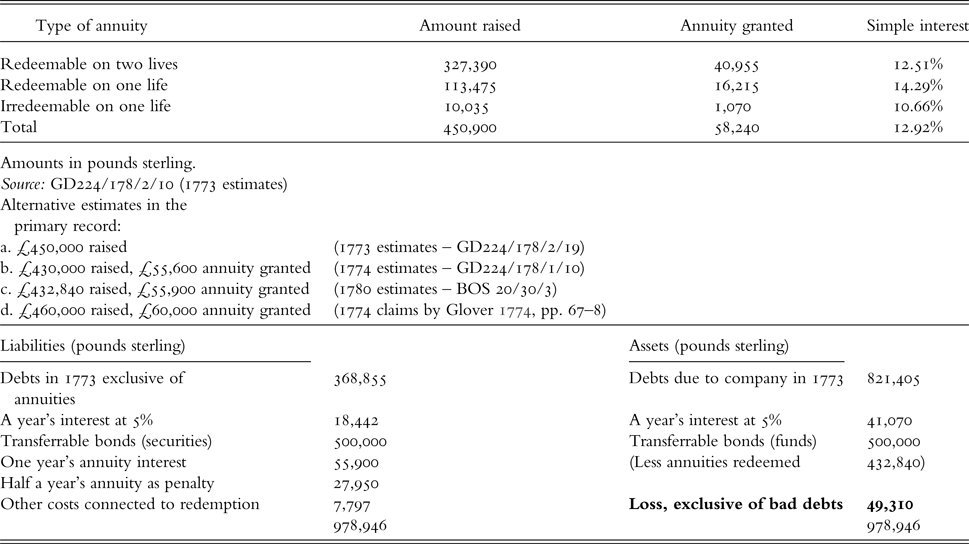
Over the course of that summer, therefore, the bank managed to raise approximately £450,000 at an interest rate between 12 and 14 per cent per annum (Table 3). The measure allowed it to resume payment, although this was little more than window dressing according to the same Hume letter quoted above:
They pretend to open at Air in order to have a Pretence for striking off any farther Interest, but as soon as great Sums are demanded they pretend that they are only to change small Notes for the Circulation of the Country; and so refuse Payment: this is in effect shutting up again.
Ayr Bank annuities (top), and balance sheet, 12 August 1774, demonstrating final loss arising from the measure (bottom)
Source: BOS 20/30/3 (1780 estimates).
The annuity measure was the pivotal event which made the company non-viable as a long-term proposition. It resulted in a minimum annual loss over interest revenue of £33,000, even before any bad debts were taken into consideration. This was a prohibitive amount under any circumstances, and an impossibility in the prevailing credit environment. Any Bank of England loan would have been made at the maximum legal interest of 5 per cent, whereas annuity interest was unrestricted. Moreover, the personal security of the two dukes was still required,Footnote 55 so it is not clear why this was considered less onerous than the terms demanded by the Bank of England, particularly as the annuity sums guaranteed were three times as great as the proposed assistance by the Bank.
There is simply not enough evidence to attribute this disastrous decision to a specific motive. A wish to remain independent, panic, or inexperience are as likely as the Precipitation's claims that the annuity money was intended for the ‘private accommodation’ of favoured counterparties.Footnote 56 George Home, manager for the company after August 1773, commented privately on the ‘foolish engagements the Directors at London were tricked into by a certain West India house in Edinburgh’,Footnote 57 probably referring to William Alexander & Sons, a major sugar and tobacco concern connected with Glyn & Hallifax in London (Price Reference Price1973, pp. 606–9, 639–42).Footnote 58 Whether by dishonesty or incompetence, the accounting of the annuities was so ‘loose and slovenly’ as to make it impossible to state what amount was raised exactly. Even worse, although most of the annuities were supposed to be redeemable at the option of the company, the option clause was omitted from the written annuity contracts. The Case explained the reason for this apparent oversight:
It was agreed verbally, though not entered in the bonds…, that it should be in the power of [the bank] at any time to redeem these annuities … This agreement, though understood between the parties, was not contracted in the annuity bonds as it was imagined if the bonds contained such clause they might be voided on the Statute of Usuries.
Later legal opinion feared that both this rationale, and any hopes of setting aside the annuities as usurious after all on the strength of their interest rate, were equally unfounded. There was a danger, moreover, that if the annuitants disputed the verbal option clause in court, the contracts would in all likelihood be judged irredeemable. There were finally no prospects of an intervention of a Court of Equity, as it had been the company which had sought the annuities in the first place, being ‘imprudent, but not deceived nor imposed on by the annuitants’.Footnote 59
All that the annuity measure had therefore achieved was to buy a little time at immense cost. A number of partners decided to use this breathing space ‘to get out of the Scrape as soon as [they could] by a dissolution of the Copartnery’. They predictably included those richest and most pre-eminent partners whose fortunes could be liable for the whole of the partnership's debts in the event of a bankruptcy. For such people it was vital that the company be wound up instead. Their manoeuvring can be observed in two significant letters written by Home in early 1773 and addressed to Henry Dundas, then Solicitor-General and one of the bank's new extraordinary directors. Home's main concern was getting out of the crippling London debt burden, which apart from the annuities included another £83,000 still serviced by the old ‘disagreeable, [almost] disgracefull, practice of hunting through the City for Discounts’. This not only cost as much as 12 per cent to maintain, but further injured the credit of the company ‘by the number of their bills circulating in London and by the arts and solicitations they are obliged to make use of to obtain discounts’.Footnote 60
There also remained over £200,000 of banknotes still outstanding and theoretically convertible to specie. Home advised seeking the help of the Edinburgh banks in withdrawing them from circulation in exchange for the company giving up business. He was confident that if the banks were certain that their competitor had resolved to wind-up, they would be keen to take up its banknotes at a discount profitable to them of at least 10 per cent.
Significantly, Home implied that winding-up was not a popular option with many of the partners, and advised that in order to dissolve the Company an extraordinary General Meeting should rather be held
in Edinburgh in April, [to] save much trouble and prevent effects of any Cabals that may be formed for the [regular] General Meeting in May. But if the Extraordinary Directors shall find it impossible to get the Company dissolved before [then], it seems prudent … upon some plausible pretence to get the meeting adjourned to Edinburgh. All the Partners in that neighbourhood will be desirous of dissolving the Company [whereas] most of the Partners about Air will wish it to go on.
On 12 August 1773 the bank closed its doors for good, and established a Committee to oversee the winding-up with Home as factor and manager. In exchange, the Edinburgh banks retired £132,000 of its banknotes between August 1773 and May 1774, each taking up about half.Footnote 61 In order to replace the annuities with cheaper and shorter-duration debt as well as to resolve the verbal redemption option problem, a Bill was submitted to Parliament in March 1774 for authorising a sale of £500,000 in transferrable bonds bearing 5 per cent. These were to be secured on unentailed estates in Scotland yielding £32,000 per annum, and repaid in equal portions in 1778, 1779, 1780 and 1782. Although the Bill was formally concerned with the bond issue alone, it also stated passim that the annuities were subject to ‘a power given by the purchasers of the said annuities, by verbal agreement’,Footnote 62 to the bank to redeem them with half a year's annuity as penalty. There was no challenge to this interpretation as had been feared, nor did the holders object to having their lucrative annuities exchanged for short-term securities paying only 5 per cent. According to Glover (Reference Glover1774), the offer was ‘unanimously agreed to by a very numerous meeting of annuitants’.Footnote 63 It is possible that the English annuitants settled for the sizeable redemption premium and the increased tradability of their new securities rather than risk the company entering bankruptcy.
Notable opposition to the scheme came from the East India Company, its own finances only recently tidied over by the government as part of the Regulating Act of 1773, which petitioned that if half a million of new transferrable bonds bearing 5 per cent were issued, ‘it would materially affect and prejudice the interest and credit of the [Company], by reducing the value of their bonds, which are now issued at an interest of three per cent only’. Despite further objections in the Commons over granting ‘a greater privilege than ever was granted before’, as well as the ongoing wrangles between the bank's partners that threatened to derail its progress through Parliament,Footnote 64 the Bill passed easily, by a majority of 176 to 36.Footnote 65 The final cost of the annuity exercise, including interest, premia and transaction costs, came close to a staggering £50,000.
IV
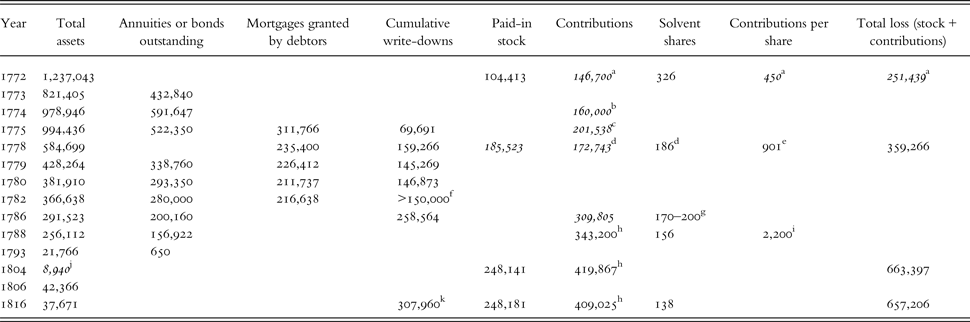
The company now entered its long liquidation phase (Table 4). In the same 1773 letters to Dundas, Home had outlined a structured debt collection plan in which he divided debtors by occupation, and proposed different collection schedules and enforcement accordingly. Merchants and manufacturers
whether possessed of land or not, should be obliged to give bills for [their] debt … If their bills are not paid when due, all that whose debt exceeds a certain sum … must resolve either to take annuities corresponding to their debt and find sufficient security for the payment of them, or submit to the diligence of the Law. Those whose debts are below the above sum must be treated according to their different circumstances. Only it should be observed as a General Rule with all, never to allow their bills to lye over when due, and never to agree to a renewal without the payment of a part.
The unwinding of the Ayr Bank, 1772–1816
Amounts in pounds sterling. Derived and estimated figures in italics.
Notes:
a1788 estimates.
b1791 estimates (GD224/178/8/3, fo. 9).
c1778 estimates. £200 per share were called for in 1776.
d1786 estimates (GD224/178/8/8).
e£900 19s (GD224/178/5/4). £541 10s 9d levied in 1778.
f‘Personal debts above £300,000 but valued only at £150,000’.
gGeorge Home's then current estimates.
hPaid-up account.
iExcludes £200 per share levied in 1776, which was included in stock account instead.
j1873 estimates by Somers, probably incomplete.
kIncludes £17,189 of ‘almost completely desperate debts’.
Sources (unless otherwise noted): 1772, Precipitation, pp. 86–7; 1773–4, 1779, BOS 20/30/3; 1775, GD224/178/3/27; 1778, GD224/178/4/7&8 and GD224/178/5/6; 1780, GD224/178/2; 1782, GD224/178/6; 1786, 1788, GD224/178/8; 1793, GD224/732/1/9; 1804, Somers 1873, p. 103; 1806, 1816, GD267/20/18.
Home urged a lenient treatment for farmers, for ‘it would be vain to force annuities upon them’, but was much more severe with landowners, who
should be obliged either to pay their debt at the first term after the dissolution of the Company, or take annuities corresponding to it and give heritable security for their regular payment. There is some reason for allowing a merchant two terms to make his payments as he may have effects which will require some time to convert into money, but a landed man can have none.Footnote 66
Home also suggested that those managing the liquidation should be ‘men of business who are to be paid for their trouble’, rather than high-minded generalists. To properly motivate such professionals, their payment should come from a percentage of the debts recovered rather than a fixed salary, as ‘it can never do harm to make it a man's interest to be honest and industrious’. It is ironic, however, that when Home took the job himself, he rather preferred a fixed salary after all.Footnote 67
Unfortunately for Home's professed ‘vanity of having it in [his] power to show that the involved affairs of a great Company may be winded up with integrity and Dispatch’,Footnote 68 the process quickly encountered difficulties. The pace of asset recovery fell behind that of bond repayments, and although interest was meticulously paid there were never enough funds to fully discharge the principal on schedule. The bonds had a mixed record as tradable securities. There had been hopes that they would prove as liquid as East India bonds, and initially at least they enjoyed brisk enough demand,Footnote 69 rising as high as a 4⅞ per cent premium in 1774.Footnote 70 A Scottish planter in Grenada in 1775 even expressed a preference for them over the Public Funds as war with America became likelier.Footnote 71 By August 1778, however, the bonds had fallen into 3½, 5½ and 7 per cent discount for the three final maturities respectively, and there were reportedly ‘no buyers whatever’ for them.Footnote 72 By 1780, market opinion had deteriorated to the point where the Bank of Scotland bluntly informed Home that ‘there are few … men in the Kingdom who will rank them with India Bonds’.Footnote 73
By then the attitude of the Bank of Scotland had become the biggest problem Home had to face. The Royal Bank proved forgiving enough, perhaps influenced by the Duke of Buccleuch's governorship since 1777.Footnote 74 Creditors in England also proved amenable to accepting extensions to the their bond maturities, probably feeling secure in the mortgages held by the independent Trustees in London, and happy to earn the maximum legal interest in the meantime. By contrast, the increasingly exasperated Bank of Scotland refused to accept having their limited capital tied up in such an unproductive investment and threatened to take action against the most prominent partners unless its principal was repaid on schedule. This was only averted through a series of demands by the Committee for extraordinary ‘contributions’ from partners. A call for £200 per share was first made in 1776, but was contested in the Court of Session on the grounds that as the company had given up business, neither the Committee nor the General Meeting had the right to compel such contributions. The Court's ruling in favour of the bank was a landmark case in defining the liability of individual partners pro rata according to shares held by each, and opened the road for further ‘contribution’ demands in the future.Footnote 75
A little over £89,000 was thus raised in 1778, and with many partners having already failed, the shortfall was made up by others contributing more than their share.Footnote 76 In 1780 the standoff with the Bank of Scotland was repeated in particularly heated terms,Footnote 77 and the impasse was resolved through new emergency calls on 40 prominent partners.Footnote 78 In 1782, the Committee made an offer to creditors to repay the remaining principal in three instalments ending in 1786, but two years after that there were still over £150,000 of undischarged bonds outstanding and even the combative Bank of Scotland still held £33,000.Footnote 79 It was only in June 1789 that the company paid off its English bondholders, and by 1793 the remaining bonds were finally redeemed. To accomplish this, a further ‘contribution’ was levied on solvent partners in 1788. Total ‘contributions’ since 1778 came to £343,200, or £2,200 per each of the 156 shares still solvent, and included compensation for those partners who had overpaid their share in the 1778 and 1780 bond emergencies. The ‘contribution’ account continued to grow after 1788 to discharge other debts.
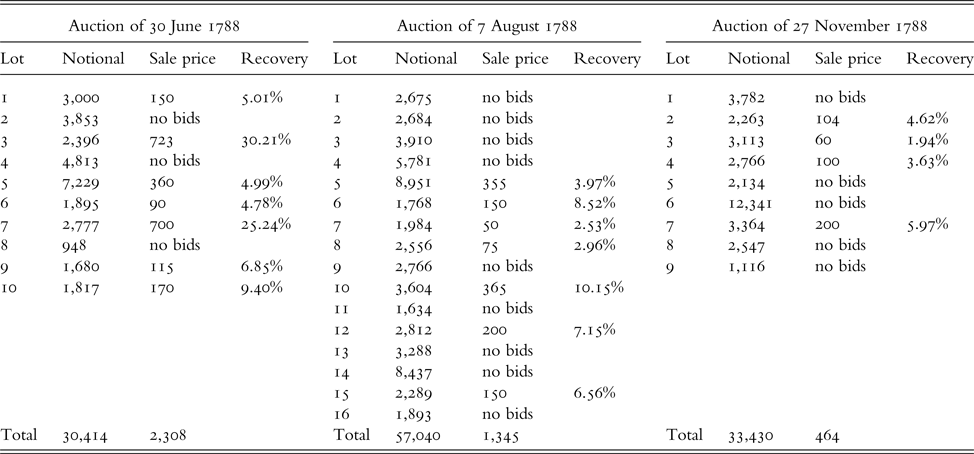
With the bonds repaid, Home aimed to wrap up the collection process by selling remaining assets to other collectors in three public auctions (Table 5). His success appears uneven, with many lots going unbid and with recovery rates for others in the low single digits, and little more than £4,000 was thus raised. On Home's retirement from managing the company in 1793, £120,000 of desperate debts were grouped together for further auctioning, with unknown results.
Ayr Bank bad debts sold by public roup, 1788
Amounts in pounds sterling.
Source: GD224/732/1/2&6, GD224/178/8, GD288/220.
These problems were partly a result of bad debts. Cumulative asset write-offs already exceeded £150,000 at the time of the bond emergencies, and were to rise to twice that amount in the future. The crisis had dealt a serious blow to Scotland's economy as land improvement and industrial projects had to be postponed or abandoned, and as trade declined in the stagnation of credit. Conditions remained distressed with the descent into the American war, and were only partly relieved by the establishment of new private banks and a branch system by the Bank of Scotland. The situation was made worse by the depreciation in the value of collateral held by the bank, as the market became glutted with land offered for sale. According to tradition (Fullarton Reference Fullarton1793, p. 22; Forbes Reference Forbes1860, p. 42n), estates worth £750,000, or even ‘a large proportion of the county of Ayr’, changed hands following the crisis. This apocryphal figure at best represents a notional pre-crash value rather than actual sale proceeds. The ever sanguine Home hoped to raise £190,000 from estate auctions in 1782,Footnote 80 but quickly admitted ‘the improbability of finding purchasers … in the present State of the Country’.Footnote 81 Considering that the bank had to call for over £400,000 in cash ‘contributions’ from its partners to discharge its debts, the liquidation of its land assets was surely done at distressed levels. Whatever the exact amount came to in the end, the land market remained depressed enough for people outside Scotland to contemplate taking advantage and purchasing land cheaply (Munn Reference Munn1981, p. 35).
V
The collapse of the Ayr Bank project has been called ‘a major catastrophe for Scotland’ (Hamilton Reference Hamilton1963, p. 412). It was certainly a catastrophe for the bank's partners, over half of whom eventually became insolvent. Rumour put the number of bankrupt partners at 114 in 1775, while the 1788 ‘contribution’ demand was in turn addressed to 112 partners leaving 125 potentially insolvent. Those identified as merchants in the proprietor lists suffered disproportionately more, with almost three-quarters not contributing.
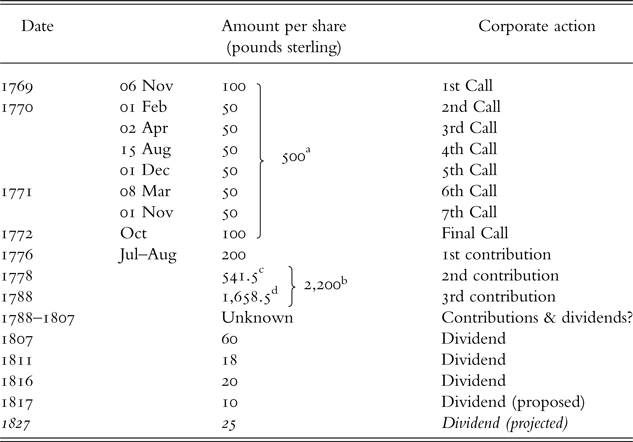
The figure given traditionally for the total value destroyed in the venture is £663,397, but this originates from a much later secondary source (Somers Reference Somers1873). Simple arithmetic furthermore shows that this cannot arise from the similarly much quoted £2,200 per share loss, which in fact only refers to the 1778 and 1788 ‘contributions’. In any event, it is neither the latest nor the most complete figure available. The primary record continues to 1816, by which time the bank's affairs had been wound down to such an extent that General Meetings were held only once every few years, either to appoint a new manager, or to approve the payment of dividends to solvent partners as the bank's remaining assets were recovered. There were at least three such payments made for a total of £98 a share, with a further £10 suggested for 1817 (Table 6). Litigation was so complicated as to make further dividends uncertain. The last known case was concluded in 1827, almost but not quite ‘some time after the passing of the Reform Act’ of popular report (Forbes Reference Forbes1860). The bank was due to receive a little over £3,500 from this settlement, which would project to a dividend of around £25 per share if the number of solvent shares remained unchanged between 1816 and 1827.Footnote 82
Schedule of capital calls, contributions, and dividends for the Ayr Bank, 1769–1827
aSubscribed capital.
bFigure usually identified in the literature as ‘total loss per share’ .
cExact amount: £541 10s 4d.
dExact amount: £1,658 9s 8d.
Estimated figures in italics.
Sources: NAS GD224/178/2/13 (calls 1–7); GD224/178/2/25, GD224/178/4/3 (final call); Decisions of the Court of Session 1778–81, XXXIV, p. 57 (1776 contribution); GD224/178/5/4 (1778 contribution); GD224/178/8 (1788 contribution); GD267/20/28 (post-1793 dividends).
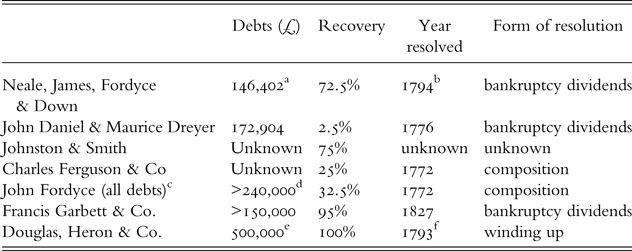
Going by the 1816 accounts, and excluding knock-on economic effects, the total value destroyed by the venture came to £657,206 and only 138 shares still drew a dividend. The Darien disaster earlier in the century, to which the Ayr Bank affair was sometimes compared,Footnote 83 was said to have cost Scotland around £400,000. Compared with the other major British failures of the 1772 crisis, this affair was the most damaging financially and one of the slowest to resolve (Table 7). The insistence on paying creditors in full and avoiding a bankruptcy at all costs prolonged what was already a difficult liquidation process, and in turn exacerbated individual partner losses as interest mounted. An anonymous 1782 pamphlet complained that the affairs of the bank were being unjustifiably prolonged, thus compounding the partners' costs, and pointedly wondered whether the delay might have been due to the ‘emoluments of office [and the] lucrative establishment’ awarded to the Committee and its Manager.Footnote 84
Comparison of major failures from the crisis of 1772
aProven debts accepted by the commission of bankruptcy on the joint estate only.
b62.5% was recovered by March 1777.
cIncludes personal debts, as well as those by Fordyce, Grant & Co and Fordyce, Malcolm & Co.
dLetter to the Partners of Mess. Douglas, Heron, and Company by ‘A Partner’, p. 10, appended to the Precipitation.
eTransferrable bonds issued under Act of Parliament, 1774.
fFinal bond repayment.
Sources (except noted above): row 1, B 3/3675–6; row 2, BGA 9/87; row 3, Saville Reference Saville1995, p. 181; rows 4–5, Precipitation, appendix X, pp. 116–23; row 6, CS44/132/64.
Along with the monetary and business model criticisms found in the literature, one must attribute the magnitude of the disaster to a few decisions at the time of the crisis, with the annuity measure most prominent of all. The bank's Directors may not have been particularly venal or incompetent as latter tradition would have them, but the way the company's misfortunes multiplied after the 1772 crash certainly underlines their inexperience. It would have proved less painful to the partners had the terms of the Bank of England rescue been accepted, onerous as they may have appeared at the time. From the moment the annuity measure was resorted to, the bank entered a series of reflexive and costly actions to fend off recurring emergencies. Whether or not this was a necessary ‘awful object lesson’ in the virtues of specialised expertise over ‘capitalism by generalists’ that Scottish banking needed to learn (Brady Reference Brady1973, p. 27), it had certainly proved a most expensive one.