1. Introduction
Priapulids are a small group of marine invertebrates in modern ecosystems. Recent study indicates that priapulids belong to Cycloneuralia of Ecdysozoa, and they have a close relationship with kinorhynchans and loriciferans (Nielsen, Reference Nielsen2012). In past decades, well-preserved fossil priapulids have been frequently recovered from Konservat-Lagerstätten, particularly in Cambrian strata (Conway Morris, Reference Conway Morris1977; Conway Morris & Robison, Reference Conway Morris and Robison1986; Hou & Bergström, Reference Hou and Bergström1994; Huang, Vannier & Chen, Reference Huang, Vannier and Chen2004a ,b; Han et al. Reference Han, Shu, Zhang and Liu2004; Hu et al. Reference Hu, Steiner, Zhu, Luo, Forchielli, Keupp, Zhao and Liu2012; Peng et al. Reference Peng, Huang, Zhao and Sun2016; Martin, Lerosey-Aubril & Vannier, Reference Martin, Lerosey-Aubril and Vannier2016; Yang, Zhao & Zhang, Reference Yang, Zhao and Zhang2016). The most diverse record of fossil priapulids is from the early Cambrian Chengjiang Lagerstätte (Han et al. Reference Han, Shu, Zhang and Liu2004; Hou et al. Reference Hou, Aldridge, Bergström, Siveter, Siveter and Feng2004; Huang, Vannier & Chen, Reference Huang, Vannier and Chen2004a ,b; Ma et al. Reference Ma, Aldridge, Siveter, Siveter, Hou and Edgecombe2014). Those fossil records indicate that priapulids were important components of early Palaeozoic ecosystems, especially the Cambrian infaunal communities (Zhao et al. Reference Zhao, Caron, Bottjer, Hu, Yin and Zhu2014). Most of these fossil priapulids are thought to be stem-group priapulids or even Cycloneuralia (Wills, Reference Wills1998; Dong et al. Reference Dong, Bengtson, Gostling, Cunningham, Harvey, Kouchinsky, Val'kov, Repetski, Stampanoni and Donoghue2010; Harvey, Dong & Donoghue, Reference Harvey, Dong and Donoghue2010; Wills et al. Reference Wills, Gerber, Ruta and Hughes2012; Ma et al. Reference Ma, Aldridge, Siveter, Siveter, Hou and Edgecombe2014). The fossils of crown group priapulids are extremely rare, and are restricted to only Palaeozoic deposits in a few localities. So far, they have been recovered from only two Lagerstätten, the early Cambrian Chengjiang and the Pennsylvanian Mazon Creek, respectively. With three reported genera and an undescribed taxon (Chen et al. Reference Chen, Luo, Hu, Yin, Jiang, Wu, Li and Chen2002; Huang, Vannier & Chen, Reference Huang, Vannier and Chen2004 b; Han et al. Reference Han, Shu, Zhang and Liu2004; Huang, Chen & Vannier, Reference Huang, Chen and Vannier2005; Ma et al. Reference Ma, Aldridge, Siveter, Siveter, Hou and Edgecombe2014), the Chengjiang Lagerstätte documents the most diverse fossil assemblage of crown group priapulids known so far (Zhao et al. Reference Zhao, Caron, Bottjer, Hu, Yin and Zhu2014). The Middle Pennsylvanian-aged Mazon Creek biota yields just one single taxon, namely Priapulites konecniorum (Schram, Reference Schram1973; Wills, Reference Wills1998). Here we report a new discovery of a crown group priapulid, Xiaoheiqingella sp., from the early Cambrian Guanshan Lagerstätte, eastern Yunnan, SW China, providing more fossil records for understanding the early evolution of priapulids.
2. Geological setting
The Guanshan Lagerstätte (Cambrian Series 2, Stage 4), slightly younger than the famous Chengjiang Lagerstätte (Cambrian Series 2, Stage 3), is an important Burgess Shale-type Lagerstätte from Yunnan Province of SW China (Hu et al. Reference Hu, Zhu, Steiner, Luo, Zhao and Liu2010). Exceptionally preserved fossils are recovered from yellowish mudstones of the Wulongqing Formation in several localities across eastern Yunnan. The age of the Wulongqing Formation is well defined by two trilobite zones, the lower Palaeolenus Zone and the upper Megapalaeolenus Zone (Luo et al. Reference Luo, Li, Hu, Fu, Hou, Liu, Chen, Li, Pang and Liu2008). Sedimentological analyses indicated that the fossil-yielding mudstone was deposited in a storm-dominated offshore transition within the photic zone, about 40–50 m in depth, which is between fair-weather wave base and storm wave base. The exceptional preservation of the Guanshan fossils likely resulted from rapid burial of storm-induced fine-grained sediments (Hu et al. Reference Hu, Zhu, Steiner, Luo, Zhao and Liu2010).
Fossil worms are common in the Guanshan Lagerstätte, but all are stem-group priapulids, including four palaeoscolecids and one corynetiid (Hu et al. Reference Hu, Li, Luo, Fu, You, Pang, Liu and Sterner2008, Reference Hu, Steiner, Zhu, Luo, Forchielli, Keupp, Zhao and Liu2012). Despite extensive collecting over several years, the fossil reported here is the only specimen of crown group priapulids from the Guanshan Lagerstätte.
3. Materials and methods
A single specimen was collected by splitting the mudstone rocks from the lower part of the Wulongqing Formation at the Gaoloufang section, Kunming, Yunnan, SW China (24°57′20″N, 102°48′20″E). The material was prepared using a sharp blade under the microscope. The specimen was photographed with a Canon Mark II camera with an EF 100 mm f/2.8L IS USM close-up lens under incident light. Enlarged details at the millimetre scale are photographed with a camera mounted on a Zeiss Stereo Discovery V16 microscope system under fibre-optic lights. The nomenclature applied in this study follows that of modern priapulids (van der Land, Reference van der Land1970) and fossil priapulids, particularly crown group priapulids (Huang, Vannier & Chen, Reference Huang, Vannier and Chen2004 b; Han et al. Reference Han, Shu, Zhang and Liu2004; Ma et al. Reference Ma, Aldridge, Siveter, Siveter, Hou and Edgecombe2014).
4. Systematic palaeontology
Phylum PRIAPULIDA Delage & Hérouard, Reference Delage and Hérouard1897
Family Xiaoheiqingidae Hu in Chen et al. Reference Chen, Luo, Hu, Yin, Jiang, Wu, Li and Chen2002
Emended diagnosis. Body small, cylindrical and divisible into four sections: an anterior introvert, a neck, an annulated trunk and one or a pair of unornamented caudal appendages. Introvert swollen, with 25 rows of scalids on the anterior half.
Included genera. Xiaoheiqingella Hu in Chen et al. Reference Chen, Luo, Hu, Yin, Jiang, Wu, Li and Chen2002
Genus Xiaoheiqingella Hu in Chen et al. Reference Chen, Luo, Hu, Yin, Jiang, Wu, Li and Chen2002
Type species. Xiaoheiqingella peculiaris Hu in Chen et al. Reference Chen, Luo, Hu, Yin, Jiang, Wu, Li and Chen2002.
Xiaoheiqingella sp.
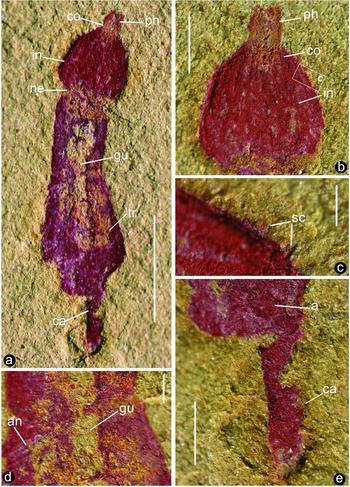
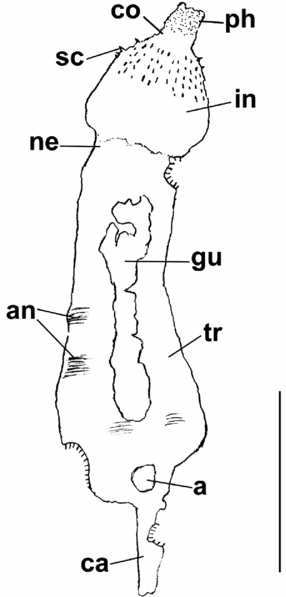
Figures 1, 2
Material. Only one single specimen, NIGPAS164492, has been recovered and made available for this study. The specimen is deposited in the Nanjing Institute of Geology and Palaeontology, Chinese Academy of Sciences, China (NIGPAS prefix).
Xiaoheiqingella sp. from the early Cambrian Guanshan Lagerstätte, Gaoloufang, Kunming City, Yunnan Province. (a) Overview of the unique specimen, NIGPAS164492. (b) Enlargement of the introvert. The frame is enlarged in (c). (c) Enlargement of the scalids. (d) Enlargement of the middle part of the trunk, showing the annulations. (e) Enlargement of the distal part of the trunk and the caudal appendage. Scale bars: 2 mm in (a); 500 μm in (b); 100 μm (c); 200 μm in (d); and 500 μm in (e). The following abbreviations are used: a – anus; an – annulation; ca – caudal appendage; co – collar; gu – gut; in – introvert; ne – neck; ph – pharynx; sc – scalids; tr – trunk.

Interpretative camera lucida drawings of Figure 1a. Scale bar is 2 mm. The following abbreviations are used: a – anus; an – annulation; ca – caudal appendage; co – collar; gu – gut; in – introvert; ne – neck; ph – pharynx; sc – scalids; tr – trunk.

Description. The animal can be divided into four distinct parts: an anterior introvert, a constricted neck, a finely annulated trunk and a caudal appendage (Fig. 1a). The total length of the body is 8.5 mm. The ratio of introvert length/trunk length is 1:2.5.
The introvert is sub-triangular (Fig. 1b), anterior to the neck, and comprises one-fourth of the body length (excluding the length of the caudal appendage); the length of the introvert is 2 mm. The introvert reaches the maximal width (1.1 mm) in its posterior half. Twelve longitudinal rows of scalids are recognized on the visible surface of the introvert. A total of 25 longitudinal rows of scalids on the entire introvert is estimated. Scalids are observed on the edge of the anterior part of the introvert (Fig. 1b, c). The total number of scalids on each row is unclear, but at least five scalids are visible. Anterior to the introvert is the collar, with a visible width of 0.8 mm. The surface of the collar is smooth, with a length of 0.1 mm, slightly narrower than the introvert (Fig. 1b). Anterior to the collar is the initial part of the pharynx, about 0.2 mm in length, armed with very tiny teeth, the detail of which is unclear owing to low preservational resolution.
The neck area is short, 0.8 mm in width, and appears as a constriction between the anterior introvert and the posterior trunk (Fig. 1a). No ornamentation or surface structures have been observed owing to preservational quality.
The trunk occupies about 3/5 of the body. The total length of the trunk and preceding neck is 5 mm. The width of the trunk is constant through the first 2 mm, and increases slightly in the next 2 mm, then decreases in the last 1 mm. Neither annulations nor ornaments are observed on the anterior half of the trunk. Fine, densely arranged annulations are present on the lower part of the trunk (Fig. 1a, d), c. 10 annulations per millimetre, but the total number of annulations is difficult to count.
The gut is obvious and preserved in relief, extending along the longitudinal axis of trunk. Most parts of the gut are filled with mud, with a light yellow colour. No food remains are recognized. There is a small, round structure close to the distal end of the trunk (Fig. 1e), with a diameter of 0.1 mm. It was interpreted as an anus, based upon its location and appearance.
A cylindrical, slender structure extending from the end of the trunk is interpreted as the caudal appendage (Fig. 1a, e). The length of the caudal appendage is 1.2 mm. The width is 0.2 mm, constant from anterior to posterior end.
Occurrence. Wulongqing Formation, Palaeolenus Zone, Guanshan Lagerstätte, Cambrian Series 2, eastern Yunnan.
Remarks. The current specimen is similar to X. peculiaris from the Chengjiang Lagerstätte in having an introvert with 25 longitudinal rows of scalids, a short neck area, a long and densely annulated trunk, and a slender caudal appendage. These typical diagnostic characteristics of Xiaoheiqingella warrant its generic assignment. The new specimen differs from X. peculiaris in having a posteriorly expanded trunk and lacking papillae. In fact, the posteriorly expanded trunk was listed as an important diagnostic characteristic of another crown group priapulid, Yunnanpriapulus (Huang, Vannier & Chen, Reference Huang, Vannier and Chen2004 b). But Yunnanpriapulus was treated as junior synonym of Xiaoheiqingella in several works (Han et al. Reference Han, Shu, Zhang and Liu2004; Han & Hu, Reference Han and Hu2006; Ma, Hou & Baines, Reference Ma, Hou and Baines2010). The Guanshan specimen probably represents a new species of Xiaoheiqingella. However, further assignment at the species level is not attempted owing to the limitation of information from the single specimen. Tentatively, the specimen is assigned herein to Xiaoheiqingella in open nomenclature.
5. Discussion
Priapulites konecniorum from the Middle Pennsylvanian Mazon Creek biota is the first fossil record of a modern-type priapulid. It has been regarded as one of the ancestors of living priapulids (Schram, Reference Schram1973). The second crown group fossil priapulid, Xiaoheiqingella peculiaris Hu in Chen et al. Reference Chen, Luo, Hu, Yin, Jiang, Wu, Li and Chen2002, was reported from the early Cambrian Chengjiang Lagerstätte (Chen et al. Reference Chen, Luo, Hu, Yin, Jiang, Wu, Li and Chen2002). Subsequently, Huang, Vannier & Chen (Reference Huang, Vannier and Chen2004 b) named a new genus of crown group priapulid, Yunnanpriapulus, also from the Chengjiang Lagerstätte and made a revision of X. peculiaris. Han et al. (Reference Han, Shu, Zhang and Liu2004) named another new priapulid, Paratubiluchus bicaudatus, from the Chengjiang Lagerstätte and assigned it to the modern family Tubiluchidae. The latest report of fossil crown group priapulids was made by Ma et al. (Reference Ma, Aldridge, Siveter, Siveter, Hou and Edgecombe2014).
Xiaoheiqingella was first assigned to a new family, Xiaoheiqingidae (Chen et al. Reference Chen, Luo, Hu, Yin, Jiang, Wu, Li and Chen2002), but was later moved to the extant Priapulidae, along with Yunnanpriapulus (Huang, Vannier & Chen, Reference Huang, Vannier and Chen2004 b). The replacement was accepted by Han et al. (Reference Han, Shu, Zhang and Liu2004). Regardless of the difference between Xiaoheiqingella and extant representatives, it is inappropriate to assign a Cambrian taxon to a modern family. Recent phylogenetic analyses of fossil and extant priapulids (Wills, Reference Wills1998; Dong et al. Reference Dong, Bengtson, Gostling, Cunningham, Harvey, Kouchinsky, Val'kov, Repetski, Stampanoni and Donoghue2010; Harvey, Dong & Donoghue, Reference Harvey, Dong and Donoghue2010; Wills et al. Reference Wills, Gerber, Ruta and Hughes2012; Ma et al. Reference Ma, Aldridge, Siveter, Siveter, Hou and Edgecombe2014; Zhang et al. Reference Zhang, Xiao, Liu, Yuan, Wan, Muscente, Shao, Gong and Cao2015) have revealed repeatedly that Xiaoheiqingella belongs to crown group priapulids, and lies stemward of the extant clade including the families Maccabeidae, Halicryptidae and Priapulidae. Therefore, Xiaoheiqingella can no longer be grouped in the Priapulidae. The Xiaoheiqingidae is then revalidated herein.
Although only a single appendage was observed on the specimen, originally two is possible by comparison with the type species, X. peculiaris. Another alternative explanation is that the original appendage number is single. The single caudal appendage of Guanshan Xiaoheiqingella was probably derived from the evolutionary loss of one of the paired appendages, since the caudal appendage is positioned on one side of the specimen rather than in the axial position of the trunk. The assumption needs to be confirmed by further discovery of new material.
Acknowledgements
This work is supported by the National Basic Research Programme (2013CB835006); the Strategic Priority Research Programme (B) of the Chinese Academy of Sciences (XDB18030304); and the National Natural Science Foundation of China (Grant No.41472012). The authors are grateful to Dr Diying Huang from Nanjing Institute of Geology and Palaeontology, Chinese Academy of Sciences, and Dr Han Jian and Dr Zhang Zhifei from Northwestern University, Xi'an, China for constructive discussion and suggestions. We also thank Mr Chen Qingtao from Kunming University for field assistance and finding the specimen for this study, and Rodney M. Feldmann from Kent State University, USA for improving the English of this manuscript. We thank the anonymous reviewers for their constructive comments and improving the manuscript.