Introduction
Advance care planning (ACP) is a process of helping individuals to reflect and share their personal values and goals of care and preferences for future medical care. In this process, individuals are encouraged to communicate with their family and healthcare providers and designate a healthcare proxy to represent them if they can no longer speak for themselves (Sudore et al., Reference Sudore, Lum and You2017). This is particularly pertinent for patients with chronic illness because their illness trajectories often involve rapid health decline (Cohen-Mansfield et al., Reference Cohen-Mansfield, Skornick-Bouchbinder and Brill2018 ). However, previous studies have consistently found racial/ethnic differences in ACP such that when compared with non-Hispanic White participants, Hispanic/Latino participants are less likely to express and document their end-of-life (EoL) treatment preferences (Smith et al., Reference Smith, McCarthy and Paulk2008; Carr, Reference Carr2011; Clark et al., Reference Clark, Person and Gosline2018).
Scholars have identified complexities in EoL decision-making that need to consider various influences, including individual and socio-cultural factors. Typically, Hispanic/Latino individuals prefer family-centered decision-making in EoL care (Kelley et al., Reference Kelley, Wenger and Sarkisian2010; Braun et al., Reference Braun, Beyth and Ford2014; Cervantes et al., Reference Cervantes, Jones and Linas2017), value family input, and prefer the family to be the decision-maker even when the patient can make their own decisions (Kelley et al., Reference Kelley, Wenger and Sarkisian2010; Cervantes et al., Reference Cervantes, Jones and Linas2017). However, due to the topic's sensitivity, some Hispanic/Latino individuals do not feel comfortable initiating EoL discussions due to a fear of upsetting the family (Clark et al., Reference Clark, Person and Gosline2018). In addition to cultural differences in values and beliefs, language barriers, limited literacy, and structural barriers intensify ACP complexities resulting in decision uncertainty and/or ill-informed choice (Smith et al., Reference Smith, Sudore and Pérez-Stable2009; Sudore et al., Reference Sudore, Schillinger and Knight2010). Nonetheless, other studies have found that Hispanic/Latino individuals consider ACP valuable and learning about EoL treatment options essential (Maldonado et al., Reference Maldonado, Goodson and Mulroy2019). They also prefer that physicians provide clear information about the patients' health conditions and expected outcomes to both patients and family members (Braun et al., Reference Braun, Beyth and Ford2008).
Hispanic/Latino patients residing in rural areas encounter various challenges in accessing and utilizing healthcare resources, including palliative/hospice care programs and trained palliative care specialists, often leaving cancer patients with limited opportunities to plan ACP and receive palliative/hospice care (Virnig et al., Reference Virnig, Ma and Hartman2006; Lynch, Reference Lynch2012; Ko et al., Reference Ko, Fuentes and Singh-Carlson2020). Residing in a border town, proximity to country of origin (Mexico), cultural beliefs, and values that permeate the community may influence their ACP perspectives. Many cultural studies with Hispanic/Latino cancer patients on ACP include decision-making patterns (Carrion et al., Reference Carrion, Nedjat-Haiem and Martinez-Tyson2013) and intervention studies (Fischer et al., Reference Fischer, Cervantes and Fink2015; Sudore et al., Reference Sudore, Schillinger and Katen2018; Maldonado et al., Reference Maldonado, Goodson and Mulroy2019). However, little is known about the challenges and needs for ACP among rural participants in a geographically unique region. This study aimed to explore ACP experiences, particularly what helps and hampers ACP engagement, and elicit suggestions to improve the ACP process. Interviews focused on participants’ experiences in ACP, particularly (1) what facilitated or hindered the participants from engaging in ACP, (2) what would help to promote ACP, and (3) how healthcare professionals (HCPs) can improve the ACP process.
Methods
Study design and setting
This study is part of a larger ACP study exploring cancer patients’ ACP engagement and the effectiveness of a patient navigator-led ACP educational intervention. As a follow-up study, this study employed a qualitative method where Hispanic/Latino cancer patients were interviewed in-person at a local cancer organization at the US/Mexico border in southern California.
Participants and recruitment procedures
A purposive sampling method was used to recruit participants from a local cancer organization. This community-based service agency served exclusively socio-economically marginalized cancer patients referred from regional oncology clinics in the border town. ACP education is a part of the programs offered at the organization. During the initial intake for the cancer organization services, patients were assessed as to whether they have completed an advance directive (AD) which is a legal document for individuals to express their EoL care preferences and designate healthcare proxy to represent them should they become incapacitated and unable to make decisions about their health care (Yadav et al., Reference Yadav, Gabler and Cooney2017). Those who have not completed an AD were offered an ACP session, led by social work navigators focusing on eliciting patient's values, concerns, and education on EoL communication and completion of AD. For this study, participants who agreed to participate in the ACP session were invited to participate 6 months after receiving the ACP session.
Eligibility criteria included adults age 18 and older, identifying as Hispanic/Latino, and having a cancer diagnosis. Among the 49 cancer patients invited, 14 declined participation in the study due to various reasons (e.g., transportation issues, out of town, busy) and five passed away, resulting in a total sample size of 30. The IRB from the San Diego State University approved all study procedures.
Data collection
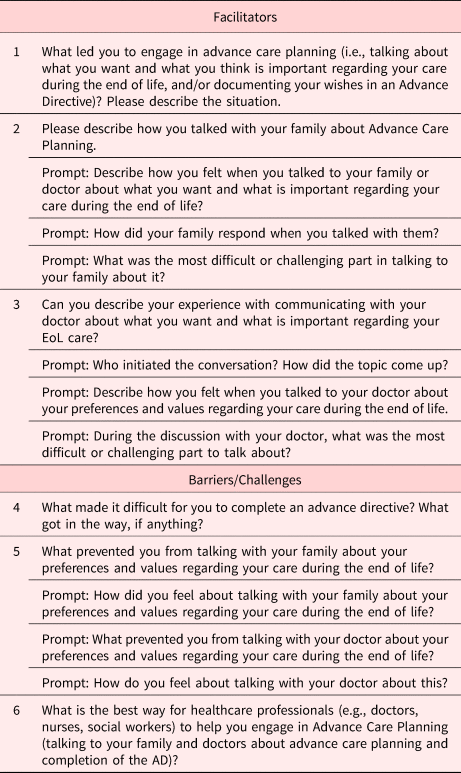
Data were collected via face-to-face interviews from October 2018 to December 2019 by a trained bilingual/bicultural research assistant using a semi-structured interview guide developed based on previous literature findings (Schickedanz et al., Reference Schickedanz, Schillinger and Landefeld2009; Simon et al., Reference Simon, Porterfield and Bouchal2015 see Table 1). All interviews were conducted in-person and two participants were accompanied by their spouses. Interviews were conducted either in Spanish or English and lasted 30–45 min. Participants’ nonverbal behaviors (i.e., facial expression, body language, and difficulty with articulation) were observed and documented in field notes that were used to add contextual meaning during analysis. Debriefing sessions were conducted between the researcher and the research assistant who reviewed any unexpected circumstances or situations that might impact the interview quality. All interviews were audio-taped, transcribed, and translated from Spanish to English. For accuracy of the translation, parts where the translation appeared unclear were reviewed and discussed with the bilingual researcher. Informed consent was obtained from each participant prior to data collection.
Interview guide

Data analysis
Data were uploaded into a qualitative software program, NVivo 12, for analysis. Data were analyzed using thematic analysis (Braun and Clarke, Reference Braun and Clarke2006) that included the following steps. First, translation and transcription of all individual interview data supplemented with researcher notes from recoded data was conducted in a word processing program. Second, we implemented data condensation, where code words were grouped around a “particular concept in the data, called categorizing” (Merriam, Reference Merriam2002, p. 149). Each case was coded independently using line-by-line coding. During this stage in the analysis, researchers (EK and AK) reviewed the transcripts multiple times independently for the purpose of generating an initial set of codes and themes. Discrepancies in the codes were resolved via discussion between the two authors. Once preliminary codes were established and agreed upon between the authors, cases were reviewed independently a second time by the authors to ensure saturation. The third step of the data analysis consisted of data display, where data were organized to identify overarching themes across the participants to gain a greater understanding of the factors that influence EoL communication and AD completion. The last step in the analysis consisted of the two researchers, again comparing findings to ensure no additional themes or codes emerged. Using qualitative data from two sources (interviews and field notes), translating the transcripts conducted in Spanish verbatim to English, and having two researchers independently code the data and compare findings (Braun and Clarke, Reference Braun and Clarke2006) were all done to improve the trustworthiness of the data.
Results
Participants’ characteristics
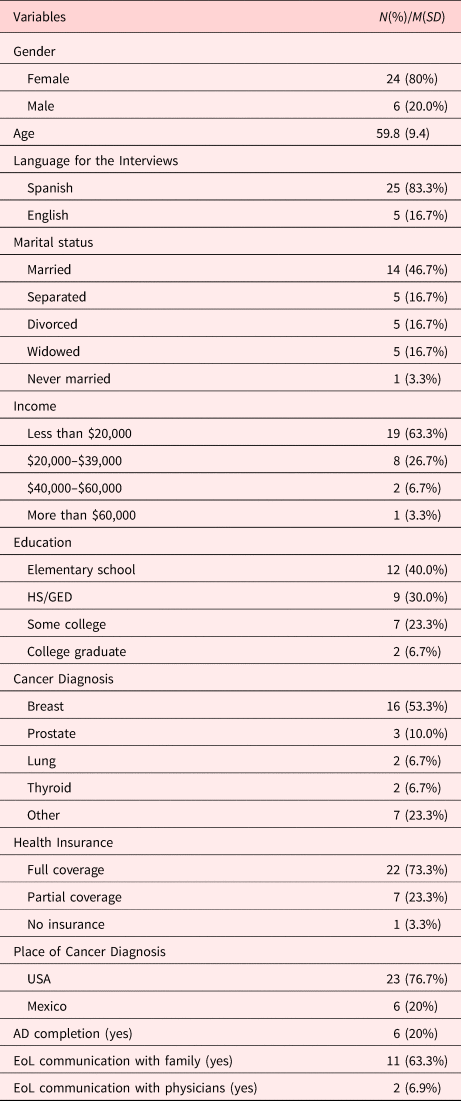
Participants’ sociodemographic and health-related information and ACP-related information are presented in Table 2. Most of the participants were female (80%) with an average age of 59.8 years old. The majority (70%) reported to have a high school degree or less, and about 63% reported having an annual income of less than $20.000. More than half (53.3%) were diagnosed with breast cancer and 20% were diagnosed in Mexico. The majority (83.3%) spoke Spanish in the interviews. In terms of ACP, only 20% of the participants have completed an AD. About two-thirds of the participants have engaged in EoL communication with family, but only 7% had done so with physicians.
Participants' socio-economic, health, and ACP related variables (n = 30)

Themes from the qualitative data
Participants offered details of the facilitators and barriers they experienced as related to ACP. A common theme was safeguarding participants’ desires to emotionally protect family members and was found as both a facilitator and barrier. Additional ACP facilitators included (1) a desire for honoring EoL care wishes and (2) experiences with EoL decision making. ACP barriers included (1) family's reluctance to participate in EoL communication and (2) clinician–patient's lack of initiation on EoL communication. Participants’ suggestions to improve ACP efforts included death education and support for family, ACP education, and person-to-person dialogue as opposed to providing AD document.
Common theme
Safeguarding family as a facilitator
Concerns about family suffering during the patient's EoL phase frequently emerged. Safeguarding family from having conflicts (i.e., decision-making conflict, emotional distress) was an important reason for ACP engagement. A participant explained her reasoning for ACP. “Due to different religious beliefs or thoughts, not just traditions, one will say, 'We are going to pull the plug' and someone else will say, 'no' … it made me see everything much clearer. I have always believed in regards to how to decide and make those decisions — sign the papers and everything” (52 y.o. female). While the EoL topic might cause discomfort in the family, this participant decided to address their EoL wishes to protect their family from emotional suffering later. Another participant noted,
“I have preferred to tell them, even though it might hurt them … I don't want to be resuscitated because I don't want myself and my family to suffer. The pain from seeing someone in a hospital, suffering with artificial life support, no…, I don't want that.” (77 y.o. female)
Safeguarding family as a barrier
Participants’ desires to protect family members from experiencing distress with EoL topics was a clear barrier to ACP. Expressing EoL treatment preferences, particularly forgoing or withdrawing life supports was expected to evoke family's strong emotional reactions. “It hurts them because thinking that the day will come” (68 y.o. female). When the patient is the sole caregiver, protecting family from emotional vulnerability becomes even more important. “They [children] only have me. I did not tell them because it is sensitive — that they can feel bad …” (51 y.o. female). Another participant described a sense of discomfort on the EoL topic, amplified by cultural differences in ACP.
“Mexicans do not get used to that kind of thing [ACP]. In here [US], everything is written in detail but in the Mexican family, we do not like to touch the heart [hurt feelings] … it hurts me to make that decision ….” (57 y.o. female)
Additional ACP facilitators
Desire for honoring EoL care wishes
Participants shared that EoL communication with family was necessary to remind them of their EoL wishes. For example, one participant stated, “They say, “Mom, you already told us. I reiterate because I don't want them to forget” (52 y.o. Female). In other cases, participants found the completion of an AD contributing to their peace of mind, knowing their wishes would be fulfilled. “It gives me peace knowing that my children and my husband already know what I want” (56 y.o. female).
A straightforward approach to expressing their wishes was considered essential to affirm their desires.
“… well, I can tell you that right now, I can say a bunch of plans about it [EoL care] but everything can change suddenly when the time comes. Right? That is why it's very important to be straightforward.” (52 y.o. female)
Experience with EoL care decision making
Participants’ experiences with family and friends relating to EoL care helped them accept death and think about values and goals of care, which further propelled them to engage in ACP. “We learn to accept end-of-life from the hardships [we experienced] from the deaths of parents …” (63 y.o. Male). Additionally, participants noted that family dynamics could potentially intensify the complexities of EoL decision making, and that completion of an AD was viewed to prevent future family discord. “I think that filling it out [AD] is something important … in the end there will be problems if it's not filled out because it reminds me of the time with my mom. We were all in agreement except for one. And I don't want that to happen with my sons” (69 y.o. female).
Additional barriers to ACP
Family's reluctance to participate in EoL communication
Family members' avoidance to engage in EoL communication swayed participants’ engagement in ACP. One participant shared the experience of her husband stifling discussions on her thoughts and plan stating, “When I mention it [end-of-life care], he tells me right away, “Don't think about that because the doctor says there are still options” (55 y.o. female). Cultural taboos on death and dying also led to the family's lack of participation. “We have a culture in which we don't talk about it. I started to talk about it with them and they change the subject” (61 y.o. female). Family members’ strong emotional reaction relating to denial, and the difficulty of accepting loved one's mortality raised participants’ concerns about their EoL wishes being honored.
“They said, 'I will not take you off [from machine] and you will not die' … Sometimes it makes me feel bad because they need to carry out [the conversation about EoL] otherwise, you are not going to die with your preferences.” (57 y.o. female)
Patient–Clinicians’ lack of initiation on EoL care communication
Lack of time with clinicians
Overall, there was a consensus about clinicians’ lack of initiation for ACP. A participant described the clinicians’ lack of time due to a high volume of patients. “Time for them is like … the faster the better because here comes another one, he/she is waiting. There are lots of people” (60 y.o. female). Hence, it leaves the healthcare practitioner with little time to discuss anything other than primary medical concerns. “Usually, you receive one testing before each appointment and they give you results, and then the time goes quickly. He can almost never treat other issues” (51 y.o. female).
ACP is not a priority
Participants emphasized the importance of focusing on current medical treatment and that ACP was not a priority. “I am continuing with my medications and going to my appointments. I know that the advance directives are important but in reality, I haven't felt it necessary right now” (58 y.o. female). ACP is deemed an inviable option for those who have available curative options. “I am hesitant to fill out the form [AD]. Because they (doctors) still haven't told me that there is nothing else that can be done. There is always this little light that says, you're still going” (55 y.o. female).
Suggestions for promoting ACP
Death education and family support
Participants expressed that the family's difficulty in accepting a loved one's death adds complexity to the ACP process. One participant noted, “Many times, it is the family who is in denial and does a lot of things like keeping a patient who is seriously ill connected” (63 y.o. male). HCP's death education and family support were thought to ease the family's distress and enhance their coping. A participant expressed particular concern about his grandchildren's distress over their loss.
“What I would like is that they [HCP] prepare them and tell them about what is going to happen and that it (death) is the most certain thing we have in life … that they don't allow them to suffer by seeing that I will no longer exist. I think some people have told them (grandchildren), 'Your papa-grandpa isn't going to last much longer' … She was crying and told me that she didn't want me to die.” (63 y.o. male)
A participant noted witnessing family suffering intensified the patient's suffering. Family-centered intervention and support were deemed to potentially mitigate the family's fear and emotional distress.
“They need a specialist to help the family understand what is going to happen … To talk thoroughly with the family so that one accepts that people are going to die. Sometimes a person who is ill suffers when they see their family suffering.” (56 y.o. female)
ACP education
Participants valued ACP education, relating it to “what it is and what its benefits are” (51 y.o. female); they also wanted it be offered to family members, as well, as a form of family support. Participants notably suggested addressing the misperception of ACP being only necessary for dying people. “Explain its concept, and it's not that you are dying already” (46 y.o. female). ACP can be facilitated in various ways and settings as demonstrated by a participant who suggested incorporating ACP in a school curriculum or providing a special class for parents. “There should be more awareness about this. I think they should give a special class for the parents” (56 y.o. female).
Dialogue vs. documentation
Most participants wanted physicians to address EoL care with patients and family members. The HCP's conversation with patients on EoL care is important for obtaining knowledge and “taking the patients’ fear away.” The HCP's active dialogue in one's native tongue (e.g., Spanish), beyond providing written documents, was seen as helpful for enhancing patients’ comprehension. “I think that the best way to get more people to accept [ACP] is teach them and talk to them. Talk to them in our language and not just [giving] the one that is written there which makes our eyes pop out whenever we read it” (52 y.o. female).
Discussion
Our study explored the facilitators and barriers for rural cancer patients’ ACP and suggestions to promote ACP from the perspectives of rural cancer patients. There was a strong theme of familial implications for ACP, which needs to be understood within the cultural context. Although this is an essential factor for ACP, our study found complex interplays between individual safeguarding and family protection, suggesting a critical practice implication.
For those who engaged in ACP, it was considered an important process to ensure their EoL wishes were known and honored. This was shaped by their experiences witnessing family suffering or family conflicts relating to EoL care, which propelled their motivation to engage in ACP. This was also supported by a previous study (Carr, Reference Carr2012). Our participants expressed a strong desire to safeguard the family from emotional distress and EoL decision-making conflicts. They exerted their EoL care preferences to be clearly communicated with the family. Scholars addressed that cultural values/traditions on medical decision-making such as filial duty can lead the surrogates to experience family distress and conflicts (Su et al., Reference Su, McMahan and Williams2014). A previous study (Chiarchiaro et al., Reference Chiarchiaro, Buddadhumaruk and Arnold2015) yielded that surrogates experience moderate or high levels of decisional conflict over patients’ EoL care. Those who had previous ACP conversations with patients had lower decisional conflicts than those who had not.
Nevertheless, participants’ desire for safeguarding family from confronting death, thus causing distress which, in turn, hindered them from initiating EoL discussions with family. The topic of EoL care can make patients and families feel uncomfortable (Ke et al., Reference Ke, Huang and Hu2016), particularly in Hispanic/Latino culture where death is a taboo subject, as noted by a participant in the current study. The family's reluctance or refusal of EoL communication was found to further dissuade the participants from engaging in ACP. Such family's response might be an act of protecting them from emotional distress, as our participants were troubled by the idea that family may not honor their EoL wishes. This was mainly attributed to the family's lack of knowledge or disagreement with participants’ desire for forgoing life-prolonging treatments. Familism, a strong sense of interdependence, and solidarity appear to inflict a dilemma for advocating their wishes with a fear of hurting family. HCP can perhaps mitigate participant's challenges, yet clinician–patients’ lack of EoL communication negatively contributed to ACP. Participants pointed to the clinicians’ lack of time with a high volume of patients, leaving limited time for them to discuss issues beyond attending to the patient's acute medical needs. This is a significant challenge in rural settings with limited healthcare resources (i.e., physicians) (Weinhold & Gurtner, Reference Weinhold and Gurtner2014; Ko et al., Reference Ko, Zúñiga and Peacher2018) which could impose additional burdens and pressure on clinicians due to time restraints. Participants’ lack of initiation for EoL communication was related to “timing” in that ACP was deemed appropriate when participants would become seriously ill (Barnes et al., Reference Barnes, Jones and Tookman2007).
Recognizing the importance of ACP, our participants offered various suggestions, including family support and death education. It was apparent that participants’ EoL decision-making is complicated by a temporal element — acute and future distress relating to family relationships. Participants’ suggestion for family support extends to grandchildren, suggesting that age-appropriate and multigenerational family support is imperative and culturally relevant. Aoun and colleagues (Aoun et al., Reference Aoun, Rumbold and Howting2017) emphasize the importance of HCP's assessment on the family's emotional/psychological distress and needs for support at pre-bereavement. Integrating early family support such as death education can, perhaps, effectively address the family's fear of death and facilitate meaningful patient-family communication.
Participants also pointed to the need for correcting the misperception that ACP is needed only for those with impending death. Due to the limited healthcare professionals and their time restraints, facilitating community-based ACP education might be an optimal solution. For example, collaborating with patient navigators who have in-depth community knowledge and resources, language efficiency, and are well-versed in cultural norms can effectively engage in underserved racial/ethnic groups for ACP/palliative care (Fischer et al., Reference Fischer, Sauaia and Kutner2007; Fink et al., Reference Fink, Kline and Bailey2020). These could help bridge the structural gaps in the rural region. Indeed, engagement in ACP in language concordant dialogue was perceived to increase patients’ active participation and comprehension. Given the negative impacts of cancer communication affected by language barriers and literacy among rural Hispanic/Latino cancer patients (Ko et al., Reference Ko, Zúñiga and Peacher2018), HCPs need to tailor ACP communication to consider patients’ language preferences and literacy.
Limitations
To our knowledge, this study is the first to explore facilitators and barriers for ACP among Hispanic/Latino cancer patients in a rural US/Mexico border region. While our study expands our knowledge of EoL decision-making and suggests culturally relevant interventions for ACP practice, there are some limitations. Although the study site is the largest community-based cancer organization in this rural region, recruiting participants from a single site limits generalizability. A future study that includes multiple locations with a larger sample size may improve representativeness. It will also be necessary to have family members as a dyad to explore ACP perspectives between patients and family members. Given that safeguarding family was an emergent theme in this study, exploring similarities/differences toward ACP might offer ACP contextual explanations among rural Hispanic/Latino populations.
Conclusion
Our findings draw attention to the barriers and facilitators Hispanic/Latino cancer patients residing in a rural, medically underserved region experience when planning for EoL care. Of particular importance is the role family members can play in ACP engagement. Findings demonstrate that how patients’ responses to ACP engagement are often contingent on perceived family member's responses. Inclusion of family in EoL care during physician visits to acknowledge and address the importance of ACP education with the patient and family is critical to promote ACP. Physician attempts to prioritize ACP education while including family members could have a meaningful impact on AD completion rates among culturally diverse cancer patients.
Availability of data and material
The data that used to report the findings of this study are available upon request. The data are not publicly available.
Acknowledgment
The authors appreciate the patients at the Cancer Resource Center of the Desert for their participation.
Funding
This study is partially funded by the San Diego State University.
Conflicts of interests
The authors have no relevant financial or non-financial interests to disclose.
Ethics approval
All research procedures in this study involving human participants were in accordance with the ethical standards of the San Diego State University Institutional Review Board and with the 1964 Helsinki Declaration and its later amendments or comparable ethical standards. This study was approved by the Institutional Review Board (Number: HS-2017-0304).
Consent to participate
Informed consent was obtained from all individual participants included in the study.
Consent for publication
The authors affirm that human research participants provided informed consent for publication of the data.