1 Introduction
It is a commonplace in research in teaching with information and communication technology (ICT) that pedagogical needs should drive technological innovation and not the reverse. It is often the case, however, that the ICT cart arrives ahead of the teaching horse, and the availability of new equipment and technical possibilities triggers changes in pedagogical practices. One such example is the “1000 videoconferences” project for English in French primary schools, launched in 2007 by the Ministry of Education with the aim of providing live access to native speakers (Educnet, 2010). This project has brought interactive whiteboards, internet access and videoconferencing (VC) technology into the classrooms of thousands of generalist primary school teachers and challenged local educational authorities (LEAs, Inspections académiques) to design and implement synchronous CMC sessions in their English as a Foreign Language (EFL) programmes. The present paper reports on the first phase of a longitudinal observational study of one such project, which linked not native speakers and learners, but rather pairs of classes of young French learners of English in a series of EFL videoconferences (VCs). The researcher followed six practising primary teachers as a participant observer in the project over a six-month period from an initial training course, where activities and sessions were designed for the initiative, to their first VC sessions, where these activities were tested. The researcher participated in training and observation, collecting both primary classroom data and feedback from teachers, learners, and trainers with a view to exploring the links between teacher education and classroom practice in this context. Part two of this paper provides the background to the study, reviewing the literature linking teacher education and classroom practice in context. In the third section, the project is presented, including participants, set-up, and research method. The next part of the paper reports the findings, showing the influence on classroom interaction of teachers’ views of effective teaching, second language learning, and the roles of teachers and learners. The discussion section examines the contribution of participant research to this type of classroom initiative, and the implications are considered in the conclusion.
2 Background
It is now more than ten years since constructivism arrived in teacher education, “shifting the conception of teaching from a behavioural view of what people do when they teach languages to a constructivist view of how people learn to teach” (Freeman & Johnson, Reference Freeman and Johnson1998: 402) and simultaneously shifting the locus of teacher development from teacher training institutes to “the school and classroom contexts” (Freeman & Johnson, Reference Freeman and Johnson1998: 413) where teaching and learning occur. CALL research has also developed in the wake of both technological and theoretical advances, asking less whether and more how ICT can enhance second language learning, although approaches differ. While proponents of educational engineering and design recommend a rational approach to CALL and CMC, where an analysis of learner needs precedes the design, development and implementation of any programme in a cyclical process (Colpaert, Reference Colpaert2006, Reference Colpaert2007), Salaberry observes the opposite approach: “the search for pedagogical applications of new technologies” (Salaberry, Reference Salaberry2001: 52).
These pedagogical applications imply teacher training, both in technical terms and with respect to pedagogical uses. Teachers need to learn to use the new tools. How best to deliver technology training remains an open question: Egbert, Paulus and Nakamichi (Reference Egbert, Paulus and Nakamichi2002) found that teachers “learned many of their technology skills on their own” and used them to “facilitate their current practice and beliefs” (op. cit.: 122). In their study comparing the attitudes of novice and expert teachers to teaching with ICT, Meskill et al. (Reference Meskill, Mossop, DiAngelo and Pasquale2002) found that an expert teacher with no ICT experience initially behaved more like a novice teacher when confronted with new classroom tools, before rapidly integrating them into her usual expert practice.
Some answers to such questions in teacher education are offered by Borg (Reference Borg2003, Reference Borg2006) both in terms of how teacher cognition may be researched, and what this research reveals about influences on teacher behaviour. A recent strand of research into language teaching with new technologies (Cutrim Schmid, Reference Cutrim Schmid2008; Develotte, et al., Reference Develotte, Guichon and Kern2007; Dooly, Reference Dooly2009) explore teachers’ cognitions, i.e., “the beliefs, knowledge, theories, assumptions, and attitudes about all aspects of their work which teachers have” (Borg, Reference Borg1999: 22), using qualitative research methods which compare classroom observations with participants’ verbal report data. Verbal commentaries are often obtained through stimulated recall interviews, using video recordings of classroom interaction, for example, as “a concrete point to elicit talk about the teaching in general” (Woods, Reference Woods1996: 28) and trace the reasons for classroom practice to teacher cognitions, in particular factors relating to their own FL learning, training, classroom experience, and institutional contexts (Borg, Reference Borg2003).
These studies highlight the importance of contextual factors, and Borg (Reference Borg2006) identifies a gap in the literature: “the surge in interest in teaching languages to young learners in recent years has not been matched by studies of cognitions and practices in this area” (op. cit.: 274). The present study focuses on the current primary FL context in France which, like much of Europe, is characterised by an influx of new technology, the transition from external FL specialists to exclusively generalist FL teaching, and a lowering of learners’ starting age. French primary teachers have typically learned English in grammar-based, culturally oriented high school programmes, and receive limited, communicatively oriented, and often remedial pre- and in-service training for FL teaching. They thus rely on their generalist teaching experience, following a national curriculum based on the Common European Framework of Reference (CEFR) via a traditional school model often involving whole-class teaching and rote learning. Teacher recruitment and promotion are managed in annual national and local campaigns, lending a certain instability to longer-term planning for both individual teachers and schools.
VC for foreign language instruction in primary schools is relatively new, and little research has been conducted in this area. A recent study of a VC project involving two Greek primary schools (Anastasiades et al., Reference Anastasiades, Filippousis, Karvunis, Siakas, Tomazinakis, Giza and Mastoraki2010), on an environmental topic and in the native language, also used the class-to-class format among other classroom configurations. It showed a high level of participant satisfaction, but concluded that other forms of asynchronous communication would help consolidate links between classes. Tele-Tandem exchange projects linking French and German schools have also used VC for foreign language learning by linking small groups of learners from each class. In a study of one such context, Dausendschön-Gay (Reference Dausendschön-Gay and Faraco2006) observes repeated rehearsal of planned interaction sequences, as well as the prevalence of what he terms “triangular communication,” where learner-to-learner interaction is continually mediated by teachers.
In an overview of the exploitation of VC in French education, Macedo-Rouet (Reference Macedo-Rouet2009) notes:
“The main uses sought in this context have been collaboration between peers (pupils) and access to experts, particularly among foreign language teachers who wish to exchange with native speakers. However, the more ‘traditional’ use [of VC] to broadcast a class at distance is also found in school uses” (op.cit.: 69; author's translation from French).
The Ministry of Education's “1000 videoconferences” initiative supported projects involving distance teaching by a native speaker, as well as class-to-class intercultural exchanges such as Comenius projects (Ministère de l’éducation nationale, 2007a, 2007b). One such exchange between a Breton and an English primary school involved short daily sessions between pairs or small groups of pupils, but also whole-class sessions often based on games using the audio-visual affordances of the technology (Gruson, Reference Gruson2010; Le Bian, Reference Le Bian2007). The model chosen by the LEA for the project described in this paper combines aspects of these different VC uses: expert foreign language teachers were paired with less experienced colleagues and the two classes taught together via VC.
In investigating the impact of this new VC technology and teaching format on FL classes, the initial research questions were:
a) How do teachers view the learning opportunities provided by the VC initiative?
b) How do teacher views and experiences shape interaction in the VC sessions?
c) In what ways can participant research support teaching and learning in early stages of such CALL/CMC projects?
The following section gives details of the project, including participant profiles, the set-up of the VC sessions, and the method of data collection.
3 The project
The subjects were six generalist primary teachers selected by the LEA through two teacher trainers to participate in the local FL-VC initiative, pairing experienced and novice FL teachers and their classes. The objective of the LEA in this project was to link a “resource” teacher, who had EFL training and experience with another teacher who had little or no EFL teaching experience, whose class would “receive” FL instruction from the “resource” class. Participants were followed over a six-month period, from an initial training course, through installation of equipment, to almost four months of VC sessions. During the training course, participants created ten theme-based VC FL lessons and posted these resources to a wiki for use during VC sessions. The researcher was a participant observer, acting as a pedagogical resource person and managing online communication for the group. The data collected during the initial phase of this initiative include:
a. a pre-training course questionnaire about FL and ICT experience and attitudes
b. video recordings of VC sessions
c. learner focus-group interviews conducted immediately after each session
d. learner drawings representing their VC experiencesFootnote 1
e. teacher and trainer contributions to an asynchronous online discussion group
f. video-stimulated teacher and trainer interviews conducted at the end of the initiative.Footnote 2
Given the novelty of the teaching situation and the exploratory nature of this initial phase of research, the aim was to gather as much data as possible from all participants, in order to gain a detailed picture of learner, teacher and trainer cognitions and begin to compare the different perspectives.
3.1 Participants
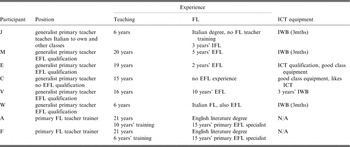
Background information about the six teachers and two trainers in the initiative is provided in Table 1. Two teachers were relatively inexperienced, while the majority had fifteen or more years in the classroom, though often much less FL teaching. Questionnaire responses showed that some saw the VC initiative as a springboard towards international exchanges, whereas others hoped to improve their own ICT skills. All feared technical difficulties and some also the replacement of face-to-face interaction with virtual communication.
Participant profiles

3.2 VC set-up
The VC sessions were conceived of as whole-class activities with all the pupils in each class in their seats facing the board where a whole-group shot of the other class was projected. For each session, a panel of four to six pupils sat at the front, also facing the camera, while the remaining pupils observed. These “speakers” generally controlled the communication with the other class and conducted activities (bingo, hangman) in which all the pupils in both classes participated. After observation of the initial VC sessions, the trainers recommended alternating speaker/observer roles by involving at least two different panels of speakers during each session to allow more learners to participate actively.
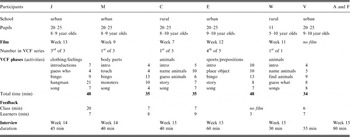
The teachers were paired as follows: J-M, E-C, and V-W, and Table 2 provides details of the VC sessions filmed, including class and school information, the phases and timing of each VC session and collection of feedback data. The classroom video recordings were segmented into the phases shown, embedded on the project site for viewing by all group members, and used in the aforementioned video-stimulated recall interviews.Footnote 3
Details of VCF sessions filmed

3.3 Data evaluation: video-stimulated teacher and trainer interviews
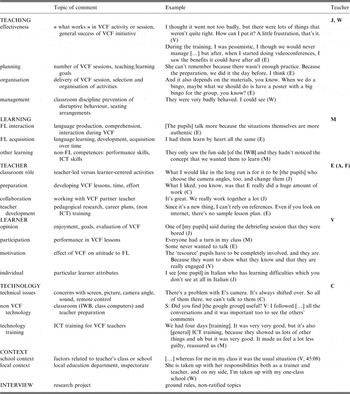
Teacher and trainer interviews were transcribed and analysed in terms of the topics which had been nominated and validated for discussion by participants in order to gain an overview of their main concerns. After several coding cycles twenty topic categories emerged, which can be grouped into six major areas; all areas were referred to at least once by all teachers – generally between two and four times, sometimes on up to six occasions.Footnote 4
Table 3 provides an example quotation from one or two teacher interviews for each category. The six most commonly cited subtopics are highlighted, and the initials of the six teachers are placed beside the area on which they focused most in their interview.
Types of Teacher Comment

For several teachers, the most frequent type of comment concerned teaching: the planning, organisation, and delivery of VC activities and sessions, classroom management, and the effectiveness of activities, or, as Hennessy and Deaney (Reference Hennessy and Deaney2007) put it, “what works”. For the two youngest teachers in the study, J and W, teaching comments were much more prevalent than any other category, reflecting these teachers’ focus on aspects of their own classroom practice. For J, the main concern was teaching, particularly effectiveness and specific organisational issues; otherwise, he commented on FL acquisition and technical issues. Like J, W's main concern was teaching, with far more comments on this area than on any of the others. She also mentioned effectiveness, and organisation, but had additional management concerns. The more experienced teachers E, M, and V also commented frequently on teaching concerns, but each focused much more strongly than the other teachers on another area. For E this concern was teacher-related issues, particularly her own professional development; otherwise she focused on organisation and FL acquisition. For M learning was essential, both FL and other skills (drama and ICT instruction). V's main focus in the interview was the learner, particularly participation and learner autonomy (V thought teachers should “slacken the reins a little” (55:05)).Footnote 5 The sixth teacher, C raised technology concerns much more frequently than the other teachers, both technical issues related to VC and other ICT tools.
None of the teachers was most concerned with their own teaching context (class, school, or local factors). Perhaps not surprisingly, trainer comments focused overwhelmingly on teaching concerns (the effectiveness of VC sessions) and the teacher, particularly the teacher's classroom role and professional development, with some mention of technology, including the communication and sharing tools introduced by the researcher for this project.
Also highlighted in Table 3 are the six most commonly cited subtopics. Within teaching, the effectiveness of the VC initiative and organisational concerns predominated, while discussion of learning was dominated by FL acquisition questions. All of the teachers commented on these topics, and for most these were frequent concerns. All participants also commented on technical issues with VC equipment. More individual variation was apparent in discussion of the teacher and the learner, with some teachers offering little or no comment on some topics. However, the role of the teacher in the classroom and collaboration with VC partner teachers were most frequently cited among comments on the teacher, and learner participation dominated talk about the learner.
The following section of the paper will leave aside organisational concerns as being particularly context-dependent, relating as they do to the specific VC teaching situation. Similarly, the technical issues raised by the teachers are specific to the video-conferencing hardware configuration used in the initiative and will not be discussed further. I will focus instead on the remaining teacher concerns under three headings: first, effective teaching in VC sessions, then second language learning, and finally the role of the teacher and issues of learner participation.
4 Findings
4.1 Effective VC teaching
All teachers made comments about the effectiveness of the VC initiative as a whole, and also with respect to specific sessions and activities. All were globally positive about the initiative. C had “no negative feelings,” and E, although initially sceptical, was more sanguine after half a dozen sessions: “I saw the benefits that it could have after all, in terms of continuous speech, all the CER A1 competences.” In her interview, V concluded that VC “was really something that should be continued, it's a positive thing,” although she expressed reservations about the single session she conducted with W's class: “W's pupils were a little too passive compared with what I would have liked.” W “very much liked the principle,” although in practice she also expressed misgivings about the session. She identified classroom management problems – “mine were very badly behaved” – and thought changes were necessary: “We'll see how it goes next year with children who are better controlled and better prepared.”
In addition to such global assessments, the teachers also expressed opinions about the effectiveness of particular activities in the VC sessions. M and J both identified episodes from their class videos which they judged particularly successful or unsuccessful. For J, the best moment occurred during a game of hangman, where one EFL learner collaborated with two classmates to guess the final letter to make the word happy. In this episode, lasting just over one minute, three of J's pupils (J1, J2 and J3) guess the letters of a word related to emotions, holding up mini-whiteboards to the camera and saying the letters in English, with a pupil in M's class (M1), responding via VC. The rest of the class observes.
Extract 1 (see Appendix for transcription conventions)
1. J2 ((takes board, writes H, raises board to camera)) aitch
2. A yes
3. J2 °happy° ((to J3))
4. J1 ((writes P, raises board to camera)) pee
5. M1 yes
6. ((whispering in group)) °happy°
7. J shh
8. J3 ((looks to J2, then J1, draws an i))
9. J2 °mais non i-grec° [no, wai]
10. J3 ((converts i to y))
11. ((to J1)) °comment dit° [how do you say it?]
12. ((J1 and J2 shrug, J2 recites alphabet under her breath))
13. ((J3 caps pen, shakes it with both fists, closes eyes tightly in concentration))
14. J2 °wai wai°
15. J1 ((raises board to camera)) wai
16. A yes
17. J1 ((shakes hands aloft in victory))
In her interview, M explained how she and J had tested the hangman activity with their classes in a practice VC session before the filmed session and found the sound quality too poor to distinguish letters. They therefore added the written letters on the boards as a necessary visual cue, making it possible to play the game “deaf,” without the foreign language component, although “we still wanted them to pronounce it […] they played by the rules, they wrote and they said it” (M, 10:57).
This example demonstrates a number of features common throughout the VC sessions filmed in the project. First, the teachers’ concern for the effectiveness of activities which leads to practice and adaptation of activities to make sure they worked: “otherwise, you see, if we had had this problem during the VC session, it would have put us off a bit” (M, 10:38).
Second, the teachers’ definition of what makes an effective activity involves factors such as learner motivation, effort, and teamwork. These characteristics are not specific to second language learning, reflecting these generalist practitioners’ reliance on general pedagogical principles for the design and evaluation of FL activities. Within a second language teaching framework, while socio-cognitive approaches also value motivation and teamwork, task-based models would find fault with this activity, since the use of the foreign language in production and comprehension during this information-gap task is only ensured by teacher-imposed rules: no guessing without saying the letters (as we see from Extract 1, line 7, as J silences pupils) and M's stipulation above: “pronounce it.”
A further factor in teachers’ assessments of effective activities is learner success and enjoyment. J selected this episode as “the best moment” of the session, and M evaluates this activity positively as “a learning experience” for J's three active pupils. However, J notes in his interview that other pupils in his class claimed during his post-session debriefing plenary to be “bored” during this activity. F, who observed J's class during this session, made the same assessment, and suggested during the activity a further adaptation whereby a fourth pupil was asked to write the letters guessed by the three learners on the blackboard to allow the whole class to follow their progress. J remarked:
“If we could make a whiteboard mode somehow, to write on instead of having the mini-boards, you see, when we do it for the others and we could see it here at the same time […] I don't know, I'll have to look at the manual.” (J, 16:40).
The problem of displaying information to the whole class while the IWB screen was taken up with the view of the other class in VC mode was discussed on several occasions during the project, and it highlights intersecting technical and pedagogical issues arising in the VC initiative. Much of the discussion between teachers and their learners after VC sessions, between teachers and trainers observing sessions, and with the researcher during video-stimulated interviews focused on organisational and technical issues involving camera angles, volume and sound quality, and individual and group participation across the two classes. Without fully understanding and mastering the technical possibilities of the VC equipment, it proved difficult for teachers and trainers to design effective activities, but without trying out different activities with their learners it was impossible for them to assess which affordances of the equipment should be exploited.
4.2 Second language learning
While all teachers made at least one comment on language learning during their interviews, this was generally a less pressing concern than the organisational concerns and assessment of the effectiveness of activities described in the foregoing section. Much of the discussion of second language interaction and acquisition was in fact initiated by the researcher, who expressed surprise at the lack of FL-related talk in feedback sessions with either teachers or learners. Comments on episodes played during the video-stimulated recall phase of the interviews frequently contained judgements and explanations of the success or failure of particular activities, but these were rarely related to learners’ language skills. An episode selected by J as an example of an unsuccessful activity, “the bingo catastrophe”, will serve to illustrate this finding:
A group of six speakers, paired English and Italian learners, name picture cards of clothing items for similar English-Italian pairs in both J's class and M's class via VC. Learners check off items on their bingo cards until a winner calls out. In this instance, learner J1 announced a new word after bingo had been called, leading to confusion in both classrooms, partly due to the similarity between the legitimate item shirt and disallowed skirt. J told these learners: “You have to find a solution because here they all have bingo. You didn't stop at the right time, so you do something, the presenters. Find a solution. What will we do?” (J, 20:02).
Viewing the incident afterwards, both teachers consider it pedagogically relevant, and each for different reasons. For J, the problem revealed a lack of communication and awareness among his pupils. In the class debriefing plenary after the VC session, one pupil identified the problem as linguistic “we mixed up shirt and skirt,” but J reframed the incident as an illegal game move: “What was the mistake? Because what did J1 do?”, eliciting from J1, “there were bingos […] I carried on.”
J1 later in this session mentions “the little mistake I made that started a huge mess” and J downplays the whole incident. In his interview he explains his pedagogical intentions of teaching his learners to solve unforeseen problems.
For her part, M considers this incident as a “real communication problem” and compares it with confusion between the words head and face in a previous VC bingo activity. For her, the pedagogical question concerns the suitability of this game for VC sessions: “outside VC sessions bingo works great” (M, 4:52), but for VC sessions, I think we need to rework it” (M, 14:39).
Neither of the teachers immediately saw the incident as an opportunity for target language use. When I suggested this, M responded:
“Yes, that's what I would like to work on now. For next year, it's that, in other words, well, this vocabulary. It's not vocabulary, but this capacity to say something […] and I would like them to have that, so that they could get themselves out of these situations, but in English. […] the automatic reflex to, yes, to jump in and say something else than what we do, something more” (M, 7:37).
Some of the teachers thus value the possibility offered by VC sessions for spontaneous interaction. When I suggested during video-stimulated interviews – in line with Le Bian (Reference Le Bian2007) – that wide-angle views of the whole class might be interspersed with close-up shots of smaller groups of children to maintain learner engagement among those not actively participating, they claimed that pre-recorded shots would result in overly theatrical VC sessions and prevent unplanned interventions on the part of learners. These comments illustrate once again the close interaction between pedagogical and technical issues as the teachers struggle to use the VC equipment to best advantage. While these teachers had learned that a number of different camera shots covering different groups of learners all over the classroom could be pre-programmed into the remote control, they failed to realise that these settings could then be called up freely during the VC session, depending on real-time learner reactions in different parts of the room, believing instead that the timing of each setting must also be pre-determined. Failure to grasp the technical possibilities in this case appears to limit the interactive potential of the VC tool with consequences for the pedagogical effectiveness of activities.
Although the potential for spontaneous interaction between learners might be valued by teachers, in practice, much of most VC sessions was carefully organised and even rehearsed ahead of time. As the trainers point out
A They know where they're going.
F And in any case, spontaneity, there is no spontaneity, I mean everything is orchestrated. So [changing shots] doesn't change that. They do actually have a planned programme (18:10).
These comments show that both teachers and trainers believed spontaneous interaction to be desirable, though perhaps not feasible for these young beginners, and possibly difficult to achieve within the highly structured VC sessions which they organised.
However, spontaneous language does not appear to be either a primary goal or a means of achieving second language acquisition for the teachers in the project. This impression is borne out by further comments by J. Responding to my remark that he made only one only language correction in the session and that very few of his or his pupils’ comments concerned the second language, he explained that the pupils’ language use was “fine, globally,” “it was all vocabulary that we had done,” and “we didn't really have any language problems […] because for us it was really reinvestment.”
The term “reinvestment” (réinvestissement, meaning reuse or revision) recurs frequently in J's interview and questionnaire data. He values the VC initiative for the opportunity to revise and consolidate previous learning: “I think it's worthwhile insofar as it is a reinvestment of notions we have worked on. I think it helps with memorisation and language learning and the development of oral competences” (J, 41:18). In these comments, J seems to view second language acquisition as a product rather than a process: information to be memorised and retrieved, rather than a capacity to interact spontaneously. He was accordingly less concerned with language performance during the VC sessions, since in his view the work had already been accomplished.
This interpretation coincides with M's comment on the same topic of lack of FL-related discussion during feedback sessions: “Perhaps we think that the language side will be dealt with during language classes, separately”Footnote 6 (M, 2:28). A similar view of the foreign language as a product to be acquired outside the VC sessions is apparent in E's interview. During the video-stimulated recall phase of the interview, when asked about specific episodes of learner comprehension and production, E framed her pupils’ language problems in terms of preparation time: “She can't remember because there wasn't enough practice. Because the preparation, we did it the day before, I think” (E, 34:01), and “there wasn't enough solid learning for the vocabulary in the bingo on sports because, again, they hadn't done sports very much ahead of time” (E, 40:30). In focus group feedback with the researcher, one learner commented “today the topic was sport and at the beginning, at bingo, I didn't really get it,” but after the activity “it was better.” E concedes that the VC session could provide a useful opportunity for practice: “That's exactly where we could reinvest. Just because it's a VC doesn't mean it's not an English class” (E, 40:58).
Asked about the feasibility of other types of teacher and learner interaction during VC sessions, E contrasts this type of reinvestment with learning (my emphasis):
“I don't know if [we can have them] repeat during initial learning. They have to repeat one by one after all […] We need to see whether I can do it with two classes in that case, assuming that my own class will already have done this learning and they can do it again” (E, 25:26).
Like J, E views the VC as a chance to put learned knowledge into practice, or as V says, a performance opportunity “to show what they have learned” (V, 24:08). The process of acquisition occurs off-stage.
These four teachers all contrast “initial learning” and “preparation” in the foreign language with “reinvestment” during the VC sessions, presenting a view of language as a product which has either been assimilated or not, and of the VC sessions as an occasion for demonstrating language proficiency, rather than developing it. Only the trainers saw the potential of the VC tools for early phases of FL learning, transforming a typical teacher-led class activity to a child-led one via VC:
“When I teach a song in class there's a phase of systematic repetition. I mean, it's like any learning, at some point you need to have a repetitive exercise. Well, it could be a child who says, ‘Repeat after me: head’ and you have the class in front and the others behind, ‘head’” (A, 1:08:10).
Such emphasis on learner-to-learner interaction was a feature of the trainers’ interview, and the focus of comments by many teachers. Section 4.3 examines this issue in more detail.
4.3 Teacher role and learner participation
Five of the six teachers talked about the role of the teacher in the classroom and learner participation, and V made extensive remarks on both topics.Footnote 7 The trainers made a clear majority of their comments on the topic of the teacher, especially professional development but also their role in the classroom. Indeed, the trainers generally saw learning and the learners through the prism of the teacher and teaching. Thus the issue of sharing the floor between teachers and learners was relevant to the majority of the teachers and trainers in the study.
Two different approaches to the allocation of teacher talk and learner talk during the VC sessions appear in the data. For some teachers, the goal was explicitly to limit teacher intervention to maximise learner participation and allow the pupils to manage the floor alone:
“You don't see us [teachers] and you hardly hear us at all” (M, 1:21).
“I tried to put a pupil in my place at one point, one of my pupils ran the game and I stood aside” (V, 53:56).
“Globally, they take control themselves” (J, 19:45).
For these teachers, it was important for all pupils in the class to participate. V “made sure that each pupil had one little thing, even a tiny little thing to say” (V, 22.35). Both J and M ensured that each pupil had a turn as a presenter in at least one VC session.
The consequences of this approach during the VC sessions can be seen as early as the introductory activities at the start of each session. In a session which took place in the first weeks of the initiative, filmed in M's class, the introductory phase lasted over five minutes, with English and Italian learners taking turns, and without verbal intervention on the part of either teacher.
Extract 2
a) non-presenting pupils in M's class stand one by one to greet the other class and give their names
b) same presentation from J's class
c) presenters in M's class (M1-M6) stand one by one to introduce themselves in greater detail
d) same presentation from J1 through J6
e) M1 asks the date in English; J1 replies ; M1 corroborates
f) M2 asks the date in Italian, J2 replies; M2 corroborates
g) M3 asks in English which pupils were absent in J's class; J3 replies “nobody”
h) M4 asks in Italian which pupils were absent in J's class; J4 replies
i) J5 asks the weather in Italian, M5 replies
j) J6 asks the weather in English, M6 replies
k) another pupil in M's class starts the next activity by standing and saying “touch your ear.”
In this excerpt, J is not heard at all, and M, off camera and positioned in the front corner of the classroom some distance from the IWB, which is the focus of class attention, whispers once at point (g), to tell M3 not to stand up as she speaks, and then a little louder some seconds later repeating J3's answer, “nobody.” Thus these teachers seem to achieve in practice their stated aim of limiting their own participation in activities by leaving the learners to manage the interaction, including transitions between activities, on their own. However, as suggested earlier in discussion of spontaneous second language production, this episode also shows a high level of planning and rehearsal. J and M planned each VC session activity by activity, down to the level of individual contributions: each displayed a detailed plan of the session beside the IWB screen and devoted some ten minutes before the start of each session to reviewing this plan with their pupils. The morning before the early session described above, which was observed by several trainers, a head teacher and an inspector, the teachers ran a full practice session. Before J's filmed session, which occurred later, towards the end of the initiative, J and M also tested a new activity (hangman) in a practice session. It seems, therefore, that this apparently high level of learner autonomy comes at the cost of spontaneity.
In M's comments regarding J's class video, she shows her awareness of this aspect of VC interaction as problematic, and offers an explanation:
“I don't know if you felt it was more spontaneous, less, less prepared, let's say because […] we said to [our pupils] ‘OK now you can let yourselves go.’ All the ones who presented at the beginning, you see, we insisted on these individual greetings at the start so that everyone at least said something, and there we said, ‘So the first time, we kept it short,’ so that, to keep the time short too, and this time we told them, ‘Well then, you say everything that you know how to say about yourselves during the greeting’” (M, 9:16).
These teachers thus felt that tight planning was necessary to meet time constraints, but that it also affected learner participation, leading them to offer their learners the opportunity to produce more speech in the later VC session.
This quote underlines once again these teachers’ strong desire for all pupils to participate; indeed M saw a link between the active participation of the pupils and their ability to control possible performance nerves. She found her pupils to be “very professional” (24:01), not showing anxiety or conversely playing up to the camera, and attributes their attitude to a theatre project in which her class learned to control possible stage fright in performing before a large audience by practising before the whole school. She explains that “they are inured to that. We are active and we weren't put off by the eye of the observer, and that, that helps at some level” (M, 25:22).
To summarise this approach to allocating teacher and learner roles in VC sessions, this episode and the associated teacher comments reveal an emphasis on limiting the teacher's role during the session in favour of learner-managed interaction. The VC session is a performance, and the teacher's place is off-stage: before the session, teachers plan the performance, allocate learners’ roles, and rehearse their parts; during the session, they are in the wings, prompting only occasionally if at all. This classroom approach was characteristic of the teachers in the study who focused most on issues related to learners and learning in their interviews, rather than teachers and teaching.
A contrasting approach is evident in the VC sessions run by E and C and in the comments of these two teachers, who in interview had the highest proportion of comments on the teacher, rather than the learner or learning. For these teachers, the comparison between VC sessions and theatrical performance seemed less apt. When asked whether her learners seemed to experience extra pressure or even performed better in front of the camera and the other class, E responded in the negative:
“No, I don't think so. […] It doesn't make any difference to me having [observers] in the class and perhaps it doesn't make any difference to [the pupils] either. […] I didn't think they seemed to be involved in a theatrical activity” (E, 26:17).
On the other hand, learners in both classes in E and C's VC sessions refused to participate as speakers (or indeed at all):
“There were some who would never agree to present” (C, 13:47).
“If they don't want to, I'm not going to force them, poor things” (C, 13:51).
“They were all speakers at some point. That was important to note. Apart from two or three, who would never agree” (E, 28:36).
“There was no point in making them ill at ease. I also think that there are children who learn just as much by listening to the others” (E, 30:51).
This contrasting approach to the discourse context of the VC session had consequences for the type of interaction observed, as can be seen in the introductory phase of one of the first VC sessions of the initiative.
Extract 3
1. C allez on démarre [OK let's start]
2. E OK so E1 please
3. E1 What was the yes yesterday
4. E non peut-être on va commencer par aujourd'hui [no perhaps we should start with today]
5. E1 What's the day
6. E today
7. E1 what's today today
8. C C1
9. C1 mm m
10. C today is
11. C1 today is
12. C non pas February qui c'est qui peut aider C2 [no not February who can help, C2?] c’est la date d'aujourd'hui [it's today's date]
13. C2 May
14. C May
15. C1 May euh six
16. C two thousand and
17. E E2
18. C Je ne sais pas s'il a- dis plus fort [I don't know if, speak louder] Est-ce que tu entends vous entendez C1 [Did you hear C1?]
19. E on a entendu mais [we heard but]
20. E1 mais elle parle un peu doucement [but she speaks a bit quietly]
21. C alors parle plus fort allez today is bien plus fort [so speak louder, OK, today is much louder]
22. C1 today is May six Thursday
23. C alors c'est [OK it's]
24. E1 alors tu l'as dit à l'envers [OK you said it backwards]
25. C1 pardon [sorry]
In 25 turns in just over one minute, the teachers take 14 turns (C, 9; E, 5) and there are no contiguous learner-learner turns until the last pair, in French. Unlike J and M, these teachers take an active role in the interaction, allocating learner turns and then evaluating and recasting their contributions throughout the interaction.
E's own class video, filmed one month and three sessions later, reveals a very similar pattern of interaction during the introductory phase of the session. On viewing the video, E commented: “Ideally the children would take control completely and I wouldn't have to repeat the dates myself” (E, 23:54). Her remark indicates a desire to increase learner autonomy in interaction. C appears less convinced:
“Since there is E who is very present, because she is the resource class, I thought I should withdraw totally […] Then in the last two videoconferences I was more present. Because we had much more interaction, since the level of English is good in the two classes, that meant I participated a little more. I repeated the instructions a bit and all that” (C, 16:46).
These comments show concern on C's part to balance intervention not between teachers and learners, but rather between the two teachers. From the comparison of the introductory activities in the two sets of classes (J-M and E-C), the consequences of this second approach seem to be less learner time at talk and even reduced learner motivation to participate, given the more face-threatening situation.
5 Discussion
This section highlights what research can contribute to teacher education in this context. Three main contributions seem pertinent: the introduction of web-based sharing and communication tools to facilitate group collaboration; increased discussion and reflection among participants with respect to FL learning and teaching, and the role of ICT; the development of a certain interest among teachers and trainers in CALL and FL research in general. These three strands are all attested in the interview data, and, though interrelated, bear examination in turn.
All participants expressed satisfaction with the project wiki and discussion group as tools which allowed better communication and clearer insights into their own and colleagues’ classroom experiences. The teachers found it reassuring and helpful to be able to compare experiences and ask for help from the group, and even those who posted little claimed to read everything and find benefit, particularly in terms of social interaction. The inclusion of my edited VC session video clips was valued by the trainers, who had not been able to observe all the sessions but could in this way follow more closely online. Interview comments showed that some teachers who were reluctant to view their own class videos had however sampled others’, and a number of discussions with the researcher were triggered by these viewings.
The research project seemed to generate greater reflection and discussion of the VC initiative during the final few weeks, since data collection and sharing was most intense during this period (see Table 2). During the final month, teachers were asked to collect drawings from their pupils depicting the experience, and the majority of class video clips were posted, preceding the teacher interviews by only one or two weeks. With some pressure to complete the project before the summer break, and the experiences fresh in participants’ minds, this activity seemed to stimulate thinking about the project and resulted in long and wide-ranging discussions with most participants, some lasting an hour or more. My own input regarding FL tasks, learner participation and teaching objectives often differed from the teachers’ and trainers’ views, prompting further reflection and negotiation.
This discussion in turn raised issues which are central to teacher education in CALL research. One teacher with a particularly pragmatic stance on determining “what works” and standardising classroom procedures seemed reluctant to accept that research cannot currently determine best practice, and that many constructivist models would deny even the ultimate feasibility or desirability of so doing. One trainer similarly insisted on the separability of technical and pedagogical issues in teaching with VC, while the analyses presented in this paper suggest otherwise. Many of the participants expressed surprise and satisfaction at their own learning during the project: several teachers claimed to have gained valuable insights into their pupils’ beliefs and experiences through their drawings, and these iconographic documents proved an unanticipated trigger during teacher and trainer interviews. Several participants expressed a sense of professional development from the project and a desire to continue with the initiative, to participate in further training, and to share their new knowledge with other teachers.
Conclusion
This study of synchronous communication among young learners in a school setting provides an initial insight into the influence of teacher cognitions on learning opportunities in this context. It has highlighted the close interaction of pedagogical and technical issues in the orchestration of whole-class synchronous video communication among young learners, as their teachers learn to design and implement effective activities. It showed that spontaneous FL interaction among learners, although often cited as a general objective, was limited, and this for various reasons. Many teachers viewed the VC as an opportunity to display memorised language; those who valued more spontaneous speech believed it beyond their young learners’ current competence. Learner and learning-centred teachers thought to foster learner autonomy by extensive rehearsal, leaving their learners ill-prepared to deal with unexpected incidents. Their teacher-centred colleagues, who instead took an active role in all classroom interaction, deterred some learners from participating.
This paper therefore raises a number of issues for teacher education research in CMC. At least in this context of a synchronous CMC initiative with non-native and non-specialist teachers of foreign languages to young learners, it foregrounds yet again the necessity of combining training in second language teaching with technology training. Teachers can and do self-train with new technology, but cannot identify the affordances of the new tools unless they receive help in identifying effective language learning practices. Conversely, it is difficult for trainers to discover and pass on such useful practices without having participated in specifically directed technology training themselves in the first place. Participant research can offer a starting point in this context in a number of ways. First, data collection stimulates interest and involvement in the project and promotes communication among teachers and with trainers. Second, the sharing of messages, class video clips, and learner feedback as the project advances allows for reflection and discussion even before data analysis is complete and helps trainers to intervene and teachers to adjust later sessions in accordance with their experience of earlier ones. Finally, video-stimulated interviews allow in-depth discussion of teaching and learning issues anchored in concrete examples, creating an interest among teachers and trainers for further reflection and perhaps research in CMC and second language acquisition in general. In this way, the project may contribute to changing beliefs and practice through the vector of new technologies.
Appendix
Transcription conventions (following Bowles & Seedhouse, Reference Bowles and Seedhouse2007)