INTRODUCTION
Food security is a major concern for eastern and southern Africa where agriculture is predominantly rain-fed (Rockström et al., Reference Rockström, Barron and Fox2002). Despite technological solutions and policy support, rainfall variability and degraded soils resulting from tillage and insufficient levels of organic matter recycling are significant factors contributing to chronically low crop yields (Kumwenda et al., Reference Kumwenda, Waddington, Snapp, Jones, Blackie, Byerlee and Eicher1997; Rockström et al., Reference Rockström, Kaumbutho, Mwalley, Nzabi, Temesgen, Mawenya, Barron, Mutua and Damgaard-Larsen2009; Wall, Reference Wall2007). In many farming systems, soil organic matter has declined to unsustainably low levels due to continuous cropping; all of which are important causes of low soil moisture, poor nutrient use efficiency and lower productivity (Parr et al., Reference Parr, Stewart, Hornick, Singh, Singh, Parr and Stewart1990). These problems reduce the benefits of improved genomic varieties and increase the inherent risks of farming (Thierfelder and Wall, Reference Thierfelder and Wall2009) and discourage adoption of improved practices. Conservation agriculture (CA) addresses these problems at several levels, and may provide a means whereby the yield risk that smallholder farmers face can be moderated.
Three actions define conservation agriculture: (1) Minimizing soil disturbance by direct sowing of crops into the soil, (2) protecting soil with cover crops or crop residues and (3) intercropping and/or crop rotation (FAO, 2002). Soil disturbance by mechanical tillage is reduced to an absolute minimum, and the use of agrochemicals and nutrients of mineral or organic origin are applied at optimal levels if known. The interactions between minimal soil disturbance, managing crop residues, applying optimal nutrient levels and controlling weed populations are often considered more consequential than the individual effects of these management activities alone. Instead of maximizing crop yields, the managerial objectives under conservation agriculture are to optimize long-term soil fertility through crop residue management and crop rotations, resulting in sustainably higher maize yields at reduced input costs.
Conservation agriculture systems improve water infiltration, decrease soil erosion and run-off, increase soil moisture retention and improve soil fertility and growth of beneficial microbial communities (Mando et al., Reference Mando, Brussaard and Stroosnijder1999; McGarry et al., Reference McGarry, Bridge and Radford2000; Roth et al., Reference Roth, Meyer, Frede and Derpsch1988; Thierfelder and Wall, Reference Thierfelder and Wall2009; Verhulst et al., Reference Verhulst, Nelissen, Jespers, Haven, Sayre, Raes, Deckers and Govaerts2011). CA systems resulted in yield increases for several crops, including maize, legumes, sorghum, cotton, sunflower, potatoes, finger millet, pigeonpea and cotton (Ngwira et al., Reference Ngwira, Aune and Mkwinda2012; Rockström et al., Reference Rockström, Kaumbutho, Mwalley, Nzabi, Temesgen, Mawenya, Barron, Mutua and Damgaard-Larsen2009; Thierfelder and Wall, Reference Thierfelder and Wall2010). A meta-analysis of the long-term effects of conservation agriculture on maize yield found increases in yield over time with practices that included crop rotations and high input use in low rainfall areas (Rusinamhodzi et al., Reference Rusinamhodzi, Corbeels, Wijk, Rufino, Nyamangara and Giller2011), but most yield increases are not observed in the early years of adoption. Cases reporting lower yields from conservation agriculture compared to conventional technologies are often associated with learning curves producers face when adapting conservation agriculture to their production systems. One probable cause of the yield drag is likely due to the crop nutrients temporarily immobilized in the soil by increased number of microbes below the surface mulch, which need nitrogen from the soil for their population increase, thus leaving little nitrogen for early plant development. In addition, the nutrients in the residue break down more slowly and are consumed by microbes and become unavailable to the plant (Doran et al., Reference Doran, Elliott and Paustian1998). The short-term risk of lower production and therefore lower household consumption is an unattractive prospect for food insecure smallholder farmers (Shively, Reference Shively2001), which makes it even more difficult to challenge farmer preconceptions of conservation agriculture. In addition to individual learning curves, newly introduced ideas or systems may appear as failures to would-be adopters if those technologies were implemented during periods of either extraordinary rainfall or extended dry spells on already-degraded, nutrient-poor soils. This short-term perspective challenges the widespread adoption of CA practices; highlighting the fact that farmer acceptance of the idea that agriculture is possible without tilling is critical (Wall, Reference Wall2007).
This study examines conservation agriculture as a risk-mitigating technology for smallholder farmers in Malawi using standard risk analysis methods. Malawi is a sub-tropical country situated between latitude 9° and 18°S and 33° and 36°E in South Eastern Africa with a land area of over 118,000 km2, of which 23,000 km2 is covered by Lake Malawi. The country is divided into three main regions: North, Central and South. Agriculture is the mainstay of the economy, contributing nearly 35% of the gross domestic product and employing more than 80% of the total labor force. It is estimated that 56.6% of the rural population live below the poverty line (NSO, 2012). The achievement of the Millennium Development Goals and growth and poverty reduction targets in the southern African region are especially challenging. This region is barely self-sufficient in food grains, with a net import of 10% if South Africa is excluded (FAOSTAT, 2010). With growth of population and incomes, the demand for maize is projected to increase approximately 3–4% annually over the next 10 years, leading to an increase in demand for maize grain by at least 40% (FAOSTAT, 2010). Typical cultivated land holding sizes range between 0.2 ha and 3 ha (Ellis et al., Reference Ellis, Kutengule and Nyasulu2003), with maize the principal crop occupying about 85% of arable land area under cultivation (MoAFS, 2011; Smale et al., Reference Smale, Kaunda, Makina, Mkandawire, Msowoya, Mwale and Heisey1991).
Standard risk analysis methods are used to determine the risk premium associated with conservation agriculture and conventional technologies, given different assumptions about farmer aversion to risk. Risk premiums are the dollar amounts that producers would be willing to pay to eliminate the risk associated with a given technology. Therefore, the risk premium of CA technologies compared with those associated with conventional maize production practices provides insight into the potential monetary value of CA technologies to risk-averse smallholder producers.
Risk is quantified as the dispersion around an expected outcome; e.g. yields (‘yield risk’) or net returns ha−1 (‘economic’ or ‘price’ risk) (Anderson and Dillon, Reference Anderson and Dillon1990). In addition to uncertain rainfall and impending disease, access to equity and capital markets, household resources, social capital and liquidity constraints also influence technology adoption or abandonment through producers’ perceptions of risk (Cavatassi et al., Reference Cavatassi, Lipper and Narloch2011; Moser and Barrett, Reference Moser and Barrett2006; Wendland and Sills, Reference Wendland and Sills2008). Commodity prices and subsidies also shape risk perception, thereby motivating the adoption of novel production technologies (Serra, Reference Serra2008).
In sub-Saharan Africa economic analyses of CA technologies as potentially risk-mitigating are relatively sparse. Technology adoption studies from Nigeria (Lal, Reference Lal1986), Zimbabwe (Vogel, Reference Vogel1993) and Zambia (Thierfelder and Wall, Reference Thierfelder and Wall2010) found that crop losses were reduced in fields managed under conservation agriculture. Cavatassi et al. (Reference Cavatassi, Lipper and Narloch2011) found that Ethiopian farmers appeared to adopt high yielding sorghum varieties to moderate production risk, yet in regions where rainfall was highly variable there were lower adoption rates of these same improved varieties. Recent partial budget analyses of conservation agriculture in sub-Saharan smallholder farming systems compared the marginal benefit of the technologies with conventional practices. For example, in their study of minimum tillage systems in Kenya, Guto et al. (Reference Guto, Pypers, Vanlauwe, de Ridder and Giller2011) conclude that risk-averse farmers preferred CA technologies to conventional practices because the discounted marginal rates of return from conservation agriculture were higher than those from the conventional systems. Mazvimavi and Twomlow's (Reference Mazvimavi and Twomlow2009) profitability analysis used a partial budgeting approach to compare returns ha−1 for conservation agriculture and conventional practices assuming low, normal and high rainfall periods. Based on partial budgeting exercises, it is often concluded that CA technologies are ‘risk-reducing’ based on superior net returns ha−1 compared to conventional tillage systems (Guto et al., Reference Guto, Pypers, Vanlauwe, de Ridder and Giller2011).
However, assertions about risk based on linear cost-benefit analysis are only relevant for risk-neutral producers (Mas-Colell et al., Reference Mas-Colell, Whinston and Green1995). Based on partial budgeting exercises it is often concluded that CA technologies are ‘risk-reducing’ based on superior net returns ha−1 compared with conventional tillage systems without actually measuring risk at all. Few studies have accounted for risk in net return comparisons of CA/non-CA production systems in Africa. For example, using stochastic dominance analysis of partial budget results Bekele (Reference Bekele2005) found that risk-averse producers preferred soil and water conserving practices. Farmers associated a premium with the technologies that moderated the production risks accompanying drought. In general, if a producer is risk-averse, then risk impedes production by inducing lower input use than would otherwise prevail (Anderson and Dillon, Reference Anderson and Dillon1990). This study examines the riskiness of net returns of conservation agriculture using non-parametric methods, stochastic dominance, target revenue sensitivity analysis and risk premium determination based on six-year (2005–2011) on-farm maize production data in Malawi. We hypothesize that the distribution of net returns generated from CA technologies will exhibit higher expected returns with lower variance compared with conventional agronomic practices. That is, the CA technologies will dominate conventional tillage practices in terms of higher risk premium at all levels of risk aversion. Thus, producers who are relatively more risk-averse will prefer CA technologies if these technologies reduce variability in net returns because of higher yields, or increase profit margins through lower input costs. We also hypothesize that these results will be generalizable across growing areas at different elevations.
MATERIALS AND METHODS
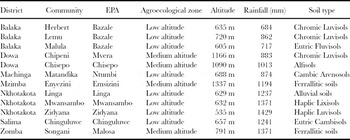
The study was conducted over six years (2005–2011) in 12 target communities of 10 extension planning areas (EPAs) in several districts in northern, central and southern Malawi (Table 1). The following districts were targeted for this research (from south to north): Zomba, Machinga, Balaka, Dowa Salima, Nkhotakota and Mzimba. All EPAs are characterized by unimodal rainfall patterns with a rainy season from November to April. The average annual rainfall was variable across the study communities (Table 1). All the study communities in Dowa, Mzimba and Zomba districts belong to the mid-altitude areas, while the rest of the communities in the remaining districts fall under low altitude areas (Brown and Young, Reference Brown and Young1966). The dominant soil types found in these EPAs are Chromic Luvisols, Haplic Lixisols, Eutric Fluvisols and Cambisols and some alluvial soils (WRB, 1998; Table 1).
Communities, geographical location and soil types of target villages.

Experimental design for on-farm field trials: Malawi 2005–2011
The study was conducted on farms with a total of six farmers hosting validation trials replicated across sites and spread across each target community (Table 1). However, the number of farmers per community varied according to the number of years of CA practice. In addition, the number of farmers changed due to farmer adherence to protocol: some years not as many, some years more than six. Following a good CA year more farmers generally followed the protocol. The main cropping systems studied in all EPAs were monocrop maize (Zea mays L.) and maize–legume intercropping. Farmer managed plots were 3000 m2. Each plot was divided into three equally sized subplots (treatments) of 1000 m2 as follows:
1. Treatment 1: Conventional control plot consisting of traditional ridge and furrow land preparations planted with continuous monocrop maize (CT or check). Residues were managed using methods commonly practiced in each EPA; i.e. residues were incorporated into the ridges in Lemu and removed in Zidyana. Continuous monocrop maize was planted on the ridges.
2. Treatment 2: CA plot with continuous monocrop maize (CA) planted into previous years’ ridges (where they still existed) or directly into the plot without previous ridge formation. Crop residues from previous years’ harvests were retained as surface mulch. Maize seeds were planted as sole crops by no till methods using a pointed stick (dibble stick).
3. Treatment 3: CA plot with maize intercropped with a legume (cowpea (Vigna unguiculata L.) in Zidyana or pigeonpea (Cajanus cajan L.) in Lemu) (CA–legumes). Both crops were planted with the dibble stick into previous years’ ridges (where they still existed) or directly into the plot without further ridging. Crop residues were retained as surface mulch as in treatment 2.
Farmers with support from extension officers in all target communities managed the trials. Field staff and technicians provided plot management recommendations. Hybrid maize DKC8033 was used for the duration of the experiments. Sudan cowpea and ICEAP0040 pigeonpea varieties were the intercrop grain legumes. All plots were seeded after the first effective rains (e.g. rainfall greater than 30 mm after 15 November). Ridges in the conventional tillage practice were prepared using hand hoes around October, and planting was done again with hand hoes. Seed was planted in CA plots with a pointed dibble stick, which aims at minimum soil disturbance by only creating a planting hole where seeds are placed. Both legumes and maize were seeded at the same time. Ridge spacing was kept constant in the CA treatments: 75 cm between maize rows, 25 cm between planting stations and one living plant per station. The CT plots followed seed population and spacing patterns normally used by the farmer. In most cases farmers have adopted similar 75 × 25-cm plant spacing according to the recommendations from Sasakawa Global 2000 (Ito et al., Reference Ito, Matsumoto and Quinones2007). Intercropped legumes were seeded between maize rows planting two seeds spaced at 60 cm and 40 cm apart for pigeonpea and cowpea respectively.
All treatments received uniform fertilizer rates of 69 kg N ha−1, which was supplied by applying two bags ha−1 of 23:21:0 + 4S at seeding and two bags ha−1 of urea (46% N) approximately three weeks after planting. Manual weeding as necessary did weed control in CT plots. In treatment 2, a tank mix of 2.5 L ha−1 glyphosate (N-(phosphono-methyl)glycine) and 6 L ha−1 bullet (which contains 25.4% Alachlor (2-chloro-N-(2,6-diethylphenyl)-N-(methoxymethyl)acetamide) and 14.5% Atrazine (2-chloro-4-ethylamino-6-isopropylamino-1,3,5-triazine)) was applied as post-planting and pre-emergence herbicide respectively. In treatment 3, only 2.5 L ha−1 post-planting herbicide glyphosate was used followed by manual weeding when weeds were 10-cm tall or 10 cm in circumference.
Maize grain yield
At physiological maturity, maize was harvested from 10 samples of two rows by 5 m from each treatment. A sub-sample of 20 cobs per treatment was shelled to calculate grain yield, to record the moisture percentage and to calculate final grain yield ha−1 basis at 12.5% moisture. The harvest area of the net plots was used to extrapolate yields to an areal basis. All maize stalks and leaves without cobs were weighed at harvest; 10 sub-samples per plot were air-dried for at least four weeks before final dry weights were taken and biomass was calculated to an areal basis.
Net returns and costs
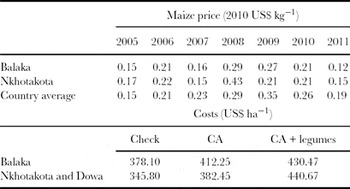
Revenue ha−1 from maize grown with conservation agriculture and conventional tillage systems are based on yields recorded from 344 replicates (three treatment plots per farmer) from on-farm trials. In all, there are 3 × 334 = 1032 observations available for analysis. Net return (profit) ha−1 was estimated for each maize yield observation (kg ha−1) produced by each technology based on the 2005–2011 domestic maize price series and the variable costs of each technology (conventional, CA, and CA + legume intercrop system; n = 344 for each technology). District maize prices were converted from Malawi Kwacha kg−1 to US dollars (US$) kg−1 using the official exchange rates for this time period posted by the Reserve Bank of Malawi.Footnote 1 Maize prices were then converted into real 2010 US$ (Table 2).
Prices and costs used to generate net revenue conventional, conservation agriculture (CA) and CA with legume intercrops.

Extension agents working with farmers over the life of the project recorded variable costs. The most reliable cost estimates were based on farmer records in the Balaka and Dowa districts. The Dowa variable cost estimates were used to proxy variable costs in the Nkhotakota and Salima districts in the central region whereas the Balaka variable cost estimates were used to proxy variable costs in Machinga and Zomba districts in the southern region. Both regions have access to all-weather roads, which provide relatively efficient transportation of produce and farm inputs. In all, there were 7 × (2 × 3) possible price-by-cost combinations (Table 2). Net revenue ha−1 from maize was then determined for each price-cost combination and each technology, given the maize yields recorded at each farmer plot over the duration of the trials. The risk analysis therefore assumes that recorded maize yields at each site, year and for each technology had an equal probability of being observed. Non-parametric procedures and descriptive statistics were used to compare the empirical distributions of the cultivation technology/net revenue ha−1 combinations and the risk associated with each technology.
Risk analysis methods
The empirical distributions of net returns ha−1 to conventional, CA and CA + legume intercrop systems were compared using three criteria: (1) stochastic dominance (Mas-Colell et al., Reference Mas-Colell, Whinston and Green1995), (2) a mean-variance approach (Lambert and Lowenberg-DeBoer, Reference Lambert and Lowenberg-DeBoer2003) and (3) a relative risk criterion (Richardson, Reference Richardson2002). Two sensitivity analyses were conducted to measure the risk associated with each technology. The first method used a target revenue approach suggested by Richardson and Mapp (Reference Richardson and Mapp1976) to estimate the likelihood of achieving a net revenue target, given the returns from a risky technology. The second approach calculates the risk premium (based on certainty equivalents; Mas-Colell et al., Reference Mas-Colell, Whinston and Green1995), or the amount producers would be willing to pay to eliminate the risk associated with a technology at different levels of risk preference. Each method is discussed in sequel.
Stochastic dominance
Mean-variance and relative risk criterion provide information about the first and second moments of the empirical distributions of maize net returns ha−1. However, skewness and extreme downside risk may be important determinants of the perceived riskiness of an alternative and the readiness of producers to adopt new technologies. Stochastic dominance compares the cumulative distributions of outcomes (e.g. net returns ha−1) based on two observations about humans: (i) people generally prefer more to less, and (ii) people prefer to avoid low-value outcomes. The second observation implies that people are generally risk-averse; however, this is not the same as saying that individuals avoid variability. Most people enjoy upside variability as long as they benefit from the outcome (e.g. higher yields, crop prices and profits) but are averse to downside variability. Those preferring more to less but are not averse to variability are risk-neutral.
These two observations about human behaviour are measurable in terms of the empirical distributions of outcomes using two decision rules which correspond with the assertions made above regarding human behaviour: first-degree stochastic dominance (FDSD) and second-degree stochastic dominance (SDSD) rules. FDSD assumes that decision makers prefer more to less. Under this criterion, a technology is preferred if it generates higher net returns ha−1 at every level of probability compared with those generated by competing technologies. Graphically, the preferred distribution is always to the right of other distributions.
Second-degree stochastic dominance assumes that producers are risk-averse. The propensity of a technology to produce low-value outcomes is measured as the area under its empirical distribution, with the alternative dominating others if the area under its empirical density is smaller at every outcome level. Non-parametric methods are typically used to detect SDSD. In the simple case of a cumulative distribution starting to the right of an alternative distribution and crossing over only once, the distribution to the right at the horizontal axis dominates if the area between the distributions below the crossover is greater than the area between the distributions above the intersection. Anderson (Reference Anderson1974) provides discussion and examples of stochastic dominance use in interpreting agronomic research data.
We apply (Meyer, Reference Meyer1977) a generalized stochastic dominance approach (or stochastic dominance analysis with respect to utility function), using the negative exponential utility function to compare the net return ha−1 distributions of each alternative across the Risk Aversion Coefficient (RAC) interval; 0 ≤ RAC < 0.03, with the upper RAC limit determined using the method outlined in Lambert and Lowenberg-DeBoer (Reference Lambert and Lowenberg-DeBoer2003). The RAC is the Arrow–Pratt constant absolute risk aversion coefficient (Moschini and Hennessy, Reference Moschini, Hennessy, Gardner and Rausser2001). The lower bound was set to zero (risk neutrality) and the upper bound was equal to the level of risk that drove the certainty equivalent associated with a technology to zero (determined to be RAC = 0.03). Meyer's approach (Reference Meyer1977) provides a method whereby inference can be made about alternative rankings, given heterogeneous risk preferences. Generalized stochastic dominance results were estimated using Simetar© software (Richardson et al., Reference Richardson, Schumann and Feldman2006). This approach admits the possibility that risk preferences, as a function of risk-aversion, may change as the empirical distributions of returns cross one another.
Mean variance (MV) and relative risk criterion
The MV rule assumes that the dominant alternative must have either a higher mean for a given variance or a lower variance for a given mean (Lambert and Lowenberg-DeBoer, Reference Lambert and Lowenberg-DeBoer2003). Rankings generated by this criterion depend on the producer's preference for the trade-off between net returns ha−1 and the variance of these returns. A closely related procedure for ranking preferred alternatives is the relative risk approach, which uses the coefficient of variation (CV) calculated from each distribution of net returns ha−1 (Richardson et al., Reference Richardson, Schumann and Feldman2006). Both methods provide a cursory assessment of risk, whereby summary statistics of the net returns from each technology can be used to rank the technologies in terms of riskiness.
Target net return probability analysis
This risk assessment method uses the empirical distributions of the net returns ha−1 to conduct sensitivity analyses regarding a target rate of return. For example, given a minimal rate of return, the likelihood of this occurring can be discerned from the empirical densities of net returns generated from each technology. The target probability methodology proposed by Richardson and Mapp (Reference Richardson and Mapp1976) was conducted using the Simetar© (Richardson et al., Reference Richardson, Schumann and Feldman2006). This risk assessment tool ranks the profitability of the technologies according to the probability of achieving a given net return target. Lower target return levels were set at US$0 (breakeven returns) comparing the conventional and CA technologies. Upper net return target levels ranged between US$100 ha−1 and US$1200 ha−1 in US$100 intervals.
Certainty equivalent (CE) and risk premium analysis
Certainty equivalents for each alternative technology were estimated at different risk tolerance levels. A certainty equivalent value is the payoff (as net returns ha−1) for which a producer is indifferent between an uncertain outcome and receiving a certain payment. Certainty equivalents for risk-averse individuals are always less than the expected monetary payoff of an uncertain project (i.e. the simple weighted average of net returns). When faced with several technology alternatives with different uncertain returns, a risk-averse individual would always choose the alternative with the highest certainty equivalent (Lambert and Lowenberg-DeBoer, Reference Lambert and Lowenberg-DeBoer2003).
Beliefs about uncertainty maintained by risk-averse individuals are typically analysed using concave, twice-differentiable functions; for example, the negative exponential utility function U(π; λ) = −exp(–RAC·π), where π is the expected net return ha−1 from a technology. Larger values of the RAC correspond with increased aversion to risk. The certainty equivalent is determined by solving the following expression with respect to the CE:
 \begin{equation*}
U({\rm CE};{\rm RAC}) = \Sigma _i p_i \,U(\pi _i ;\,{\rm RAC}),\end{equation*}
RESULTS AND DISCUSSION
Agronomic results
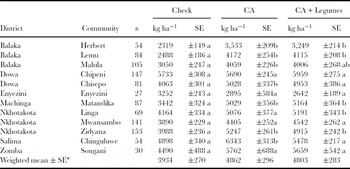
Maize grain yields were highest under both CA systems across almost all target communities (Table 3). Explanations of yield differences between the three treatments across communities have been summarized by Thierfelder et al. (Reference Thierfelder, Chisui, Gama, Cheesman, Jere, Trent Bunderson, Eash and Rusinamhodzi2013); here we only show overall yields across communities since maize grain yields are used as a basis of calculating economic returns. On average, maize yields on CA treatments out-yielded conventional control plots by 23.6% (CA) and 22.1% (CA + legume) over all years and communities. The highest yields for the CA system with monocrop maize were recorded in Chinguluwe (6343 kg ha−1), Songani (5767 kg ha−1) and Chipeni (5690 kg ha−1) whereas the lowest yields were produced in Enyezini (2895 kg ha−1) and Herbert (3533 kg ha−1). For CA with maize–legume intercropping system, the highest yields were achieved in Chipeni (5959 kg ha−1), Songani (5659 kg ha−1) and Chinguluwe (5478 kg ha−1) whereas the lowest yields were achieved again in Enyezini (2642 kg ha−1) and Herbert (3249 kg ha−1).
Conventional tillage (check), conservation agriculture (CA), and CA and legume intercrop treatment means (kg ha−1) ± standard errors of means (SE), Malawi, 2005–2011.

Notes: *The number of replicates in each community are determined by dividing the sample size in each community by 3 (the number of treatments; check CA and CA + legumes). Thus, in Herbert, there were 18 on-farm replicate trials. Weighted average across all sites (±SE of the weighted mean) based on sample size (n) of each site. Rows sharing the same letter are not different at the 5% level of significance (t-test).
Net returns
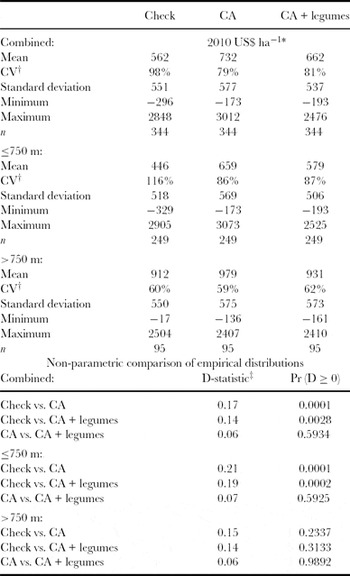
On average, highest maize net returns ha−1 were produced under the CA monocrop maize (732 ± 1.73, mean ± standard error of the mean, 2010 US$), followed by the net returns ha−1 from the CA maize–legume intercrop system (662 ± 1.61) and then the net returns ha−1 from conventional tillage (562 ± 1.65; Table 4). Pairwise t-tests suggest that observed differences in expected net returns ha−1 were significant (p < 0.01 for all comparisons). The coefficient of variation of net returns ha−1 for the CA monocrop maize was lowest (79%), followed by the CA maize–legume intercrop (81%) and then the conventional tillage technology (98%; Table 4). There were no ties in the CVs, therefore the mean-variance rankings are the same as those categorized by the relative risk criteria. By these criteria it appears that risk-averse farmers would prefer both CA technologies.
Summary statistics comparing net returns ha−1 for conventional, conservation agriculture (CA) and CA + legume intercrop technologies, Malawi, 2005–2011.

Notes: *2010 US$.
†Coefficient of variation.
‡Distance statistics, Kolmogorov–Smirnoff non-parametric test of equality between empirical distributions.
Stochastic dominance
The stochastic dominance analysis corresponds to the relative ranking and mean-variance criteria. Based on the generalized stochastic dominance analysis, the CA monocrop maize would be preferred by risk neutral and risk-averse individuals over the CA maize–legume intercrop and continual tillage systems. The CA maize–legume system would be preferred over the conventional tillage system when these two technologies were compared side-by-side.
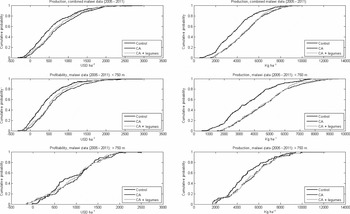
Net returns ha−1 were lowest for the conventional tillage practice (–US$296 ha−1; Table 4 and Figure 1); therefore conventional tillage practices cannot dominate the CA systems by the first or second decision rules. Risk-averse producers would always rank the conventional technology last compared with the two CA systems. By similar reasoning the CA monocrop maize would be preferred to the CA maize–legume intercrop system by risk-averse individuals, even though the empirical distributions were not significantly different (Kolmogorov–Smirnoff D-statistic = 0.06, p = 0.59; Table 4). The empirical distributions of the CA systems were significantly different from the empirical distribution of the net returns ha−1 produced under the conventional tillage system (p < 0.01; Table 4). Thus, risk averse and risk neutral individuals would prefer both CA systems over the conventional system technology, with the CA maize–legume system ranking second.
Empirical distribution of net returns (2010 US$ ha−1) from conventional (‘Control’), conservation agriculture (CA) and CA + intercropped legume cultivation; Balaka, Dowa and Nkhotakota districts, Malawi, 2005–2011.

Target return sensitivity analysis
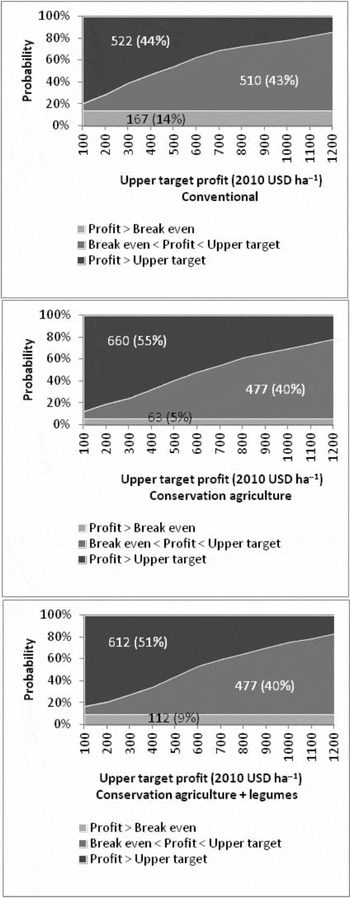
The target return analysis uses empirical distributions (Figure 1) to estimate the probability of achieving a target value (Figure 2). The CA monocrop maize and the CA maize–legume intercrop systems yielded the most optimistic return profiles at all target net return levels. For example, the likelihood of a net revenue outcome occurring below breakeven levels was 14% on the conventional system, followed by 9% for the CA maize–legume system and 5% for the CA monocrop maize. Thus, the smaller the difference between the probability of achieving the breakeven and upper target values, the more likely returns ha−1 exceed the breakeven profit. Consider, for example, the upper target of US$600 ha−1. In this scenario, the likelihood of observing net returns falling above the breakeven-upper target interval for the conventional tillage practice was 49% whereas for the CA monocrop maize and CA maize–legume intercrop technologies the probabilities of this occurring were 43% and 44% respectively. Thus, the likelihood of exceeding the US$600 ha−1 target would be 1.00 – 0.44 – 0.05 = 51% and 1.00 – 0.43 – 0.09 = 48% for the CA monocrop maize and CA maize–legume systems respectively. In this scenario, surpassing the upper level of US$600 ha−1 target, given the conventional tillage system, was lowest at 37%.
Target net returns ha−1 and associated probabilities for each technology.
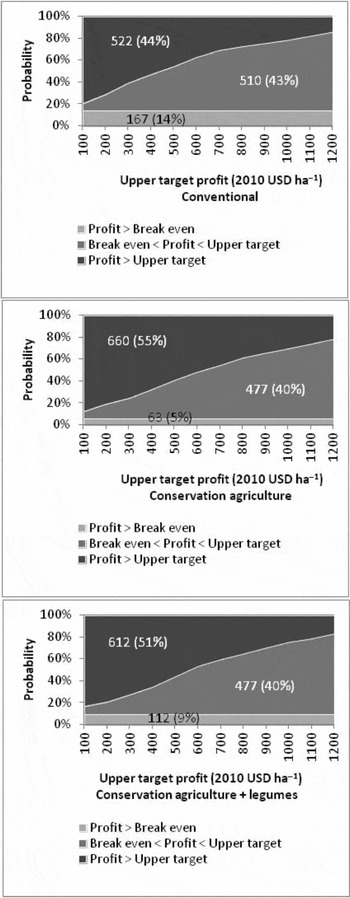
The aggregate areas generated by the target profiles also provide some indication of the degree of risk associated with the expected net returns ha−1 (Figure 2, inset values and corresponding percentages). For example, over the simulated outcomes, net returns ha−1 surpassed target returns 55% and 51% of the time for the CA monocrop maize and CA maize–legume intercrop systems whereas the return target surpassed only 44% of the time for the conventional tillage system.
Certainty equivalents and risk premiums
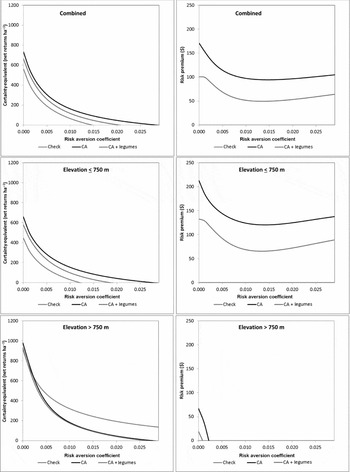
Certainty equivalents (the amount a risk-averse individual would accept instead of a risky outcome, in 2010 US$ ha−1) preserved the rankings found in the mean variance and stochastic dominance analyses (Figure 3). The certainty equivalent associated with the conventional tillage technology was driven to zero more quickly than those of the alternative technologies because the returns were relatively more risky (CE = 0 at RAC = 0.0177). Certainty equivalents were driven to zero for the CA monocrop maize and CA maize–legume intercrop at RAC = 0.0237 and 0.0296 respectively. Thus, the ‘risk-preferred’ technologies are those where the certainty equivalent remains positive as risk aversion increases. That the certainty equivalent curves do not overlap supports the technology rankings determined by the stochastic dominance analysis.
Certainty equivalents (2010 US$ ha−1) and confidence premium associated with each technology.

What dollar amount would producers be indifferent between CA monocrop maize, a CA maize–legume intercrop system and conventional tillage systems? Using the CEs calculated for each technology at the upper RAC bound of 0.0296, if producers who already adopted CA monocrop maize were offered US$40.42 (US$105.45), then they would be indifferent between using the CA monocrop maize and the CA maize–legume intercrop (conventional tillage) systems (Figure 3). Focusing on the next dominant technology – the CA maize–legume intercropping – producers would be indifferent between using this technology and a conventional tillage system if they were offered US$65.03 (Figure 3). In other words, from the perspective of risk-averse smallholder farmers in Malawi, these confidence premiums suggest a reasonable valuation of the CA monocrop maize and CA maize–legume intercrop systems compared with conventional tillage systems. As evidenced in Figure 3, the risk premiums associated with the CA technologies are positive when compared with the conventional technology at all levels of risk aversion. An important caveat is that these findings are based on pooled (combined) data and do not take into consideration potential differences in the performance of these technologies in different elevations in terms of production. We explore this caveat, keeping in mind that yield differences generated by the technologies were less evident in the high elevation sites (Figure 1).
Sensitivity analysis: net return distributions and elevation
We hypothesize that the degree to which technologies will be risk-preferred may differ according to the growing conditions typical of agroecological zones. We test this hypothesis by conducting the stochastic dominance and certainty equivalent analyses on the subsets of the data, categorizing the study sites into two agroecological zones according to elevation: communities situated at elevations less than 750 m (low altitude sites), and those located above this level (mid-altitude sites; Table 1) (Brown and Young, Reference Brown and Young1966).
Net returns for maize produced using conventional tillage were 30% and 47% lower than net returns generated by the CA and CA + legume systems in lower elevation communities (Table 4). Pairwise t-tests suggest that these differences are significant at the 5% level for all comparisons. The CV of net returns ha−1 for the CA technologies were similar (about 87%), and considerably lower than the net returns ha−1 CV associated with the conventional maize production technology. By these criteria it appears that risk-averse farmers in low-elevation communities would prefer both CA technologies. The stochastic dominance ordering was similar to the pooled data results, with the conventional practice dominated by the CA technologies (Figure 1, Table 4), as were the results of the certainty equivalent analysis (Figure 3). At the RAC level of 0.029, producers in the lower altitude region would be indifferent between using the CA monocrop system and a conventional tillage system if they were offered US$137.71; whereas for the CA + legume system the risk premium was US$89.05. Consistent with the stochastic dominance results, the risk premium relative to the check plot was always positive across a range of RAC (Figure 3).
In the higher elevation communities, differences between the net return distributions were less evident (Figure 1, Table 4). The net returns from the conventional and CA monocrop plots were not different at the 5% level, and the CVs of the conventional and monocrop CA net returns were similar (about 60%). In contrast to the results based on the pooled data, the CA technologies do not exhibit stochastic dominance over the conventional technology as evidenced by the D-statistics of the Kolmogorov–Smirnoff tests and the net return distributions, and also because net return minimum of the CA technologies was lower than the minimum net revenue of the conventional system (Figure 1). Net returns are clearly higher for the CA systems (relative to the conventional tillage system) between 25th and 50th percentiles; otherwise, the three distributions cross numerous times. At the higher elevations, risk neutral producers (RAC = 0) and producers with relatively low aversion to risk (RAC < 0.0012) would still prefer the CA technologies over the conventional system. The risk premium associated with the CA technologies becomes negative as risk aversion increases above an RAC of 0.0012. In other words, in the higher elevation, the more risk-averse a producer is, the higher the incentive would have to be for them to switch from a conventional tillage/maize production system to either of the CA systems. Clearly, these results are driven by the yield profiles of the technologies (Figure 1). At higher elevations, the distinction between the technologies disappears under excellent growing conditions.
CONCLUSIONS
This study examined the riskiness of net returns from maize production using monocrop maize and maize–legume intercropping CA technologies based on six-year on-farm production data in Malawi (2005–2011). The non-parametric methods used in this analysis, stochastic dominance and risk premium determination, account for upside variability in returns without resorting to strong distribution assumptions.
Maize grain yields in different treatments did not follow a similar trend across the target communities confirming the need to target and adapt conservation agriculture to local conditions (Rusinamhodzi et al., Reference Rusinamhodzi, Corbeels, Wijk, Rufino, Nyamangara and Giller2011; Wall, Reference Wall2007). In low rainfall, low altitude areas of Balaka and Machinga, conservation agriculture resulted in yield increases of 31.3% and 67.7%, respectively, over conventional tillage systems. In high rainfall, mid-altitude areas of Chipeni and Enyezini, conservation agriculture resulted in productivity decrease of 1.6% and 14.9%, respectively compared to conventional tillage systems. The lower differences in yields according to elevation had important implications with respect to analyzing the riskiness of the CA technologies compared to conventional tillage systems. Using the pooled data (low and high elevations combined), stochastic dominance analysis of the net returns ha−1 for maize production suggest that direct planting with solely maize and maize intercropped with legumes would be preferred by risk-averse producers compared to returns from maize produced using conventional methods. These findings were corroborated with a sensitivity analysis where the risk premiums associated with conservation agriculture and conventional maize production systems were estimated and compared. The differences between the conventional and conservation agriculture risk premium suggest that risk-averse producers would generally place more value on CA technologies (in terms of eliminating return risk). Given target return levels, the CA technologies analysed here could also be risk-preferred in terms of the likelihood target returns are obtainable. These findings were generally consistent when the yield data from lower altitude sites were analysed separately. However, the narrow margin in the percentage change in yield differences between technologies translated into profound differences in the risk analysis distribution comparisons analysing the higher elevation sites. At the higher elevation sites, under exceptional growing conditions the differences in net returns from the technologies appear less evident, and the case that CA technologies are ‘risk-reducing’ (in terms of expected net returns) becomes less clear. Indeed, the risk premiums determined by the ex-post analysis suggest that stronger incentives may be required to entice adoption of CA technologies at higher elevations. The reversal in preference ordering of the technologies is likely driven by the similarity in yields between the CA technologies studied relative to the conventional tillage system used as a reference practice.
Although based on six years of production data over a variety of growing conditions, the risk analysis only provides an ex-post profile assessment of the technologies. The results should be put into perspective in terms of the price data used in the analysis. Future studies could analyse the sensitivity of these findings with respect to stochastic prices using the Monte Carlo analysis. A more in-depth analysis would also entail correlating these findings with individual preferences. This would require detailed household socioeconomic and farm production obtained from household surveys. In addition, while some insight into the value of CA technologies was provided by the analysis, more structured interviews would be needed to generate the willingness-to-adopt estimates. There are other factors that are important in farmers’ decisions to adopt conservation agriculture. For example Kassam et al. (Reference Kassam, Friedrich, Shaxson and Pretty2009) conclude that widespread sustained adoption of conservation agriculture will require a deeper understanding by producers of the ecological systems which drive residue management and soil fertility dynamics. This deeper understanding suggests that farmers need to understand that the payoff from CA systems may not occur during the first year but in subsequent years once the improvement in soil properties are manifested. Comprehension of these biophysical interactions by producers underscores the relatively large investments (e.g. in fertilizers, equipment, herbicides, education and farmer training) needed to enhance farmer success with CA systems. Extensive adoption of conservation agriculture by small-scale farmers has also been constrained by institutional capacity for transferring new knowledge to agriculturalists (Gowing and Palmer, Reference Gowing and Palmer2008) as well as lack to deliver new practical knowledge. Additional barriers to CA adoption include removal of crop residues for fodder, lack of appropriate seed drills that can sow in unploughed fields, high crop residues and the lack of availability or prohibitively high costs of herbicides or other inputs. On top of these problems are weak or nonexistent credit markets for purchasing inputs and markets for selling product (Giller et al., Reference Giller, Witter, Corbeels and Tittonell2009; Lal, Reference Lal2009; Silici, Reference Silici2010). Without reliable knowledge transfer systems and resilient social capital networks (e.g. Silici, Reference Silici2010), partial, localized and sporadic adoption of CA technologies will likely to continue to be the norm (Gowing and Palmer, Reference Gowing and Palmer2008; Mazvimavi et al., Reference Mazvimavi, Twomlow, Belder and Howe2008).
Finally, the impact of policies designed to extend the adoption of CA technologies may depend more on the ability of incentives to compensate producers for anticipated losses and the extent to which information is shared rather than on the ‘band-wagon’ effect produced by early adopters or targeted incentives (Baerenklau, Reference Baerenklau2005). Risk preferences and learning are key determinants in the adoption decision whereas peer-group influence could be less relevant (Baerenklau, Reference Baerenklau2005). The risk premium found here are first steps towards this end, acknowledging that a more in-depth microeconometric analysis of household and production data would be needed. Access to inputs may also be an important determinant of how would-be adopters welcome or dismiss CA technologies. Gowing and Palmer (Reference Gowing and Palmer2008) concluded that conservation agriculture would deliver the productivity gains required to achieve food security and poverty targets only if farmers have access to fertilizers and herbicides and knowledge how to use them. For labour-intensive production systems that require extensive weeding during critical growth periods and access to herbicides may provide impetus to integrate CA technologies into smallholder production systems. If net returns of farmers practicing conservation agriculture are not higher than from conventional practice but the ecosystem services (reduced soil erosion or carbon sequestration) are enhanced, then risk premium analyses may help formulate incentives provided by the government or non-government organizations. Such information bears important messages for technology promoters and policy makers.
Acknowledgements
We wish to thank the farmers, Total Land Care staff and Agricultural Extension Development Officers (AEDO) of Chinguluwe, Chipeni, Chisepo, Enyezini, Herbert, Lemu, Linga, Malula, Matandika, Mwansambo, Songani and Zidyana sections for their enthusiasm, collaboration and support during project implementation phase. Special thanks go to John Chisui, Richard Museka, Mphatso Gama, Ivy Ligowe, Florence Kamwana and Pacsu Simwaka for their tireless efforts in coordination of project activities. We also wish to acknowledge the International Maize and Wheat Improvement Centre (CIMMYT) for logistical support, and the German Technical Cooperation (GTZ) and International Fund for Agriculture Development (IFAD) for funding project activities.