Introduction
Background
An Emergency Medical Service (EMS) is defined as a complete system that responds to public medical and surgical emergencies with prompt and adequate emergency care. Reference Rockwood, Mann, Farrington, Hampton and Motley1 In 1832, the introduction of a transport carriage facility to shift patients suffering from cholera in London, England was considered a major advancement in the evolution of modern ambulance services. Reference Pantridge and Wilson2
In the Nepalese context, prehospital care is very limited, and the EMS system is still a new concept. In a study in the emergency room at Patan Hospital in Kathmandu, only 9.9% of patients came by ambulance, 53.6% by taxi, 11.4% by private car, 13.5% by bus, 5.4% by bicycle, and another 6.2% came with alternative routes. In 2008, the out-of-hospital EMS situation in Nepal was kindly described as non-existent, with no trained providers, a toll-free emergency number or dispatch center, and a few scattered, unarmed vehicles that were not suitable as ambulances. Reference Walker, Auerbach, Kelley, Gongal, Amsalem and Mahadevan3
Nepal Ambulance Service (NAS) was established with the aim of providing emergency ambulance services to hospitals and life-saving medical care to sick people and the injured, no matter how much they can pay. Reference Walker, Auerbach, Kelley, Gongal, Amsalem and Mahadevan3 It officially launched its prehospital emergency care service in 2011. The Kathmandu district started with five ambulances and now has approximately 40 ambulances; it has expanded the service in Pokhara and Chitwan and provides prehospital medical care by emergency medical technicians (EMTs) trained for three months by Stanford University School of Medicine specialists from Stanford Emergency Medicine International (SEMI; Stanford, California USA). Reference Bhandari and Yadav4
Ambulatory care services are particularly at high risk of coronavirus disease 2019 (COVID-19) infection because of more frequent exposure. Reference Arif and Doost5 If immediate ambulance services are available in such emergency conditions, they can play a major role as they save hundreds of lives daily by reaching the patients as soon as possible. Reference Paudel6
The study aims to investigate the constraints, challenges, and achievements made by the ambulance services during the COVID-19 pandemic. Further, the objective is expanded to explore the experience and to recognize the achievements made by the ambulance service in service delivery during the COVID-19 pandemic.
Methods
This study explored NAS’s response during the COVID-19 pandemic in Kathmandu through a phenomenological qualitative approach.
Study Population and Sample Size
Human resources from managers to field staff working the first wave of the COVID-19 pandemic in NAS were selected. Six human resources were taken based on the data saturation.
Inclusion and Exclusion Criteria
Inclusion criteria were human resources, managerial level and field staff, working in NAS inside Kathmandu Valley during the first wave of the COVID-19 pandemic. Participants who were COVID-19 infected during the time of data collection and those who refused to participate in the study were excluded. All ambulances (governmental, non-governmental) other than NAS running at Kathmandu Valley were excluded in the study.
Ethical Approval
Ethical approval was taken from Institutional Review Committee (IRC), Pokhara University (Kaski, Nepal) with reference number 13-078/079. Permission was also taken from NAS, Kathmandu to conduct the study.
Results
This report includes the findings obtained from in-depth interviews (IDIs) in two major sections: demographic characteristics of the participants and experiences, and challenges faced by ambulance service providers.
Demographic Characteristics of Study Participants
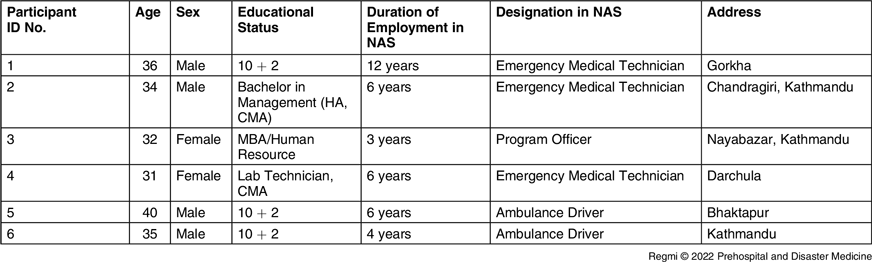
Six human resources working in NAS in the past two years were interviewed in this study (Table 1). The age range of the participants was between 31-40 years and their work experience ranged from three to 12 years. Two female and four male participants were included in this study and the majority of the participant’s permanent address was out from Kathmandu Valley. Almost all of the participant’s lowest education qualification was 10 + 2.
Demographic Characteristics of the Participants (N = 6)

Abbreviations: NAS, Nepal Ambulance Services; HA, Health Assistant; CMA, Community Medicine Assistant; MBA, Masters in Business Administration.
Classification of Themes and Sub-Themes
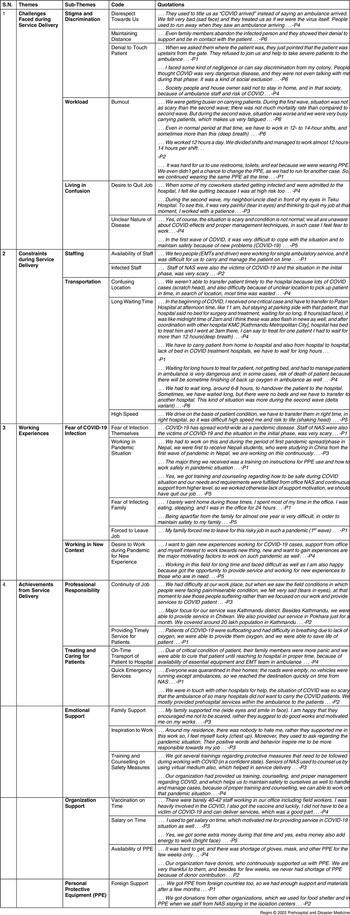
Four themes and 12 sub-themes were generated based on the IDIs generated through thematic analysis. The major four themes were: (1) challenges faced during service delivery; (2) constraints during service delivery; (3) working experiences during the pandemic; and (4) achievements from service delivery during the COVID-19 pandemic (Table 2).
Themes, Sub-Themes, Codes, and Quotations

Abbreviations: COVID-19, coronavirus disease 2019; PPE, personal protective equipment; EMT, emergency medical technician; NAS, Nepal Ambulance Service.
Theme 1: Challenges during Service Delivery
This theme is the abstraction from three major sub-themes: (1) stigma and discrimination; (2) workload; and (3) living in confusion.
Stigma and Discrimination—COVID-19, due to the ease of transmission from one person to another, the pandemic first gained a reputation for being frightening and ambiguous, and people began to take greater precautions. Social exclusion, wearing personal protective equipment (PPE), and keeping good cleanliness were the best ways to prevent this disease. People with COVID-19 were often treated unfairly, mistreated, and alienated from society, which caused participants to feel degraded and disrespected. Stigma and prejudice thus became one of the main issues when providing services:
…They used to title us as “COVID arrived” instead of saying an ambulance arrived. We felt very bad (sad face) and they treated us as if we were the virus itself. People used to run away when they saw an ambulance arriving…-P4
…Even family members abandon the infected person and they showed their denial to support and be in contact with the patient…-P6
…When we asked them where the patient was, they just pointed that the patient was upstairs from the gate. They refused to join us and help to take severe patients to the ambulance…-P1
…Society people and house owner said not to stay in home, and in that society, because of ambulance staff and risk of COVID…-P4
Workload—During the pandemic situation, work duty hours of participants were not fixed and it was unknown about whom to handover the duty; because of increasing COVID-19 cases and sometimes a shortage of PPE, this compelled participants to work on duty for long hours by single participants:
… It was hard for us to use restrooms, toilets, and eat because we were wearing PPE. We even didn’t get a chance to change the PPE, as we had to run for another case. So, we continued wearing the same PPE all the time…-P1
…Even in normal period at that time, we have to work in 12- to 14-hour shifts, and sometimes more than this (deep breath) …-P6
…We worked 12 hours a day. We divided shifts and managed to work almost 12 hours-14 hours per shift…-P2
Living in Confusion—Participants claimed that their family and other relatives had pressured them to quit their jobs. They considered quitting their jobs when other employees and patients were ill and had to be admitted to the hospital. When pandemics occur, participants are more unsure about their decision to stay on the work or quit. If they stay on the work throughout the epidemic or quit, they do so in a more perplexed condition:
…When some of my coworkers started getting infected and were admitted to the hospital, I felt like quitting because I was at high risk too…-P4
…During the second wave, my neighbor/uncle died in front of my eyes in Teku Hospital. To see this, it was very painful (tear in eyes) and thinking to quit my job at that moment, I worked with a patience…-P3
…In the first wave of COVID, it was very difficult to cope with the situation and to maintain safety because of new problems (COVID-19) …-P5
Theme 2: Constraints during Service Delivery
This theme is abstracted from two major sub-themes: (1) staffing and (2) transportation.
Staffing—There was a lot of uncertainty throughout the pandemic’s early stages. As NAS employees were also COVID-19 afflicted, there was a lack of human resources because a single service provider had to care for several patients:
… Staff of NAS were also the victims of COVID-19 and the situation in the initial phase, was very scary…-P2
…We two people (EMTs and driver) were working for single ambulatory service, and it was difficult for us to carry and manage the patient on time…-P1
Transportation—Staff found it challenging to receive patients on time since there was little information available on a clear place to welcome the patient. Long periods of patient waiting hampered their ability to organize their time effectively. Additionally, there was no timely vehicle maintenance or repair. Similar to this, the patient had to wait a long time to acquire a bed at the hospital. Even for a single case, they might need to look at many hospitals to get a bed. They had to wait a long time to get a bed for treatment for individual patients, sometimes even up to 12 hours:
…We [weren’t] able to transfer patient timely to the hospital because lots of COVID cases (scratch head), and also difficulty because of unclear location to pick up patient in time, in search of location, most time was wasted…-P4
…We have to carry patient from home to hospital and also from hospital to hospital, lack of bed in COVID treatment hospitals, we have to wait for long hours…-P1
…In the beginning of COVID, I received one critical case and have to transfer to Patan Hospital at afternoon time, like 11am, but staying at parking side with that patient, that hospital said no bed for surgery and treatment, waiting for so long, 8 hours (sad face), it was like midnight time of 2am and I think these was also flash in news as well, and after coordination with other hospital KMC [Kathmandu Metropolitan City], hospital has bed to treat him and I went at 3am there, I can say to treat for one patient I had to wait for more than 12 hours (deep breath)…-P4
Theme 3: Working Experiences during Pandemic
This theme is abstracted from sub-themes like: (1) fear of COVID-19 infection and (2) working in a new context.
The most important requirement for good service delivery was a pleasant work atmosphere. During the most crucial period of the epidemic, family and societal support were crucial. Working on the new COVID-19 illness had grown more difficult, but there were also opportunities to learn new things.
Fear of COVID-19 Infection—Participants in the COVID-19 pandemic crisis, especially in the early stages, were extremely scared of contracting the disease. Participants also expressed concern about spreading disease to family members as a result of their on-going involvement in frontline health care activities. However, many volunteers were inspired to continue performing their duties in order to develop new skills while working in a pandemic environment:
…COVID-19 has spread world-wide as a pandemic disease. Staff of NAS were also the victims of COVID-19 and the situation in the initial phase, was very scary…-P1
…We had to work on this and during the period of first pandemic spread/phase in Nepal, we were first to receive Nepali students, who were studying in China from the first wave of pandemic in Nepal, we are working on this continuously…-P3
Working in New Context—One of the hardest tasks for them was dealing with COVID-19, a new disease for which they had no knowledge of treatment options during the early stages of the pandemic. They also had to work long shifts, endure demanding hours, struggle to maintain personal cleanliness and handle PPE, and keep appropriate social distances while doing so. In addition, they noted that working in such an unfamiliar environment during the early stages of the epidemic caused people to experience mental and psychological stress:
…I want to gain new experiences working for COVID-19 cases, support from office and myself interest to work towards new thing, new and want to gain experiences are the major motivating factors to work on such pandemic as well…-P4
…Working in this field for long time and faced difficult, as well as I am also happy because got the opportunity to provide service and working for new experiences to those who are in need…-P5
Theme 4: Achievements from Service Delivery
This theme is abstracted from sub-themes like: (1) professional responsibility; (2) treating and caring for patients; (3) emotional support; (4) organization support; and (5) PPE.
Professional Responsibility—Despite the extremely tough conditions during the pandemic, participants said that they were motivated to perform their duties to transfer patients from various locations to various health care facilities for treatment. Participants acknowledged their pride at having been able to save so many individuals throughout the epidemic:
…We had difficulty at our work place, but when we saw the field conditions in which people were facing pain/miserable condition, we felt very sad (tears in eyes), at that moment to see those people suffering, rather than we focused on our work and provide services to COVID patient…-P3
…We provide care in proper time, patients were suffocating, had difficulty in breathing due to lack of oxygen, and we transferred them in ambulance, checked their vitals, where their breathing pattern was irregular and the oxygen saturation was very low, and we were able to provide them oxygen, and the patient finally could breathe, and this response from the patient was relieving moment for us…-P1
Treating and Caring for Patient—The presence of appropriate tools and medications in the ambulance, as well as the availability of PPE and other resources, were mentioned by participants as ways that a frontline health professional may treat and care for a patient before they arrived at the hospital. In certain instances, patients got emotional care before being admitted to the hospital so that they and their families could develop strong emotional bonds:
…When we saw the field conditions in which people were facing, pain/miserable condition, we felt very sad at that moment, we counselled them not to worry about the situation and motivate them…-P3
…I had to transfer one severe/critical COVID patient from Kathmandu Dental Hospital to Civil Hospital, and we were involved in that case and transfer him to hospital; the family members were more panicked because of situation, and the efforts from EMT ambulance facilities, management in ambulance help him to manage the critical situation, presence of medical team help him to safely transfer to another hospital; that was one example from our service, we can transfer safely critical/serious condition patient to another hospital on proper/right time…-P4
Emotional Support—Good reinforcement and incentives, such as encouragement and assistance throughout work, had a positive influence. Similar to how encouragement and inspiration contribute positive energy to an activity, praise does too. Participants acknowledged that having a positive outlook and receiving encouragement empowered them to complete tasks and provide services with greater assurance:
…Around my residence, there was nobody to hate me, rather they supported me in this work so, I feel myself lucky (chest up). Moreover, they used to ask regarding the pandemic situation. Their positive words and behavior inspire me to be more responsible towards my job…-P3
Organization Support—One of the key motivators in the fight against the epidemic was organization support. Participants stated that working in NAS and receiving support from higher levels, as well as regular monitoring and inquiries about the situation while they were in quarantine, encouraged and motivated them to complete their tasks. The main key supporting factors for them to deal with and handle the prehospital care were the timely provision of PPE and other equipment to deal with COVID-19 management and treat the patient in the appropriate time, the timely provision of salary, early training, motivation, COVID-cash payment, and different priority and facilities:
…I used to get salary on time…-P2
…We got several trainings regarding protective measures that need to be followed during working with COVID (in a confident state). Seniors of NAS used to counsel us by using virtual medium also, which helped in service delivery…-P3
…Yes, we got some extra money during that time and yes, extra money also add energy to work (bright face) …-P5
Personal Protective Equipment (PPE)—Participants reported that for the first few weeks alone, there was a scarcity of gloves, masks, and other PPE. However, after the organization gave them a lot of support, they claimed that having enough PPE would not hinder their ability to provide services to the COVID-19 patient. Instead, they claimed that having enough PPE would enable them to provide services at the appropriate time. As hygienic tools, correct PPE handling and other training instructions offered more energy to execute activities; early and good management of PPE resulted in positive motivation on the job. There was no barrier due to the lack of PPE throughout the epidemic, despite wearing and handling challenges with eating and toileting:
…It was hard to get, and there was shortage of gloves, mask, and other PPE for the few weeks only…-P4
…Our organization have donors, who continuously supported us with PPE. We are very thankful to them, and besides for few weeks, we never had shortage of PPE because of donor contribution…P2
…We got PPE from foreign countries too, so we had enough support and materials after a few months…-P1
Discussion
The study examines the service delivery constraints, challenges, and achievement of the ambulance service in Kathmandu Valley during the COVID-19 pandemic. Four themes were generated through the thematic analysis, including 12 sub-themes.
Community members showed categorizing behavior towards the service providers. This finding shows consistency with the other study done in India where COVID-19 front warriors were ostracized by the community members, making them felt hurt, dismay, and humiliation. Reference Bhanot, Singh, Verma and Sharad7 The similarity between these two studies could be due to the nature of COVID-19, as this is a newly emerged pandemic.
Participants described that they felt the burden of workload during the pandemic as they had to perform heavy shifts, long working hours, and difficulty in wearing and maintaining hygiene while using PPE. Similar findings were found in other studies which showed workload during the outbreak where EMS providers were affected, Reference Liu, Luo and Haase8,Reference Mohammadi, Tehranineshat, Bijani and Khaleghi9 and where insufficient number of health care providers make them exhausted in providing service.
This study explored unavailability of staff in adequate numbers and difficulty in finding the location of patients as barrier in providing services to patients during the initial phase of the pandemic. The findings of this study contradict with another study done in Iran where lack of equipment during the pandemic had seriously affected the prehospital care. Reference Mohammadi, Tehranineshat, Bijani and Khaleghi9 As during the first phase, the health system was affected due to the large number of COVID-19 patients, and also Nepalese people may not be technology friendly.
The study found that during the initial phase of pandemic situation, participants were very much afraid of getting transmission. They revealed their worries about infecting family due to their continuous involvement in handling of patients. Similar findings were found in a study conducted in China which showed that due to lack of understanding of transmission of virus, health care workers were constantly in fear of being infected with COVID-19. Although well-protected in the isolation wards, health care providers were afraid of unintentional occupational exposure and of transmitting the virus to their colleagues. Reference Liu, Luo and Haase8
Similar findings were found on meta synthesis of the lived experience of health care providers, Reference Chandy, Kanthi and Pradeep10 where the health worker stated that they felt proud to serve the people who were seeking care during the pandemic and they joined the pandemic war without any hesitation to save the patients’ lives. They have also shown a sense of professional responsibility and sacrificial commitment to safeguard the patients from the virus attack.
The study also exposes that the participants had expressed their emotional support to care for the patients, whatever the situation is. As a frontline health worker, they are equipped with necessary equipment, medicine, PPE, and other materials so that they can treat and care for patients in proper time before reaching the hospitals. Participants felt that they are able to save the patient in time, which reduces the severe consequences due to effective prehospital services. This finding shows consistency with another study done; Reference Liu, Luo and Haase8 it was identified that frontline health workers provide care and support to isolated patients for better treatment to reduce the severity and to provide psychological support.
Organization support is one of the most important motivating factors in working for the pandemic situation. Participants of this study stated that the organization supported them from higher level management, time and again, monitoring and asking about the situation while stayed in quarantine made them motivated and got inspired to work. Similarly, supply of PPE and other equipment helped them to tackle COVID-19 management and treat the patients in proper time. Participants stated that the service was mildly affected by the shortage of the PPE and other necessary equipment, as they did not feel the scarcity of such protective gears. This finding is in contrary with the study conducted in Iran, Reference Mohammadi, Tehranineshat, Bijani and Khaleghi9 where the EMS workers suffered several psychological difficulties as a result of inadequate PPE/equipment and job overload in the crisis, which negatively impacted the standard of their prehospital emergency care. Similarly, according to the findings of this study, provision of salary on time, early training, motivation, COVID-cash payment, and different priority and facilities are the main key supporting factors for them to deal with and handle the prehospital care. Findings were consistent with the study conducted in Iran, Reference Mohammadi, Tehranineshat, Bijani and Khaleghi9 where there was urgent need for the development of comprehensive care protocols to deal with the COVID-19 patient, which leads to the development of clinical instruction on providing care to the COVID-19 patient and guidelines to handle prehospital emergency care and protocols for supervising EMS personnel provision of care provided to COVID-19 patients at home. These findings are also in line with the study conducted in China, Reference Liu, Luo and Haase8 which also stated that the participants said that hospital gives them strong logistical support, including providing medical protective supplies, accommodations, transportation, food, medicines, and subsidies.
In this study, it was identified that during the pandemic period, most of the people leave their job and became more panicked because of the increasing trend of COVID-19 cases, but the family of the participants encouraged them to do work and motivated them by praising their jobs during the situation. Findings of the study were found to be similar to the study conducted in Western Africa during the Ebola pandemic. Reference McGillis Hall and Kashin11
Participants expressed that family-paid caregivers have a role in bed-side care and assisting with activities of daily living for hospitalized patients that are not in intensive care units, and patients view this family care as important psychological support while they are ill. In contrary, the findings of the study conducted in China revealed that some health care providers felt challenged to have good relationships with patients, because it was more difficult to communicate when they were in such a stressful situation. Other health care providers felt their relationships with patients were enhanced when patients expressed appreciation for their willingness to put themselves at risk to provide care to them, even when providing the care was difficult. Reference Liu, Luo and Haase8
Limitation
The findings of this study may only be applicable to similar settings. All other ambulances operated by both the government and non-government in Kathmandu besides NAS were not included in this study.
Conclusions
According to the study’s findings, the initially confusing nature of COVID-19, a staffing shortage, and a variety of restrictions or precautions that had to be followed when caring for COVID-19 patients made working circumstances for service providers challenging.
This study’s IDIs with the participants indicated that they experienced a variety of difficulties during the pandemic, including stigma, service delivery issues, patient location identification, wearing PPE for extended periods of time, and a tremendous workload. Participants were nevertheless able to efficiently provide prehospital care services and could quickly transfer COVID-19 patients to various hospitals for better care despite these obstacles.
Conflicts of interest/funding
The author(s) declared no potential conflicts of interest with respect to the research, authorship, and/or publication of this article. The author(s) received no financial support for the research, authorship, and/or publication of this article.
Acknowledgement
Authors are thankful to Nepal Ambulance Service (NAS) for providing the authority to conduct this research.