

INTRODUCTION
Human trafficking is one of the major social evils growing globally. Like terrorism, human trafficking has also been recognized as one of the major problems in India and the world over. The United Nations Office on Drugs and Crime (UNODC), Regional Office for South Asia, in partnership with the Indian Ministry of Home Affairs (MHA), implemented Project IND/S16 for “Strengthening Law Enforcement Response to Human Trafficking” in India. UNODC initiated the project to train law enforcement officers in five states of India, namely Maharashtra, Goa, West Bengal, Bihar, and Andhra Pradesh.
The Supreme Court of India directed the government to establish an organized crime investigative agency by December 2015–2016 to investigate human trafficking cases and rescue and rehabilitate victims. Such an agency was pending the passing of the draft anti-trafficking bill. The Indian MHA allocated 832 million Indian rupees ($12.3 million) to fund the agency.
Anti-human trafficking units (AHTUs) continued to serve as the primary investigative force for human trafficking crimes. In India, of the more than 600 districts, 226 have had active AHTUs so far. Despite these researchers’ sincere efforts, it is not known if the number of AHTUs increased at the national level. However, with the help and guidance of his mentor, one of the researchers (Rajkamal Ajmeri) succeeded in getting the data for Gujarat State after a rigorous follow-up.
In 2010–2011 AHTUs were working to prevent illegal human traffic in Gujarat State. The first phase began with five AHTUs. They were at the following districts of Gujarat State: Ahmedabad rural; Ahmedabad city; Rajkot city; Surat city; and Vadodara city.
In 2012–2013, after receiving permission from the MHA, the Gujarat State Police Department added five more for a total of 10 AHTUs in the state: Ahmedabad rural; Ahmedabad city; Anand; Bhavnagar; Mehsana; Nadiad; Rajkot; Surat city; Vadodara city; and Vadodara rural.
According to official data, it was heartening to note that by 2017–2018 the number increased to 40 AHTUs. All the 40 AHTUs are actively working to control/prevent human trafficking in Gujarat State.Footnote 1
Anti-Human Trafficking Unit Functionaries in Gujarat (India)
AHTU functionaries are team members of the task force who are directly responsible for dealing with trafficking cases in Gujarat State and India. All the police functionaries who are specifically appointed in AHTUs represent various ranks from top to bottom.Footnote 2
Research Questions
Research questions were:
-
What is the profile of AHTUs and other functionaries?
-
What are the current formal/informal structures, procedures, and practices?
-
How do the AHTUs functionaries manage the actual situations?
-
What are the hurdles faced by AHTUs functionaries leading to ineffective implementation of anti-human trafficking initiatives?
-
What are their opinions and suggestions to improve the system?
-
What contribution can social work professionals make in preventing and controlling human trafficking?
AIM AND OBJECTIVES
The broad aim of this research was to understand the existing structures created to control and prevent human trafficking and find the scope to improve and enhance current practices and procedures by using supportive social work strategies.
Other specific objectives were:
-
To explore the prevalence of reported cases in human trafficking in Gujarat State.
-
To study the current formal/informal practices and procedures followed by the government to control human trafficking in Gujarat.
-
To describe the current standard procedure followed by the AHTUs’ functionaries of Gujarat State.
-
To explore and describe the experiences of AHTUs’ functionaries.
-
To identify the difficulties faced by the AHTUs’ functionaries in Gujarat.
-
To describe opinions and suggestions of AHTUs’ functionaries based on their practical wisdom.
-
Based on the findings, provide suggestions for structural and procedural improvements with social work knowledge, skills and support.
RESEARCH METHODOLOGY
This exploratory research was conducted using a census survey of 214 functionaries of all 40 AHTUs from Gujarat. The survey covered all functionaries with the help of an interview schedule. The information was supplemented and triangulated by using in-depth interviews with key informants. The data were analyzed using the SPSS program, mainly distributed in simple frequency tables and cross-tabulation.
THE RESEARCHERS’ EXPERIENCES WITH ANTI-HUMAN TRAFFICKING UNITS IN GUJARAT (INDIA) ALSO CONTRIBUTED
Gujarat began with five AHTUs in the first phase, but at the time of data collection, 40 AHTUs were working with independent or internal arrangements throughout Gujarat State.
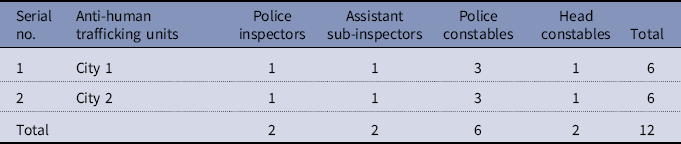
However, currently, only two independent AHTUs are working with full infrastructure in Gujarat State. These two independent units incorporated nine independent supporting staff and two independent nodal functionaries in charge. A total budget of 22,750,000 rupees was allocated to start up 12 independent AHTUs in Gujarat in 2012–2013. However, only two (and not 12) independent AHTUs in two cities were authorized. The workforce sanctioned under the official resolution was as shown in Table 1.
Approved Manpower in 2013 (Director General of Police 2016e)

The researchers observed that two police inspectors were trying hard to manage these AHTUs. The supporting staff in each unit included three assistant sub-inspectors, one head constable and one police constable. Moreover, of the two police inspectors, one worked in a women’s police station with the additional assignment to an AHTU. This took place, even though the resolution of 2012 allocated six posts to be filled there for 2013.
Requests made to the concerned recruiting authority in 2018 for appointing 10 new supporting staff are still pending. It was evident that the AHTUs were simultaneously running with a shortage of adequate workforce.
It was observed in various AHTUs that many respondents were facing difficulties when placed in charge of additional AHTUs, over and above their original postings. They hesitantly confessed that even if they tried their best to cope, a good performance in their allotted workload in an AHTU was humanly impossible.
It was observed by and shared with the researchers that the basic facilities allotted in some AHTUs existed on paper only. Four-wheelers, cameras, mobile phones, headphones, sound cards, and hard discs were insufficient or badly required proper maintenance. Example 1 provides details of improper maintenance:
As to transportation, an old four-wheeler vehicle was provided for AHTU on paper, but this vehicle required many repairs. One could not use this vehicle for following escaping traffickers because this vehicle had a capacity of running a maximum of four miles with a maximum speed of 20–40 km/h on roads.
Many respondents complained that many resources were not carefully handed over from previously appointed staff members and that there was unnecessary paperwork with very limited execution.
Some AHTUs were found to be without resources. Many supporting staff members had spent much money from their own pockets to sustain the AHTUs. They contributed collectively to buy furniture, printer machine, and computer. Their repeated requests remained unheard, and the higher authorities have given no concrete solution until now.
During the discussion with respondents, it became clear that they are working more than eight hours without overtime pay.
Respondents experienced problems establishing investigation links in old cases, especially because, as per current guidelines, AHTUs received cases from respective police stations only after four months if the local police station could not track the cases. Much time is lost, thus, to rescue the trafficked persons!
Many respondents criticized the careless attitude of the Primary Investigation Branch, the place where the “missing person” cases are registered and are supposed to be investigated. Many respondents complained that the police officers in charge of primary investigations usually remain inactive, waiting for four months to pass. At that point, the cases are immediately transferred to an AHTU without any effort and progress. If this is the scenario, it is high time that the Administration revises the policy guidelines.
Many AHTUs do not have the required female staff. It was found that deputed females in charge and supporting staff in many AHTUs were facing male colleagues’ dominating behavior and a double workload. In the cases of trafficked children, girls and women, the presence of qualified, trained women staff was felt to be especially essential.
The respondents opined that the frequent transfers of the officers in charge of AHTUs also affect the units’ performance. Frequent transfers disrupted the opportunity and continuity of learning from senior officials. The supporting staff was suffering from poor knowledge. The study found that the average length of respondents working in AHTUs was between one to six months, too short to grasp the crime-specific knowledge and skills.
To follow raids and other important work, the Additional Director General of Police issued an official letter for the appointment of district-level police officers from the Local Crime Branch (LCB) and city-level AHTU police officers from the Detection Crime Branch (DCB). However, this order was poorly implemented.
The idea of deputizing police officers from LCBs and DCBs was very intelligently framed to ensure immediate action and fast-tracking the accused, but systemic lethargy seemed to be a major hurdle in delivering the results. Example 2 details systemic lethargy:
The women’s police station had a limitation: they were not authorized to access the Global Positioning System (GPS) to track the close location of the accused. The LCB and DCB had complete control. Consequently, in such cases, a women’s police station officer had to depend on the information from these branches. As a result, the chances of escaping for the offenders increased. It also delayed and affected the victim/survivor cases.
Respondents said that children were the most vulnerable victims of human trafficking according to their experience. Most of the cases of adult females were for the flesh trade.
It was observed that male officials were interviewing female survivors in the absence of female workers from non-governmental organizations (NGOs). This was because no NGOs were working in those AHTUs within their jurisdiction. No standard victim identification tool was found in AHTUs. Respondents were facing problems in the classification of human trafficking cases without victim/survivor identification. Because of this, respondents were unable to categorize the actual cases of human trafficking.
It was disappointing to know that there were no allocations of secret funds for the AHTUs. Respondents could not frame any secret network for getting information about the organized gangs behind human trafficking because of poor fund allocation. Normally, these networks run through the support of money. Usually, respondents paid secret informants (Batmidars) for sharing the information. In the absence of inputs from informal channels, it was hard to achieve results.
It was found that the respondents were unaware of the website on human trafficking. Accumulating, compiling classified data and feeding in information about missing and trafficked victims is an important function of AHTUs, but this function was operated by a different branch of the police department – probably because the AHTU staff is under-confident in handling computers. There is a great need for proper liaison between these two branches, the AHTU and the Reader branch.
While respondents replied that they were offering medical help to the victims of human trafficking, they also confided that, in reality, a medical test was a time- and money-consuming activity. Many AHTUs were located far from civil hospitals, and a special test in a small hospital was not possible.
Some constables confided that they were avoiding and escaping from their responsibility of carrying the victims for medical tests. It became clear in the discussion that female police constables had had to spend money from their own pockets for medical tests in the past. Police constables admitted that they refused to carry the victims for tests because their expenses were not reimbursed. They sadly replied that they could not afford to do it at a personal cost, despite their wish to help the victim.
According to Supreme Court guidelines, AHTUs received cases four months after the initial report of a disappearance. Respondents of many AHTUs strongly believed that investigating transferred cases of victims (received after four months) was the only duty of AHTUs. Many respondents were unaware of conducting raids/rescue/search operations, which is another important function of the AHTUs. They lacked clarity about conducting these operations, thinking that they were the responsibility of other branches of the police department (i.e. Modus Operandi Branch, LCB). They never called for these kinds of challenging operations from other branches.
Training workshops on human trafficking were organized only for the nodal officers of AHTUs but not for the subordinate staff.
In addition to this, preference was given to a few selected members. Not all the staff members had an equal opportunity to participate in such training programs.
Some respondents believed that trafficking of child labor and its prevention were the actual responsibility of the concerned Government department and that police were playing a supporting role to concerned Government officials like the Social Defence and Labour departments. This, according to the guideline prescribed, had to be done in coordination with each other.
It was found that respondents lacked support from other government departmental officials and were critical for their lack of cooperation in taking the initiative in raids/rescues/search operations. Example 3 demonstrates non-cooperation:
After a raid or drive, officials from the Labour Department emotionally insist on filling a proxy on their behalf to the police officials. It seems they are not following their duty properly in many cases.
Respondents badly needed language translators. They were facing the problem of language, especially in the case of victims who came from neighboring countries like Nepal, Bangladesh or other states and only spoke their native language.
During the discussion with one female police officer, she became emotional and cried while sharing her personal experience. She shared her case with the researchers as follows:
She was working in a women’s police station as police inspector but was also given the additional charge of an AHTU. She had a staff of a female police sub-inspector and other supporting personnel. After a month, an official order relieved her from the main charge of the women’s police station, which was given to her subordinate female police sub-inspector. Now, she had to depend on the women’s police station for support. Because the supportive staff now reported to the police sub-inspector, they refused to cooperate with the original police inspector in charge of the AHTU. The ego clash between the two officers resulted in the AHTU without sufficient supporting staff and the workload falling on the AHTU police inspector. She tried to get the support of the police staff for court-related matters, but they avoided it by showing the workload of the women’s police station. The police inspector needed someone who could properly manage the cases. She lacked proper infrastructure and workforce. She hence became emotional and criticized the system for the poor decision-making and support.
CONCLUSION
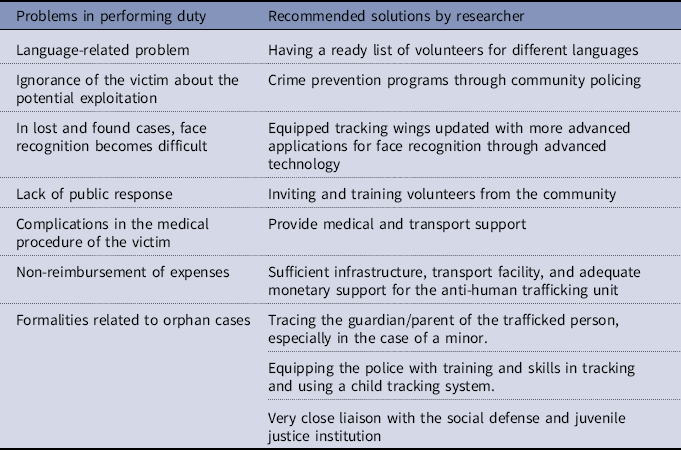
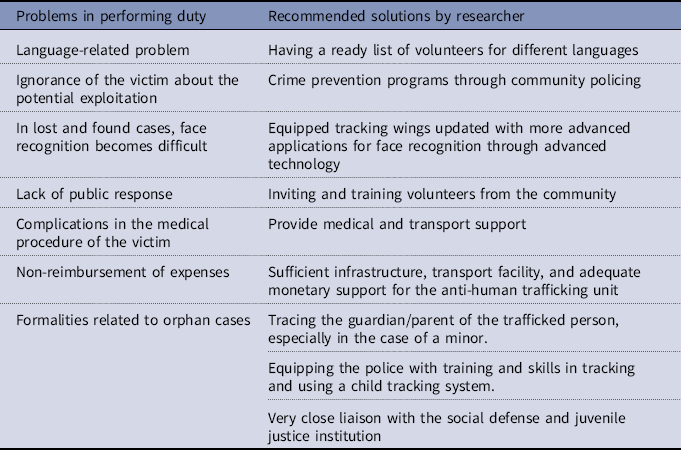
In a nutshell, it can be said that respondents were facing many problems while performing their duties in an AHTU (see Table 2).
Problems and Solutions
It was good to note that respondents wanted to improve their knowledge of AHTUs and benefit from training in such an area. Hence the system should organize more programs to increase their knowledge and skills. Being posted in an AHTU should not seem to be “punishment posting.” This is possible only if the required resources are provided to the AHTUs. This study provided many insights into the needs for changes in the policy, structure, resources and, above all, training needs of the staff. AHTU functionaries deserve better support, dignity, and participation in policymaking if we want to help them efficiently prevent and protect millions of citizens falling prey to the global trafficking network.
Acknowledgements
Special thanks to all functionaries of AHTUs and Gujarat Police Department and the Additional Director General of Police.
Rajkamal Ajmeri has been engaged in teaching and research work for more than 10 years. He is also a Research Ethical Committee member, Institutional Review Board member, and on the boards of studies in several universities of Gujarat (India). His professional experience incorporates work with the United Nations Organization (UNO)-ICJA abroad program in Germany and India. Dr. Ajmeri has worked with refugees and presented many international research papers on their psychosocial conditions in Germany. His work was noticed and he was interviewed by many international and local newspaper agencies in Gujarat (India) and Germany. He has presented many research papers and participated in several national as well as international seminars. Furthermore, he has received appreciation from the District Administration Department of the Government of Gujarat.
Leena Mehta has been extensively engaged in action linked to research for more than 30 years. She is actively involved in Gujarat State’s gender policymaking and participates in several advisory committees in the Ministry of Home, Ministry of Social Justice and Empowerment issues. The Honorable Gujarat High Court, while directing the State Government to rehabilitate brothel-based sex workers, has quoted Dr. Mehta’s findings and suggestions in related judgments. She has published articles on probation of offenders, child sex-workers and social work education. She received the state government’s nomination as Honorary Magistrate and Chairperson of the Vadodara District Juvenile Welfare Board in the Juvenile Justice System and the Primary Education Board of the Local Self Government.