Adult personality disorders are conceptualized as enduring character-based patterns of psychopathology that emerge in adolescence or adulthood (American Psychiatric Association, 2014). However, longitudinal investigations of normal development and pathology suggest that personality organization may be more dynamic (Caspi & Shiner, Reference Caspi, Shiner, Damon, Lerner and Eisenberg2006; Rutter, Kim- Cohen, & Maughan, Reference Rutter, Kim-Cohen and Maughan2006; Shiner, Reference Shiner2009). A developmental perspective, encompassing typical as well as atypical functioning, may provide a useful framework and common principles for conceptualizing and examining processes that underlie personality functioning across the lifespan (e.g., Carlson, Sroufe, & Egeland, Reference Carlson, Sroufe and Egeland2004; Cicchetti, Reference Cicchetti2014; Tackett, Balsis, Oltmanns, & Krueger, Reference Tackett, Balsis, Oltmanns and Krueger2009; Widiger, De Clercq, & De Fruyt, Reference Widiger, De Clerca and De Fruyt2009). From this framework, personality functioning and disorder do not appear de novo in adolescence, but instead emerge from dynamic processes of organization, reorganization, and integration of diverse biological, psychological, and social systems across developmental periods beginning in infancy (Cicchetti, Reference Cicchetti, Cicchetti and Cohen2006, Reference Cicchetti2014). Disturbance may reflect varying degrees of abnormality across domains; however, the diverse areas do not exist in isolation. The domains of functioning are interrelated, mutually interdependent, and transformative. Investigations of the multiple aspects of the developmental process concurrently can shed light on the nature of the interrelations and their origins (Cicchetti & Crick, Reference Cicchetti and Crick2009). Grounded in developmental principles and using longitudinal data from a risk sample, the current study investigates the relations among representational and behavioral experience from infancy to early adolescence in the evolution of personality disturbance.
Developmental Framework
Within a developmental framework, emphasis is placed on the organization of experience and patterns of adaptation (Sroufe & Waters, Reference Sroufe and Waters1977) defined with respect to salient developmental issues (Cicchetti, Reference Cicchetti, Cicchetti and Carlson1989; Waters & Sroufe, Reference Waters and Sroufe1983). Positive adaptation is characterized by integrations of biological, socioemotional, cognitive, and representational capacities that promote the flexible negotiation of concurrent and future developmental issues (Cicchetti, Reference Cicchetti1993; Egeland, Carlson, & Sroufe, Reference Egeland, Carlson and Sroufe1993; Sroufe, Reference Sroufe and Cicchetti1989; Waters & Sroufe, Reference Waters and Sroufe1983). Maladaptation (i.e., psychopathology) reflects developmental deviation(s) from normal patterns of adaptation, rigid patterns of functioning that compromise development (Cicchetti, Reference Cicchetti1993; Sroufe, Reference Sroufe and Cicchetti1989). In a cumulative series of qualitative reorganizations whereby earlier patterns of adaptation provide a framework for, and are transformed by, later adaptations, early experience is uniquely influential as an initiating condition, providing a foundation for successive transformations. Of central importance are the ways in which early experience, later experience, and current circumstances interact to shape adaptation or disturbance.
From this perspective, personality functioning, whether typical or atypical, is defined by the organization of experience, internal expectations, attitudes, and related feelings with manifestations in attention, behavior, and relationships (Breger, Reference Breger1974; Loevinger, Reference Loevinger1976; Sroufe, Reference Sroufe, Cicchetti and Beeghly1990). Beginning in infancy, mechanisms underlying the origin and evolution of personality disturbance are integrally related to those underlying the development of normative functioning. Personality disorder is viewed as a developmental construction, created step by step, as is personality itself.
Attachment theory, as articulated by Bowlby (1969/Reference Bowlby1982, Reference Bowlby1973, Reference Bowlby1988) and elaborated by others (e.g., Sroufe, Reference Sroufe1996; Sroufe, Egeland, Carlson, & Collins, Reference Sroufe, Egeland, Carlson and Collins2005), includes specific claims about how experience in early relationships may pave the way for personality organization. From this perspective, typically, in infancy and early childhood, experiences are modulated by the caregiver in daily routines across domains of functioning. Through repeated experiences with a responsive caregiver and subsequent supportive relationships, relational strategies for maintaining organization are internalized (e.g., Emde, Reference Emde1983; Sroufe, Reference Sroufe1996). From responsive early caregiving, children are likely to develop flexible individual patterns of regulating emotion and attention, positive expectations and attitudes regarding the self and others, and fundamental relational skills that maintain internal organization and effective connections with others (e.g., Sroufe, Reference Sroufe1996; Sroufe et al., Reference Sroufe, Egeland, Carlson and Collins2005). Emerging cognitive capabilities, caregiver scaffolding, and interactions with the social world all contribute to the child's evolving organization of a coherent sense of self (e.g., Maccoby, Reference Maccoby1992, Reference Maccoby2000; Nelson, Reference Nelson2007; Sroufe et al., Reference Sroufe, Egeland, Carlson and Collins2005; Thompson, Reference Thompson, Eisenberg, Damon and Lerner2006; Vygotsky, Reference Vygotsky1978).
In contrast, in the context of unbuffered or overwhelming malevolent early caregiving experience, emergent capacities for organization and regulation may be disrupted or distorted at multiple levels (Carlson, Yates, & Sroufe, Reference Carlson, Yates, Sroufe, Dill, O'Neil and Somer2009; van der Kolk, Reference van der Kolk1987, Reference van der Kolk1988). Negative early dyadic emotional experiences may compromise normal processes of individual organization and integration, and developing cognitive capacities as well as social experiences that typically provide new avenues for managing and integrating experience may be restricted. In this way, altered, mutually reinforcing relationship-based internal and external developmental processes contribute to personality disturbance.
Development of Personality Disorders
Investigations of childhood antecedents of personality disorders support the links among early caregiving experience, developing cognitive and affective regulatory patterns, social experience, and later pathology. For example, there is growing evidence that manifestations of personality pathology have their origins in the early years of life (Cohen, Reference Cohen2008; Raine, Reference Raine2006; Tackett et al., Reference Tackett, Balsis, Oltmanns and Krueger2009; Weston & Riolo, Reference Weston and Riolo2007). Particularly relevant to the development of personality disorders are disruptions in caregiving relationships in infancy (i.e., attachment disorganization) and experiences of trauma (e.g., maltreatment and prolonged separations in early childhood; e.g., Carlson, Egeland, & Sroufe, Reference Carlson, Egeland and Sroufe2009; Dozier, Stovall, & Albus, 2008; Shi, Bureau, Easterbrooks, Zhao, & Lyons-Ruth, Reference Shi, Bureau, Easterbrooks, Zhao and Lyons-Ruth2012). Extreme unbuffered arousal challenges young children to organize and integrate emotional experience beyond developmental capacities (when organization depends upon dyadic regulation; e.g., Carlson, Reference Carlson1998). The abilities to organize emotional experience and to link affect and behavior with underlying mental states (i.e., to mentalize) are thought to be critical to the development of emotion regulation, impulse control, and self-awareness, and to the development and maintenance of social relationships (Fonagy & Bateman, Reference Fonagy, Bateman, Oldham, Skodol and Bender2005, Reference Fonagy and Bateman2008). In the context of malevolent or disrupted caregiving experience, the development of harsh or fear-based expectations of relationships and restricted cognitive capacities may result in distortions in social schema (i.e., expectations of self and other) and related behavior, placing children at risk for disturbance (Tackett et al., Reference Tackett, Balsis, Oltmanns and Krueger2009). Further, negative or unstable internal representations and inflexible cognitive styles are likely to create conditions in which interpersonal relationships are tumultuous, conflictual, and self-perpetuating by the behavioral responses that they tend to evoke. From this framework, mental representations and associated affective and behavioral patterns may account for the links between early life experiences and adult functioning (Fonagy & Bateman, Reference Fonagy, Bateman, Oldham, Skodol and Bender2005, Reference Fonagy and Bateman2008; Patrick, Hobson, Castle, Howard, & Maughan, Reference Patrick, Hobson, Castle, Howard and Maughan1994).
An organizational development perspective is supported by multilevel research on the antecedents and precursors of personality disorder in childhood and early adolescence (Belsky et al., Reference Belsky, Caspi, Arseneault, Bleidorn, Fonagy and Goodman2012; Carlson, Egeland, et al., Reference Carlson, Yates, Sroufe, Dill, O'Neil and Somer2009; Cicchetti & Crick, Reference Cicchetti and Crick2009; Crick, Murray-Close, & Woods, Reference Crick, Murray-Close and Woods2005; Holmes, Slaughter, & Kashani, Reference Holmes, Slaughter and Kashani2001; Rogosch & Cicchetti, Reference Rogosch and Cicchetti2005; Wolke, Schreier, Zanarini, & Winsper, Reference Wolke, Schreier, Zanarini and Winsper2012). Adult personality disorders (especially borderline and antisocial) have been related to characteristic patterns of cognitive sensitivity (e.g., hostile worldview), deficits in executive functioning, emotional and behavioral problems (e.g., aggression and impulsivity), and difficulties in relationships with peers and adults (Carlson, Egeland, et al., Reference Carlson, Yates, Sroufe, Dill, O'Neil and Somer2009; Crick et al., Reference Crick, Murray-Close and Woods2005; Rogosch & Cicchetti, Reference Rogosch and Cicchetti2005; Winsper, Zanarini, & Wolke, Reference Winsper, Zanarini and Wolke2012; Wolke et al., Reference Wolke, Schreier, Zanarini and Winsper2012) beginning as early as the preschool period (Belsky et al., Reference Belsky, Caspi, Arseneault, Bleidorn, Fonagy and Goodman2012; Holmes et al., Reference Holmes, Slaughter and Kashani2001). Longitudinal investigations are needed to understand the mechanisms associated with possible developmental trajectories as well as the common and distinct dimensions of functioning underlying the emergence of variations in patterns of personality disturbance.
Current Study
Building on a developmental framework and a multilevel study of normative development (Carlson et al., Reference Carlson, Sroufe and Egeland2004), the current study employed longitudinal data to examine the transactional relations between internal and external experience in the development of adult personality disorder symptoms. In previous work, (Carlson et al., Reference Carlson, Sroufe and Egeland2004), structural equation models were used to investigate the normative relations among caregiving experience in infancy, relational representation and social experience from early childhood to early adolescence, and socioemotional functioning in late adolescence. Models representing interactive contributions of representational and behavioral experience demonstrated significantly improved model fit over competing noninteractive models, supporting the view that socioemotional adaptation may arise from the progressive construction of mutually informing expectations and social experience.
In the current study, we tested interactive developmental hypotheses related to the evolution of personality disturbance. Using path analytic techniques, we (a) examined the direct and indirect influence (through representation and behavior) of early experience on adult personality functioning and (b) compared interactive and noninteractive developmental models of relations between relationship representation and behavior predicting personality disorder symptoms. As in normative functioning, disturbance in personality was expected to be related to ongoing reciprocal influences between internal and external experiences, wherein representational processes carry forward previous social experience and provide structure for subsequent encounters with the world, while at the same time existing representations are altered by ongoing changes in social interaction.
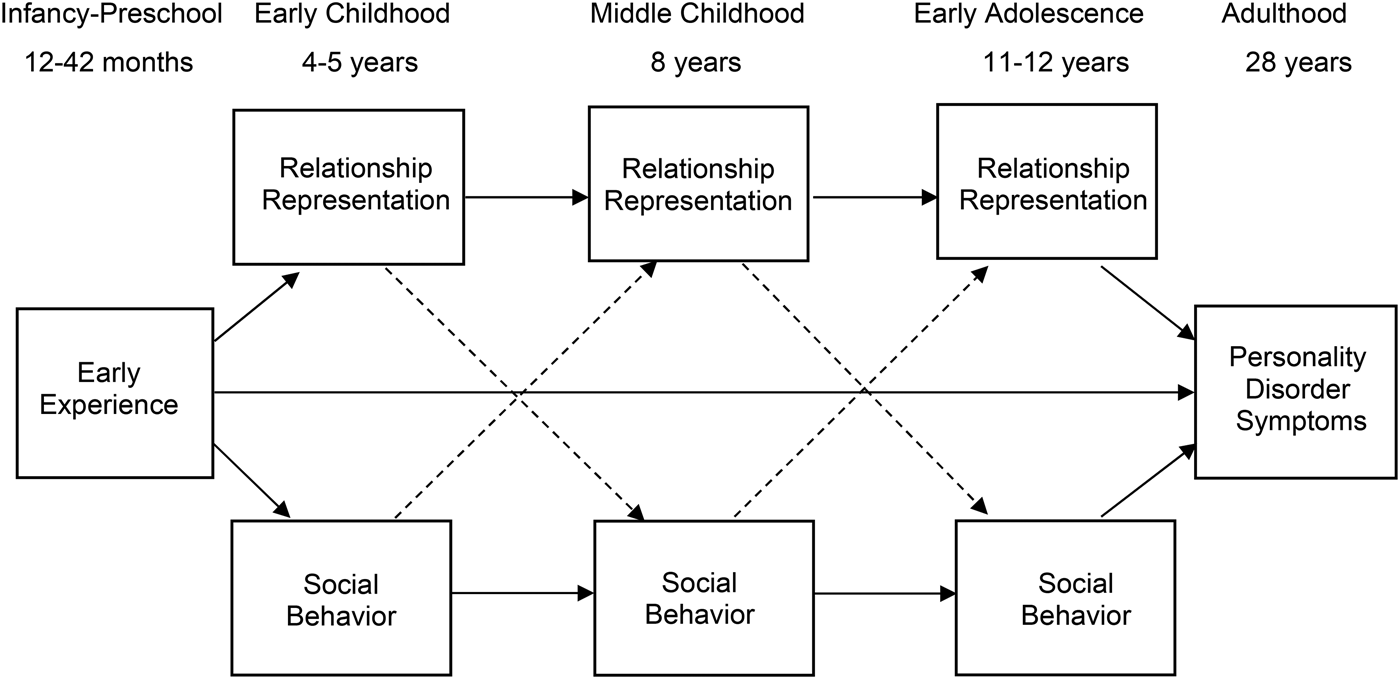
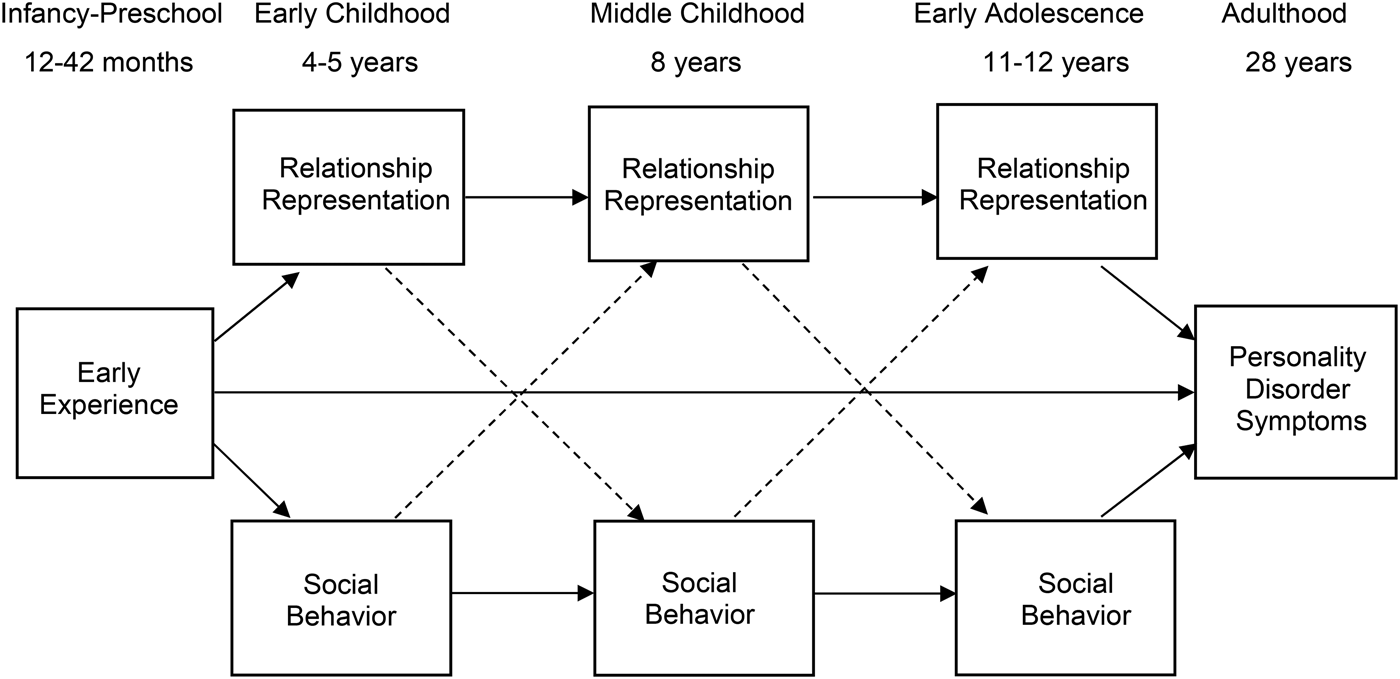
The study examined the transactional proposition using a comprehensive series of cross-lag path models of relations between measures of relationship-based representation and behavior to predict adult disorder. Principal conceptual models utilized data representing five assessment periods: infancy through the preschool period (1–3 years), early childhood (5 years), middle childhood (8 years), early adolescence (12 years), and adulthood (28 years; see Figure 1). To maximize the use of data available across time, composite variables were created to represent relevant dimensions at each developmental period. Early childhood experience was represented by attachment quality, caregiver–toddler relationship quality, and caregiver–preschooler relationship quality, initiating experiences for both representational and behavioral processes related to the development of personality disturbance (Carlson & Sroufe, Reference Carlson, Sroufe, Cicchetti and Cohen1995; Sroufe, Reference Sroufe1996). In subsequent developmental periods (i.e., early childhood, middle childhood, and early adolescence), composite representational variables included ratings of child relationship expectations, attitudes and feelings, and indices of pathology and cognitive organization regarding relationship experience derived from child productions (i.e., interviews, drawings, and projective narratives). In the same three developmental periods, composite behavioral variables consisted of observational assessments of child social interaction with peers and emotional health. Adult personality disorder symptoms were measured at age 28 years. Path models included noninteractive paths between representation and behavior from early childhood through early adolescence (Model 1) and successive reciprocal associations between representation and behavior in early childhood through early adolescence (Model 2). Through the selective deletion of paths and developmental data, subsequent nested and nonnested models were conducted to challenge the fit of the proposed interactive structure.
Path models examining the development of personality disorder symptoms. Model 1 (noninteractive) includes paths represented by solid lines. Model 2 (interactive) includes paths represented by solid and dashed lines.
Method
Participants
Participants (N = 162; 82 males, 80 females) were drawn from a longitudinal study of development and adaptation in a poverty sample of young mothers (range = 14–34 years, M = 20.66, SD = 3.57) and their firstborn children (for complete sample data, see Egeland, Reference Egeland, Starr and Wolfe1991). The original sample of primiparous mothers was recruited between 1975 and 1977 from the public health clinics where they were receiving prenatal care. The families were identified as at risk for parenting problems due to poverty (100%), single motherhood (62%), and low maternal educational attainment (34% had not completed high school). The current sample was 67% Caucasian; 11% African American; 5% Native American, Latino, or Asian; and 17% multiracial. Based on US Census occupational categories, 43% of heads of households were employed as clerical, service workers, operatives, or craftsmen; 5% were employed in technical, managerial, or sales positions; 40% were unemployed; and 12% were students when the infants were born. Attrition analyses did not reveal demographic differences between the current participants and the original sample.
Procedure
Because longitudinal multivariate data afford the opportunity for multiple analyses regarding a particular phenomenon, a rationale or strategy for variable selection is critical. The goals of the current study were to examine the relations between early experience and personality disorder symptoms and the transactional contributions of representational and social experience in childhood and early adolescence to adult disturbance. Guided by the investigation of transactional processes in normative development (Carlson et al., Reference Carlson, Sroufe and Egeland2004), data analytic specifications, and sample size, path analysis composite variables were constructed to represent early experience, representation, and behavior in three developmental periods, and adult personality symptoms. Composite variable composition is described in the following sections.
Early experience
Early experience composite indicators were selected to represent disturbances in infant, toddler, and preschool experience in caregiving relationships. The composite variable included measures of attachment disorganization (12–18 months) and negative experiences in mother–child relationships during toddlerhood (24 months) and the preschool period (42 months). The variables were standardized and averaged to create the early experience composite (Cronbach α = 0.60). Personality disorder was a specific pathological outcome posited by Bowlby's (1969/Reference Bowlby1982) theory of attachment, and numerous studies have traced personality disturbance to disruptions in early caregiving (e.g., Carlson, Yates, et al., Reference Carlson, Yates, Sroufe, Dill, O'Neil and Somer2009; Shi et al., Reference Shi, Bureau, Easterbrooks, Zhao and Lyons-Ruth2012; Tackett et al., Reference Tackett, Balsis, Oltmanns and Krueger2009).
Attachment quality at 12 and 18 months
Attachment assessments were conducted at 12 and 18 months using Ainsworth's strange situation procedure (Ainsworth, Blehar, Waters, & Wall, Reference Ainsworth, Blehar, Waters and Wall1978). The standardized laboratory procedure consists of eight brief episodes designed to activate infant attachment behavior through an increasingly stressful series of infant–mother separations and reunions. Individual differences in attachment relationships are coded with respect to the infant's gaining comfort in the mother's presence when stressed and using the mother as a secure base from which to explore. Infant–mother dyads were assigned to one of three major classifications (secure, anxious avoidant, or anxious resistant) based on the patterning of interactive behavioral ratings and coded for attachment disorganization/disorientation using the classification scheme developed by Main and Solomon (Reference Main, Solomon, Greenberg, Cicchetti and Cummings1990). Indices of disorganization/disorientation include (a) sequential display of contradictory behavior patterns; (b) simultaneous display of contradictory behavior patterns; (c) undirected, misdirected, incomplete, and interrupted movements and expressions; (d) stereotypies, asymmetrical movements, mistimed movements, and anomalous postures; (e) freezing, stilling, and slowed movements and expressions; (f) direct indices of apprehension regarding the parent; and (g) direct indices of disorganization or disorientation. The 9-point rating of disorganization/disorientation in infant–caregiver attachment was used in current analyses (M = 3.68, SD = 2.24). Coders were trained by Main, and interrater agreement was 86% based on 35 cases (κ = 0.72). In previous longitudinal research, disorganization ratings were correlated significantly with dissociation ratings and psychopathology in late adolescence, r (128) = .36, p < .001 (Carlson, Reference Carlson1998).
Quality of mother–child relationship at 24 months
The quality of the mother–child relationship at 24 months was assessed in a laboratory problem-solving procedure described by Matas, Arend, and Sroufe (Reference Matas, Arend and Sroufe1978). In this situation, the child is challenged to solve a series of problems of graded difficulty with mother available to help. The child's overall experience in this laboratory assessment is rated on a 5-point Likert-type scale. A high rating (rating = 5) was assigned when the child's experience of structure and support was judged to be positive and likely to promote greater confidence in facing subsequent challenges. A low rating (rating = 1) was assigned when the child's experience was judged to be very poor due to parental belittling, taunting, abuse, or unavailability in times of stress. The variable has been validated extensively as an index of the overall quality and effectiveness of the mother–child pair at this developmental period (Egeland, Sroufe, & Erickson, Reference Egeland, Sroufe and Erickson1983; Erickson, Sroufe, & Egeland, Reference Erickson, Sroufe and Egeland1985). Assessments were coded by independent coders with adequate reliability, r (185) = .87. For current analyses, the rating was reverse coded to reflect negative child experience (M = 2.82, SD = 1.04).
Quality of mother–child relationship at 42 months
The quality of the mother–child relationship at 42 months was observed in a series of teaching tasks: building block towers of specific proportions, naming things with wheels, matching colors and shapes on a form board, and tracing a preset pattern through an Etch-a-Sketch maze adapted from the Berkeley Longitudinal Study (Block & Block, Reference Block, Block and Collins1980). The tasks were designed to challenges the abilities of most children, requiring the parent/caregiver to help the child complete the task and capturing the coping skills of the child and his or her capacity to use the mother as a supportive resource (see Erickson et al., Reference Erickson, Sroufe and Egeland1985).
The quality of the mother–child interaction was measured in a scale rating the child's experience in the session (Sroufe et al., Reference Sroufe, Egeland, Carlson and Collins2005). The scale reflects the degree to which the child's experience in the session would result in feelings of success and competence on the tasks and of confidence in the relationship with his/her mother. At the high end of the 7-point scale, interactions were typically positive; through appropriate maternal assistance, the child was able to complete the tasks with some sense of autonomy or problem-solving success. At the low end of the scale (rating =1), the child's experience in the session was deemed as negative, characterized by conflicts with the mother or by dominance or rejection by the mother in ways that were likely to contribute to lower expectations of his/her own competence. The relationship variable discriminated children with and without a history of abuse in early childhood (Egeland et al., Reference Egeland, Sroufe and Erickson1983) and children with and without behavior problems in preschool (Erickson et al., Reference Erickson, Sroufe and Egeland1985). The assessments were rated by independent coders with adequate reliability, r (87) = .78. For current analyses, the rating was reversed coded with high ratings reflecting negative child experience (M = 3.25, SD = 1.54).
Representational measures
Representational measures were selected to reflect content (i.e., expectations, attitudes, and feelings), structural quality (i.e., cognitive flexibility and coherence) of child internal experience regarding social relationships, and indices of disturbance in relationships and in core self-processes previously found to predict personality pathology (e.g., Carlson, Yates, et al., Reference Carlson, Yates, Sroufe, Dill, O'Neil and Somer2009; Crick et al., Reference Crick, Murray-Close and Woods2005). The composite variables included measures of representational experience in early childhood (preschool interpersonal problem-solving assessment), middle childhood (family drawing assessment), and early adolescence (narrative projective assessment). For each assessment period, original indicators were standardized and averaged to form composite variables (Cronbach α = 0.84 at age 5 years, 0.84 at age 8 years, and 0.91 at age 12 years).
Preschool Interpersonal Problem-Solving Assessment (PIPS; 4–5 years)
Relationship expectations, attitudes, and feelings were assessed at age 4.5 using the PIPS (Shure & Spivak, Reference Shure and Spivak1974). The interview challenges children to resolve interpersonal dilemmas related to parent–child and peer relationships. Theoretically derived 5-point ratings of representational quality of mother–child and peer relationships and of cognitive flexibility were used in this study. Original rating descriptions are summarized below.
High ratings of mother–child relationship quality on the PIPS measure (rating = 5) were assigned to responses reflecting child expectations of relationship support (e.g., parental acceptance of child apologies, maternal kindness expressed verbally or through physical affection, or positive tone). Low ratings (rating = 1) represented multiple or uniformly negative expectations of the caregiving relationship (e.g., child expectations of maternal aggression or fear of the mother). In the longitudinal study, ratings of mother–child relationship quality were related to quality of the home environment (Inventory of Home Environment total score; Caldwell & Bradley, Reference Caldwell and Bradley1978), r (157) = .25, p < .01, and family life stress (Life Events Schedule; Cochrane & Robertson, Reference Cochrane and Robertson1973), r (157) = –.20, p < .05, and to observer ratings of child ego resilience, r (160) = .32, p < .001. Intraclass interrater reliability for the original rating was 0.71 (N = 162). Following reverse coding for current analyses, high ratings represented negative expectations of adult caregivers (M = 3.03, SD = 0.90).
High ratings of representational peer relationship quality (rating = 5) were assigned for solutions characterized by coordination of play (e.g., “take turns” or “share toys”) and/or expectations of empathy between play partners. Low ratings (rating = 1) were assigned for responses characterized by conflict and the use of control or force or by withdrawal and helplessness. Peer relationship quality ratings were related to concurrent preschool teacher ratings of social skill, r (85) = .30, p < .01, and positive affect, r (85) = .41, p < .001, and to kindergarten teacher peer competence ratings (Devereux Behavior Rating Scale—Second Edition [DESB-II]; Spivak & Swift, Reference Spivak and Swift1982), r (157) = .30, p < .001. Intraclass interrater reliability for the original sample was 0.72 (N = 167). For current analyses, ratings were reverse coded with high scores indicating negative expectations of relationships with peers/play partners (M = 2.84, SD = 1.12).
Cognitive flexibility ratings ranged from high scores (rating = 5) assigned for responses reflecting multiple alternative approaches to peer conflict resolution (e.g., “take turns,” “seek adult assistance,” “play together,” “get another toy,” or “take the toy”) to low ratings (rating = 1) assigned for perseverative response patterns (e.g., repetition of solutions such as “get help”). Cognitive flexibility ratings were related to 54-month observer ratings of ego resilience, r (166) = .43, p < .01, and creativity, r (157) = .16, p < .05, and concurrent preschool teacher ratings of social skill controlling for IQ, r (76) = .27, p < .01. Intraclass interrater reliability was 0.70 (N = 167). For purposes of the current study, ratings were reversed with high ratings indicating concrete and/or rigid cognitive styles (M = 3.32, SD = 2.68).
Family Drawing Assessment (8 years)
Relationship representational organization in middle childhood was assessed through family drawings (cf. Main, Kaplan, & Cassidy, Reference Main, Kaplan and Cassidy1985) and coded using theoretically derived 7-point global ratings (Fury, Carlson, & Sroufe, Reference Fury, Carlson and Sroufe1997). Representational ratings of family relationship quality, global pathology, and self-disorganization/organization were used in the current study. Family relationship ratings were designed to capture the child's expectations of family interaction and the child's sense of pride in the family group. High rating (rating = 7) indicators included inclusion of all family members in the drawing, organized positioning of family members (e.g., not crowded together or randomly placed), complete figures (e.g., no gross distortions, disguises, or omissions of body parts of facial features), positive indices of family connection (e.g., figures holding hands or shared activity), and use of color. Representational ratings of family relationships were related to quality of home environment (Inventory of Home Environment total score; Caldwell & Bradley, Reference Caldwell and Bradley1978), r (156) = .20, p < .05, and family life stress (Life Events Schedule; Cochrane & Robertson, Reference Cochrane and Robertson1973), r (153) = –.20, p < .05. Intraclass interrater reliability was 0.73 (n = 91). Following reverse coding, high ratings indicated negative representations of family interactions (M = 4.01, SD = 1.45).
The rating of relationship pathology was designed to assess the overall degree of pathology or disturbance in the family. High ratings (rating = 7) were assigned to drawings depicting a strikingly high degree of family disharmony, sadness, or emotional alienation. Pervasive themes were captured in facial expressions of anger, depictions of behavioral conflict, rigidity and distance, and interpersonal dominance. At the low end of the scale (rating = 1), drawings reflected positive integrated family dynamics through grounded and complete figures, positive or varied facial expressions, and harmonious family activity. Drawing ratings of relationship pathology were significantly correlated with the quality of home environment (30 months), r (168) = –.20, p < .01, and concurrent child behavior problems (8 years), r (167) = .21, p < .01. Interrater reliability was 0.88 (n = 91). Descriptive statistics for the current sample included M = 4.18 and SD = 1.52.
Ratings of self-disorganization/organization were designed to capture lapses or lack of organization of the self in relationships as reflected through structural or thematic indicators. Structural indicators included the absence of (e.g., figure omitted, “buried,” or obscured) or extreme distortions (e.g., fragmented or “floating” body parts, or false starts) in the drawing. Thematic components included frightening depictions of the self (e.g., scary figures) or inexplicable self-related markings (e.g., uninterpretable chaotic scenes). Ratings captured a range of frequent and/or severe indicators (rating = 5) to weak or no indicators (rating = 1). The rating was related significantly to antecedent histories of abuse, r (175) = .25, p < .001, and consequent dissociative symptoms in adolescence, r (156) = .30, p < .001; Carlson & Levy, Reference Carlson and Levy1999). Interrater reliability was 0.81 (n = 63). Descriptive statistics for the current sample were M = 1.93 and SD = 1.04.
Narrative Projective Assessment (12 years)
Relationship representational organization was assessed in early adolescence using a battery of narrative projective tasks with parent–child and peer relationship themes. The assessment includes: a sentence completion task, a storytelling task, fable interpretation, and a friendship interview. The sentence completion task consists of 28 ambiguous sentence stems designed to assess attitudes and perceptions regarding central developmental issues (e.g., parent–child and peer relationships, emotional states, and self-perceptions). The projective storytelling task includes four pictures depicting ambiguous social situations designed to elicit relationship themes: two drawn from the Tasks of Emotional Development (1 and 3; Cohen & Weil, Reference Cohen and Weil1971) and two from the Thematic Apperception Test (3BM and 16; Murray, 1938/Reference Murray1943). In response to each picture, children are asked to tell a story with a beginning, middle, and end, and to relate character thoughts and feelings. The fable interview, an adaptation of Johnston's (Reference Johnston, Gilligan, Ward and Taylor1988/1985) moral dilemma procedure, is designed to assess the child's understanding and resolution of a moral conflict and more general social expectations and attitudes. Following the reading of a short, standardized fable, children are administered a semistructured interview regarding interpersonal problem-solving strategies. The friendship interview is a semistructured, open-ended interview designed to elicit general expectations of friendships as well as specific perceptions, feelings, and attitudes regarding close relationships.
Socioemotional expectations and attitudes across the four narrative measures were assessed using theoretically derived 7-point rating scales. Ratings of relationship quality, relationship pathology, and coherence were used in the current study. Relationship ratings assessed child expectations and attitudes regarding emotional connection in relationships. High ratings (rating = 7) were assigned to responses reflecting expectations of sustained, positive emotional relationship connections. Moderate ratings (rating = 4) were assigned for responses reflecting expectations of shared activity and instrumental exchange rather than shared emotional support. Low ratings (rating = 1) were assigned for responses reflecting expectations of abuse, bullying, victimization, isolation, ingratiation, or unavailability in relationships. Relationship representational ratings were correlated with concurrent teacher ratings of peer cooperation, r (179) = .33, p < .001, and project camp counselor ratings of social skill, r (45) = .54, p < .001, and friendship, r (45) = .52, p < .001. Intraclass interrater reliability was 0.87 (n = 60). For the current study, ratings were reverse coded with high ratings indicating negative relationship expectations (M = 3.97, SD = 1.30).
Relationship pathology ratings assessed the overall degree of pathology reflected in child responses to projective material. The rating aims to capture emotional themes of anxiety, anger, dependency, alienation, and depression and to serve as an overall index of emotional health. High ratings (rating = 7) were assigned for repeated evidence of extreme guilt, fear, unexplained violence, boundary dissolution, bizarre images, as well as indicators of dissociative process. Low ratings reflected minimal or no evidence of negative emotional themes. Relationship pathology ratings were significantly related to attachment disorganization (12–18 months), r (134) = .52, p < .01, to concurrent family life stress (12 years), r (174) = .20, p < .01, and to concurrent child behavior problems (12 years), r (178) = .28, p < .01. Interrater reliability was 0.80 (n = 60), and descriptive statistics for the current sample included M = 3.43 and SD = 1.25.
Coherence ratings assessed the extent to which the child's responses were consistent across stimuli, flexibly adapted to the stimulus content, and reflective of cognitive and affective integration. Ratings ranged from highly coherent spontaneous responses (rating = 7) reflecting plausible relationship expectations, events, and outcomes to highly incoherent responses (rating = 1) characterized by contradictions, distortions, nonsequiturs, and/or oscillations. Coherence ratings were correlated significantly with concurrent teacher reports of relevant thinking (DESB-II; Spivak & Swift, Reference Spivak and Swift1982), r (179) = .21, p < .001, and self-reliance, r (179) = .23, p < .001, and camp counselor rankings of emotional flexibility and health, r (45) = .55, p < .001. Interrater reliability was 0.73 (n = 60). Ratings were reverse coded, resulting in high ratings indicating confusion or incoherence in response to narrative tasks (M = 4.24, SD = 1.03).
Behavioral measures
Behavioral measures were selected to represent observer (i.e., independent teacher) assessments of child relationship behavior (peer competence rankings) and socioemotional functioning (emotional rankings) in kindergarten (5 years; Cronbach α = 0.89), Grade 3 (8 years; Cronbach α = 0.82), and Grade 6 (11–12 years; Cronbach α = 0.87). Indices of behavior in peer relationships (e.g., bullying, victimization, or rejection) and socioemotional functioning in childhood and early adolescence have been related to concurrent, adolescent, and adult indicators of personality disturbance (e.g., Belsky et al., Reference Belsky, Caspi, Arseneault, Bleidorn, Fonagy and Goodman2012; Carlson, Yates, et al., Reference Carlson, Yates, Sroufe, Dill, O'Neil and Somer2009; Rogosch & Cicchetti, Reference Rogosch and Cicchetti2005; Wolke et al., Reference Wolke, Schreier, Zanarini and Winsper2012).
Peer competence rankings (kindergarten and Grades 3 and 6)
Peer competence rank order assessments employed a teacher nomination procedure developed by longitudinal project staff as a means of calibrating the hundreds of teacher ratings and classroom setting variations (i.e., one project child in a given classroom). In kindergarten and Grades 3 and 6, teachers were asked to rank order students based on a written behavioral description of childhood and early adolescent adaptive relationship qualities with the child most closely resembling the criterion description ranked at the top. Criteria for high rankings included observed sociability, wide acceptance and respect among peers (i.e., his/her ideas and actions were followed; others chose to be with the child), clearly identifiable friendships (e.g., special companions), social skills (e.g., perspective taking and interpersonal communication skills), and leadership qualities.
Peer competence rankings were recorded as the ratio of the inverse of the child's rank divided by the number of students in the class (i.e., the child ranked 11th in a class of 30 received a score of 0.66 = [30–11 + 1]/30). Reliability and validity of this procedure were supported by findings of Connolly and Doyle (Reference Connolly and Doyle1981). In the current study, kindergarten peer competence rankings were correlated with concurrent teacher ratings of leadership, r (177) = .73, p < .001, positive affect, r (178) = .68, p < .001, and social skill (Achenbach & Edelbrock, Reference Achenbach and Edelbrock1986), r (179) = .52, p < .001. Third-grade rankings were correlated with concurrent teacher ratings of peer cooperation (DESB-II; Spivak & Swift, Reference Spivak and Swift1982), r (153) = .67, p < .001, and social skill (Achenbach & Edelbrock, Reference Achenbach and Edelbrock1986), r (183) = .66, p < .001. Sixth-grade rankings were correlated with concurrent teacher ratings of peer cooperation (DESB-II; Spivak & Swift, Reference Spivak and Swift1982), r (156) = .67, p < .001, and social skill (Achenbach & Edelbrock, Reference Achenbach and Edelbrock1986), r (183) = .57, p < .001, and camp counselor social competence rankings, r (46) = .48, p < .001 (Hiester, Carlson, & Sroufe, Reference Hiester, Carlson and Sroufe1993).
Because single teachers completed the rank orders for participants at each grade level, interrater reliability coefficients were not available for the longitudinal sample. The teacher rankings, however, showed moderate stability from year to year: kindergarten to Grade 1, r (170) = .45, p < .001; Grades 1 to 2, r (173) = .48, p < .001; Grades 2 to 3, r (180) = .55, p < .001, and in a separate study, intraclass reliability coefficients for camp counselor peer competence rankings ranged from 0.60 to 0.80. Peer competence rankings in kindergarten and Grades 3 and 6 were reverse coded for purposes of this study. Ranking means and standard deviations included kindergarten (M = 50.15, SD = 29.34), Grade 3 (M = 51.53, SD = 27.52), and Grade 6 (M = 43.96, SD = 28.90).
Emotional health rankings (kindergarten and Grades 3 and 6)
The emotional health rank order measure employed the teacher nomination procedure developed by longitudinal project staff (see description of peer competence ranking). Emotional health ranking criteria included observed self-confidence, curiosity about and enjoyment of new experiences and challenges, engagement in activity and relationships, and self-direction. Kindergarten emotional health rankings were correlated with teacher ratings of agency, r (178) = .63, p < .001, and behavior problems (Achenbach & Edelbrock, Reference Achenbach and Edelbrock1986), r (179) = –.51, p < .001. Third-grade rankings were correlated with teacher ratings of independence, r (157) = .65, p < .001, and behavior problems (Achenbach & Edelbrock, Reference Achenbach and Edelbrock1986), r (183) = –.57, p < .001. Sixth-grade rankings were correlated with teacher reports of behavior problems (Achenbach & Edelbrock, Reference Achenbach and Edelbrock1986), r (182) = –.64, p < .001, and camp counselor rankings of ego control, r (46) = .38, p < .001 (Hiester et al., Reference Hiester, Carlson and Sroufe1993).
As noted above, interrater reliability coefficients were not available for this procedure. Teacher emotional health rankings showed significant stability from year to year: kindergarten to Grade 1, r (170) = .43, p < .001; Grades 1 to 2, r (173) = .62, p < .001; Grades 2 to 3, r (180) = .60, p < .001, and in a separate study, intraclass reliability coefficients for camp counselor emotional health rankings ranged from 0.60 to 0.81. Emotional health rankings in kindergarten and Grades 3 and 6 were reverse coded for purposes of this study. Ranking means and standard deviations included kindergarten (M = 48.90, SD = 27.88), Grade 3 (M = 51.53, SD = 28.55), and Grade 6 (M = 46.58, SD = 30.02).
Cognitive functioning
Wechsler Intelligence Scale for Children—Revised (8 years)
The results of an abbreviated Wechsler intelligence assessment (Wechsler, Reference Wechsler1974) were used as a control variable in the study. The three-subtest form (including vocabulary, similarities, and block design subtests) met Salvia and Ysseldyke's (Reference Salvia and Ysseldyke1985) criteria for research use (correlation with full-scale IQ = .93; Sattler, Reference Sattler1982). Subtest reliabilities were .79 or greater. Descriptive statistics for the derived IQ for participants in this study (N = 162) were M = 104.89 and SD = 14.99 (range = 56–142.
Adult personality disorder symptoms
Structured Clinical Interview for DSM Disorders (SCID; 28 years)
The research version of the SCID was used to assess personality disorders. The interview provides a full range of information that allows for classification of the disorder as well as a symptom count that can be used as a dimensional scale for each disorder (First, Spitzer, Gibbon, & Williams, Reference First, Spitzer, Gibbon and Williams1997a, Reference First, Spitzer, Gibbon and Williams1997b). In addition, information is provided regarding the chronology of the disorder (e.g., age of onset and presence of and percentage of time symptoms have been present). For purposes of the dimensional approach in the current study, personality disorder symptom count was used (Haslam, Reference Haslam2003; Pickles & Angold, Reference Pickles and Angold2003). Symptom counts for avoidant, dependent, paranoid, schizoid, histrionic, narcissistic, borderline, and antisocial personality disorder were included.
Because the SCID relies on clinical judgment, reliability depends on the training and skill of the interviewer. In the current study, the interview was administered by advanced graduate students trained and supervised by senior investigators experienced in SCID interview use. Training procedures are outlined by First and Gibbon in their SCID Training Guide (First, Gibbon, Spitzer, & Williams, Reference First, Gibbon, Spitzer and Williams1996). Segal, Hersen, and Hasselt (Reference Segal, Hersen and Hasselt1994) reported highly reliable diagnoses for most Axis I and II disorders. In a study using the DSM-IV (American Psychiatric Association, 2000), Ventura, Liberman, Green, Shaner, and Mintz (Reference Ventura, Liberman, Green, Shaner and Mintz1998) found excellent reliability on SCID symptoms (overall κ = 0.85).
Data analytic strategy
Path analytic techniques were employed to test theoretical models examining relations among representational and behavioral measures from early childhood to early adolescence, predicting adult personality disorder symptoms. Analyses were conducted in MPlus version 7.0 (Muthén & Muthén, Reference Muthén and Muthén1998–2013) using maximum likelihood (ML) estimation methods (Hoyle & Panter, Reference Hoyle, Panter and Hoyle1995). The ML estimation method assumes continuous measures with multivariate normal distributions, although it is robust even when multivariate normality is violated (Chou & Bentler, Reference Chou, Bentler and Hoyle1995). Related to ML assumptions, interval and ordinal-level measures (including five or more response categories; Hays, Widaman, DiMatteo, & Stacy, Reference Hays, Widaman, DiMatteo and Stacy1987) were employed in analyses, and all variables were tested for substantial departure from normality (i.e., skewness > 2.5, kurtosis > 7; Curran, West, & Finch, Reference Curran, West and Finch1996). ML estimation also accounted for the minimal amount of missing data for the composite variables.
Four indices assessed the plausibility of hypothesized model fit to longitudinal data. Absolute fit indices included the χ2 statistic (Bollen, Reference Bollen1989) and the standardized root mean square residual (SRMR), a measure of the mean absolute value of the covariance residuals. Relative fit indices were used to evaluate model comparisons. The root mean square error of approximation (RMSEA; Steiger, Reference Steiger1990) is a measure of fit per degree of freedom, thus, taking into account the parsimony of the model. In addition, it has the advantage of being sensitive to model misspecification (Hu & Bentler, Reference Hu, Bentler and Hoyle1995). The comparative fit index (CFI; Bentler, Reference Bentler1990) assesses the relative improvement in model fit compared with baseline or alternative models.
Results
Correlational analyses
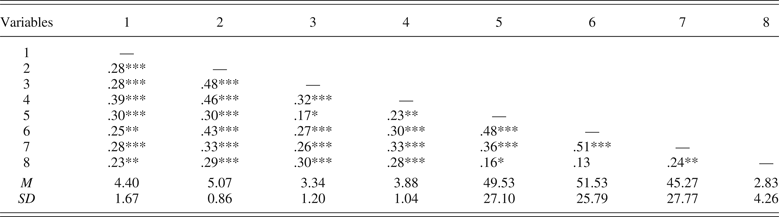
Zero-order correlations among composite variables included in path analyses are presented in Table 1. The early experience composite variable was significantly correlated with the adult outcome measure of personality disorder symptoms (r = .23, p = .01). Personality disorder symptoms in adulthood were also significantly correlated to measures of representation during all three developmental periods and to relationship experiences in early childhood and early adolescence. Moderate but significant correlations were demonstrated among composite measures of representational assessments of relationships from early childhood through early adolescence and among behavioral measures over time. Moderate but significant relations also were found between composite measures of relationship representation and antecedent, concurrent, and consequent behavior from preschool to early adolescence. In each developmental period, representational measures were related to prior experiential variables and to concurrent observational measures of behavior in social relationships. Partial correlations conducted with representational measures controlling for IQ did not lead to meaningful reductions in significance levels.
Descriptive statistics and zero-order correlations among composite variables included in path analyses (N = 162)

Note: 1, Early experience rating composite (12–42 months): attachment disorganization, toddler experience, preschool experience; 2, representational rating composite (5 years): mother–child relationship quality, peer relationship quality, cognitive flexibility; 3, representational rating composite (8 years): family relationship quality, family pathology, self-disorganization/organization; 4, representational rating composite (12 years): family relationship quality, relationship pathology, coherence; 5, behavioral ranking composite (5 years): peer competence, emotional health; 6, behavioral ranking composite (8 years): peer competence, emotional health; 7, behavioral ranking composite (12 years): peer competence, emotional health; 8, personality disorder composite (28 years): total symptom count.
*p < .05. **p < .01. ***p < .001.
Path analyses
Model 1: Noninteractive model
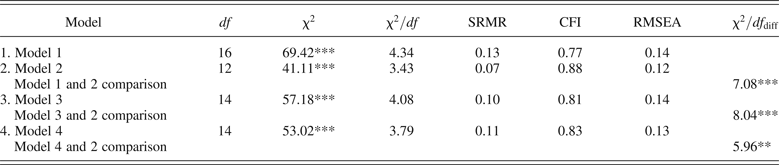
Model 1 examined the progressive noninteractive or “parallel” contributions of relationship representation and social behavior from early childhood to early adolescence predicting adult personality disorder symptoms in adulthood (for an illustration, see Figure 1; for results, see Table 2). The model fit to data was reflected in the following statistics: χ2/df = 4.34, SRMR = 0.13, CFI = 0.77, and RMSEA = 0.14, with no significant change controlling for IQ. All paths between within-domain composites (i.e., representation and behavior) were significant: from early experience to early childhood representation and behavior (t = 3.58, p < .001; t = 4.17, p < .001), early to middle childhood representation and behavior (t = 5.11, p < .001; t = 6.67, p < .001), middle childhood to early adolescent representation and behavior (t = 3.53, p < .001; t = 6.27, p < .001), and early adolescent representation and behavior to adult personality disorder symptoms (t = 2.26, p < .05; t = 2.01, p < .05). The direct path from early experience to adult personality disorder symptoms was not significant.
Fit statistics for proposed and competing path analysis models (N = 162)
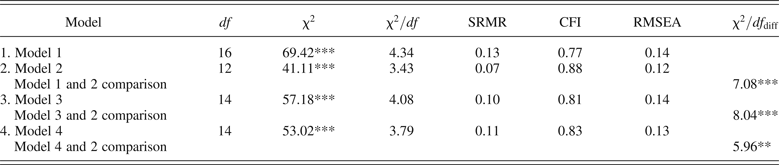
Note: Model 1, Noninteractive model; Model 2, interactive model; Model 3, interactive model, early to middle childhood interaction paths deleted; Model 4, interactive model, middle childhood to early adolescent interaction paths deleted. SRMR, Standardized root mean square residual; CFI, comparative fit index; RMSEA, root mean square error of approximation.
**p < .01. ***p < .001.
Model 2: Interactive model
Model 2 examined the proposed transactional process of relations between relationship representational quality and social experience from early childhood through early adolescence (see Figure 1 and Table 2). Model 2 represented the data reasonably well, χ2/df = 3.43, SRMR = 0.07, CFI = 0.88, and RMSEA = 0.12, with significant improvement over the noninteractive structure examined in Model 1, with and without controlling for IQ. Parallel interactive paths among representational and among behavioral composites in Model 1 remained significant in Model 2. In addition, paths from early childhood representation to middle childhood behavior (t = 4.05, p < .001) and from middle childhood behavior to early adolescent representation (t = 2.97, p < .01) were significant. The path from middle childhood representation (assessed through a drawing rather than narrative format) to early adolescent behavior (t = 1.83, p < .06) approached significance. The paths from early childhood behavior to middle childhood representation and from early experience to adult personality disorder symptoms were not significant.
Models 3 and 4: Alternative nested models
Additional nested model comparisons incorporating systematic path deletion were conducted to examine further the proposition regarding interactive contributions of behavior and representation and the significance of early versus later childhood reciprocal relations. Interactive paths were omitted between early and middle childhood (Model 3) and between middle childhood and early adolescence (Model 4). Models 3 and 4 fit statistics were χ2/df = 4.08, SRMR = 0.10, CFI = 0.81, RMSEA = 0.14 and χ2/df = 3.79, SRMR = 0.11, CFI = 0.83, RMSEA = 0.13, respectively. Both models demonstrated significantly poorer fit to the data when compared with the full interactive model, Model 2 (see Table 2).
Models 5, 6, and 7: Nonnested alternative models
Path analyses incorporating systematic deletion of developmental data were employed to examine the interactive (vs. noninteractive) hypothesis regarding representation and behavior across differing developmental periods and the prediction of adult personality disorder symptoms. Model 5 examined middle childhood to early adolescent representational and behavioral constructs (omitting all early childhood data). Model 6 examined relations from early childhood to early adolescence (omitting middle childhood data), and Model 7 examined relations from early to middle childhood (omitting early adolescent data). In all cases, interactive models yielded significant improvement in model fit over noninteractive models: Model 5: Δχ2 (2) = 12.11, p ≤ .01; Model 6: Δχ2 (2) = 10.02, p ≤ .01; Model 7: Δχ2 (2) = 16.51, p ≤ .001.
Discussion
Grounded in an organizational, developmental perspective (Cicchetti, Reference Cicchetti1984, Reference Cicchetti1993, Reference Cicchetti2014) and the investigation of multilevel, normative developmental processes (Carlson et al., Reference Carlson, Sroufe and Egeland2004), the current research examined propositions regarding the role of early experience in the evolution of maladaptive functioning, the internalization of experience, and transactional processes purported to underlie typical as well as atypical development. Specific objectives were to utilize longitudinal data to examine the direct and indirect influence of early experience on and the contributions among changing relational representation and behavior to adult personality disorder symptoms.
Correlational analyses demonstrated a significant predictive relation between early caregiving experience and personality disorder symptoms 25 years later. In addition, relatively consistent evidence supported the prediction of adult disturbance from indices of social behavior and relationship representations during childhood and early adolescence. Path analyses demonstrated continuities within and cross-lag influences on personality disturbance of specific instantiations of relationship-based representational and behavioral constructs in three developmental periods. Results of the simpler as well as the more complex model testing consistently demonstrated significant improvement in model fit of interactive over noninteractive models of representational and behavioral relations.
The current research findings support a view of personality processes, including those related to disturbance, as dynamic and interrelated with origins early in life. The findings are consistent with a systems perspective regarding “initiating conditions” (e.g., Thelen, Reference Thelen, Gunnar and Thelen1989), organismic theories specifying differentiation from prior structures, and related hypotheses regarding early developmental origins of more profound adult disturbance (e.g., Bowlby, 1969/Reference Bowlby1982). Across perspectives, development is viewed as a cumulative process wherein early experience initiates processes that are linked to later functioning through mutually influencing developmental processes (for a review, see Sroufe, Reference Sroufe and Masten2007). Further, the findings posit representational mechanisms as carriers of experience, mediating the links between childhood experience (e.g., maltreatment) and later disorder.
Limitations and future directions
As in all theory testing, replication, extension, and alternative model testing are critically important in the validation process, the clarification of model specification, and to our understanding of developmental phenomena (Maruyama, Reference Maruyama1998). The current study, based in a community sample, provides an illustration of a developmental hypothesis applied to the study of personality pathology to be examined with greater specificity, including variation in personality disorder, in future research. Limitations of the current work also relate to the potential gap between variables as operationalized and the theoretical constructs they are intended to represent. Aggregate data (e.g., composite variables) may have reduced the presence of error in measurement in the current sample. However, the tasks of defining and assessing representational indices of pathology derived from experience and distinguishing the assessments from measures of behavior and related constructs are challenging. In the current study, representational measures were derived from the content and structure of child responses, excluding behavioral observation, and behavioral measures were derived from independent sources. However, all assessments were drawn from existing data and varied with respect to contributing indicators (e.g., relationship quality, pathology, and cognition) and validation criteria (e.g., behavioral and cognitive assessments).
Despite methodological limitations (e.g., sample size and measurement variation) and the exploratory nature of the research (i.e., need for model replication and extension), the study has theoretical significance in exploring mechanisms that guide continuity and change in personality disturbance from an organizational perspective (Cicchetti, Reference Cicchetti2014; Sroufe & Waters, Reference Sroufe and Waters1977). Rather than propose specific relations among domains of functioning or a model of development, the study provides support for an organizational perspective as a useful way of conceiving and investigating personality functioning. In keeping with the biological principle of epigenesis (Sameroff & Chandler, Reference Sameroff, Chandler and Horowitz1975; Werner, Reference Werner and Harris1957), the study depicts the formation of personality organization, including disturbance, as a dynamic process resulting from successive transactions between the organism and the environment.
Critical developmental questions for future research concern the origins and nature of the transitions and transformations in patterns over time and the emergence of specific forms of dysfunction, in other words, how specificity in disturbance emerges from complex transactions across developmental periods and how individuals actively participate in these processes (Cicchetti, Reference Cicchetti, Cicchetti and Cohen2006, Reference Cicchetti2014; Sameroff & Chandler, Reference Sameroff, Chandler and Horowitz1975; Sroufe, Reference Sroufe1979; Thelen, Reference Thelen, Gunnar and Thelen1989; Werner, Reference Werner and Harris1957). Systematic investigations of the emergence and development of representational experience, especially in early childhood, are required to understand self-organizing principles and transformational processes related to the internalization of experience in the context of differing forms of caregiving. Further study is also needed to understand the role of gender (e.g., Paris, Reference Paris2004; Tackett et al., Reference Tackett, Balsis, Oltmanns and Krueger2009) and of genetic and biological influences (e.g., Reichborn-Kjennerud, Reference Reichborn-Kjennerud2010) in the dynamic processes leading to personality disturbance.
Summary and implications
The findings from the current research suggest that adult personality disturbance may reflect a lengthy, multidetermined developmental process, beginning in the earliest years of life (Lenzenweger & Cicchetti, Reference Lenzenweger and Cicchetti2005; Sroufe, 1997). The results contribute to conceptualizations of personality disorder that incorporate a developmental psychopathology perspective, with an emphasis on understanding normative processes related to personality development and change as a basis for understanding the course of and dimensions underlying disturbance (Cicchetti, Reference Cicchetti2014; Lenzenweger & Cicchetti, Reference Lenzenweger and Cicchetti2005). Longitudinal studies of disturbance in tandem with normative investigations are needed to distinguish specific forms of personality functioning and the environmental (e.g., trauma or loss) and biological factors that may influence pathways toward and away from personality disorder (Cicchetti & Crick, Reference Cicchetti and Crick2009; Shiner, Reference Shiner2009). Such specificity may contribute to the early identification of children who only later show clear disturbance, identification of risk and protective factors for the general sample and for subgroups of participants, and identification of factors associated with change (Lenzenweger & Cicchetti, Reference Lenzenweger and Cicchetti2005).
The current research has further implications for prevention and intervention. Across development, transactional processes suggest opportunities (i.e., ports of entry) at multiple levels of functioning and in varied settings to assist children and young adolescents. In particular, the findings support efforts to ameliorate the negative consequences of adversity in infancy and early childhood as self-processes become consolidated. Strategies that support a relational approach to emotional regulation and self-understanding in early development may reduce the initiation of pathways to personality disturbance. From early childhood through adolescence, of critical importance are developmentally informed interventions that address the integration of multiple aspects of functioning and aid children to interpret and integrate experience, to develop genuine connections with others, and to make use of broader social supports from family and community.