Introduction
The pistachio twig borer, Kermania pistaciella (Lepidoptera: Tineidae: Hieroxestinae), is an important pest of pistachio trees, Pistacia vera, throughout the main pistachio-producing areas of Iran and Southeast Anatolia regions of Turkey (Mart et al., Reference Mart, Yigit and Çelik1995; Mehrnejad, Reference Mehrnejad and Ak2001; Yanik & Yücel, Reference Yanik, Yücel and Ak2001; Bolu, Reference Bolu2002; Abbaszadeh et al., Reference Abbaszadeh, Seiedoleslami, Samih and Hatami2006). The insect has one generation per year and females lay eggs on pistachio flowers and fruit clusters in early spring. The larvae penetrate the plant tissue and bore tunnels in the twigs, feeding on xylem and pith tissues. The canals in the young wood destroy the core of branches and prevent growth of young branches, dehydrating them (Samih et al., Reference Samih, Alizadeh and Saberi2005). Larval development takes almost 10 months and the last (4th) instar overwinters inside twig. Larvae leave their tunnels the following year during early March and find suitable places on twigs to form cocoons in which they pupate and, after approximately 3 weeks, emerge as adults (Taghizadeh & Jafaripour, Reference Taghizadeh and Jafaripour1965; Küçükarslan, Reference Küçükarslan1966; Mehrnejad, Reference Mehrnejad and Ak2001; Achterberg & Mehrnejad, Reference Achterberg and Mehrnejad2002; Abbaszadeh et al., Reference Abbaszadeh, Seiedoleslami, Samih and Hatami2006). Larval feeding inside the twig causes severe economic damage by fruit drop, twig weakening and death. Most pistachio plantations in Iran and Turkey are treated every year with insecticides to suppress K. pistaciella populations. Insecticides, however, pose a serious threat to the environment and are harmful to natural enemies. Therefore, insecticide applications should be phased out of the main periods of parasitoids’ activity (Mehrnejad, Reference Mehrnejad2002; Özgen et al., Reference Özgen, Bolu and Beyarslan2012).Toward this aim, the sex pheromone of the pistachio twig borer was identified, and it is now used in the field for monitoring activity of males and timing of the insecticidal sprays (Gries et al., Reference Gries, Khaskin, Daroogheh, Mart, Karadag, Kubilay Er, Britton and Gries2006). The situation calls for development of new pest control methods that would be based on more environment-friendly practices, which in turn, require better knowledge of K. pistaciealla biology and ecology.
The overwintering phase represents an important part of K. pistaciella life cycle that is insufficiently known. Overwintering and winter cold tolerance have been suggested to be major factors governing the performance of insect populations including their establishment in new territories and/or responses to climate change (Bale, Reference Bale, Lee and Denlinger1991; Leather et al., Reference Leather, Walters and Bale1995; Addo-Bediako et al., Reference Addo-Bediako, Chown and Gaston2000; Williams et al., Reference Williams, Henry and Sinclair2015). The physiological principles of insect cold tolerance are known to be highly complex (Salt, Reference Salt1961; Lee & Denlinger, Reference Lee and Denlinger1991; Denlinger & Lee, Reference Denlinger and Lee2010), including, among other mechanisms, developmental transition to dormancy/diapause stage (Denlinger, Reference Denlinger, Lee and Denlinger1991), regulation of supercooling capacity or propensity to undergo extracellular freezing (Zachariassen, Reference Zachariassen1985), and synthesis of low-molecular mass cryoprotectants (Storey & Storey, Reference Storey, Storey, Lee and Denlinger1991). The physiology, biochemistry, and the ecophysiological limits of cold tolerance have not been rigorously studied in K. pistaciealla so far. It is currently unknown whether and how much the overwintering larvae suffer from mortality caused by cold. Pistachio trees require a semi-desert climate with long, dry, hot summers, and cool but not frigid winters. After shedding their leaves in the fall, pistachio trees need a winter dormancy period during which they prefer mild temperatures fluctuating around 0°C. Although prolonged cold spells deeply below 0°C are known to be detrimental for some cultivars of pistachio, other cultivars are successfully grown for instance in Central Asia mountain plains where they survive at winter temperatures below −30°C (Kayimov et al., Reference Kayimov, Sultanov, Chernova, Padulosi and Hadj-Hassan1998; Thakur & Mehta, Reference Thakur, Mehta, Jindal and Sharma2004). The minimum air temperatures in pistachio-producing areas in Iran often fall below zero during the winter months (from December to March/April). Subzero temperatures are typically occurring during night, while day temperatures rise above zero. For instance, the absolute yearly minimum temperatures in Rafsanjan, Iran (recorded since 1991) ranged from −5°C (2014) to −16.6°C (1995) (Data Processing Centre of the Iran Meteorological Organization). In our earlier paper (Izadi et al., Reference Izadi, Samih, Behroozy, Hadavi and Mahdian2011), we reported on preliminary assays of cold tolerance in overwintering larvae. We observed that dormant larvae sampled during the peak of winter 2009/10 survived 24 h exposure to −15°C, while active larvae collected by the end of summer did not survive the same treatment.
The main objective of our study was to fill the gap in our knowledge on the overwintering biology of K. pistaciella. We aimed to describe the physiological limits of cold tolerance in overwintering larvae of K. pistaciella and how these correspond to prevailing climate in pistachio-producing areas. In other words, we aimed to estimate what is the risk of cold-induced mortality and whether it may be considered an important factor for pest population growth/decline. We sampled larvae from the field during the cold season (October–February), measured their supercooling points (SCPs, temperature of spontaneous freezing of body fluids) and assayed cold tolerance directly by exposing larvae to a range of subzero temperatures for ecologically relevant periods of time. In addition, we analysed seasonal changes in fresh mass (FM), relative water content, glycogen content and metabolomic composition in order to register seasonal changes in levels of potential low-molecular mass cryoprotectants and to obtain links to the physiological background of larval cold tolerance.
Material and methods
Insects
Pistachio twig borer larvae were collected from infested pistachio trees, cultivar Owhadi, in Rafsanjan, Iran (35°39′N, 52°05′E; alt. 1800 m), on five sampling occasions during the cold season 2013/14. Each sampling occasion took 4–5 days around: 29 October, 26 November, 26 December, 25 January and 24 February. Infested twigs were transported to the laboratory and cut longitudinally to find larvae. Penultimate (3rd) and last (4th) larval instars were distinguished according to their size, width of head capsule and absence (3rd) or presence (4th) of thoracic legs and abdominal prolegs. The status of gut was scored as full or empty by visual inspection through the transparent larval cuticle (for examples of larval habitus, see fig. S1). Collected larvae were stored outdoors overnight and processed the next morning.
FM was measured individually in 6–9 larvae for each sampling date using a Sartorius balance with sensitivity of 0.1 mg. Dry mass was measured after drying the specimens at 65°C for 48 h. Relative water content was calculated from gravimetric data and expressed as % of FM.
SCP and cold tolerance
The SCP was measured as the temperature of spontaneous crystallization of body fluids (start of freeze exotherm) during gradual cooling. Six individual larvae for each sampling date were cooled from outdoor temperature down to −30°C at a constant rate of 0.5°C min−1 using the programmable temperature tester GT-7005-A4S (Geotech, Taichung, South Korea). The temperatures were recorded using the data logger 177-T4 and Comsoft 3.0 software (Testo, Lenzkirch, Germany).
Cold tolerance was assessed as survival after exposure to a range of subzero temperatures (−10, −15, −20 and −25°C). Twenty larvae were exposed to each endpoint temperature for each sampling date. Larvae in plastic Petri dishes (6 cm in diameter) were placed in a programmable refrigerated test chamber and the temperature was lowered from 20°C to specific endpoint at a rate of 0.5°C min−1. The exposure to endpoint temperature took 24 h, and then the temperatures were rised back to 20°C at a rate of 0.5°C min−1. Survival/mortality was scored after 24 h recovery at 20°C. Larvae that showed no movements upon probing with a fine brush were considered dead.
In addition, we tested survival of dormant larvae collected during the peak of winter (December and January) after subjecting them to repeated cold exposures. Groups of 20 larvae were exposed to the endpoint temperature of −20°C in two different repeated-exposure treatments: (i) exposed twice, to −15°C for 24 h followed by −20°C for 24 h; (ii) exposed thrice, to −10°C for 24 h; followed by −15°C for 24 h; followed by −20°C for 24 h. These treatments were designed to simulate extremely cold spell during winter when ambient conditions fluctuate on a daily basis from above-zero to deeply below-zero temperatures in 2–3 consecutive days. Survival/mortality was scored after the endpoint temperature (−20°C) treatment as described above.
Glycogen and metabolomics
Five larvae were weighed (FM) and pooled to prepare one sample for biochemical analysis. Six replications (total of 30 larvae) were analyzed for each sampling date (except February sample, where only five replications were taken). The specimens were homogenized and extracted twice in 400 µl of 70% ethanol. After centrifugation at 20,000 g for10 min at 25°C, the supernatant was used for nontargeted metabolomic profiling and the pellet was used for the determination of glycogen.
Glycogen was extracted from the pellet in hot alkali solution (Bueding & Orrell, Reference Bueding and Orrell1964) and glucose, released after the treatment in hot phenol and concentrated sulphuric acid, was determined by colourimetric assay (DuBois et al., Reference DuBois, Gilles, Hamilton, Rebers and Smith1956). Oyster glycogen (Fluka, Germany) was used as calibration standard.
The ethanolic extract was used for nontargeted analysis of major metabolites using a combination of mass spectrometry (MS)-based analytical methods as described earlier (Koštál et al., Reference Koštál, Korbelová, Rozsypal, Zahradníčková, Cimlová, Tomčala and Šimek2011). Low-molecular-weight sugars and polyols were determined after o-methyloxime trimethylsilyl derivatization using gas chromatograph (GC) with flame ionization detector GC-FID-2014 equipped with AOC-20i autosampler (both from Shimadzu Corporation, Kyoto, Japan). Profiling of acidic metabolites was done after the treatment with ethyl chloroformate under pyridine catalysis and simultaneous extraction in chloroform (Hušek & Šimek, Reference Hušek and Šimek2001; Koštál et al., Reference Koštál, Korbelová, Rozsypal, Zahradníčková, Cimlová, Tomčala and Šimek2011) using Trace 1300 GC combined with single quadrupole mass spectrometry (ISQ-MS) (both from Thermo Fisher Scientific, San Jose, CA, USA) and liquid chromatograph Accela LTQ XL with linear ion trap combined with high resolution mass spectrometers Q Exactive Plus coupled with Dionex Ultimate 3000 (all from Thermo Fisher Scientific). The metabolites were identified against relevant standards and subjected to quantitative analysis by using an internal standard calibration method. All standards used were purchased from Sigma–Aldrich (Saint Luis, MI, USA).
Statistical analysis
One-way ANOVAs were used to analyze whether there is any influence of the sampling date on the measured physiological parameters. Post-hoc Bonferroni's tests were applied to find the differences in physiological parameters among sampling dates. Data were initially tested for normality (Kolmogorov–Smirnov test) and homoscedasticity (Bartlett's test) before subjecting them to ANOVAs. Unpaired two-tailed t-tests were used to assess the differences between the means of the two groups (October vs. November, i.e., penultimate vs. last larval instar). The F tests were applied first to verify that variances of the two means did not significantly differ. The above statistical calculations were performed using Prism6 (GraphPad Software, San Diego, CA, USA). The complex association of metabolomic composition with the calendar season (sampling date) was determined by principal component analysis (PCA) using Canoco v. 4.52 for Windows (Biometris-Plant Research International).
Results
Larvae maintain high supercooling capacity over the whole cold season
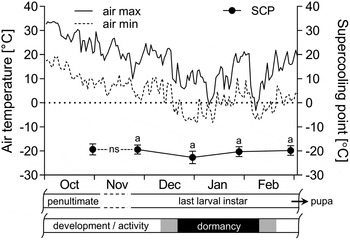
We found no statistically significant differences in larval SCP between the samples taken during the whole cold season (fig. 1). Relatively low mean SCP was maintained stably from October to February despite the fact that larvae passed different developmental and activity states. The 3rd instars collected in October (SCP = −19.4°C) were fully active, feeding and developing. After the molt to the last instar, the larvae continued feeding activity (fig. S1) at least until the end of November, while no change of SCP was observed (−19.4°C). Last instar larvae collected during December were most probably dormant as they had empty guts and their mean SCP was slightlty lower than that of all other samples (−22.7°C). Larvae continued in dormancy at least until the end of January (−20.3°C) and then resumed activity by the end of February (−19.8°C), which was accompanied with striking change in colouration of intestines from pale yellow to reddish (fig. S1). The SCP values were always much lower than minimum air temperatures recorded in a nearby meteorological station during the same cold season (fig. 1).
Ambient temperatures in Rafsanjan (Iran) and SCPs in larvae of Kermania pistaciella sampled during the cold season 2013/14. Air temperature data were obtained from the Data Processing Centre of the Iran Meteorological Organization. The meteorological station was located at 1 km distance from the sampling site. The SCP datapoints are means ± SD (N = 6 larvae). Difference between October (3rd instar) and November (4th instar) samples was analyzed using unpaired two-tailed t-test (ns, not significant, P > 0.05). Differences between samples taken from November to February were analyzed using one-way ANOVA followed by post-hoc Bonferroni's test (means flanked by different letters are significantly different).

The SCP sets the limit of cold tolerance in dormant larvae
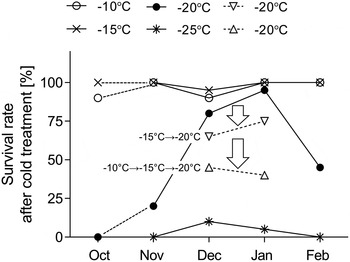
First of all, no larvae survived our SCP determination. All larvae died when crystallization of their body fluids occurred. In all larvae, irrespective of sampling date, survival rates were higher than 90% after the 24-h-long exposures to subzero temperatures of −10°C and −15°C, i.e., safely above the range of SCP. In contrast, larvae did not survive after exposure to −25°C with the exception of samples taken in December (10% survival) and January (5%). Some of December- and January-collected larvae showed SCP values close to or below −25°C. We observed a clear seasonal pattern in survival after exposure to −20°C, which was 0% in October, 20% in November, then rised considerably to 80% (December) and 95% (January), and dropped again to 45% in February (fig. 2).
Cold tolerance in larvae of Kermania pistaciella sampled during the cold season 2013/14. Each datapoint shows percentage of survivors in a sample (N = 20 larvae) exposed to specific subzero temperature for 24 h. Arrows and triangle symbols show decreasing survival in repeated-exposure experiments: twice (−15°C followed by −20°C); thrice (−10°C followed by −15°C followed by −20°C).

Repeated exposures to cold of the same individuals indicated that two or three cold spells applied in a consecutive manner result in a gradual decrease of survival. In December larvae, survival after exposure to −20°C decreased from 80% (single exposure) to 65% (twice) and to 45% (thrice), while in January larvae, the drop was from 95 to 75 and to 40%, respectively (fig. 2)
Seasonal changes in FM, water content and biochemical composition
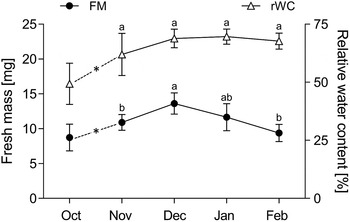
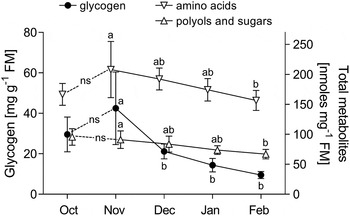
The penultimate larval instars (October) were smaller and had lower relative water content than the last larval instars (November) (fig. 3). The relative contents of glycogen, total free amino acids, sugars and polyols did not statistically differ betwen October and November samples (fig. 4). Nevertheless, when considering the increasing FM, our data confirm that absolute total contents of glycogen and free amino acids were higher in the November-collected last instars than in October-collected penultimate instars. Larvae continued increasing their FM between November and December and also their relative water content slightly increased, though this increase was not statistically significant (fig. 3). In addition, we observed statistically significant increase of FM in the other larvae collected for parallel experiments: November, 9.4 ± 2.5 (N = 45) vs. December, 11.9 ± 2.4 (N = 61) (t-test: t = 5.166; df = 104; P < 0.0001). These results suggest that last larval instars continued feeding and growing during the early (warmer) part of November–December period. During the same time, larvae partially depleted their glycogen reserves and a trend of gradual loss of total free amino acids and sugars and polyols became also apparent (fig. 4). For the rest of the winter (December–February), larvae tended to lose FM, glycogen, free amino acids, sugars and polyols, while their relative water content remained unchanged (figs 3 and 4).
FM and relative water content in larvae of Kermania pistaciella sampled during the cold season 2013/14. Each datapoint shows mean ± SD (N = 6–9 larvae). Difference between October (3rd instar) and November (4th instar) samples was analysed using unpaired two-tailed t-test (*, P < 0.05). Differences between samples taken from November to February were analyzed using one-way ANOVA followed by post-hoc Bonferroni's test (means flanked by different letters are significantly different).

Glycogen, total amino acid and total sugar and polyol contents in larvae of Kermania pistaciella sampled during the cold season 2013/14. Each datapoint shows mean ± SD (N = 6 samples, 5 larvae each). Difference between October (3rd instar) and November (4th instar) samples was analyzed using unpaired two-tailed t-test (ns, not significant, P > 0.05). Differences between samples taken from November to February were analyzed using one-way ANOVA followed by post-hoc Bonferroni's test (means flanked by different letters are significantly different).

No low-molecular mass cryoprotectants accumulated in overwintering larvae
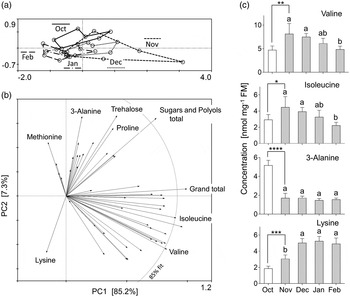
Our nontargeted metabolomic analysis covered seasonal fluctuations in 43 different organic acids, free amino acids and other amino-compounds, free fatty acids, sugars and polyols (see table S1 for detailed results). PCA revealed that there were only small differences in larval metabolomic composition between sampling dates. The clusters of replicate points for individual sampling dates overlap in the centre of a two-dimensional plot of PC1 and PC2 components, which together account for 94.5% of total inertia (fig 5A). None of the metabolites showed any distinct accumulation trend in dormant last instar larvae (December, January), meaning that there was no hint of a biochemical mechanism underlying the highest cold tolerance of dormant larvae. All sampling dates showed considerable between-replicate variations that were expressed as a wide spread of replicate points along the PC1 axis. The variation/spread was especially high for November sample, where two replicates were driven far from the mean (from the gravity centre of six replicate points) along the PC1 axis. There was a small but distinct separation along the PC2 axis of the October cluster from the clusters of samples taken in December, January and February. The contributions of individual metabolites to overall seasonal differences are depicted in fig. 5B. The separation along PC1 axis was mainly driven by a total concentration of all metabolites (Grand total) and also by a total concentration of all amino acids (AA total). Among individual metabolites, valine and isoleucine showed the longest eigenvectors in direction of positive PC1. The separation along the PC2 axis was mainly driven by 3-alanine (positive PC2, i.e., high in October) and lysine (negative PC2, i.e., high in December, January, February). Four metabolites with major influence on seasonal differences in metabolomic composition are shown individually in fig. 5C.
Multivariate analysis of metabolomic changes in larvae of Kermania pistaciella sampled during the cold season 2013/14. (A) PCA separation of sampling dates. Each sampling date is represented by a colour-coded cluster of replicate points (N = 6 replicates, 5 larvae each). (B) The PCA eigenvectors representing 43 different metabolites in a two-dimensional plot of PC1 and PC2 components. The eigenvectors extending beyond the dashed correlation circle fit the model by more than 95%. Important eigenvectors are labeled with names. (C) Seasonal changes in concentrations of four selected metabolites. Difference between October (3rd instar) and November (4th instar) samples was analyzed using unpaired two-tailed t-test (*, P < 0.05; **, P < 0.01; ***, P < 0.001; ****, P < 0.0001). Differences between samples taken from November to February were analyzed using one-way ANOVA followed by post-hoc Bonferroni's test (means flanked by different letters are significantly different).

Discussion
Limits of cold tolerance in overwintering larvae of K. pistaciella
In this paper, we extend our earlier preliminary observations (Izadi et al., Reference Izadi, Samih, Behroozy, Hadavi and Mahdian2011) on cold tolerance in the larvae of K. pistaciella and present a relatively detailed description of their overwintering physiology. We found that physiological limits of winter cold tolerance are set sufficiently low to ensure high larval survival rates in average winter conditions in Rafsanjan, central Iran. All larvae sampled during the cold season, between October 2013 and February 2014, were able to survive 24 h exposure to −15°C, and dormant larvae, collected during December and January, showed high survival rates even after exposure to −20°C. Considering the historical minimum air temperature record of −16.6°C (Rafsanjan, January1995), we may assume that winter cold does not represent a major source of mortality in K. pistaciella populations in this region. Nevertheless, we are careful in concluding so straightforwardly for two reasons: first, we found that repeated cold exposures to subzero temperatures resulted in decreased survival. Daily thermal fluctuations are very typical for the Rafsanjan winter. During December/January, for instance, the air temperatures fluctuated between + 15 and −10°C on a daily basis for almost one moth (fig. 1). Larvae inside thin twigs probably experienced similar thermal fluctuations. Thermal fluctuations are linked with higher energy expenditures during warm spells, which may negatively influence the subsequent cold tolerance and winter survival of insects (Marshall & Sinclair, Reference Marshall and Sinclair2012; Williams et al., Reference Williams, Marshall, MacMillan, Dzurishin, Hellman and Sinclair2012). In addition, cumulative damage during successive exposures may occur and increase the cold-induced mortality (Colinet et al., Reference Colinet, Sinclair, Vernon and Renault2015). Second, our survival criterion (larval movement upon probing with brush 24 h after the cold exposure) was relatively weak, meaning that potential latent damage could have been underestimated. It was difficult to assess the larval survival/mortality later, as the larvae could not be easily returned to their natural microclimate inside the twigs. Optimally, additional assays of cold tolerance should be designed in future to account for the influence of longer periods of fluctuating and constant low temperatures, considering cold exposures of larvae inside the twigs, and scoring the pupation and adult emergence in spring as ultimate survival criterions.
Winter cold in pistachio-producing areas other than Rafsanjan can be more severe. For instance, the historical minimum temperature record in Kerman, Iran (altitude 1755 m) was as low as −30°C (January, 1973) (Data Processing Centre of the Iran Meteorological Organization). This low temperature would kill 100% of K. pistaciella larvae of the Rafsanjan population. It remains unknown whether the Kerman population of K. pistaciella has a lower limit of cold tolerance than Rafsanjan population or whether it experienced exceptionally high mortality during year 1973.
Physiological basis of cold tolerance in K. pistaciella larvae
It seems highly probable that supercooling capacity sets the limits of cold tolerance in overwintering K. pistaciella larvae. We verified that dormant larvae survive at temperatures very close to the SCP limit but not below it. This insect, at least in its dormant stage, belongs to a class of freeze-avoidant insects according to Bale's categorization (Bale, Reference Bale1993). The values of SCP did not exhibit a particular seasonal trend in K. pistaciella larvae. The lowest mean SCP of −22.7°C was recorded in the sample taken during December (80% survival at −20°C), but it was not significantly different from the other samples. January-collected larvae had a slightly higher mean SCP of −20.3°C but they showed the highest survival at −20°C (95%). Both, January- and December-collected larvae were most probably dormant as we could not see any food content in their guts. In contrast, developing and feeding larvae that were sampled either during autumn or spring showed relatively low survival at −20°C (0–45%). Thus, entry into dormancy appears to be an important mechanism to fully exploit the supercooling capacity and reach maximum cold tolerance.
The nature of K. pistaciella's dormancy, diapause or quiescence, was not rigorously assessed. Some characteristics seem to support the view that this dormancy is of the quiescence type, responding directly to low ambient temperatures and/or to seasonal changes in the host tree biology. The life cycle of K. pistaciella is univoltine, throughout its area of occurrence (Taghizadeh & Jafaripour, Reference Taghizadeh and Jafaripour1965), with slow and long larval development. We observed the 3rd/4th larval molts to occur during November in most individuals but a small proportion of 3rd instars or freshly molting larvae were regularly found in twigs until the end of winter (Mollaei, unpublished results). Our results strongly suggest that larvae were able to continue feeding (full gut) and growing (increasing FM) during December, probably until the ambient temperatures drop below a certain threshold for such activities. For instance, +10°C was reported to be a threshold temperature for larval molts (Bassirat, Reference Bassirat2006). The ambient temperatures dropped below + 10°C just during the second half of December 2014 (fig. 1). At the same time, night minima moved below 0°C (fig. 1). The pistachio trees enter seasonal dormancy shedding their leaves also during the second half of December. This is accompanied with changes in nutrient flows in the tree (more nutrients accumulated in roots) and drying of twigs. Such changes in the host tree might be perceived as seasonal signals by K. pistaciella larvae or they can serve as direct factors contributing to induction of their winter dormancy. The spring end of larval dormancy, which is indicated by a striking change in larval colouration (fig. S1), seems to be stimulated by vernal rise of temperatures and unlinked to host tree biology. At least in our February sample, where re-activated larvae prevailed, the host tree twigs were still very dry.
Overall stability of biochemical composition is another feature that favors classification of K. pistaciella dormancy as quiescence rather than diapause. In our earlier paper (Izadi et al., Reference Izadi, Samih, Behroozy, Hadavi and Mahdian2011), we reported on seasonal stability of total protein and total lipid reserves in overwintering larvae. Glycogen reserves were partially depleted during November–December (fig. 4 in Izadi et al., Reference Izadi, Samih, Behroozy, Hadavi and Mahdian2011), concomitantly with the period of feeding and growth activity in the last larval instar preceding their entry into dormancy. This massive loss of glycogen was not, however, associated with accumulation of any low-molecular mass cryoprotectants. It seems that larvae of K. pistaciella exploit the glycogen reserves to fuel their energy metabolism in a situation when dormant host tree did not supply them with food substrate of sufficient quality. In other overwintering insects, the seasonal accumulation of glycogen (typically linked to anticipatory phase of diapause) and its later interconversion to species-specific mixture of low-molecular mass cryoprotectants (linked to cold-acclimation phase) is one of the typical features of diapause and seasonal cold hardening (Hayakawa & Chino, Reference Hayakawa and Chino1982; Storey & Storey, Reference Storey and Storey1983, Reference Storey and Storey1986; Hoshikawa, Reference Hoshikawa1987; Rozsypal et al., Reference Rozsypal, Koštál, Zahradníčková and Šimek2013).
In conclusion, K. pistaciella exemplifies a sort of seasonal cold hardening that is apparently independent of anticipatory diapause-linked physiological adjustments. Instead, the overwintering larvae rely on stably high supercooling capacity, which becomes fully exploited upon entry into a quiescence type of dormancy caused directly by low ambient temperatures and/or changes in host tree physiology. During dormancy, the larvae attain highest cold tolerance, which offers them sufficient protection against geographically and ecologically relevant cold spells. The substantial mortality of pistachio twig borer populations can be expected only in the growing regions or years where or when the microclimatic temperatures inside the twigs drop below the average larval SCP (i.e., below −20°C). Partial mortality can be expected when ambient temperatures remain above the larval SCP level but repeatedly drop close to it on a diurnal basis.
Supplementary Material
The supplementary material for this article can be found at http://dx.doi.org/10.1017/S0007485316000237.
Acknowledgements
We acknowledge receiving the financial support from Ministry of Science, Research and Technology of Iran to M.M. allowing her stipend stay at the Institue of Entomology, Biology Centre CAS, Czech Republic. Metabolomic analysis was supported by the Czech Science Foundation grant No.13-18509S (to P. S.). We thank Anna Heydova and Helena Zahradnickova for sample preparation and GC-MS and LC-MS analysis.