Introduction
The number of studies focusing on knowledge of the helminth communities of amphibians in the Neotropical region has increased in recent years (Boquimpani-Freitas et al., Reference Boquimpani-Freitas, Vrcibradic, Vicente, Bursey, Rocha and Sluys2001; Luque et al., Reference Luque, Martins and Tavares2005; Hamann et al., Reference Hamann, González and Kehr2006a, b; Schaefer et al., Reference Schaefer, Hamann, Kehr, González and Duré2006; Goldberg et al., Reference Goldberg, Bursey, Caldwell, Vitt and Costa2007; Holmes et al., Reference Holmes, Bocchiglieri, Caldeira de Araújo and Silva2008; Campião et al., Reference Campião, Silva and Ferreira2009; Pinhão et al., Reference Pinhão, Wunderlich, Anjos and Silva2009; Santos & Amato, Reference Santos and Amato2010; Klain et al., Reference Klain, Gomes, Tavares, Rocha and Van Sluys2011). Some of these studies have shown that different factors can influence the structure of the parasite community, including size and sex, diet composition, habitat preference and reproductive behaviour of the host (Bursey et al., Reference Bursey, Goldberg and Parmelee2001; Hamann et al., Reference Hamann, González and Kehr2006a, b; Schaefer et al., Reference Schaefer, Hamann, Kehr, González and Duré2006; Santos & Amato, Reference Santos and Amato2010).
This study evaluated the helminth component community of Leptodactylus latrans (Steffen, 1815), commonly known as Creole frog, and formerly referred to as Leptodactylus ocellatus (L., 1758). This species, revalidated by Lavilla et al. (Reference Lavilla, Langone, Caramaschi, Heyer and De Sá2010) in a recent study, is a large-sized leptodactylid frog, widely distributed in South America, including Paraguay, Argentina, Uruguay and Brazil (Frost, Reference Frost1985; Kwet & Di-Bernardo, 1999; Brusquetti & Lavilla, Reference Brusquetti and Lavilla2006; Achaval & Olmos, Reference Achaval and Olmos2007). This species lives in litter or in the midst of grasses, but usually reproduces near temporary or permanent ponds, streams or marshes (Heyer et al., Reference Heyer, Rand, Cruz, Peixoto and Nelson1990). Leptodactylus latrans is an opportunistic feeder as its diet is determined by the availability of prey in the environment (Duellman & Trueb, Reference Duellman and Trueb1994). Little is known about the helminth parasites of L. latrans, for which some isolated studies in Atlantic rainforest have been published (Vicente & Santos, Reference Vicente and Santos1976; Rodrigues et al., Reference Rodrigues, Rodrigues and Cristofaro1982, Reference Rodrigues, Rodrigues and Faria1990; Stumpf, Reference Stumpf1982). However, to our knowledge, no studies on the helminth community structure of this host species have been conducted.
The present aims are to describe helminth species richness and diversity at the component and infracommunity levels for comparison with other frogs within the genus Leptodactylus. In addition, the relationship between the parasitological descriptors and host body size is considered.
Materials and methods
Collection and examination of frogs
Frogs were sampled from a private property surrounded by Atlantic rainforest remnants located in the municipality of São Luiz do Paraitinga (23°13′S; 45°18′W), São Paulo State, south-eastern Brazil. A total of 38 specimens (29 juveniles and 9 adults) of L. latrans were sampled by active search at night, with five specimens recovered from February to November 2009 and 33 specimens in January and February 2010 under license from Instituto Brasileiro do Meio Ambiente – IBAMA (collection permit IBAMA/SISBIO 18 240-1/2009) and deposited in the Museu de Zoologia da Universidade Estadual de Campinas ‘Adão José Cardoso’. Frogs were transported live to the laboratory, and then euthanized with sodium thiopental solution. The snout–vent length (SVL) and body mass were recorded. Then they were necropsied and the gastrointestinal tract, lungs, kidneys, liver, urinary bladder, body cavity and musculature of the hind limbs were examined for the presence of helminths.
Helminths were fixed in alcohol–formaldehyde–acetic acid (AFA) and preserved in 70% ethyl alcohol. For species identification, cestodes and trematodes were stained with hydrochloric carmine and cleared with creosote. Nematodes were cleared in lactophenol and examined as temporary mounts. The systematic determination of the helminths was carried out following the approaches given by Yamaguti (Reference Yamaguti1959, Reference Yamaguti1961), Vicente et al. (Reference Vicente, Rodrigues, Gomes and Pinto1991), Schmidt (Reference Schmidt1986), Anderson et al. (Reference Anderson, Chabaud and Willmott2009) and Gibbons (Reference Gibbons2010). The voucher species were deposited at the Coleção Helmintológica do Instituto de Biociências de Botucatu (CHIBB) at the Universidade Estadual Paulista (UNESP), São Paulo State, Brazil.
Data analysis
The overall prevalence, mean intensity of infection and mean abundance were calculated according to Bush et al. (Reference Bush, Lafferty, Lotz and Shostak1997). The hosts were classified as juveniles (SVL < 70.0 mm) and adults (SVL ≥ 70.0 mm) (Maneyro et al., Reference Maneyro, Naya, Rosa, Canavero and Camargo2004). This classification was based on samples that were already reproductively mature. Fisher's exact test (P) and Z-test were used for comparing the infection between the juveniles and adults. The discrepancy index (D) was calculated following the method described by Poulin (Reference Poulin1993). Berger–Parker's index of dominance (d) was used to determine the most abundant species (Magurran, Reference Magurran2004). The measures of community richness and diversity included the total number of helminth species (richness, S) and Shannon's index. Mean helminth species richness is the sum of helminth species per individual frog, including uninfected individuals, divided by the total sample size. Student's t-test was used to examine possible ontogenetic differences in richness of parasites (juveniles and adults) (Magurran, Reference Magurran1988). The Spearman coefficient of correlation (r s) was used to evaluate the correlation between host body size and parasite richness, abundance and intensity of infection. To evaluate the similarity of helminth fauna between phylogenetic groups of Leptodactylus and their localities of origin, a cluster analysis was performed.
Statistical analyses were performed using BioEstat 5.0 (Ayres et al., Reference Ayres, Ayres, Ayres and Santos2007), and MultiVariate Statistical Package (MVSP 3.1; Kovach, Reference Kovach1999). The Quantitative Parasitology 3.0 program (Rózsa et al., Reference Rózsa, Reiczigel and Majoros2000) was used to calculate discrepancy indices.
Results and discussion
Up to 24 of 38 frogs examined (63.2%) were infected with at least one parasite species and prevalence values were similar in juveniles (55.2%) and adults (88.9%) (Z-test = 1.468, P= 0.142). This was also confirmed by the Fisher's exact test (juveniles, n= 16 versus adults, n= 8; P= 0.11).
A total of 271 helminths were recovered, with a mean abundance of 7.1 ± 2.5 and a mean intensity of infection of 11.3 ± 3.8. The helminth component community in the population of L. latrans comprised eight taxa, six of which were adult parasites and two were in larval stages, a cestode and Physaloptera sp. (table 1). In view of the similarity between congeneric females and the absence of males, the identification of the cosmocercid nematode was not possible. The most abundant group was the Trematoda (48.0%), followed by the Nematoda (46.9%) and Cestoda (5.2%) (table 1). The most prevalent taxon was the unidentified Cosmocercidae, followed by O. subauricularis (table 1). Gorgoderina parvicava was the most abundant species (d= 0.44).
The prevalence (%), mean abundance (MA), mean intensity (MI), discrepancy index (D) and site of infection (SI) of the helminth parasites found in Leptodactylus latrans collected in São Luis do Paraitinga, SP, Brazil; range in parasite numbers given in brackets and SE=standard error.
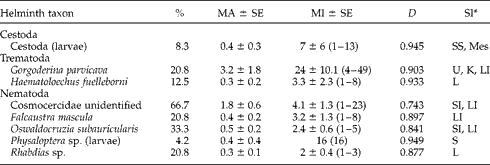
* Site of infection: S, mucosa of stomach; SS, serosa of stomach; Mes, mesentery; U, urinary bladder; K, kidneys; LI, large intestine; SI, small intestine; L, lungs.
Although eight helminth taxa were identified, the mean richness was 1.2 ± 0.2 helminths/host, and greater richness (S= 4) was found in three hosts. The mean richness in adults (S mean= 2.2 ± 0.5) was higher than in juvenile hosts (S mean= 0.9 ± 0.2, t= 3.1196, df = 36, P= 0.0036). Adult frogs showed a lower diversity of parasites than the juvenile (H′ juvenile = 0.761, H′ adult = 0.552).
Host body size showed a very weak correlation with parasitic abundance (abundance versus length: r s= 0.4586, n= 37, P= 0.0043; abundance versus weight: r s= 0.4764, n= 37, P= 0.0029) and richness (richness versus length: r s= 0.4475, n= 37, P= 0.0054; richness versus weight: r s= 0.4857 n= 37, P= 0.0023), and the host body size was not significantly correlated with the intensity of infection (intensity of infection versus length: r s= 0.3161, n= 24, P= 0.1322; intensity of infection versus weight: r s= 0.2895, n= 24, P= 0.1699).
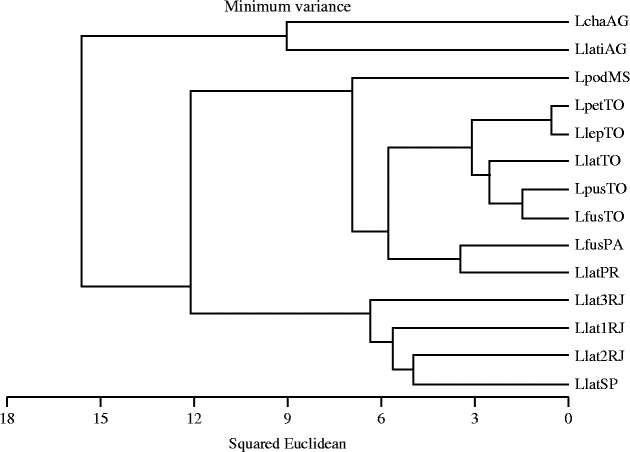
Using a cluster analysis, hosts sampled from the same region of origin showed a closer similarity between L. petersii and L. leptodactyloides, belonging to the group melanonotus, although L. pustulatus, also in this group, showed a closer similarity to L. fuscus from the fuscus group (fig. 1). The helminth fauna of L. latrans was more similar and independent of region, except for populations from Parana and Tocantins.
Cluster analysis based on the composition of helminth parasites of Leptodactylus from nine locations in South America; LlatSP = Leptodactylus latrans (São Paulo; present paper); LlatPR = L. latrans (Paraná; Stumpf, Reference Stumpf1982); Llat1RJ = L. latrans (Rio de Janeiro; Rodrigues et al., Reference Rodrigues, Rodrigues and Faria1990); Llat2RJ = L. latrans (Rio de Janeiro; Rodrigues et al., Reference Rodrigues, Rodrigues and Cristofaro1982); Llat3RJ = L. latrans (Rio de Janeiro; Vicente & Santos, Reference Vicente and Santos1976); LfusPA = L. fuscus (Pará; Goldberg et al., Reference Goldberg, Bursey, Caldwell, Vitt and Costa2007); LfusTO = L. fuscus, LpusTO = L. pustulatus, LlatTO = L. latrans, LlepTO = L. leptodactyloides, LpetTO = L. petersii (Tocantins; Goldberg et al., Reference Goldberg, Bursey, Caldwell and Shepard2009); LpodMS = L. podicipinus (Mato Grosso do Sul; Campião et al., Reference Campião, Silva and Ferreira2009); LlatiAG = L. latinasus (Argentina; Hamann et al., Reference Hamann, González and Kehr2006a); LchaAG = L. chaquensis (Argentina; Schaefer et al., Reference Schaefer, Hamann, Kehr, González and Duré2006).
Leptodactylus latrans has a wide range of helminth fauna characteristic of both aquatic and terrestrial hosts (Vicente & Santos, Reference Vicente and Santos1976; Stumpf, Reference Stumpf1982; Goldberg et al., Reference Goldberg, Bursey, Caldwell and Shepard2009). In this study, the component helminth community the L. latrans included preferentially nematode and trematode taxa. The high richness of nematodes is likely to be related to their monoxenous life cycle (Anderson, Reference Anderson2000) and low host specificity, since these taxa are found in amphibian species of several phylogenetic groups.
Values of helminth species richness (S= 8) and mean richness per host (S mean= 1.2 ± 0.2) for L. latrans were lower than the average values reported by Aho (Reference Aho, Esch, Bush and Aho1990) (S= 9; S mean= 3.54 ± 0.24). Therefore, the present results suggest that helminth communities of amphibians have relatively low species richness and a dominance of generalist species (Aho, Reference Aho, Esch, Bush and Aho1990). Helminth infracommunities of adult L. latrans showed low species diversity compared with the juveniles. Although amphibian and reptile juveniles generally have less diversity than adults (Campião et al., Reference Campião, Silva and Ferreira2009), these data suggest that for this species, the juveniles are more susceptible to parasitic infection than the adults at the time and locality studied.
Frog body size has been recognized as an important correlate of parasite richness (Hamann & Kehr, Reference Hamann and Kehr1998; Bolek & Coggins, Reference Bolek and Coggins2003; Hamann et al., Reference Hamann, Kehr and González2006b). Our data indicated that richness and abundance of helminth infracommunities in L. latrans were influenced by host body size. Large frogs ingest substantial amounts of food (Duré, Reference Duré1999) and, in addition, the larger surface area of the host may also increase opportunities for infection (Hamann et al., Reference Hamann, Kehr and González2006b). On the other hand, similar tests undertaken only on infected hosts showed no correlation, suggesting that all helminth taxa reported in the present study showed an aggregated distribution in the host population, i.e. when all parasites are found in a single host (Poulin, Reference Poulin1993).
A comparison of the helminth fauna of L. latrans with other species of Leptodactylus in Brazil showed that L. latrans presented high species richness in the component community level, similar to that found by Rodrigues et al. (Reference Rodrigues, Rodrigues and Faria1990) and Goldberg et al. (Reference Goldberg, Bursey, Caldwell and Shepard2009) for L. latrans, and Campião et al. (Reference Campião, Silva and Ferreira2009) for L. podicipinus. It was also observed that infection by parasites is more closely related to the location rather than host species of the group in which they are included. Some groups of species were phylogenetically similar but only from the same locality or sampling area. Hosts from the same location, even those of different species and genera, might share some helminth taxa once they are exposed to similar ecological conditions (Aho, Reference Aho, Esch, Bush and Aho1990).
According to Janovy et al. (Reference Janovy, Clopton and Percival1992), the community structure of amphibian and reptile parasites is influenced mainly by the probability of individual hosts acquiring the various species of parasites, which in turn is influenced by the ecological requirements of each host species. This can lead to differing assemblages of parasites between hosts, and the present results seem to agree with this affirmation. The present study, apart from contributing to our knowledge of the helminth fauna of Atlantic rainforest amphibians, has shown that L. latrans has a high rate of helminth infection and that there is a significant difference in the pattern of infection among juveniles and adults in this frog species.
Acknowledgements
We would like to thank colleagues from the Laboratório de Parasitologia de Animais Silvestres (LAPAS), UNESP for help with fieldwork.
Financial support
G.M.T. thanks the Conselho Nacional de Desenvolvimento Científico e Tecnológico (CNPq) for MSc scholarships (130585/2011-4). L.A.A. thanks the Fundação de Amparo à Pesquisa do Estado de São Paulo (FAPESP) for a postdoctoral grant (2008/50 417-7). R.J.S. is grateful to FAPESP for financial support (2008/58 180-6).
Conflict of interest
None.
Ethical standards
The authors assert that all procedures contributing to this work comply with the ethical standards of the relevant national guides on the care and use of laboratory animals and has been approved by the institutional committee Comissão de Ética no Uso de Animais (CEUA) do Instituto de Biociências de Botucatu.