Introduction
In recent years, the use of thermo and pH-sensitive polymers have been widely recurred to obtain new biomaterials with hydrophilic properties as they contain functional groups that are able to ionize or establish hydrogen bonds in aqueous media. This kind of polymers is frequently used to synthesize biomaterials because of the phase transition that they present, when exposed to changes in their environments.[Reference Schmaljohann1, Reference Burillo, Bucio, Arenas and Lopez2] However, a pH-sensitive material presents changes on its conformation by ionization/deionization when the pH of medium changes; a thermo-sensitive polymer is a material that undergoes an abrupt change in the swelling degree when temperature of aqueous medium that surrounds it increases. The phase transition in such polymers is known as lower critical solution temperature (LCST).[Reference Cortez-Lemus and Licea-Claverie3–Reference Kirsh, Yanul and Kalninsh5]
A traditional way to synthesize new polymeric materials is through the organic synthesis; however, it takes many years for these materials to have some biomedical applications since they have to demonstrate their biocompatibility; therefore, an interesting alternative to obtain novel polymeric materials with potential applications in the medical field is by the surface modification of commercially available polymers.[Reference Alvarez-Lorenzo, Bucio, Burillo and Concheiro6–Reference Soliman, Beshir, Abdel-Fattah and Abdel-Rehim10] By means of surface modification of polymers, it is possible to get materials with suitable properties according to the purpose for which it is working. Graft copolymerization by ionizing radiation is a well-established technique to produce or modify polymeric materials that combine the chemical and physical properties of both the base polymer and the grafted monomer without the need of a chemical initiator to simultaneously sterilize the material.[Reference Alvarez-Lorenzo, Bucio, Burillo and Concheiro6–Reference Goddard and Hotchkiss9, Reference Pino-Ramos, Alvarez-Lorenzo, Concheiro and Bucio11]
Among many chemical compounds that could be grafted onto a polymer surface, 4-vinylpyridine (4VP) and N-vinylcaprolactam (NVCL) are two of the most interesting polymers, this is because the polymer of the first (poly 4VP) is pH sensitive and shows the ability to host drugs[Reference Melendez-Ortiz, Bucio and Burillo8, Reference Soliman, Beshir, Abdel-Fattah and Abdel-Rehim10–Reference Mundargi, Rangaswamy and Aminabhavi13] and some metals[Reference Sahiner and Ozay14]; also has potential applications as drug delivery system in medicine field.[Reference Alvarez-Lorenzo, Bucio, Burillo and Concheiro6] On the other hand, poly NVCL is a thermo-responsive polymer that has demonstrated a good biocompatibility and capacity to host drugs such as sodium diclofenac,[Reference Pino-Ramos, Alvarez-Lorenzo, Concheiro and Bucio11, Reference Magaña, Palomino, Cornejo-Bravo, Alvarez-Lorenzo, Concheiro and Bucio12] 5-fluorouracil,[Reference Mundargi, Rangaswamy and Aminabhavi13, Reference Sahiner and Ozay14] doxorubicin,[Reference Madhusudana Rao, Mallikarjuna, Krishna Rao, Siraj, Chowdoji Rao and Subha15] ketoprofen, in addition to enzymes.[Reference Cortez-Lemus and Licea-Claverie3] Silicone rubber (SR) is one of the most useful polymeric material to manufacture medical devices due to its good properties such as tensile strength, low toxicity, hypoallergenic character, chemical stability, etc[Reference Massey16–Reference Traeger and Castonguay20]; however, it has a hydrophobic surface which makes it susceptible to microbial adhesion.[Reference Ruggieri, Hanno and Levin21–Reference Doyle25] Therefore, its surface modification with hydrophilic organic compounds can provide a hydrophilic character and bring the suitable properties to host drugs such as antibiotics that could release them at the implant site.
The aim of this work was to synthesize a binary graft copolymer grafting N- NVCL and 4VP onto SR films by two-step method to obtain a hydrophilic material with sensitiveness to variations of temperature and pH. The effect of PNVCL (second graft) was analyzed on the critical pH of SR-g-4VP by increasing the proportion of the second grafting, keeping constant the grafting percentage of 4VP. There are few works that are focused on the comonomer effect; most of the papers about binary graft copolymers assume that both critical pH and LCST of this kind of systems cannot be altered when the polymeric system is synthesized or at least when they cannot consider them. However, this work demonstrates that the proportion of comonomer affects both critical pH and LCST of the graft copolymers.
Material and methods
Materials
SR-film (1 mm in thickness) was acquired from Goodfellow (Huntingdon, UK); NVCL 98% and 4VP, citric acid, sodium ortophosphate monobasic hydrate and boric acid were purchased from Sigma-Aldrich (St Louis, MO, USA) and purified by distillation before use. Ethanol and N,N-dimethylformamide (DMF) were purchased from J.T. Baker (Mexico). Distilled water was used for all experiments.
Synthesis of SR-g-4VP
SR-films were cut and washed with ethanol for 5 h, changing the solvent twice; films were dried at 60 °C and then weighed. Pieces of the films (4 cm × 1 cm) were placed into glass ampoules with solutions of 4VP at different monomer ratios in DMF. The ampoules were degassed by freeze-thaw cycles (at least 5 times) and sealed under vacuum. The reaction media were irradiated at different doses (from 10 to 70 kGy) using a 60Co γ-source at room temperature (Gammabeam 651 PT, MDS Nordion, Canada). Grafted films were extracted and soaked in ethanol to remove subproducts. The grafted films were dried under vacuum until constant weight. The graft percentage was calculated by
 $$\hbox{Grafting}(\% ) = \displaystyle{{W_{\rm f} - W_{\rm i}} \over {W_{\rm i}}} \times 100$$
where W i is the weight of SR-film and W f is the weight of modified films, respectively.
Grafting of NVCL onto SR-g-4VP film
Samples of SR-g-4VP films were placed in glass ampoules; then, 5 mL of NVCL solutions at different concentrations in DMF was added in each ampoule. The samples were irradiated at distinct doses (from 10 to 70 kGy) to expose them to a 60Co γ-source at room temperature (Gammabeam 651 PT, MDS Nordion, Canada). Subsequently, the grafted films were extracted and soaked in ethanol to remove subproducts. Then, these were dried until constant weight. The graft percentage was also calculated by Eq. (1):
Structural characterization
The FTIR-ATR spectrum of (SR-g-4VP)-g-NVCL samples was recorded using a Perkin Elmer Spectrum 100 spectrometer (Perkin Elmer Cetus Instruments, Norwalk, CT) with 16 scans. Solid-state Cross-Polarization Magic Angle Spinning Carbon-13 Nuclear Magnetic Resonance (CP/MAS 13C-NMR) was used to analyze the structure of binary graft copolymer films in a Bruker Avance III HD at 400 MHz; for this analysis, small pieces of grafted film were cut (250 mg) in order to introduce it into the probe and 5120 scans were recorded at room temperature. The Bruker software Topspin 3.5 pl5 was used for processing. Thermogravimetric analysis (TGA) was carried out in a nitrogen atmosphere between 25 and 800 °C, at a heating rate of 10 °C/min using a TGA Q50 (TA Instruments, New Castle, DE). Both SR grafted films surface and cross-section were analyzed using a scanning electron microscope (Zeiss EVOL515 SEM, México).
pH and temperature responsiveness
Phosphate buffer solutions (PBS) from pH 2 to 13 were prepared by mixing aqueous solutions of boric acid (0.2 M)/citric acid (0.05 M) with solutions of trisodium phosphate dodecahydrate 0.1 M, at different proportions.
Samples of singly and binary grafted films were immersed in PBS solutions (previously prepared). To determine the critical pH, changes were made in welling degree after 24 h at room temperature for each pH until it reached the maximum swelling. After this time, the excess of water on the copolymer films was removed with an absorbent paper, and the swollen samples were weighed. This procedure was used for each pH; the increment in weight was used to calculate the swelling percentage which was determined by
 $$\hbox{Swelling}({\rm \%} ) = \displaystyle{{W_{\rm s} - W_{\rm d}} \over {W_{\rm d}}} \times 100,$$
where W s and W d represent the weights of the swollen and the dried film, respectively.
Critical pH value was calculated from the inflection point of the swelling percentage versus pH plot (Boltzmann function fitting).
The critical temperature (LCST) of the binary graft copolymer with the change in swelling degree of films was studied by immersing them in water as a function of temperature ranging from 18 to 54 °C. (SR-g-4VP)-g-NVCL films with different grafting percentages were first placed in vials with distilled water at 18 °C and were tested for 24 h. The excess of water was removed from the film´s surface; then, they were weighed and returned to the vials. The temperature was raised (4 °C each time). After temperature stabilization, the films were kept in the medium for the next 24 h and weighed again. This procedure was repeated for several times. The LCST value was estimated from the inflection point of the plot degree swelling versus temperature.
Results and discussion
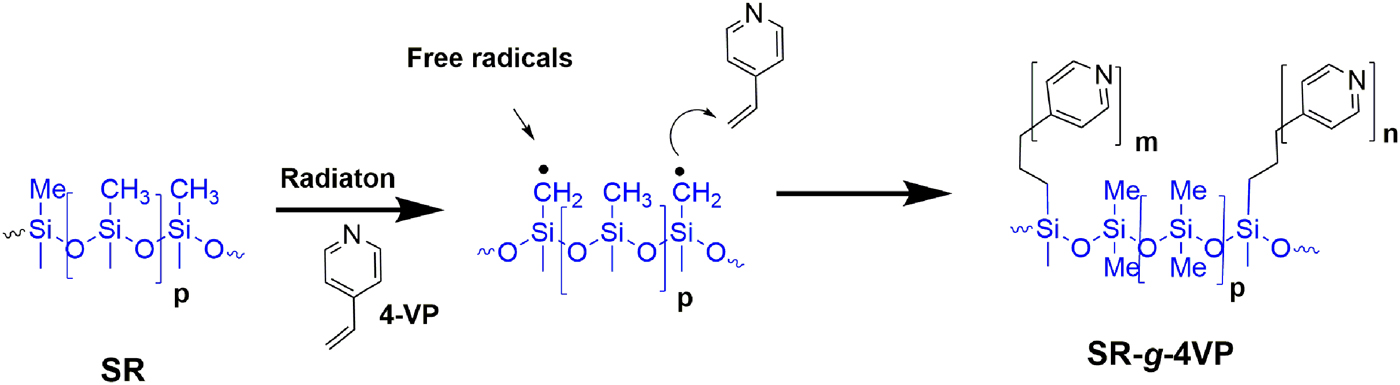
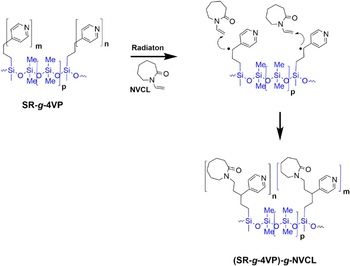
The mechanism proposed is based on the works of Palsule and Frounchi,[Reference Palsule, Clarson and Widenhouse17, Reference Frounchi, Dadbin and Panahinia18] who studied the effect of gamma rays onto SRs. They demonstrated that the main species formed during gamma irradiation of SRs are free radicals by C–H and Si–C homolytic ruptures. Based on those works, we propose that grafting reaction that occurs among 4VP and SR initiates when the free radicals formed by gamma rays onto SR surface, react with the double bond of a 4VP molecule. This coupling forms a simple bond with a secondary free radical, which propagates the polymerization process until it forms the polymer chains (Scheme 1). In the second step, when a SR-g-4VP film is irradiated, it is proposed that free radicals are formed mainly in the P4VP grafted chain due to free radicals that can be stabilized by the resonance of aromatic ring; these free radicals react with the vinyl group of NVCL molecules encouraging the initiation of the second grafting to finally give (SR-g-4VP)-g-NVCL (Scheme 2).
Proposal of grafting process for 4VP onto SR film surface by grafting-radiation technique.

Proposal of grafting process for NVCL onto SR-g-4VP by means of the simultaneous method.

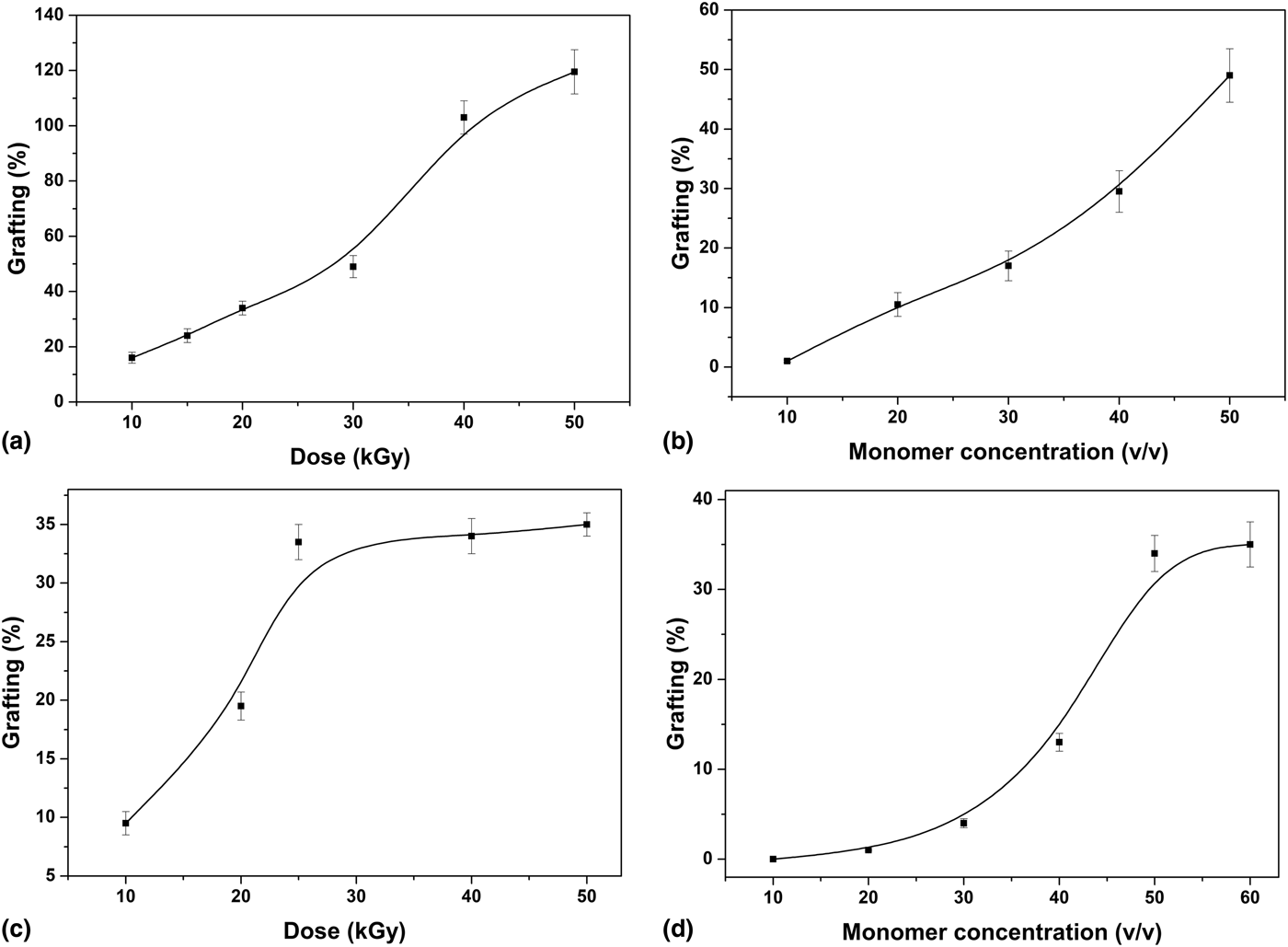
The results obtained in the dose–effect study are observed in Fig. 1(a); this was observed as a dependence of dose on the grafting percentage. At an applied dose of 10 kGy, was obtained around 17% grafting, at 20 kGy, 35% grafting was reached. Grafting yield was superior to 100% at doses of 40 and 50 kGy. This is because at higher doses, a greater number of free radicals are formed on SR films and that means more reactive sites where can growth P4VP chains. The concentration effect of 4VP in DMF showed a positive impact on the grafting percentage obtained at 25 kGy of applied dose, it means that the grafting was higher at high monomer contents in reactions media. This occurred because of reactions between monomer molecules and free radicals formed on SR surface as they are more feasible at higher concentrations of 4VP. The study was also carried out by the simultaneous method [Fig. 1(b)].
(a) Grafting yields as a function of applied dose at 50% monomer concentration. (b) Grafting (%) as a function of monomer concentration at 30 kGy. (c) Grafting yield of NVCL onto SR-g-4VP films at different doses and 50% monomer concentration. (d) Grafting yields of 4VP onto SR films at different monomer concentration and 30 kGy of dose. DMF was used as a solvent in each reaction and monomer concentration was (v/v).

Regarding FTIR-ATR analysis, (SR-g-4VP)-g-NVCL film exhibited a stretching band at 3060 cm−1 due to aromatic C–H stretching bond from the aromatic ring of 4VP, the bands that appeared at 2950 and 2845 cm−1 correspond to the asymmetric and symmetric stretching of C–H, at 1645 cm−1 appeared the stretching vibration of carbonyl group that belongs from NVCL ring. The signals were observed in the spectrum at 1412 and 1205 cm−1 that correspond to asymmetric and symmetric bending of CH3 groups. Stretching vibration of the C–N bond was observed at 1250 cm−1; the band at 1012 cm−1 is associated with aromatic C–H bending of 4VP. Finally, the bands of PDMS appeared at 710 and 494 cm−1; the first one is associated with stretching vibration of Si-C bond and the second with the stretching of the Si–O bond, respectively. These stretching signals confirmed the structure of binary graft copolymer (Fig. S1).
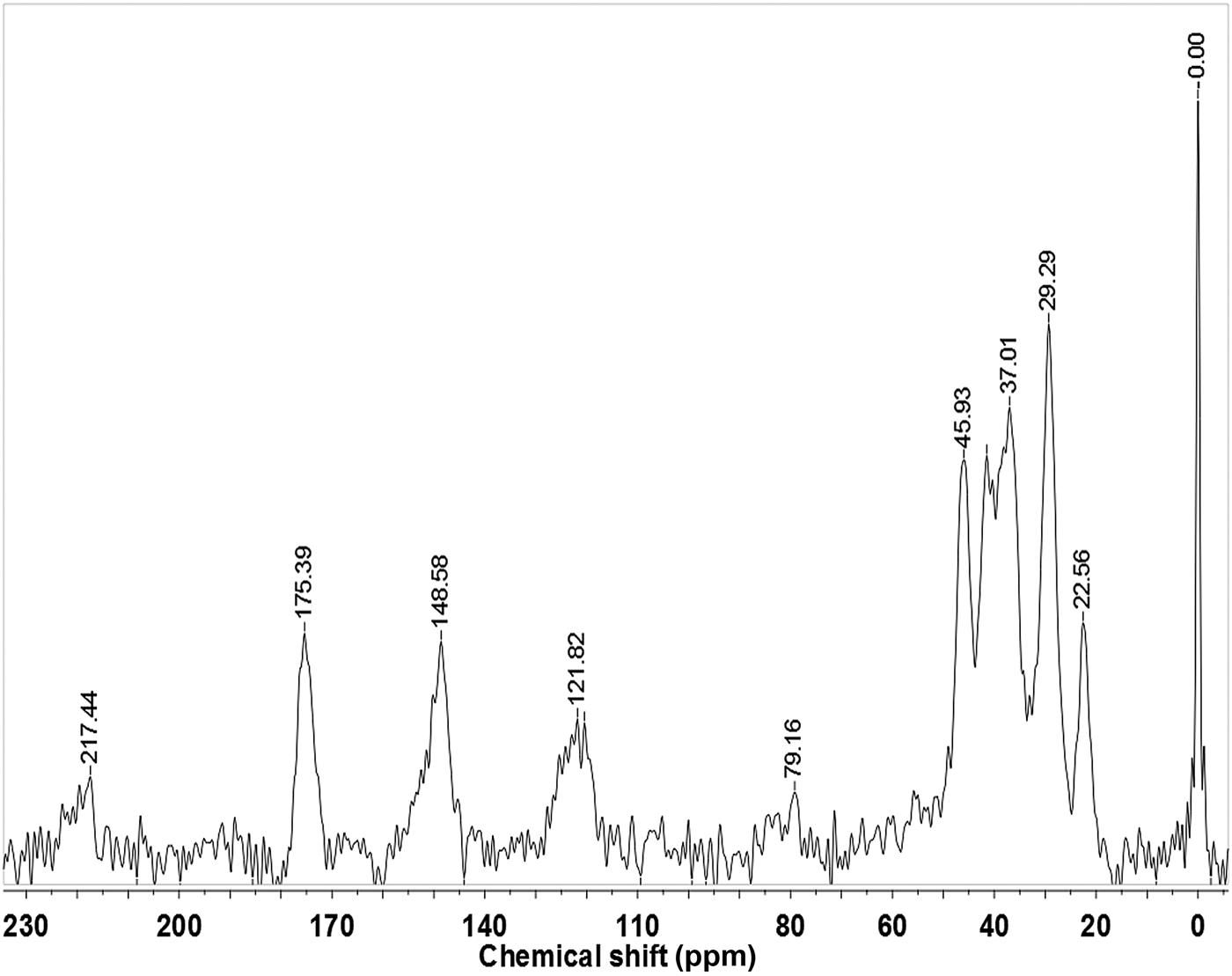
In the 13C-NMR spectrum, the characteristic chemical shift of PDMS methyl groups near to 0 ppm are observed. In the region from 20 to 50 ppm appeared methylenes groups that belong to NVCL ring and new aliphatic bonds formed by the polymerization process. The peak that appeared at 79 ppm corresponds to carbon directly coupled to nitrogen atom from grafted NVCL. The signals appeared at 124, 148 ppm correspond to aromatic carbons (position 4 and 3, respectively) from 4VP; while C═N bond (from pyridine ring) appeared around to 175 ppm. The most displaced peak observed in the NMR spectrum corresponds to the C═O group from NVCL which appeared at 217 ppm (Fig. 2). All these chemical shifts confirmed the composition of the binary graft copolymer. Elongation study (Young's modulus) of grafted films was carried out to determine the effect of grafting on the elasticity of modified samples. In Fig. S2 is observed the elongation profile of irradiated SR film in DMF at 30 kGy which showed an elongation of 305% approximately. This is because ionizing radiation induces crosslink process on SR film. Regarding grafted films, SR-g-4VP with 7% grafting showed slightly less elongation than SR irradiated (230% elongation), meanwhile SR-g-4VP with 17% grafting showed an elongation at break of 110% approximately. The binary graft copolymer showed a shorter elongation than all previous ones, as the film was exposed twice to gamma radiation; however, the loss in elongation was not only caused by the cross-linking induced by gamma rays on the film but also of interactions among polymer chains.
13C-RMN spectrum of (SR-g-4VP)-g-4VP.

The functionalization produced a slight increase in the thickness of SR film which was observed by SEM analysis. In Fig. 3 are clearly observed differences among pristine SR [Fig. 3(a)] and binary graft copolymer micrographs, this is due to the presence of the polymeric chains that were grafted on the surface [Fig. 3(b)]; micrograph showed a homogeneous grafting on the whole surface. The cross-section analysis showed remarkable differences among top sections of pristine SR [Fig. 3(c)] and (SR-g-4VP)-g-NVCL film by the grafting layer which was quite thin [Fig. 3(d)]. In Fig. 3(d) it is easily observed that grafting did not diffuse deeply inside the film, this is because the solvent did not swell much to SR films which favored the grafting onto the surface. Greater magnifications were necessary for a better examination of cross-section [Fig. 3(e)], in this figure was observed certain roughness. Some flake structures in the cross-section were observed at 30,000 magnifications, which correspond to the grafting of (SR-g-4VP)-g-NVCL film [Fig. 3(f)].
Micrographs of: (a) Pristine SR, (b) (SR-g-NVCL)-4VP and (c) cross-section of SR, (d) cross-section of (SR-g-NVCL)-4VP at 500, (e) 4000 and (f) 30 000 magnifications, respectively.

Thermograms of homopolymers, grafted film, and pristine SR carried out from room temperature to 800 °C are presented in Fig. S3. Pristine SR was more thermally stable than other polymers studied by TGA since it showed a decomposition temperature of 640 °C approximately and a residue of 32% after 750 °C. On the other hand, were observed decomposition temperatures at 407 and 438 °C for PNVCL and P4VP, respectively. PNVCL showed lower thermal resistance than all other analyzed samples; both polymers showed a residue of 1.3% at 750 °C which demonstrated that homopolymers are more susceptible to thermal degradation. Based on the decomposition temperature observed for PNVCL and P4VP in Fig. S3, we can assume that the decomposition curve observed for (SR-g-4VP)-g-NVCL at 430 °C corresponds to the grafting (4VP/NVCL) and the second decomposition curve at 495 °C belongs to SR. This indicates that grafting drastically affects the thermal stability of pristine SR; however, assuming that the potential application of grafted films would be in the biomedical field, this lost in thermal stability is not quite significant.
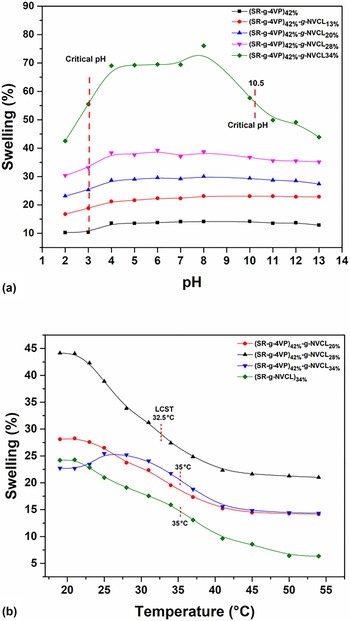
Since the ionization degree of functional groups such as amides and amines change as a function of pH of the medium; PBS solutions at different pH were used to observe the critical pH of binary grafted films by changes in their swelling degree. SR-g-4VP film showed a critical pH around 3 and this value did not present a displacement after second grafting even with 28% of NVCL, just was observed an increase in the swelling degree of graft copolymers as the presence of amide groups belong to NVCL in the pH-sensitive system; this is because amide group present ability to establish hydrogen bond in aqueous medium, this behavior demonstrated that C═O from amide group of NVCL is more effective establishing hydrogen bonds with water than nitrogen atom of 4VP. When the proportion of NVCL grafted onto SR-g-4VP was of 34%, an unexpected swelling behavior was observed; firstly, a remarkable increase in swelling degree was noticed among pH 2 and 4, without any displacement in the critical pH [Fig. 4(a)]. Maximum swelling kept almost constant from pH 4 to 8; after this, a pronounced collapse was observed until it reached the same swelling degree presented at pH 2, which gave rise to the appearance of another critical pH at 10.5 approximately. This is very interesting because this material could be used as drug delivery system for its hydrophilic properties and its response to critical pH or for water treatment,[Reference Sahiner and Ozay14] absorbing metals at acidic conditions (maximum swelling) and desorb them at basic pH (deswelling process) to reuse the polymer.
(a) Swelling profile of binary graft copolymers in different buffer solutions and (b) phase transition of binary graft copolymers at different temperature (LCST).

This is not the first time that a thermo-sensitive polymer undergoes reversal sensitiveness, changing its LCST to UCST (Upper Critical Solution Temperature) by its combination with a pH-sensitive polymer in a unique grafting onto a polymeric surface; this phenomenon was previously observed by Burillo in a binary graft copolymer of poly(N,N-dimethylaminoethyl methacrylate) (PDMAEMA) and 4VP onto polypropylene.[Reference Burillo, Bucio, Arenas and Lopez2] On the other hand, displacement in pH was observed previously by Hernández-Martínez[Reference Hernández-Martínez and Bucio26]; in that work, the authors grafted DMAEMA/PEGMEMA onto LDPE in one step. Some studies have demonstrated remarkably displacements in critical pH with the increment in comonomer content; however, in those studies, the used acrylates hydrophobically modified the aliphatic chains. In those works, was observed that critical pH displacements depended on the long aliphatic moiety[Reference Philippova, Hourdet, Audebert and Khokhlov27–Reference Rogel-Hernández, Licea-Claveríe, Cornejo-Bravo and Arndt30]; however, no work was observed similar to swelling profile for binary graft copolymers, as is observed for (SR-g-4VP)42%-g-NVCL34%.
As the binary graft copolymer is composed of NVCL and 4VP, the necessary results analyze the LCST of the SR-g-NVCL film at the same conditions which studied the binary graft copolymers; the LCST of SR-g-NVCL (32.5 °C) matches as previously reported.[Reference Pino-Ramos, Flores-Rojas, Alvarez-Lorenzo, Concheiro and Bucio31] It is important to remember that SR-g-4VP did not show any response to changes to temperature variations. The binary graft copolymers ((SR-g-4VP)-g-NVCL) films presented displacements in the critical temperature compared with SR-g-NVCL; they exhibited an LCST near to 35 °C. The critical temperature displacement that undergoes binary graft copolymers was due to the presence of P4VP [Fig. 4(b)]. In this study, it was also noticed that the hydrophilic character is remarkably enhanced by the second graft. This positive effect is observed mainly for (SR-g-4VP)42%-g-NVCL28%, that film showed almost twice swelling degree than SR-g-NVCL, this is interesting as it had been observed that PNVCL is more hydrophilic than grafting of P4VP. There appeared a small UCST for the film with 34% graft of 4VP, it means that the proportion of pH-sensitive moiety affects the thermosensitivity of NVCL. Both critical pH and thermo-responsive behavior demonstrated the hydrophilicity of binary graft copolymer, because improving the surface affinity to water enhances the biocompatibility.[Reference Ruiz, Burillo and Bucio32–Reference Jones36]
Conclusions
A binary graft copolymer was successfully synthesized by two-step method to obtain a thermo- and pH-sensitive material; it was observed as a dependence on monomer concentration and applied dose on the grafting percentage, it means that at higher monomer concentration and higher applied dose, grafting yield increases. FTIR-ATR and 13C-NMR analysis confirmed the structure of binary grafted films by identifying the functional groups and chemical shift displacements, respectively. The binary grafted films showed an improved hydrophilicity compared with SR which did not swell.
(SR-g-4VP)-g-NVCL with 34% of NVCL grafted showed a new critical pH around to 10.5; this behavior was unexpected, but it confirms that the comonomer has a remarkable effect on pH-sensitive polymers. Binary graft copolymer showed response to both pH and temperature and this phase transitions; also (SR-g-4VP)-g-NVCL films have potential applications as drug delivery systems.
Supplementary material
The supplementary material for this article can be found at https://doi.org/10.1557/mrc.2018.170
Acknowledgments
This work was supported by DGAPA-UNAM Grant IN201617 (Mexico). The authors thank B. Leal and M. Cruz from ICN-UNAM; G. Cedillo and E. Hernández-Mecinas from IIM-UNAM, all for their technical assistance.