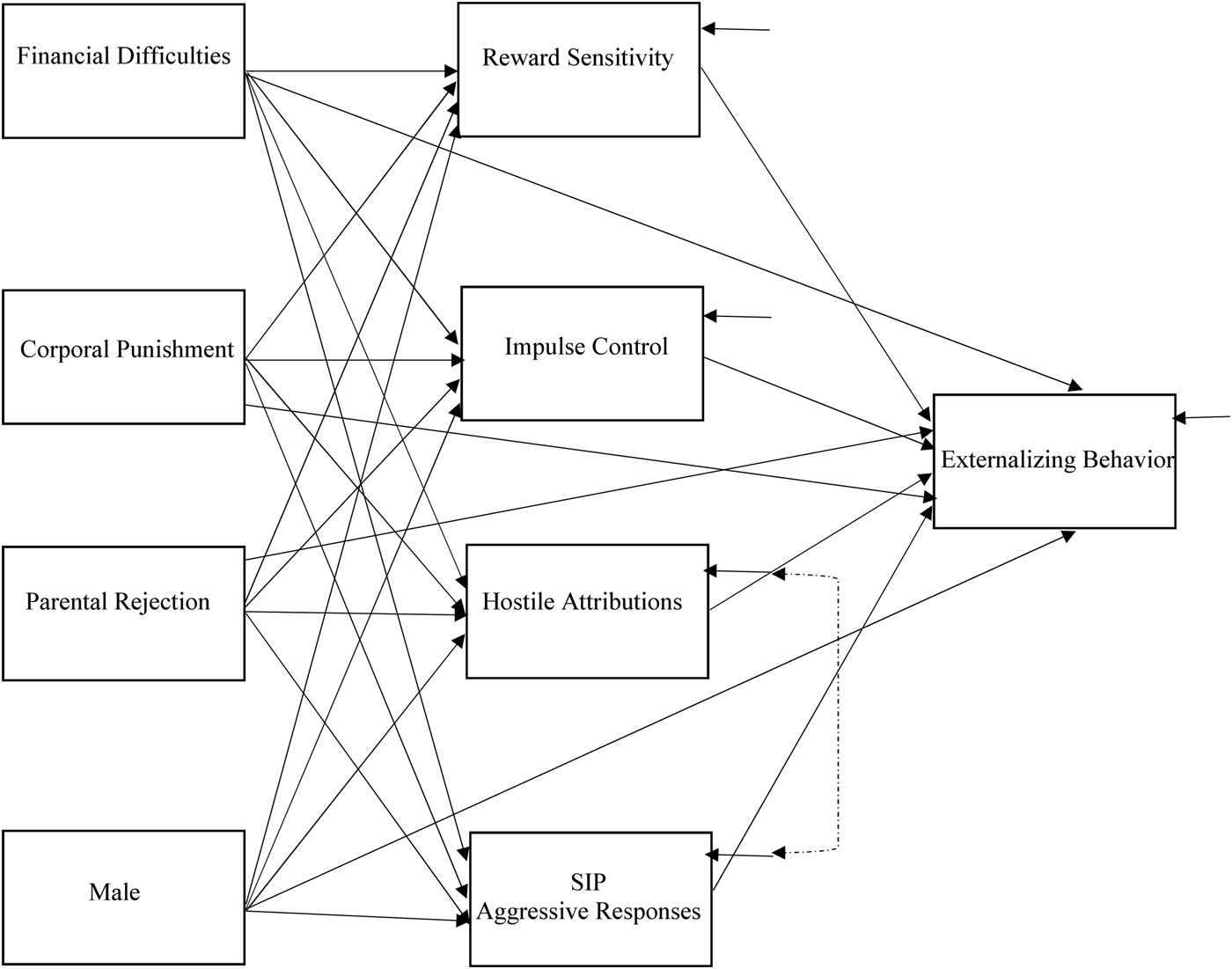
Using longitudinal data reported by mothers, fathers, and children in eight countries (Colombia, Italy, Jordan, Kenya, the Philippines, Sweden, Thailand, and the United States), this study in two ways takes a multilevel approach to understanding the development of externalizing behavior. First, the study examines whether family-level childhood adversity predictors including financial difficulties, corporal punishment, and parental rejection are related to subsequent externalizing behavior in similar or different ways in the samples from the eight countries. Second, the study incorporates multiple levels of developmental outcomes including both psychological outcomes (i.e., reward sensitivity, impulse control, hostile attributions, and social information processing related to aggressive responding) and behavioral outcomes (i.e., externalizing behavior). The psychological outcomes are tested as mediators of the links between childhood adversity and subsequent externalizing behavior. Our full conceptual model is depicted in Figure 1. Developmentally, we focus on a period from age 9 to age 12, which spans late childhood to early adolescence. During this developmental period, children's social cognitive processes become better predictors of their behavior than was the case earlier in childhood (e.g., Davis-Kean et al., Reference Davis-Kean, Huesmann, Jager, Collins, Bates and Lansford2008), and reward sensitivity and impulse control are undergoing developmental changes that make adolescents especially prone to risky behavior (Steinberg, Reference Steinberg2008).
A priori conceptual and analytic model with age 9 family adversity, age 10 psychological mediators, and age 12 externalizing behavior. The dashed double arrow was added to the a priori model to improve model fit.

Childhood Family Adversity and Externalizing Behavior
Family adversity during childhood is characterized both in terms of sociodemographic factors and stressful life experiences, which often go hand in hand. Poverty is a leading sociodemographic marker of family adversity that has been linked in a large body of research to child externalizing behavior problems (e.g., Conger, Conger, & Martin, Reference Conger, Conger and Martin2010). Studies with strong methodologic designs suggest the importance of income for predicting children's behavior problems. For example, a longitudinal study that tracked both family income and children's behavior problems over time found that externalizing problems decreased as family income increased (Dearing, McCartney, & Taylor, Reference Dearing, McCartney and Taylor2006). Likewise, in a natural experiment brought about when a casino opened in a poor community, resulting in cash transfers to members of the community, children in families that were brought out of poverty by the cash transfers showed fewer externalizing behaviors than children in families that remained in poverty (Costello, Compton, Keeler, & Angold, Reference Costello, Compton, Keeler and Angold2003).
Previous research has distinguished absolute poverty from relative poverty, with the former characterized by income that is below some threshold determined to be the poverty line and the latter characterized by income that is less than the income of others in the population (World Bank, 2014). Comparative international research complicates the operationalization of poverty because of differences in standards of living that make poverty in one country look different from poverty in another country. To illustrate using examples from countries in the present study, 34% of the population of Kenya and 18% of the population of the Philippines live on less than the international poverty threshold of US$1.90 per day, compared to virtually no one in Italy, Sweden, and the United States (UNICEF, 2016). However, the purchasing power of US$1.90 is considerably greater in lower income countries than in higher income countries (World Bank, 2017), and research in Ecuador, Hungary, the Philippines, and Zambia suggests ways that social support networks are mobilized to cope with poverty (Moser, Reference Moser1996). Differences in poverty characterize even wealthy countries. For example, before taking into account taxes and transfers, 26.7% of American children and 23.4% of Swedish children live below their countries’ respective poverty thresholds, but after taking into account taxes and transfers, 22.4% of American children compared to only 2.6% of Swedish children live below their countries’ poverty thresholds (UNICEF, 2000). In the present study, we operationalized financial difficulties in terms of parents’ perception of not having enough money to pay for basic living expenses.
Financial difficulties are linked to stressful life experiences (Evans & English, Reference Evans and English2002), but we also considered two additional aspects of childhood family adversity that have been related to externalizing behavior problems: corporal punishment and parental rejection. In a meta-analysis of spanking and child outcomes, the effect size linking corporal punishment and externalizing behavior was moderate (Gershoff & Grogan-Kaylor, Reference Gershoff and Grogan-Kaylor2016), even in longitudinal studies controlling for prior externalizing behavior to reduce the possibility that children with more externalizing problems simply elicit more corporal punishment from their parents. Corporal punishment has recently been proposed as a “toxic stressor” with effects on both brain development and behavioral development (Gershoff, Reference Gershoff2016). In previous research in four of the eight countries included in the present study, more frequent corporal punishment was related to more child aggression as reported by mothers and children (Lansford et al., Reference Lansford, Chang, Dodge, Malone, Oburu, Palmérus and Quinn2005).
In contrast to parental warmth and acceptance, rejection conveys to children that they are unloved and unwanted (Rohner, Reference Rohner2004). Children's perceptions of being rejected by their parents have been theorized and empirically demonstrated to be an important predictor of children's behavioral and psychological problems (e.g., Rohner, Reference Rohner2004), including in the eight countries in the present study (Putnick et al., Reference Putnick, Bornstein, Lansford, Malone, Pastorelli, Skinner and Oburu2015). Clearly, it would have been possible to investigate many other aspects of childhood family adversity that have been associated with children's externalizing behaviors in previous research, but focusing on financial difficulties, corporal punishment, and parental rejection enabled us to test exemplars of sociodemographic and stressful experiences related to parenting that are applicable in the diverse countries included in the present study.
Childhood Family Adversity, Reward Sensitivity, Impulse Control, and Social Cognition
Many aspects of childhood family adversity that have been found to be related to children's externalizing behaviors have also been related to reward sensitivity, impulse control, and social cognition, particularly hostile attribution biases and social information processing related to aggressive responses. The dual systems model describes how brain regions responsible for seeking rewards and controlling impulses develop at different rates (Shulman et al., Reference Shulman, Smith, Silva, Icenogle, Duell, Chein and Steinberg2016). Regions of the striatum and medial and orbital prefrontal cortices, which are sensitive to rewards and drive individuals to seek new sensations and experiences, develop earlier and more quickly than regions of the lateral prefrontal, lateral parietal, and anterior cingulate cortices, which are responsible for impulse and cognitive control that help individuals plan a course of action that takes into account potential consequences (Shulman et al., Reference Shulman, Smith, Silva, Icenogle, Duell, Chein and Steinberg2016). Support for this dual systems model has been found in the countries involved in the present study (Steinberg et al., Reference Steinberg, Icenogle, Shulman, Breiner, Chein, Bacchini and Takashin press).
Despite cross-individual and cross-cultural similarities in this general pattern of development of reward sensitivity and impulse control, experiences during childhood also can affect the development of reward sensitivity and impulse control. In particular, parenting quality and stress have both been linked to individual differences in reward sensitivity and impulse control. For example, more parental rejection, use of corporal punishment, and stressful life events (as might be expected in the face of financial difficulties) have been found to predict impairments in the development of self-regulation and impulse control over time (King, Lengua, & Monahan, Reference King, Lengua and Monahan2013). Similarly, less maternal warmth and more maternal punitive discipline when children were ages 4–5 years predicted less self-regulation at ages 8–9, even after controlling for prior self-regulation (Colman, Hardy, Albert, Raffaelli, & Crockett, Reference Colman, Hardy, Albert, Raffaelli and Crockett2006).
Likewise, childhood family adversity also has been found to predict aspects of social cognition including hostile attribution biases and social information processing related to aggressive responses. Social information processing theory describes how individuals interpret social stimuli in a series of cognitive steps that make it more or less likely that individuals will respond to the social stimuli with aggression (Crick & Dodge, Reference Crick and Dodge1994). In the present study, we focus on two of these steps: hostile attributions and social information processing related to aggressive responses. In the face of an ambiguous social provocation, individuals may interpret the provocateur's behavior as being benign (it happened by accident) or hostile (it happened because the provocateur was angry or trying to be mean). In addition, when faced with a provocative social situation, individuals cognitively generate a set of hypothetical responses, which may be competent, inept, or aggressive, before evaluating the merits of each response and deciding how to act (Fontaine, Yang, Dodge, Pettit, & Bates, Reference Fontaine, Yang, Dodge, Pettit and Bates2009).
Experiencing corporal punishment has been associated with social information processing biases (Weiss, Dodge, Bates, & Pettit, Reference Weiss, Dodge, Bates and Pettit1992), perhaps because by using physical force to respond to children's misbehaviors, parents inadvertently convey the message that using aggression is an appropriate way to respond to social problems (Widom & Wilson, Reference Widom, Wilson, Lindert and Levav2015). Frequently being spanked by parents is the strongest predictor of children's endorsement of aggressive problem solving strategies with peers and siblings relative to parental acceptance, parents’ experience of corporal punishment, and family demographics (Simons & Wurtele, Reference Simons and Wurtele2010). Likewise, children who have been rejected by their peers are more likely than children accepted by their peers to develop hostile attribution biases and generate aggressive responses to hypothetical situations (Dodge et al., Reference Dodge, Lansford, Burks, Bates, Pettit, Fontaine and Price2003). Similar mechanisms may be at work when children are rejected by their parents.
Reward Sensitivity, Impulse Control, Social Cognition, and Externalizing Behavior
Reward sensitivity and inability to control impulses have together been found to contribute to higher levels of risky behavior during adolescence than earlier in childhood or in adulthood (Shulman et al., Reference Shulman, Smith, Silva, Icenogle, Duell, Chein and Steinberg2016). Even within a particular developmental stage, individuals higher in reward sensitivity engage in more externalizing behavior than individuals lower in reward sensitivity, and individuals higher in impulse control engage in less externalizing behavior than individuals lower in impulse control (Galván, Reference Galván2010). For example, greater sensitivity to rewards is predictive of future sensation seeking and risky behaviors (Galván, Reference Galván2010). In contrast, better impulse control is related to lower levels of externalizing problems, perhaps in part because being able to pause and avoid impulsive responding enables individuals to have time to formulate adaptive responses rather than acting out (Morris, Keane, Calkins, Shanahan, & O'Brien, Reference Morris, Keane, Calkins, Shanahan and O'Brien2014).
Individuals are more likely to behave aggressively if they believe that others have acted with hostile intent (for a meta-analysis, see Orobio de Castro, Veerman, Koops, Bosch, & Monshouwer, Reference Orobio de Castro, Veerman, Koops, Bosch and Monshouwer2002). This relation holds for children in all eight countries in the present study (Dodge et al., Reference Dodge, Malone, Lansford, Sorbring, Skinner, Tapanya and Pastorelli2015). Individuals are more likely to indicate they would respond aggressively to situations in which they perceive others to have behaved with hostile intent than those same individuals in response to situations in which they perceive others to have behaved with benign intent (Dodge et al., Reference Dodge, Malone, Lansford, Sorbring, Skinner, Tapanya and Pastorelli2015). In addition, individuals who are biased toward perceiving others as behaving with hostile intent are more likely than individuals who do not hold hostile attributional biases to be rated by mothers and children as behaving more aggressively (Dodge et al., Reference Dodge, Malone, Lansford, Sorbring, Skinner, Tapanya and Pastorelli2015). Furthermore, individuals who eventually behave aggressively are likely to generate fewer competent responses and more aggressive responses to provocative situations (Asarnow & Callan, Reference Asarnow and Callan1985). Social information processing, including making hostile attributions and generating aggressive responses, has been found to mediate links between more distal risk factors and externalizing behaviors (e.g., Dodge, Bates, & Pettit, Reference Dodge, Bates and Pettit1990; Dodge et al., Reference Dodge, Lansford, Burks, Bates, Pettit, Fontaine and Price2003).
Eight Participating Countries
The studies cited above have all used American samples, except in the specific instances in which other countries were named in the description of the findings. Therefore, a question left unanswered by most previous research is whether the theoretical model holds in a wide range of cultural contexts or whether the model is primarily a function of experiences within the United States. There are at least two ways of approaching country-level effects in testing the theoretical model in our eight-country sample. One way would be through multilevel modeling to parse variance into between-family within-country effects compared to between-country effects. A different way, and the approach adopted in this study, is through multigroup modeling to test whether the hypothesized links are the same or different across countries. Although we did not hypothesize specific pairwise differences between countries, the eight countries differ in several ways that might affect the links in the theoretical model. For example, with respect to externalizing behaviors, previous research has demonstrated that externalizing behaviors are perceived as being more problematic and less tolerated in Thailand compared to the United States (Weisz, Suwanlert, Chaiyasit, & Walter, Reference Weisz, Suwanlert, Chaiyasit and Walter1987) and that, relative to internalizing problems, externalizing problems may be less common in Kenya (Weisz, Sigman, Weiss, & Mosk, Reference Weisz, Sigman, Weiss and Mosk1993). In addition, although more corporal punishment predicts more aggression in Italy, Kenya, the Philippines, and Thailand, the associations are weaker in countries in which corporal punishment is more normative (Lansford et al., Reference Lansford, Chang, Dodge, Malone, Oburu, Palmérus and Quinn2005), suggesting that the strength of relations among some variables in the conceptual model may depend on cultural or other factors. By contrast, other relations may be less variable across countries; for example, meta-analyses have demonstrated cross-cultural consistency in associations between parental rejection and more child behavior problems (e.g., Khaleque & Rohner, Reference Khaleque and Rohner2012). Testing the generalizability of the model across the eight groups moves the field in the direction of searching for psychological universals that may characterize individuals from diverse cultural backgrounds (Norenzayan & Heine, Reference Norenzayan and Heine2005).
Present Study
The overarching goal of this study was to understand the development of externalizing behavior in diverse countries, with attention to both family and psychological predictors. We addressed two specific research questions. First, is childhood family adversity in the form of financial difficulties, corporal punishment, and parental rejection directly related to subsequent externalizing behaviors in similar ways in eight diverse countries? Second, do reward sensitivity, impulse control, hostile attributions, and social information processing that are related to aggressive responses mediate associations between childhood family adversity and subsequent externalizing behaviors similarly in eight diverse countries? We hypothesized direct associations between childhood family adversity and subsequent externalizing behaviors as well as indirect associations through psychological mediators. We did not have a priori hypotheses regarding specific differences between countries.
Method
Participants
Participants were drawn from the Parenting Across Cultures study, which included 1,177 children (M = 8.29 years, SD = 0.66, range = 7–10 years at Time 1; 51% girls), their mothers (n = 1,156), and their fathers (n = 912). Families were drawn from Medellín, Colombia (n = 108); Naples and Rome, Italy (n = 203); Zarqa, Jordan (n = 114); Kisumu, Kenya (n = 100); Manila, Philippines (n = 120); Trollhättan/Vänersborg, Sweden (n = 101); Chiang Mai, Thailand (n = 120); and Durham, North Carolina, United States (n = 111 European Americans, n = 103 African Americans, n = 97 Latinos). Participants were recruited through letters sent from schools. To ensure economic diversity, we included students from private and public schools and from high- to low-income families, sampled in proportions representative of each recruitment area. For example, in Colombia, we recruited participants from six well-defined economic strata in proportion to the percentage of the population of the recruitment city of Medellín who were in each strata. Thus, the samples were not nationally representative but were locally representative of the cities from which they were recruited.
Most parents (79%) were married, and nonresidential parents were able to provide data. Nearly all were biological parents, with 3% being grandparents, stepparents, or other adult caregivers. Child age and gender did not vary across countries. Data for the present study were drawn from interviews 1, 2, and 4 years after initial recruitment (at Waves 2, 3, and 5 of the larger study) because these were the times at which data relevant to the current questions were collected. At the follow-up interviews 4 years after the initial interviews, 83% of the original sample provided data (M age of children = 12.90 years, SD = 0.81). Participants who provided follow-up data did not differ from the original sample with respect to child gender, parents’ marital status, or mothers’ education.
Procedure and measures
Measures were administered in the predominant language of each country, following forward- and back-translation and meetings to resolve any item-by-item ambiguities in linguistic or semantic content (Erkut, Reference Erkut2010). Translators were fluent in English and the target language. In addition to translating the measures, translators noted items that did not translate well, were inappropriate for the participants, were culturally insensitive, or elicited multiple meanings, and suggested improvements (Maxwell, Reference Maxwell, Martin and Kelly1996; Peña, Reference Peña2007). Country coordinators and the translators reviewed the discrepant items and made appropriate modifications. Measures were administered in Spanish (Colombia and the United States), Italian (Italy), Arabic (Jordan), Dholuo (Kenya), Filipino (the Philippines), Swedish (Sweden), Thai (Thailand), and American English (the United States and the Philippines).
Interviews lasted 1.5 to 2 hr at each wave and were conducted in participants’ homes, schools, or at other locations chosen by the participants. Procedures were approved by local institutional review boards at universities in each participating country. Mothers and fathers provided written consent, and children provided assent. Family members were interviewed separately to ensure privacy. Children were given small gifts or monetary compensation to thank them for their participation, and parents were given modest financial compensation for their participation, families were entered into drawings for prizes, or modest financial contributions were made to children's schools.
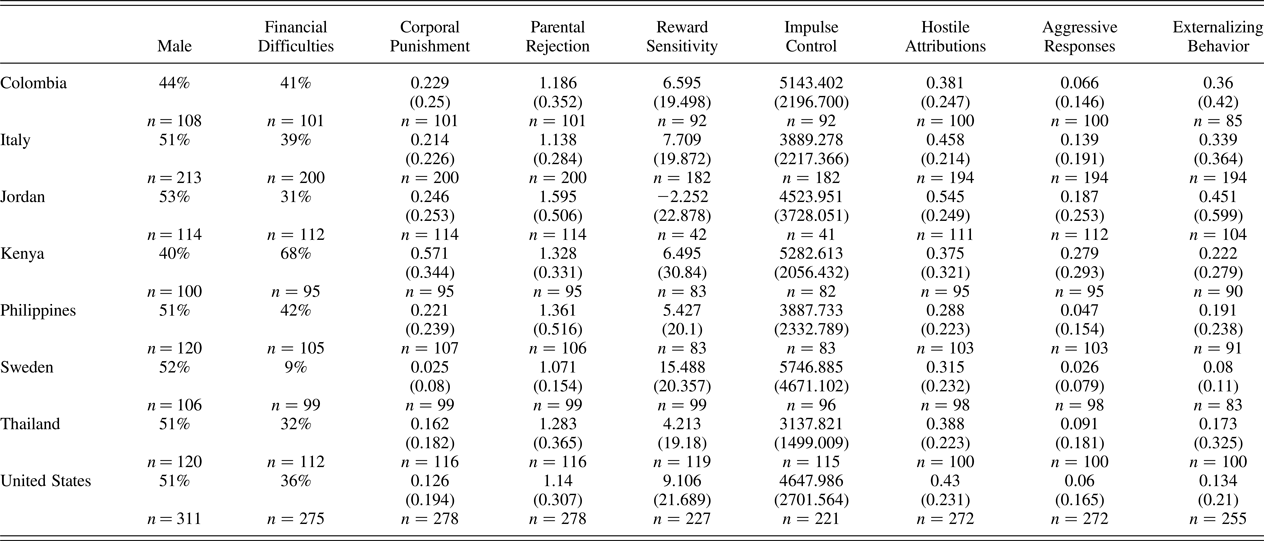
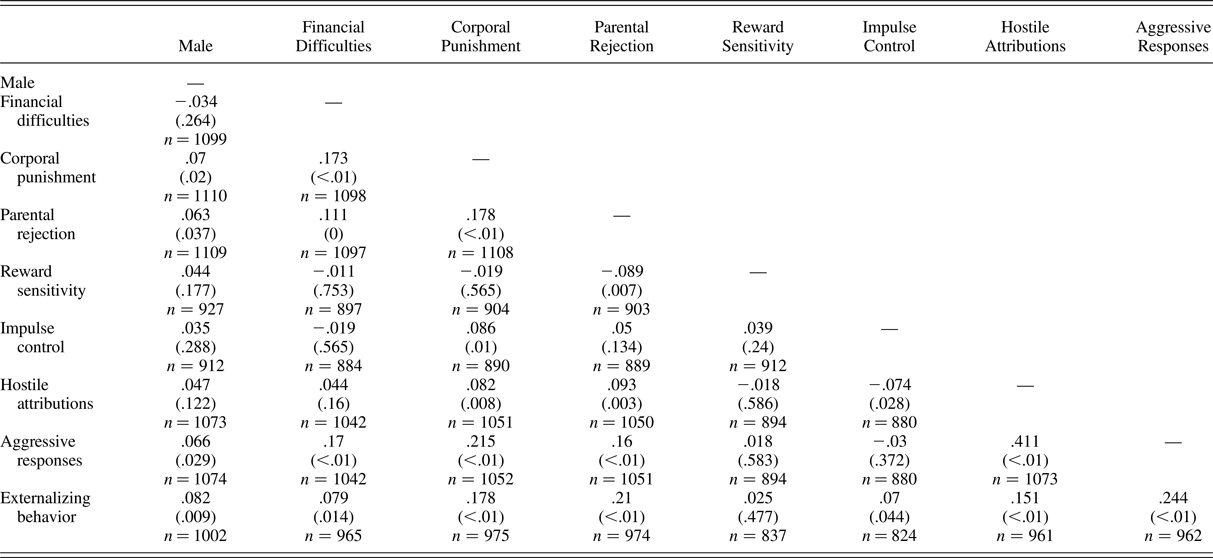
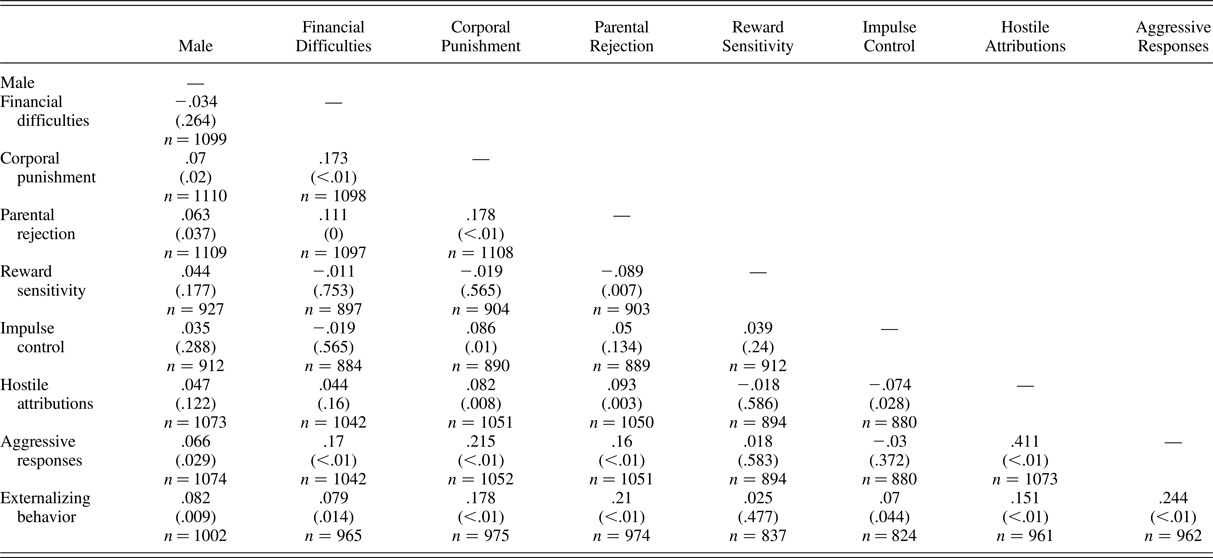
Table 1 provides the means, standard deviations, and sample sizes for each variable in each of the eight countries. Table 2 provides the bivariate correlations across the variables used in the model for all countries combined.
Descriptive statistics by country
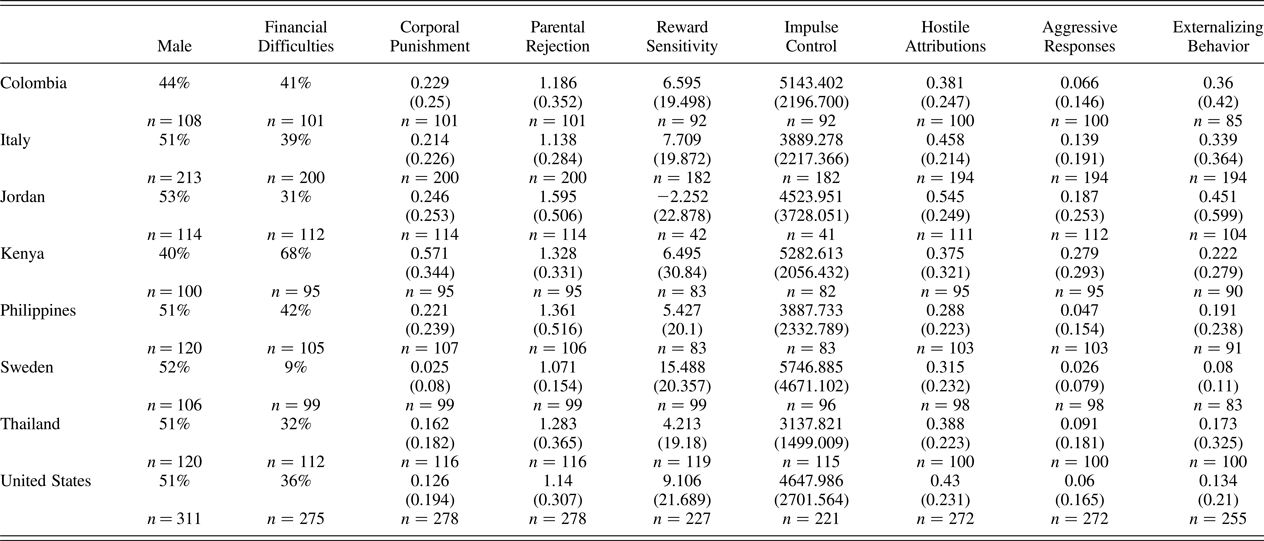
Note: The values are mean (standard deviation) and sample size.
Correlations (p values and sample size)
Childhood family adversity
Childhood family adversity was measured by three scales administered in the second year of the project, when children were 9 years old, on average. First, mothers completed the Life Events measure (Dodge, Pettit, & Bates, Reference Dodge, Pettit and Bates1994), including an item capturing financial difficulties measured by whether the family experienced “money problems that made it hard to pay for basic living expenses” in the past year.
Second, both parents completed a scale from UNICEF's (2006) Multiple Indicator Cluster Survey that captured whether the child experienced six types of corporal punishment in the last month: spanked/hit with bare hand, hit on the bottom, slapped/hit on the hand, slapped/hit on the face, shaken, or beaten. The items were adapted by UNICEF from the Parent-Child Conflict Tactics Scale (Straus, Hamby, Finkelhor, Moore, & Runyan, Reference Straus, Hamby, Finkelhor, Moore and Runyan1998) and have been used in many countries (e.g., Lansford & Deater-Deckard, Reference Lansford and Deater-Deckard2012). A Corporal Punishment Scale was created by averaging across the six indicators for whether either parent reported each type of corporal punishment (α = 0.73).
Third, children completed the Parental Acceptance-Rejection/Control Questionnaire—Short Form (Rohner, Reference Rohner, Rohner and Khaleque2005) as a measure of perceived parental rejection. The rejection scale included four items about children's perceptions of their mothers’ rejection and four items about children's perceptions of their fathers’ rejection (e.g., my mother/father sees me as a big nuisance and my mother/father makes me feel unloved if I misbehave), which children rated on a 4-point scale (1 = never or almost never, 2 = once a month, 3 = once a week, or 4 = every day). Based on feedback from pretesting, we modified the original response scale (almost never true, rarely true, sometimes true, or almost always true) by quantifying it to reduce the possibility of ambiguous interpretations across cultures. The measure has demonstrated good psychometric properties in the present samples (Putnick et al., Reference Putnick, Bornstein, Lansford, Malone, Pastorelli, Skinner and Oburu2015) as well as in a large body of international research (e.g., Khaleque & Rohner, Reference Khaleque and Rohner2012). Items were averaged to create the parental rejection scale (α = 0.73).
Psychological mediators
Psychological mediators included four measures from the third year of the project, when children were 10 years old, on average. Two of the measures were derived from a set of computerized tasks completed by children. First, reward sensitivity was assessed using the Modified Iowa Gambling Task (Bechara, Damasio, Damasio, & Anderson, Reference Bechara, Damasio, Damasio and Anderson1994; Cauffman et al., Reference Cauffman, Shulman, Steinberg, Claus, Banich, Graham and Woolard2010). Children were presented on the computer screen with four different decks of cards and were asked to attempt to earn pretend money by playing or passing cards from each deck. Two of the decks yielded relatively small gains, but those gains exceeded the losses in the long-run (“good” decks), and two of the decks yielded large gains, but over time the losses exceeded the gains (“bad” decks). Within each set of decks, one deck had frequent but relatively low losses and the other had infrequent high losses, thus creating a level of uncertainty within both the good and bad decks. In each of six rounds with 20 trials each, children earned (or lost) points by choosing cards from the four decks, but they could also choose not to pick from any or all decks. The standard task (Bechara et al., Reference Bechara, Damasio, Damasio and Anderson1994) was modified in two ways. First, participants decide to play or pass a card from a preselected deck rather than deciding to draw from any of the four decks (see Cauffman et al., Reference Cauffman, Shulman, Steinberg, Claus, Banich, Graham and Woolard2010, for details). This modification is shown to be more sensitive to individual differences in performance because it separates the independent effects of gains and losses on subsequent card selection (Peters & Slovic, Reference Peters and Slovic2000). Second, participants receive information on net gain or loss associated with each card rather than information on gain and loss separately. This modification was made to ensure that participants did not unequally weigh rewards and losses within a given trial.
During the task, one of four decks is highlighted, and participants are given 4 s to play or pass the card. A running total of the participant's “earnings” appears on each screen. If the participant passes, the image of the card displays the message “Pass,” and the total amount of money earned does not change. If the participant plays, a monetary outcome is displayed on the card, and the total amount of money earned is updated. Individuals who play from advantageous decks more than disadvantageous decks earlier in the task are thought to be more reward sensitive. This index is calculated in two parts: first, by computing the proportion of plays from advantageous decks relative to the total number of advantageous cards presented during the task; second, by turning this proportion into a percentage and taking the difference between plays from advantageous decks in the last and first blocks: (% Play Block 6) – (% Play Block 1). Reward sensitivity is captured by the change in percentage of plays from “good” decks from the first to the last round. Higher values indicate greater sensitivity to rewards (see Icenogle et al., Reference Icenogle, Steinberg, Olino, Shulman, Chein, Alampay and Uribe Tirado2017, for additional information about the task in the present sample).
Second, children completed a computerized version of the Tower of London task (Shallice, Reference Shallice1982) to measure impulse control (Steinberg et al., Reference Steinberg, Albert, Cauffman, Banich, Graham and Woolard2008). Children were presented with pictures of two sets of three colored balls distributed across three rods, one of which can hold three balls, one two balls, and the last, one ball. The first picture shows the starting position of the three balls, and the second picture shows the goal position. The child is instructed to move the balls from the starting position to match the goal position in as few moves as possible, using the computer cursor to “drag” and “drop” each ball. Five sets of four problems each are presented, beginning with four that can be solved in as few as three moves, and progressing to sets that can be solved in as few as four, five, six, and seven moves. Thus, the required patterns ranged in difficulty from easy to hard. Impulse control was measured by the time children waited before making their first move on the difficult patterns that required five, six, or seven moves to solve. Time to first move was measured as the amount of time that elapses (in milliseconds) between the presentation of each problem and the child's first move, with longer latencies to first move indicating greater impulse control (in this case, the ability to inhibit acting before a plan is fully formed; see Duell et al., Reference Duell, Steinberg, Chein, Al-Hassan, Bacchini, Chang and Alampay2016, for additional information about the task in this sample).
Third, children's hostile attributions were assessed using the Children's Stories measure (Dodge et al., Reference Dodge, Malone, Lansford, Sorbring, Skinner, Tapanya and Pastorelli2015). Children were presented with 10 brief vignettes describing ambiguous social situations (e.g., Imagine that you are walking to school and you're wearing new shoes. You really like your new shoes, and this is the first day you have worn them. Suddenly, you are bumped from behind by a boy. You stumble and fall into a mud puddle and your new shoes get muddy). Children were asked why they thought each provocateur behaved as he or she did (on purpose coded 1 or by accident coded 0). A scale capturing a child's hostile attributions in ambiguous social situations was created by averaging across these 10 indicators (α = 0.70).
Fourth, social information processing (SIP) related to aggressive response also was assessed from children's responses to the Children's Stories measure (see Dodge et al., Reference Dodge, Malone, Lansford, Sorbring, Skinner, Tapanya and Pastorelli2015, for additional information about the measure in the present sample). After indicating whether they believed the provocateur caused the negative event on purpose or by accident, the children were asked to choose how they would respond to the situation by picking from three possible responses (e.g., with respect to the example vignette above, the aggressive response was to push the boy in the mud, the competent response was to clean up the shoes, and the avoidant response was to walk away from the boy). A scale capturing SIP aggressive response was created by calculating the proportion of vignettes for which the child chose the aggressive response (α = 0.85).
Externalizing behavior
In the fifth year of the project, when children were 12 years old, on average, children completed the Behavior Frequency Scale, which consists of items derived from Farrell, Danish, and Howard (Reference Farrell, Danish and Howard1992), Crick and Bigbee (Reference Crick and Bigbee1998), and Orpinas and Frankowski (Reference Orpinas and Frankowski2001). Children were asked how often in the last 30 days they engaged in a series of aggressive and delinquent behaviors, using a scale ranging from 0 (never) to 5 (20 or more times). Averaging across different sets of items yields three subscales: the delinquency scale includes 10 items (e.g., been suspended); the nonphysical aggression scale contains 6 items (e.g., teased someone to make them angry); and the physical aggression scale has 10 items (e.g., shoved and pushed another kid). A composite measure of externalizing behavior was created by averaging across these three scales (α = 0.87).
Analysis plan
Our a priori model (Figure 1, excluding the dashed double arrow) estimates that age 9 childhood family adversity (financial difficulties, corporal punishment, and parental rejection) predicts age 10 psychological mediators (reward sensitivity, impulse control, hostile attributions, and SIP aggressive response). In turn, childhood adversity and psychological mediators predict the final outcome, externalizing behavior, at age 12. Child gender is also included as a covariate. All continuous variables were standardized to a grand mean of 0 and an SD of 1 to yield easily interpretable standardized relations between predictors and outcomes.
We first estimate the a priori model using the entire sample without regard to country using Mplus Version 7.2 (Muthén & Muthén, Reference Muthén and Muthén2015). Full information maximum likelihood is used to account for data missing at random (data for 117 of the original respondents are missing). Good model fit is defined by a nonsignificant χ2 test, a comparative fit index (CFI) and a Tucker–Lewis index (TLI) of ≥0.95, a root mean square error of approximation (RMSEA) of ≤0.06, and a standardized root mean square residual (SRMR) of ≤0.08 (Hu & Bentler, Reference Hu and Bentler1999). If good model fit is not achieved, modification indices are consulted to determine theoretically plausible paths that can be added to the model to improve fit. The a priori model (or modified model) is then estimated as a multiple group model with intercepts, residual variances, and structural paths freely estimated across the eight countries. This unconstrained model is then compared to a model in which the structural paths are constrained to be equal across countries using a χ2 test. If the test reveals a significant difference in fit, the modification indices are consulted. The theoretically plausible path with the largest index is freed. This iterative process continues until the χ2 test comparing the unconstrained and constrained model is nonsignificant, indicating that the more parsimonious fixed model fits the data sufficiently well. The indirect effects of childhood adversity on externalizing behavior and the corresponding bootstrapped 95% confidence intervals (CIs) are calculated for the final model.
Results
Our initial a priori model estimated using the full sample without distinguishing between countries did not fit the data well, χ2 (6) = 189.187, p = .000, RMSEA = 0.169, 90% CI [0.148, 0.190], CFI = 0.531, TLI = –1.345, and SRMR = 0.055. The modification indices suggested that model fit would improve if the residual covariance between hostile attributions and SIP aggressive response is freely estimated rather than fixed to 0 (as depicted in Figure 1 by the dashed double arrow). The fit of this revised model was good, χ2 (5) = 8.470, p = .1321, RMSEA = 0.025, 90% CI [0.000, 0.054], CFI = 0.991, TLI = 0.947, and SRMR = 0.015.
This revised model was then estimated as a multiple group model with intercepts, residual variances, structural paths, and residual covariance freely estimated across the eight countries. Again, model fit was good, χ2 (40) = 43.086, p = .3407, RMSEA = 0.024, 90% CI [0.000, 0.066], CFI = 0.991, TLI = 0.949, and SRMR = 0.030. This unconstrained model was then compared to a model in which the structural paths were held fixed across countries. The intercepts, the residual variances, and the residual covariance between hostile attributions and SIP aggressive response were freely estimated for each country. A χ2 test comparing the two models revealed that the unconstrained model was preferred, χ2 (168) = 238.403, p = .000. Modification indices were examined. A nonsignificant χ2 test was achieved after freeing three paths for the Jordan sample: the relations between male and both externalizing problems and hostile attributions as well as the relation between impulse control and externalizing problems, χ2 (165) = 193.069, p = .067. The fit statistics for the final model were as follows: χ2 (205) = 236.155, p = .0669, RMSEA = 0.034, 90% CI [0.000, 0.052], CFI = 0.914, TLI = 0.899, and SRMR = 0.074.
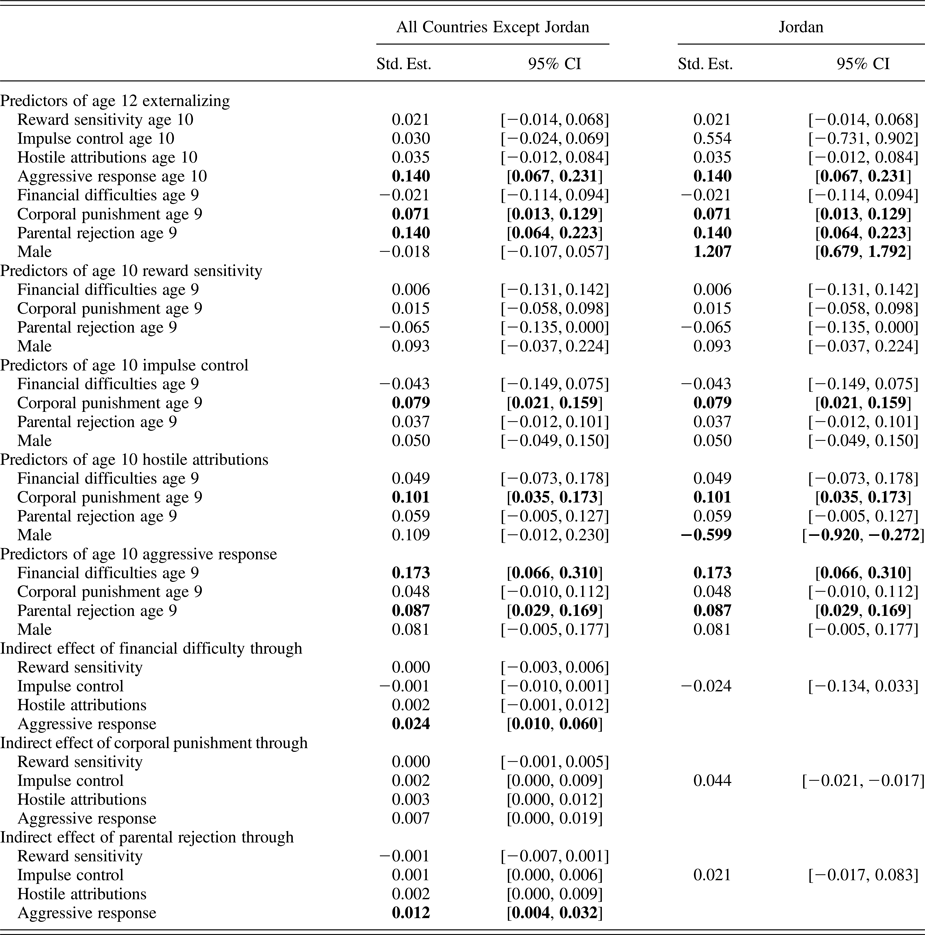
Table 3 provides the standardized results for the final model, including the bootstrapped confidence intervals and the indirect effects of childhood family adversity on externalizing behavior through reward sensitivity, impulse control, hostile attributions, and SIP aggressive response. The relations are fixed across all countries except Jordan. The results for Jordan are also displayed to depict the three relations that were freed. Across all eight countries, there is evidence that age 9 childhood family adversity is significantly related to the age 10 psychological mediators. Greater corporal punishment at age 9 is associated with greater impulse control as well as greater hostile attributions. A 1 SD increase in corporal punishment (above the grand mean) is associated with a 0.079 SD increase in impulse control, 95% CI [0.021, 0.159], and a 0.101 SD increase in hostile attributions, 95% CI [0.035, 0.173]. Experiencing financial difficulties in childhood is associated with a 0.173 SD increase in SIP aggressive responses, 95% CI [0.066, 0.310]. In addition, a 1 SD increase in parental rejection is associated with a 0.087 SD increase in SIP aggressive responses, 95% CI [0.029, 0.169].
Standardized results for the final model
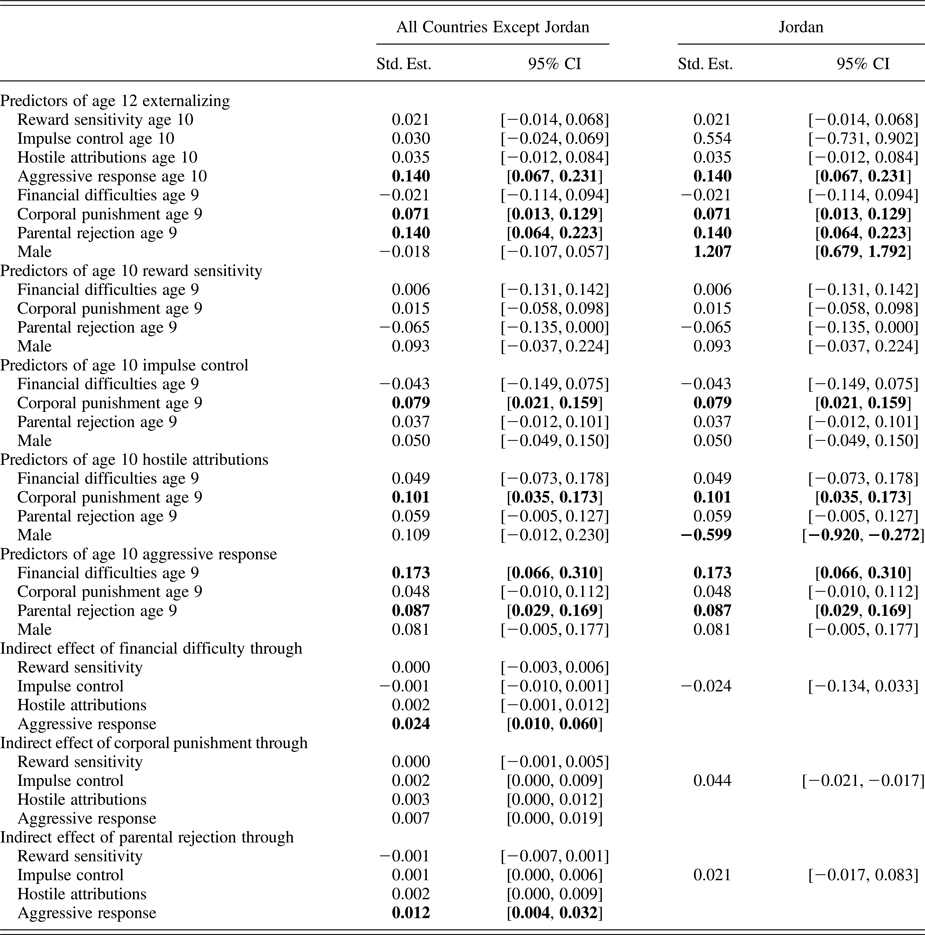
Note: The relations are fixed across all countries except Jordan. The results for Jordan are also displayed to depict the three relations that were freed. Bold values were statistically significant.
There is also some evidence that both childhood family adversity and psychological mediators are statistically significantly related to externalizing behavior at age 12. Across all countries, more SIP aggressive responses at age 10 are associated with more externalizing behavior at age 12. A 1 SD increase in aggressive responses is associated with a 0.140 SD increase in externalizing behavior, 95% CI [0.067, 0.231]. In addition, across all countries, greater corporal punishment and parental rejection at age 9 predict more externalizing behavior at age 12. A 1 SD increase in corporal punishment is associated with a 0.071 SD increase in externalizing behavior, 95% CI [0.013, 0.129]. In addition a 1 SD increase in parental rejection at age 9 is associated with a 0.140 SD increase in externalizing behavior at age 12, 95% CI [0.064, 0.223].
We tested the significance of the indirect paths between childhood family adversity and externalizing behaviors. The indirect path between financial difficulty and externalizing behaviors through SIP aggressive responses is statistically significant. Financial difficulties are associated with a 0.024 SD indirect increase in externalizing behaviors, 95% CI [0.010, 0.060]. Similarly, the indirect path between parental rejection and externalizing behaviors through SIP aggressive responses is statistically significant. A 1 SD increase in parental rejection is associated with a 0.012 SD indirect increase in externalizing behaviors, 95% CI [0.004, 0.032].
Discussion
In examining how childhood family adversity is related to subsequent externalizing behaviors in eight countries, we found overall support for our two main hypotheses; namely, childhood family adversity had direct effects on externalizing behaviors 3 years later, and childhood family adversity had indirect effects on externalizing behavior through psychological mediators. We found support for consistency in these relations across seven of the eight countries, and support for consistency in the relations in all except three paths in the eighth country. The specific childhood family adversity and psychological factors that demonstrated direct and indirect effects on subsequent externalizing varied somewhat, but together, the findings suggest ways in which family-level adversity poses risk for children's subsequent development of problems at psychological and behavioral levels, situated within diverse cultural contexts.
All three indicators of childhood family adversity were related to at least one psychological mediator and directly, indirectly, or both to subsequent externalizing behavior. Thus, the findings were consistent with previous research, demonstrating that financial difficulties (Conger et al., Reference Conger, Conger and Martin2010), corporal punishment (Gershoff & Grogan-Kaylor, Reference Gershoff and Grogan-Kaylor2016), and parental rejection (Khaleque & Rohner, Reference Khaleque and Rohner2012) put children at risk for the development of externalizing behavior problems. More novel to this study is the finding that these relations were for the most part consistent across eight countries that differ widely in country-level economic circumstances, normativeness and laws regarding corporal punishment, and ways in which parents may demonstrate acceptance versus rejection. To illustrate, although 68% of parents in Kenya compared to only 9% of parents in Sweden reported having financial difficulties that made it difficult to pay for basic living expenses when their children were 9 years old, children at age 12 in both countries were more likely to demonstrate externalizing problems if their parents had previously reported financial difficulties. Despite their economic differences, Kenya and Sweden were alike in being the only two countries of the eight included in this study that have outlawed all forms of corporal punishment (for a history of corporal punishment bans, see http://www.endcorporalpunishment.org/). In all eight countries, experiencing corporal punishment at age 9 was related to more externalizing problems at age 12. Finally, although parental rejection might be demonstrated through different behaviors in different countries (e.g., Bornstein, Reference Bornstein2012), children's perceptions of being rejected by their parents at age 9 were related to more externalizing behavior at age 12 in all eight countries.
Although 3 of the 24 paths were freed for the Jordan sample rather than constrained across all countries, the overall pattern of findings reflected more similarities than differences across countries in the hypothesized relations. For one of the paths that was freed for the sample from Jordan (impulse control to externalizing behavior), the magnitude of the path was larger in Jordan than the other sites but in the same direction and not significant in any countries. For the other two paths (male to externalizing behavior and male to hostile attributions), the paths were significant in Jordan but not the other countries. Future research addressing the role of child gender in the development of externalizing problems in diverse countries would seem warranted.
Reward sensitivity was the only tested mediator that was neither predicted by childhood family adversity nor predictive of subsequent externalizing behaviors. We assessed reward sensitivity at age 10, which is at the early phase or prior to puberty for most children, so the majority of children in our sample most likely had not yet experienced the brain changes during adolescence that are associated with greater sensitivity to rewards (Shulman et al., Reference Shulman, Smith, Silva, Icenogle, Duell, Chein and Steinberg2016). In addition, it is possible that our measure of externalizing behaviors did not capture the kinds of risky behaviors that appeal to individuals high in reward sensitivity (e.g., reckless behavior in the presence of peers; Steinberg, Reference Steinberg2008). Nevertheless, reward sensitivity is an important component of dual systems models of adolescent risk taking and is worthy of future international empirical research.
The psychological mediator that was most consistently related to both childhood family adversity predictors and externalizing behavior outcomes was social information processing related to aggressive responses. Both financial difficulties and parental rejection at age 9 predicted more proclivity to aggressive responses in hypothetical provocative situations at age 10, and these aggressive response proclivities at age 10 in turn predicted more externalizing behaviors at age 12. In social information processing theory, generating aggressive responses is a relatively late stage in processing social information (following encoding of information from social stimuli and making attributions about others’ intent; Crick & Dodge, Reference Crick and Dodge1994). It may be more difficult for individuals to overcome biases in this relatively late stage of processing social information because if individuals are more likely to generate or choose aggressive responses to social provocation, the only intervening step between the generation of aggressive responses and the enactment of them would be unfavorably evaluating the aggressive responses (Lansford et al., Reference Lansford, Malone, Dodge, Crozier, Pettit and Bates2006). Perhaps it is the relative temporal proximity of social information processing regarding aggressive responses and the enactment of aggression that accounted for its strong mediating role in our analyses.
Establishing that the hypothesized relations held with few exceptions in the eight participating countries contributes to confidence in the robustness and replicability of the findings. Within-study robustness checks have been described as an important way to check rigor and generalizability of findings (Duncan, Engel, Claessens, & Dowsett, Reference Duncan, Engel, Claessens and Dowsett2014). Establishing the cross-cultural generalizability of psychological processes has been noted as a particularly important endeavor to avoid assuming that psychological processes at work in one locale are universally generalizable (Norenzayan & Heine, Reference Norenzayan and Heine2005). Thus, major strengths and innovations of the present study were the inclusion of data from mothers, fathers, and children in eight countries and testing whether the conceptual model holds across the eight countries.
At least three limitations should be noted, however. First, childhood family adversity involves many risk factors other than the three considered in this study, and risk factors in peer groups, neighborhoods, and school settings also contribute to the development of externalizing behavior. Likewise, reward sensitivity, impulse control, hostile attributions, and social information processing related to aggressive responding represent just a subset of potential mediators of links between childhood family adversity and subsequent externalizing behavior. Thus, future international research would benefit from exploring other risk factors as predictors of externalizing behaviors. Second, the samples were not nationally representative, so care should be taken not to draw conclusions about entire countries on the basis of our findings. Nevertheless, the locally representative samples from eight countries had the advantage of providing a more diverse sample than is typical in most psychological and behavioral research (see Henrich, Heine, & Norenzayan, Reference Henrich, Heine and Norenzayan2010). Third, comparing the conceptual model across countries has the advantage of being able to test for similarities and differences in the specific hypothesized paths, but it does not take into account family adversities, ways of thinking, or forms of problem behaviors that may be unique to particular countries, which would be better suited to ethnographic or within-country quantitative study. For example, during the course of our study, children in Kenya were exposed to varying degrees to political violence after a contested election (Skinner, Oburu, Lansford, & Bacchini, Reference Skinner, Oburu, Lansford and Bacchini2014), and some children in the Philippines were exposed to the aftermath of a typhoon that caused a great deal of damage to property as well as loss of life (UNESCO, 2016). The whole constellation of country-specific variation is taken into account in our analyses by the use of the multigroup models, but examining children's development within individual countries as well as comparing across countries is an important direction for future research.
Taking a multilevel approach to understanding the development of children's externalizing behaviors elucidates several potential entry points for interventions and policies to mitigate risk factors or enhance protective factors. For example, at the family level, conditional cash transfers (in which families are given income supplements provided they meet some requirements such as keeping their children in school or participating in parent education programs) have shown promise not only in bringing families out of poverty but also in reducing children's externalizing problems (Ozer, Fernald, Manley, & Gertler, Reference Ozer, Fernald, Manley and Gertler2009). To illustrate, in an evaluation of a large-scale conditional cash transfer in Mexico, children whose families had received the cash transfer for 3.5 to 5 years experienced 10% fewer aggressive and oppositional behavior problems compared to a carefully matched group of comparison children who had not yet received the cash transfer, even though the cash transfer program did not explicitly target children's externalizing behaviors (Ozer et al., Reference Ozer, Fernald, Manley and Gertler2009). At the psychological level, several school-based interventions have been developed to deliver a curriculum focusing on skills such as impulse control and social problem solving. In rigorous evaluations, programs such as Second Step (Espelage, Low, Polanin, & Brown, Reference Espelage, Low, Polanin and Brown2013) and PATHS (Greenberg, Kusche, Cook, & Quamma, Reference Greenberg, Kusche, Cook and Quamma1995) that attempt to change children's social cognition have been found to reduce children's externalizing problems. Finally, at the cultural level, changing policies to protect children with the goal of exposing them to fewer adversities offers promise as an additional entry point that could ultimately prevent the development of externalizing problems. As an example, 53 countries have outlawed corporal punishment as of September 2017 (http://www.endcorporalpunishment.org/). Laws represent a public instantiation of a country's beliefs and norms about acceptable behavior and, as such, have the potential to change parents’ behavior to align with standards set in the law (see Lansford et al., Reference Lansford, Cappa, Putnick, Bornstein, Deater-Deckard and Bradleyin press). Thus, considering family, psychological, and cultural levels reveals several potential entry points for ultimately reducing children's externalizing behavior.
A large body of previous research has examined associations between individual variables in our conceptual model (e.g., financial difficulties or parental rejection as predictors of child externalizing behavior; Conger et al., Reference Conger, Conger and Martin2010; Rohner, Reference Rohner2004) or single mediators (e.g., hostile attribution bias as a mediator of the link between corporal punishment and externalizing behavior; Weiss et al., Reference Weiss, Dodge, Bates and Pettit1992). However, our study is unique in empirically testing a longitudinal conceptual model that incorporates multiple indicators of family-level childhood adversity, psychological-level mediators, and behavioral-level child externalizing behavior outcomes tested across eight diverse countries. A major conclusion is that despite country-level differences in economic status and family norms and policies, family-level financial difficulties, corporal punishment, and parental rejection are related similarly to children's subsequent externalizing behaviors and that in addition to these direct associations, childhood family adversity is also related indirectly to subsequent child externalizing behavior through psychological mediators.