




No CrossRef data available.
Article contents
Covariance in species diversity and facilitation among non-interactive parasite taxa: all against the host
Published online by Cambridge University Press: 23 May 2005
Abstract
Different parasite taxa exploit different host resources and are often unlikely to interact directly. It is unclear, however, whether the diversity of any given parasite taxon is indirectly influenced by that of other parasite taxa on the same host. Some components of host immune defences may operate simultaneously against all kinds of parasites, whereas investment by the host in specific defences against one type of parasite may come at the expense of defence against other parasites. We investigated the relationships between the species diversity of 4 higher taxa of ectoparasites (fleas, sucking lice, mesostigmatid mites, and ixodid ticks), and between the species richness of ectoparasites and endoparasitic helminths, across different species of rodent hosts. Our analyses used 2 measures of species diversity, species richness and taxonomic distinctness, and controlled for the potentially confounding effects of sampling effort and phylogenetic relationships among host species. We found positive pairwise correlations between the species richness of fleas, mites and ticks; however, there was no association between species richness of any of these 3 groups and that of lice. We also found a strong positive relationship between the taxonomic distinctness of ecto- and endoparasite assemblages across host species. These results suggest the existence of a process of apparent facilitation among unrelated taxa in the organization of parasite communities. We propose explanations based on host immune responses, involving acquired cross-resistance to infection and interspecific variation in immunocompetence among hosts, to account for these patterns.
Information
- Type
- Research Article
- Information
- Copyright
- © 2005 Cambridge University Press
INTRODUCTION
Interactions between species within a community include a variety of direct and indirect relations with species exerting positive or negative effects on each other (Martin and Martin, 2001). Furthermore, facilitation and competition may operate among the same species either simultaneously or with the strength of each process varying in time or space (Callaway and King, 1996; Callaway and Walker, 1997; Levine, 1999), with consequences on community organization. Recently, the many advantages of using parasites to search for rules that govern community organization have become clear. These advantages include the ease of obtaining replicated samples, the similar trophic and spatial niche of different parasite species, and the simultaneous presence on a host of several closely related parasites. As a result, the number of studies of community organization in parasitic organisms has increased considerably (see Combes, 2001).
Depending on the presence or absence of interspecific interactions, both isolationist and interactive parasite communities can be distinguished (Holmes and Price, 1986; Bush et al. 1997). It is commonly accepted that interactive communities are those that comprise parasite species belonging to the same guild, e.g. sharing the same trophic level, whereas parasite species in isolationist communities, though sharing a host, do not exploit the same resources (Poulin, 1998). Nevertheless, interactions, although rather indirect than direct, between parasite species belonging to different guilds are also possible. These interactions could be mediated via host defence mechanisms. Indeed, in contrast to the habitats of free-living organisms, the habitat of parasites (host) defends itself from exploiters (parasites) on ecological time-scales. For example, suppression of a host defence system by one parasite species could lead to greater opportunities for another parasite species to survive and, thus, to facilitation among parasite species. Alternatively, the triggering of host defence systems by one parasite species could lead to concomitant fitness decrease in another parasite species. An example of the latter is provided by the phenomenon of cross-resistance of a host against closely-related parasites. For instance, cross-resistance to closely-related species of parasites has been repeatedly reported mainly for haematophagous arthropods (McTier, George and Bennet, 1981; Njau and Nyiando, 1987; Khokhlova et al. 2004a,b) but also for protozoans (Leemans et al. 1999) and gastrointestinal helminths (Smith and Archibald, 1969). However, haematophagy evolved independently in different taxa of arthropods and, thus, it is commonly accepted that chemical mediators occurring in their saliva are different (Ribeiro, 1987, 1996; Jones, 1996). Therefore, cross-resistance is expected against closely-related species but not against parasites belonging to different taxa (Mans, Louw and Neitz, 2002).
Activation of an immune response and even maintenance of a competent immune system is an energetically demanding protective process that requires trade-off decisions among competing energy demands for growth, reproduction, thermoregulation, work, and immunity (Sheldon and Verhulst, 1996). In other words, the trade-offs occur between defence against parasites and other concurrent needs of the organism (Sheldon and Verhulst, 1996). Empirical evidence suggests that such costs can be relatively high (e.g., Moret and Schmid-Hempel, 2000; Bonneaud et al. 2003). Development of immune responses and investment into immune defences should thus depend on the pattern of parasite pressure (see Combes, 2001 and references therein). For example, it could depend on the frequency and probability of parasite attacks (Martin et al. 2001; Tella, Scheuerlein and Ricklefs, 2002). Consequently, if the probability of attacks by parasites of one taxon is higher than that by parasites of other taxa, a host should develop those immune responses that are most effective against parasites belonging to a taxon whose attacks are most probable (Khokhlova et al. 2004b). Given (a) the likelihood of cross-resistance against parasites belonging to the same taxon, and (b) the likelihood of a trade-off between mounting multiple immune responses and investment in other functions, negative relationships between the species diversity of different parasite taxa within the same host individual or population would be expected. A host that effectively withstands the attacks of, for example, flea parasites and is able to eliminate some or even most of them could thus be more prone to the attacks by, for example, various mite or tick species. Furthermore, these negative relationships could be expected in relation to both different taxa of parasites that share spatial and trophic level (e.g., haematophagous ectoparasites) and different taxa of parasites that belong to different guilds (e.g., ectoparasitic arthropods and gastrointestinal helminths). This is because the defence properties of a host against various parasites are based on the same morphological, biochemical and energetic resources (immune system).
On the other hand, also because of the common basis of defence resources, suppression of host defence system due to parasitism by one parasite taxon could facilitate parasitism by other parasite taxa, not necessarily belonging to the same guild. In this case, the species diversity of parasites of different taxa exploiting the same host individual or population would be positively correlated.
However, in spite of extensive investigations of community organization of parasites over the last 2 decades, most studies only considered interactions (direct or mediated via host) within the same parasite taxon or spatial and/or trophic guild (see Poulin, 1998; Combes, 2001 and references therein). One of the reasons for this is a scarcity of data on parasites belonging to different taxa and/or guilds collected from the same hosts in the same locality at the same time, especially for terrestrial hosts. Studies that aim to investigate the composition of communities of both ecto- and endoparasites in terrestrial hosts are especially rare.
Here we studied species diversity of 4 higher taxa of haematophagous ectoparasites [fleas (Siphonaptera), sucking lice (Anoplura), mesostigmatid mites (Mesostigmata) and ixodid ticks (Ixodidae)] and 4 higher taxa of gastrointestinal helminths [flukes (Trematoda), tapeworms (Cestoda), roundworms (Nematoda) and thorny-headed worms (Acanthocephala)] in a variety of rodent hosts sampled in different localities of the world (Europe, Asia, North and South America and Africa). The aim of this study was to compare species diversity (a) between parasite taxa sharing space and resources (different taxa of haematophagous parasites) and (b) between parasite taxa that do not share space and resources (ectoparasites and endoparasites) among different host species. We asked (a) whether there are relationships between the species diversity of different parasite taxa within the same host; and (b) whether these relationships (if any) are negative or positive. The occurrence of relationships would advocate interactivity of the parasite community even if it is composed of parasites from different spatial and resource guilds. Negative relationships between the species diversities of any 2 parasite taxa would suggest a trade-off between host defence mechanisms aimed at different parasites, whereas positive relationships would suggest host-mediated facilitation among different parasites.
In addition, rather than taking the mere number of parasite species as a measure of species diversity, we also applied a measure that takes into account the taxonomic or phylogenetic affinities of the various parasite species (Clarke and Warwick, 1998, 1999; Poulin and Mouillot, 2004). This measure places the emphasis on the taxonomic distance between parasite species exploiting a host rather than on their number.
MATERIALS AND METHODS
Data set
Data on ecto- and endoparasite species richness were obtained from published studies that simultaneously sampled either more than one of ectoparasite taxa (fleas, lice, mesostigmatid mites and ticks) or at least one ectoparasite taxon and at least one taxon of gastrointestinal helminths and reported data on the number and identity of parasite species found on a particular rodent species in a particular location (see Appendix, Table A1 and Table A2). We used only those sources where sampling effort (the number of examined hosts) was reported. In total, we used data on 80 rodent species for the analyses concerning ectoparasite taxa and 20 rodent species for the analysis concerning ecto- versus endoparasites.
Estimates of parasite species richness may be biased if some hosts are studied more intensively than others (Morand and Poulin, 1998). Consequently, unequal study effort among host species may result in confounding variation in estimates of parasite species richness. To ensure that variation in sampling effort did not bias estimates of species richness, we regressed the number of parasite species found against the number of hosts examined. Parasite richness appeared to be strongly affected by sampling effort (r2=0·17–0·27, F=14·1–29·9, N=20–80; P<0·001 for all). Each value of parasite richness was then substituted by its residual deviation from a linear regression of the number of parasite species found against the number of hosts examined in the ln-ln space. This provided a measure of parasite richness that is independent of sampling effort.
Measures of parasite species diversity
We used 2 measures of parasite species diversity (a) the number of parasite species found on a host species, or species richness, corrected for sampling effort (residuals of the linear regression against number of hosts examined) and (b) average taxonomic distinctness (Δ+) of the parasite species present. When these parasite species are placed within a taxonomic hierarchy, the average taxonomic distinctness is the mean number of steps up the hierarchy that must be taken to reach a taxon common to 2 parasite species, computed across all possible pairs of parasite species (Clarke and Warwick, 1998, 1999; Warwick and Clarke, 2001; Poulin and Mouillot, 2004). The greater the taxonomic distinctness between parasite species, the higher the number of steps needed, and the higher the value of the index Δ+ (see details in Poulin and Mouillot, 2004). All parasite species included here were fitted into a taxonomic structure with a different number of hierarchical levels above species, namely 8 for fleas (subgenus or species group, genus, tribe, subfamily, family, superfamily, infraorder, and order), 4 for lice (genus, family, suborder and order), 5 for mites (genus, family, superfamily, cohort and suborder), 4 for ticks (subgenus, genus, subfamily and family) and 7 for gastrointestinal helminths (genus, family, order, subclass, class, phylum and subkingdom). The sources for taxonomic classification were Smit (1982) and Medvedev (1998) for fleas, Durden and Musser (1994) for sucking lice, Bregetova (1956), Halliday (1998) and Salmane (2001) for mesostigmatid mites, Camicas et al. (1998) and Horak, Camicas & Keirans (2002) for ticks, and Dailey (1996) for helminths. When ectoparasites of different taxa were considered together (for the analysis of species diversity between ectoparasitic and endoparasitic assemblages), they were fitted into a taxonomic structure with 12 hierarchical levels above species (subgenus or species group, genus, tribe, subfamily, family, superfamily, cohort, infraorder or suborder, order, class and phylum). The maximum value that the index Δ+ can take is thus 4–12 (when all parasite species belong to different suborders/subfamilies-classes, respectively), and its lowest value is 1 (when all parasite species belong to the same subgenus or species group). However, since the index cannot be computed for hosts exploited by a single parasite species, we assigned a Δ+ value of 0 to these host species, to reflect their extremely species-poor parasite assemblages. To calculate Δ+, DM and RP have developed a computer program using Borland C++ Builder 6.0 (available at http://www.otago.ac.nz/zoology/downloads/poulin/TaxoBiodiv1.2). To compare taxonomic distinctness among different parasite taxa we scaled Δ+ values to range between 1 and 100, regardless of the number of taxonomic levels. Instead of giving each step up the taxonomic tree a length value of 1 unit, we gave it a length of 100/n, where n was the maximum number of steps or taxonomic levels.
Across host species, the number of ectoparasite species of a particular ectoparasite taxon exploiting a host species was significantly positively correlated with Δ+ for this taxon (Pearson product-moment correlations, r=0·68–0·88, N=38–74; respectively, P<0·05 for all), indicating that this measure is influenced by the number of species in a host's parasite assemblage. However, Δ+ values for the assemblage of combined ectoparasite taxa or intestinal helminths were not affected by the number of species in an assemblage (r=−0·01 and r=0·39, respectively; N=20, P>0·05 for both). Therefore, in the subsequent analyses Δ+ was corrected for the parasite species richness in an assemblage when necessary.
Data analyses
To examine if the species diversity of an assemblage of a particular parasite taxon within a host species is associated with that of another parasite taxon, we correlated species richness (corrected for sampling effort) and taxonomic distinctness (corrected for the species richness of a parasite assemblage if necessary) between each pair of ectoparasite taxa as well as between the entire ectoparasite assemblage and the entire assemblage of gastrointestinal helminths using Pearson's product-moment correlations. Because we examined the correlations of the same ectoparasite taxa in different combinations, we avoided an inflated Type I error by performing Bonferroni adjustments of alpha. Significance was only recorded at the adjusted level.
Treating host species as statistically independent data points in a comparative study may be invalid as it can introduce bias in the analysis (Harvey and Pagel, 1991). To control for the effects of phylogeny, we used the method of independent contrasts (Felsenstein, 1985). We used a phylogeny of rodents derived from various sources (see Krasnov et al. 2004). To compute independent contrasts, we used the PDAP[ratio ]PDTREE program (Garland et al. 1993; Midford, Garland and Maddison, 2004) implemented in Mesquite Modular System for Evolutionary Analysis (Maddison and Maddison, 2004). Procedure of the method of independent contrasts followed Garland, Harvey and Ives (1992). Regressions were forced through the origin as is standard practice with contrasts, because of the arbitrariness associated with the sign of independent contrasts (see Garland et al. 1992 for details).
RESULTS
Comparison among ectoparasite taxa
Different host species supported a different number of ectoparasites belonging to different taxa. The number of flea species per host species ranged from 1 to 19 with a median value of 2. Published surveys used in this study reported no flea species for 5 of 80 rodents (Akodon azarae, Nectomys squamipes, Bolomys lasiurus, Oryzomys subflavus, and Spermophilus beldingi). Lice were found on 38 of 80 rodent hosts only. Species richness of these ectoparasites ranged from 1 (30 of 38 hosts) to a maximum of 3 species (4 of 38 hosts) with a median of 1. Of 80 rodent species, 68 were parasitized by mesostigmatid mites with the number of species ranging from 1 to 21 with a median of 4. Ticks were found on 55 of 80 rodents. Tick species richness varied from one to 12 with a median of 2. The species richness of flea assemblages on a host species varied significantly across geographical regions (Palaearctic, Nearctic, Neotropical and Afrotropical: ANOVA, F3,71=4·0, P<0·05) being highest in the Palaearctic. However, this significance disappeared when 3 of 27 Palaearctic species that had the richest flea assemblages (Alticola argentata, Cricetulus migratorius and Microtus arvalis) were excluded from the analysis (F3,68=2·6, P>0·05). On the contrary, species richness of the assemblages of other ectoparasite taxa did not differ among regions (ANOVAs, F3,34–64=0·6–2·3, P>0·05 for all). The same was true for taxonomic distinctness of the assemblages of any ectoparasite taxon (ANOVAs, F3,34–71=1·1–1·3, P>0·05 for all).
Numbers of species of most ectoparasite taxa on the same host (controlled for sampling effort) were significantly positively correlated with one another (Table 1; see Fig. 1 for the illustrative example with fleas and ticks). However, this was not the case for lice. The number of louse species was not correlated with the number of species of any other ectoparasite taxon (Table 1). Taxonomic distinctness (Δ+) was not correlated among the assemblages of different ectoparasitic taxa (Table 1). The results did not change after exclusion from the analyses of 11 host species for which fewer than 10 individuals were examined (Table 1).


Fig. 1. Relationships between the number of tick species and the number of flea species on the same host species among 52 rodent species.
Comparisons of species richness among ectoparasitic taxa using the method of independent contrasts yielded essentially the same results as those of conventional analyses. Species richness but not taxonomic distinctness was significantly positively correlated among the assemblages of fleas, mites and ticks (Table 2), whereas neither the number of louse species nor the taxonomic distinctness of their assemblages were correlated with those of other ectoparasites (Table 2). The results did not change after exclusion from the analyses of 11 host species for which fewer than 10 individuals were examined, as was the case with conventional statistics (Table 1). An illustrative example with mites and ticks is shown in Fig. 2. The correlation remained significant (r=0·30, P<0·05) after removal of one data point from the bottom left corner (contrast between Neotoma floridana and Neotoma fuscipes) and two data points from the upper right corner (contrast between Alticola argentata and Alticola streltzovi and contrast between Microtus arvalis and Microtus ochrogaster).


Fig. 2. Relationships between the number of tick species and the number of mesostigmatid mite species on the same host species among 55 rodent species using independent contrasts.
Comparison between ectoparasite and endoparasites assemblages
Neither species richness nor taxonomic distinctness of ectoparasite and endoparasite assemblages in a host species differed significantly among geographical regions (ANOVAs, F2,17=0·2–1·3, P>0·05 for all). The species richness of ectoparasite assemblages was not correlated with that of the assemblage of gastrointestinal helminths on the same host species when their relationship was analysed using both conventional statistics and the method of independent contrasts (r=0·26, N=20 and r=0·27, N=19, respectively, P>0·05 for both). In contrast, the correlation between the taxonomic distinctness of ectoparasite assemblages and that of endoparasites was highly significantly positive when both conventional analysis and the method of independent contrasts were used (r=0·82, N=20 and r=0·83, N=19, respectively P<0·01; see Fig. 3 for independent contrasts). Correlations remained significant after the exclusion of 2 host species for which fewer than 10 individuals were examined (r=0·81, N=18 for conventional analysis and r=0·84, N=17 for independent contrasts; P<0·01 for both). In addition, the correlation between independent contrasts in taxonomic distinctness of ectoparasite assemblages and independent contrasts in taxonomic distinctness of assemblages of gastrointestinal helminths remained significant, albeit weaker, when the two right upper points (Fig. 3) were removed (r=0·47, N=17, P<0·05); these points represented the contrasts between Spermophilus armatus and Spermophilus beldingi and between Geomys bursarius and Perognathus parvus.

Fig. 3. Relationships between the taxonomic distinctness of ectoparasite and endoparasite assemblages among 20 rodent species using phylogenetically independent contrasts.
DISCUSSION
The results of this study demonstrated that, in general, the species diversities of different parasite taxa in the same host species are positively interrelated. This appeared to be true among parasites that use the same space and resource in their host (fleas, mites and ticks) as well as between parasites belonging to completely different spatial and trophic guilds (ectoparasites and gastrointestinal helminths). These results, combined with an earlier demonstration that the species richnesses of different groups of endoparasitic helminths covary among their vertebrate hosts (Poulin and Morand, 2004, pp. 75–79), provide strong evidence of apparent facilitation (sensu Levine, 1999) among different parasite taxa.
The existence of relationships between species diversities of different parasite taxa (even those from different guilds) suggests that the host represents an important force shaping parasite communities. Moreover, positive correlations between species diversities among 3 ectoparasite taxa and between ecto- and endoparasites advocate host-mediated facilitation among different parasites. A host that is unable to resist attacks from multiple flea species appears to be also unable to resist attacks from multiple mite and tick species. When the diversity of unrelated taxa of free-living organisms co-varies positively across localities, the general explanation usually invokes intrinsic differences in rates of colonization and extinction among localities (Gaston, 1996). It is thus possible that intrinsic properties of the various host species could lead to some hosts accumulating parasites of all taxa at a high rate. In this context, our results are more likely due to some biochemical or physiological properties of a host rather than to its ecological characteristics. Indeed, the depth and degree of complexity of a rodent burrow system can determine the relative richness of flea and mite assemblages (Kucheruk, 1983) because pre-imaginal development in many species occurs off-host. In most ixodid ticks, though, questing larvae and nymphs (adult ticks of most species parasitize mainly large mammals) do not depend on the host's burrow but crawl up the stems of grass or perch on the edges of leaves on the ground and wait for a host passing by.
On the other hand, a host species that is able to resist attacks from many species of one parasite taxon appears to be able also to resist attacks from many species of other parasite taxa. This suggests some level of cross-resistance against distantly related parasites. In particular, rodent species that are exploited by only a few flea species appeared also to be exploited by only few mite and tick species. Although many chemical mediators that are contained in the saliva of different ectoparasite lineages are different (Ribeiro, 1996), some salivary anti-clotting, anti-platelet and vasodilatory substances can be quite similar among taxa. Indeed, cross-immunity between distantly-related parasite taxa has been reported. For example, rabbits infested with mites Prosoptes cuniculi produce antibodies reactive to both mite and tick extracts (den Hollander and Allen, 1986). However, the occurrence of cross-immunity seems to depend on both parasite and host taxon. For example, guinea pigs demonstrated cross-immunity between different ticks of the genus Dermacentor but not between ticks of the genera Dermacentor and Amblyomma (McTier et al. 1981). Rabbits demonstrated cross-resistance between 2 Hyalomma ticks (Kumar and Kumar, 1996), but not between Rhipicephalus and Ixodes (Rechav, Heller-Haupt and Varma, 1989). Cross-immunity between 2 Rhipicephalus species was reported for rabbits (Njau and Nyindo, 1987), but not for guinea pigs (Rechav et al. 1989). Nevertheless, close homology of saliva proteins was found in closely related argasid ticks (Mans et al. 2002) but not in closely-related sand flies (Warburg et al. 1994). Thus, some still unknown factors determine cross-resistance patterns in different host–parasite systems.
Species richness of anopluran lice was not correlated with that of any other ectoparasite taxon, whereas their taxonomic distinctness was sometimes even negatively, albeit not significantly, correlated with that of other taxa. The number of louse species on a host species was low independently of the species richness of any other parasite taxon. Indeed, the vast majority of host species harboured a single louse species only. Furthermore, taxonomic distinctness of louse assemblages was always low (in average across hosts, 12·4±4·0 compared with 54·4±4·3, 41·7±2·8 and 48·8±5·3 for fleas, mites and ticks, respectively) regardless of whether the Δ+ of other ectoparasite taxa is high or low. In other words, some ectoparasite taxa (e.g., lice) could be constrained in their taxonomic diversity, whereas this is not the case for other taxa. Constraints in louse taxonomic diversity can be explained by the extremely high host specificity of lice and their extremely low dispersal capacity. Another explanation can be that sucking lice were under-sampled in at least part of the reported surveys. This is likely the case because these insects are small, usually attach to the hair bases next to the host skin and, thus, cannot be easily brushed off the host.
The positive relationships among species diversities of the assemblages of different ectoparasites as well as between ecto- and endoparasites could arise also from immunodepression in a host subjected to multiple immune challenges from a variety of parasite species. The occurrence of a positive correlation in terms of taxonomic distinctness rather than in terms of number of species between ecto- and endoparasite assemblages strengthens this explanation. Immunity is an energetically and/or nutritionally demanding process (Lochmiller and Deerenberg, 2000). Indeed, relationships between parasitism, immunity and reproduction observed in wild birds and mammals strongly support a high energy cost of the immune system (Norris, Anwar and Read, 1994; Demas and Nelson, 1998; Ilmonen et al. 2003). The difference between defence mechanisms against haematophagous ectoparasites versus intestinal helminths is much sharper than that between defence mechanisms against different ectoparasite taxa (see Wakelin, 1996; Wikel, 1996). Maintaining several different means of defence is likely more costly than mounting one specific type of defence (Taylor, Mackinnon and Read, 1998). As a result, the effectiveness of energy allocation to immune defence decreases as the diversity of attack types increases (Jokela, Schmid-Hempel and Rigby, 2000). Jokela et al. (2000) argued that in cases when the diversity of attacks is high and, thus, the effectiveness of defence is low, the optimal strategy is to tolerate damage. Consequently, a host subjected to attacks from multiple parasite species is forced to give up its defence and to surrender. This can be one of the reasons explaining why hosts that are exploited by taxonomically diverse assemblages of haematophagous arthropods, also harbour assemblages of gastrointestinal helminths of high taxonomic distinctness.
Another, not necessarily alternative, explanation for the observed patterns is that host species can differ also in their intrinsic ability to defend themselves against parasites using their immune system. Different, sometimes even closely related, rodent species have been shown to have different abilities to mount both humoral and cell-mediated immune responses (Klein and Nelson, 1998a,b). As a result, a rodent with lower intrinsic immunocompetence can be exploited by a higher number of parasite species compared with more immunocompetent species.
Finally, the results of this study do not support suggestions of strong direct or host-mediated competitive exclusion between different parasite species or lineages (Waage, 1979; Rozsa, 1993), although such competition undoubtedly occurs (Barker and Close, 1990; Patrick, 1991; Combes, 2001). Instead, our results suggest host-mediated facilitation among species of different taxa within parasite assemblages of rodent hosts. Because a host is not only a resource but also a competitor for a parasite (Combes, 2001), the relationships among different parasite lineages in a host species represent a sort of apparent facilitation, i.e. positive interactions mediated by a shared competitor (Levine, 1999). Apparent facilitation is considered as an important process in communities of both free-living (Levine, 1999) and parasitic (Cox, 2001; Krasnov et al. 2005) organisms.
This study was partly supported by the Israel Science Foundation (Grant no. 249/04 to B. Krasnov, I. Khokhlova and G. Shenbrot) and by Israel Ministry of Science and Technology. We thank two anonymous referees for helpful comments. This is publication no. 178 of the Ramon Science Center and no. 483 of the Mitrani Department of Desert Ecology.
APPENDIX


References
REFERENCES
Barker, S. C. and
Close, R. L. (
1990).
Zoogeography and host associations of the Heterodoxus octoseriatus group and H. ampulatus (Phthiraptera: Boopiidae) from rock-wallabies (Marsupialia: Petrogale).
International Journal for Parasitology
20,
1081–1087.Google Scholar
Bonneaud, C.,
Mazuc, J.,
Gonzalez, G.,
Haussy, C.,
Chastel, O.,
Faivre, B. and
Sorci, G. (
2003).
Assessing the cost of mounting an immune response.
American Naturalist
161,
367–379.CrossRefGoogle Scholar
Bregetova, N. G. (
1956).
Gamasoidea. Keys to the Fauna of the USSR, Issue 61.
Publishing House of the Academy of Science of USSR,
Leningrad,
USSR (in Russian).
Bush, A. O.,
Lafferty, K. D.,
Lotz, J. M. and
Shostak, A. W. (
1997).
Parasitology meets ecology on its own terms: Margolis et al. revisited.
Journal of Parasitology
83,
575–583.CrossRefGoogle Scholar
Callaway, R. M. and
King, L. (
1996).
Temperature-driven variation in substrate oxygenation and the balance of competition and facilitation.
Ecology
77,
1189–1195.CrossRefGoogle Scholar
Callaway, R. M. and
Walker, L. R. (
1997).
Competition and facilitation: a synthetic approach to interactions in plant communities.
Ecology
78,
1958–1965.CrossRefGoogle Scholar
Camicas, J.-L.,
Hervy, J.-P.,
Adam, F. and
Morel, P. C. (
1998).
The Ticks of the World (Acarida, Ixodida). Nomenclature, Described Stages, Hosts, Distribution.
Orstom Éditions,
Paris.
Clarke, K. R. and
Warwick, R. M. (
1998).
A taxonomic distinctness index and its statistical properties.
Journal of Applied Ecology
35,
523–531.CrossRefGoogle Scholar
Clarke, K. R. and
Warwick, R. M. (
1999).
The taxonomic distinctness measure of biodiversity: weighting of step lengths between hierarchical levels.
Marine Ecology Progress Series
184,
21–29.CrossRefGoogle Scholar
Combes, C. (
2001).
Parasitism. The Ecology and Evolution of Intimate Interactions.
University of Chicago Press,
Chicago.
Cox, F. E. G. (
2001).
Concomitant infections, parasites and immune responses.
Parasitology
122 (Suppl.),
S23–S38.CrossRefGoogle Scholar
Dailey, M. D. (
1996).
Meyer, Olsen and Schmidt's Essentials of Parasitology, 6th Edn.
Wm. C. Brown Publishers,
Dubuque, Iowa.
Demas, G. E. and
Nelson, R. J. (
1998).
Photoperiod, ambient temperature, and food availability interact to affect reproductive and immune function in adult male deer mice (Peromyscus maniculatus).
Journal of Biological Rhythms
13,
253–262.CrossRefGoogle Scholar
den Hollander, N. and
Allen, J. R. (
1986).
Cross-reactive antigens between a tick Dermacentor variabilis (Acari: Ixodidae) and a mite Prosoptes cuniculi (Acari: Psoroptidae).
Journal of Medical Entomology
23,
44–50.CrossRefGoogle Scholar
Durden, L. A. and
Musser, G. G. (
1994).
The sucking lice (Insecta, Anoplura) of the world: A taxonomic checklist with records of mammalian hosts and geographic distributions.
Bulletin of the American Museum of Natural History
218,
1–90.Google Scholar
Felsenstein, J. (
1985).
Phylogenies and the comparative method.
American Naturalist
125,
1–15.CrossRefGoogle Scholar
Garland, T. Jr.,
Harvey, P. H. and
Ives, A. R. (
1992).
Procedures for the analysis of comparative data using phylogenetically independent contrasts.
American Naturalist
41,
18–32.Google Scholar
Garland, T. Jr.,
Dickerman, A. W. C.,
Janis, M. and
Jones, J. A. (
1993).
Phylogenetic analysis of covariance by computer simulation.
Systematic Biology
42,
265–292.CrossRefGoogle Scholar
Gaston, K. J. (
1996).
Spatial covariance in the species richness of higher taxa. In
Aspects of the Genesis and Maintenance of Biological Diversity (ed. Hochberg, M. E., Clobert, J. and Barbault, R.), pp.
221–242.
Oxford University Press,
Oxford.
Halliday, R. B. (
1998).
Mites of Australia: A Checklist and Bibliography.
CSIRO Publishing,
Melbourne.
Harvey, P. H. and
Pagel, M. D. (
1991).
A Comparative Method in Evolutionary Biology.
Oxford University Press,
Oxford.
Holmes, J. C. and
Price, P. W. (
1986).
Communities of parasites. In
Community Ecology: Patterns and Processes (
ed. Kikkawa, J. and Anderson, D. J.), pp.
187–213.
Blackwell Science,
New York.
Horak, I. G.,
Camicas, J.-L. and
Keirans, J. E. (
2002).
The Argasidae, Ixodidae and Nuttalliellidae (Acari: Ixodida): a world list of valid tick names.
Experimental and Applied Acarology
28,
27–54.CrossRefGoogle Scholar
Ilmonen, P.,
Hasselquist, D.,
Langefors, A. and
Wiehn, J. (
2003).
Stress, immunocompetence and leucocyte profiles of pied flycatchers in relation to brood size manipulation.
Oecologia
136,
148–154.CrossRefGoogle Scholar
Jokela, J.,
Schmid-Hempel, P. and
Rigby, M. C. (
2000).
Dr. Pangloss restrained by the Red Quinn – steps towards a unified defence theory.
Oikos
89,
267–274.Google Scholar
Jones, C. J. (
1996).
Immune responses to fleas, bugs and sucking lice. In
The Immunology of Host-Ectoparasitic Arthropod Relationships (ed. Wikel, S. K.), pp.
150–174.
CAB International,
Wallingford,
UK.
Khokhlova, I. S.,
Spinu, M.,
Krasnov, B. R. and
Degen, A. A. (
2004 a).
Immune response to fleas in a wild desert rodent: effect of parasite species, parasite burden, sex of host and host parasitological experience.
Journal of Experimental Biology
207,
2725–2733.Google Scholar
Khokhlova, I. S.,
Spinu, M.,
Krasnov, B. R. and
Degen, A. A. (
2004 b).
Immune responses to fleas in two rodent species differing in natural prevalence of infestation and diversity of flea assemblages.
Parasitology Research
94,
304–311.Google Scholar
Klein, S. L. and
Nelson, R. J. (
1998 a).
Sex and species differences in cell-mediated immune responses in voles.
Canadian Journal of Zoology
76,
1394–1398.Google Scholar
Klein, S. L. and
Nelson, R. J. (
1998 b).
Adaptive immune responses are linked to the mating system of arvicoline rodents.
American Naturalist
151,
59–67.Google Scholar
Krasnov, B. R.,
Shenbrot, G. I.,
Khokhlova, I. S. and
Degen, A. A. (
2004).
Ectoparasite species richness and characteristics of host body, host geography and host “milieu”.
Journal of Animal Ecology
73,
1121–1128.CrossRefGoogle Scholar
Krasnov, B. R.,
Mouillot, D.,
Shenbrot, G. I.,
Khokhlova, I. S. and
Poulin, R. (
2005).
Abundance patterns and coexistence processes in communities of fleas parasitic on small mammals.
Ecography (in Press).CrossRefGoogle Scholar
Kucheruk, V. V. (
1983).
Mammal burrows: their structure, topology and use.
Fauna and Ecology of Rodents
15,
5–54 (in Russian).Google Scholar
Kumar, R. and
Kumar, R. (
1996).
Cross-resistance to Hyalomma anatolicum anatolicum ticks in rabbits immunized with midgut antigens of Hyalomma dromedarii.
Indian Journal of Animal Sciences
66,
657–661.Google Scholar
Leemans, I.,
Brown, D.,
Hooshmand-Rad, P.,
Kirvar, E. and
Uggla, A. (
1999).
Infectivity and cross-immunity studies of Theileria lestoquardi and Theileria annulata in sheep and cattle: I. In vivo responses.
Veterinary Parasitology
82,
179–192.CrossRefGoogle Scholar
Levine, J. M. (
1999).
Indirect facilitation: evidence and predictions from a riparian community.
Ecology
80,
1762–1769.CrossRefGoogle Scholar
Lochmiller, R. I. and
Deerenberg, C. B. (
2000).
Trade-offs in evolutionary ecology: just what is the cost of immunity?
Oikos
88,
87–88.Google Scholar
Maddison, W. P. and
Maddison, D. R. (
2004).
Mesquite: a Modular System for Evolutionary Analysis. Version 1.05. http://mesquiteproject.org.
Mans, B. J.,
Louw, A. I. and
Neitz, A. W. H. (
2002).
Evolution of hematophagy in ticks: common origins for blood coagulation and platelet aggregation inhibitors from soft ticks of the genus Ornithodoros.
Molecular Biology and Evolution
19,
1695–1705.CrossRefGoogle Scholar
Martin, P. R. and
Martin, T. E. (
2001).
Ecological and fitness consequences of species coexistence: a removal experiment with wood warblers.
Ecology
82,
189–206.CrossRefGoogle Scholar
Martin, T. E.,
Moller, A. P.,
Merino, S. and
Clobert, J. (
2001).
Does clutch size evolve in response to parasites and immunocompetence?
Proceedings of the National Academy of Sciences, USA
98,
2071–2076.Google Scholar
McTier, T. L.,
George, J. E. and
Bennet, S. N. (
1981).
Resistance and cross-resistance of guinea pigs to Dermacentor andersoni Stiles, D. variabilis (Say), Amblyomma americanum (Linnaeus) and Ixodes capularis Say.
Journal of Parasitology
67,
813–822.Google Scholar
Medvedev, S. G. (
1998).
Classification of fleas (order Siphonaptera) and its theoretical foundations.
Entomological Review
78,
511–521.Google Scholar
Midford, P. E.,
Garland, T. Jr. and
Maddison, W. (
2004).
PDAP:PDTREE Package for Mesquite, version 1.05. http://mesquiteproject.org/pdap_mesquite/index.html
Morand, S. and
Poulin, R. (
1998).
Density, body mass and parasite species richness of terrestrial mammals.
Evolutionary Ecology
12,
717–727.CrossRefGoogle Scholar
Moret, R. and
Schmid-Hempel, P. (
2000).
Survival for immunity: the price of immune system activation for bumblebee workers.
Science
290,
1166–1168.CrossRefGoogle Scholar
Njau, B. C. and
Nyindo, M. (
1987).
Detection of immune response in rabbits infested with Rhipicephalus appendiculatus and Rhipicephalus evertsi evertsi.
Research in Veterinary Science
43,
217–221.Google Scholar
Norris, K.,
Anwar, M. and
Read, A. F. (
1994).
Reproductive effort influences prevalence of haematozoan parasites in great tits.
Journal of Animal Ecology
63,
601–610.CrossRefGoogle Scholar
Patrick, M. J. (
1991).
Distribution of enteric helminths in Glaucomys volans L. (Sciuridae): a test for competition.
Ecology
72,
755–758.Google Scholar
Poulin, R. (
1998).
Evolutionary Ecology of Parasites: From Individuals to Communities.
Chapman and Hall,
London.
Poulin, R. and
Morand, S. (
2004).
Parasite Biodiversity.
Smithsonian Institution Press,
Washington, DC.
Poulin, R. and
Mouillot, D. (
2004).
The evolution of taxonomic diversity in helminth assemblages of mammalian hosts.
Evolutionary Ecology
18,
231–247.CrossRefGoogle Scholar
Rechav, Y.,
Heller-Haupt, A. and
Varma, M. G. R. (
1989).
Resistance and cross-resistance in guinea-pigs and rabbits to immature stages of ixodid ticks.
Medical and Veterinary Entomology
3,
333–336.CrossRefGoogle Scholar
Ribeiro, J. M. C. (
1987).
Role of saliva in blood feeding in arthropods.
Annual Review of Entomology
32,
463–478.CrossRefGoogle Scholar
Ribeiro, J. M. C. (
1996).
Common problems of arthropod vectors of disease. In
The Biology of Disease Vectors (ed. Beaty, B. J. and Marquardt, W. C.), pp.
25–33.
University Press of Colorado,
Niwot,
Colorado.
Rozsa, L. (
1993).
Speciation patterns of ectoparasites and “straggling” lice.
International Journal for Parasitology
23,
859–864.CrossRefGoogle Scholar
Salmane, I. (
2001).
Check-list of Latvian Gamasina mites (Acari, Mesostogmata) with short notes on their ecology.
Latvijas Entomologs
38,
27–38.Google Scholar
Sheldon, B. C. and
Verhulst, S. (
1996).
Ecological immunology: costly parasite defenses and trade offs in evolutionary ecology.
Trends in Ecology and Evolution
11,
317–321.CrossRefGoogle Scholar
Smit, F. G. A. M. (
1982).
Siphonaptera. In
Synopsis and Classification of Living Organisms, vol. 2. (
ed. Parker, S. P.), pp.
557–563.
McGraw-Hill,
New York.
Smith, H. J. and
Archibald, R. M. (
1969).
Development of cross immunity in lambs by exposure to bovine gastrointestinal parasites.
Canadian Veterinary Journal
10,
286–290.Google Scholar
Taylor, L. H.,
Mackinnon, M. J. and
Read, A. F. (
1998).
Virulence of mixed-clone and single-clone infections of the rodent malaria Plasmodium chabaudi.
Evolution
52,
583–591.CrossRefGoogle Scholar
Tella, J. L.,
Scheuerlein, A. and
Ricklefs, R. E. (
2002).
Is cell-mediated immunity related to the evolution of life-history strategies in birds?
Proceedings of the Royal Society of London, B
269,
1059–1066.Google Scholar
Waage, J. K. (
1979).
The evolution of insect/vertebrate associations.
Biological Journal of the Linnean Society
12,
186–124.CrossRefGoogle Scholar
Warburg, A.,
Saraiva, E.,
Lanzaro, G. C.,
Titus, R. G. and
Neva, F. (
1994).
Saliva of Lutzomyia longipalpis sibling species differs in its composition and capacity to enhance leishmaniasis.
Philosophical Transactions of the Royal Society of London, B
345,
223–230.CrossRefGoogle Scholar
Warwick, R. M. and
Clarke, K. R. (
2001).
Practical measures of marine biodiversity based on relatedness of species.
Oceanography and Marine Biology
39,
207–231.Google Scholar
Wakelin, D. (
1996).
Immunity to Parasites. How Parasitic Infections are Controlled, 2nd Edn.
Cambridge University Press,
Cambridge.
Wikel, S. K. (ed.) (
1996).
The Immunology of Host-Ectoparasitic Arthropod Relationships.
CAB International,
Wallingford,
UK.
REFERENCES FOR APPENDIX
Anderson, P. C. and
Kok, O. B. (
2003).
Ectoparasites of springhares in the Northern Cape Province, South Africa.
South African Journal of Wildlife Research
33,
3–32.Google Scholar
Barros-Battesti, D. M.,
Arzua, M.,
Linardi, P. M.,
Botelho, J. R. and
Sbalqueiro, I. J. (
1998).
Interrelationship between ectoparasites and wild rodents from Tijucas do Sul, State of Parana, Brazil.
Memorias do Instituto Oswaldo Cruz
93,
719–725.CrossRefGoogle Scholar
Bartel, M. H. and
Gardner, S. L. (
2000).
Arthropod and helminth parasites from the plains pocket gopher, Geomys bursarius bursarius from the hosts' northern boundary range in Minnesota.
Journal of Parasitology
86,
153–156CrossRefGoogle Scholar
Bossi, D. E. P.,
Linhares, A. X. and
de Godoy Bergallo, H. (
2002).
Parasitic arthropods of some wild rodents from Jureia-Itatins Ecological Station, State of Sao Paulo, Brazil.
Memorias do Instituto Oswaldo Cruz
97,
959–963.CrossRefGoogle Scholar
Braack, L. E. O.,
Horak, I. G.,
Jordaan, L. C.,
Segerman, J. and
Louw, J. P. (
1996).
The comparative host status of red veld rats (Aethomys chrysophilus) and bushveld gerbils (Tatera leucogaster) to epifaunal arthropods in the southern Kruger National Park, South Africa.
Onderstepoort Journal of Veterinary Research
63,
149–158.Google Scholar
Bugmyrin, S. V.,
Ieshhko, E. P.,
Anikanova, V. S. and
Bespyatova, L. A. (
2003).
About parasite fauna of small mammals of national parks of Paanajarvi, Oulanka. In
Nature of the Paanajarvi National Park, pp.
97–101.
Karelian Science Center of Russian Academy of Sciences,
Petrozavodsk,
Russia (in Russian).
Coyner, D. F.,
Wooding, J. B. and
Forrester, D. J. (
1996).
A comparison of parasitic helminths and arthropods from two subspecies of fox squirrels (Sciurus niger) in Florida.
Journal of Wildlife Diseases
32,
492–497.CrossRefGoogle Scholar
Cudmore, W. W. (
1986).
Ectoparasites of Neotoma cinerea and N. fuscipes from Western Oregon.
Northwest Science
60,
174–178.Google Scholar
Durden, L. A.,
Banks, C. W.,
Clark, K L.,
Belbey, B. V. and
Oliver, J. H. Jr. (
1997).
Ectoparasite fauna of the eastern woodrat, Neotoma floridana: composition, origin, and comparison with ectoparasite faunas of western woodrat species.
Journal of Parasitology
83,
374–381.CrossRefGoogle Scholar
Durden, L. A.,
Hu, R.,
Oliver, H. H. Jr. and
Cilek, J. E. (
2000).
Rodent ectoparasites from two locations in northwestern Florida.
Journal of Vector Ecology
25,
222–228.Google Scholar
Durden, L. A.,
Polur, R. N.,
Nims, T.,
Banks, C. W. and
Oliver, J. H. Jr. (
2004).
Ectoparasites and other epifaunistic arthropods of sympatric cotton mice and golden mice: comparisons and implications for vector-borne zoonotic diseases.
Journal of Parasitology
90,
1293–1297.CrossRefGoogle Scholar
Elshanskaya, N. I. and
Popov, M. N. (
1972).
Zoologico-parasitological characteristics of the river Kenkeme valley (Central Yakutia). In
Theriology,
vol. 1. (ed. Kolosova, L. D. and Lukyanova, I. V.), pp.
368–372.
Nauka Publishing House, Siberian Branch,
Novosibirsk,
USSR (in Russian).
Garbuzov, M. A. (
1958).
Ectoparasites of Ondatra zibethica L. and its contacts with other rodents in Khabarovsk region.
Proceedings of the Irkutsk State Scientific Anti-Plague Institute of Siberia and Far East
17,
143–146 (in Russian).Google Scholar
Hawbecker, A. C. (
1959).
Parasites of Ammospermophilus nelsoni.
Journal of Mammalogy
40,
446–447.CrossRefGoogle Scholar
Jenkins, E.-R. and
Grundmann, A. W. (
1973).
The parasitology of the ground squirrels of western Utah.
Proceedings of the Helminthological Society of Washington
40,
77–86.Google Scholar
Kollars, T. M. Jr.,
Durden, L. A. and
Oliver, J. H. Jr. (
1997).
Fleas and lice parasitizing mammals in Missouri.
Journal of Vector Ecology
22,
125–132.Google Scholar
Lareschi, M.,
Notarnicola, J.,
Navone, G. and
Linardi, P. M. (
2003).
Arthropod and filarioid parasites associated with wild rodents in the northeast marshes of Buenos Aires, Argentina.
Memorias do Instituto Oswaldo Cruz
98,
673–677.CrossRefGoogle Scholar
Lehmann, T. (
1992).
Ectoparasite impacts on Gerbillus andersoni allenbyi under natural conditions.
Parasitology
104,
479–488.CrossRefGoogle Scholar
Letov, G. S.,
Emelyanova, N. D.,
Letova, G. I. and
Sulimov, A. D. (
1966).
Rodents and their ectoparasites in the settlements of Tuva.
Proceedings of the Irkutsk State Scientific Anti-Plague Institute of Siberia and Far East
26,
270–276 (in Russian).Google Scholar
Letova, G. I.,
Emelyanova, N. D. and
Letov, G. S. (
1963).
Ectoparasites of myomorph rodents of Tuva. I. Ectoparasites of water vole (Arvicola terrestris L.).
Proceedings of the Irkutsk State Scientific Anti-Plague Institute of Siberia and Far East
25,
352–359 (in Russian).Google Scholar
Linardi, P. M.,
Botelho, J. R.,
Xemenez, A. and
Padovani, C. R. (
1991).
Notes on ectoparasites of some small mammals from Santa Catarina State, Brazil.
Journal of Medical Entomology
28,
183–185.CrossRefGoogle Scholar
Lopes, C. M. L.,
Linardi, P. M. and
Botelho, J. R. (
1989).
Ectoparasitos de roedores do municipio de Tiradentes, Minas Gerais. I. Ectoparasitofauna.
Memorias do Instituto Oswaldo Cruz
84,
333–334.CrossRefGoogle Scholar
Nava, S.,
Lareschi, M. and
Voglino, D. (
2003).
Interrelationship between ectoparasites and wild rodents from northeastern Buenos Aires Province, Argentina.
Memorias do Instituto Oswaldo Cruz
98,
45–49.CrossRefGoogle Scholar
O'Farrel, T. P. (
1975).
Small mammals, their parasites and pathologic lesions of the Arid Lands Ecology Reserve, Benton County, Washington.
American Midland Naturalist
93,
377–387.CrossRefGoogle Scholar
Oguge, N.,
Rerieya, M. and
Ondiaka, P. (
1997).
A preliminary survey of macroparasite communities of rodents of Kahawa, central Kenya.
Belgian Journal of Zoology
127,
113–118.Google Scholar
Pung, O. J.,
Durden, L. A.,
Patrick, M. J.,
Conyers, T. and
Mitchell, L. R. (
2000).
Ectoparasites and gastrointestinal helminths of southern flying squirrels in southeast Georgia.
Journal of Parasitology
86,
1051–1055.CrossRefGoogle Scholar
Ritzi, C. M. and
Whitaker, J. O. Jr. (
2003).
Ectoparasites of small mammals from the Newport Chemical Depot, Vermillion County, Indiana.
Northeastern Naturalist
10,
149–158.CrossRefGoogle Scholar
Sartbaev, S. K. (
1975).
Ectoparasites of Rodents and Lagomorphs of Kyrgyzstan.
Ylym Publishers,
Frunze,
USSR (in Russian).
Shinozaki, Y.,
Shiibashi, T.,
Yoshizawa, K.,
Murata, K.,
Kimura, J.,
Maruyama, S.,
Hayama, Y.,
Yoshida, H. and
Nogami, S. (
2004).
Ectoparasites of the Pallas squirrel, Callosciurus erythraeus, introduced to Japan.
Medical and Veterinary Entomology
18,
61–63.CrossRefGoogle Scholar
Shubin, I. G. (
1959).
Ecology of Streltzov's vole in the Kazakh Upland.
Proceedings of the Institute of Zoology of the Academy of Science of Kazakh SSR
10,
87–113 (in Russian).Google Scholar
Shvedko, L. P. (
1958).
On ectoparasites of rodents in Nerchinskaya steppe-forest region.
Proceedings of the Irkutsk State Scientific Anti-Plague Institute of Siberia and Far East
17,
47–51 (in Russian).Google Scholar
Smith, M. A.,
Whitaker, J. O. and
Layne, J. N. (
1988).
Ectoparasites of the round-tailed muskrat (Neofiber alleni) with special emphasis on mites of the family Listrophoridae.
American Midland Naturalist
120,
268–275.CrossRefGoogle Scholar
Stojcevic, D.,
Mihailjevic, Z. and
Marinculic, A. (
2004).
Parasitological survey of rats in rural regions of Slovakia.
Veterinarni Medicina
49,
70–74.Google Scholar
Vasiliev, G. I. (
1966).
On ectoparasites and their hosts in relation to the plague epizootic in Bajan-Khongor aimak (Mongolian People Republic).
Proceedings of the Irkutsk State Scientific Anti-Plague Institute of Siberia and Far East
26,
277–281 (in Russian).Google Scholar
Whitaker, J. O. Jr. (
1963 a).
Food, habitat and parasites of the woodland jumping mouse in central New York.
Journal of Mammalogy
44,
316–321.Google Scholar
Whitaker, J. O. Jr. (
1963 b).
A study of the meadow jumping mouse, Zapus hudsonius (Zimmerman), in central New York.
Ecological Monographs
33,
215–254.Google Scholar

Table 1. Pearson's correlation coefficients (r) for all pairwise associations of species richness (SR) and taxonomic distinctness (Δ+) between assemblages of four higher ectoparasite taxa found on the same host species

Fig. 1. Relationships between the number of tick species and the number of flea species on the same host species among 52 rodent species.
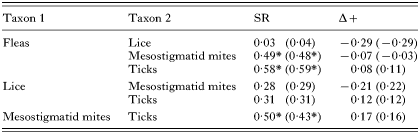
Table 2. Pearson's correlation coefficients (r) for all pairwise associations of species richness (SR) and taxonomic distinctness (Δ+) between assemblages of four higher ectoparasite taxa found on the same host species using the method of phylogenetically independent contrasts
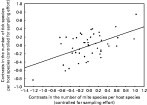
Fig. 2. Relationships between the number of tick species and the number of mesostigmatid mite species on the same host species among 55 rodent species using independent contrasts.
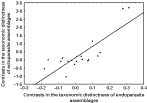
Fig. 3. Relationships between the taxonomic distinctness of ectoparasite and endoparasite assemblages among 20 rodent species using phylogenetically independent contrasts.
 You have
Access
- 29
- Cited by