INTRODUCTION
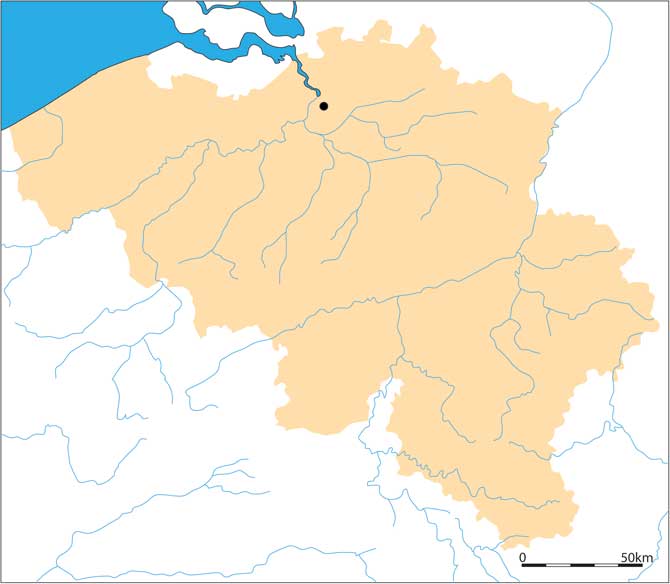
Wijnegem is located in northern Belgium, east of the city of Antwerp (Figure 1). The site, called Blikstraat, is situated on the northern limit of a sandy plateau, which borders an old river called het Klein Schijn. In the north, the area descends to the river valley. The former landscape in the region has been altered by the construction of the Albert channel in the former century (Pede et al. Reference Pede, Jacobs, Klinkenborg and De Mulder2014).
Location of the Wijnegem/Blikstraat site.
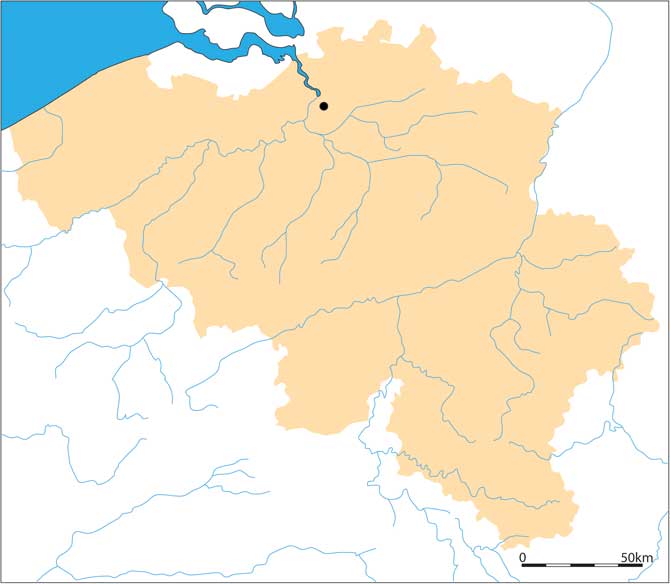
Due to the economic development of the area, trial trenching was recommended, which resulted in the discovery of an urnfield on the site. Between September 2008 and May 2009 2.6 ha were excavated. Next to the cemetery, also a Gallo-Roman settlement and medieval features were discovered (Pede et al. Reference Pede, Jacobs and De Mulder2011).
SITE DESCRIPTION
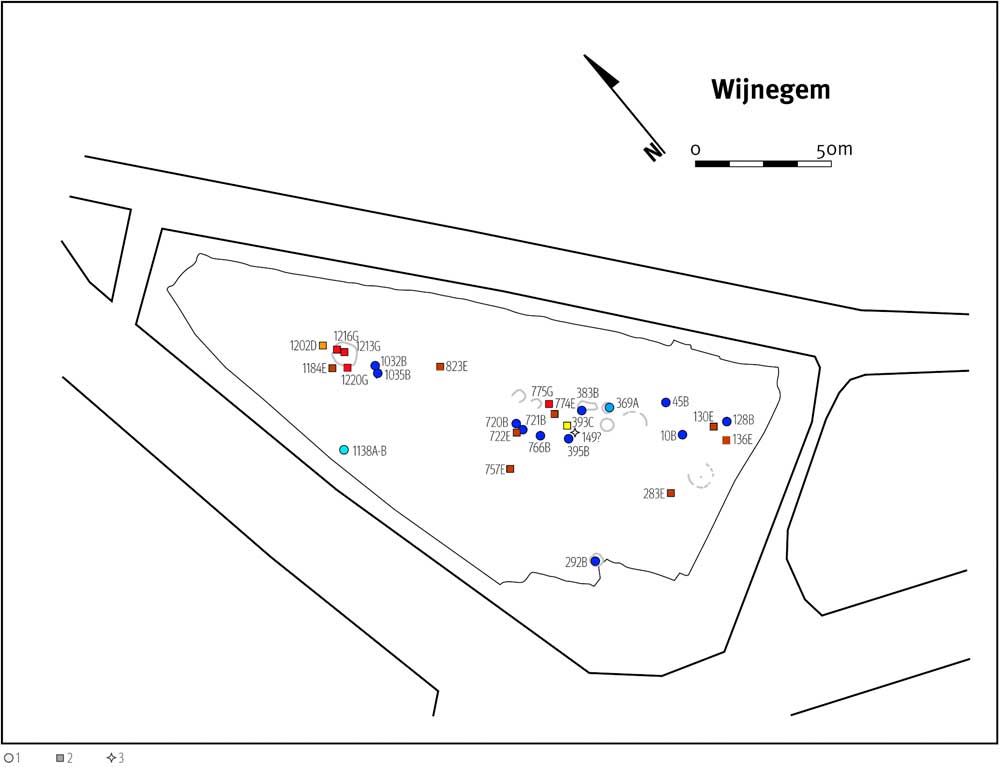
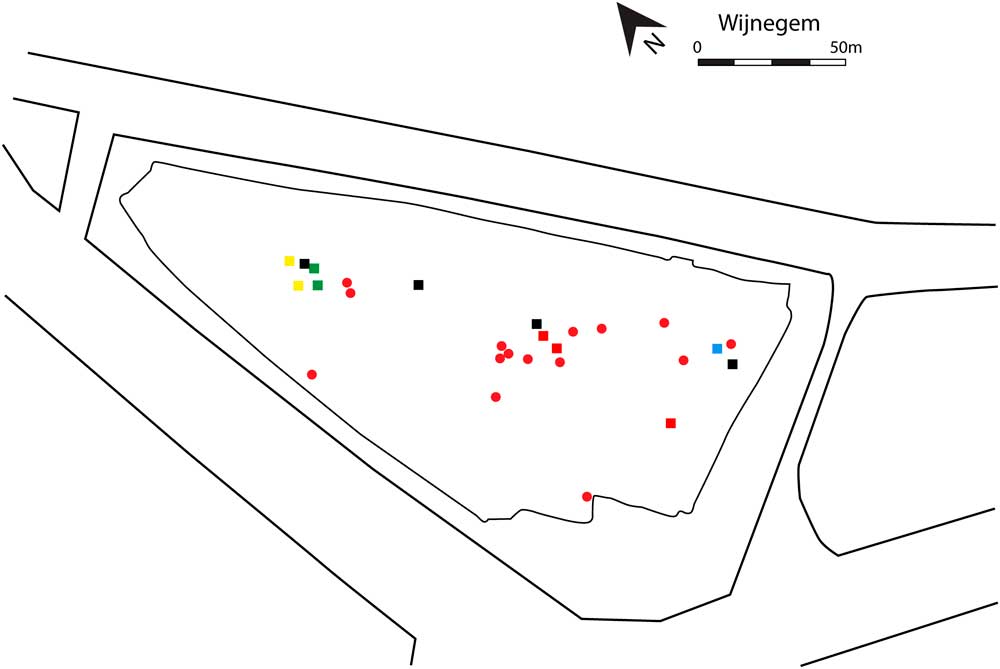
The layout of the cemetery was determined by the landscape. Most of the cremation burials and funerary monuments were located on a small sandy ridge, running from east to west on the larger plateau (Figure 2). Only in the southern corner of the excavated area, away from the central axis from the cemetery, an isolated monument with central grave was discovered. Twenty-nine cremation burials and nine funerary monuments were uncovered. Only in three of the funerary monuments was the central cremation grave still preserved. In the other cases, the monuments were eroded, probably due to their higher position in the subsoil.
The layout of the cemetery at Wijnegem/Blikstraat. The colors represent the different types of cremation graves. See also Figure 3. (Colors refer to online version.)
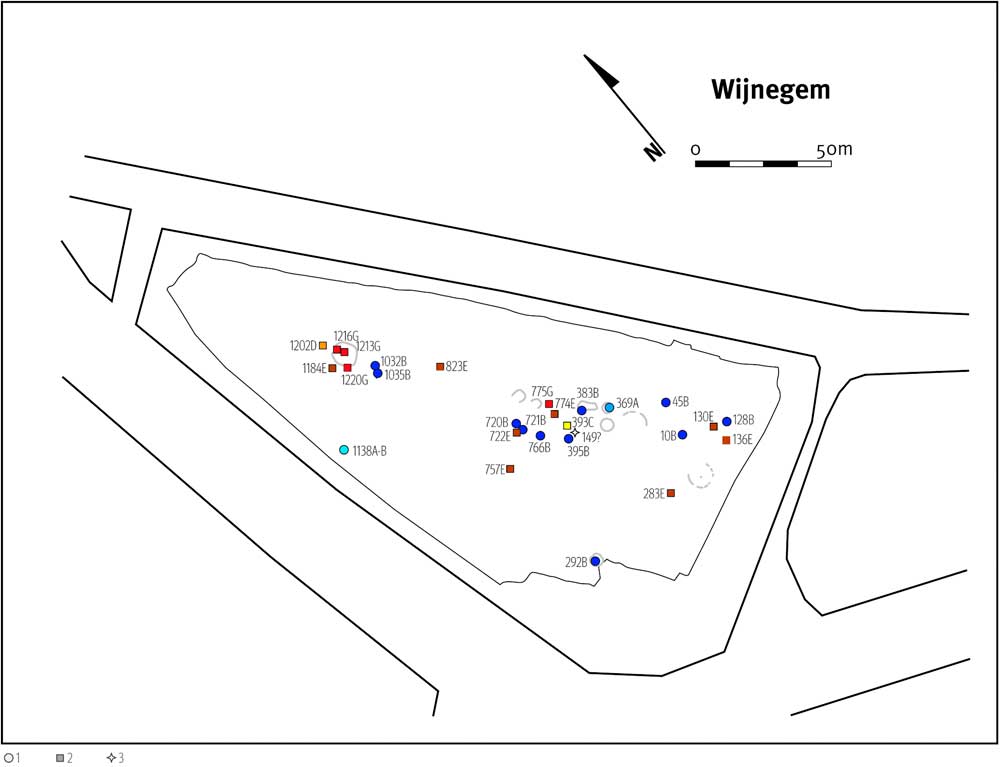
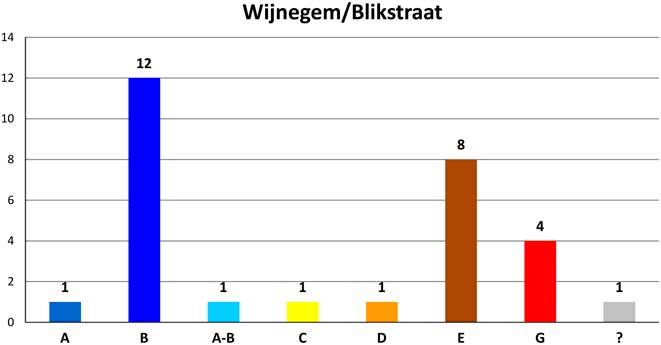
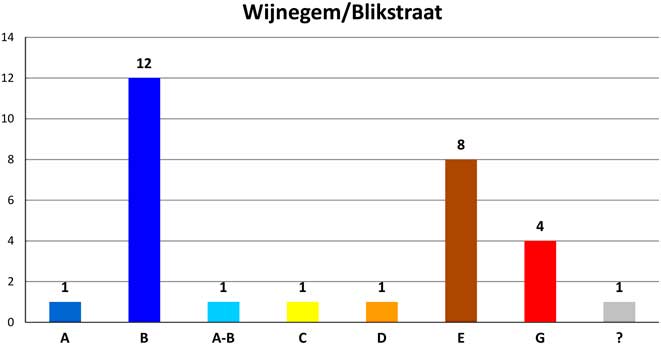
The cremation burials can be divided into different types according to a classification established for cremations in the Scheldt basin (Figure 3). This classification reflects the choices made at the selection of the cremated bones at the pyre and the way they are deposited in the burial pit (De Mulder Reference De Mulder2011). The largest group consists of two different types of urngraves, one containing only cremated bone (type A) and the other, containing also remnants from the pyre (type B). Type B was represented by 12 examples. Among the group of urnless cremations, more variability is observed. With eight examples the so-called Brandgrubengräber (type E), was the best represented cremation grave in this category. Furthermore, one so-called bonepackgrave (type C) was unearthed and one cremation grave style Destelbergen (type D). Interesting was the discovery for the first time of a new kind of cremation grave (type G). Four examples have been excavated. The dimension of the burial pit was variable. These structures are characterized by an infill that resembles the natural soil. In this infill, cremated bones were randomly dispersed in small groups of several handfuls of bone in the burial pit. Charcoal fragments were scarce. One cremation grave was too disturbed to be identified as a certain type.
Overview of the different types of cremation graves at Wijnegem/Blikstraat.
The excavated funerary monuments can be divided in eight ring ditches and one so-called Langgraben. Not all the ring ditches were completely preserved. In four cases, the ditch was partly eroded. Nevertheless, the estimated size could be reconstructed and estimated between 4.5 and 11.4 m. Based on their dimensions the complete ring ditches can be divided in two groups. One has an external diameter of 4–8 m and the other of 10–11 m. The elongated monument (the Langgraben) measured 8.45 m by 3.55 m.
MATERIAL AND METHODS
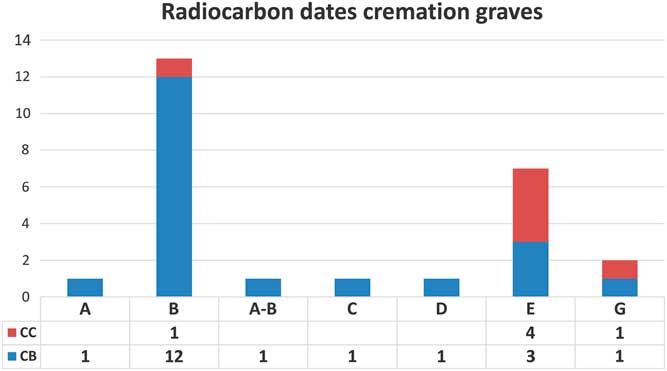
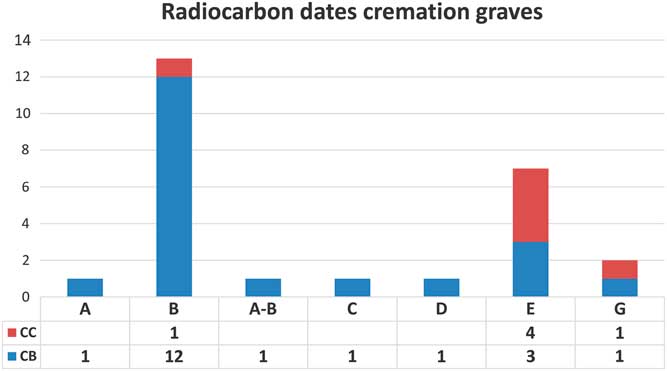
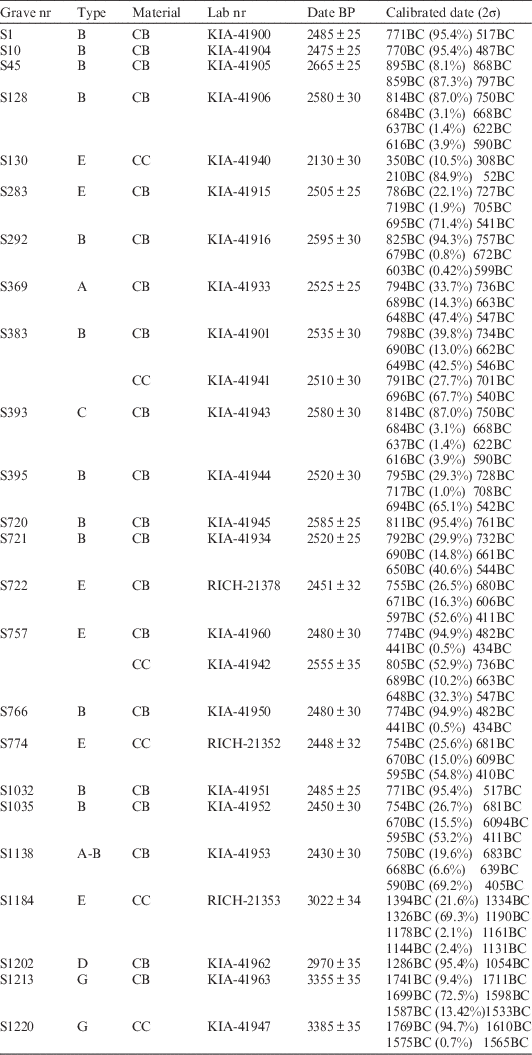
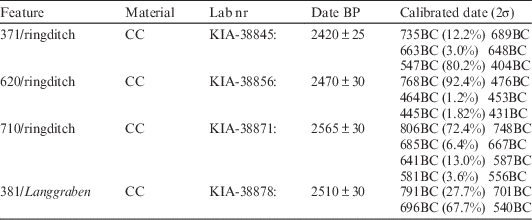
Thirty radiocarbon (14C) dates have been carried out, mostly on cremated bone, but also on charcoal (10 dates). Of this group, 26 dates were done on cremation graves. It was our aim to date the different excavated grave types in the cemetery (Figure 4). Twenty-four cremation burials were studied. Two of these, a cremation type B and one type E, were double dated on cremated bone and charcoal. For three cremations, two from type E and one cremation type G, it was only possible to date charcoal, because there was not enough bone or too small fragments to have reliable results. The charcoal was mostly determined as quercus, except for one grave (S1184) were the selected sample was betula or alnus. Furthermore, four funerary monuments, in which no central grave was preserved, were dated as well. Charcoal was selected from the lower infill of the so-called Langgraben and three ring ditches. The finds from the lower infill of the ditches were considered to represent an age closest to the construction of the monument. This method had also been used to date Middle Bronze Age barrows in western Flanders (De Reu and Bourgeois Reference De Reu and Bourgeois2013; De Reu Reference De Reu2014).
Overview of the number of 14C dates on the different types of cremation graves at Wijnegem/Blikstraat.
Cremated bone material from the graves was selected for 14C dating according to the standards for selecting cremated bone as described in Van Strydonck et al. (Reference Van Strydonck, Boudin and De Mulder2009). The fragments were prepared in the laboratory in Brussels according to the standard procedures for cremated bone samples in the laboratory (Van Strydonck and Van der Borg Reference Van Strydonck and Van der Borg1991; Van Strydonck et al. Reference Van Strydonck, Boudin and De Mulder2009). Most of the samples were measured in the AMS-facility of the Leibniz AMS facility at Kiel University (Nadeau et al. Reference Nadeau, Grootes, Schliecher, Hasselberg, Rieck and Bitterling1998). The latest samples were measured on the MICADAS in the Institute at Brussels (Boudin et al. Reference Boudin, Van Strydonck, van den Brande, Synal and Wacker2015). Charcoal samples from the graves and the ditches were treated according the standard AAA-method in the Brussels Laboratory and measured again in Kiel or in Brussels. Dates are calibrated using OxCal 4.3 (Bronk Ramsey Reference Bronk Ramsey2009; atmospheric data from Reimer et al. Reference Reimer, Bard, Bayliss, Beck, Blackwell, Bronk Ramsey, Buck, Cheng, Edwards, Friedrich, Grootes, Guilderson, Haflidason, Hajdas, Hatté, Heaton, Hoffmann, Hogg, Hughen, Kaiser, Kromer, Manning, Niu, Reimer, Richards, Scott, Southon, Staff, Turney and van der Plicht2013).
RESULTS AND DISCUSSION
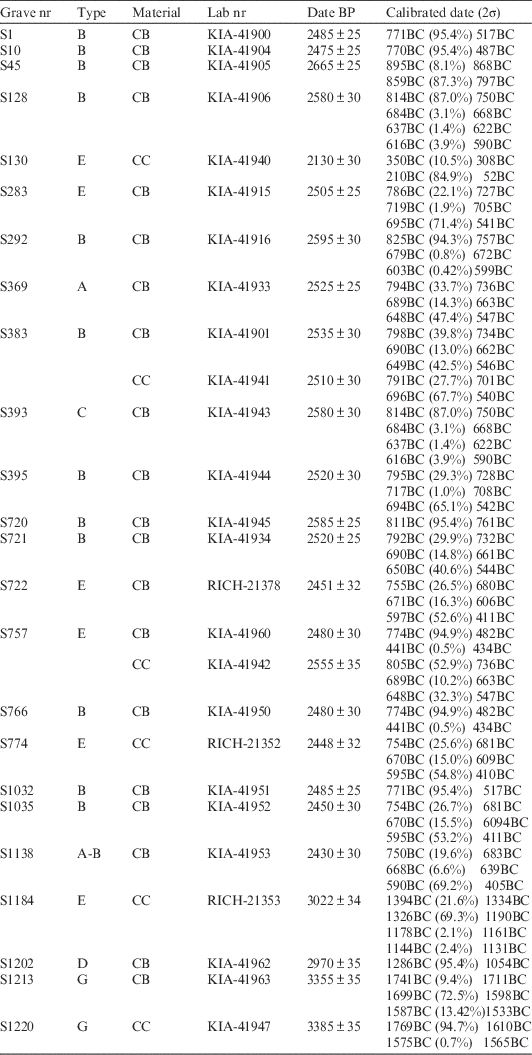
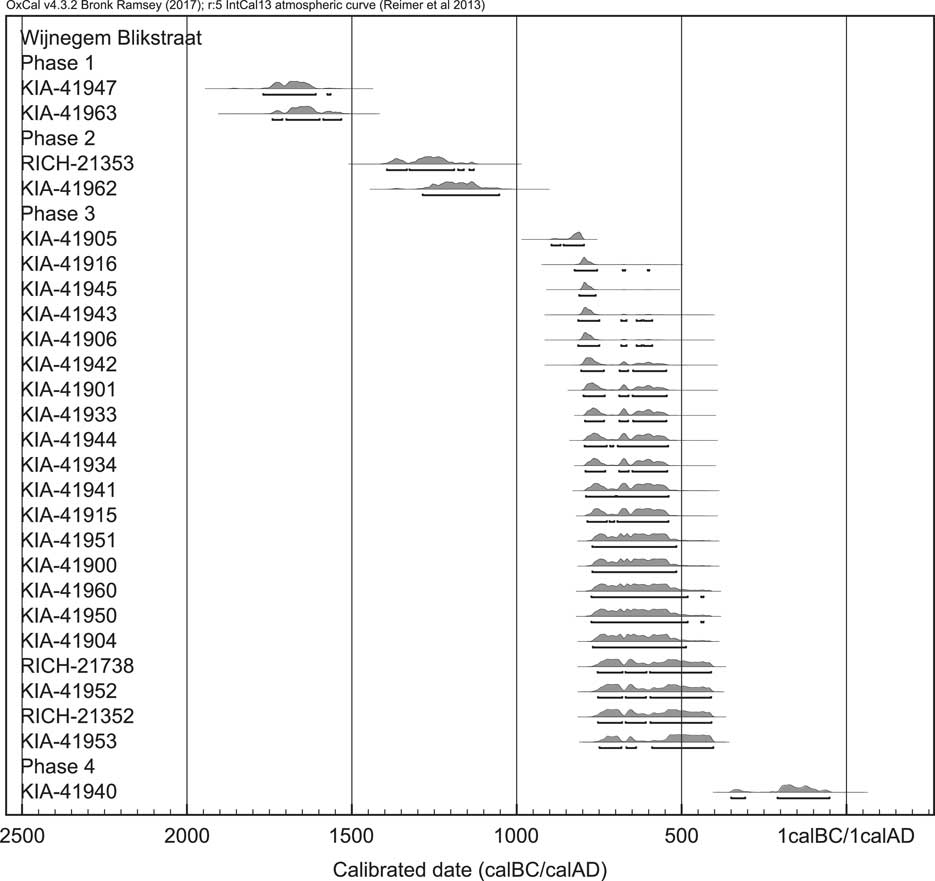
The 14C results reveal a long and complex history of use which differs from the traditional idea that most urnfields start in the Late Bronze Age or Early Iron Age (Table 1 and 2) (De Laet Reference De Laet1982; De Mulder Reference De Mulder1994; Bourgeois and Cherretté Reference Bourgeois and Cherretté2005). In the southwestern part of the cemetery a Hilversum vessel, belonging to the Early–Middle Bronze Age, was found in the ring ditch from a circular monument. Furthermore, the cremation graves in this area belonged to depositions without an urn. A stratigraphical change to the southeastern area could be supposed as a hypothesis. The results showed that the site had probably different occupation phases. The supposed phases 1 and 2 are represented with two 14C dates, phase 4 with only one result. Phase 3 is better documented with 19 dated graves. Since only this phase is well represented we will try by using Bayesian analysis to determine the lifespan of phase 3 in the long occupation history of the site. For this model, we used only the 14C dates of the cremation graves, both the results on cremated bone as on charcoal. The results of the charcoal samples from the infill of the monuments were not included in the model, but will be integrated in the discussion.
14C dates on cremated bone (CB) and charcoal (CC) from the cremation graves.
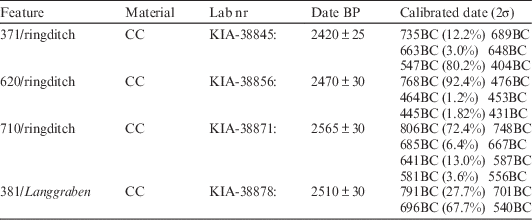
14C dates on CC from the funerary monuments.
Some of the cremation graves were dated solely on charcoal because there was not enough cremated bone preserved or these fragments were too small to have a reliable result (Van Strydonck et al. Reference Van Strydonck, Boudin and De Mulder2009). An old-wood effect cannot be excluded. However, archaeological and anthropological information suggests that young wood was preferred as a combustible for the pyre (Van Strydonck et al. Reference Van Strydonck, Boudin and De Mulder2010). Grave S383 at Wijnegem delivers not much difference in 14C age between the cremated bone and the charcoal. At grave S757 the difference is larger between both tested samples. However, according to the chi-square test (df=1, T=2.7 [5% 3.8]) both dates are statistically the same. A double date on both sample categories for grave 75 at Destelbergen matches also statistically. The same is observed at the urnfield cemetery of Tessenderlo where the results for two graves matched, although both of the last-mentioned sites also showed an example of charcoal that was older than the cremated bone (De Mulder et al. Reference De Mulder, Van Strydonck and Boudin2009)
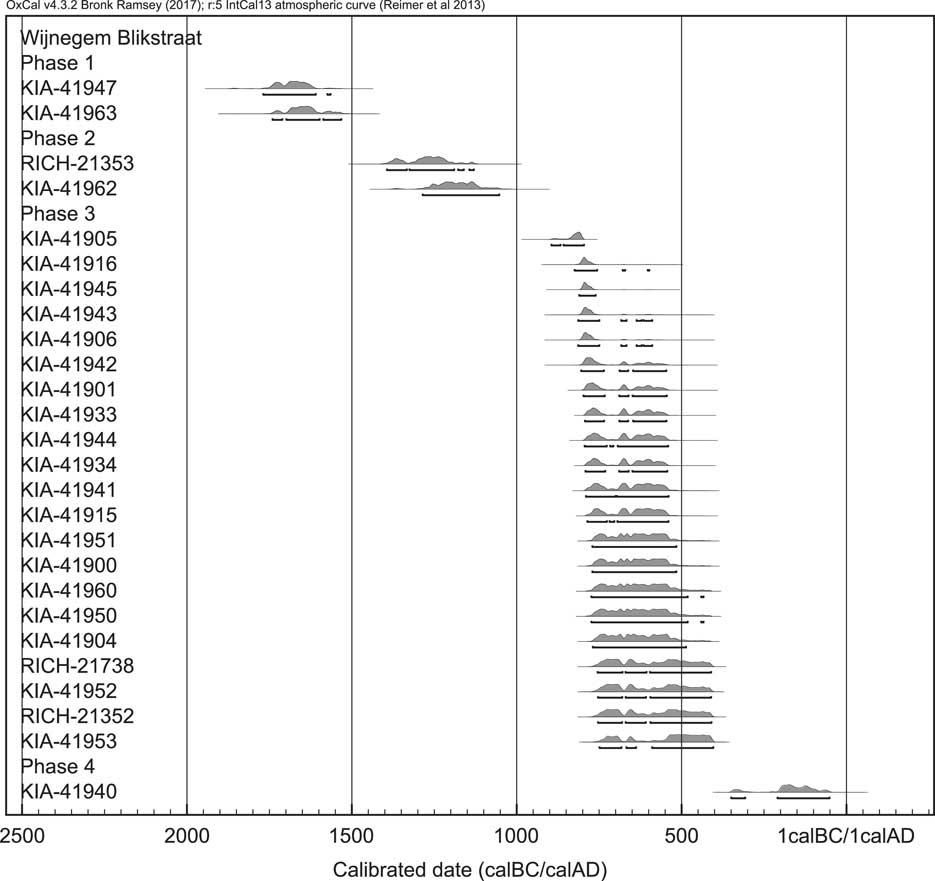
The oldest phase of the site is represented by two cremation graves type G in the northern sector of the cemetery (Figures 5 and 6). One date has been performed on cremated bone, the other on charcoal. Both graves are located close to a circular funerary monument. Both graves are situated in a period between the middle of the 18th century and the second half of the 16th century BC, which dates them in the Middle Bronze Age. This result supports the discovery and the typochronological date of a typical Hilversum vessel in the infill of the ringditch. These vessels are frequently used as urns, but there was not a single fragment of cremated bone in and around this vessel. Therefore, the hypothesis of a ritual deposition in the ditch seems more plausible.
Calibration curve of the dated cremation graves at Wijnegem/Blikstraat (OxCal 4.3 Bronk Ramsey Reference Bronk Ramsey2009; atmospheric data from Reimer et al. Reference Reimer, Bard, Bayliss, Beck, Blackwell, Bronk Ramsey, Buck, Cheng, Edwards, Friedrich, Grootes, Guilderson, Haflidason, Hajdas, Hatté, Heaton, Hoffmann, Hogg, Hughen, Kaiser, Kromer, Manning, Niu, Reimer, Richards, Scott, Southon, Staff, Turney and van der Plicht2013).
Overview of the different phases in the cemetery of Wijnegem/Blikstraat. The different grave types are simplified: ●=urngraves; ■=urnless cremations. Phase 1 (green), phase 2 (yellow), phase 3 (red), and phase 4 (blue). (Colors refer to online version.)
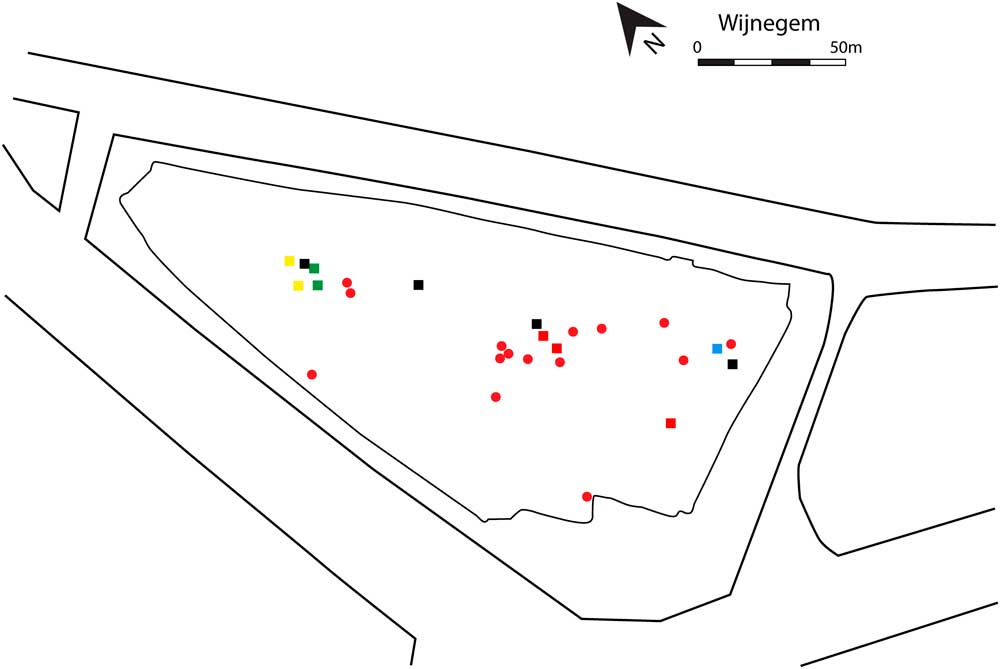
The supposed second phase is again represented by two cremation graves, which are also centered on the northern circular funerary monument (Figures 5 and 6). The cremation type Destelbergen was dated on a fragment of cremated bone between the beginning of the 13th and the middle of the 11th century BC. For the so-called Brandgrubengrab we had to rely on a fragment of charcoal. This grave can be older and is to be placed in the beginning of the 14th and the middle of the 12th century. Both graves can be attributed to the transition period from the Middle Bronze Age to the Late Bronze Age. During this period, so-called flatgraves are more frequently appearing in the archaeological record and represent the transition to a new burial ritual (De Mulder Reference De Mulder2011).
The main occupation period of the cemetery dates to the final phase of the Late Bronze Age and the Early Iron Age. Nineteen graves have delivered a result in this period. Deposition of the cremated remains in an urn are dominant, although there are also so-called urnless cremations. The preference for depositing the cremated bone in an urn in this period has also been recognized on other sites in the region such as Kontich/Duffelsesteenweg (De Mulder and Bourgeois Reference De Mulder and Bourgeois2014) and Brecht/Ringlaan (Bracke Reference Bracke2016).
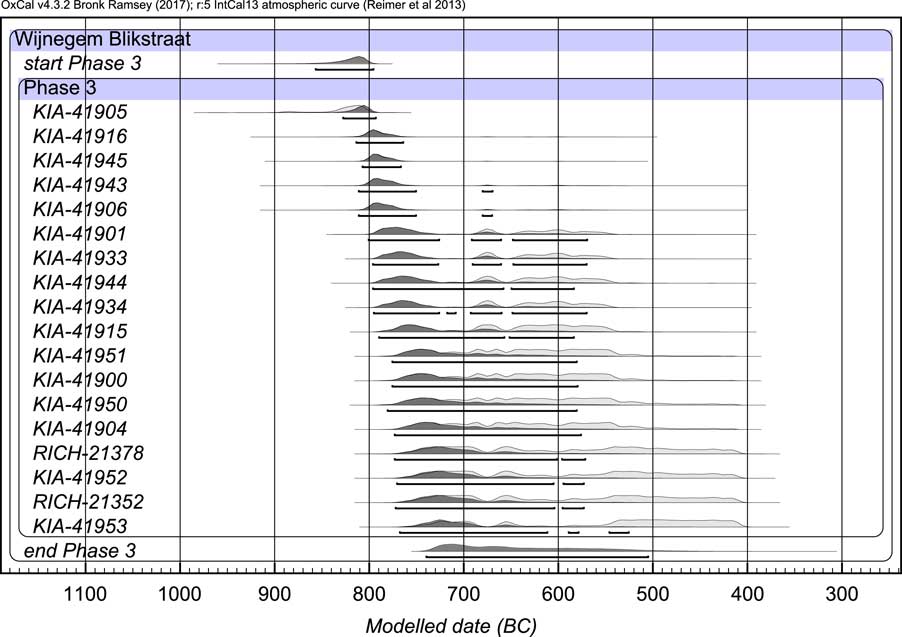
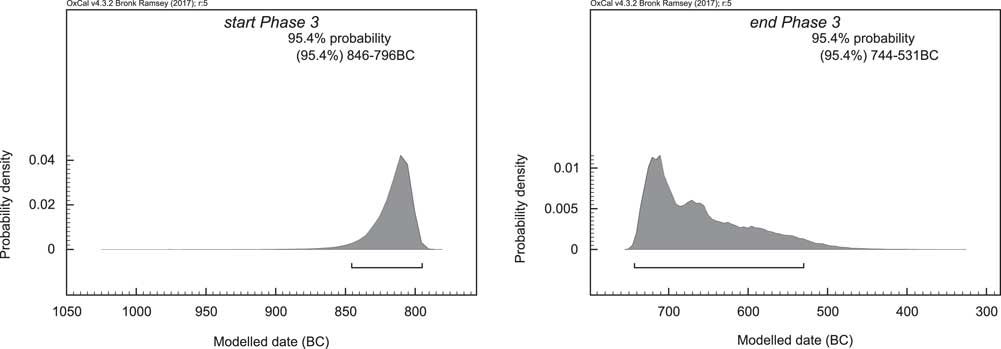
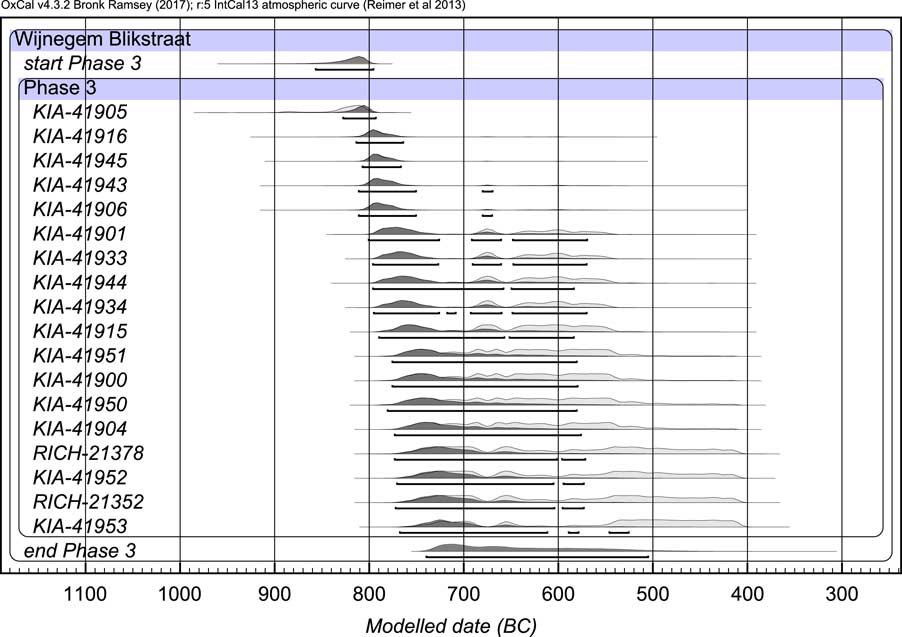
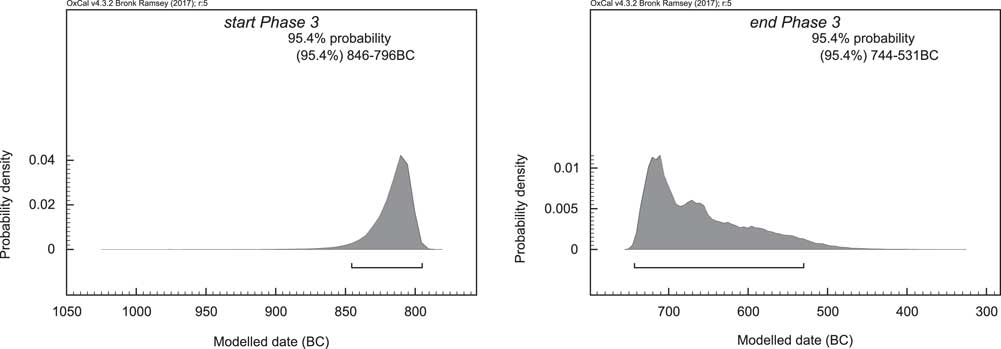
The Bayesian model constructed for phase 3 tried to refine the period of occupation (Figure 7). Since there is no important statistical difference between the results of charcoal and cremated bone dates, both sample categories are integrated in this model. The results discussed concerned the 95.4% probability range (agreement model 113.4; agreement overall 113.5). The start phase of the model begins between 848 and 796 cal BC. The end phase is calculated between 743 and 526 cal BC (Figure 8). The beginning of the third phase at the end of the Late Bronze Age is confirmed by the few ceramic finds from this period. The urn of grave S45 shows a shape that is a forerunner of the later Harpstedt pottery. The final occupation of phase 3 is difficult to date exactly due to the well-known Hallstatt plateau of the calibration curve. The typology of the associated pottery belongs also to the Early Iron Age period and is difficult to date very precisely in the region in comparison with other European areas (De Mulder and Bourgeois Reference De Mulder and Bourgeois2014). The end of this phase around the last quarter of the 6th century BC is acceptable due to the lack of archaeological artifacts associated with the 5th century BC.
Bayesian model of phase 3 (OxCal 4.3 Bronk Ramsey Reference Bronk Ramsey2009; atmospheric data from Reimer et al. Reference Reimer, Bard, Bayliss, Beck, Blackwell, Bronk Ramsey, Buck, Cheng, Edwards, Friedrich, Grootes, Guilderson, Haflidason, Hajdas, Hatté, Heaton, Hoffmann, Hogg, Hughen, Kaiser, Kromer, Manning, Niu, Reimer, Richards, Scott, Southon, Staff, Turney and van der Plicht2013).
Start and end boundaries of phase 3 (OxCal 4.3 Bronk Ramsey Reference Bronk Ramsey2009; atmospheric data from Reimer et al. Reference Reimer, Bard, Bayliss, Beck, Blackwell, Bronk Ramsey, Buck, Cheng, Edwards, Friedrich, Grootes, Guilderson, Haflidason, Hajdas, Hatté, Heaton, Hoffmann, Hogg, Hughen, Kaiser, Kromer, Manning, Niu, Reimer, Richards, Scott, Southon, Staff, Turney and van der Plicht2013).
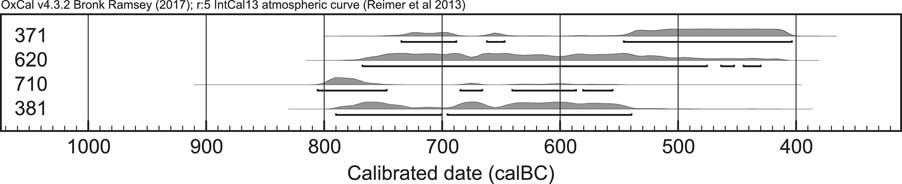
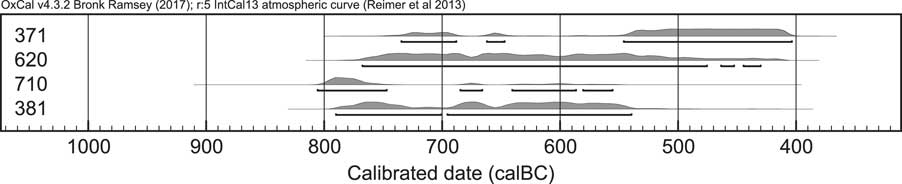
The cremations of this period are located in the southern part of the excavated area and follow the small local ridge. Two are found in the western sector of the excavation. The 14C results on the three ring ditches and the Langgraben belong also to the Early Iron Age, suggesting the erection of these monuments to phase 3 (Figure 9). The dated samples were retrieved from the lower infill of the ditches, representing the silting up of the monuments and can only be interpreted as a terminus post quem. The lost central graves must have been of an earlier period. As previously mentioned, we assume that the lower infill is closely related in time to the deposition of the cremated bones and the construction of the monument. Furthermore, taking into account the position of the monuments within the organization of the cemetery we can assume that they are probably contemporary within the dated cremation graves from phase 3.
The calibrated 14C dates of the funerary monuments (OxCal 4.3 Bronk Ramsey Reference Bronk Ramsey2009; atmospheric data from Reimer et al. Reference Reimer, Bard, Bayliss, Beck, Blackwell, Bronk Ramsey, Buck, Cheng, Edwards, Friedrich, Grootes, Guilderson, Haflidason, Hajdas, Hatté, Heaton, Hoffmann, Hogg, Hughen, Kaiser, Kromer, Manning, Niu, Reimer, Richards, Scott, Southon, Staff, Turney and van der Plicht2013).
The final use of the cemetery is represented by a single Brandgrubengrab, which was deposited in the southern part of the necropolis among some older cremation graves. This isolated grave in time is dated to the Late Iron Age. This phenomenon of depositing human remains in an older urnfield is since recently known in the region. It has been ascertained at the cemeteries of Kontich/Duffelsesteenweg (De Mulder and Bourgeois Reference De Mulder and Bourgeois2014) and Destelbergen/Eenbeekeinde (De Mulder Reference De Mulder2010; De Mulder and Deweirdt Reference De Mulder and Deweirdt2012). In both cases, two Late Iron Age cremations were buried afterwards in these necropolises, suggesting that the local communities remembered these places as funerary sites.
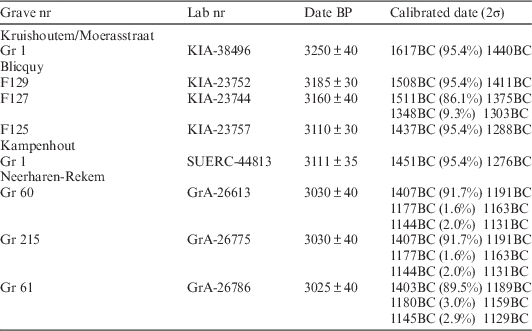
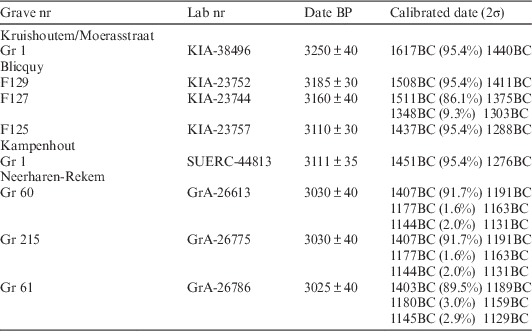
Flat cremation graves are traditionally associated in the region with the appearance of the urnfield cemeteries in the Late Bronze Age (De Laet Reference De Laet1982; Bourgeois and Cherretté Reference Bourgeois and Cherretté2005). However, the four urnless cremations around the funerary circular structure in the northern area of the Wijnegem cemetery date to the end of the Early Bronze Age and the Middle Bronze Age. 14C dating of cremated bone has also revealed the early appearance of flat graves on other sites (Table 3). In some cases, it concerns isolated flat graves. At Kruishoutem/Moerasstraat a Middle Bronze Age urngrave has been discovered (De Mulder Reference De Mulder2011). Another find comes from Kampenhout where an urnless cremation was also dated in the later phase of the Middle Bronze Age (Hazen and Drenth Reference Hazen and Drenth2014). The urnfield of Blicquy in southern Belgium has also an early start during the Middle Bronze Age. The oldest flat graves go back to the Middle Bronze Age B period (De Mulder et al. Reference De Mulder, Van Strydonck, Boudin, Lerclercq, Paridaens and Warmenbol2007). In addition, some flat graves at the cemetery of Neerharen-Rekem in northeastern Belgium also have a Middle Bronze Age B date (Temmerman Reference Temmerman2007).
14C dates on flat graves in Belgium.
The integration and reuse of Middle Bronze Age barrows in urnfields of the Late Bronze Age and Early Iron Age was known at some Belgian sites. This varies from an incidental reuse to the development of a larger cemetery (Van Beeck and De Mulder Reference Van Beeck and De Mulder2014). The 14C results of Wijnegem/Blikstraat show that a longer and more complex funerary occupation history of sites can be detected. The cemetery of Wijnegem has a long-term use that covers the 2nd and 1st millennia BC. In the section above, the earlier appearance of urnfield cemeteries in Belgium has already been mentioned. The same phenomenon has been ascertained at sites in northern and northeastern France. The cemetery of Croix-de-Mission at Marolles-sur-Seine shows different phases of use starting in the Early Bronze Age and continuous until the Early Iron Age. In the neighboring necropolis of Croix-Saint-Jacques at Marolles-sur-Seine the cemetery starts in the Early Bronze Age but its main occupation is limited to the Late Bronze Age (Peake and Delattre Reference Peake and Delattre2005; Delattre and Peake Reference Delattre and Peake2015). The same pattern is visible at the cemetery of Jâlons/La Grande Pâture. The site was in use during different phases, which started at the transition of the Early-Middle Bronze Age, and ends during the Early Iron Age (Lenda et al. Reference Lenda, Deborde, Depierre and Turé2012).
CONCLUSION
According to the 14C dates derived from the cremation graves and the ditches of the funerary monuments, the cemetery of Wijnegem/Blikstraat had a long lifespan. The cemetery was founded at the beginning of the Middle Bronze Age and functioned until the Late Iron Age. Four periods of use can be determined but the final phase of the Late Bronze Age and the Early Iron Age represent the heyday of its use. Furthermore, the appearance of flat graves in Belgium is, according to the information of Wijnegem, a much earlier phenomenon than previously accepted, but confirmed by other sites. The long-term occupation from funerary sites is a phenomenon that is also seen in other regions. 14C dating of cremated bone also led to the discovery of the la longue durée history of some French protohistoric cemeteries.