High-yielding dairy cows often develop severe negative energy balance (NEB) during early lactation because of insufficient feed intake to meet energy requirements resulting from high milk production (Fiore et al. Reference Fiore, Gianesella, Arfuso, Giudice, Piccione, Lora, Stefani and Morgante2014).
Several strategies have been performed to minimise the NEB and consequently the effect on fat mobilisation syndrome in ruminants during the periparturient period (Fiore et al. Reference Fiore, Gianesella, Arfuso, Giudice, Piccione, Lora, Stefani and Morgante2014). Oral administration of folic acid and vitamin B12 increased milk and milk component yields during the first weeks of lactation without an effect on dry matter intake (DMI) or plasma non-esterified fatty acids (NEFA), but increased plasma glucose and decreased hepatic concentrations of lipids (Preynat et al. Reference Preynat, Lapierre, Thivierge, Palin, Matte, Desrochers and Girard2009). Multiple intravenous (i.v.) injections of cyanocobalamin and butaphosphan during the close-up period have a beneficial effect on the metabolism of periparturient dairy cows in improving the metabolic status, the DMI and health of dairy cows in early lactation (Fürll et al. Reference Fürll, Deniz, Westphal, Illing and Constable2010). Furthermore, combined butaphosphan and cyanocobalamin application in dairy cows, without disorders and without high plasma β-hydroxybutyrate (BHB) concentrations, tended to have lower plasma NEFA concentrations after treatment, instead the plasma BHB concentrations were not affected by treatment in early lactating dairy cows (Kreipe et al. Reference Kreipe, Deniz, Bruckmaier and van Dorland2011).
The association of acetylmethionine, cyanocobalamin and α-lipoic acid is a commercially available treatment, named Erbacolina®, that is designed to minimise alterations of hepatic metabolism related to enzyme deficiencies in cows. To the best of the author's knowledge, it has never been rigorously investigated in dairy cows and the exact mechanism of action of these substances in combination is not clearly known.
In view of this, the aim of the study reported in this Research Communication was to investigate the effect of a combined acetylmethionine, cyanocobalamin and α-lipoic acid treatment, on some metabolic parameters of early lactating high-yielding dairy cows.
Materials and methods
Thirty pregnant multiparous Holstein dairy cows from a high producing dairy farm were used. The farm was selected with a milk production of about 10 000 kg for year. The farm utilised a dry period of 60 d and a period of steaming-up of 15 d before calving. All animals were multiparous at different parities: 10 in second lactation (38·1 ± 2·1 months), 10 in third lactation (49·2 ± 3·8 months) and 10 in fourth lactation (77·6 ± 6·5 months). Average milk yield of the selected animals was 9005 ± 2865 kg per year (EG: 8912 ± 3626, CG: 9098 ± 2104). All cows had continuous access to a complete mixed ration fed twice daily (online Supplementary Table S1). The diet was balanced and in accordance with the nutritional requirements of the transition period. The animals included in the study were enrolled after a general clinical examination and included if they presented absence of hyperthermia or fever symptoms.
At the beginning of the experimental procedure, all cows were randomly divided into two groups: experimental group (EG, n = 20) and control group (CG, n = 10). EG received 20 ml of experimental treatment (intramuscular, i.m., Erbacolina®, Ceva Salute Animale S.p.A., Agrate Brianza, MB, Italy) at 10 ± 2 d postpartum (T0). At the same time point, CG received the same amount of physiological solution (NaCl 0·9%). The treatments were administered every 2 d for 14 d. The composition of Erbacolina® in 100 ml of product is: Acetylmethionine (480 mg), Cyanocobalamin (50 mg) and α-Lipoic acid (25 mg).
Body condition score (BCS, 0–5 scale) was evaluated in each subject according to Edmonson et al. (Reference Edmonson, Lean, Weaver, Farver and Webster1989). Blood samples were collected from each animal at the same hour in the morning from jugular vein into vacuum glass tubes (Venosafe™, Terumo Europe) containing no additive. BCS and blood samples were evaluated at 3 time points: 10 ± 2 d postpartum (T0), 30 ± 2 d postpartum (T1) and 50 ± 2 d postpartum (T2) by the same operator.
Blood samples were centrifuged at 3500 rpm for 10 min and the obtained sera were transferred into plastic tube and stored at −18 °C until assay. Glucose, BHB and NEFA were assessed by a UV spectrophotometer, Cobas C 501 analyser (Roche Diagnostics, Mannheim, Germany) using available commercial kit. Triglycerides, total cholesterol (TC), alanine aminotransferase (ALT), aspartate aminotransferase (AST), γ-glutamiltransferase (GGT), total bilirubin (TB), conjugated bilirubin (CB), total proteins (TP), globulins, albumin and urea were determined by an automated biochemistry analyser BT1500 (Biotecnica Instruments S.p.A., Roma, Italy) using available commercial kit.
In our study, protocols of animal husbandry and experimentation were reviewed and approved in accordance with the standards recommended by the Guide for the Care and Use of Laboratory Animals and Directive 2010/63/EU for animal experiments.
The obtained data were expressed as mean ± standard deviation (sd). Data were tested for normality using the Shapiro-Wilk test and were found to be normally distributed. Two-way analysis of variance (ANOVA) for repeated measures was applied to assess the statistically significant effects of treatment and of the sampling time on the studied parameters. Bonferroni's multiple comparison test was used for post hoc comparison test and P values <0·05 were considered statistically significant. Statistical analysis was performed using the STATISTICA software package (STATISTICA 7 Stat Software Inc., Tulsa, Oklahoma).
Results
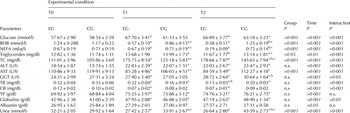
In Table 1 are shown the mean ± standard deviations (±sd) and statistical analysis of all studied parameters. The application of ANOVA showed significant differences in the values of glucose, BHB, NEFA, triglycerides, TC, AST and urea (P < 0·05) between EG and CG. In particular, glucose showed higher values in EG respect to CG at T1. At the same time, BHB, NEFA and AST showed lower values in EG respect to CG at T1 and T2. The values of triglycerides were lower in EG compared to CG at T2. TC showed higher values in EG respect to CG at T1 and T2. Urea values were lower in EG compared to CG at T1 and T2. A statistical significant interaction was found in all studied parameters except for TP and albumin between time and groups. BCS didn't show statistical significant differences in either group.
Mean ± standard deviations (±sd) and statistical analysis of triglycerides, total cholesterol (TC), alanine aminotransferase (ALT), aspartate aminotransferase (AST), γ-glutamiltransferase (GGT), total bilirubin (TB), conjugated bilirubin (CB), total proteins (TP), globulins, albumin and urea, together with statistical significances, obtained at T0 (10 ± 2 d postpartum), T1(30 ± 2 d postpartum) and T2(50 ± 2 d postpartum) in experimental group (EG) and control group (CG)

Significant effect of time (P < 0·05): a vs T0; b vs T1.
Significant effect of treatment (P < 0·05): c vs EG.
Moreover, a statistically significant effect of sampling time (P < 0·05) on all studied parameters was found in both groups. In particular, glucose, TC, ALT, GGT, TP and globulins statistically increased in EG at T1 and T2 vs T0. BHB, NEFA, AST, TB,CB and urea statistically decreased in EG at T1 and T2 vs T0. Triglycerides and TB statistically decreased at T2 vs T1.
The CG showed a statistically significant increase of triglycerides, TC, ALT, TP, globulins and urea values at T1 and T2 vs T0. TB levels showed an opposite trend. BHB, NEFA and AST concentrations statistically decreased at T1 vs T0. Glucose and GGT statistically increased at T2 vs T0. BHB, NEFA, TC, GGT and urea values statistically increased at T2 vs T1.
Discussion
The obtained results showed that the treatment with acetylmethionine, cyanocobalamin and α-lipoic acid could have a beneficial effect in reducing the risk of hyperketonemia and hepatic lipidosis during the weeks after calving in high-yielding cows.
In agreement with Fürll et al. (Reference Fürll, Deniz, Westphal, Illing and Constable2010), who utilised a different experimental protocol, glucose concentrations significantly increased at T1 and T2 in EG, whereas significantly increased only at T2 in CG. Similar results have been described by Preynat et al. (Reference Preynat, Lapierre, Thivierge, Palin, Matte, Desrochers and Girard2009), who observed that, even if milk production was similar for cows fed supplementary folic acid alone or combined with cyanocobalamin, plasma concentration of glucose was higher in cows supplemented with both vitamins. It is well known that glucose metabolism takes on increased significance in ruminants during early lactation. The lactating mammary gland necessitates major adjustments in glucose production and utilisation in maternal liver, adipose tissue, skeletal muscle, and other tissues (Fiore et al. Reference Fiore, Gianesella, Arfuso, Giudice, Piccione, Lora, Stefani and Morgante2014). Therefore, glucose synthesis during early lactation should be increased to accommodate mammary demands. In the present study it has been shown that the EG had a better glucose trend compared to CG, underlining the beneficial effect of the treatment on glucose and, consequently, on energetic metabolism of lactating cows. This hypothesis seems to be reinforced by NEFA and BHB trend found in EG. Effectively, in agreement with Preynat et al. (Reference Preynat, Lapierre, Thivierge, Palin, Matte, Desrochers and Girard2009), who utilised a different protocol, NEFA and BHB concentrations significantly decreased at T1 and T2 in EG; this may indicate a possible improvement in metabolic efficiency consequently to the treatment. Instead, NEFA and BHB measured in CG showed statistically significant higher values at T2 respect to EG. According to our findings, it has been reported that fat mobilisation syndrome is characterised by increases in serum NEFA and BHB concentrations, and decreases in serum glucose concentration (Fürll et al. Reference Fürll, Deniz, Westphal, Illing and Constable2010). In recent studies, it was demonstrated that glucose infusion influenced metabolism in ruminants modifying glucose, NEFA and BHB profile (Fiore et al. Reference Fiore, Gianesella, Arfuso, Giudice, Piccione, Lora, Stefani and Morgante2014) and other authors demonstrated that the treatment with propylene glycol increases glucose concentration, while NEFA and BHB concentrations are decreased (Nielsen & Ingvartsen Reference Nielsen and Ingvartsen2004).
The serum values of TC showed significant increase at T2 in both groups; the increase of TC levels suggest a greater lipoprotein export from the liver (Duffield et al. Reference Duffield, LeBlanc, Bagg, Leslie, Ten Hag and Dick2003; Piccione et al. Reference Piccione, Messina, Marafioti, Casella, Giannetto and Fazio2012). The fact that the increase of serum TC levels was stronger in EG at T1 and T2 could be supportive of improved energy metabolism in treated cows during mid lactation. Our results are in accordance with Duffield et al. (Reference Duffield, LeBlanc, Bagg, Leslie, Ten Hag and Dick2003) who demonstrated that monensin treated cows had higher cholesterol concentrations both pre and postcalving. The significant decrease of triglycerides values in EG at T2 highlights the beneficial effect of the treatment on the liver function (in CG we observed a significant increase of triglycerides values until the end of the experiment). The increase of triglycerides values could be due to lipid mobilisation from liver related to the metabolic demands of calving and the onset of lactation (Piccione et al. Reference Piccione, Messina, Marafioti, Casella, Giannetto and Fazio2012).
According to Stojević et al. (Reference Stojević, Piršljin, Milinković-Tur, Zdelar-Tuk and Ljubić2005), who didn't utilise any treatment, the significantly highest AST activity was recorded at T0 significantly decreasing at T1 and T2 in both groups, having significant lower values especially at T2 in EG.
The increase in urea serum levels during the lactation period is strictly dependent on the dietary intake of proteins, because of the increased requirements (Roubies et al. Reference Roubies, Panouis, Fytianou, Katsoulos, Giadinis and Karatzias2006). Urea concentrations showed significant differences between the two groups showing the lowest level in EG, may be due to the beneficial effect of the treatment. These data are in contrast with Duffield et al. (Reference Duffield, LeBlanc, Bagg, Leslie, Ten Hag and Dick2003) who showed that serum urea levels were elevated both pre and postcalving in monensin treated animals.
In conclusion, the serum haematochemical analysis revealed the expected postpartum alterations attributable to physiological adaptations occurring during this period in CG. Moreover, the changes in studied parameters were less evident in EG than in CG suggesting that the treatment with the combination of acetylmethionine, cyanocobalamin and α-lipoic acid positively influenced liver metabolism in high-yielding dairy cows, indicating an overall improved energy status. This treatment may be considered as a good therapeutic agent in preventing the excessive fat mobilisation, the main cause of an imbalance in hepatic carbohydrate and fat metabolism which may result in metabolic disorders during early lactation period.
Supplementary material
The supplementary material for this article can be found at https://doi.org/10.1017/S0022029916000509