Obsessive-compulsive disorder (OCD) is a psychological disorder characterised by the presence of obsessions and/or compulsions (American Psychiatric Association [APA], 2013). Crino, Slade, and Andrews (Reference Crino, Slade and Andrews2005) identified the 12-month prevalence of OCD in the Australian population as being approximately 0.6%. While OCD affects a minority of the population, it carries a significant social and economic burden that extends beyond individuals with the disorder to affect their partners and families (Steketee, Reference Steketee1997). Consequently, research examining the pathogenesis, nature, and treatment of this disorder is warranted. One area of enquiry has focused on differences in decision-making in patients with OCD on cognitive tasks such as the Iowa Gambling Task (IGT; Bechara, Damasio, Damasio, & Anderson, Reference Bechara, Damasio, Damasio and Anderson1994).
Researchers have suggested that deficits in efficacious decision-making, which are commonly exhibited among people with OCD (Dittrich & Johansen, Reference Dittrich and Johansen2013), are the underlying factors responsible for the obsessions and compulsions that characterise this disorder (Starcke, Tuschen-Caffier, Markowitsch, & Brand, Reference Starcke, Tuschen-Caffier, Markowitsch and Brand2010). Specifically, it has been suggested that OCD is a ‘disorder of decision-making’ (Sachdev & Malhi, Reference Sachdev and Malhi2005, p. 757). OCD patients have demonstrated significantly poorer decision-making capabilities than their healthy counterparts on tasks such as the IGT and the Cambridge Gambling Task (CGT; Rogers et al., Reference Rogers, Everitt, Baldacchino, Blackshaw, Swainson, Wynne and Robbins1999; e.g., Da Rocha, Alvarenga, Malloy-Diniz, & Correa, Reference Da Rocha, Alvarenga, Malloy-Diniz and Correa2011; Dittrich & Johansen, Reference Dittrich and Johansen2013; Starcke, Tuschen-Caffier, Markowitsch, & Brand, Reference Starcke, Tuschen-Caffier, Markowitsch and Brand2010).
The CGT is commonly used as a measure of decision-making under conditions of risk. In a recent study employing this task Dittrich and Johansen (Reference Dittrich and Johansen2013) reported that OC patients made significantly fewer rational decisions than control group participants, signifying a predilection for risky decisions. Executive function deficits were also found among the clinical group. The authors implicate emotional processing as a possible explanation of the mechanisms that underlie these deficits.
Other researchers have attempted to delineate the differences in decision-making performance on the basis of whether the decision in question is made under conditions of risk or ambiguity. Starcke et al. (Reference Starcke, Tuschen-Caffier, Markowitsch and Brand2010) investigated the relative performance of OCD patients with a matched healthy control group on a battery of tasks that tested executive function, as well as two decision-making tasks — the IGT and the Game of Dice Task (GDT; Brand et al., Reference Brand, Fujiwara, Borsutzky, Kalbe, Kessler and Markowitsch2005). The IGT was posited to assess decision-making under conditions of ambiguity, since it requires participants to select a card from one of four decks that have stable but unstated win/loss contingencies. Conversely, the GDT is a task with rules that are stated explicitly and would thus reflect decision-making under conditions of risk. Starcke et al. (Reference Starcke, Tuschen-Caffier, Markowitsch and Brand2010) found that OC patients performed significantly more poorly overall than controls on the IGT only. OC patients also exhibited a sustained preference over the five blocks of the task for choosing cards from decks that yield higher immediate rewards but more severe long-term losses. Furthermore, there was a significant interaction between group and block. While the performance of the control group eventually improved over the course of the task, improvements in performance among OC patients were significantly less evident as the task progressed. Like Dittrich and Johansen (Reference Dittrich and Johansen2013), the authors also implicated emotional processing as a possible factor in the rationalisation of their results.
However, unlike Dittrich and Johansen (Reference Dittrich and Johansen2013), the authors claimed that this study did not demonstrate the finding of differences in decision-making under conditions of risk, given that Starcke et al. (Reference Starcke, Tuschen-Caffier, Markowitsch and Brand2010) did not recognise that the IGT incorporates risky decision-making. This is problematic, since while the rules that govern the decks in the IGT are never made explicit, players must arrive at an implicit understanding of which decks will yield higher profits in the long term to prosper in the task. Additionally, they must then decide to use these learned contingencies to aid their decision-making. Consequently, once the contingencies attached to each deck are learned, the conditions under which a decision is made shift from ambiguous to risky. Starcke et al. (Reference Starcke, Tuschen-Caffier, Markowitsch and Brand2010) attributed the failure of OC patients to demonstrate the sustained improvements exhibited by healthy controls on the IGT to the inability of OC patients to learn the contingencies attached to each deck. However, they did not consider the possibility that poor performance of OC patients on the later blocks of the IGT related to an inherent deficit in rational decision-making under conditions of risk. Given that studies such as those conducted by Dittrich and Johansen (Reference Dittrich and Johansen2013), and Dittrich, Johansen, Landro, and Fineberg (Reference Dittrich, Johansen, Landro and Fineberg2011) have demonstrated that patients with OCD exhibit differences in risky decision-making, interpreting the poor performance of OC patients on the final blocks of the IGT as a failure to exhibit rational decision-making under conditions of risk may be considered a valid and useful approach.
Additionally, these deficits have been demonstrated when OCD patients’ performance has been compared with patients with other disorders such as panic disorder (Cavedini et al., Reference Cavedini, Riboldi, D'Annucci, Belotti, Cisima and Bellodi2002) and schizophrenia (Cavallaro et al., Reference Cavallaro, Cavedini, Mistretta, Bassi, Angelone, Ubbiali and Bellodi2003). Cavedini et al. (Reference Cavedini, Riboldi, D'Annucci, Belotti, Cisima and Bellodi2002) attribute the relatively poor performance of this patient group to an innate preference among OC populations for immediate gratification, thereby accounting for the lack of risk aversion exhibited by OC patients on decision-making tasks. Other researchers have replicated the finding of decision-making impairments among OC populations and have suggested that understanding the relationship between OCD and decision-making impairments is an avenue that could lead to novel approaches for treatment (e.g., Da Rocha et al., Reference Da Rocha, Alvarenga, Malloy-Diniz and Correa2011).
While it is evident that the majority of research has reported a link between OCD and decision-making impairments, results from some studies have not found this relationship. For example, Nielen, Veltman, de Jong, Mulder, and den Boer (Reference Nielen, Veltman, de Jong, Mulder and den Boer2002) found no evidence of a significant difference in decision-making behaviour on the IGT between an OC group and a control group that had been matched on gender, age and intelligence. However, the authors note that risk-taking in the task was significantly correlated with OCD severity, such that more severe patients exhibited a greater propensity to make risky decisions. More recently, Boisseau, Thompson-Brenner, Pratt, Farchione, and Barlow (Reference Boisseau, Thompson-Brenner, Pratt, Farchione and Barlow2013) also reported no significant differences in performance on the IGT between OCD patients and healthy controls. However, the results of this study may be limited since it employed a relatively small sample of participants comprising an OCD group (n = 19), a healthy control group (n = 21), and a group of patients who had been diagnosed with an eating disorder (n = 17). Additionally, all participants were female. Overall, the majority of studies published to date have found evidence that indicate clear decision-making impairments among OC populations.
A variety of theories have been proposed to explain the impairments in decision-making exhibited by OC patients. Sachdev and Malhi (Reference Sachdev and Malhi2005) suggest that differences in decision-making occur as a result of the dysfunctional interaction between cognition and emotion. Specifically, they assert that increased activation of the orbitofrontal cortex (OFC) as a result of anxiety or arousal degrades the decision-making capability of patients with OCD, while healthy patients do not exhibit increased activation to the same degree under similar conditions of arousal. Furthermore, the efficacy of healthy patients’ decision-making is not significantly degraded unless the anxiety experienced surpasses a specific threshold. Dittrich and Johansen (Reference Dittrich and Johansen2013) argue along similar lines. It is perhaps surprising then that studies examining decision-making among OCD populations have not, to our knowledge, included an explicit anxiety manipulation. There have been studies that have demonstrated decision-making deficits among individuals with high trait anxiety (e.g., De Visser et al., Reference De Visser, van der Knaap, van de Loo, van der Weerd, Ohl and van den Bos2010; Miu, Heilman, & Houser, Reference Miu, Heilman and Houser2008). The question of whether anxiety moderates the relationship between OC symptoms and decision-making is one that will be addressed in the current study. Since researchers have found executive functioning deficits that indicate orbitofrontal impairment in nonclinical samples who score highly on OC measures (e.g., Spitznagel & Suhr, Reference Spitznagel and Suhr2002; Zhu et al., Reference Zhu, Yu, Ye, Chen, Dong, Li and Wang2014), this study will employ a non-clinical sample.
In order to determine whether anxiety moderates the relationship between OC symptoms and decision-making, participants will be allocated into two groups; an anxiety group who undergo an experimental manipulation to induce anxiety, and a control group. Consistent with previous research it is hypothesised that significant overall differences in the quality of decision-making will exist as a function of the degree of self-reported OC symptoms. It is predicted that participants in the anxiety condition will demonstrate more impaired decision-making on the IGT compared to the control group. Studies such as Miu et al. (Reference Miu, Heilman and Houser2008) have demonstrated decision-making deficits among people who had higher levels of trait anxiety. It is hypothesised that the detrimental effect of anxious arousal on decision-making will be evident when anxiety is induced in individuals on a state level, given that the negative effect of anxiety on broad cognitive performance has been demonstrated at both a trait and state level (Derakshan & Eysenck, Reference Derakshan and Eysenck2009).
The experience of anxiety is hypothesised to moderate the relationship between decision-making and OC symptomatology, such that anxious arousal will significantly degrade the performance of participants who score higher on OC measures, while it will have a less marked effect on those who score lower on OC measures.
It is also predicted that participants with a greater degree of self-rated OC symptoms will fail to exhibit the shift towards advantageous decision-making when contingencies in the IGT are learned. This prediction arises as a result of past research that has examined the differential performance of OC patients and controls when decisions are made under conditions which have shifted from ambiguous to risky on the IGT (e.g., Dittrich & Johansen, Reference Dittrich and Johansen2013; Starcke et al., Reference Starcke, Tuschen-Caffier, Markowitsch and Brand2010). Furthermore, it is predicted that participants in the anxiety condition will also demonstrate continuously poor performance on the IGT, as it has been suggested that anxious arousal sustains impairments in decision-making (Sachdev & Malhi, Reference Sachdev and Malhi2005).
Method
Ethical Considerations
Ethical approval was obtained from the University of Sydney Human Research Ethics Committee.
Participants
One hundred and twenty students enrolled in a first-year psychology course at the University of Sydney volunteered to participate in this study in exchange for course credit. Participants were randomly allocated to either the anxiety or control group. Exclusion criteria consisted of the experience of brain trauma that had been confirmed previously by a medical professional or a reported history of drug and substance abuse.
The final sample consisted of 110 participants. It was comprised of 41 males and 69 females whose ages ranged from 18 to 49 (M = 19.72, SD = 4.55). Of the 110 participants, 58 were allocated to the anxiety condition and 52 to the control condition.
Materials/Apparatus
Demographic questionnaire
The demographic questionnaire consisted of items used to ascertain the gender, age, handedness of participants, and whether they had been diagnosed with a mental illness by a medical professional. Other items required participants to identify whether they met the exclusion criteria outlined above.
Iowa Gambling Task (IGT; Bechara et al., Reference Bechara, Damasio, Damasio and Anderson1994)
The IGT consists of 100 trials in which participants are required to choose a card from one of four decks. Two of the decks yield high immediate rewards, but devastating long-term losses. The other two decks yield more modest immediate rewards; however, the losses they deal in the long term are much lower. Participants are informed that their aim is to gain the largest possible return from a starting capital. The IGT is a measure of decision-making under conditions that are initially ambiguous but that shift theoretically to risky once the contingencies accompanying deck choices are learned.
Measures
Obsessive Compulsive Inventory — Revised (OCI-R; Foa et al., Reference Foa, Huppert, Leiberg, Langner, Kichic, Hajcak and Salkovskis2002)
The OCI-R consists of 18 items that assess obsessions and a range of compulsions. Participants are required to rate how much the experiences listed in the scale have caused them distress in the last month on a 5-point Likert scale ranging from 0 (not at all) to 4 (extremely). Scores can range from 0 to 72, where higher scores signify the likely presence of OCD. The OCI-R has been judged to be psychometrically sound in a non-clinical sample, yielding an internal consistency estimate of .88 (Hajcak, Huppert, Simons, & Foa, Reference Hajcak, Huppert, Simons and Foa2004).
Beck Depression Inventory — Second Edition (BDI-II; Beck, Steer, & Brown, Reference Beck, Steer and Brown1996)
The BDI-II is a self-report measure consisting of 21 items that assess the cognitive-affective and somatic symptoms of the disorder. Items consist of a series of four self-evaluative statements that allow a participant to indicate whether they do not experience the symptom at all, or whether they experience it to a mild, moderate, or debilitating degree. Individual item scores range from 0 to 3, where higher scores indicate greater symptom severity. Scores on the total scale can range from 0 to 63. The BDI-II has been shown to be a valid and reliable tool for measuring depression in non-clinical college samples, with an internal consistency estimate of .90 for the total scale (Storch, Roberti, & Roth, Reference Storch, Roberti and Roth2004).
State-Trait Anxiety Inventory — Form Y (STAI-Form Y; Spielberger, Gorsuch, Lushene, Vagg, & Jacobs, Reference Spielberger, Gorsuch, Lushene, Vagg and Jacobs1983)
The STAI-Form Y consists of a 40-item self-report measure that assesses anxiety on the two dimensions that form its subscales — the state level (STAI-S) and the trait level (STAI-T). Participants are asked to indicate the degree to which they endorse various statements relating to both their current and their typical level of anxiety on a 4-point Likert scale ranging from 1 (not at all) to 4 (very much so). Approximately half of the items on the scale are reverse-scored. Scores for each subscale may range from 20 to 80, while scores on the total STAI-Form Y may range from 40 to 160. Reported internal consistency estimates of the measure have been high, ranging from .86 to .95 (Spielberger et al., Reference Spielberger, Gorsuch, Lushene, Vagg and Jacobs1983).
Procedure
Participants completed the experiment in groups under the supervision of the first author. Throughout testing, participants were not seated adjacent to one another in order to preserve the integrity of the separate experimental conditions. In all sessions, a digital video camera was set up in plain view of all participants as they entered the room and completed consent forms. The experiment consisted of four stages: questionnaire completion, anxiety manipulation, IGT completion and manipulation check. The maximum duration of the experiment was 45 minutes.
Questionnaire Completion
Participants completed the questionnaires on a computer. The questionnaires were presented to all participants in the following fixed order: OCI-R, BDI-II, STAI-S, and STAI-T.
Anxiety Manipulation
After questionnaire completion, those who had been randomly allocated to the anxiety condition were redirected to an information screen containing the following notice:
You will now be taking part in a portion of the study that deals with testing your thinking style. We are interested in your ability to think quickly with limited time for preparation. Research has shown that these skills are related to your decision-making ability. For this task you must quickly prepare and then deliver a short speech about what you like and dislike about your body while standing in front of a video camera that will record your speech. This speech will be delivered immediately after you complete the decision-making task. It is very important that you think about the speech you are about to give. This has been shown to improve performance on the decision-making task. Once the timer reaches 0, please click the button that will appear below in order to begin the decision-making task.
A timer appearing below the notice counted down 6.5 minutes, giving participants adequate time to read the notice and prepare their speeches. This method of inducing anxiety is based on the work of Phillips and Giancola (Reference Phillips and Giancola2008). Following the anxiety manipulation, participants completed a post-manipulation anxiety check. This measure consisted of a rating scale ranging from 1 to 10 and served as one part of the manipulation check. Participants in the anxiety condition were asked: ‘How anxious are you about delivering the 3 minute, videotaped speech you have prepared, on a scale from 1 to 10 (1 being not at all anxious, 10 being very anxious)?’
No Anxiety Manipulation
Participants who had been allocated to the control condition were given the following notice and a timer that counted down 6 minutes, as they had a significantly shorter block of text to read:
You will now experience a 6-minute waiting period before you begin the decision-making task. Please remain silent during this time. When the 6 minutes are up, you can begin the decision-making task by pressing the button that will appear below.
After the allotted time had elapsed, participants in the control condition were asked: ‘How would you rate your current level of anxiety on a scale from 1 to 10 (1 being not at all anxious, 10 being very anxious)?’
IGT completion
Participants in both conditions were redirected to the introduction screen of the IGT after the on-screen timer had elapsed. Participants then completed the IGT.
Manipulation check
Once all participants in the session had finished the decision-making task, those who had been allocated to the anxiety condition were not required to deliver their prepared speeches. However, these participants were asked to indicate ‘yes’ or ‘no’ on a form that asked whether they had been convinced that they would actually be required to deliver the videotaped speech. All participants then received a written debrief.
Results
Data Preparation
Participants’ scores on clinical measures were treated as continuous independent variables in the analysis.
Scores on the IGT formed the basis of the dependent variable and were computed in two ways. First, a total IGT score was calculated by subtracting the number of choices made from advantageous decks from the number of choices made from disadvantageous decks throughout the entire task. Second, five block scores were calculated for each participant by applying this method to every 20 rounds of the task. Thus, higher total and block scores indicate more disadvantageous decision-making.
All statistical analyses were completed using IBM SPSS Statistics Version 22.
Demographic variables
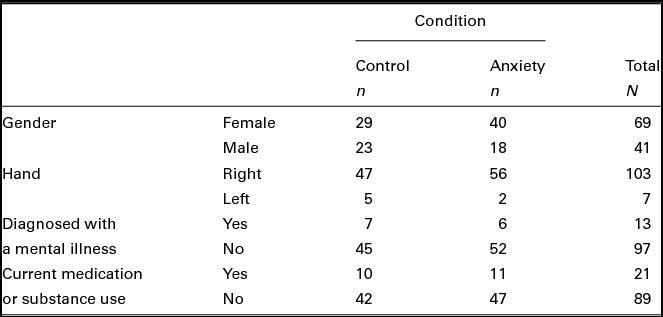
Chi-squared tests of independence were used to determine whether there were significant differences between participants in the anxiety and control conditions based on most demographic grouping variables. There were no significant participant differences between conditions for gender, χ2(1, N = 110) = 2.04, p =. 15; dominant hand, χ2(1, N = 110) = 1.75, p = .19; diagnosis with a mental illness, χ2(1, N = 110) = .26, p = .61; reported medication or substance use at the time of testing, χ2(1, N = 110) < .01, p = .97. An independent samples t test was used to examine whether participants in the anxiety and control conditions differed in terms of age. No significant difference in age was found between the two conditions, t(108) = −.27, p = .79.
Clinical measures
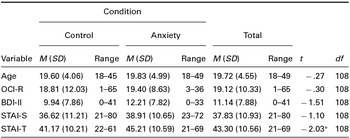
Independent samples t tests were conducted between the anxiety and control conditions for scores on the clinical measures. There were no significant differences in mean scores on the OCI-R, the BDI-II, or the STAI-S between conditions. However, there was a significant difference in the mean score on the STAI-T between the anxiety and control conditions, t(108) = −2.03, p < .05. On average, participants in the anxiety condition scored 4.04 points higher on the STAI-T than those in the control condition. Given that it had been planned that the depression and anxiety measures included in the questionnaire battery would be included as covariates in the main analysis, in line with the recommendation of Sachdev and Malhi (Reference Sachdev and Malhi2005), the between-condition difference in STAI-T scores was not considered problematic. Information regarding the distribution of participants between conditions on the basis of demographic variables, as well as the means, standard deviations, ranges of scores, and their associated t tests on the age of the current sample and their scores on the clinical measures can be seen in Tables 1 and 2.
Distribution of Demographic Characteristics Between Conditions
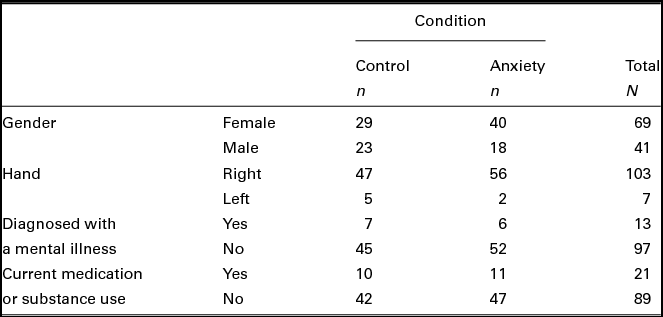
Note: N = 110.
Descriptive Statistics and Results of Independent Samples T Tests for Age and Clinical Measures

Note: M = mean; SD = standard deviation; df = degrees of freedom; N = 110. OCI-R = Obsessive Compulsive Inventory — Revised; BDI-II = Beck Depression Inventory — Second Edition; STAI-S = State-Trait Anxiety Inventory — State Subscale; STAI-T = State-Trait Anxiety Inventory — Trait Subscale.
*Significant at p < .05
Manipulation checks
The first manipulation check consisted of self-report ratings of anxiety on a 10-point scale. The mean rating of self-reported anxiety across all participants was 4.55 (SD = 2.65). Participants in the anxiety condition had a mean rating of 5.88 (SD = 2.35) and those in the control condition reported a mean rating of 3.08 (SD = 2.14). An independent samples t test revealed a significant difference in self-reported ratings of anxiety between the two conditions, t(108) = −6.52, p < .001.
The second manipulation check consisted of a yes/no questionnaire completed by participants in the anxiety condition. Participants were required to indicate whether or not they believed the anxiety manipulation. Of the 58 participants who had been allocated to the anxiety condition, 38% reported that they did not believe the anxiety manipulation. In spite of this occurrence, an independent samples t test revealed no significant differences in self-rated anxiety between participants who believed the manipulation and those who did not, t(56) = −.85, p = .40. However, there was a significant difference in global performance on the IGT as a function of whether or not participants in the anxiety condition believed the manipulation, t(56) = −2.30, p = .03. The mean score for participants who believed the anxiety manipulation (n = 36) was 22.11 (SD = 22.11; range = −22–94) on the IGT, while participants in the anxiety condition who did not believe the experimental manipulation (n = 22) had a mean score of −.45 (SD = 44.50; range = −100–100) on this task.
IGT performance
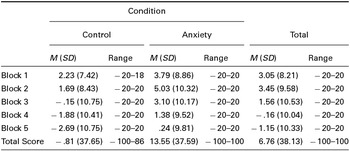
An independent samples t test revealed significant differences in total score on the IGT between the anxiety and control conditions, t(108) = −2.00, p < .05. On average, participants in the anxiety condition scored 14.36 points higher on the IGT than those in the control condition, indicating significantly poorer performance overall. Table 3 depicts the mean performance of participants on the blocks of the IGT, as well as global performance on the task.
Descriptive Statistics of Score on the IGT Between Conditions

Note: M=mean; SD = standard deviation; N = 110.
Main Analysis
Global decision-making effects
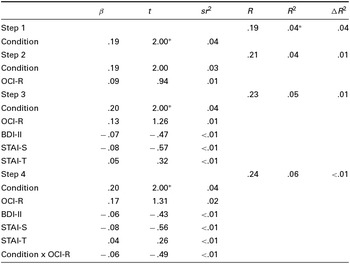
A bivariate correlation analysis was used to examine the relationships between variables of interest in general terms, and more specifically, whether a relationship between OC symptoms and decision-making existed in the current sample. A four-stage hierarchical regression analysis was conducted with total IGT score as the dependent variable to determine whether the experience of anxiety exerts a moderating influence on this relationship. Given that a significant relationship between condition and global IGT performance had been observed in preliminary analyses, it was decided that experimental condition would be entered as the first step of the model. The other main independent variable of interest, OC symptoms, was accounted for in step 2 when total OCI-R scores were entered into the model. Step 3 consisted of the entry of clinical covariates, to determine whether any relationships between OC symptoms and anxiety with decision-making held when these covariates were accounted for. Consequently, scores on the BDI-II, STAI-S, and the STAI-T were entered into the model at this stage. The fourth and final step of the regression model consisted of the entry of a computed interaction variable to assess whether the experience of anxiety, as a result of the experimental manipulation, moderated the relationship between OC symptoms and decision-making.
Testing of regression assumptions
Scatterplots of standardised residuals indicated that assumptions of the independence of errors, linearity and homoscedasticity were fulfilled for total IGT score. A histogram and normal probability plot of standardised residuals confirmed that the assumption of normally distributed errors had also been met.
Bivariate correlations
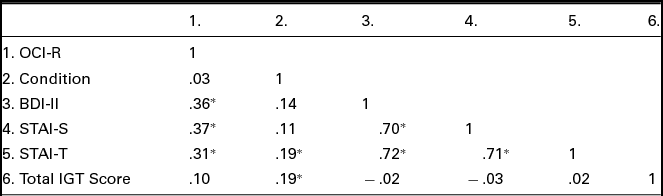
The correlations between total IGT score and the independent variables of interest are presented in Table 4. All of the clinical measures were significantly, and positively, related. These positive correlations were particularly high among the measures of anxiety and depression and signified that multicollinearity may have presented an issue for the analysis planned. There was a significant relationship between scores on the STAI-T measure and experimental condition, as discussed above. Experimental condition was also significantly associated with total IGT score. The nature of this relationship has also been delineated previously.
Zero Order Correlations Between the Dependent Variable, the Main Independent Variables and Other Predictors of Interest
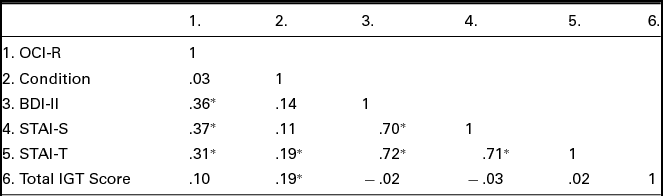
Note: N = 110. OCI-R = Obsessive Compulsive Inventory — Revised; BDI-II = Beck Depression Inventory — Second Edition; STAI-S = State-Trait Anxiety Inventory — State Subscale; STAI-T = State-Trait Anxiety Inventory — Trait Subscale.
*p < .05.
Analysis of the planned model
Model 1 of the hierarchical regression examined the efficacy of assigned experimental condition as a predictor of global IGT performance. It was found that experimental condition accounted for 3.6% of the variance in total IGT score. This proportion of variance explained was significant, F(1,108) = 4.00, p < .05. This first model is a simple linear regression model and it represents the relationship between experimental condition and total IGT score, which was discussed in the section ‘IGT performance’. Participants’ scores on the OCI-R were entered into the model at step 2. Together with experimental condition, scores on the OCI-R accounted for 4.4% of the variance in total IGT score. This proportion was not significant, F(2,107) = 2.44, p = .09. When participants’ scores on the BDI-II, STAI-S and STAI-T were entered into the model at step 3 in order to account for clinical covariates, the resulting model explained 5.4% of the variance in total score on the IGT. This proportion was not significant, F(5,104) = 1.18, p = .32. Although the reported bivariate correlations between clinical predictors signified a potential problem of multicollinearity, tolerance statistics for individual predictors were in the acceptable range. The interaction term was entered into the model in the final step. The final model accounted for 5.6% of the variance in total IGT score; this amount was not statistically significant, F(6,103) = 1.02, p = .42. A comprehensive account of regression coefficients and their associated t tests is presented in Table 5.
Hierarchical Regression Analysis for Variables Predicting Total IGT Score

Note: N = 110. OCI-R = Obsessive Compulsive Inventory — Revised; BDI-II = Beck Depression Inventory — Second Edition; STAI-S = State-Trait Anxiety Inventory —State Subscale; STAI-T = State-Trait Anxiety Inventory — Trait Subscale.
*p < .05.
Trends in decision-making
A repeated measures ANOVA was used in order to examine whether trends in decision-making differed as a function of OC symptoms and the experience of anxiety. Experimental condition was entered as the between-subjects variable and the five block scores that combine to form total IGT score constituted the repeated measures factor. Participants’ scores on the OCI-R were treated as a covariate. Of particular interest to the current study was whether fluctuations in performance throughout the task interacted with experimental condition, when OC symptomatology was controlled for as a covariate.
Testing of repeated measures ANOVA assumptions
The assumptions of a continuous dependent variable and a categorical independent variable that consisted of at least two independent groups were met. An examination of extreme values in the dataset did not indicate that there were outliers present, and a histogram showed that the distribution of the dependent variable appeared to be normal. However, Mauchley's test was significant, indicating that the assumption of sphericity had been violated, χ2(9) = 22.96, p = .01. Consequently, the Huynh-Feldt correction was utilised in analysis (ε = .94). It is an epsilon correction that adjusts the degrees of freedom in order to increase the critical value, thus countering the inflated type I error rate that violations of sphericity may result in (Muller & Barton, Reference Muller and Barton1989). The Huynh-Feldt correction was chosen specifically as a result of the assertion of Girden (Reference Girden1992) that when the Greenhouse-Geisser estimate of epsilon is greater than .75, the Huynh-Feldt correction should be used.
Analysis of the repeated measures ANOVA model
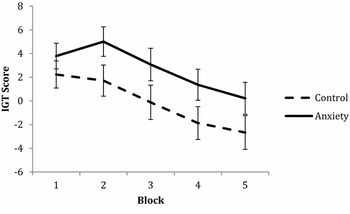
A graphical depiction of the differential performance of the anxiety and control conditions across blocks of the IGT when OCI-R scores are accounted for appears in Figure 1. There was a significant effect of block on IGT performance, such that participants’ scores consistently changed across the blocks of the task, F(3.77,403.78) = 9.29, p < .001. There was no evidence of a significant main effect of experimental condition, F(1,107) = 3.88, p = .051, or OCI-R score, F(1,107) = .89, p = .35, on performance across blocks. The interaction between block and experimental condition was not significant, F(3.77,403.78) = .31, p = .86. Nor was the interaction between block and score on the OCI-R, F(3.77,403.78) = .31, p = .86.
Comparison of performance on the IGT by block across condition when OCI-R scores are accounted for.

There was a significant linear trend in performance across blocks, F(1,107) = 23.44, p < .001. Performance on the IGT appeared to improve across all participants, regardless of experimental condition and score on the OCI-R, as the blocks in the task progressed. There were no other statistically significant trends within the main block effect, or either of the block by OCI-R score or block by experimental condition interaction effects.
A planned interaction contrast was conducted, examining whether the difference in performance between the first two and final two blocks of the task differed between the two experimental conditions when OCI-R score was controlled for. Blocks were combined in this manner to determine whether the experience gained over the first two blocks of the task exerted the same influence over decisions in the final two blocks of the task in both groups. The differential performance of participants in the anxiety and control conditions between the first and final two blocks of the IGT were not significantly different from one another, F(1,85) = .33, p > .05.
Discussion
This study aimed to fill the gap in the literature addressing the relationship between decision-making and the experience of OC symptoms by explicitly examining whether anxious arousal moderated this relationship. It also aimed to investigate whether there were differences in decision-making as a function of OC symptomatology in a non-clinical sample.
The first hypothesis that significant differences in decision-making would be found as a function of self-reported OC symptoms was not supported, since scores on the OCI-R did not significantly predict IGT performance. The most straightforward interpretation of this finding is that decision-making differences and the OFC abnormalities posited to produce them (Lawrence, Jollant, O'Daly, Zelaya, & Phillips, Reference Lawrence, Jollant, O'Daly, Zelaya and Phillips2009) are simply unrelated to OC symptomatology in non-clinical participants. Findings in this area relating to impairments in decision-making on the IGT have typically occurred when the performance of clinical patients is compared to that of healthy controls (e.g., Cavedini et al., Reference Cavedini, Riboldi, D'Annucci, Belotti, Cisima and Bellodi2002; Da Rocha et al., Reference Da Rocha, Alvarenga, Malloy-Diniz and Correa2011; Dittrich & Johansen, Reference Dittrich and Johansen2013; Starcke et al., Reference Starcke, Tuschen-Caffier, Markowitsch and Brand2010). Thus, while OCD symptoms may manifest to varying degrees across clinical and non-clinical populations, there are features of the disorder that may be specific to clinically diagnosable OCD. This accounts for findings of decision-making deficits in OCD clinical populations (e.g., Cavallaro et al., Reference Cavallaro, Cavedini, Mistretta, Bassi, Angelone, Ubbiali and Bellodi2003; Cavedini et al., Reference Cavedini, Riboldi, D'Annucci, Belotti, Cisima and Bellodi2002; Da Rocha et al., Reference Da Rocha, Alvarenga, Malloy-Diniz and Correa2011; Dittrich & Johansen, Reference Dittrich and Johansen2013), but inconsistent findings among non-clinical student samples that score highly on OCD measures (e.g., Johansen & Dittrich, Reference Johansen and Dittrich2013; Zhu et al., Reference Zhu, Yu, Ye, Chen, Dong, Li and Wang2014).
In accordance with the second hypothesis, participants in the anxiety condition demonstrated significantly more impaired performance on the IGT than controls. High trait anxiety has been linked to impaired decision-making on the IGT (e.g., De Visser et al., Reference De Visser, van der Knaap, van de Loo, van der Weerd, Ohl and van den Bos2010; Miu et al., Reference Miu, Heilman and Houser2008). Despite this, STAI-T scores and STAI-S scores were not correlated with IGT performance in this study. However, it is assumed that state anxiety levels changed as a result of the experimental manipulation, as evidenced by significantly higher levels of self-reported anxiety among participants in the anxiety condition following the manipulation. Furthermore, participants in the anxiety condition who reported that they believed the manipulation performed significantly worse on the IGT than those who expressed disbelief in the terms of the manipulation. Thus, the experience of anxious arousal appears to significantly degrade decision-making performance in the IGT.
This result is consistent with the Somatic Marker Hypothesis (SMH; Damasio, Reference Damasio1996). It is theorised that incoming emotional signals disrupt cognitive appraisals and are thus accountable for impairments in the performance of cognitive tasks such as decision-making (Dittrich & Johansen, Reference Dittrich and Johansen2013). This experiment is the first to explicitly test this notion and its results indicate that the anxious arousal experienced by participants in the anxiety condition may have served to interrupt the learning process whereby somatic markers were assigned to advantageous and disadvantageous choices. Consequently, participants in the anxiety condition may have lacked the assistance of somatic markers in the course of their decision-making in the IGT, leading to their poor performance relative to controls. While the results of the current study thus appear to support the SMH, it is necessary for this experimental paradigm to be repeated while accompanied by measurements of skin conductance responses and other signs of physiological arousal in order to confirm the validity of explaining these results by means of the SMH.
The hypothesis that the experience of anxiety would moderate the relationship between decision-making and OC symptomatology was not supported. Sachdev and Malhi (Reference Sachdev and Malhi2005) contend that anxiety results in the abnormal activation of the OFC among people with OCD, leading to impaired decision-making. As such, the moderating effect of anxiety on the relationship between decision-making and OC symptoms may be exclusive to patients with OCD. Given that anxiety has been shown to affect the efficacy of decision-making in the non-clinical sample utilised in this study, it may be a valid line of inquiry to examine its effects among a clinical population where impairments in decision-making have been established. Furthermore, there have been findings which suggest that the efficacy of decision-making on the IGT differs as a function of OCD subtype. Lawrence et al. (Reference Lawrence, Wooderson, Mataix-Cols, David, Speckens and Phillips2006) found that poor performance on the IGT was exhibited in hoarding and washing subtypes, but not others. Thus, future research may also consider applying the experimental paradigm utilised in this study to determine whether anxiety has a differential effect on decision-making which is subtype specific among patients with OCD.
The final hypothesis was not supported since performance on the IGT appeared to improve among all participants over the course of the task, regardless of their OCI-R score or the condition to which they had been assigned. A possible explanation for this finding is that a lack of orbitofrontal dysfunction in the current sample means that the learning mechanisms that facilitate task performance on the IGT remained intact among participants. Abnormalities in the OFC have been implicated repeatedly in theories accounting for decision-making impairments among patients with OCD (e.g., Da Rocha et al., Reference Da Rocha, Alvarenga, Malloy-Diniz and Correa2011; Sachdev & Malhi, Reference Sachdev and Malhi2005; Spitznagel & Suhr, Reference Spitznagel and Suhr2002; Starcke et al., Reference Starcke, Tuschen-Caffier, Markowitsch and Brand2010). If these abnormalities are pathology specific, non-clinical individuals would not be affected by the interference of orbitofrontal dysfunction in the process of learning task contingencies (Cavedini, Gorini, & Bellodi, Reference Cavedini, Gorini and Bellodi2006). Thus, this finding may have implications for the clinical understanding of OCD and the mechanisms that sustain the disorder.
The performance of participants in the anxiety condition appeared to improve over the course of the IGT while nevertheless remaining poorer than the performance of the control condition, overall. A possible explanation for this finding is that while the contingencies attached to the various decks in the IGT may have been comprehended by those in the anxiety condition, the degree to which the knowledge of these contingencies was utilised to inform decisions was consistently lower than in the control group. While Miu et al. (Reference Miu, Heilman and Houser2008) contend that anxious arousal renders affected individuals unable to learn deck contingencies in the IGT, it instead appears that this arousal may interfere in the adaptive application of these learned contingencies. It may be useful for future experiments to explore this idea using a paradigm that differentiates between the process of learning and the application of learned contingencies so that the mechanisms underlying the influence of anxiety on decision-making can be elucidated. Additionally, we suggest that future research examining how anxiety affects the relationship between decision-making and OC symptoms should draw their samples from clinical populations of OCD patients.
While this study explicitly attempts to address the link between cognition and emotional processing and how this relationship affects functional decision-making, it was also subject to some limitations. First, there was no selection of participants on the basis of OCI-R scores. Given that the mean OCI-R scores of the anxiety and control groups are similar to that of non-anxious controls reported by Foa et al. (Reference Foa, Huppert, Leiberg, Langner, Kichic, Hajcak and Salkovskis2002), the lack of participant selection may account for the non-significant effect of OCI-R scores on the efficacy of decision-making. Future studies should consider the application of this experimental paradigm to non-clinical groups with elevated OCI-R scores. Additionally, only one task was utilised to examine cognitive deficits in decision-making. As stated above, the IGT is a valid tool that is commonly used in this research area to capture deficits in decision-making. However, the inclusion of tasks such as the CGT or the GDT may further elucidate the specific effects of anxiety on decision-making in OC populations. Another limitation is that galvanic skin responses were not collected from participants as they completed the IGT. Future studies incorporating this data would add support to findings of OFC abnormalities that are indicated by poor performance on the IGT. Furthermore, it is unclear whether poorer performance on the IGT by the anxiety group in the current study can be attributed solely to anxiety, or whether distraction at the prospect of the upcoming speech may have been a contributing factor. Finally, the fact that this sample was drawn from a non-clinical sample limits the degree to which findings can be generalised to the clinical experience of OCD. The use of non-clinical samples in research relating to OCD has been justified by authors such as Wu and Cortesi (2009), who contend that the non-clinical experience of OC symptoms is similar to the experience reported by patients with OCD. Nevertheless, future studies wishing to explore how anxiety affects the relationship between decision-making and OC symptoms more definitively should draw their samples from clinical populations of OCD patients.
Conclusions
While the current study presents significant findings of the detrimental effect of anxious arousal on decision-making efficacy, the experience of anxiety was not found to moderate a relationship between differences in decision-making and OC symptomatology. Evidence of a significant relationship between OC symptomatology and decision-making performance on the IGT in a non-clinical sample was not found. Nor was there evidence that performance over the course of the IGT differs as a function of the degree of OC symptomatology, or whether participants were subject to the experimental manipulation. Despite some non-significant findings, the results provide a number of theoretical implications. They expose the possibility that decision-making deficits are implicated specifically with the clinical manifestation of OCD. The finding that anxiety results in decision-making deficits in a non-clinical sample is important, given that OCD patients are particularly sensitive to anxiety and distress (Sachdev & Malhi, Reference Sachdev and Malhi2005). There are important practical implications of any significant findings in the future of this research area. For example, if it is found that anxiety significantly moderates the relationship between decision-making and OCD, novel treatments that specifically target stress reduction may be integrated into treatment to aid in the management of this debilitating disorder.