INTRODUCTION AND THEORY
It has proven difficult to address climate change using large-scale transfers of resources from developed to developing countries. This is surprising for at least three reasons. First, the mitigation of climate change is a global public good, so the benefits are shared globally no matter where emissions are reduced. Second, a majority of citizens in developed countries support the mitigation of climate change. Third, the most cost-effective mitigation programs are located in developing countries (Bosetti et al. Reference Bosetti, Valentina, Carlo and Massimo2009; Calvin et al. Reference Calvin, Katherine, Pralit, Allen, Leon, Karen, Jae, Kim, Ron and Marshall2009; den Elzen, Paul, and van Vuuren Reference Elzen, Paul and van Vuuren2005; Landis, Florian, and Thomas Reference Landis, Florian and Thomas2012).Footnote 1 According to the theory about the efficient provision of public goods, support for international transfers should be high under these conditions, yet international transfers account for a small portion of mitigation efforts globally.
To shed light on this puzzle, we study whether the American public exhibits a home preference: preferring domestic rather than overseas mitigation. Existing research has assumed a preference for cost-effective policies among the public and policy-makers and has focused on overcoming other problems associated with providing public goods, such as negotiating relative contributions across countries (Cheon and Urpelainen Reference Cheon and Urpelainen2013; Eckersley Reference Eckersley2012; Tavoni et al. Reference Tavoni, Dannenberg, Kallis and Loschel2011; Tingley and Tomz Reference Tingley and Tomz2013), monitoring contributions (Aldy Reference Aldy2014; Aldy and Pizer Reference Aldy and Pizer2015), designing enforcement mechanisms (Barrett Reference Barrett2008; Hovi et al. Reference Hovi, Greaker, Hagem and Holtsmark2012), decreasing coordination costs and uncertainty (Barrett and Dannenberg Reference Barrett and Dannenberg2012; Keohane and Victor Reference Keohane and Victor2011), and managing heterogeneous preferences among potential contributors (Gampfer Reference Gampfer2014; McGinty Reference McGinty2006; Mendelsohn, Dinar, and Williams Reference Mendelsohn, Dinar and Williams2006). Two recent studies have considered support for international transfers, but one does not do so in comparison to domestic action and only relies on measures of attitudes (Gampfer, Bernauer, and Kachi Reference Gampfer, Bernauer and Kachi2014), and the other compares support across locations of mitigation programs, but only for private donations (Diederich and Goeschl Reference Diederich and Goeschl2017).
We investigate whether American subjects will act to support both public and private international transfers for mitigation as compared to funding domestic mitigation. We focus on public actions because politicians in the United States and elsewhere act in the shadow of the public when it comes to foreign policy (Tomz, Weeks, and Yarhi-Milo Reference Tomz, Weeks and Yarhi-Milo2017), and because private willingness to pay for voluntary emissions reductions is large (Diederich and Goeschl Reference Diederich and Goeschl2013). Indeed, both President Obama and President Trump have publicly addressed climate change mitigation and financing, showing that the public is of central concern.Footnote 2
On average, we expect individuals to prefer domestic programs compared to foreign programs for three reasons. First, home preference could result from poor information about the location of cost-effective programs (Rhodes, Axsen, and Jaccard Reference Rhodes, Axsen and Jaccard2014). If individuals are concerned with maximizing mitigation within a budget constraint, then preferences should tend towards countries that have perceived advantages in mitigation. If information about cost-effectiveness is not known, increasing knowledge that the most cost-effective options for mitigation are in rapidly industrializing countries (den Elzen et al. Reference Elzen, Paul and van Vuuren2005; Iyer et al. 2015; Olmstead and Stavins 2012) should cause the public to be more supportive of transfers.
Second, because of self-interest, individuals may support domestic programs that offer them tangible, personal benefits that are not shared globally.Footnote 3 Indeed, much of the popular coverage and political rhetoric about mitigation emphasize private co-benefits. During the Obama administration's public outreach campaign in support of America's Clean Power Plan, the President recorded a video emphasizing the domestic benefits of mitigation programs, like job creation, clean air, and technological leadership.Footnote 4 Indeed, politicians often attempt to engage the self-interest of the public when selling climate change mitigation.
Third and relatedly, individuals may have group interests that lead them to prefer programs that they perceive to primarily benefit people who are “closer” to them (Schelling Reference Schelling1995), such as their co-citizens. For example, subjects playing dictator games in laboratory settings more often send contributions to receiving players with the same party identity (Fowler and Kam Reference Fowler and Kam2007) and homogenous groups are more likely to succeed in providing public goods (Habyarimana et al. Reference Habyarimana, Humphreys, Posner and Weinstein2009). In sum, a home preference might arise because people perceive the in-group benefits of mitigation to be more salient than the globally-shared benefits.
We demonstrate that American subjects have a strong baseline preference to act in support of private and public funding for climate change mitigation at home rather than overseas. Home preference is only mitigated in the case of private donations when we successfully inform some subjects that programs located abroad are more cost-effective than domestic programs. Home preference is exacerbated when the private co-benefits of mitigation programs are highlighted. Our results indicate that climate policy based on international transfers faces significant constraints when it comes to engaging public support.Footnote 5
METHODOLOGY
Sample
We fielded two online behavioral experiments using participants recruited from Amazon's Mechanical Turk. In both experiments, the target population is the portion of the U.S. public hypothetically willing to support action to mitigate climate change, since we expect a lack of support regardless of location among individuals who dismiss climate change.Footnote 6 Our convenience samples (Experiment 1, September 2014, n = 1,140; Experiment 2, April 2015, n = 2,656) approximate the characteristics of our target population, since they are more educated and less conservative politically than nationally representative samples (Supplementary Information (SI), Table S1a–c) (McCright and Dunlap Reference McCright and Dunlap2011).Footnote 7 Thus, our sample meets the most important criterion when evaluating online experiments (Berinsky, Huber, and Lenz Reference Berinsky, Huber and Lenz2012; Huff and Tingley Reference Huff and Tingley2015). Nonetheless, we verify that the effectiveness of our manipulation is not affected by level of education (Table S8) and our main results are not conditional on party (Figures S2–S4).
Outcomes
We prompted Americans to make real donations to a non-governmental organization and to write letters to elected officials about public spending (see SI for full description). We examine both private and public spending for several reasons. Private donations are a natural behavior. However, they are not a behavioral measure of a public policy preference. Thus, we pair donations with the behavioral outcome of writing a letter to elected officials for government spending. Examining both private and public spending also offers a within-study replication across different funding channels and allows us to develop a new theory to the extent that the private and public results diverge.
In Experiment 1 for private donations, subjects are asked whether they would consider donating their own money to the World Resources Institute. If they reply affirmatively, they receive an unexpected $0.50 bonus and are given the chance to donate the bonus or to keep it.Footnote 8 In Experiment 2 for private donations, subjects pre-committed to split a potential $20 bonus between a donation to a domestic climate program, a foreign program, and/or their own payout. We use this second, multi-dimensional donation outcome to make opportunity costs salient and to rule out the possibility that an expressive benefit of supporting any mitigation when no choice is available attenuates treatment effects.Footnote 9 For public spending, we maintain the same location treatment and ask subjects to write to their congressperson supporting or opposing government spending for climate programs and to click a link to submit it in both experiments.Footnote 10
Experimental Treatments
In Experiment 1, we randomly assignFootnote 11 whether the mitigation program for which a donation and letter is requested will be implemented domestically (United States), in a friendly foreign country (India), or in an adversarial foreign country (China).Footnote 12 Second, we randomly assign some subjects to receive information about the cost-effectiveness of programs in their assigned country. Treated subjects are told about either the low (United States), medium (India), or high (China) cost-effectiveness of programs (see Table S4 for the experimental groups).
Experiment 2 has a different structure with five experimental groups. A pure control group received no informational prime. All other experimental groups receive a baseline prompt about the shared, global benefits of climate change mitigation. Within the remaining four treatment groups, we assigned two treatment arms independently (Table S5). Unlike Experiment 1, subjects assigned to the cost-effectiveness treatment received information about the cost-effectiveness of programs implemented both domestically and in rapidly developing countries. Subjects assigned to the co-benefits treatment received a prompt highlighting the local co-benefits of providing climate change mitigation, like a reduction in air pollution.Footnote 13
Estimation
To estimate our treatment effects, we use non-parametric randomization inference without covariate adjustment, which does not make any distributional assumptions about the data generating process (see Athey and Imbens Reference Athey, Imbens, Banerjee and Duflo2017 for a recent discussion). We assume the sharp null hypothesis has no effect for any subject, which allows us to posit a full schedule of potential outcomes. We then exactly replicate our randomization procedure, in this case simple random assignment, to assign each observed subject to a treatment condition assuming the sharp null hypothesis and record the observed average treatment in each of 10,000 trials. We use the resulting sampling distribution to calculate the one-tailed p-value of the actual observed difference in proportions or difference in means.
RESULTS
Location
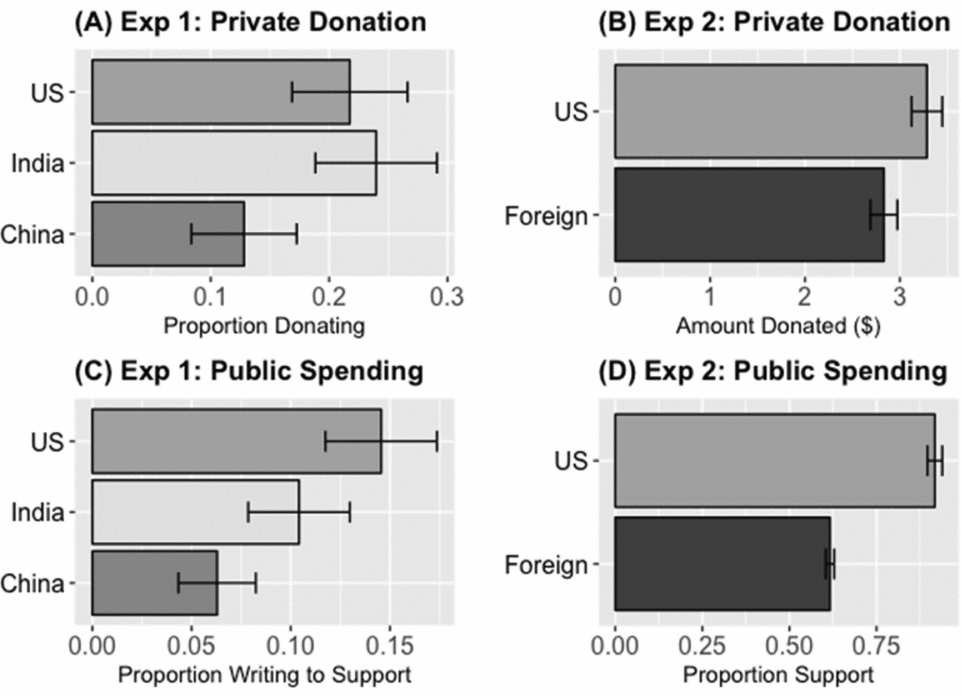
All of our experiments show a baseline tendency to support mitigation at home rather than abroad (Figure 1). In Experiment 1 (displayed in Figure 1 (Panel A)), approximately 22% of subjects donated an unexpected $0.50 bonus to support the U.S. program, compared with 24% for a program in India (te = 0.02, p = 0.69) and only 13% for a program in China (te = −0.09, p = 0.03). These results are restricted to the control group that did not receive information about the cost-effectiveness of programs. In Experiment 2 (displayed in Figure 1 (Panel B)), subjects in the pure control condition who were asked to split a potential $20 bonus between a donation to a domestic program, a foreign program, and their own payout show a significant preference to act at home (diff = −$0.45, p = 0.02).
Proportion of Subjects Supporting Climate Change Mitigation by Program Location.

Figure 1 (Panel C) shows the proportion of subjects in Experiment 1 who write a letter to elected officials in support of public spending, revealing an even stronger preference to act at home in the group not presented with information on cost-effectiveness. The proportion writing a note in favor of spending in the United States is 40% higher than the proportion writing a supportive note for India (te = −0.04, p = 0.18) and more than double the proportion in the China group (te = −0.10, p = 0.01). We find the expected results in the reverse order when considering letters discouraging spending (Figure S1).
Figure 1 (Panel D) shows the proportion of subjects in the pure control condition in Experiment 2 who state their support for public spending. This is the only outcome in any experiment for which the measure is attitudinal rather than behavioral, due to low uptake of the behavioral measure in Experiment 2 (see Table S1b–c for similar attitudinal items in nationally representative surveys). A staggering 91% of respondents supported government spending for programs located at home, while only 62% of respondents said they would support the U.S. government spending money on programs to mitigate climate change in rapidly developing countries (diff = −0.30, p = 0.00).
Together, these four sets of results show that the location of climate change mitigation significantly shapes behaviors related to private and public spending on mitigation. We further find that a strong home preference is consistent across subjects with different political preferences (see Figures S2–S4). Indeed, a home preference may be one of the rare points of bipartisan agreement related to climate change. Furthermore, we show that these results were not obtained because our subjects believe that the United States has a greater ability to implement programs compared to foreign countries (Table S7 and related discussion).
Cost-Effectiveness
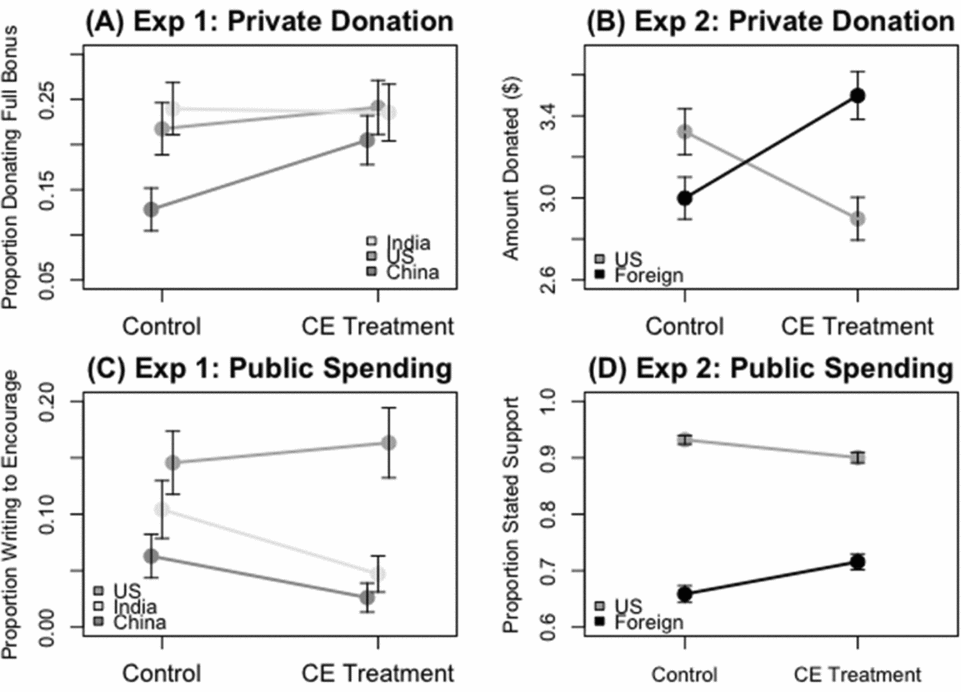
Next, we consider whether individuals act in response to information on cost-effectiveness. A manipulation check confirms that respondents understood this information and updated their beliefs on average (Table S7).Footnote 14 For private donations, cost-effectiveness information changes behavior as expected in most cases. For Experiment 1, displayed in Figure 2 (Panel A), learning that programs in China are the most cost-effective significantly increases the likelihood that the respondent donates their bonus (te = 0.08, p = 0.04). We did not have strong expectations about how subjects would react to information that programs located in India are “somewhat” cost-effective. Indeed, the probability of donating to a program in India after learning about cost-effectiveness matches the control group (te = −0.00, p = 0.64, two-tailed). For donations to programs in the United States, surprisingly, we observe no decrease in the rate of donation after information about low cost-effectiveness is presented (te = 0.02, p = 0.68), demonstrating the robustness of a preference to act at home. On the other hand, cost-effectiveness information increases the probability of donating to foreign programs such that there are no differences in preferences for donations to China as compared to the U.S. program (te = −0.04, p = 0.24) or to India (te = −0.01, p = 0.46). Home preference is mitigated by information, but not reversed.
Proportion of Subjects Supporting Climate Change Mitigation by Program Location and Cost-Effectiveness Treatment.
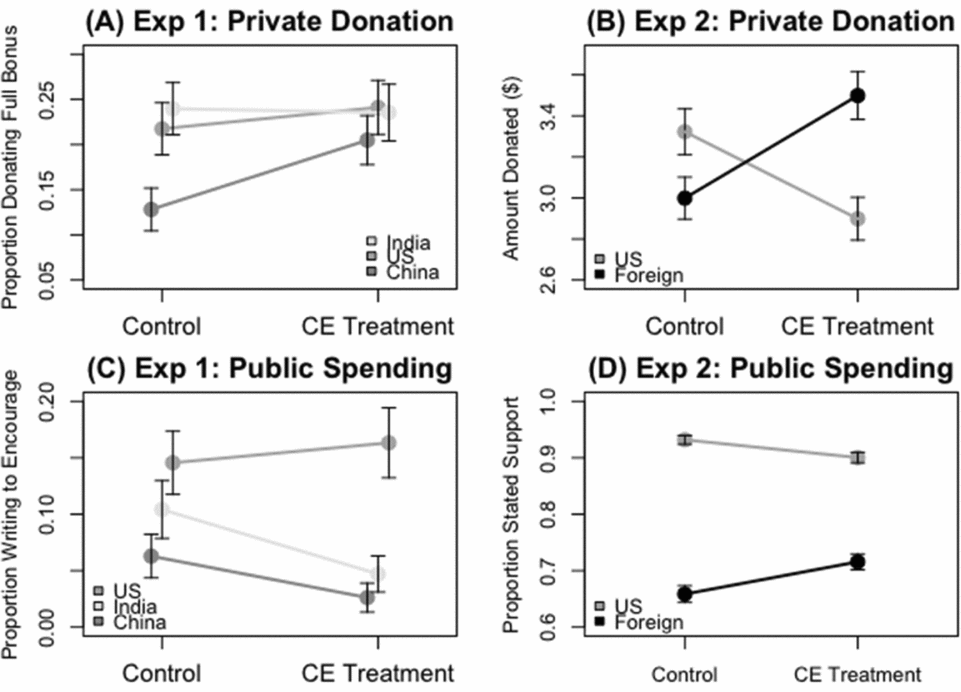
Figure 2 (Panel B) shows a strong and significant effect of cost-effectiveness information under the amended design of Experiment 2. Learning that foreign programs are the most cost-effective significantly increases the amount donated to those programs, while the effect on United States based programs is equal and opposite (foreign: te = $0.50, p = 0.00; United States: te = −$0.42, p = 0.00). Because respondents could keep any amount of their potential bonus, this equal and opposite effect did not obtain by construction. Subjects learn and act on information when other more cost-effective options for mitigation are available and global benefits are primed.
Turning to public spending, the effect of cost-effectiveness information is considerably more limited. Figure 2 (Panel C) shows that cost-effectiveness information actually reduces the likelihood that individuals write a letter in support of public spending on programs in India and China in Experiment 1 (India: te = −0.06, p = 0.08, two-tailed; China: te = −0.04, p = 0.97). Similarly, we see no change in the probability of supporting domestic programs, even though individuals are told that programs in the United States are the least cost-effective (te = 0.02, p = 0.72).
The results from Experiment 2, displayed in Figure 2 (Panel D), are more consistent with expectations, though the effects are muted as compared to donations. Respondents are slightly less likely to support government spending on programs in the United States and slightly more likely to support government spending on programs abroad when learning about the relative cost-effectiveness of these programs (United States: te = −0.03, p = 0.01; Foreign: te = 0.06, p = 0.00). Even with this information, a large gap remains in support for programs based on location.
Although the location of a program has a large effect on individual donations to a mitigation program, learning about the cost-effectiveness of programs can eliminate or even reverse the effects of location in some cases. This is never the case, however, for public programs. The fact that cost-effectiveness information has an effect on donation behavior but not letter writing behavior, suggests that poor information about relative cost-effectiveness may contribute to a home preference, but for public spending there are other factors at play. We suggest two possibilities.
First, considering public spending on international transfers may prompt individuals to think about the spending their government could do domestically on the same issue or others. Second, it could remind people that other countries have governments that could spend funds in their own countries to combat climate change. The statements of around two-thirds of the individuals who wrote to their representatives discouraging public spending in Experiment 1 use this logic (see SI for more details).Footnote 15 Future research could parse these explanations by designing experiments to explicitly compare justifications for behaviors related to public and private spending on climate change mitigation as well as other public goods.
Provisioning Benefits
Finally, we investigated whether the local co-benefits, or provisioning benefits, that obtain from climate change mitigation programs are driving our results. Individuals may prioritize the private benefits that accrue to countries that host mitigation programs—such as job creation and better local air quality—rather than the global benefits. We expect that priming individuals to think about provisioning benefits may strengthen the home preference, since individuals may be more inclined to support domestic programs and perhaps more opposed to foreign programs that provide exclusive benefits to foreign countries.
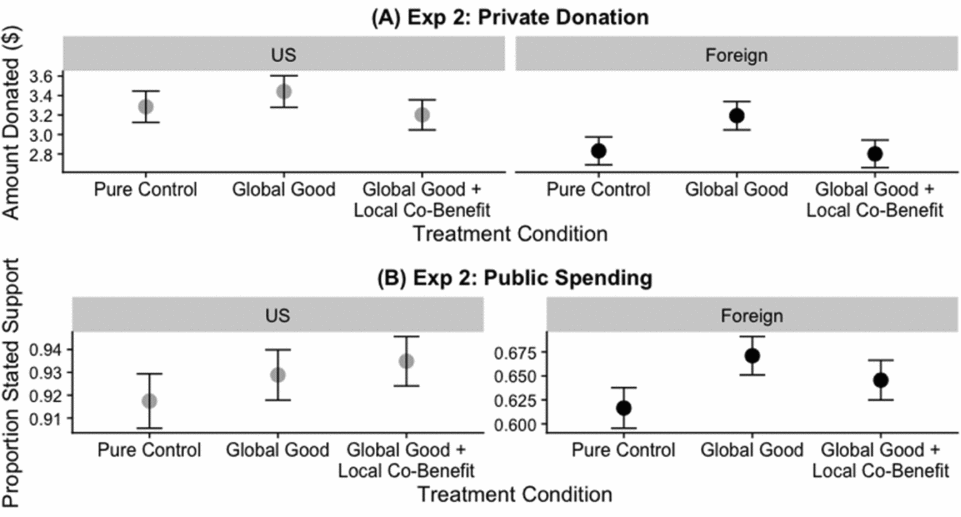
Only Experiment 2 contained an informational prime about provisioning benefits, which is always given when subjects are also provided information about the public goods nature of climate change mitigation (see Table S3). In Figure 3, the pure control group is provided with no informational primes, the control group (labeled in figure as “Global Good”) is provided with only information about the public goods nature of mitigation, and the local co-benefit group is provided with information about both the public goods nature of mitigation programs and provisioning benefits.
Amounts Donated and Proportion of Subjects Supporting Climate Change Mitigation by Program Location and Provisioning Benefits Treatment.

Figure 3 (Panel A) contains the findings for the donation outcome. For donations to U.S. programs, we cannot reject the null that providing information about the public goods nature of climate change mitigation does not change donation rates (te = $0.16, p = 0.50, two-tailed). Likewise, highlighting the local co-benefits of mitigation programs does not change donation rates by an amount that is inconsistent with the null (te = –$0.12, p = 0.78), possibly because local benefits are already salient. By contrast, the public goods prime significantly increases donations to foreign programs (te = $0.36, p = 0.06) and the provisioning benefits treatment significantly decreases donations to foreign programs (te = –$0.31, p = 0.02). These results confirm that subjects on average perceive the benefits from climate programs to be rival.
The findings on the government spending outcome, displayed in Figure 3 (Panel B), show that highlighting the public goods nature of climate change mitigation does not increase support for U.S. programs (te = 0.01, p = 0.24), but does increase support for foreign programs at magnitudes inconsistent with random chance (te = 0.05, p = 0.03). The provisioning benefits treatment in contrast increases support for government spending on domestic programs and decreases support for government spending on foreign programs though these effects are not significant at traditional levels (United States: te = 0.01, p = 0.21; Foreign: te = –0.02, p = 0.16). There remains across all conditions a large and significant difference (note the different y-axis scales) between domestic programs (strongly supported) and programs located abroad (moderately supported).
DISCUSSION
Although many Americans appear willing to act to support domestic mitigation efforts, our experiments show that this behavior weakens at the water's edge. These findings contribute to theoretical debates on providing public goods in at least two ways.Footnote 16 First, we build on the work on group identity and public goods to show that nationality is an important identity conditioning support for global public goods. Future work should explore the role of nationality as it pertains to support for other international public goods, such as foreign aid and global health spending. Second, we identify differences across actions in support of public spending and private donations. While previous work has primarily focused on whether private action crowds out support for public programs (see, e.g., Werfel Reference Werfel2017), we address differences in the factors that predict action across the two domains. We show that a home preference is particularly strong for public spending, but malleable for private donations. Future work can explore whether these differences obtain, for example, because individuals have unique preferences about spending their own money versus public funds or because they have strong beliefs that governments should be oriented towards domestic concerns.
Our work strongly suggests that politicians will be able to more effectively persuade the public to take action to mitigate climate change at home and will likely find that putting much effort into transfer schemes will significantly limit the coalition that can be assembled for ambitious action.Footnote 17 This has two main implications for policy and policy research. First, scholars may need to reconsider researchFootnote 18 that for decades has focused on coordinated solutions to mitigation that take advantage of cost-effective international transfers via mechanisms such as carbon markets (Flachsland, Marschinski, and Edenhofer Reference Flachsland, Marschinski and Edenhofer2009), technology transfers (Yang, Zili, and Nordhaus Reference Yang, Zili and Nordhaus2006), and carbon offsets (Kindermann et al. Reference Kindermann, Obersteiner, Sohngen, Sathaye, Andrasko, Rametsteiner, Schlamadinger, Wunder and Beach2008). Second, transfers are the glue that holds recent climate agreements together and if there is weak support for such transfers in countries that must supply them, then the foundation for such agreements is on shaky ground. Although the main objections to transfers from the United States, such as those directed through the Green Climate Fund, have largely come from Republican politicians, our findings show broader resistance among the public to transfers as compared to acting at home. Over the longer term, we must conclude that more mitigation is likely to be accomplished by focusing on ambitious policies and programs at home that have public support, even if those policies are not optimal in terms of cost-effectiveness globally.Footnote 19
CONFLICT OF INTEREST STATEMENT
The authors did not use external funding or receive remuneration for the research. The authors report no conflicts of interest. No party had the right to review this research prior to publication.
SUPPLEMENTARY MATERIAL
To view supplementary material for this article, please visit https://doi.org/10.1017/XPS.2017.34