There is no question that the Christian Churches in Britain have declined in power, popularity and prestige. Different indices of involvement follow different trajectories but few will disagree with Callum Brown's conclusion that church attendance was ‘historically very high’ in 1851 when the Census of Religious Worship suggested that between 40 and 60 per cent of the adult population attended church on 30 March and that church membership grew through the second half of the nineteenth century ‘to reach a peak in England and Wales in 1904 and in Scotland in 1905’.Footnote 1 In 1966 Bryan Wilson published his seminal Religion in secular society and the following year Peter L. Berger published The sacred canopy,Footnote 2 two works that between them contained much of the sociological secularisation paradigm that seemed to explain the decline of religion in Britain. As the rate of decline of the Churches has accelerated since the 1960s, one might have thought the secularisation paradigm would now be largely uncontroversial but criticism remains widespread.
A brief summary invariably glosses over differences of emphasis between scholars but there is enough of a common sociological approach to secularisation to provide the context for this paper. The sociological account argues that a series of complex changes, typically glossed as ‘modernisation’, weakened the certainty with which people held religious beliefs, and thus hampered the successful transmission of the faith from one generation to the next. Increasing individualism, the decline of the traditional residential community, increasing cultural diversity and the increasing rationalisation of public life combined gradually to marginalise shared faiths. In the sociological account, the decline of the Churches is seen as a symptom of a wider decline in the plausibility and salience of supernaturalist belief systems. Against this, scholars have argued for a variety of alternative understandings which reject the idea that the decline of the Churches indicates a decline in demand for, or interest in, religion per se. One common thrust of such revisionism is that there is a body of religious belief and practice outside organised religion which endures and persists. Grace Davie, for example, has argued that the decline of the Churches owes more to a loss of interest in public association than to a loss of faith and that Britons remain ‘believing but not belonging’.Footnote 3
This essay considers the ‘popular religion’ critique of the secularisation approach. It uses material from a re-examination of religion in the north Yorkshire fishing village of Staithes to question the possibility that a vibrant folk religion can survive the collapse of institutional Christianity. It will argue that the evidence supports what logic would suggest: religion beyond the Churches is dependent on a core of organised religion and, although elements of a popular religion culture can endure for some time after the core begins to shrink, such survivals require a climate of collusion between committed Christians and the wider population that breaks down once the institutional core is clearly deviant. The case will be made that, far from being immune to secularisation, popular religion is doubly vulnerable: it is directly eroded by the changes that erode institutional religion and it is indirectly undermined by the decline of the Churches. Without an institutional core, a popular religious culture cannot be sustained.
Staithes has been chosen not because it is typical of villages in rural Britain but because David Clark, in his Between pulpit and pew, used it to make a strong case for the enduring nature of popular religion and because others have since cited it to the same purpose.Footnote 4 Staithes is something of an outlier (both in its current secularity and in its previous religiosity) but other villages in the Cleveland area are similar.Footnote 5 That it is an outlier has the heuristic advantage of dramatising what is at issue in the debate.
Popular religion
Historians such as James Obelkevich, Jeffrey Cox and Sarah WilliamsFootnote 6 are right to draw attention to what Richard Sykes calls the ‘rich flora and fauna of religious beliefs and practises … profoundly shaped by an apparently seamless web of religiosity drawing on folk, superstitious and orthodox elements’Footnote 7 that exists beyond the world of churches and chapels. What is at issue in arguments over the secularisation thesis is the relationship between institutional core and popular religion.
As Sykes notes, what is presented as popular or folk religion includes superstition that has varying degrees of connection with Christian ideas, popular appropriations of Christian themes and rituals and occasional involvement with Christianity (for example claiming a Christian identity, using religious offices for rites of passage and attending church for such major services as harvest festivals, Christmas and Easter).Footnote 8 Williams defines popular religion as ‘a generally shared understanding of religious meaning including both folk beliefs as well as formal and officially sanctioned practices and ideas, operating within a loosely bounded interpretative community’.Footnote 9 David Clark stresses another feature when he adds that the popular appropriation of the activities of the Christian Churches may be at odds with the intentions of the Churches: not just beyond but against institutional religion.Footnote 10
Limitations of space allow only a brief discussion of superstition. Rather, this article will focus upon the enduring popularity (or otherwise) of occasional and peripheral involvement with the Churches, which is what mostly concerns those who use popular religion to rebut the secularisation thesis. Williams, for example, presents her material under four chapter headings – urban folk religion, occasional conformity, the ideal of the true believer and religion by deputy. The last three concern people's relationship to the Churches, while the first is largely concerned with quasi-Christian beliefs and rituals.
Nor will there be discussion of ‘implicit religion’: the idea that apparently secular activities should be seen as religious because they share personal or social functions with religion conventionally viewed. Timothy Jenkins, for example, might be right that the typically secular subjects of his studies of Religion in English everyday life Footnote 11 share many of the concerns (such as establishing respectability) that were once expressed through religious affiliation and practice but that provides no warrant for arguing, as he does at length, that the secularisation thesis is wrong. For matters that were once dealt with within a religious framework now to be managed in a secular manner seems good evidence of secularisation. Even at its most convincing, the notion of implicit religion invites contrast with explicit religion.
The idea of popular religion is important and useful, but it becomes misleading when it is presented as refutation of the secularisation thesis, because a vital element of the argument is usually missing: there is little attention to change over time. Williams shows that there was a lot of religion beyond the Churches in Southwark between 1880 and 1939, and concludes that concentrating on indices of involvement in institutional religion is a mistake; so the secularisation thesis, which is often illustrated with such evidence, is mistaken. And it is not only mistaken for Southwark 1880–1939; it is mistaken tout court. To quote the final words of her book:
We need to understand how successive generations continued to construct, communicate, and adapt religious language if we are to appreciate popular religion as a distinctive system of belief in its own right, persisting not only beyond the advent of the modern industrial world but also into the post-modern era in which we find ourselves today.Footnote 12
She does not actually show that popular religion persists. She shows that during one period, between 120 and 70 years in the past, there existed a vibrant popular appropriation of what was still then a persuasively powerful official religious culture. She does not track that culture for long enough (and for long enough after the decline of the Churches) to inspire confidence that successive generations really continued to have any great interest in religion, popular or otherwise. As Hugh McLeodFootnote 13 has pointed out, sociologists of secularisation are often unhelpfully vague about the dating of the starting point, but classically the contrast is between the ‘Christendom’ of a largely agricultural society (say 1800) and the secularity of 2000. Studies of popular religion generally cover only a couple of generations, or worse, are single time frames. Jenkins, for example, presents an account of Whit Walks in the 1980s in the Kingswood area of Bristol as part of a rejection of the secularisation approach.Footnote 14 What he does not do is tell us how such walks compared in popularity and scale with those of 1950 or 1920.
This leaves open an obvious riposte to the popular religion critique: that attention to change over time would show that popular religion has declined in tandem with institutional religion. Rather than being an enduring autonomous culture which shows that interest in religion (defined broadly) has not declined, the most important elements of popular religion at least are inexorably tied to institutional religion.
Staithes and its religious institutions
David Clark's Between pulpit and pew, based on fieldwork carried out between 1974 and 1976, is a richly detailed study of the religious life of Staithes. The village lies 10 miles up the coast from Whitby and 18 miles south-east of the Cleveland industrial conurbation. It was built around a deep narrow creek and is hemmed in by hills and cliffs, its cottages piled one on top of another. In the 1960s two small estates of council houses were built on the high ground inland. Over the course of the twentieth century, the population of Hinderwell parish (which contains Staithes) fluctuated with the fortunes of the local economy. Its peak was 2,608 in 1920s; in 2006 it was estimated at 2,010, with about half resident in Staithes.Footnote 15 In the first part of the twentieth century the main occupations were fishing and ironstone mining. The ironstone industry shrank in the 1940s and 1950s and the last iron mines closed in the early 1960s, but they were replaced by potassium carbonate mining in the 1960s. During Clark's time more than seventy villagers worked at the Boulby Potash mine. Others worked at the British Steel rolling mills at Skinningrove some seven miles away. There were ten teachers living in the village. Many women worked in offices and shops in Loftus and Middleborough to the north or Whitby to the south. By Clark's time there were few full-time fishermen.
Although geography and geology made Staithes somewhat isolated, it had a regular train service between 1865 and the late 1950s and, along with neighbouring coastal villages, it was a popular tourist resort. The area attracted painters: Laura and Harold Knight created something of a ‘Staithes School’ when they lived there from 1900 to 1907.
The Anglican parish church base was two miles away in the village of Hinderwell and was supported mainly by farmers. The lack of an Anglican presence in the village left the fisherfolk open to dissenters. The Congregational chapel opened in 1823. Wesleyan Methodists had a society in 1821 and a chapel building from 1824. The Primitive Methodists recorded a society in that year and in 1838 opened a purpose-built chapel, seating 200. The 1851 Census of Religious Worship gives us a good indicator of the strength of the chapels. The total attendance at the most popular services of the three chapels was 570, about 60 per cent of the population. And each chapel had more than sixty children in its Sunday School. With growth came respectability. The foundation stone of the 1865 Wesleyan chapel (with 500 seats in the church and 250 seats in the schoolroom) was laid by the marquis of Normanby. A contemporary press summary of his speech neatly expressed his interest in evangelical religion:
He trusted that the children might learn in the schoolroom lessons of veneration and subordination which would be of benefit to them even in this life and that in the chapel they would be instructed in the truths of our common Christianity. The Marquis was at pains to point out that as a member of the Established Church, he entertained a sincere veneration for the Anglican tenets, but he did not think it proper to interfere with those who sincerely differed from him in their mode of worshipping God.Footnote 16
From 1875 the Wesleyan Loftus and Staithes circuit of nine chapels had two full-time ministers: one in Loftus and one in Staithes. The Primitives had seven chapels in a Staithes circuit with more than sixty lay preachers. Bethel, the Congregational chapel, had also prospered. Recruiting more from the inland farming and mining communities, in 1862 it attracted some 150 attenders to its services and had some 100 children in its Sunday school.
The Church of England was slow to react to the growth of dissent. In 1874 it licensed its National School Room in the village for services and the Hinderwell evening service was moved to what was dedicated as ‘the Mission Church of St Peter the Fisherman’.Footnote 17 It never seriously competed with the three chapels and in the 1970s only a handful of villagers attended its services. Clark notes that there had only been eight Anglican baptisms since 1874. In 1884 a Catholic Church was built inland in the higher part of the village – Lane End – but it attracted few people from Staithes. Clark found only one Catholic family in the village.
One mark of the strength of chapel culture was the village's sabbatarianism. In the second half of the nineteenth century the sabbath was kept free of unnecessary work and public secular leisure. The fishermen got into harbour before midnight on Saturday and did not sail again until just after midnight on Sunday.Footnote 18 Another sign of the influence of Evangelical religion was a change in boat names. The seventeen boats built in Staithes between 1755 and 1835 were named Midsummer, Good Intent, Industrious Farmer, Adventure, Brotherly Love, Happy Returns, Two Brothers, Pomona, Friends Glory, Thomas and James, Flora, John and Elisabeth, Sophia Ann, Friends, Ceres, Endeavour Increase and Ocean.Footnote 19 The local historian John Howard lists the following late nineteenth-century boat names: Simon Peter, Good Samaritan, Soar, Rock of Ages, Rose of Sharon and Star of Bethlehem.Footnote 20
By the time that Clark began his fieldwork in 1974, the chapels had shrunk. Most affected was Bethel, presumably because it drew more heavily than the Methodist chapels on the two inland populations that had declined in numbers (although not, in the case of the farmers, in prosperity). It had not had a resident minister since 1965 when it withdrew from the Congregational Union of England and Wales and subsequently declined to join the United Reformed Church.Footnote 21 Its morning service attracted fewer then ten people and its evening services attracted an average of only thirty. The Wesleyans had thirty-four members and average attendances of twenty at the morning service and thirty in the evening. However the Sunday School remained popular with fifty children on the roll and two-thirds attending regularly. The formerly Primitive Methodist High Street chapel had thirty-two members, with average attendances of fifteen in the morning and twenty-five in the evening. But, as with the Wesleyan chapel, Sunday School was relatively more popular with forty scholars on the rolls.
Popular religion in Staithes
Clark follows his evidence of chapel decline by noting ‘this apparent institutional atrophy belies a persisting relevance in the community’.Footnote 22 Evidence of that relevance for non-members included identifying with a chapel, attending church-based social events, sending children to Sunday school, occasionally attending services, singing hymns in a non-church context, keeping the Sabbath and using religious offices for rites of passage.
Both Methodist chapels had a Bright Hour meeting, which drew its support ‘from a broad circle of women who consider themselves as either Wesleyans or Primitives, even though … this self-image may be rooted in the most limited ties to the chapel’.Footnote 23 Apart from opening and closing with prayer, the Bright Hour was mainly social: like the meetings of the Women's Institute, the Bright Hour entertained and educated its attenders with handicraft displays, talks from visiting speakers and the like. In addition to these weekly events, both chapels organised many coffee mornings, ‘autumn fairs’ and other fund-raisers that were well-supported by villagers who were not regular chapel attenders.
Almost all the village children were enrolled in a Sunday School and one of the highpoints of the chapel year was the Sunday School anniversary (also known as ‘Piece-saying Sunday’). All the children memorised a ‘turn’ – a song, a piece of Scripture or a poem – which they performed on Sunday and again on the Monday evening. Serious effort was put into preparation. The children were rehearsed on weekday evenings a couple of times a week in the month before the event. The purchase or making of new clothes for the children was synchronised with the annual event so that they would be turned out in their new Sunday ‘best’. An elderly lady in the village described the system thus:
Wesley held their SS Anniversary on the first weekend in February, Bethel held theirs on the third weekend and the Primitives held theirs on the first weekend in March. Each anniversary was a celebration and family and friends would rally round and attend the services to support their particular children/grandchildren. The services were very well attended but some people would not be seen in Chapel again until the next year's anniversary. There were three services: Sunday afternoons and evening and then again on Monday evening after a public tea. Clapping was allowed at Monday's service. ‘Pieces’ were said at each service except on the Sunday afternoon at Wesley. This service took the form of a question and answer session when each child was examined in the Conference Catechism, the Sunday School Superintendent asking the questions. Because of the Catechism it was traditional for the girls to wear white dresses.Footnote 24
A similar system operated in the Methodist chapel at Runswick Bay a few miles down the coast. In his reminiscences, Jazzer Johnson describes himself as the only bairn in Runswick Bay who did not go regularly to Sunday School but even he took part in the Anniversary piece-saying: a price he thought worth paying for the privilege of going on the Sunday School outing.Footnote 25
One of the best-known elements of a popular religion culture in the village was hymn-singing. The revivalist songs of the Ira Sankey songbook were a great favourite. ‘Old Singing Isaac’ Verrill was the second of five generations of the same family to run the Primitive Methodist chapel. He gained his sobriquet from his custom of singing at the wake and at the graveside of every villager: a custom that others continued into the 1960s. On Sunday evenings in summer in the 1930s large numbers of men gathered on the harbour front. Henry Verrill gave out the note and they struck up a hymn and marched up the road. As they passed each chapel, the men would peel off to their respective places of worship. One appropriate and popular choice had the chorus ‘We're marching to Sion/ Beautiful beautiful Sion/ We're marching upward to Sion/ The beautiful city of God.’ One choir sang at London's Crystal Palace in 1900. In the 1940s a Willie Verrill led a quintet which broadcast on the BBC a number of times.Footnote 26 That grew into a large choir which was proficient enough to perform in the Manchester Free Trade Hall.
One of the main themes of Clark's work (the reporting of which caused locals to dislike him sufficiently for unpleasant associations to persist for thirty years) was the almost subversive nature of folk religion. Most obviously, the villagers showed relatively little interest in the Christian Church's hierarchy of calendrical events; they were much more interested in Sunday School and chapel anniversaries than in Easter, for example. And their identification with ‘their’ chapel was so strong that local rivalries subverted the Methodist Church's attempts to rationalise provision in the village and often led to what Clark regards as patently unChristian attitudes and behaviour.
Clark summarises the links between chapel and popular religion in two key texts:
for the majority of children, week by week involvement with the chapel ceases at the age of twelve or thirteen; henceforth attendance is usually restricted to the important events of the life and annual cycles. Despite its apparent arbitrariness, this form of chapel affiliation is likely to be lifelong.Footnote 27
and
For adults, nominal affiliation, grounded in the Sunday Schools, means attendance at the main events of the chapel year, such as Harvest festivals, and anniversaries … Undoubtedly it presupposes the baptism of one's children in the chapel and the expectation that one's funeral will eventually take place there. Nominal affiliation elicits support for coffee-mornings, bazaars, jumble sales and even, in some cases, extends to making commentary gifts to chapel funds in lieu of Sunday attendance. Above all, it signifies a deeply felt identification with the traditions of both village and chapel alike.Footnote 28
Repeatedly Clark reports changes in the culture of popular religion that are hard to describe in terms other than decline. His evocative description of funerals, for example, notes that villagers no longer sing hymns at the graveside or outside the home of the deceased. His account of the Sunday School anniversaries reports various strategies that the chapels use to disguise the fact that such events are no longer as popular as they were in the pre-war era. In a discussion of ‘churching’ (which was so attenuated that merely to step inside the chapel was enough for a recent mother to be ‘cleansed’ and returned to circulation), he makes it clear that such customs are no longer popular. None the less, he commits himself to a critique of the secularisation thesis based on the enduring nature of popular religion: ‘The evidence from Staithes clearly points to [folk religion's] persistence and vitality.’Footnote 29
Staithes in 2009
What has happened to institutional religion in Staithes since Clark's study was published? As of 2008 the Lane End Catholic Church continues to have occasional services but these attract no more than the tiny numbers that attended in the 1970s. Although very occasional services are scheduled there, St Peter's, the Anglican mission room, is now a bookable community arts centre. Bethel closed sometime in the 1980s. Remarkably, its demise was so complete and its passing so little mourned that despite much effort it was impossible to trace anyone who had been a member.
The merger in 1932 of the three main bodies of Methodism – Wesleyan, United and Primitive – called into question the continued value of having two large chapels within a stone's throw of each other but both societies firmly resisted repeated merger. Elsewhere in the circuit, rationalisation was slow but it did gradually occur. In 1946 two Loftus societies merged. A year later the two societies in Hinderwell united, as did those of Skinningrove. The chapels at Brotton West and Streethouses were closed in 1948. In 1961 the Wesleyan and Primitive chapels in Carlin How merged. But the Staithes chapels remained obdurately separate. In 1973 the Circuit Quarterly Meeting noted that ‘It was necessary to do something about the churches at Staithes’.Footnote 30 Four years earlier, a District Replanning Committee had recommended that four of the circuit's chapels close. In Staithes, High Street (which was in a more prominent position) was to be retained. Members of Wesleyan firmly opposed the decision and no action was taken. In 1973 the recommendation was reversed: Wesleyan was to be retained. Again the decision was ignored. Between 1970 and 1975 the two chapels were forced to rotate services but this arrangement was resented strongly and equally by both sides. Many would not attend services at ‘the other’ chapel and Clark's detailed account of collection receipts suggests that those who did attend the away services ‘held back’ their donations. In 1976 both chapels reverted to having two services each every Sunday.
In 1981 the situation resolved itself when, to quote from a letter sent by the superintendent minister to all members:
The Church Council at High St Chapel found themselves unable to provide Church Officials to carry out the necessary duties demanded by the Constitution and Practice and Discipline of the Methodist Church. The Banks, auditors, Charity Commissioners and the Methodist Church Act all require that properly elected Church Officials serve, and perform their duties as representatives of the managing Trustees. It is sad to think that our people at High Street Chapel, having served so faithfully, are now, because of age unable to carry on.Footnote 31
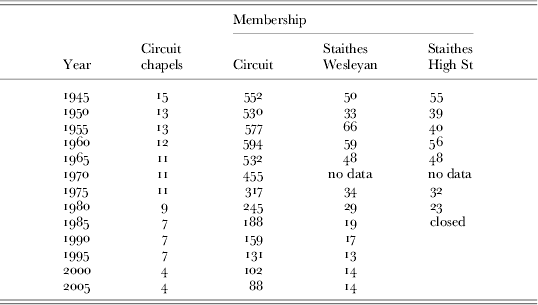
Most members of High Street did not transfer to Wesleyan (see Table 1). Between 1980 and 1985 membership at Wesleyan fell from twenty-nine to nineteen, despite the availability of twenty-three members of the former Primitive Methodist chapel. The lack of any corresponding increase in neighbouring chapels suggests that the refuseniks did not transfer to more distant homes. Doubtless some of the missing twenty-three Staithes Methodists were only nominal members whose tenuous commitment was ended by the need to affiliate elsewhere but it must be the case that many who had been committed members of High Street simply stopped being Methodists. Its new status as sole chapel in the village did not help Wesleyan. Membership continued to decline and in 2005 stood at fourteen with a typical Sunday attendance of only ten and no Sunday School.
Membership: Loftus and Staithes Methodist circuit and Staithes chapels, 1945–2005
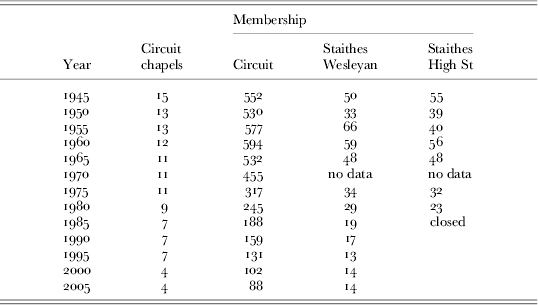
In 1997–8 the Loftus and Staithes circuit merged with the Redcar, Saltburn and Guisborough circuit to become the Cleveland circuit, which in 2005 merged with Danby to become Cleveland and Danby. Figures for circuit membership are for only those chapels that were part of the original 1940 Loftus and Staithes circuit. Figures for 1945–85 are taken from contemporary quarterly preaching plans. For most of the period membership figures were revised every quarter. Figures given in the second preaching plan of each year are usually taken as the membership for the close of the previous year. Figures for 2000 are from Sheila Crossman and Bob Preston (eds), Southside story: the first hundred years, 1907–2007, Guisborough 2008, 53.
To pre-empt one possible criticism of presenting this sort of institutional data as evidence of the religious interest of Staithes people, it is worth adding that there is no evidence of any significant number of villagers attending church or chapel further afield. Membership at the nearest chapel outside the village – Hinderwell – was around fifty in the 1970s. In 1998 it was eighteen (with an average of 16·5 attendances on a typical Sunday). In 2007 membership was fourteen with attendances at 11·3. Since 1970, as Table 1 shows, membership for the Loftus and Staithes circuit has fallen from 455 to 102. Other denominations in the area have also recorded large falls in membership and attendance. The only URC church in the area (at Loftus) closed in 2003 and the nearest Congregational chapel – in Whitby – was reduced to meeting in a front room in the 1990s. It is possible that a significant number of Christians in Staithes now worship elsewhere but the available statistical evidence does not suggest it and no such pattern was mentioned by informants.
Having charted the decline of the village chapels, what of Clark's elements of popular religion? Sporadic attendance has ceased completely: no non-members attend the remaining chapel, there is no Sunday School for village children to attend and there are no ‘Piece-saying’ Sunday services to attract adult well-wishers. Not even Christmas can stimulate attendance: in recent years, the nearest carol services were in Skinningrove Village Hall, some seven miles away, and they were poorly attended. There are no longer any social activities organised by the chapels: no weekly Bright Hour meetings, no church bazaars and no coffee mornings. Rites of passage are now very rarely celebrated in the remaining chapel: very few children are baptised there; most marriages are not celebrated in the chapel; and the few funerals there are those of existing members. More than a quarter of a century after Bethel and the High Street chapel closed, and with the remaining Wesleyan chapel on its last legs, it is unlikely that the more than a handful of villagers retain any notion of themselves as belonging to a chapel.
There is no longer any public singing of hymns. The custom of singing by the graveside has died. The last of a series of choirs that recruited from the chapels and broadcast their repertoire of hymns ceased in 1980. In 1985 some members formed ‘The Men of Staithes’ with a largely secular maritime repertoire. As one member explained, ‘when we revived the choir we sort of became secular, rather than sacred. The old choir was a sacred choir. Before they had the congregations. You've got to get people involved, to come to these concerts. That's why we like to do the secular stuff’.Footnote 32 This choir folded in 2005. The only communal music event in the village in the late 2000s was an annual jazz festival.
The wider influence of Christianity is more difficult to judge but it is clear that sabbatarianism has completely died. There is nothing about the tenor of a Sunday in Staithes that distinguishes it from Sunday anywhere else. When a young Strict Baptist tried to preach at the harbour in the late 1980s, he was reported to the police who asked him to move on or be charged with breach of the peace.Footnote 33
The fate of the Primitive chapel neatly symbolises the status of religion in Staithes. It is now a museum that documents the two most significant parts of the village's past – fishing and chapel culture – in ways that make it clear that both are indeed past. Black-and-white photographs of women in their peculiar Staithes bonnets (designed to keep fish-scales out of the hair and to pad the head to bear the weight of fish baskets) and men, either in thick knitted sweaters or their Sunday best suits, show a world that has been lost. As their comments in museum workbooks show, the children of Staithes find the chapel culture of their grandparents every bit as alien as the Bradford mosque and Asian grocery that they visited on a school trip intended to improve their grasp of multi-culturalism.Footnote 34 In a remarkable act of historical censorship, tourist guides now give examples of quaint fishing superstitions and puff the Captain Cook connection but pass over the influence of the chapels.Footnote 35
Institutional decline and popular religion
The argument that concentration on institutional religion leads commentators to exaggerate secularisation implies that the sphere of popular religion is in some senses autonomous. Put rather brutally, the key point of the return to Staithes is that once there is no institutional religion, there is nothing to which people can occasionally conform. Once the chapels close, it is only a matter of time before residual affiliations become erased. Even the pig-headed preference for preserving their own chapel rather than promoting Methodism (or Christianity) at large requires that there be an own chapel.
That said, there are some interesting observations to be made about the micro-mechanics of decline. As Keith Thomas's Religion and the decline of magic Footnote 36 showed, church officials have always been critical of the failure of the common people to live up their expectations. None the less, there is a difference between a world in which almost everyone occasionally conforms and generally accepts ecclesiastical direction and a largely secular society where Christians are a small minority. As the Staithes chapels declined, relations between the chapelgoers and the rest of the village became increasingly fraught, as it became ever more obvious that most villagers were not Christian and had no wish so to be. Of the three chapels, Bethel was most vulnerable because it drew more of its members from outside the immediate village and because, as an independent chapel that had rejected the protection of the Congregational Union, it was entirely reliant on its own resources. In its last years it came to be dominated by two families of evangelical Christians with a millennialist worldview. They decided that Bethel had declined because it had not sufficiently ‘trusted the Lord’ and they ended all the social events that linked chapel and community. Bethel lost its periphery without adding to its core and closed. Although they did not press it to the same conclusion, in the 1970s core members of the Wesleyan chapel, inspired by the wife of a minister who felt that the chapel should be more evangelistic, tried to make its social events more religious and in so doing alienated peripheral supporters.
There was also tension over the Sunday Schools. In the nineteenth century, when a much higher proportion of adults regularly attended church, the social aspects of the Sunday School could be appreciated as secondary benefits of a popular primary purpose: basic religious education. In the last third of the twentieth century, those chapel members sufficiently committed to teach in the Sunday School became increasingly resentful that the tail of entertaining non-members was wagging the dog of educating their charges. Describing a chapel in the Deerness circuit in 1970, Robert Moore notes: ‘It was the entertainment aspect of the [Sunday School] anniversary which troubled the teachers. They did not wish to revive the anniversary, especially as it interfered with any set course of lessons.’Footnote 37 Similar resentment was expressed by a number of respondents in Staithes who felt that, in the last days of the chapels, their faith was being insulted by people who were interested only in seeing their children and grandchildren do a turn.
Even without increasing animosity between committed Christians and their nominally Christian neighbours, the shrinking of the Churches created a number of practical difficulties. If the Loftus and Staithes Methodist circuit managers did nothing, they were left with the enduring problem of finding enough preachers (from a declining roster) to service a large number of badly attended services – 123 a quarter in 1986.Footnote 38 The fact that the services were badly attended itself discouraged activists from volunteering as local preachers. As Robin Gill has painstakingly pointed out, poor attendance at most services discouraged outsiders from joining.Footnote 39
Rationalisation, while it might serve the interests of members by making efficient use of resources, makes peripheral involvement less likely. Although the Church of England and the Church in Wales are more constrained than other denominations by the venerable age of some of their stock, all denominations have reacted to their decline by a combination of two strategies – closing outlets and rotating services – both of which make it increasingly difficult for outsiders to attend.
Local closure means that involvement requires more effort. Villagers in Loftus, Liverton Mines and Runswick Bay can no longer send their children to Sunday School with little effort beyond opening a door and issuing an instruction. Now a car journey is involved and the children will be more reluctant to attend a distant chapel because they were less likely to know any of the other Sunday scholars.
The history of the chapel in Runswick Bay offers a telling illustration. Although it boasted Primitive and Wesleyan chapels until the 1932 union, being only half the size of Staithes, Runswick Bay's Methodist society was small. In 1953 membership was only nineteen and by the 1970s it was in low single figures. For a decade after its closure was first debated by the Circuit Quarterly Meeting, services were scheduled only in the summer to service demand from tourists.Footnote 40 Its one genuinely popular use was as part of an informal New Year's Eve event arranged by a number of local families. Through the evening, they enjoyed a ‘movable feast’, having one course and a round of drinks at each of a series of houses and ending up at the chapel for a Watchnight service. By the end of the 1990s, with summer attendances down to single figures, the circuit decided that being properly used only once a year by people who were not chapel members did not justify the repair bills and the chapel was closed and sold. Although Watchnight services were available elsewhere in the area, attending them required transport and the Runswick Bay revellers abandoned their custom.
The other response to decline has been the creation of complex patterns of rotation of services. Rather than the same thing occurring at the same time and place every Sunday, priests and ministers in charge of a number of sites have to vary what is on offer. This is particularly a problem for the Church of England's communion services, which can only be taken by ordained clergy. The following illustration was taken down (with some difficulty) from the notice board of Kirkby Stephen parish church. It had an 8·30 a.m. Holy Communion (the Book of Common Prayer form once a month; Common Worship the other times) and a 10·30 a.m. service every Sunday (alternating Sung Mattins and Parish Communion). Three Sundays out of four there is a 6·30 p.m. Evensong, one of which is jointly conducted with the Roman Catholic congregation that shares the building. The two associated ‘chapels of ease’ have a service every fortnight. Mallerstang has Holy Communion at 10·30 a.m. on the second Sunday of the month and Morning Prayer at 10·30 a.m. on the fourth Sunday. Crosby Garrett has Holy Communion at 10·30 a.m. on the first Sunday but its second service, on every third Sunday, is Evensong at 6·30 p.m. What occurs when there is a fifth Sunday in a month is a mystery.
Rotation also depresses the attendance (and financial support) of church and chapel members. Kirkby Lonsdale is the senior of eight grouped Anglican parishes. It has three services every Sunday. Barbon and Preston Patrick have weekly services. Hutton Roof, Casterton and Lupton have fortnightly services. Middleton and Mansergh have monthly services. Clergy interviewed in Yorkshire and Westmorland estimate that only a quarter or fewer of those who regularly attend their own church for fortnightly or monthly services attend another church on an off Sunday. The Kirkby Lonsdale group is sufficiently well-staffed to maintain (and publicise) a regular roster of services. One of the clearest symptoms of decay in the Loftus and Staithes Methodist circuit – and this is also true of Westmorland, Durham and North Wales – is that many of the extant chapels did not have notice boards advertising their services.
Rationalisation of provision also ends occasional financial support. A fascinating element of popular religion is support for what one frustrated preacher, parodying the typical villager, called ‘the chapel I have a right not to attend’. He added: ‘They never go but by Jove they kick up if you try to close it.’ There are many reasons why people feel attached to a church or chapel that they never attend. They may have strong family ties from an earlier generation. They may, like Jazzer Johnson of Runswick Bay, have fond memories from their own childhoods. They may simply feel that, like a shop, a pub and a post office, a church or chapel is an essential element of a proper village. At least since the Second World War the Methodists of Forest-in-Teesdale, County Durham, have raised a good proportion of their income by sending all residents a Carol Service invitation that included an envelope for donations. The returned envelopes were hung on a Christmas tree in the chapel. Thirty or forty households that never attended would make a donation in that way. Many other rural chapels have similar schemes. When the Skinningrove chapel was damaged by floods in 2000, non chapel-going neighbours gave generously of time and money to help repair it. The crucial point is that such attachments are local. When even core members of a closed chapel are reluctant to transfer affiliation, sympathetic outsiders and occasional attenders are not going to support a church five miles down the road.
The point seems so obvious that it would not need to be argued were it not that serious scholars build a case that depends on it not being so: a notional sense of affiliation and occasional and peripheral involvement in churches and chapels requires that there be functioning churches and chapels close at hand.
Double secularisation
Although this article has followed the example of Williams, Clark and Sykes and concentrated on those elements of popular religion that are closest to the life of the Churches, a few speculative comments on superstition and folklore will help to clarify the general argument.Footnote 41 The study reported here did not involve the lengthy fieldwork that would be required to be sure that the local culture of superstition and folklore had been eroded by the forces that undermined support for the Christian Churches but there seems little doubt that such has indeed been the case. The disappearance of the fishing industry has obviously removed the vast body of folklore associated with fishing and there is no evidence that the children and grandchildren of the fishing residents have replaced those traditions with shared superstitions about school teaching, lecturing at local universities and colleges, house building, aromatherapy massage or the fitting of satellite television systems (to list some of their current occupations).Footnote 42 The replacement of the community where work, family and education are intertwined by a dormitory from which people with widely differing standards of living, experiences and life-chances commute to very different occupations undermines the social pre-conditions for the reproduction of distinctive local cultures.Footnote 43 That is as true for folklore as it is for institutional Christianity. An effective national health service and global networks of information about alternative medical remedies have undermined local folkloric medical traditions. The mechanisation of mining and the vastly improved safety record of British minesFootnote 44 has eroded the salience of mine-related folklore as has the fact that the remaining small number of people involved in mining are no longer inheritors of life-long jobs which parents and neighbours previously performed. Without the continuity and density of occupations, traditions associated with any particular line of work wither. The same point can be made about the domestic folklore that Williams records in Southwark. Most women in Staithes work outside the home (and the village) and are more likely to acquire domestic knowledge from the mass media than from their mothers and grandmothers.
The case being made is not that true science displaces false superstition (any more than the secularisation thesis requires that science displaces irrational religion). It is that increased social and geographical mobility, separation of work and home, decline of isolated local societies, increasing cultural diversity and the globalisation of knowledge make difficult the maintenance of any distinctive shared belief system. Superstition, like mainstream religion, becomes increasingly personalised and psychologised. What were previously widely shared beliefs and practices, under-pinned by a supernaturalist ontology, are now idiosyncratic and, if an explanation is demanded, are likely to be defended with largely naturalistic explanations. Where the Staithes fishermen avoided using certain words (‘eggs’ for example) because they believed an external force would deliver ill-fortune to the crew, the local footballer will wear his lucky socks because they have associations with success and provide reassurance.
Enough has been said to sketch the point: if we were to work through the complex explanation of how modernisation weakens the bases for the reproduction of shared religion, we would find that it similarly erodes the bases for the maintenance and transmission of superstition and folklore. And, insofar as such folklore involves Christian elements, a crucial point was missed by Williams, Clark and others: there can only be Christian beliefs to be worked into local folklore if the people are acquainted with basic Christian ideas, symbols and rituals. With Christianity now largely absent from the mass media and the local schools (or there presented as only one of a number of equally persuasive alternatives) and with only a handful of villagers attending Christian services, there is no longer a common stock of religious knowledge to be popularised.
In a nutshell, it seems reasonable to conclude that popular religion is doubly vulnerable to modernisation: it is directly affected by the same changes as institutional religion and it is indirectly affected in that the collapse of the churches removes one of the main sources of religious knowledge and removes the opportunities for occasional involvement.
In 1967 Howard wrote that ‘Today it would be difficult to imagine Staithes without its Wesleyan connection. There can be few communities in England where the church has been built on such strength and sincerity of feeling as has the Wesley church in Staithes.’Footnote 45 Forty years on, it is difficult to imagine Staithes with a vibrant religious culture, Wesleyan or otherwise. What the popular religion critique of the secularisation thesis misses is an appreciation of how folk religion relies on the resources of organised religion. With no Sunday Schools, there is nowhere for children to learn the rudiments of the Christian faith which is the raw material for the creation of a somewhat deviant folk or popular religion. With no church or chapel, rites of passage cannot be celebrated with religious offices. Even the stripped-down DIY churching of the young mother stepping into and out of the chapel, requires that there be a chapel. In 1945 the Loftus and Staithes circuit had fifteen of them. In 2009 it has just four and two of those will close shortly. No new churches or chapels have filled any of those spaces. It is worth returning to Clark's succinct summary of the popular religion of Staithes in the 1970s:
For adults, nominal affiliation, grounded in the Sunday Schools, means attendance at the main events of the chapel year, such as Harvest festivals, and anniversaries … Undoubtedly it presupposes the baptism of one's children in the chapel and the expectation that one's funeral will eventually take place there. Nominal affiliation elicits support for coffee-mornings, bazaars, jumble sales and even, in some cases, extends to making commentary gifts to chapel funds in lieu of Sunday attendance. Above all, it signifies a deeply felt identification with the traditions of both village and chapel alike.Footnote 46
The disappearance of the activities mentioned in the first three sentences explains why the attitude described in the last sentence has now passed.