Transnational NGOs (TNGOs)Footnote 1 shape outcomes across a wide range of issue areas, including human rights, environmental protection, sustainable development, conflict resolution, and humanitarian aid. The sector has experienced significant growth in the past decades, both in terms of the number of organisations and their combined resources.Footnote 2 The United States alone is home to more than 7,200 international nonprofit organisations, spending almost $30 billion combined (nominally) during their most recent fiscal years.Footnote 3 As a result of the growing visibility of TNGOs, scholars across different disciplines have paid increased attention to these actors and the motives driving their behaviour. Some have argued that TNGOs introduce a logic of principled activismFootnote 4 and appropriateness into global affairs that can force states and other actors toward normative convergence and international cooperation.Footnote 5 Others have challenged those assumptions and have argued that organisational survival and competition for funding and media attention are at least as important in explaining their behaviour.Footnote 6 Increasingly, TNGOs are conceptualised as special types of firms that function in policy markets. In these accounts of transnational behaviour, resource acquisition may undermine principled advocacy, motivating some scholars to exhort TNGO leaders ‘to ensure that strategic considerations do not play too large a role’.Footnote 7
This article responds to this scholarship by first examining how TNGO leaders understand the relationship between organisational mission and the need for financial security, and second, by explicitly specifying this relationship with a formal model. Rather than deducing the motives of these actors from existing theories, we take an inductive approach based on a mixed-method analysis of semi-structured interviews with top organisational leaders from a cross-section of 152 US-registered TNGOs. This research design addresses methodological limitations of the existing literature, in particular the limited generalisability of results derived from small-n case studies that reflect relatively narrow subsets of the TNGO sector. By looking across all major sectors of transnational activism,Footnote 8 this study adds unique empirical evidence complementing our existing understanding of the nature of TNGOs as global actorsFootnote 9 in processes of national and global governance.Footnote 10 In particular, our sample's variation in size and sector offers an important corrective to the dominance of studies focusing on only a handful of large, well-known advocacy organisations.Footnote 11
This study challenges arguments claiming that resource dependence,Footnote 12 financial incentives,Footnote 13 government contracting practices,Footnote 14 and competition for resourcesFootnote 15 undermine the principled character of TNGOs and cause them to sacrifice their social missions in the pursuit of financial security. Economic environmental factors do not necessarily pervert the principled nature of TNGOs, but function instead as an exogenous set of constraints within which TNGOs act in pursuit of their missions. We label this behaviour ‘principled instrumentalism’ as organisations instrumentally pursue their principled objectives within the economic constraints and political opportunity structuresFootnote 16 imposed by their external environments. Our analysis reveals that a principled orientation is embedded in the objective functions of organisations, meaning that TNGOs define self-interest in terms of the rational pursuit of organisational effectiveness. Funding concerns are highly salient to TNGO leaders, but they primarily constrain the distribution and magnitude of principled activity rather than crowd out or undermine it.
The article proceeds in the first section by summarising TNGO scholarship and highlighting the core insights of this literature. In the next section we briefly introduce the underlying interview study as an effort to supplement existing explanations of TNGO behaviour with the perspectives of contemporary TNGO leaders. We then re-examine a priori theory in light of the new empirical evidence. This leads us to propose an a posterori theory that more closely aligns with leaders' perspectives. We then discuss the limitations of this approach and conclude with suggestions for future research.
Explanations for TNGO behaviour
Scholarship on transnational activism within International Relations (IR) emerged in the 1990s and focused on establishing the relevance of non-state actors – particularly in the human rights, conflict resolution, and environmental sectors – claiming to advance universal principles in a state-centric world. Along with the emergence of constructivist scholarship and its emphasis on norms, TNGOs and transnational networks became identified as the primary carriers of these principles. Studying these actors, scholars have focused on how they promote norm institutionalisation at the global levelFootnote 17 as well as how they collaborate or clash with local actors in efforts to implement norms and policies at the domestic level.Footnote 18 Transnational NGOs exert a form of normative or ideational power through processes of persuasion and socialisation, which scholars assert is not easily captured by interest-based models of behavioural change.Footnote 19
Beyond explanations of the conditions under which such transnational actors have more or less influence, the literature developed a significant focus on understanding the motives of transnational activism.Footnote 20 For much of this scholarship, principles such as human rights are central to understanding the emergence and power of transnational NGOs. Principles give rise to campaigns by defining certain social conditions as unacceptable. Principles also integrate transnational networks and distinguish them from hierarchical and market-based forms of social organising. From this perspective, principled transnational activism has its origins primarily in a desire to correct injustices and promote human rights, rather than in a claim to assert power or generate profit.
In contrast to this emphasis on universal principles as a distinctive animating force behind TNGO behaviour, other scholarship has drawn parallels between TNGOs and interest groups or firms seeking private gains.Footnote 21 These perspectives emphasise that TNGOs are organisations acting in a competitive marketplace. Since TNGOs must secure resources to survive, the constant need to fundraise leads organisations to compete rather than cooperate and may cause them to subjugate their principles to the pursuit of financial security,Footnote 22 initiating self-serving behaviour that erodes their principled character. The nonprofit marketplace ‘pushes them to behave in rational and rent-seeking ways’ and TNGOs are thus more ‘likely to behave like their for-profit counterparts’.Footnote 23 Interest-based accounts of TNGOs have concluded that a preoccupation for organisational survival leads organisations to ignore deserving causesFootnote 24 and select campaigns based on likely donor support and media resonance rather than a principled assessment of greatest need.Footnote 25
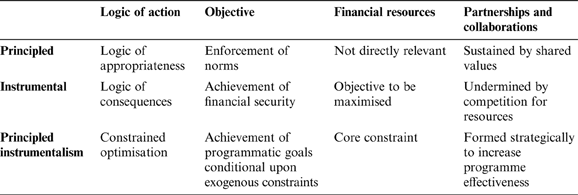
Distinct constructivist and rationalist cultures of inquiry have helped to sustain the divergence between principled and instrumentalist approaches to understanding TNGO behaviour. Within each analytical culture actors engage with their environments differently. For constructivists, structural norms external to agents condition organisational behaviour. Such scholarship emphasises the ideational determinants of organisational behaviour, a social ontology, and a logic of appropriateness. For rationalists, economic self-interest typically takes precedence over normative factors. Rationalist scholarship emphasises the material determinants of organisational behaviour, individual self-interest, and a logic of consequences (see Table 1).Footnote 26
Three perspectives on TNGO behaviour

Scholars have developed a number of projects aimed at building bridges or even synthesising constructivist and rationalist approaches in IR.Footnote 27 In the broader IR literature, a growing consensus is based on the ‘increasing realization that constructivism and rationalism are complementary rather than contradictory’.Footnote 28 Indeed, recent studies on TNGOs have begun to move beyond the rationalist-constructivist divide.Footnote 29 There is growing interest in variation in national originFootnote 30 as well as internal organisational structure.Footnote 31 Scholarship now equally appreciates that intersubjective meanings expressed in national identities shape ‘varieties of activism’Footnote 32 and that transnational activism is frequently consequentialist in its logic when identifying targets, building coalitions, or increasing leverage.Footnote 33
This study of TNGO leadership perspectives resonates particularly well with recent efforts to promote epistemological pragmatismFootnote 34 and establish a ‘logic of practicality’Footnote 35 as a means of identifying deep-seated social practices. Rather than assume a logic of appropriateness or consequences, our focus on how TNGO leaders discuss the social practices of their organisations offers a different perspective that supplements existing studies and offers a distinct framework designed to advance the literature on non-state actors.Footnote 36 By interviewing TNGO leaders, we gain insight into how they understand themselves and more specifically how they conceptualise the decisions they confront and the roles their organisations play in world affairs.
Data
Our findings are derived from semi-structured interviews with top organisational leaders from a diverse sample of 152 TNGOs registered in the United States.Footnote 37 The interview protocol was not designed to test a priori theory, but specifically to gather baseline information about organisations' goals, strategies, activities, effectiveness, accountability, communications, collaborations, and leadership. Leader's organisations were drawn from a population of international nonprofits rated by Charity Navigator, an independent ratings agency in the United States.Footnote 38 For convenience we refer to organisations in our sample simply as TNGOs, although our results are generaliseable only to the narrower population of US-registered organisations from which they were drawn.Footnote 39
Researchers employed stratified random sampling to ensure representative diversity in size, sector, and financial characteristics.Footnote 40 The overall response rate was 68 per cent.Footnote 41 In the final sample, 81 per cent of respondents were the CEOs, presidents or executive directors of their organisations, 12 per cent were vice presidents, and only 7 per cent were below the level of vice-president.
Respondents were guaranteed confidentiality to minimise self-censorship and promote candor. Interviewers were required to assess respondent candor in debriefing documents following the interviews. These qualitative assessments did not indicate material evidence of respondent self-censorship. Results have also been corroborated through ongoing outreach initiatives with the TNGO practitioner community facilitated by the study's institutional sponsor.
Interviews took place at leaders' preferred locations, usually their offices, and lasted about 1.4 hours on average. Researchers collected over 200 hours of digital recordings, which were subsequently transcribed. An interdisciplinary team of scholars created a codebook based on inductive readings of initial transcripts for emergent themes as well as input from the coding team. The coding team coded the interview transcripts using computer-aided qualitative data analysis software, generating over 19,000 quotations captured by 413 codes.
To measure the overall degree of intercoder agreement across all 413 codes, ten complete in-sample interviews were each coded twice by separate coders. Scores were calculated measuring the percentage of agreement between the two coders of each interview transcript. The ten scores were then averaged. A value of zero indicates complete disagreement, while a value of one indicates complete agreement. The overall score is 0.80, indicating satisfactory intercoder agreement.
Leadership perspectives
Scholarship on TNGOs has highlighted and sometimes contrasted principled and interest-based explanations for organisational behaviour. In our effort to advance a synthesis of these perspectives, we explored the salience of principled and instrumentalist accounts by TNGO leaders during the interviews. Specifically, we examined how leaders understand their organisations' goals, obstacles, changes to goals and strategies, benefits to collaboration, and obstacles to collaboration. We address each of these five topics in turn.
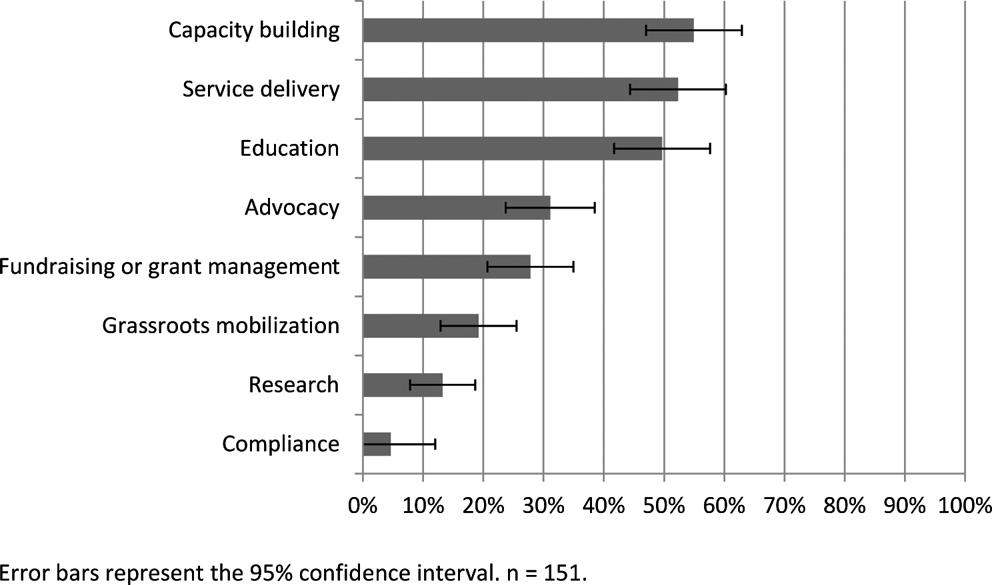
First, the principled perspective suggests that respondents should mention the substantive goals expressed in their mandates when prompted to discuss organisational goals, whereas the instrumental view predicts interviewees should mention financial concerns. Evidence from the interview study suggests that resource acquisition is not highly salient to leaders as an organisational goal. Respondents were asked, ‘In general, what would you say your organization is trying to accomplish?’ A majority of 55 per cent of respondents mentioned beneficiary capacity-building, 52 per cent mentioned service delivery, and 50 per cent mentioned public education. Comparatively, only 28 per cent of respondents mentioned fundraising or grant management. Figure 1 shows that the top three substantive goals are statistically more salient to respondents than fundraising. When leaders were prompted to consider their organisational goals, they considered the objectives related to their principled mandates more so than financial objectives.Footnote 42
Organisational goals and strategies
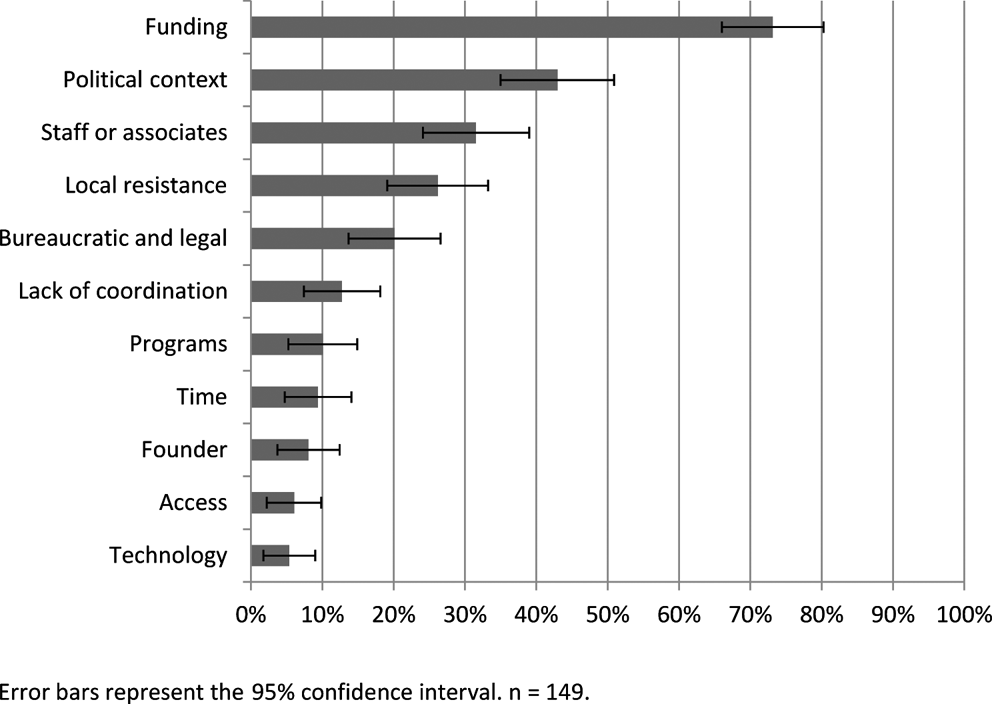
Second, whereas the instrumental perspective implies that obtaining increased resources should be a primary objective, the principled view largely neglects the role of fundraising as a significant factor affecting TNGO behaviour. Although leaders generally did not report fundraising as an organisational goal, when asked about obstacles to goals, respondents overwhelmingly mentioned financial constraints as their first and foremost concern. Interviewers asked leaders the following question: ‘What are the major obstacles, if any, to reaching your objectives?’ Almost three-quarters, or 73 per cent, of leaders mentioned funding. The next most prominent obstacle concerned the political or social context, which was mentioned by 43 per cent of respondents. Other notable obstacles include staff or associate competencies (32 per cent), local resistance (26 per cent), and bureaucratic and legal requirements (20 per cent). Figure 2 shows that financial obstacles are significantly more salient than any other obstacle. These results suggest that TNGO leaders predominantly view the need to secure resources as a constraint rather than an objective.
Obstacles to goals
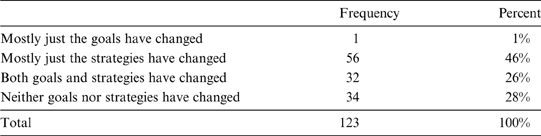
Third, whereas the principled view predicts that organisations should only rarely alter their missions, except perhaps in response to changes in their operating environments, proponents of an instrumental perspective argue that organisations frequently change their goals and mandates in response to resource availability. Our study suggests that organisational goals are surprisingly stable. After having discussed their organisational goals, leaders were asked: ‘Have these objectives changed any in the last 10 years? If so, in what ways have they changed?’ Table 2 displays a portrait of TNGO goal and strategy change. Although many TNGO leaders reported changes in their strategies during the last ten years (44 per cent), changes in organisational goals were far less common. Only one respondent mentioned that his or her organisation's goals had changed significantly within the last ten years.
Goal or strategy change
Error due to rounding.
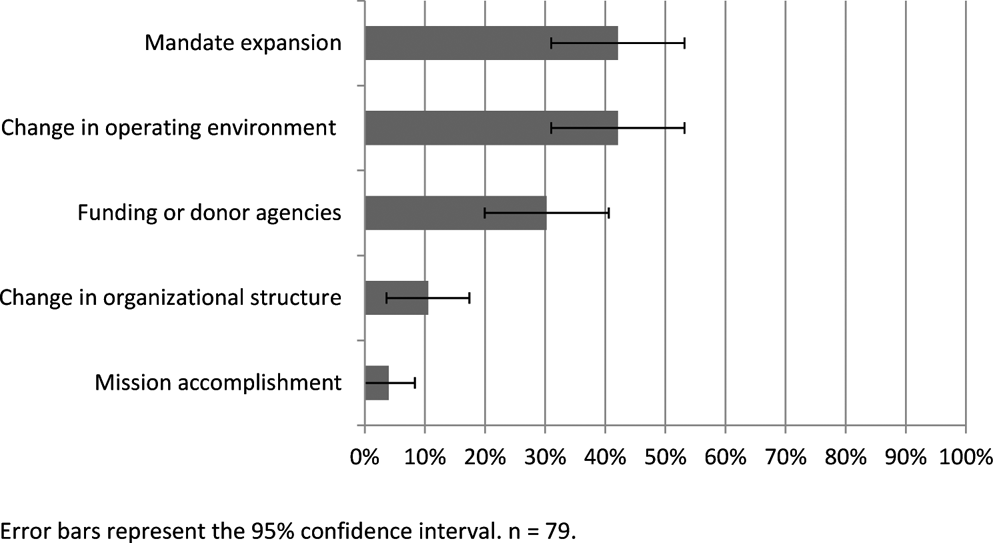
The sole respondent for whom his or her organisation's goals had changed did not report that this change was due to funding concerns. Of the respondents for whom only their strategies had changed, 32 per cent listed funding as one of the reasons. For those who indicated that both their goals and strategies had changed, 39 per cent mentioned funding. Overall, only about 30 per cent of respondents mentioned funding concerns in the context of goal or strategy change. As shown in Figure 3, the most common reasons for goal or strategy change were not related to funding, but were attributed to changes in operating environments (42 per cent) and mandate expansion (42 per cent). Indeed, many leaders described implementing specific strategies to guard against donor control and safeguard organisational autonomy.Footnote 43 For example, subsequent conversations with TNGO leaders confirmed that, as a general rule, many prefer to limit funding received from any individual source to no more than 30 per cent to protect their independence.Footnote 44
Reasons for goal or strategy change
Fourth, scholars have traditionally contended that organisations are motivated to collaborate to enhance the effectiveness of programmes and campaigns, predicting more cooperation and a stronger global civil society as the number of TNGOs increases. However, instrumentalist accounts portray the TNGO sector as a market characterised by fierce competition among organisations vying for scarce resources, predicting increased competition as organisations avoid collaboration unless doing so enhances their ability to secure more resources.
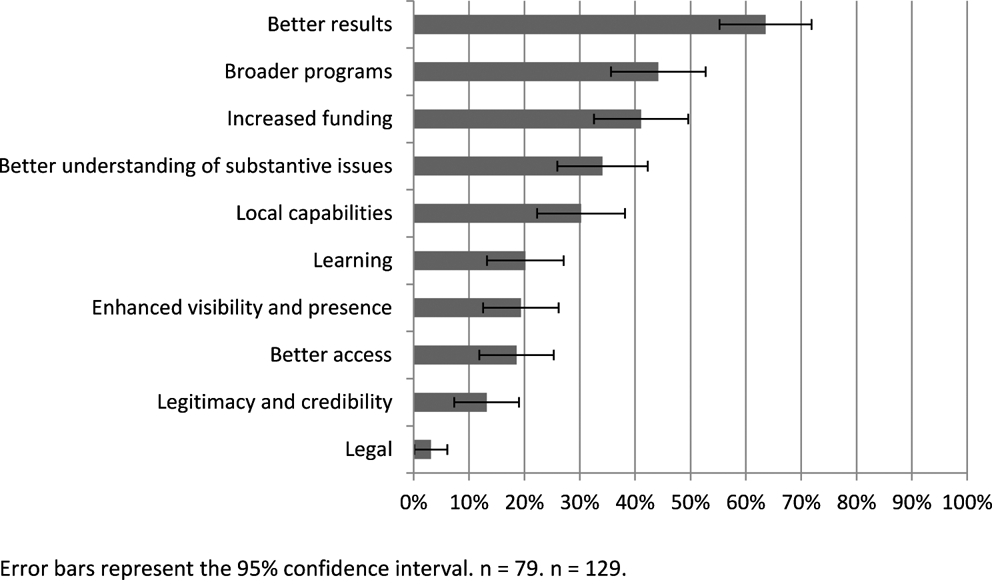
Investigating the perceived benefits of partnerships can help reveal the motives behind leaders' decisions to collaborate with their peers. Interviewers asked respondents: ‘What kinds of benefits, if any, do you see resulting from networks and the formation of partnerships?’ As displayed in Figure 4, the greatest number of respondents, 64 per cent, mentioned better results as a primary benefit of partnerships and 44 per cent mentioned broader programmes. Forty-one per cent of respondents mentioned increased funding. Only 19 per cent of respondents mentioned enhanced visibility and presence and only 13 per cent mentioned increased credibility, either of which could be interpreted as indication of strategic behaviour aimed at raising organisational profiles to attract more resources. However, these factors were statistically less salient than increased results. These findings suggest that better results and broader programmes are the primary drivers behind TNGO collaborations, followed by increased funding.
Benefits of partnerships and collaborations
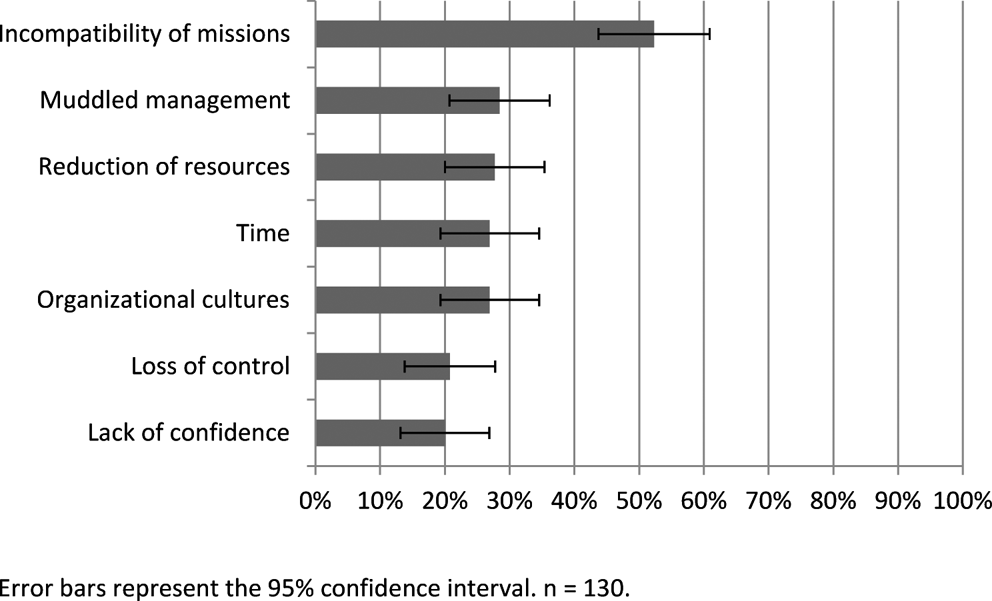
Fifth, principled approaches imply that TNGOs are highly protective of their missions and that the necessity of safeguarding their principles could pose the most important obstacle to partnerships. The instrumental perspective predicts that organisations will subjugate their missions to maximise resource acquisition as organisations seek to maximise their own share of market resources at the expense of their peers. Examining the perceived obstacles to partnerships can help reveal the extent to which mission-related and financial concerns are salient to TNGO leaders. To investigate the obstacles to collaborations that TNGO leaders perceive, interviewers asked leaders the following questions: ‘Are there obstacles or challenges that arise in the formation of partnerships and networks? What difficulties, if any, do other NGOs in your field pose for your organization?’ Figure 5 displays the results. 52 per cent of respondents mentioned incompatibility of missions, 28 per cent mentioned managerial problems, 28 per cent mentioned reduction of resources, 27 per cent mentioned organisational cultures, and 27 per cent mentioned time. Incompatibility of missions was significantly more salient than any other concern. Furthermore, analysis shows that TNGO leaders were more likely to mention financial resources as a benefit, rather than as an obstacle to collaboration.
Obstacles to partnerships and collaborations
Leaders generally view partnerships positively as a means for enhancing the effectiveness and scope of programmes and were substantially more concerned about protecting their core missions than they were with losing resources through competition. For example, a respondent from a humanitarian relief TNGO (ID=60) said:
I see everyone as a potential partner rather than a potential competitor, especially in this industry. It is just kind of the way that you have to look at it. If it is true that we all genuinely are trying to support the missions that we advocate, then we're going to be willing to work together to further enhance that mission.
A leader from a sustainable development organisation (ID=77) explained that what competition does exist does not necessarily affect the ability of TNGOs to cooperate. ‘It is the nature of this industry to compete and then to hug each other after competing’, the leader said. Similarly, another such leader (ID=137) said: ‘We tend to work with organizations whose goals are fairly similar to ours where we have some relationship over the long-term. We can each look out for each other. While we might compete one day, we are collaborative the next.’Footnote 45
Unlike the for-profit sector, competition is not the default and to remain effective TNGOs must manage ongoing relationships with other organisations against which they may have competed for funding in the past. The overriding motive behind partnerships and collaborations appears to be increased efficacy through pooled resources, and competition is only occasionally a salient attribute of the resource acquisition process. The perspective that emerges is one that focuses more on questions of how TNGOs can structure partnerships more effectively to achieve better results while still safeguarding the integrity of their unique missions.
To summarise, evidence suggests that: (1) TNGO leaders understand their organisations' goals as those expressed in their principled mandates; (2) the need to secure resources is highly salient as a constraint, but not as an objective; (3) TNGOs do not appear to significantly adjust their goals in response to resource availability; (4) leaders view peer organisations as potential partners to augment organisational effectiveness more so than competitors that diminish scarce resources; and (5) leaders evince substantial concern over safeguarding their organisational missions and are significantly less preoccupied with the possibility that the presence of peer organisations may reduce funding availability.
Transnational NGO scholarship can benefit from the perspectives of TNGO leaders. In the following section, we synthesise these findings to propose a model of TNGO behaviour we term ‘principled instrumentalism’.
Principled instrumentalism
Transnational NGOs have to make choices about where to invest their limited resources most effectively. In the short-term, they must manage a balance between addressing the immediate needs of beneficiaries and allocating enough funds to sustain the organisational growth necessary for improving long-term effectiveness. Because the global need for the activities and services of TNGOs is so vast, it is natural that organisations will converge on strategies that accommodate perpetual organisational growth. This internal investment may appear instrumental in the short-term as organisations expend resources on fundraising at the expense of current programmes, but in the long-term such investments may help sustain higher levels of programme spending over future periods.
Most TNGO leaders define organisational effectiveness as the extent to which they make specified levels of progress toward their predetermined goals.Footnote 46 To maintain the widest generality, we assume that an organisation's long-term effectiveness is proportional to the magnitude of the substantive impact it creates through its programming. As such, we further assume that long-term organisational effectiveness depends upon the level of programming, P, in each period. We thus distinguish between the short-term, composed of only one period, and the long-term, composed of multiple periods. We present a model consisting of multiple periods, consistent with the view that TNGOs seek to maximise long-term, not short-term effectiveness. For simplicity, we introduce the two-period case.
 $$Effectiveness = \sum^2_{t=1} p_t$$
The most salient obstacle to TNGO leaders is funding, which we include in the budget constraint in accordance with leaders' perspectives. The budget for the first period, B 1, is augmented by prior fundraising income,  $F_0 \over \alpha_0$, where F 0 represents prior fundraising expenditures and α0 is the cost to raise one dollar, a widely used measure. The TNGO chooses the level of current programming, P 1, at a cost of β1, as well as the level of current fundraising, F 1.
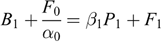 $$B_1 + {F_0 \over \alpha_0} = \beta_1 P_1 + F_1$$
where
 $$F_0 = 0$$
The second period constraint can similarly be written as follows.
 $$B_2 + {F_1 \over \alpha_1} = \beta_2 P_2 +F_2$$
where
 $$F_2 = 0$$
Combining (2) and (3) and solving for P 2 yields the intertemporal budget constraint.
 $$P_2 = - {\beta_1 \over \alpha_1 \beta_2} P_1 + {B_1 \over \alpha_1\beta_2} + {B_2 \over \beta_2}$$
And given (3) it can also be shown that the level of programming in period two depends positively upon the amount of fundraising undertaken in period one and negatively upon fundraising and programming costs.
 $$P_2 = {F_1 \over \alpha_1 \beta_2} + {B_2 \over \beta_2}$$
Finally, solving (2) for P 1 and inserting (2) and (5) into (1) yields the following.
 $$Effectiveness = P_1 + P_2 = {B_1 - F_1 \over \beta_1} + {F_1 \over \alpha_1 \beta_2} + {B_2 \over \beta_2}$$
In a static environment TNGOs would myopically spend all of their resources on programmes since there is no possibility for a return on fundraising. According to a static, short-term view, TNGOs with positive non-programme expenditures are unprincipled or otherwise not living up to their mandates since these expenditures are not investments but rather a form of self-interested consumption or waste. In a dynamic, long-term environment, however, fundraising investments may result in greater long-term impact through positive future returns even though they necessarily reduce current programme spending.
Most transnational NGOs are engaged with persistent issues (for example, promoting human rights, protecting the environment, reducing poverty, and so forth) that require more than one round of fundraising and programming. Organisations simultaneously engage in programming (principled) and fundraising (instrumental) behaviour. However, evidence from TNGO leaders suggests that is inaccurate to equate instrumentalism with unprincipled behaviour or self-interested resource acquisition. Instead, TNGOs are instrumental in that they make rational internal decisions about resource allocation between programming and fundraising so as to maximise long-term organisational effectiveness. They are also principled in that their objective function maximises long-term organisational effectiveness. In essence, a TNGO's principles determine its objective function, while its external environment determines its financial constraints. Transnational NGOs can thus be understood as classical constrained optimisers: they rationally maximise long-term organisational effectiveness given exogenous financial constraints. We term this phenomenon ‘principled instrumentalism’.
This framework implies a number of novel research implications. Intertemporally, strategic TNGOs will increase programming (decrease fundraising) when the cost to raise one dollar rises, ceteris paribus, because the long-term return to current programming will rise in relation to the return to fundraising. Moreover, when the cost to raise one dollar falls rational organisations will reduce programming (increase fundraising), ceteris paribus, to exploit the more advantageous fundraising environment. This helps explain, for example, why TNGOs are more likely to place expensive television advertisements shortly after natural disasters heavily publicised by the media. In the wake of such events, individual donors are more amenable to making contributions, substantially lowering a TNGO's cost to raise one dollar.
Similarly, if a strategic TNGO's current operational environment deteriorates, effectively increasing the cost of current programmes, it will scale back current programming (increase fundraising) to accommodate the shock, ceteris paribus. It is not necessarily that TNGOs balk in the face of adversity, but that TNGOs may be better off allocating programme spending over time away from relatively inefficient periods and toward relatively more efficient periods. Alternatively, if a TNGO's current operational environment were to improve (for example, through increased target vulnerability or improved opportunity structures) it will increase current programming (reduce fundraising), ceteris paribus.
Many transnational NGOs work across multiple issue areas and have the capability to allocate resources among different programmes to maximise long-term effectiveness. The mandate expansion that many TNGOs experience may partly be explained as a rational strategy that is responsive to changing environmental conditions. This same behaviour could also result if donor communities continuously reallocate resources among causes célèbres. Strategic TNGOs will adjust their programme portfolios to increase fundraising when doing so increases long-term effectiveness. While our data suggest that organisations rarely change their overarching missions, they occasionally expand the scope of their programmes as they adapt their strategies to changing circumstances.Footnote 47
More sophisticated models taking into account administrative spending, saving, borrowing, and other factors would surely achieve greater fidelity, but are not necessary to illustrate our major claims. Prior scholarship has argued that organisations are subjected to external forces that undermine their supposedly principled character. However, we find that there is no necessary conflict between principled behaviour and strategic responses to exogenous financial conditions over the long-term. Acting dynamically and instrumentally, TNGOs rationally pursue their principled goals given the external constraints that they confront.
Disaggregating TNGOs: a universal framework?
Our model offers an organising framework that clarifies and reconciles prior scholarship advancing seemingly contradictory arguments. A common criticism of models of the type we propose is that they are positivistic and inappropriately universalising. We believe that the first charge does not apply because our model has been developed abductively from a large-n interview study of top organisational leaders from a diverse sample of TNGOs. Moreover, we have not presumed much about organisations' objective functions apart from assuming that fundraising and programming activities are costly and that organisational effectiveness depends positively on the level programming. Regarding TNGOs' external environments, we only assume that costs are exogenous and variable over the long-term. The latter critique, however, deserves further attention.
There are two senses in which scope conditions limit the applicability of the model. First, as has already been noted, our findings may be limited to organisations based in the United States. Our inferences may be generaliseable to TNGOs based in Europe or even in the global South, but we have no direct evidence to support or reject such claims. In the second sense, there may be important differences among various types of TNGOs such that our model would fit some subsets of the population better than others. Here we must consider the operational distinction between advocacy and service delivery organisations, as well as other potential variables such as organisational size.Footnote 48 While we assert that the concept of principled instrumentalism can be used to describe and understand TNGO behaviour generally, common sense suggests that advocacy and service delivery organisations may differ in theoretically consequential ways.
For organisations concerned with the delivery of certain materials or services, maximising organisational effectiveness is likely to involve some form of average cost minimisation. If service delivery groups focus exclusively on short-term goals such as providing food and shelter after a natural disaster, they are more likely to compete with others for contracts and they may find relatively fewer reasons to enter into broad-based networks with other groups.Footnote 49 As a result, maximising effectiveness is more likely to be characterised by a desire for access (via donor support) and a need for growth allowing the group to produce the services within the boundaries of its own organisation with greater economy of scale.
In contrast, advocacy groups may be more likely to define effectiveness in terms of long-term social and political change and to pursue such goals in a collective-cooperative (for example, networking), rather than individual-competitive manner. Maintaining organisational boundaries is not as useful for advocacy organisations because significant power can only be exerted through networks of like-minded individuals with the capacity to shape public opinion and the preferences of key targets.Footnote 50 Unlike service delivery organisations that can more easily demonstrate efficiency and effectiveness by minimising costs per recipient and measuring outputs, advocacy groups and their supporters must exercise greater creativity in defining effectiveness and measuring results. This is complicated by the fact that most advocacy organisations broadly share knowledge and resources, rendering it difficult to attribute outcomes to particular members within a network.
However, evidence from our study suggests that while subsets of advocacy- and service delivery-oriented organisations still exist within the general population of TNGOs, organisations appear to be converging toward a more heterodox approach. Unfortunately, the snapshot provided by the interview study does not allow us to track the long-term movement toward ‘rights-based development’ that explicitly calls for service delivery organisations to strengthen advocacy strategies.Footnote 51 While the central concept of organisational effectiveness is necessarily broad, we have explicitly defined it here in terms of organisations striving to achieve progress toward their own goals. While this is very general, we have attempted to open the door to more specific operationalisations taking TNGO heterogeneity into account.
Conclusion
Transnational NGO scholarship focuses considerable attention on the variously principled or self-interested motives of organisations. This article confirms the presence of these complex motivations and advances the literature by offering a theoretical model describing how principled and interest-based motives interact to explain TNGO behaviour. Relying on unique, cross-sectoral interview data, the study confirms that funding concerns are highly salient to TNGO leaders, but function primarily as a set of constraints within which organisations pursue their principled missions. We find little support for arguments that see a preoccupation for organisational survival as a major logical cause for unprincipled behaviour. Principles appear to be constitutive of TNGO identities at the level of their core missions, which rarely change in direct response to funding availability. Moreover, our model helps explain why internal decisions about resource allocation may alternately appear principled and instrumental as organisations respond rationally to exogenous shocks. In short, the model offers a general framework for analysing the complex decisions TNGO leaders continuously confront.
Research programmes rooted in constructivism or rationalism have generated divergent conclusions about TNGO behaviour. But a constructivist-rationalist bifurcation precludes more comprehensive explanations of organisational activity. In addition to deductive approaches that purposively select cases to illustrate a priori theory, we recommend an exploratory, inductive approach to theory-building and urge scholars to adopt the heuristic of principled instrumentalism, which explicitly incorporates tenets associated with constructivist and rationalist research.
The lack of a theory of TNGO behaviour has put TNGO scholarship at a relative disadvantage compared to more established social scientific theories of the state and the firm. Part of the difficulty lies in the fact that unlike states and for-profit corporations, TNGOs do not appear to uniformly share a common substantive goal, such as maximising national security or economic profits. This lack of goal-homogeneity within the TNGO sector is obvious when one considers the impressive breadth of issues TNGOs pursue, from performing highly specific services in limited geographical areas to propagating global human rights norms. Without a clearer idea of what TNGOs actually do, a comparable theory of TNGO behaviour has remained elusive. Prior characterisations have often been derived from narrow subsets of the TNGO population, such as a particular sector or movement. Having identified this gap, we have developed a general theory of TNGO behaviour based on a large and diverse sample of TNGOs registered in the United States. Based on our experience, we believe that future research in this area should combine in-depth qualitative investigations with large, representative samples to reduce the likelihood of bias in case selection. In particular, we would like to see the results of this study reproduced or challenged by similar investigations covering organisations headquartered outside of the US, particularly in the global South.
Beyond the global TNGO sector, the principled instrumentalism heuristic provides a useful analytical framework for analysing the behaviour of many actors in global affairs motivated by principles but constrained by limited resources. As with any model, it may not explain every single case, but it offers an organising framework based on the assumptions that: (1) principles are a stable component of organisational identity; and (2) resource availability acts as a constraint on substantive goal attainment. Future research seeking to understand TNGO behaviour should examine this interaction between a TNGO's normatively conditioned goals and the exogenous constraints imposed by its external environment. Examinations of this dynamic interaction will likely provide fuller accounts of organisational behaviour.