1. Introduction
The South China Craton, composed of the Yangtze Block in the NW and the Cathaysia Block in the SE, is one of the largest Precambrian blocks in eastern Asia. Most studies agree that the Yangtze and Cathaysia blocks were amalgamated in the Neoproterozoic Era (Zhao & Cawood, Reference Zhao and Cawood2012; Zhang & Zheng, Reference Zhang and Zheng2013; Xia et al. Reference Xia, Xu, Niu and Liu2018), but their respective tectonic histories and the affinity of the Yangtze Block and the Cathaysia Block before Neoproterozoic time are still under debate. Due to the scarce exposures of Precambrian rocks, research work on the Precambrian tectonic evolution of the South China Craton has been limited.
However, zircons with Precambrian ages give us another way to study tectonics, especially the situation in the deep crust. Although zircons cannot provide as much evidence as exposed rocks, they can carry information about unexposed rocks in the deep crust or even in the mantle (O’Reilly & Griffin, Reference O’Reilly and Griffin2013). Previous studies used xenoliths to study geological events in the deep crust (Lu et al. Reference Lu, Zheng, Griffin and Yu2013; Pan et al. Reference Pan, Zheng, Griffin, Xu and Li2015; Sun et al. Reference Sun, Niu, Guo, Cui, Ye and Liu2018), but xenoliths are extremely rare to find. Similarly, the development of zircon isotope technology has brought opportunities for Precambrian tectonics and deep crustal Earth sciences. With numerous captured and detrital zircons with ancient ages discovered in all kinds of rocks, their information about ancient geological history and the deep continent have helped scientists to recover the tectonic evolution of continent blocks all over the world (Li et al. Reference Li, Zheng, Xiong, Zhou and Xiang2018b; Ge et al. Reference Ge, Wilde, Nemchin, Whitehouse, Bellucci and Erickson2019; Ma et al. Reference Ma, Xu, Huang, Zheng, Ping and Xia2020). In the recent decade, much research has been carried out to study the ages of Precambrian zircons from both the exposed rocks and captured or detrital zircons. The Precambrian tectonic evolution of the Yangtze Block has already been unravelled (Zhao & Cawood, Reference Zhao and Cawood2012; Zhang & Zheng, Reference Zhang and Zheng2013).
The Cathaysia Block is very different from the Yangtze Block. There are two main reasons to explain why the Precambrian tectonics of the Cathaysia Block remain under debate: first, few Precambrian rocks, especially rocks older than Palaeoproterozoic age, are exposed (Li et al. Reference Li, Li and Li2014b); second, wide and intense magmatic events occurred during multiple periods after the Cambrian Period and erased the record of earlier Precambrian geological events (Shu et al. Reference Shu, Wang, Sun, Chen and Shen2013). Although previous studies have found small amounts of Precambrian rocks exposed in the Cathaysia Block, the oldest of them is a granitic complex called the Badu complex, which underwent at least two stages of high-grade metamorphism at 1886–1882 Ma and 252–234 Ma. The early metamorphic rocks are intruded by the 1.88-Ga syn-orogenic S-type granite (Yu et al. Reference Yu, Wang, O’Reilly, Griffin, Zhang, Li and Shu2009, Reference Yu, O’Reilly, Zhou, Griffin and Wang2012; Zhao et al. Reference Zhao, Zhou, Zhai, Santosh, Ma, Shan and Cui2014). None of these Precambrian rocks have ages older than Palaeoproterozoic. The lack of Archean rocks led to the controversy over whether the Cathaysia Block is a craton or only an accretionary block. Most geologists have considered the Cathaysia Block to be an accretionary block due to the lack of Archean basement rocks (Zhang & Zheng, Reference Zhang and Zheng2013; Li et al. Reference Li, Li and Li2014b). Nevertheless, several researchers have recently found many Archean detrital zircons or captured zircons in post-Archean rocks, advancing the new viewpoint that unexposed Archean basement does exist underneath the Cathaysia Block (Yu et al. Reference Yu, O’Reilly, Wang, Griffin, Zhou, Zhang and Shu2010, Reference Yu, O’Reilly, Zhou, Griffin and Wang2012; Li et al. Reference Li, Zheng, Xiong, Zhou and Xiang2018b), which completely rewrites the tectonic evolution history of the Cathaysia Block.
Although the discovery of Archean zircons has changed the interpretation, the tectonic evolution history of the Cathaysia Block remains controversial (Cawood et al. Reference Cawood, Zhao, Yao, Wang, Xu and Wang2018), and the tectonic evolution history before Palaeoproterozoic time still lacks sufficient study and geological evidence. In this study, a number of captured zircons with ages of c. 2.5 Ga were found in Yanshanian acidic dykes in the Xianghualing area of the western Cathaysia Block. We analysed their U–Pb–Hf isotopes and trace elements, and compared them with detrital zircons in sedimentary rocks from different periods of the Cathaysia Block, to recover the specific geological event recorded by these zircons in the Cathaysia Block at 2.5 Ga and reconstruct the tectonic evolution of the Cathaysia Block at 2.5 Ga.
2. Geological background
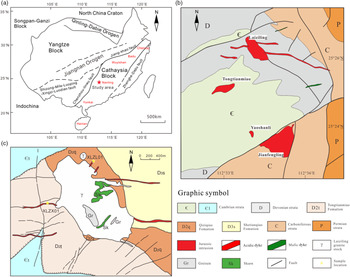
The Yangtze and Cathaysia blocks (Fig. 1a) were amalgamated during the Neoproterozoic Era, forming the Jiangnan Orogenic Belt in between (Zhang & Zheng, Reference Zhang and Zheng2013; Zhao, Reference Zhao2015; Xia et al. Reference Xia, Xu, Niu and Liu2018). Subsequently, the South China Craton was amalgamated with the North China Craton during the Triassic Period and formed the Qingling–Dabie Orogen (Hacker et al. Reference Hacker, Ratschbacher, Liou, Malpas, Fletcher, Ali and Aitchison2004; Zheng, Reference Zheng2008). The Songpan–Ganzi Block, which consists of several minor blocks, was amalgamated onto the South China Craton gradually during the Triassic Period after the Qingling–Dabie Orogen was formed (Edmund, Reference Edmund2000; Enkelmann et al. Reference Enkelmann, Weislogel, Ratschbacher, Eide, Renno and Wooden2007). However, the Cathaysia Block in the SE part of the South China Craton can also be divided into six areas: the Yunkai and Hainan areas on the SW, the Nanling area in the middle, and the Wuyishan, Badu and Chencai areas in the NE (Yu et al. Reference Yu, O’Reilly, Wang, Griffin, Zhou, Zhang and Shu2010).
Geological map of the (a) South China Block (after Zhang & Zheng, Reference Zhang and Zheng2013); (b) Xianghualing District (after Qiu et al. Reference Qiu, Deng, Cai, Zhou, Chang and Du2002); and (c) Laiziling pluton (after Lai, Reference Lai2014).

Although Precambrian basement rocks in the Cathaysia Block are sparsely exposed in the Chencai, Badu, Wuyishan, Nanling, Yunkai and Hainan areas, none of the basement rocks were found to be older than Archean age. Some authors regard the Cathaysia Block as an early Palaeozoic folded belt bordering the SE margin of the Yangtze Block; however, some authors also regard Cathaysia as a discrete continental block that amalgamated with the Yangtze Block during early Neoproterozoic time. With no Archean exposed rocks, but the presence of numerous Archean detrital zircons and minor inherited/xenocrystic zircons (which implies the existence of Archean crust underlying the block or present in adjacent regions and subsequently removed), some researchers proposed that the Precambrian basement of the Cathaysia Block can be divided into the Wuyishan Terrane to the NE and the Nanling–Yunkai Terrane to the SW. However, the widespread presence of Eoarchean–Neoarchean zircons implies that the Cathaysia Block is either underlain by Archean crust or it developed on the margin of an Archean block (Zhao & Cawood Reference Zhao and Cawood2012).
The Xianghualing area at the NW edge of the Cathaysia Block is one of the metallogenic areas belonging to the famous Nanling metallogenic province (Fig. 1b). The strata of the Xianghualing area are mainly Cambrian, Devonian and Carboniferous, with sporadic exposure of Permian, Triassic, Jurassic and Quaternary strata. The Cambrian strata are composed of metamorphic shallow-sea facies clastic rocks, the Devonian strata are composed of shallow-sea facies carbonate rocks and clastic rocks, and the Carboniferous strata are composed of shallow-sea facies carbonate rocks. The dominant ore-bearing strata are the Devonian carbonate rocks, which are commonly altered into skarns with abundant W, Sn, Pb and Zn mineralization. Fold and fault structures are strongly developed in the Xianghualing area, and the whole area comprises a large dome with the Tongtianmiao granite in the centre. Fractures are complicated in this area with various trends. The N–S- and E–W-trending faults are considered to have formed prior to the magmatic rocks. In contrast, the NE-trending faults cut through the granitic rocks and were formed after the granite intruded. These faults control the distribution of ore bodies (Lai, Reference Lai2014).
Magmatic rocks are well developed in this area, and three main granitic intrusions called Laiziling, Jianfengling and Tongtianmiao are the largest plutons (Fig. 1b). As ore-bearing rock masses, they controlled the distribution of multiple W, Sn, Nb, Ta, Be, Pb and Zn deposits in this region. However, six acidic dykes are distributed around the Laiziling granite, several of which are also reported to have related W–Sn–Nb–Ta mineralization. The Tongtianmiao pluton has no access roads and not been studied in any detail, but both the Laiziling and Jianfengling plutons have been thoroughly researched. The Laiziling granite yields zircon U–Pb ages of 155–150 Ma (Shu et al. Reference Shu, Wang, Sun, Xu and Dai2011; Zhu et al. Reference Zhu, Wang, Lu, Zhang, Zhang, Xie and Zhang2011; Lai, Reference Lai2014; Yang et al. Reference Yang, Wu, Cao, Hu, Zhang, Gong and Liu2018; Xiao et al. Reference Xiao, Shen and Wei2019), while the Jianfengling granite gives zircon U–Pb ages of 165–160 Ma (Xuan et al. Reference Xuan, Yuan, Yuan and Mi2014; Yang et al. Reference Yang, Wu, Cao, Hu, Zhang, Gong and Liu2018). Previous research also found that zircons from the Laiziling pluton have multiple age groups including Proterozoic (> 900 Ma), Silurian (c. 430 Ma), Triassic (c. 220 Ma), Jurassic (c. 150 Ma) and Cretaceous (c. 80 Ma). The Proterozoic zircons are interpreted as residual zircons from the magma source region, Silurian zircons as detrital zircons assimilated from sedimentary formations, Triassic zircons as captured zircons from pre-existing magmatic rocks, Jurassic zircons as original magmatic zircons and Cretaceous zircons as later injected hydrothermal zircons (Li et al. Reference Li, Wu, Evans, Jiang and Zhou2018a). Moreover, zircons with multiple age groups were also discovered in skarns and sulphide ores adjacent to the Laiziling pluton. Zircons from skarns have similar age groups to those from the Laiziling pluton, which are Silurian (c. 430 Ma), Triassic (c. 220 Ma) and Jurassic (c. 150 Ma), corresponding to three episodes of magmatic and associated hydrothermal activity in the Nanling region. Zircons from sulphide ores have a wide range of ages (497–3409 Ma, peak at 800–1000 Ma) and are consistent with those of Cambrian sedimentary rocks in the study region, implying that later ore-forming fluids may have circulated through upper crustal sedimentary rocks (Wu et al. Reference Wu, Li, Algeo, Jiang and Zhou2018). The Laiziling pluton, which has been studied in detail, is a highly evolved A-type granite formed by the re-melting of lower crustal granulite rocks; the whole process was triggered by the Palaeo-pacific slab roll-back, back-arc extension and subsequent asthenospheric upwelling (Yang et al. Reference Yang, Wu, Cao, Hu, Zhang, Gong and Liu2018; Liu et al. Reference Liu, Lai, Xiao, Jeffrey, Du, Li, Liu, Wen and Yu2019). Mafic rocks are relatively rare in this area; only two lamprophyre dykes were reported exposed in this area. One lamprophyre dyke is exposed on the NE side, c. 1000 m from the Laiziling pluton, c. 5–10 m wide and 500 m long and trending c. 70° from the north. Another lamprophyre dyke is exposed on the SE side, c. 1500 m from the Laiziling pluton, c. 10–20 m wide and 500 m long and trending c. 80° from the north. Unfortunately, no detailed petrology and geochemistry study of these two dykes has been reported.
The six acidic dykes lack chronology except for the longest porphyry granitic dyke on the SE of the granite, which yields zircon U–Pb ages of 151.2 ± 0.9 Ma (Lai, Reference Lai2014). The remaining five dykes are all highly evolved and have undergone different degrees of greisenization; they either lack original magmatic zircons (c. 150 Ma or younger) or have highly metamictized zircon grains (Wu et al. Reference Wu, Liu, Ji, Wang and Yang2017). For example, zircons from the 431 ongonite-topazite dyke (the dyke on the middle of the east side of the Laiziling pluton) are extremely rare, and the few remaining grains are very small and strongly metamictized (Xie et al. Reference Xie, Wang, Zhu, Lu, Zhang, Che, Zhang and Huang2013; Huang et al. Reference Huang, Wang, Xie, Zhu, Erdmann, Che and Zhang2015); the lack of appropriate zircons for dating has led to limited research on these dykes. However, five of the six dykes cut through the Laiziling granite, indicating that they formed after the Laiziling granite. The sixth dyke lies to the SW of the granite and does not cut through it. Combining this information with the longest 151-Ma porphyritic granitic dyke on the SE of the granite, we have reason to believe that all of the dykes actually formed in the Jurassic Period. In this study, many captured zircons were selected from two acidic dykes (one on the west and one on the NE of the granite; Fig. 1c); we attempt to use these zircons to reconstruct the tectonic events that occurred in the lower crust of the Cathaysia Block, and the capture process of these zircons during Yanshanian magmatic events.
3. Geological features and sample petrography
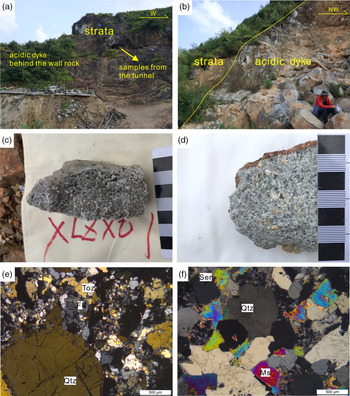
The acidic dyke on the west side of the Laiziling pluton is c. 500 m long, 10–20 m wide, trending c. 270° from north and shows an overall curved shape (Fig. 1c). Its western part intrudes into Devonian limestone, while its eastern part cuts into the Laiziling pluton (Fig. 2a). The dyke is not exposed at the surface, but has been intersected by tunnels that are now closed; samples were obtained from loose material excavated from the tunnels. The Devonian limestones as wall rock were mostly altered into brown skarns, but some of them remain unaltered. Samples from the western dyke (XLZX01) are quartz topazite (Fig. 2c), composed of topaz (65–70%), quartz (15–20%) and fluorite (5–10%); a small number of opaque sulphides can also be observed. The quartz grains are mainly large grains of c. 2–3 mm, and the topaz and fluorite are small grains of c. 50 μm and 20 μm. Fluid inclusions can be clearly observed in the quartz grains but mostly along the cracks, indicating a secondary origin (Fig. 2e).
Field photo of (a) XLZX01 and (b) XLZL01 acidic dykes; hand specimen of (c) XLZX01 quartz topazite and (d) XLZL01 greisen; and photomicrograph of (e) XLZX01 quartz topazite (cross-polarized light) and (f) XLZL01 greisen (cross-polarized light). Fl – fluorite; Ms – muscovite; Qtz – quartz; Ser – sericite; Toz – topaz.

The acidic dyke on the NE side of the Laiziling pluton is the one of the two shortest dykes among the six dykes, and is c. 100 m long, 10–15 m wide and trending 40° from the north (Fig. 1c). Its NE part intrudes into the Devonian limestone, while its SW part cuts into the Laiziling pluton (Fig. 2b). The dyke is heavily altered into greisen with no clear feldspars remaining; however, the Devonian limestone wall rocks are not entirely altered, perhaps because of the small scale of the dyke. Samples from the NE dyke (XLZL01) are greisen (Fig. 2d), composed of quartz (50–55%), muscovite (20–25%), sericite (10–15%), and a small quantity of topaz (2–3%) and fluorite (1–2%); a small number of opaque sulphides can also be observed. The sericitization is likely the result of altered feldspars, although no primitive shapes of feldspars are preserved; the sericites are almost filled within the quartz and muscovite particles and mostly around the edges of muscovite (Fig. 2f).
4. Analytical methods
4.a. Zircon U–Pb dating and trace-element analysis
One sample from each dyke was selected for zircon dating and trace-element analysis. Zircon grains from these samples were separated by conventional magnetic and heavy liquid techniques, and then hand-picked under a binocular microscope at Langfang Integrity Geological Services Co. Ltd. To avoid any possible contamination, the mineral separation laboratory is maintained as a clean environment to exclude dust. The pulverizer and the ore beneficiation equipment were cleaned by water after every single process; before the next process, they were air-dried for 15–30 minutes to prevent any residue. Next, they were mounted in epoxy resin blocks and polished to obtain flat surfaces. Cathodoluminescence (CL) and backscattered electron (BSE) imaging techniques were used to visualize the internal structures of individual zircon grains with a scanning electron microscope (SEM) housed at Chongqing Yujing Science and Technology Services Co. Ltd.
U–Pb geochronology and trace elements of zircon were measured by laser ablation inductively coupled plasma mass spectrometry (LA-ICP-MS) at Nanjing FocuMS Technology Co. Ltd. A Teledyne Cetac Technologies Analyte Excite LA system (Bozeman, Montana, USA) and an Agilent Technologies 7700× quadrupole ICP-MS (Hachioji, Tokyo, Japan) were combined for the experiments. The 193-nm ArF excimer laser, which was homogenized by a set of beam delivery systems, was focused on the zircon surface with a fluence of 6.0 J cm–2. The ablation protocol employed a spot diameter of 35 μm at an 8 Hz repetition rate for 40 s (equal to 320 pulses). Helium was applied as a carrier gas to efficiently transport the aerosol to the ICP-MS. Zircon 91500 was used as an external standard to correct instrumental mass discrimination and elemental fractionation during the ablation. Zircon GJ-1 was treated as a quality control for geochronology. The lead abundance and other trace elements of zircon was externally calibrated against NIST SRM 610 with Si as the internal standard (Liu et al. Reference Liu, Gao, Hu, Gao, Zong and Wang2010a; Hu et al. Reference Hu, Liu, Chen, Zhou, Li and Zong2011). Raw data reductions were performed offline using ICPMSDataCal software (Liu et al. Reference Liu, Gao, Hu, Gao, Zong and Wang2010a, b), quantitative calibration for Pb isotope dating was performed by ComPbcorr#3_18 (Andersen, Reference Andersen2002), and concordia diagrams and weighted mean calculations were performed using ISOPLOT 4.15 (Ludwig, Reference Ludwig2003).
4.b. Zircon Hf isotope analysis
Representative zircon grains were selected for Hf isotope analysis. Hafnium isotope ratios of zircons were determined by LA-MC-ICP-MS at Nanjing FocuMS Technology Co. Ltd. A Teledyne Cetac Technologies Analyte Excite laser-ablation system (Bozeman, Montana, USA) and Nu Instruments Nu Plasma II MC-ICP-MS (Wrexham, Wales, UK) were combined for the experiments. The 193-nm ArF excimer laser, which was homogenized by a set of beam delivery systems, was focused on the zircon surface with a fluence of 6.0 J cm–2. The ablation protocol employed a spot diameter of 50 μm at an 8 Hz repetition rate for 40 seconds (equal to 320 pulses). Helium was applied as a carrier gas to efficiently transport the aerosol into the MC-ICP-MS. Three standard zircons (GJ-1, 91500 and Plešovice) were treated as quality controls for every 10 unknown samples.
4.c. Whole-rock major- and trace-element analysis
One sample from each dyke was selected for whole-rock major- and trace-element analysis, which are the same samples used for zircon picking. The whole-rock major- and trace-element compositions were analysed at ALS Chemex, Guangzhou, China. The samples were crushed in a milling machine to pass 200 mesh before major-element contents were measured using a Panalytical Axios Max X-ray fluorescence (XRF) instrument with an analytical accuracy of c. 1–5%. Trace-element compositions were measured using an ICP-MS (Perkin Elmer Elan 9000), with an analytical accuracy of > 5%.
5. Analytical results
5.a. Zircon U–Pb dating
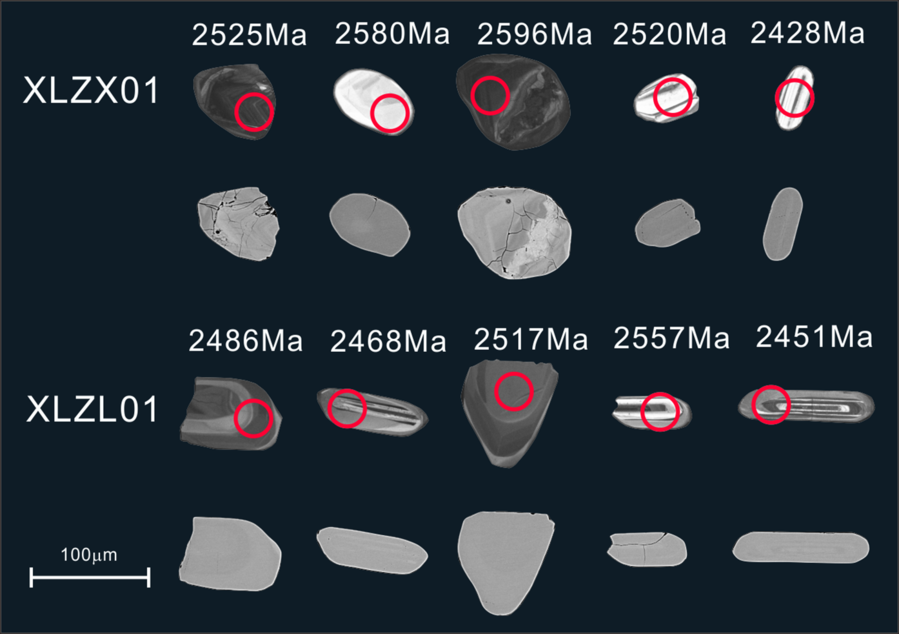
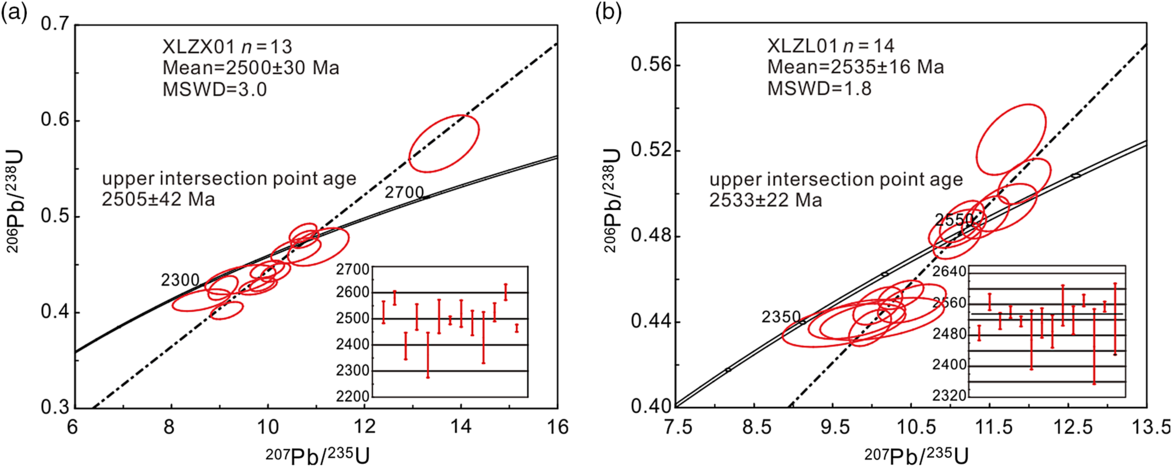
The analytical results of zircon LA-ICP-MS U–Pb dating are provided in online Supplementary Table S1 (available at http://journals.cambridge.org/geo), and the CL and BSE images of representative zircons are shown in Figure 3. The zircons from samples XLZX01 and XLZL01 are mostly anhedral with oval shapes, but some of them still retain the original prismatic shapes. The sizes range from 30 to 100 μm, with length to width ratios of 1:1 to 3:1. Most of the zircons have bright CL images and clear oscillatory zoning, but some of them lack oscillatory zoning and are totally dark or have dark rims or cores, indicating later alteration. The altered zircons usually have abundant cracks and bright areas on their BSE images when compared with the unaltered zircons, indicating that the later alteration may be related to hydrothermal fluids. The fluids along the cracks changed some parts of the zircons or even the whole grain. All spots selected for dating were clean without cracks and inclusions, with CL and BSE images similar to magmatic zircons. A total of 15 zircons from sample XLZX01 were analysed, excluding the discordant grains; 13 zircons yielded ages with high concordance. These zircons have significant variations in Th and U contents (Th, 1.79–593 ppm; U, 14.2–713 ppm) with variable Th/U ratios of 0.05–2.19. Three zircons have Th/U ratios of < 0.3, which may indicate hydrothermal fluid alteration (Hoskin et al. Reference Hoskin, Kinny, Wyborn and Chappell2000; Belousova et al. Reference Belousova, Griffin, O’Reilly and Fisher2002). The 13 zircons from sample XLZX01 yielded 207Pb/206Pb ages ranging from 2396 ± 51 Ma to 2602 ± 30 Ma, a weighed mean 207Pb/206Pb age of 2500 ± 30 Ma and an upper intersection point 206U/238Pb age of 2505 ± 42 Ma (Fig. 4a). A total of 15 zircons from sample XLZL01 were analysed, excluding the discordant grains; 14 zircons yielded ages with high concordance. These zircons have significant variations in Th and U contents (Th, 0.64–68.1 ppm; U, 23.0–98.1 ppm) with variable Th/U ratios of 0.03–1.07. Four zircons with Th/U ratios < 0.3 may also indicate some hydrothermal fluid alteration. The 14 zircons of sample XLZL01 yielded 207Pb/206Pb ages ranging from 2451 ± 97 Ma to 2570 ± 15 Ma, a weighed mean 207Pb/206Pb age of 2535 ± 16 Ma and an upper intersection point 206U/238Pb age of 2533 ± 22 Ma (Fig. 4b). The dating results clearly indicate that these zircons were captured or inherited rather than original magmatic zircons.
Representative zircon cathodoluminescence (CL) and backscattered electron (BSE) images.

Zircon U–Pb concordia diagrams.

5.b. Zircon trace elements
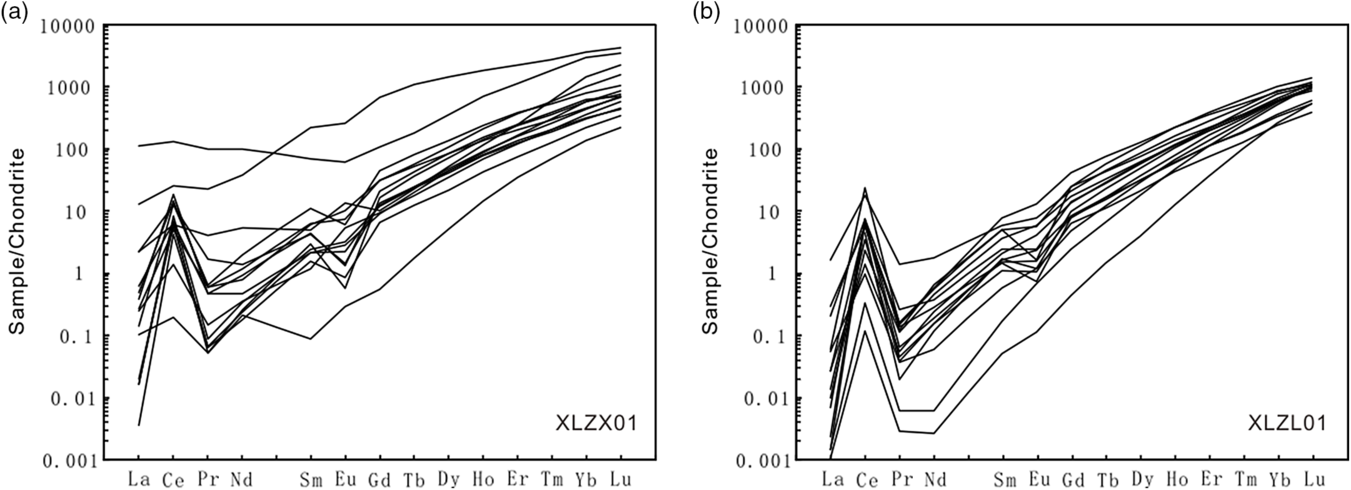
The analytical results of zircon trace elements are presented in online Supplementary Table S2 (available at http://journals.cambridge.org/geo). Zircon trace elements from literature are also used to compare with zircons in this study, which are presented in online Supplementary Table S3. All 15 zircons from sample XLZX01 have variable rare earth element (REE) contents of 79.15–2539.20 ppm, and all 15 zircons from sample XLZL01 have variable REE contents of 116.29–526.23 ppm. Zircons with high REE contents tend to have higher light REE (LREE), Hf and Y contents, with inconspicuous positive Ce anomalies and negative Eu anomalies, similar to hydrothermal zircons; zircons with moderate REE contents tend to have lower LREE, Hf and Y contents, with intense positive Ce anomalies and negative Eu anomalies (Fig. 5a, b), similar to magmatic zircons (Hoskin et al. Reference Hoskin, Kinny, Wyborn and Chappell2000). When comparing with the inherited zircons from the Laiziling pluton, skarns and sulphide ores, our zircons have similar trace-element compositions as Archean zircons, but are distinct with Jurassic magmatic zircons.
Zircon chondrite-normalized rare earth element (REE) distribution pattern diagrams. The chondrite-normalized and primitive mantle-normalized values are from Sun & McDonough (1989).

5.c. Zircon Hf isotope
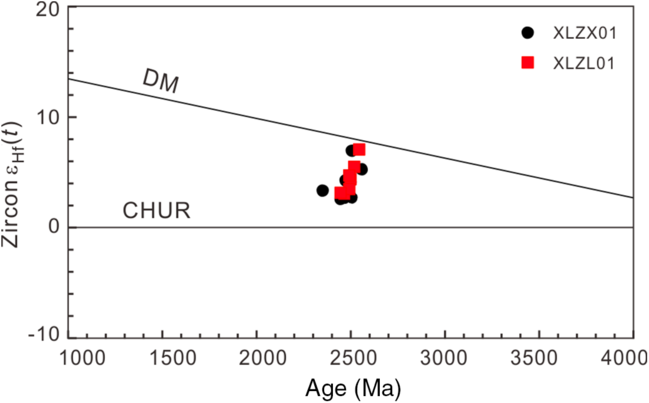
Zircons dated with concordant U–Pb ages were selected for Lu–Hf isotope analysis, with the results given in online Supplementary Table S4 (available at http://journals.cambridge.org/geo). Eight zircon grains from sample XLZX01 were selected for Lu–Hf isotope analysis. These zircons have ϵHf(t) values of 2.5–6.7, with an average of 3.8; the one-stage model (T DM) ages are 2565–2741 Ma, with an average of 2659 Ma and the two-stage model (T DM2) ages are 2608–2864 Ma, with an average of 2761 Ma. Seven zircon grains from sample XLZL01 were selected for Lu–Hf isotope analysis. These zircons have ϵHf(t) values of 2.9–6.9, with an average of 4.3; the T DM ages are 2605–2697 Ma with an average of 2659 Ma and T DM2 ages are 2629–2810 Ma with an average of 2748 Ma. These captured zircons have positive ϵHf(t) values near to the depleted mantle line (Fig. 6), with similar 207Pb/206Pb, T DM and T DM2 ages.
Zircon ages versus ϵHf(t) diagram. CHUR– chondritic uniform reservoir; DM – depleted mantle.

5.d. Whole-rock geochemistry
The major- and trace-element analytical results are presented in online Supplementary Table S5 (available at http://journals.cambridge.org/geo). Samples of the two dykes have different major-element concentrations when compared with the Laiziling granites, indicating either highly evolved melts or some extent of post-magmatic alteration. Sample XLZX01 has relatively low SiO2 (59.98), Na2O (< 0.01) and K2O (0.01) contents, but high Al2O3 (18.89) contents; it also has relatively low CaO (1), MgO (0.01), P2O5 (0.03), TFe2O3 (4.09), TiO2 (< 0.01) and SO3 (7.76) contents, with unusually high A/NK and A/CNK values. Sample XLZL01 has relatively low SiO2 (69.91), Na2O (0.14) and K2O (1.47) contents, but high Al2O3 (16.84) contents; it also has relatively low CaO (0.02), MgO (0.04), P2O5 (0.01), TFe2O3 (2.95), TiO2 (0.01) and SO3 (4.79) contents, with unusually high A/NK and A/CNK values.
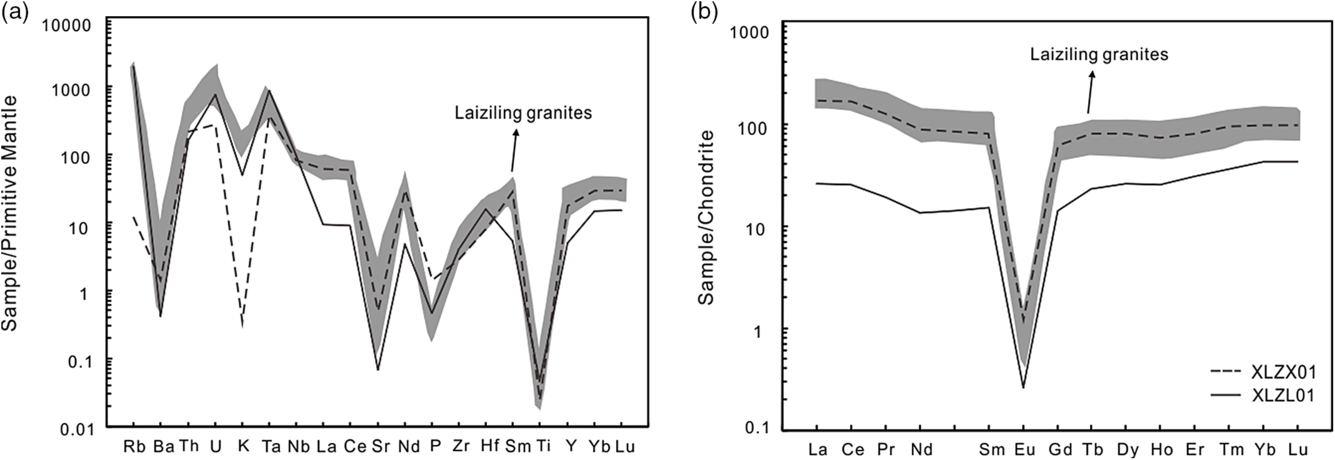
The primitive mantle-normalized trace-element spider diagram is presented in Figure 7a. Sample XLZX01 exhibits enrichment in Rb, Th, U, Ta, Nb, Zr and Hf and depletion in Ba, Sr, P and Ti, very similar to the distribution pattern of the Laiziling granites. Sample XLZX01 also exhibits enrichment in Rb, Th, U, Ta, Nb, Zr and Hf and depletion in Ba, Sr, P and Ti, but its U and K contents are much lower than for sample XLZL01. The chondrite-normalized REE distribution pattern diagram is presented in Figure 7b. Sample XLZX01 has total REE contents of 279.26, with negative Eu anomalies and distinct tetrad effects (Eu/Eu*=0.03); it also has inconspicuous fractionation of heavy REE (HREE) and LREE, with ΣLREE/ΣHREE = 3.31 and LaN/YbN = 2.13, exhibiting a flat REE pattern. Sample XLZL01 has total REE contents of 58.21 with relatively low LREE contents. It also has negative Eu anomalies and distinct tetrad effects (Eu/Eu*=1.00), and a flat REE pattern with ΣLREE/ΣHREE = 1.24 and LaN/YbN = 0.62. These two samples have REE distribution patterns similar to the Laiziling granites.
Whole-rock (a) primitive mantle-normalized trace element spider diagram and (b) chondrite-normalized rare earth element (REE) distribution pattern diagram. Values from Sun & McDonough (1989).

6. Discussion
6.a. Zircon genesis: magmatic, metamorphic or hydrothermal?
Zircons from different host rocks or formed by different types of geological processes usually have disparate internal structures. For example, the CL images of magmatic zircons from granitic rocks often have clear and broad oscillatory zoning, but zircons from mafic rocks often have narrow and obscure zoning, or even lack zoning (Wu & Zheng, Reference Wu and Zheng2004). In comparison, hydrothermal zircons have various internal structures according to their related fluids; however, two main structures can be recognized. Zircons crystallized from hydrothermal fluid usually have regular shapes, clear banded zoning or oscillatory zoning, and recrystallized zircons in hydrothermal fluid or metamict zircons affected by hydrothermal fluid usually have porous, spongy or even skeletal structures, with abundant mineral inclusions (Wu & Zheng, Reference Wu and Zheng2004). The morphology of metamorphic zircons can be more complicated due to the complex and various metamorphic processes. From schist to eclogite, with different phases of their host rocks zircons can form distinct structures, but none of them have structures like magmatic zircons with regular shapes and zoning (Wu & Zheng, Reference Wu and Zheng2004; Yang et al. Reference Yang, Santosh, Tsunogae, Tang and Teng2017).
In this study, our zircons have CL images showing extremely round shapes with weak zoning or even no zoning; such round shapes may indicate long-distance transport, while the weak or limited zoning may indicate that the zircons originated from mafic magmatic rocks or metamorphic rocks (Fig. 3). However, metamorphic zircons can be excluded because of the moderate Th/U ratios of these zircons; most zircons have Th/U ratios of 0.1–1, much higher than those of metamorphic zircons (< 0.01) according to Hoskin & Schaltegger (Reference Hoskin and Schaltegger2003). On the other hand, if these zircons are magmatic zircons transported for long distances, they can also have two possible types of host rocks: sedimentary rocks or mantle-derived magmatic rocks. However, the clustered ages can exclude the former type because zircons from sedimentary rocks have multiple origins with dispersed zircon ages. These zircons therefore may be from mantle-derived rocks that intruded into the crust, but we cannot confirm or exclude the fact that they have been altered by later hydrothermal fluid. To ascertain their host rocks, we use zircon trace elements for discrimination.
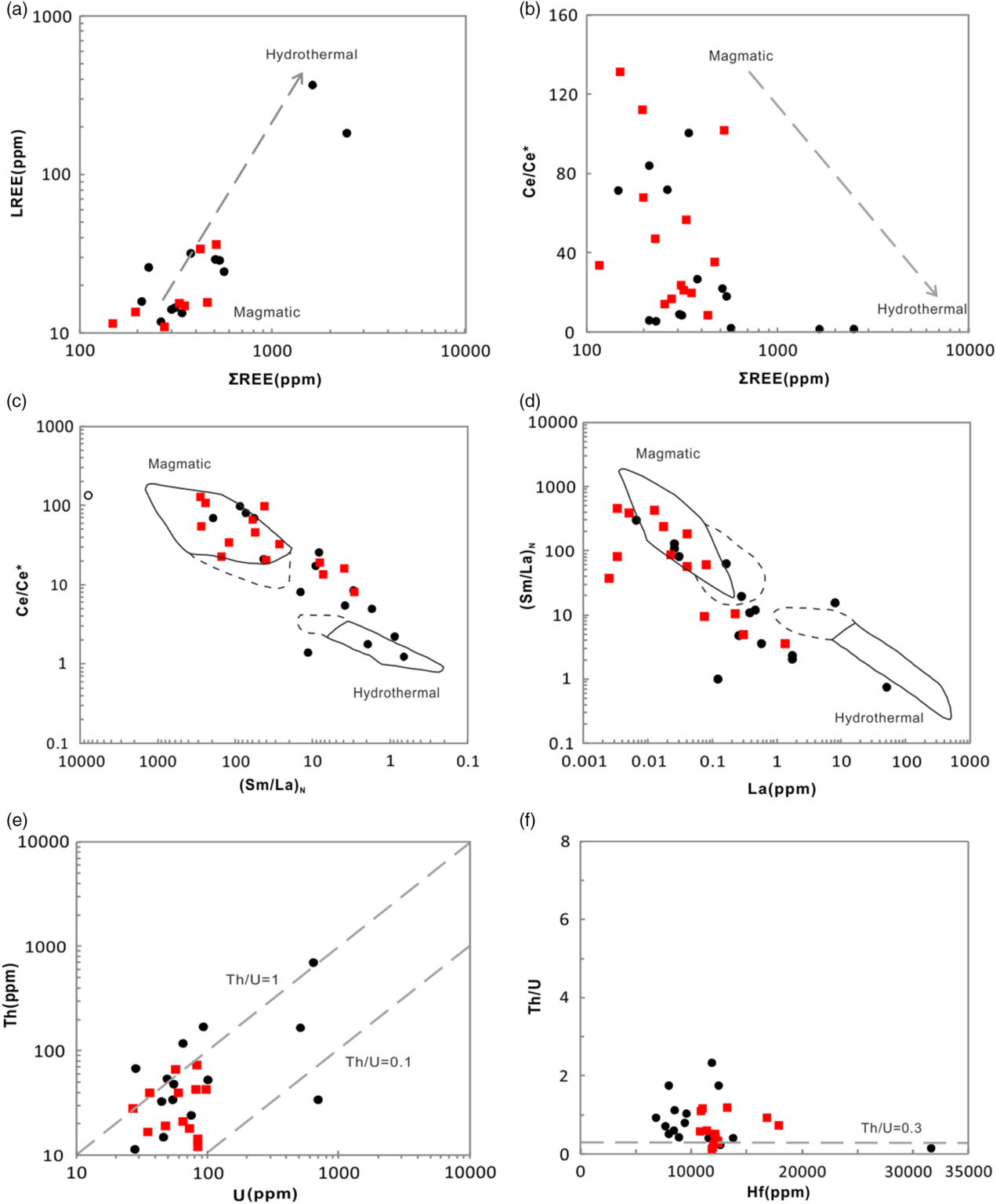
Compared with magmatic zircons, hydrothermal zircons usually have higher REE contents (Hoskin et al. Reference Hoskin, Kinny, Wyborn and Chappell2000). Due to the abundant LREE-bearing mineral inclusions brought by the fluid, hydrothermal zircons usually have more negative Ce anomalies and high LREE contents. Hoskin (Reference Hoskin2005) used La versus (Sm/La)N and (Sm/La)N versus Ce/Ce* diagrams to discriminate hydrothermal zircons and magmatic zircons. In this study, zircons from samples XLZX01 and XLZL01 have relatively high Ce/Ce* but low LREE contents (Fig. 8a, b). The majority of these zircons plot in the magmatic zircon field; however, some zircons plot in the transition zone between the magmatic zircon and hydrothermal zircon fields (Fig. 8c, d), indicating that these zircons were altered to some extent by later hydrothermal fluid. Moreover, the Th and U contents and Th/U ratios can discriminate metamorphic zircons and magmatic zircons, as well as hydrothermal zircons. Magmatic zircons often have high Th and low U contents with high Th/U ratios (> 0.3), while metamorphic zircons usually have extremely low Th/U ratios (< 0.01) (Hoskin & Schaltegger, Reference Hoskin and Schaltegger2003). Zircons altered by hydrothermal fluid may have enhanced their U and Hf contents, which leads to decreases in Th/U ratios (Li et al. Reference Li, Watanabe and Yonezu2014a). Zircons from samples XLZX01 and XLZL01 have relatively high Th/U ratios. The majority have Th/U ratios > 0.3, although some have Th/U ratios < 0.3 but never <0.01 (Fig. 8e, f), indicating that these zircons are magmatic zircons but that some of them were altered by hydrothermal fluid.
Zircon discrimination diagram of (a) ∑REE versus LREE; (b) ∑REE versus Ce/Ce*; (c) (Sm/La)N versus Ce/Ce*; (d) La vs (Sm/La)N; (e) U versus Th; and (f) Hf versus Th/U. Graphic symbols as for Figure 6.

6.b. Zircon host rock discrimination
We conclude that the captured zircons from Xianghualing acidic dykes are mainly magmatic zircons, and a portion of them was altered by later hydrothermal fluid. According to the discussion above, we proposed a strict indicator of both La contents and Th/U ratios to separate the 2.5-Ga captured zircons from magmatic zircons (La < 1 ppm, Th/U > 0.3) and hydrothermal altered zircons (La > 1 ppm, Th/U < 0.3), since the discriminations below are only suitable for magmatic zircons. Belousova et al. (Reference Belousova, Griffin, O’Reilly and Fisher2002) proposed a method to distinguish magmatic zircons on the basis of their different host rocks because the trace-element contents of zircons from mafic to felsic magmatic rocks differ significantly, especially in REEs and incompatible elements. The statistical results indicate that magmatic zircons from granitoids have the highest REE contents (> 10 000 ppm), while those from mafic rocks have relatively lower REE contents (1000–2000 ppm). Magmatic zircons from carbonatite and lamproite have even lower REE contents (600–700 ppm), and kimberlites have the lowest values (< 50 ppm). In this study, the captured magmatic zircons have REE contents of 147–526 ppm, much lower than the zircons from granitoid rocks but similar to zircons from carbonatite and lamproite.
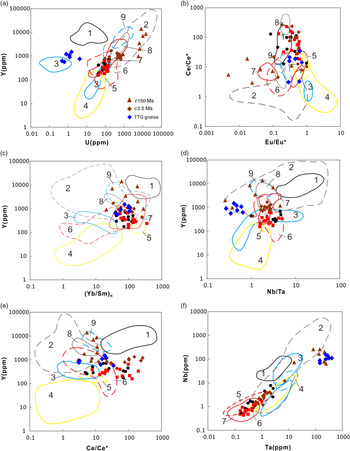
Belousova et al. (Reference Belousova, Griffin, O’Reilly and Fisher2002) also proposed some methods to use incompatible elements of magmatic zircons to discriminate their host rocks. This technique is based on the fact that incompatible elements tend to become enriched in more evolved felsic rocks relative to less evolved mafic rocks; zircons from felsic rocks therefore tend to have higher incompatible element contents. Moreover, magmas with high degrees of differentiation and oxygen fugacities tend to crystallize zircons with low Eu/Eu* ratios and high Ce/Ce* ratios (El-Bialy & Ali Reference El-Bialy and Ali2013; Wu et al. Reference Wu, Cao, Kong, Shao, Li, Xi and Deng2016). According to the theory mentioned above, Belousova et al. (Reference Belousova, Griffin, O’Reilly and Fisher2002) proposed a series of discrimination diagrams to distinguish the host rocks of magmatic zircons. In the U versus Y, Eu/Eu* versus Ce/Ce*, (Yb/Sm)N versus Y, Nb/Ta versus Y, Ce/Ce* versus Y and Ta versus Nb diagrams, all our zircons plot in the field of mafic rocks and lamproite (Fig. 9a–f); regardless of the inevitable deviations, these zircons are more likely to have crystallized from mafic magma than from felsic magma.
(a–f) Host rock discrimination diagrams of magmatic zircons (after Belousova et al. Reference Belousova, Griffin, O’Reilly and Fisher2002). 1, nepheline syenite and syenite pegmatite; 2, granitoid; 3, carbonatite; 4, kimberlite; 5, syenite; 6, lamproite; 7, mafic rock; 8, syenite pegmatite; 9, larvikite. Graphic symbols as for Figure 6. Brown spots represent zircons from the Laiziling granites, skarns and sulphide ores; blue spots represent zircons from TTG gneisses in North China Craton (data provided in online Supplementary Table S5, available at http://journals.cambridge.org/geo).

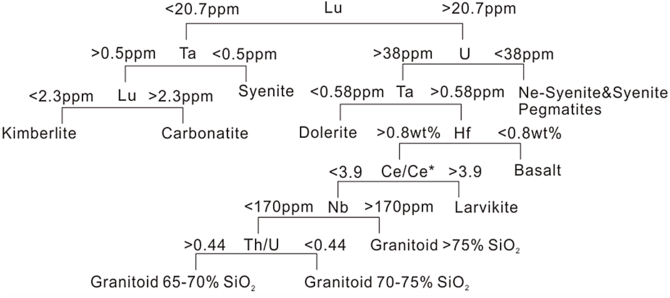
A more accurate way to discriminate zircon host rocks with trace elements was also proposed by Belousova et al. (Reference Belousova, Griffin, O’Reilly and Fisher2002). Based on the diagrams mentioned above, they proposed a classification and regression tree (CART) recognition process to deduce the original host rock according to zircon trace elements; this process goes through rounds of selections using zircon trace elements until it reaches the final outcome (Fig. 10). In this diagram, most of our zircons have original host rocks of dolerite (n = 14), a few zircons have original host rocks of syenite (n = 6), nepheline syenite+syenite pegmatite (n = 2), granitoid (n = 3), larvikite (n = 4) and carbonatite (n = 1). This discrimination also reflects a majority of zircons that crystallized from mafic magma; the unexpected results can be explained as later hydrothermal fluid interaction, which caused the high content of Nb, Ta and Hf in zircons and incorrectly classified the host rocks as acid rocks. It is worth mentioning that the altered zircons have different extents of alteration; the alteration changed the trace elements of these zircons gradually from magmatic zircons to hydrothermal zircons with no clear division. This has led to variable success in discriminating original host rocks. However, the hydrothermal zircons also obtained similar concordant ages when compared with the pure magmatic zircons, so we consider that the hydrothermal interaction did not disturb the U–Pb isotopic system and the dating results are robust; only the trace elements within the hydrothermal zircons were altered.
CART tree diagram of zircon host rock discrimination (after Belousova et al. Reference Belousova, Griffin, O’Reilly and Fisher2002).

However, since trondhjemite–tonalite–granodiorite (TTG) rocks are generated by partial melting of hydrous metabasaltic rocks, we found that magmatic zircons from mantle-derived TTG gneisses can also have similar trace-element compositions as mafic rocks, and positive ϵHf(t) values near the depleted mantle line. As Liu et al. (Reference Liu, Liu, Ding, Liu, Yang, Liu, Wang and Meng2013) reported in the North China Craton, magmatic zircons from TTG gneisses with ages of c. 2.9, 2.7 and 2.5 Ga have positive ϵHf(t) values of 3.2–10.2, 0.7–6.8 and 3.0–12.6, respectively; these are near to the depleted mantle line, indicating that these TTG gneisses were generated by re-melting of juvenile crust that derived from the depleted mantle over a very short period. When considering the trace elements of these zircons, they also have a very similar REE distribution pattern to our 2.5-Ga zircons; they have total REE contents of 473–1124 ppm, higher than our 2.5-Ga zircons but similar to those from the mafic rocks (1000–2000 ppm). In the host rock discrimination diagrams, we found that the magmatic zircons from TTG gneisses have Y contents and Eu/Eu*, Ce/Ce* and (Yb/Sm)N ratios similar to our 2.5-Ga zircons and the 2.5-Ga zircons from the Laiziling granites, skarns and sulphide ores, but distinct Nb, Ta and U contents and Nb/Ta ratios (Fig. 9a–f). Considering that Nb, Ta and U contents are easily enhanced with fractional crystallization processes, the high Nb, Ta and U contents of magmatic zircons in TTG gneisses than our 2.5-Ga zircons may due to their higher evolved feature. TTG gneisses can therefore also be an alternative possibility as host rocks of our 2.5-Ga zircons, an option that was not considered by Belousova et al. (Reference Belousova, Griffin, O’Reilly and Fisher2002).
6.c. Tectonic setting and magma source of c. 2.5-Ga zircons
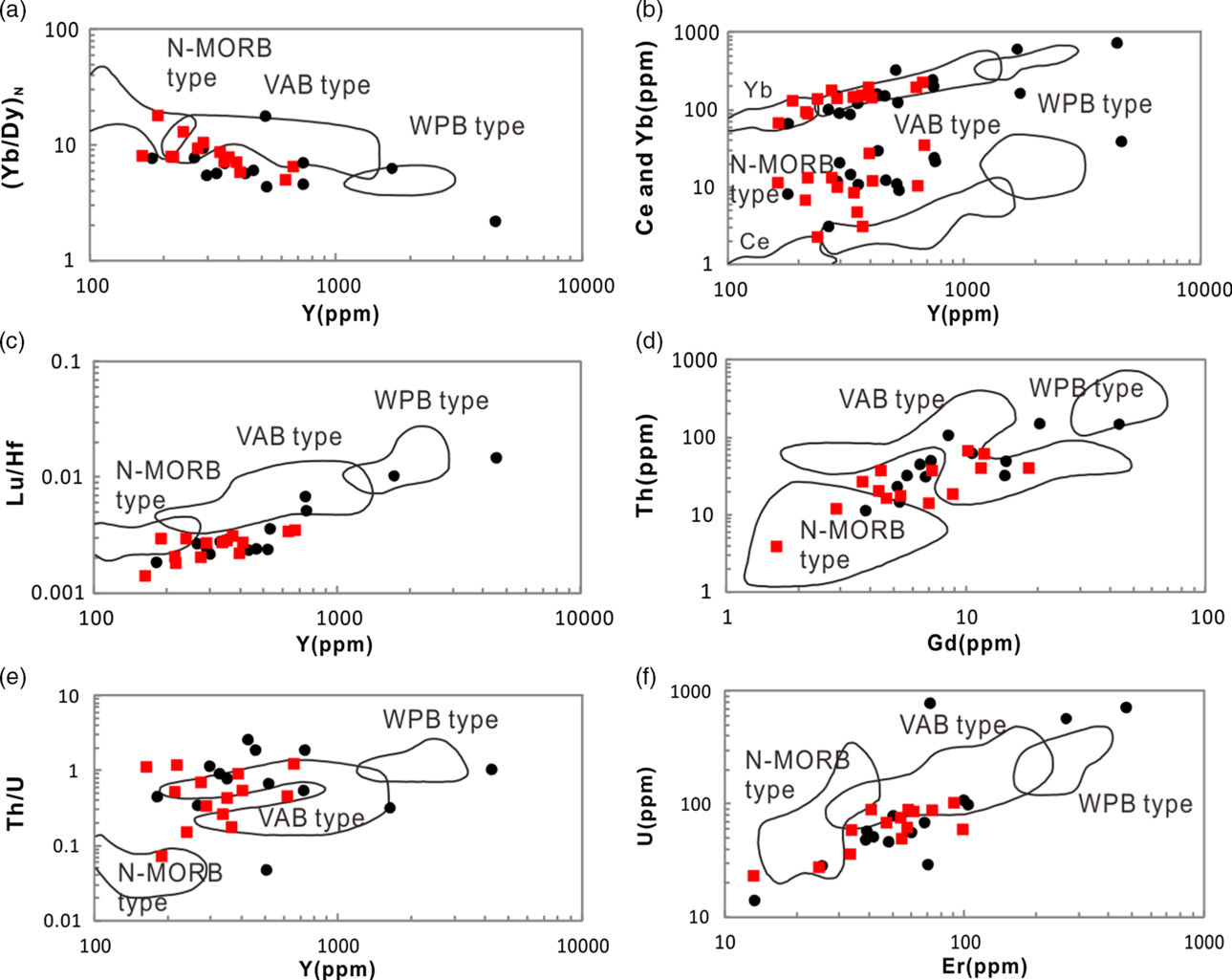
Previous research has reported abundant examples to constrain the tectonic settings by major and trace elements of igneous rocks; however, zircon trace elements can have the same function. Although there exist uncertainties when using zircons to discriminate tectonic settings, in specific situations (e.g. a lack of exposed rocks and structures) zircons may be the only available evidence to study very ancient geological events. Schultz et al. (Reference Schultz, Klemd and Brätz2006) first studied zircons from metabasites around the world, and found that zircons from metabasites in different tectonic settings tend to have different REE contents, similar to the differences reflected in their host rock geochemistry. According to these distinctions, Schultz et al. (Reference Schultz, Klemd and Brätz2006) proposed a series of discrimination diagrams to unravel the host rock tectonic settings using zircon trace elements. In the diagrams of (Yb/Dy)N versus Y, Ce+Y versus Y, Lu/Hf versus Y, Th versus Gd, Th/U versus Y and U versus Er, we find that our zircons mostly plot in the volcanic-arc basalt (VAB) field (Fig. 11a–f), although with some deviations in U, Th and Ce contents and Lu/Hf and (Yb/Dy)N ratios, which may reflect the geochemical characteristics of the host rock magma.
(a–f) Tectonic environment discrimination diagrams of zircons from basic rocks (after Schultz et al. Reference Schultz, Klemd and Brätz2006). Graphic symbols as for Figure 6. N-MORB – normal mid-ocean ridge basalt; VAB – volcanic-arc basalt; WPB – within-plate basalt.

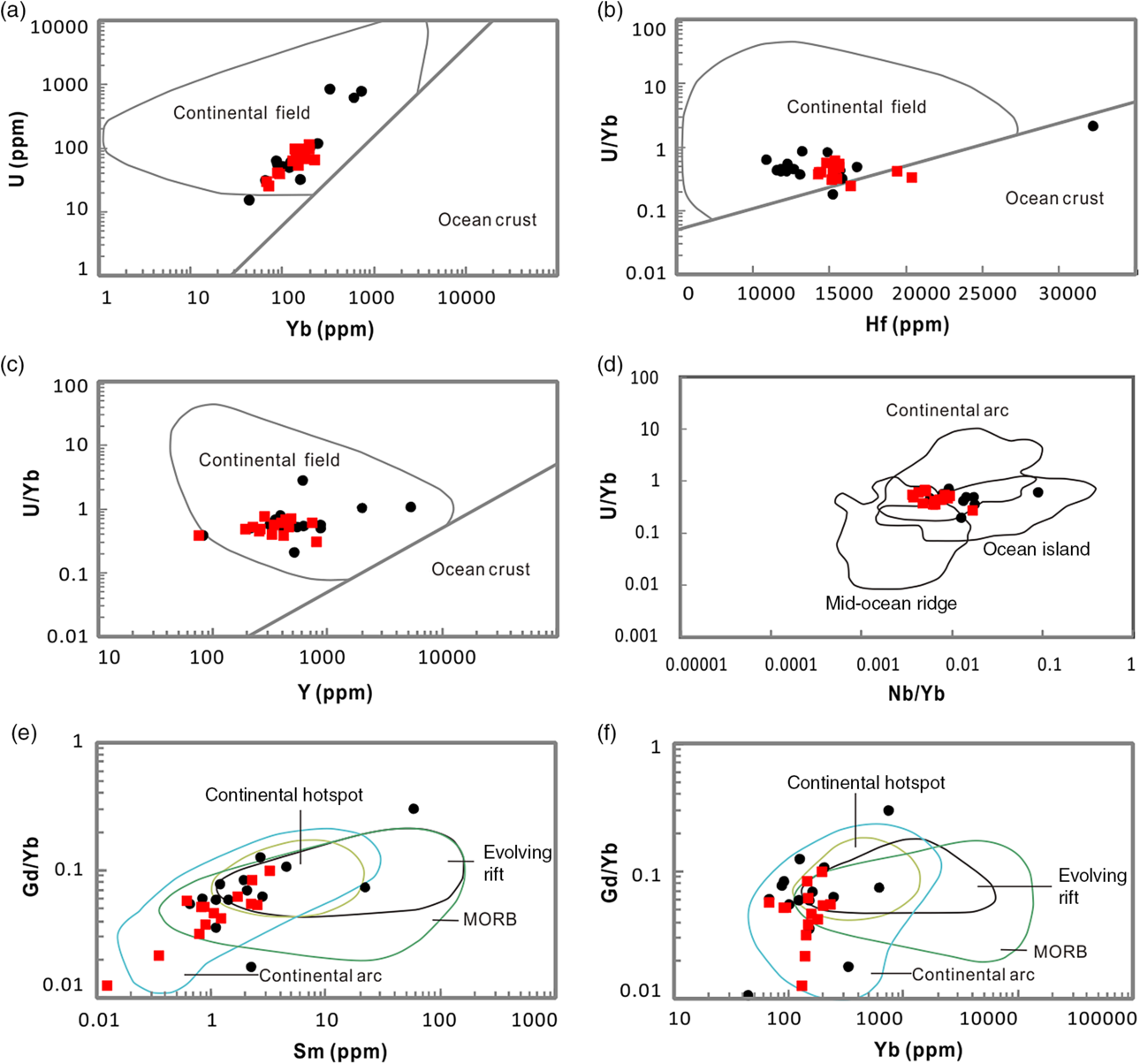
Similarly, Grimes et al. (Reference Grimes, John, Kelemen, Mazdab, Wooden, Cheadle, Hanghoj and Schwartz2007) also advanced a method to distinguish zircons from host rocks under tectonic settings from continental crust to oceanic crust. This method is also based on the theory that the host rock magmas have different geochemical contents: U and Th concentrations are enriched in continental or arc magmas relative to oceanic magmas, while HREEs such as Yb, Hf and Y can be depleted in continental or arc magmas. In the diagrams of Yb versus U, Hf versus U/Yb and Y versus U/Yb, our zircons mostly plot in the continental crust field, indicating a continental provenance (Fig. 12a–c). However, these diagrams cannot discriminate the zircon provenance well because the continental crust can also include several tectonic settings, such as continental-arc systems and continental-rift systems. Grimes et al. (Reference Grimes, Wooden, Cheadle and John2015) therefore proposed other discrimination diagrams using different trace elements, such as Nb and Sc, based on the theory that the host rock magmas from mid-ocean-ridge and ocean-island settings extend to lower Sc/Yb, while continental zircons mostly cluster tightly at higher Sc/Yb. In contrast, elevated Nb is a common feature of within-plate igneous rocks and alkaline magmas in general. Combining this information with the U/Yb ratio discussed above, Grimes et al. (Reference Grimes, Wooden, Cheadle and John2015) proposed a series of diagrams: Nb/Yb versus U/Yb, Nb/Yb versus Sc/Yb and Sc/Yb versus U/Yb. Unfortunately, Sc was not analysed in our zircons; however, in the diagram of Nb/Yb versus U/Yb, they mostly plot in the continental-arc field (Fig. 12d). Although Grimes et al. (Reference Grimes, Wooden, Cheadle and John2015) also emphasized the influence of magma differentiation and argued that zircons from highly evolved magmas with high Hf contents (> 15 000 ppm) are not suitable for discrimination, most of our zircons do not have such high Hf contents, and a highly evolved origin can be excluded.
Tectonic environment discrimination diagrams of zircons (after Grimes et al. Reference Grimes, John, Kelemen, Mazdab, Wooden, Cheadle, Hanghoj and Schwartz2007, Reference Grimes, Wooden, Cheadle and John2015; Carley et al. Reference Carley, Miller, Wooden, Padilla, Schmitt, Economos, Bindeman and Jordan2014). Graphic symbols as for Figure 6.

A more detailed tectonic setting discrimination method was proposed by Carley et al. (Reference Carley, Miller, Wooden, Padilla, Schmitt, Economos, Bindeman and Jordan2014). In their diagrams, zircons can be distinguished in the tectonic settings of continental arcs, continental hotspots, evolving rifts and mid-ocean-ridge basalts (MORBs). These diagrams are based on the theory that REEs and Y are incompatible with major minerals that coexist with higher-temperature melts that are often produced in the tectonic settings of an evolving rift or MORB; in contrast, amphibole and REE-rich accessory minerals commonly join the crystalline assemblage in cooler, wetter magmas in subduction environments such as continental arcs or continental hotspots. Melts produced by the fractionation of these minerals have high concentrations of these elements in high-temperature magma but low concentrations in cool and wet magma. These differences cause MREE and HREE to become enriched in rift or MORB magmas as well as their zircons compared with continental-arc or hotspot magmas and zircons; Sm versus Gd/Yb and Yb versus Gd/Yb diagrams have therefore been proposed. In these diagrams, our zircons are mostly dispersed but conform more to the continental-arc field (Fig. 12e, f).
When we apply the Lu–Hf isotopes to constrain the source of these zircons, our zircons show ϵHf(t) values of 2.5–6.9, which is slightly lower than that (8) for the 2.5-Ga depleted-mantle line (Fig. 6). In addition, the T DM (2565–2741 Ma) and T DM2 (2608–2864 Ma) ages of these zircons are close to their 206Pb/207Pb ages (2468–2580 Ma). Combining these data with the ϵHf(t) values, we believe that these zircons crystallized in magmas that directly originated from either the depleted mantle or juvenile crust derived from the depleted mantle over a very short period, first injected into the crust from the mantle reservoir at c. 2.5 Ga. The initial magmas were contaminated by some crustal material, which caused a slight decrease in ϵHf(t) values compared with the depleted-mantle line.
Overall, although some grains were altered by hydrothermal fluid, the remainder of these zircons are magmatic zircons and from mafic igneous host rocks in a continental-arc environment, and the initial magma source was the depleted mantle. We interpret the whole process as follows. At c. 2.5 Ga, the Cathaysia Block was under a continental-arc environment; during this period, magma from the depleted mantle was underplated and related mafic rocks were intruded and remained in the lower crust, possibly forming the source region of the Jurassic A-type melts. The lower crust of the Cathaysia Block, which contains many old zircons, was intruded by mantle magma multiple times before the Jurassic Period (Wu et al. Reference Wu, Li, Algeo, Jiang and Zhou2018). During the Jurassic Period, the large-scale melting of the lower crust produced abundant A-type granitic rocks. These granitic rocks captured abundant old zircons during their magma ascent process (Li et al. Reference Li, Wu, Evans, Jiang and Zhou2018a), including Archean zircons that may have been captured in their source region. Our acidic dykes, which may represent the highly evolved part of the Laiziling A-type granite, contain no original magmatic zircons due to its highly evolved nature; they only captured the 2.5-Ga zircons in their source region, but did not capture other zircons during their ascent process. In summary, we consider that a crustal growth event occurred in the Cathaysia Block during Archean–Palaeoproterozoic time, which we discuss in the following section in combination with evidence and data reported by other authors.
6.d. Crustal growth event in the Cathaysia Block at 2.5 Ga
Cratons have long been defined as blocks that formed continental cores before the Palaeoproterozoic Era (Zhai, Reference Zhai2011). Typical cratons worldwide contain multiple exposed rocks with Archean ages; however, blocks without such rocks remain under debate. The Cathaysia Block was long considered a block newly formed after the Archean Eon because no exposed Archean rocks have ever been found there (Yu et al. Reference Yu, O’Reilly, Wang, Griffin, Zhang, Wang, Jiang and Shu2008; Li et al. Reference Li, Li and Li2014b). However, multiple captured zircons with Archean ages have recently been discovered from rocks that belong to the Cathaysia Block, either detrital zircons from sedimentary rocks or inherited zircons from meta-igneous rocks. These discoveries led some authors to propose that a hidden Archean basement is actually present beneath the Cathaysia continent (Yu et al. Reference Yu, Wang, O’Reilly, Griffin, Zhang, Li and Shu2009; Yao et al. Reference Yao, Shu and Santosh2011; Li et al. Reference Li, Zheng, Xiong, Zhou and Xiang2018b). In this study, we also found some captured Archean zircons in the Jurassic acidic dykes, and we would argue that they originated from the Cathaysia Block rather than transferring from exotic blocks. Regardless of whether this evidence can eventually prove that the Cathaysia Block is a craton with a hidden basement, we consider that a large-scale crustal growth event occurred in the Cathaysia Block at 2.5 Ga, an event that rewrote the tectonic history of the Cathaysia Block during the Archean–Palaeoproterozoic period.
There are several lines of evidence that can prove these zircons were formed from the Cathaysia Block rather than transported from exotic blocks. First, these zircons have relatively clustered ages of c. 2.5 Ga; although there was possible Pb loss during the later hydrothermal alteration that caused deviation from the concordant curve, the zircons are concentrated on one line that intersects the concordant curve with upper intersection 238U/206Pb ages of 2.5 Ga, which perfectly match their weighted mean 206Pb/207Pb ages. If zircons were transferred from exotic blocks, multiple zircons with older ages should also appear, similar to detrital zircons from sedimentary rocks (Chen et al. Reference Chen, Wu, Gan, Zhang and Fu2019). Second, as discussed above, these zircons are mantle zircons captured by Jurassic acidic dykes, which means that they were present in the deep crust since they separated from the mantle reservoir at 2.5 Ga and were captured by the later A-type granitic magma formed in the lower crust. This phenomenon means that a 2.5-Ga crustal growth event may have happened in the Cathaysia Block. Combining this information with the interpretation that the zircons formed in a continental-arc environment, we deduce that at 2.5 Ga, the Cathaysia Block had already formed at least its continental core (Li et al. Reference Li, Zheng, Xiong, Zhou and Xiang2018b), and experienced frequent subduction and accretion; regardless of whether its scale was vast enough to be called a craton, we cannot deny that massive geological events were already occurring in the initial Cathaysia continental core during late Archean – early Palaeoproterozoic time.
There is still one alternative possibility that the initial Cathaysia Block may have been an accretionary zone formed on the margin of an Archean block, as many publications report that numerous zircons with Archean ages even older than 2.5 Ga have been found in the Cathaysia Block (Zhao & Cawood, Reference Zhao and Cawood2012; Li et al. Reference Li, Zheng, Xiong, Zhou and Xiang2018b); these grains are either detrital zircons from sedimentary rocks or captured zircons from igneous rocks, which means that subduction and accretion may have happened a long time ago before 2.5 Ga.
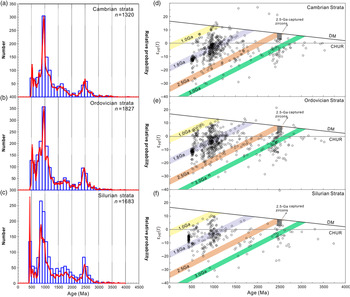
Detrital zircon age spectrum and Lu–Hf isotopes also reveal a large-scale crustal growth event at c. 2.5 Ga (Yao et al. Reference Yao, Li, Li, Su and Yang2015). The detrital zircon age spectrum from sedimentary rocks show three main age peaks at c. 500 and 900 Ma and c. 2.5 Ga (Fig. 13a–c); the 500 and 900-Ma age peaks may correspond to the acknowledged Caledonian and Jinning movements, but the 2.5-Ga magmatic event left no record on the Cathaysia Block that can be interpreted as transported zircons from the Yangtze Block. However, our discovery of 2.5-Ga captured zircons in Jurassic acidic dykes imply that 2.5-Ga magmatism may have occurred in the initial Cathaysia Block. In addition, on the age versus ϵHf(t) diagrams (Fig. 13d–f), three main age peaks at c. 500 and 900 Ma and c. 2.5 Ga that correspond to at least four periods of crustal growth events can be identified; our data correspond to the 2.5-Ga crustal growth event, and represent juvenile mantle-derived materials. The 2.5-Ga detrital zircons have a wide range of ϵHf(t) values, indicating not only juvenile mantle-derived materials but also a reworking of old crustal components.
Detrital zircon relative probability diagrams of (a) Cambrian, (b) Ordovician and (c) Silurian strata of the Cathaysia Block. Detrital zircon ϵHf(t) values versus age diagrams of (d) Cambrian, (e) Ordovician and (f) Silurian strata of the Cathaysia Block (data from Yao et al. Reference Yao, Li, Li, Su and Yang2015). CHUR– chondritic uniform reservoir; DM – depleted mantle.

In summary, regardless of which kind of tectonic event the Cathaysia Block experienced at 2.5 Ga we consider that a large-scale crustal growth event occurred, which caused multiple magmatic intrusions, including continental magma from the depleted mantle.
7. Conclusion
Captured zircons were found in two samples from the Xianghualing acidic dykes; these dykes formed during the Jurassic Period after formation of the 150-Ma Laiziling pluton, but the zircons yield 207Pb/206Pb ages ranging from 2396 ± 51 to 2602 ± 30 Ma and 2451 ± 97 to 2570 ± 15 Ma, with upper intersection 206U/238Pb point ages of 2505 ± 442 and 2533 ± 22 Ma and weighed mean 207Pb/206Pb ages of 2500 ± 30 and 2535 ± 16 Ma, respectively.
The trace-element compositions indicate that these zircons are magmatic zircons with minor later hydrothermal modification; omitting the hydrothermal zircons, the remaining magmatic zircons are not detrital but directly captured from igneous rocks. Their host rocks were either mafic rocks or TTG gneisses, and they existed in a continental-arc setting at 2.5 Ga. Lu–Hf isotopes indicate that they either came directly from the depleted mantle, or were generated by the remelting of juvenile crust derived from the depleted mantle over a very short period.
Combining the detrital zircon age spectrum and Lu–Hf isotopes, we infer that the Cathaysia Block experienced a crustal growth event at 2.5 Ga.
Acknowledgements
This study was financially supported by the Key R&D Program of China (grant no. 2017YFC0602402), the Innovation-driven Plan of Central South University, China (grant no. 2015CX008) and Open Research Fund Program of Key Laboratory of Metallogenic Prediction of Nonferrous Metals and Geological Environment Monitoring (Central South University), Ministry of Education (grant no. 2019YSJS23 and 2018YSJS07). We thank editor Kathryn Goodenough, two anonymous reviewers and Associate Professor Thomas Ulrich, whose comments helped to improve this manuscript.
Supplementary material
To view supplementary material for this article, please visit https://doi.org/10.1017/S0016756820000667