Introduction
In 2002, the United States Department of Agriculture (USDA) established the National Organic Program (NOP) to standardise organic products nationally and to meet consumer expectations regarding these products. Specific regulations are outlined by the USDAs Agricultural Marketing Service 7 CFR (Code of Federal Regulations) Part 205, National Organic Program, with sections 205.236 through 205.239 covering livestock regulations (including poultry) (USDA, 2012a). The NOP regulations also define a National List of Allowed and Prohibited Substances for producing organic food products (Section 205.600). This list allows all non-synthetic (e.g. natural) substances (unless specifically prohibited) and disallows all synthetic substances (unless exempted) (USDA, 2012b).
On March 15, 2011, the NOP ruled that synthetic methionine (Met) use was to be limited to 2, 2.5, and 3 kg per metric tonne (4, 5, and 6 lbs per short ton) of feed for organic laying hens, broilers, and turkeys and other poultry, respectively (USDA, 2011). Synthetic Met has since been further restricted to 1, 1, and 1.5 kg per metric tonne (2, 2, and 3 lbs per short ton) of feed for organic laying hens, broilers, and turkeys and other poultry, respectively, as of October 2, 2012 (USDA, 2012c). This is half (or less than half for broilers) of the quantity previously allowed for all species. This presents a unique and challenging issue for formulating organic poultry diets, particularly for early phases of growth, and synthetic Met use in organic poultry diets may be banned entirely in the near future. All other synthetic amino acids (AA) have previously been banned (USDA, 2012b). A companion paper has previously discussed unconventional feed ingredients that could be used to address this issue (Burley et al., Reference BURLEY, PATTERSON and ANDERSON2015). The review herein aims to explore alternative genetic bird strains and unconventional feeding strategies for organic production systems that could be used to lessen the impacts of limiting dietary synthetic Met use for these birds.
Importance of methionine for poultry
Synthetic Met is the last synthetic AA to be allowed for use in organic poultry diets (although its inclusion rate has now been limited) because Met is typically considered the first limiting AA when birds are fed corn and soybean meal based diets. Coenzyme S-adenosylmethionine (SAMe; the active form of Met) serves as an important labile methyl-group donor, which allows for the formation of many essential compounds in the body including choline, creatine, epinephrine, DNA, glutathionine, and many others (Harper, Reference HARPER1965; Fanatico, Reference FANATICO2010). Together, Met and cysteine (Cys), the two sulphur-containing AA, are also major sources of organic sulphur in the body (Harper, Reference HARPER1965). Sulphur is converted into sulphate during catabolism of these two AA, which in turn plays a major role in support of connective tissues (NRC, 1994). Methionine is therefore a key dietary nutrient for maintaining poultry growth and production at current industry levels (Schutte et al., Reference SCHUTTE, VAN WEERDEN and BERTRAM1983; Shafer et al., Reference SHAFER, CAREY and PROCHASKA1996; Carew et al., Reference CAREW, MCMURTRY and ALSTER2003; Vieira et al., Reference VIEIRA, LEMME, GOLDENBERG and BRUGALLI2004; Corzo et al., Reference CORZO, KIDD, DOZIER III, SHACK and BURGESS2006). If organic poultry diets have limited or no inclusion allowance for synthetic Met, which is a key dietary supplement in both conventional and organic systems, producers would experience major economic burdens from reduced productive performance unless significant changes to dietary formulations are employed.
High crude protein diets
To lessen potential production losses from limiting or banning Met supplementation for organic poultry, dramatic increases in the crude protein (CP) level would need to be employed in organic poultry diets to meet the Met requirements of the birds. For example, Pesti (Reference PESTI2009) reported that if a corn and soybean meal (SBM) based broiler diet were formulated without synthetic AA, it would require 70.86% SBM and contain 35.60% CP to meet the Met requirements and would require an additional 12.22% added fat just to meet energy requirements due to lower corn levels in this diet. This type of diet would not be acceptable in practice and can even be harmful to the bird due to excessive N intake (Chandra et al., Reference CHANDRA, SINGH, SONI and AHUJA1984; Ward et al., Reference WARD, MCNABB and MCNABB1975). Chandra et al. (Reference CHANDRA, SINGH, SONI and AHUJA1984) noted numerous symptoms indicative of experimentally induced nephritis (including oedemal fluid in the hydropericardium and thoracic cavity, urate deposition on kidney and other organs surfaces, atrophy of the kidney lobes, etc.) when 42.28% CP diets were fed to 18 d old broilers over a period of 15 weeks. High CP diets have been shown to elevate litter moisture levels (resulting in foot pad lesions) and to increase N excretion from birds and NH3 emissions from litter (Ward et al., Reference WARD, MCNABB and MCNABB1975; Meluzzi et al., Reference MELUZZI, SIRRI, TALLARICO and FRANCHINI2001; Liang et al., Reference LIANG, XIN, WHEELER, GATES, LI, ZAJACZKOWSKI, TOPPER, CASEY, BEHRENDS, BURNHAM and ZAJACZKOWSKI2005; Roberts et al., Reference ROBERTS, XIN, KERR, RUSSELL and BREGENDAHL2007; Burley, Reference BURLEY2012).
Dramatic increases in feed prices would be realised if organic poultry farmers employed high CP diets to satisfy Met needs. For example, when an organic corn and SBM based broiler starter diets are formulated with 5, 2, or 0 lb/ton synthetic Met (using organic ingredient prices and no other synthetic AA as per U.S. organic regulations), CP levels increase from 23.68 to 28.32 to 36.05%, respectively, and diet prices increase from $757.59 to $851.72 to $1.004.00/ton of feed, respectively (unpublished data). These exceedingly high feed prices would have major economical impacts on farmers.
Alternative strategies to mitigate dietary synthetic methionine needs
alternative bird genetics
Methionine is a critical compound for many physiological processes in the body of birds. Thus, although genetic selection of ‘heritage’ breeds results in slower growing broiler strains and lower producing layers, which may require reduced quantities of Met on a percentage or daily basis, ultimately the requirement for this essential AA remains the same across strains when considered over an entire grow out or production period when you take time to reach market weight or egg production rate into account (Anderson, Reference ANDERSON2011).
Fast-growing strains of broiler chickens (seven weeks or less to market weight) are typically used in U.S. organic production, as in conventional production. Slower growing broiler breeds (12 weeks to market weight), commonly used in the EU, have been reported to have less efficient meat yield, but better livability, higher levels of activity, and possibly more tender and flavourful meat (as detectable by a trained panel, but not by consumers) compared to fast-growing strains (Fanatico et al., Reference FANATICO, PILLAI, EMMERT, GBUR, MEULLENET and OWENS2007a; Reference FANATICO, PILLAI, EMMERT and OWENS2007b; Reference FANATICO, PILLAI, HESTER, FALCONE, MENCH, OWENS and EMMERT2008). A flock of a 1955 broiler strain, Athens Canadian Random Bred, were additionally found to have greater internal organ weights (as a percentage of total body weight), including the heart and lungs, compared to a 2012 Cobb broiler strain despite the 1955 strain being 3.7 to 4.7 times lower in body weight (BW) (Collins et al., Reference COLLINS, KIEPPER, RITZ, MCLENDON and WILSON2014). Such alterative breeds would likely experience much less metabolic strain than fast growing modern genetic lines. Despite their slower growth, however, slower growing broiler breeds (12 weeks to market weight) were still found to have the same dietary Met requirements as fast growing breeds (Fanatico et al., Reference FANATICO, PILLAI, O'CONNOR-DENNIE and EMMERT2006). Jacob et al. (Reference JACOB, PESCATORE, CANTOR, FISHER and FORD2014) evaluated the performance and Met needs of three alternative ‘dual purpose’ breeds (i.e. Black Australorp, Rhode Island Red, and Barred Plymouth Rock), which are meant to serve as egg layers or meat birds. Despite lower Met needs of these three alternative breeds (0.31% dietary Met, similar to typical laying hen requirements) when fed a low energy diet (3,047 kcal/kg ME), the growth of these breeds was very poor, making them not cost effective as an alternative meat chicken breed.
Commercial hybrid brown laying hen varieties (i.e. Hy-Line, Bovan, Lohmann, and ISA Brown) are the most commonly used breeds in organic production in the U.S. today. Replacing these strains with ‘heritage’ breed hens (e.g. those with historical genotypes) has been investigated to compare productivity from 1958 through 1993 using the Canadian Random Bred Strains (Jones et al., Reference JONES, ANDERSON and DAVIS2001). Unfortunately, the CS5, CS7 and CS10 ‘heritage’ Canadian Random Bred Strains were found to have poorer performance than in the 1993 strain despite being fed the same dietary regimen. There is the potential of ‘heritage’ strains to both have lower percent Met requirements and better inclination to forage, which may also ameliorate Met need in the feed (Fanatico, Reference FANATICO2010). Potentially lower percent Met requirements could be the result of reduced production performance of ‘heritage’ layers in range, cage-free, and caged settings (Anderson, Reference ANDERSON2011). However, Elwinger et al. (Reference ELWINGER, TUFVESSON, LAGERKVIST and TAUSON2008) found otherwise when comparing an experimental heritage breed called the ‘Swedish hen’ (SH) (SLU-1329), which was a Rhode Island x White Leghorn cross selected on low CP diets (130 g/kg) over 25 generations, to two typical commercial strains (Hy-Line W98 and Lohmann-LSL hens). When varying levels of Met were fed, egg weight and plumage condition were negatively impacted by reduced dietary Met for all genotypes, indicating that selection of SH hens on low CP diets over multiple generations did not give them any advantage over commercial strains for lower Met requirements.
Currently, typical fast growing strains of turkeys (needing three to four months to attain market weight) (e.g. Broad Breasted White) are used in organic production in the U.S.; however, the E.U. more often uses slow growing ‘heritage’ turkey breeds (seven to eight months to market weight), as with broiler chickens (Blair, Reference BLAIR2008; Fanatico, Reference FANATICO2010). To be defined as a ‘heritage’ breed, turkeys must be able to reproduce naturally (fertility rate 70-80%), have a long breeding lifespan (three to five years for toms and five to seven years for hens), and slow/moderate growth rates (Blair, Reference BLAIR2008). Heritage breeds are characterised by approximately 50:50 white to dark meat composition versus fast growing strains with an approximate 70:30 ratio, due to heritage breeds being single rather than double-breasted (Blair, Reference BLAIR2008). Methionine requirements of slow versus fast growing turkeys have not yet been investigated.
alternative feeding strategies
Although outdoor access for poultry is required by the NOP, there are no set guidelines for the quantity and quality of forage access (Fanatico et al., 2009). Methionine content in fresh pasture forages is quite low on an ‘as is’ basis due to their high moisture content, so it is not possible for birds to consume large enough quantities of forage material to meet their Met needs entirely through forages alone. Forages are not very digestible by poultry, their nutrient and AA levels (including Met) vary with season and plant species, and their palatability differs by plant variety (Wood, Reference WOOD1956; Blair, Reference BLAIR2008). Forage intake by birds is also fairly low (2 to 8% DM intake as measured in crop contents; Wood, Reference WOOD1956). However, broilers from three to eight weeks of age have been shown to be able to make up for a marginal Met deficiency (NRC, 1994) through provision of forage (Moritz et al., Reference MORITZ, PARSONS, BUCHANAN, BAKER, JACZYNSKI, GEKARA and BRYAN2005). Also, higher levels of activity and greater inclination to forage have been reported for heritage and slower growing broiler breeds (Bizeray et al., Reference BIZERAY, LETERRIER, CONSTANTIN, PICARD and FAURE2000; Rack et al., Reference RACK, LILLY, BEAMAN, GEHRING and MORITZ2009). Forage intake has been shown to be increased by feed restriction (Moritz et al., Reference MORITZ, PARSONS, BUCHANAN, BAKER, JACZYNSKI, GEKARA and BRYAN2005; Karsten et al., Reference KARSTEN, PATTERSON, STOUT and CREWS2010). However, Karsten et al. (Reference KARSTEN, PATTERSON, STOUT and CREWS2010) noted that pastured hens fed 70 g/hen/d complete mash had lower body wt, egg production, and egg size compared to caged hens, and it has been estimated that the pastured hens were only able to forage for 13.2% of their dietary energy and 21.5% of their protein requirements. Similarly, Baluch et al. (Reference BALUCH, PATTERSON, MAYER, ALP, BURLEY, TOOKER and DOUGLAS2014) found that when pastured hens had their feed restricted to 80% of a typical amount of feed, this reduced BW and negatively impacted egg production and egg interior quality compared to full fed pastured hens. Forage consumption can impact both meat and egg quality. Higher contents of n-3 polyunsaturated fatty acids (e.g. eicosapentaenoic, docosapentaenoic, and docosahexaenoic) were noted in the breast meat of broilers offered dried leguminous forage in addition to a typical corn/soybean meal based diet fed from day old to four weeks versus analogous birds that were not offered this supplemental forage (Ponte et al., Reference PONTE, PRATES, CRESPO, CRESPO, MOURÃO, ALVES, BESSA, CHAVEIRO-SOARES, FERREIRA and FONTES2008). Additionally, hens given pasture access (alfalfa, clover, or grass) produced eggs with darker yolks and higher omega 3 fatty acid, vitamin A and vitamin D levels compared to control hens not provided access to pasture (Karsten et al., Reference KARSTEN, PATTERSON, STOUT and CREWS2010). Eggs produced from hens given access to grass-clover pasture (in addition to typical diet), however, have been found to have less favourable sensory profiles (detected by a trained panel) compared to eggs from hens without pasture access (Horsted et al., Reference HORSTED, HAMMERSHØJ and ALLESEN-HOLM2010).
Cherry and Siegel (Reference CHERRY and SIEGEL1981) were able to demonstrate that young hens from two different genotypes could compensate for marginal total sulphur AA (Met+Cys) levels by increasing their feed intake when fed isocaloric, 15% CP diets. Schutte et al. (Reference SCHUTTE, DE JONG and BERTRAM1994) similarly noted the ability of laying hens to compensate for marginal Met deficiencies by increasing feed intake without resulting in production losses. Similar feed intake increases to make up for a marginal Met deficiency has been observed for broilers (Chee and Polin, Reference CHEE and POLIN1978). Additionally, Sundrum et al. (Reference SUNDRUM, SCHNEIDER and RICHTER2005) noted that, with increasing age, turkey poults become more capable of making up for suboptimal AA levels in their diets by means of increased feed intake both due to their lower AA demands (compared to younger poults) and their greater capacity for feed intake as they become larger. These authors commented that male turkeys had a greater feed intake capacity than females. Schutte et al. (Reference SCHUTTE, DE JONG and BERTRAM1994) cautioned, however, that if there is a more than a marginal Met deficiency in the feed (e.g. 0.23% or lower total dietary Met for 25 to 77 wk old Lohmann LSL White Leghorn laying hens in this case), then feed intake actually begins to decrease and the birds’ Met deficiency symptoms become more severe. Therefore, caution should be used if this strategy should ever be employed, since there is a fine line between providing marginal Met to birds to encourage increased feed intake to make up for the deficiency successfully without growth or production losses.
Self selection is a feeding strategy where poultry are provided a choice between two or more separate rations (e.g. one consisting of corn and the other of a protein concentrate). Birds are meant to select between these rations only as specific nutrients are needed and therefore be able to choose between these feeds to meet their Met requirements exactly as their needs change over different phases of production (Rack et al., Reference RACK, LILLY, BEAMAN, GEHRING and MORITZ2009). Feeding diets in this manner would in theory require little or no synthetic Met since the birds would be selecting their own rations to meet their nutrient requirements rather than consuming a complete diet. Hughes (Reference HUGHES1979) showed that hens that were allowed to select between Met adequate and Met deficient diets had improved egg production compared to those fed a Met deficient diet alone, demonstrating the capacity of the birds to recognise their need for an adequate level of Met in their diet. However, egg production did not improve to the level of those fed solely the Met adequate diet. Unfortunately, Rack et al. (Reference RACK, LILLY, BEAMAN, GEHRING and MORITZ2009) and Cerrate et al. (Reference CERRATE, WANG, COTO, YAN and WALDROUP2007) reported that self selection of feed can lead to the over consumption of corn/energy ingredients versus protein concentrates, which negatively influences broiler growth due to resulting in AA deficiencies. This effect was attributed to either the birds’ drive to first satisfy their energy needs prior to other nutrients and/or the high palatability of corn. Interestingly, Cadirci et al. (2009) noted that laying hens provided with a Met deficient diet could, with colour-cue assistance (coloured water), self select a water source that was supplemented with additional Met over a normal water source in order to compensate for their Met deficiency, which in turn eliminated their deficiency symptoms.
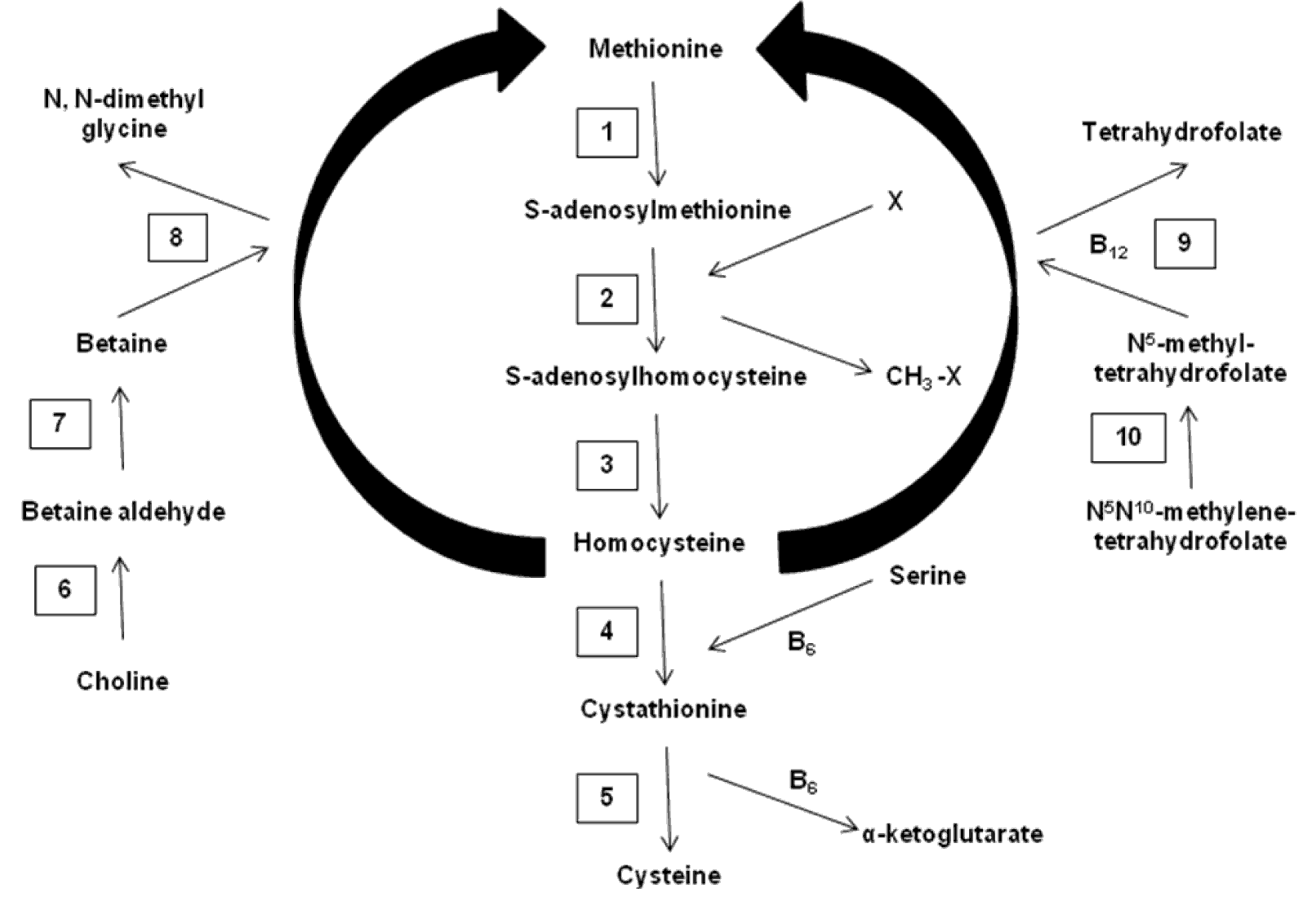
Before Met can donate its methyl group during metabolism, it must first be converted to its active form, coenzyme SAMe, with an input of energy in the form of adenosyl triphophate (Figure 1). After donating its methyl group, coenzyme SAMe is converted irreversibly to S-adenosylhomocysteine and then to homocysteine. At this point, homocysteine, along with serine, can be converted irreversibly to the non-essential AA Cys, through the intermediate cystathionine (NRC, 1994). Homocysteine can alternatively be re-methylated by betaine (after its formation from the oxidation of choline) or by N5-methyl-tetrahyrdofolate to form Met (Pillai et al., Reference PILLAI, FANATICO, BEERS, BLAIR and EMMERT2006). Due to the interrelationship of Met, betaine and choline, numerous studies have investigated the sparing activity of these methyl donors on poultry Met requirements. Researchers have concluded that choline and betaine have limited or no sparing effect on Met needs for broilers, laying hens, turkey poults (choline only) and ducks when birds were provided marginally Met deficient diets - improving the Met sparing effect when inorganic sulphate was supplemented to broiler chick and turkey poult diets in addition to choline (Miles et al., Reference MILES, RUIZ and HARMS1983a; Reference MILES, RUIZ and HARMS1983b; Schutte et al., Reference SCHUTTE, DE JONG, SMINK and PACK1997; Simon, Reference SIMON1999; Wang et al., Reference WANG, XU and FENG2004; Zhan et al., Reference ZHAN, LI, XU and ZHAO2006). Inorganic sulphate has been shown to have a minor sparing effect (only ~0.05% of supplemental Met) on the Met requirements for both growth and feed to gain ratio when it was added in moderately Met-deficient diets of young chicks (Bornstein and Plavnik, Reference BORNSTEIN and PLAVNIK1977).
Interrelationship between methionine, cysteine, and associated methyl-group donors. Numbers indicate enzymes as follows: 1) methionine adenosyltransferase; 2) multiple enzymes; 3) S-adenosylhomocysteine hydrolase; 4) cystathionine β-synthase; 5) cystathionine lyase; 6) choline dehydrogenase; 7) betaine aldehyde dehydrogenase; 8) betaine-homocysteine methyltransferase; 9) methionine synthase; 10) N5, N10-methylenetetrahydrofolate reductase [information for this figure sourced from Emmert et al. (Reference EMMERT, GARROW and BAKER1996)].

Combining strategies
Although many of the solutions examined herein have been shown to reduce the need for supplemental Met in organic poultry diets (even if only to a minor extent), there is no alternative breed or feeding strategy that has been shown to eliminate the need for this feed additive entirely. It is therefore recommended that combinations of solutions be looked at more closely in future studies, since these could further reduce the need for synthetic Met beyond what a single solution will allow. As an example, Attia et al. (Reference ATTIA, HASSAN, SHEHATTA and ABD EL-HADY2005) found that the sparing effect of betaine on supplemental Met was particularly notable in a study that provided betaine to slow-growing chicks from 0 to 56 d of age. They reported that Met level could be reduced to 0.32% with a 0.07% betaine supplement without reductions in growth or feed conversion efficiency. This was attributed to potentially lower Met requirements of a unique Mandarah broiler strain (0.42% Met) versus the more typically used commercial Ross strain broilers (0.51% Met) (Attia et al., Reference ATTIA, HASSAN, SHEHATTA and ABD EL-HADY2005; Aviagen, 2009; Bunchasak, Reference BUNCHASAK2009). Fisher et al. (Reference FISHER, PESCATORE, JACOB, PAUL, VAN BENSCHOTEN, GOOD, CANTOR and FORD2014), as another example of combining feeding strategies with alternative genetics, looked at a self selection feeding program with four diets including a protein concentrate (39% CP) without added Met and three grains of varying energy content (cracked corn, naked oats, and pearl millet) and compared the self selection process of three commercial meat-type breeds (Cornish Cross males, Cornish Cross females, Red Ranger) to three heritage breeds (Rhode Island Red, Barred Plymouth Rock, and Black Australorp). It was noted that heritage breed meat-type birds consistently had lower BW and selectively consumed less CP and Met at any given age compared to the commercial breed birds. This indicated a lower Met requirement for the heritage meat-type birds (although also slower growth) and showed that these heritage breeds will actively self select these lower quantities of Met when offered this feeding strategy.
Conclusions
Given the current status of organic poultry production, this review addresses a number of alternative genetics and feeding strategies that have been examined for their potential to limit the quantity of synthetic Met needed in U.S. organic laying hen, broiler, and turkey and other poultry diets given the current restrictions on dietary synthetic Met inclusion. Alternative ‘heritage’ breed birds have been shown to potentially have lower Met needs than modern commercial breeds; however, these alternative genetic lines have slower growth, poorer productive performance, and therefore could lead to significantly higher costs for farmers. Foraging can provide some nutrient enrichment of eggs and meat, but can only make up for very marginal Met deficiencies due to low consumption of high moisture forages. Lowering Met density in bird diets has been shown to increase feed consumption and subsequently make up for any marginal deficiency; however, caution should be used with this strategy since more than a slight Met deficiency can reduce feed intake, which would exacerbate the deficiency and negatively impact growth and/or production. Birds have been shown to have some capability to self select between energy-rich ingredients and protein concentrates to attempt to meet their Met needs, although overconsumption of energy has been reported using this method. The potential of methyl donors (betaine and choline) to spare Met has been shown to be limited value, but inorganic sulphate may have some sparing capacity. It is demonstrated herein that there is no one definitive solution using alternative genetics or feeding strategies that has the ability to eliminate the need for synthetic Met inclusion in organic poultry diets at this time; however, a combination of one or more of these strategies could reduce economic hardship from production losses that would result if bird Met requirements are not met and could limit feed cost increases and detrimental environmental impacts from high CP diets that would otherwise be necessary given current synthetic Met restrictions. If a timely and viable alternative to dietary synthetic Met inclusion cannot be developed, the ability of the organic poultry producer to provide a reasonably priced and nutritious product will be lost. It is therefore imperative that research in this area continue until a solution is realised.