Introduction
There is widespread evidence that the last two decades have witnessed a marked fertility decline in sub-Saharan Africa, albeit to varying degrees (Macro International, 2009). While differences exist between and within countries, the decline has occurred among virtually all social, demographic and economic groupings (APHRC, 2002; Feyisetan & Bankole, Reference Bankole and Feyisetan2002; Anyara & Hinde, Reference Anyara and Hinde2006). Notwithstanding the recent decline, however, fertility rates in the region are still higher than in any other major region of the world. For instance, the total fertility rate of sub-Saharan Africa is 5.2 compared with 2.2 for Asia and 2.3 for Latin America (Population Reference Bureau, 2010). It is therefore not surprising that fertility regulation still tops the agenda of many African governments' programmes on population and reproductive health.
Past research on fertility in the region has largely focused on levels, trends, determinants, fertility desires, intentions, preferences and contraceptive behaviour (Thomson et al., Reference Thomson, McDonald and Bumpass1990; Thomson, Reference Thomson1997; Schoen et al., Reference Schoen, Astone, Kim, Nathanson and Jason1999; Ibisomi, Reference Ibisomi2007). With regard to fertility desires, it has been noted that for various reasons, desired family size cannot be precisely attained and as such, there is often a disjoint between desired and actual family size. According to Bongaarts (Reference Bongaarts1998), desired family size is usually lower than actual family size in early- and mid-transitional societies, while the reverse is often the case in post-transitional ones. Bongaarts identified unwanted fertility, replacement of deceased children and gender preferences as factors that could enhance observed fertility relative to desired family size, and rising age at marriage, involuntary infertility (marital disruption, physiological sterility) and competing preferences (economic, social, health and other factors that cause women to stop childbearing earlier than planned) as factors that could reduce observed fertility relative to desired family size. In a qualitative study on achievement of fertility desires in Nigeria, Ibisomi (Reference Ibisomi2007) found that economic factors, migration/living apart, marital disruption, infertility, ill-health (including rhesus incompatibility), occultic influence (in relation to magical power), child mortality, early/late marriage, polygamy, sex preference, societal and other third-party influences, improvement in economic conditions, lack of effective knowledge on contraception, mismatch in couples' desires (including abusive/drunkard husbands) and multiple births are some of the important factors that make it difficult to achieve desired family size.
While the factors associated with fertility desires and actual fertility behaviour, as well as the relationships between them, have been well researched (see, for example, Monnier, Reference Monnier1989; Westoff, Reference Westoff1990; Thomson et al., Reference Thomson, McDonald and Bumpass1990; Hagewen & Morgan, Reference Hagewen and Morgan2005; Roy et al., Reference Roy, Sinha, Koenig, Mohanty and Patel2008), there is little empirical work on what accounts for the difference between the two fertility measures, and the implications for women's reproductive health and well-being. Understanding the gap between desired and actual number of children is important as it sheds light on the inability of women to achieve their stated fertility desires. While some women have more than they desire, others have fewer than wanted. Unfortunately, issues relating to the latter group remain largely ignored due to the preoccupation with population control in the developing world. What is apparent though is that women at both ends of the divide have ‘unmet fertility desires’. The mismatch between desired and observed fertility has implications for policy and programme interventions (Pritchett, Reference Pritchett1994; Hagewen & Morgan, Reference Hagewen and Morgan2005). For low-fertility countries, it has been argued that below-replacement fertility would disappear if respondents' fertility intentions were realized (Bongaarts, Reference Bongaarts, Bulatao and Casterline2001, Reference Bongaarts2002; Goldstein et al., Reference Goldstein, Lutz and Testa2003). For high-fertility countries concerned with population growth and unwanted fertility, the disjuncture between desired fertility and realized fertility represents a significant opportunity for policy interventions that, on the one hand, might help individuals realize their fertility intentions, and on the other might slow the rate of population growth (Pritchett, Reference Pritchett1994).
Although both desired and actual fertility levels are high in Nigeria, the latter exceeds the former, as is typical of most developing countries. For instance, the average number of children per woman in 2003 of 5.7 was about 9% higher than the mean desired number of 5.2 (National Population Commission, 2004; Ibisomi, Reference Ibisomi2007). Given the reported discrepancy between observed and desired fertility in Nigeria, this study seeks to answer the following questions: (1) what is the profile of women with unmet fertility desires; (2) what are the factors associated with the mismatch between fertility desires and achievement; and (3) what are the implications for women's reproductive health and welfare? The study will add to the body of knowledge on fertility and reproductive health issues in Nigeria. In addition, it could assist in policy formulation and in the design of appropriate programmes or fortification of existing ones with the aim of improving the level at which people achieve their fertility desires.
Methods
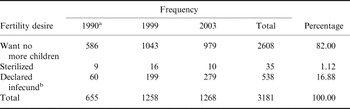
To ensure an adequate sample size, this study pools together the 1990, 1999 and 2003 Nigeria Demographic and Health Survey (NDHS) individual-women data for analysis. The three NDHSs are nationally representative (cross-sectional) probability sample surveys of women aged 15–49 years designed to provide up-to-date information on fertility, among numerous other issues. For this study, women who wanted no more children, were sterilized or declared infecund and who gave a numeric response to the question on desired (ideal) number of children constitute the study sample. These criteria are used to restrict the sample to women who have ‘theoretically’ completed their reproductive career. This restriction yielded an analytic sample of 3181 women, the breakdown of which is presented in Table 1.
Study sample, NDHS 1990, 1999 and 2003

a In the 1990 survey, only women who were married or living together with a partner were asked questions on their fertility preference. This accounts for the small number of cases in 1990 compared with the other two survey years.
b Women who respond that they want another child, but when asked when they would like the next child, respond that they cannot get pregnant, are classified in the declared infecund category.
The response variable ‘unmet fertility desires’ is defined as the difference between desired and actual number of children. The variable is operationalized by subtracting the number of living children (herein referred to as actual number of children) of each woman from the number that she desired. The number of living children is used as opposed to number of births to cater for the possibility of occurrence of child replacement. On the basis of this, respondents were classified into one of three groups and coded as: 0, actual=desired; 1, actual greater than desired; and 2, actual fewer than desired. On the assumption that the behaviour of the two groups of women (those who had more than desired and those that had fewer than desired) could be different as they face different challenges, the sample was stratified accordingly. The first sample deals with women with met fertility desires (desired number of children equals actual number of children) and those who had more children than desired; while the second consists of women with met fertility desires and those with fewer children than desired.
In the multivariate model, some theoretically relevant variables in the Bongaarts (Reference Bongaarts1998) and Ibisomi (Reference Ibisomi2007) studies were controlled for, including: age at first birth, experience of child death, fecundity, marital status, occupation, current age of respondent, place and region of residence, highest level of education, religion, household wealth (constructed into three equal parts on the national sample before sub-setting study sample) and contraceptive behaviour. The study also controls for the three different years within which the surveys were conducted. Also, one would expect unmet fertility desires of the never married and the formerly married women to be different. However, due to the small number of cases (only two) of the never married women who desired fewer children than they already have, the never married and formerly married groups are combined to constitute the ‘not in union’ group to enable higher level analysis.
Bivariate and multivariate analyses are carried out to achieve the study objectives. The bivariate analysis examined prevalence of unmet fertility desires by the profiles of women who have more and those who have fewer children than desired. Bivariate analysis was also used to examine the relationship between the dependent variable and each individual covariate. Binary logistic regression was then used to identify the factors associated with unmet fertility desires for women at the two ends (women with more children than desired and those with fewer children than desired).
Results
Sample characteristics
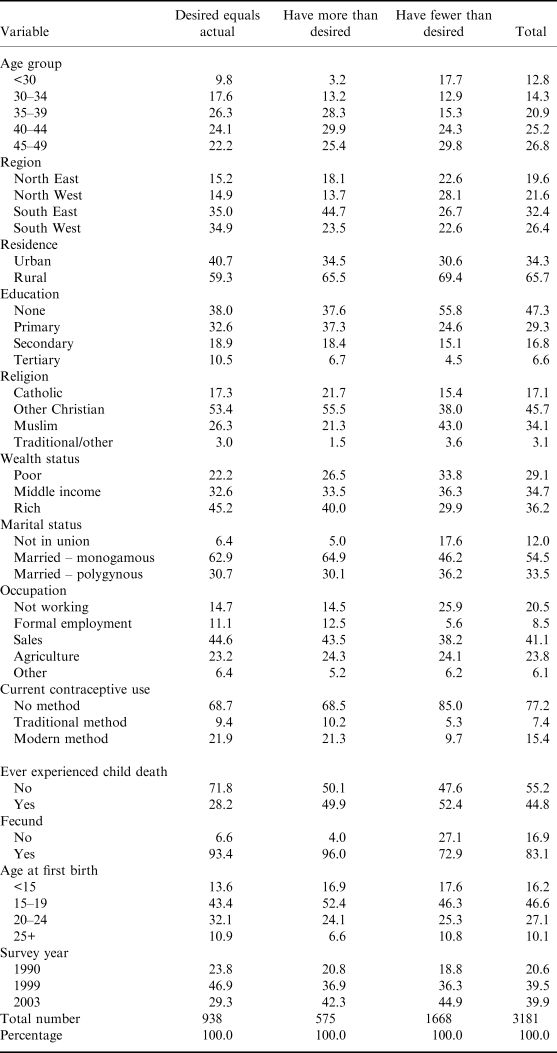
Table 2 gives the percentage distribution of the respondents by selected characteristics. About two-thirds are from rural areas, nine-tenths are in marital union and one-fifth are unemployed. Close to half have no formal education and four-fifths are non-contraceptive users. Almost half of the women in the selected sample have experienced the death of a child and about one-sixth are infecund. Christianity is the dominant religion, constituting almost two-thirds of the sample.
Percentage distribution of sampled respondents by selected characteristics and desired fertility achievement, NDHS 1990, 1999 and 2003
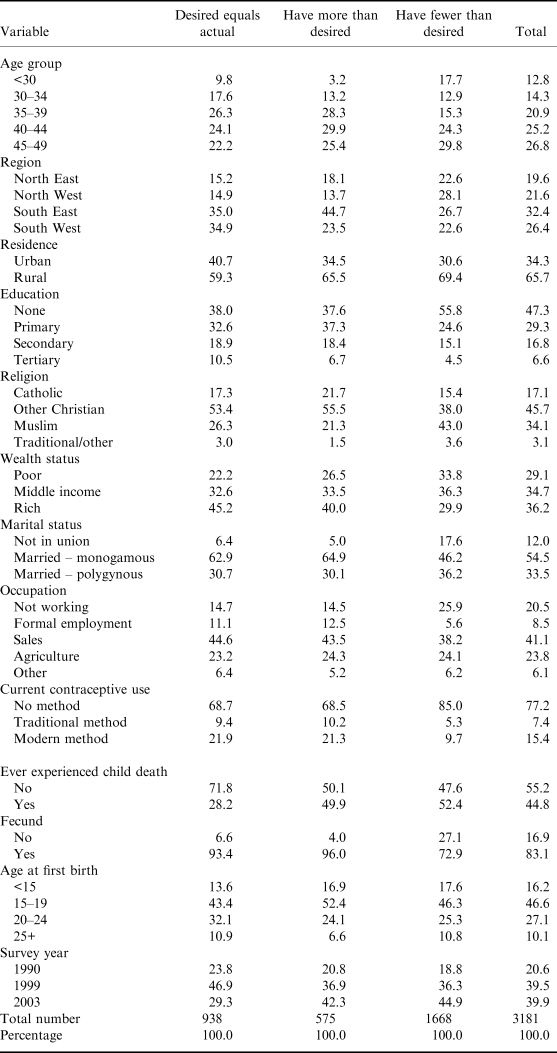
The percentage distribution of women with unmet fertility desires generally increases with age, while the percentage decreases with increase in educational attainment. The majority of the women with unmet fertility desires are from rural areas, in the sales sector of employment, in monogamous unions, fecund, use no method of contraception, had their first birth between the ages of 15 and 19 years or were interviewed during the 2003 round of the surveys. Among the women that had more children than desired, non-Catholic Christians, women from rich households and women from the South East part of the country are in the majority, while Muslims, women from middle-income households and women from the North West are in the majority among the group that had fewer children than desired by religion, household wealth and regional characteristics, respectively.
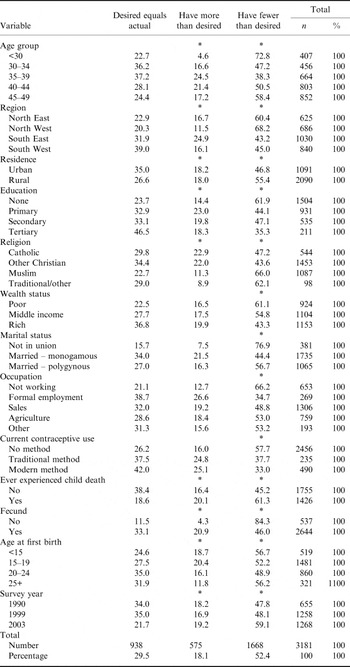
Table 3 shows the prevalence of unmet fertility desires by selected characteristics of the women. It shows that 29.5% of the women have the same number of living children as desired, 18.1% have more than desired and 52% have fewer than desired, which underscores the pronatalist culture in the country. Thus, overall about 70% of the women have unmet fertility desires. The table further indicates important differences in the profile of women based on the achievement of their fertility desires. For current age, women aged 35–39 years old seem more likely to have met their desires compared with the other age groups. Also women in the southern regions tend to be different from those in the northern regions. For instance, just over two-fifths of women from the South have fewer children than desired compared with over three-fifths among women from the North. A higher proportion of rural women are also found to have fewer than desired children compared with urban women. Marked differences by educational attainment and household wealth are observed. For instance, almost half (46%) of the women with tertiary education have met their desires, compared with only a quarter of those without formal education. Similarly, more than a third of those in rich households have their desires met compared with just about a fifth of those in poorer households. Other differences worth noting are current use of contraception, child mortality experience and age at first birth. Further, all the thirteen independent variables are individually significantly associated with having fewer children than desired in this study sample, while all but education, household wealth, marital status, occupation and current use of contraceptives are significantly associated with having more children than desired.
Prevalence of unmet fertility desires by selected characteristics among women in Nigeria, NDHS 1990, 1999 and 2003

* p<0.05.
Factors associated with unmet fertility desires
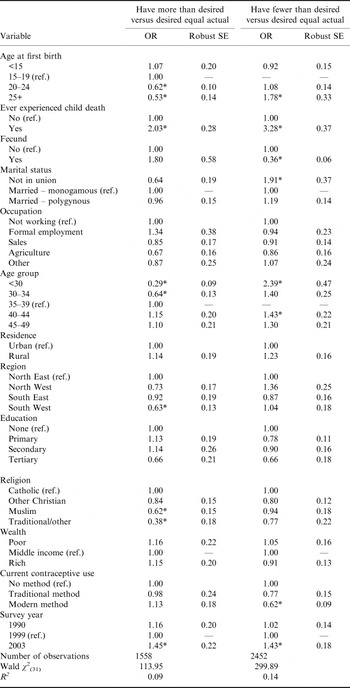
The multivariate results presented in Table 4 show that the odds of having more children than desired decreases with age at first birth, while the reverse is true for women with less than desired fertility. That is, women who had first births late are less likely to have more than the desired number of children but more likely to have fewer than desired. Also, younger women are more likely to have fewer than the desired number of children, but less likely to have more than desired. Surprisingly, women who have experienced child death are not only more likely to have more than the desired number of children, but also more likely to have fewer than desired. Women who are not in union, as well as those in polygynous unions, are also less likely to have more than the desired number of children compared with women in monogamous unions.
Adjusted odds ratios (OR) of factors associated with unmet fertility desire among women in Nigeria, NDHS 1990, 1999 and 2003

* p<0.05.
Women in the South West region and non-Christian women are significantly less likely to have more children than they desired. For education, wealth and contraceptive use, no definable pattern is found. However, women with tertiary level of education are less likely to have more children than they desired compared with women with no formal education. Fecund women or women who are current users of modern methods of contraception are significantly less likely to have fewer children than they desired. Furthermore, women in rural areas, women with no formal education, women who are Catholics or women from poor households are generally more likely to have unmet fertility desires, although the relationships are not significant at conventional alpha levels.
Discussion and conclusion
This paper examined the profile of women with unmet fertility desires, as well as the factors associated with such desires in Nigeria. While the results showed that about 70% of the sample had unmet fertility desires, the overwhelming majority of these are those who have fewer than desired, which is consistent with prior findings in the country (Makinwa-Adebusoye, Reference Makinwa-Adebusoye2001; Bankole & Feyisetan, Reference Bankole and Feyisetan2002; National Population Commission, 2000, 2004).
The high fertility desires perhaps reflect pronatalist cultural imperatives in the country and the discrepancy between the two could perpetuate Nigeria's high-fertility regime. It should be noted, however, that the low percentage of women who have more children than desired is likely to be an underestimate due to the rationalization of births. It has been noted that people tend to revise their desired family size upward to reflect the number of children that they already have. Upward adjustment in desired family size to approximate actual number of children has long been observed in the literature (Knodel & Prachuabmoh, Reference Knodel and Prachuabmoh1973; Lightbourne, Reference Lightbourne, Cleland and Hobcraft1985; Westoff et al., Reference Westoff, Goldman and Moreno1988; Bongaarts, Reference Bongaarts1990; Pritchett, Reference Pritchett1994; Ibisomi, Reference Ibisomi2007).
In this study, age at first birth was found to be a consistent predictor of fertility desires. The odds of having more children than desired decreases with increase in age at first birth, while the reverse is true for those with less than desired fertility. This implies that besides the reproductive health implications, too early or too late childbearing are important risk factors that prevent women from attaining their fertility desires.
A woman's experience with child death was found to increase the odds of having fewer as well as having more children than desired. Having fewer children than desired among women who have experienced child death is expected, especially if there was no opportunity to replace the dead child. For those who have more than their desired number of children among women who have experienced child death, this could be explained through the insurance hypothesis of fertility response to child mortality where such women tend to have many children as insurance against potential future deaths (Gyimah & Rajulton, Reference Gyimah and Rajulton2003, Reference Gyimah and Rajulton2004). Another possible explanation could be the timing of the death of the child. It is possible that the woman had too many children than she desired before experiencing the loss of a child such that even the loss could still not bring the number of surviving children down to her desired level.
Furthermore, the results showed that women from the South West region of the country were less likely to have unmet fertility desires. Women who have more children than desired were also found to be more likely to be users of modern methods of contraception. Understandably, women who are not in union are significantly more likely to have fewer children than they desired. This could be attributed to limited exposure to the risk of conception among never-married women (probably because their fertility desires were premised upon marriage) and marital disruption among women who were formerly married. As for religion, it was found that Muslim and Traditional women were significantly less likely to have more than the desired number of children compared with Catholic women. This result differs from findings of recent work on religion and fertility in Ghana (Gyimah et al., Reference Gyimah, Takyi and Tenkorang2008).
The study also found that women in polygynous unions were more likely to have less than desired fertility compared with those in monogamous unions. One possible reason for the difference between monogamous and polygynous women is the fear among the former that their husbands might take other wives if they do not give him enough children and were therefore ready to sacrifice their personal fertility desires (Oheneba-Sakyi & Takyi, Reference Oheneba-Sakyi and Takyi1997; DeRose et al., Reference DeRose, Dodoo and Patil2002; DeRose, Reference DeRose2003).
In addition, although not statistically significant at conventional alpha levels, women from poor households and those from rural areas were more likely to have unmet fertility desires. Being resident in rural areas or being poor in themselves are great threats to the reproductive health and general well-being of women. While the underlying reasons are beyond the scope of this study, it is likely that lack of access to information and health care services are important factors. It is also worth noting the beneficial effect of higher education on the attainment of fertility desires, as highly educated women were less likely to have unmet fertility desires. Women in polygynous unions were more likely to have less than desired fertility compared with women in monogamous unions. While this is not consistent with Ibisomi's (Reference Ibisomi2007) qualitative study, it could be attributed to the disruption in couples' relationships as the husband might not be available for much of the time, especially during the woman's fertile period. It is also possible that the polygynous husband's fertility desires have been met or even exceeded through his several wives, thereby limiting individual woman's desired fertility.
In conclusion, evidence from this study suggests that a high percentage of women in Nigeria have unmet fertility desires. The study also found that too early or too late childbearing do not only pose great health risks to mother and child but are also important factors for the attainment of fertility desires. Thus, policies and programmes need to target early and late childbearing to enable women attain and enjoy their reproductive intentions, health and rights to the maximum. Furthermore, the two groups of women with unmet fertility desires have different challenges and resolving them may require different strategies. While the reproductive health programmes in place could in the long run prevent women (who are willing to take up the services) from having more children than they desire, policies and programmes need to address the plight of the women at the other end of the unmet fertility desires – those who have fewer children than they desire – especially in relation to infertility and child mortality, to enable them live a dignified and fulfilling reproductive life. Having stated this, there is also the need for policies and programmes to reach out to the population at large on the advantages of smaller family size and its interrelation with development with a view to ‘de-culturalizing’ the desire for large families evidenced in Nigerian society.