Introduction
In bilingual and multilingual individuals, the ability to switch between languages and maintain conversations in one target language involves cognitive control processes for reducing lexical (Kroll, Bogulski & McClain, Reference Kroll, Bogulski and McClain2012; Misra, Guo, Bobb & Kroll, Reference Misra, Guo, Bobb and Kroll2012) and grammatical (Kroll, Dussias, Bogulski & Valdes Kroff, Reference Kroll, Dussias, Bogulski and Valdes Kroff2012; Tokowicz & MacWhinney, Reference MacWhinney2005) interference between languages. Cognitive control is therefore crucial in order to avoid any negative transfer, the incorrect use of an L1 processing strategy in the L2, which would likely impede the process of understanding (Bjorklund & Harnishfeger, Reference Bjorklund, Harnishfeger, Dempster and Brainerd1995; De Neys & Van Gelder, Reference De Neys and Van Gelder2009; MacWhinney, Reference MacWhinney2005; Tokowicz & MacWhinney, Reference MacWhinney2005). Executive functions, especially cognitive inhibition, play an essential role in this control process. Like other psychological constructs, such as memory, executive function is multidimensional. Consequently, several models provide different viewpoints of the basic component processes associated with executive functions (for a review, see Godefroy, Jeannerod, Allain & Le Gall, Reference Godefroy, Jeannerod, Allain and Le Gall2008). Among them, the model of Miyake, Friedman, Emerson, Witzki, Howerter and Wager (Reference Miyake, Friedman, Emerson, Witzki, Howerter and Wager2000) postulates a division into the three most discussed executive functions, namely the inhibition of dominant responses (“inhibition”), the shifting of mental sets (“shifting”) and the monitoring and updating of information in working memory (“updating”). In this study, we primarily focused on the relation between bilingualism and cognitive inhibition. Different theories of the mind related to cognitive inhibition originated in the 19th century, showing reflex inhibition and central inhibition in the brain. In the wide domain of neuroscience, while various kinds of inhibition can be identified, e.g. lateral inhibition, reciprocal inhibition and recurrent inhibition among others, each kind can be clearly distinguished from another because its mechanism can either be observed neurophysiologically or clearly operationalized in terms of behaviour (Aron, Reference Aron2007). Unfortunately, this is not the case in psychology. One reason is that cognitive inhibition can only be observed indirectly using experimental paradigms designed to examine many various executive processes. Despite the empirical difficulties to tap these processes, Aron (Reference Aron2007) proposed that there is a major distinction between automatic inhibition (for example, the lateral inhibition between response representations) and active inhibition (the suppression of an irrelevant response). Models of bilingual language processing have postulated that active inhibition occurs in the inhibition of the inappropriate non-target language (Green, Reference Green1998). On the basis of this theory, we examined whether the efficiency of active inhibition among bilinguals is influenced by the need to switch language in their daily lives.
Previous studies have shown an improvement of the executive functions based on an increased level of activity in all age ranges. Interestingly, this phenomenon was even observed in age groups that normally exhibit a decreased capacity in their executive functions, i.e. children and older individuals (A. Diamond & Lee, Reference Diamond and Lee2011; Zelazo, Craik & Booth, Reference Zelazo, Craik and Booth2004; for a review, see Bialystok, Reference Bialystok2007). This observation reinforces the idea that executive functions can be trained by different activities, in particular by those requiring attention, memorization, and control of complex processes (A. Diamond, Reference Diamond, Braddick, Atkinson and Innocenti2011). Playing the biggest role in the increase of executive function is the use of multiple languages (Bialystok, Reference Bialystok2006; Bialystok & DePape, Reference Bialystok and DePape2009; Costa, Hernández & Sebastián-Gallés, Reference Costa, Hernández and Sebastián-Gallés2008; J. Diamond, Reference Diamond2010; Kroll, Dussias, Bogulski & Valdes Kroff, Reference Kroll, Dussias, Bogulski and Valdes Kroff2012), as well as playing music (Bialystok & DePape, Reference Bialystok and DePape2009), playing computer or video games (Bialystok, Reference Bialystok2006), or actively performing sports that require high bimanual coordination (A. Diamond & Lee, Reference Diamond and Lee2011; for a review, see A. Diamond, Reference Diamond, Braddick, Atkinson and Innocenti2011). However, taken together, behavioural studies exploring the advantages yielded by bilingualism on executive functions do not provide a clear picture. While several studies reported a clear advantage for performing various tasks involving inhibitory control (e.g. Bialystok, Craik, Klein & Viswanathan, Reference Bialystok and Martin2004; Bialystok, Craik & Luk, Reference Bialystok, Craik and Luk2008; Costa et al., Reference Costa, Hernández and Sebastián-Gallés2008; Linck, Hoshino & Kroll, Reference Linck, Hoshino and Kroll2008), others did not (Carlson & Meltzoff, Reference Carlson and Meltzoff2008; Morton & Harper, Reference Morton and Harper2007; for a review, see Costa, Hernández, Costa-Faidella & Sebastián-Gallés, Reference Costa, Hernández, Costa-Faidella and Sebastián-Gallés2009).
Empirical data on the impact of bilingualism on executive functions
A series of studies found that bilingual individuals find it easier to solve conflicts occurring in tasks like the Stroop task (Stroop, Reference Stroop1935), the Simon task (Simon & Ruddell, Reference Simon and Ruddell1967) or the Tower of Hanoi task. One possible explanation to account for this advantage is that the inhibitory control of bilingual individuals is better trained due to frequent code switching in their daily lives, compared to monolingual individuals (Badzakova-Trajkov, Reference Badzakova-Trajkov2008; Bialystok et al., Reference Bialystok, Craik, Klein and Viswanathan2004; Bialystok et al., Reference Bialystok, Craik and Luk2008; Costa et al., Reference Costa, Hernández and Sebastián-Gallés2008). In these tasks, a reduced interference effect and/or faster response times are frequently considered to reflect higher capacities of inhibitory control.Footnote 1 Some of these behavioural studies on inhibition controlled for biological age (Bialystok et al., Reference Bialystok, Craik and Luk2008; Bialystok, Craik & Ryan, Reference Bialystok, Craik and Ryan2006; Gathercole, Thomas, Jones, Guasch, Young & Hughes, Reference Gathercole, Thomas, Jones, Guasch, Young and Hughes2010) because the efficiency of the executive functions has been shown to vary with age (Best & Miller, Reference Best and Miller2010; Bjorklund & Harnishfeger, Reference Bjorklund, Harnishfeger, Dempster and Brainerd1995; De Neys & Van Gelder, Reference De Neys and Van Gelder2009; A. Diamond, Reference Diamond, Bialystok and Craik2006; Treitz, Reference Treitz2006; Zelazo et al., Reference Zelazo, Craik and Booth2004). Using a Stroop task, Badzakova-Trajkov (Reference Badzakova-Trajkov2008) found reduced Stroop interference for young adult successiveFootnote 2 bilinguals with different combinations of L1 and L2 (Macedonian–English; German–English), as compared to monolingual young adults (English). Such a bilingual advantage was also observed for older adults (Bialystok et al., Reference Bialystok, Craik and Luk2008) and for children (Gathercole et al., Reference Gathercole, Thomas, Jones, Guasch, Young and Hughes2010). Furthermore, in young adults, a bilingual advantage was found for the Simon task (Bialystok, Reference Bialystok2006; Bialystok & DePape, Reference Bialystok and DePape2009), an attentional network task (ANT; Costa et al., Reference Costa, Hernández and Sebastián-Gallés2008), a lateralized attention network task (LANT; Tao, Marzecová, Taft, Asanowicz & Wodniecka, Reference Tao, Marzecová, Taft, Asanowicz and Wodniecka2011), and a flanker task (Luk, de Sa & Bialystok, Reference Luk, Bialystok, Craik and Grady2011). A similar bilingual advantage was also reported in older adults with a Simon task (Bialystok et al., Reference Bialystok, Craik, Klein and Viswanathan2004; Bialystok et al., Reference Bialystok, Craik and Luk2008; Linck et al., Reference Linck, Hoshino and Kroll2008) and in children of different ages with a range of tasks that tested inhibition, e.g. ANT (Yang, Yang & Lust, Reference Yang, Yang and Lust2011), the dimensional card sorting task (Bialystok & Martin, Reference Bialystok and Martin2004; for reviews see Bialystok, Reference Bialystok2001, Reference Bialystok2005), and ToM tasks (Kovács, Reference Kovács2009). Moreover, a bilingual advantage has also been found in switching tasks (Kovács & Mehler, Reference Kovács and Mehler2009; Prior & MacWhinney, Reference Prior and MacWhinney2010), which plausibly include both inhibition and shifting processes (Prior & MacWhinney, Reference Prior and MacWhinney2010).
Conversely, several studies failed to show that bilingual older adults had an advantage in inhibitory control in a Stroop task (Kousaie & Phillips, Reference Kousaie and Phillips2012). Furthermore, in children, some studies did not find any advantage resulting from bilingualism, either with a Simon task (Morton & Harper, Reference Morton and Harper2007) or with an ANT task (Carlson & Meltzoff, Reference Carlson and Meltzoff2008; for a review, see Costa et al., Reference Costa, Hernández, Costa-Faidella and Sebastián-Gallés2009). To sum up, the above-mentioned behavioural studies examining the effect of bilingualism on executive functions do not unequivocally demonstrate an advantage of bilingualism on executive function. Although there is strong evidence to support the claim that multiple language use favours the training of the executive functions, some studies shed doubt on how general this conclusion is. A factor that may account for the diversity of the results may be the varied relative frequency of language use in the different populations of bilingual individuals. Unfortunately, to date, this linguistic factor has not been systematically taken into consideration. Therefore, our goal was to examine the effects of the frequency of language use on the inhibitory control among highly proficient successive French–German bilinguals.
The present study
The major contribution of the present study was to examine the use of one executive function, inhibitory control in bilingualism, on the performance of an executive task, i.e. the Stroop task. To date there is still no clear-cut picture on the relationship between bilingualism and conflict resolution in executive tasks. Following the hypothesis of A. Diamond and Lee (Reference Diamond and Lee2011) that all successful programs involved repeated practice and progressively increasing the challenge to the executive functions, we investigated whether the training of task switching in the daily lives of bilingual individuals influenced their performance on the Stroop task. Therefore, in the present study we examined the role of the relative frequency of language use on the inhibitory control. Critically, we investigated the role of the frequency of the daily use of an L2 (German for all participants) on conflict resolution, by testing bilingual participants in two different linguistic environments (either in France, the linguistic environment of their L1, French, or in Germany or Austria, that of the L2, German), while other linguistic factors such as the age of the acquisition (AoA) of the L2 and the proficiency in the L2 were controlled. The rationale was that the regular use of the L2 in the linguistic environment related to this language should increase the activation of the L2. Consequently, we assumed that the L2 has to be inhibited more in the L2 linguistic environment than that of the L1, where this language is not commonly used. Moreover, while successive bilingual individuals in an L1 linguistic environment mostly have to inhibit only one, not highly activated language (i.e. their L2), bilingual individuals living in an L2 linguistic environment often have to inhibit two languages, namely the highly activated automatic L1 (Linck, Kroll & Sunderman, Reference Linck, Kroll and Sunderman2009) and the regularly activated/used L2. Therefore, the more frequent the L2 use, the stronger the inhibitory control due to a regular use of L2. Furthermore, as few studies focused on whether the regular use of an additional third language might reinforce the effects of bilingualism (see J. Diamond, Reference Diamond2010; Chertkow, Whitehead, Phillips, Wolfson, Atherton & Bergman, Reference Diamond2010), we decided to include in our study the frequency of use of an L3. In order to study the strength of the inhibitory control, a classic Stroop task was administrated to two groups of proficient successive French (L1) – German (L2) bilingual adults.
Using the Colour Word Stroop task (Stroop, Reference Stroop1935) enabled us to study one particular aspect of executive function, inhibitory control, because, in this task, decisions must be based on task-relevant information in the face of distracting information. Indeed, “two conflicting mental representations are active, each associated with a different response, and attention must be paid to only relevant cues” (Bialystok et al., Reference Bialystok, Craik and Ryan2006, p. 1342). Specifically, an ink colour must be identified while ignoring the written word itself. Since word reading is more automatic than colour naming, executive control is required to override the tendency to respond on the basis of the word rather than the ink colour. The need of such control is reflected in slower responses when the word name is competing with the ink colour (i.e. incongruent condition like the word
 written in red ink) than when it does not (i.e. congruent condition like the word
 written in green ink). The conflict in the incongruent condition arises because an automatic process (i.e. word reading) disturbs a controlled process (i.e. print colour naming), the former having to be inhibited to allow the latter to take place. The Stroop effect is calculated by subtracting the mean response times in the congruent condition from those in the incongruent condition. Shorter response times (RT) to the incongruent condition, a smaller Stroop effect size, are interpreted to reflect stronger inhibitory controlFootnote
3
(Badzakova-Trajkov, Reference Badzakova-Trajkov2008; Pardo, Pardo, Janer & Raichle, Reference Pardo, Pardo, Janer and Raichle1990). This definition of the Stroop effect is in line with several preceding studies (Bruchmann, Herper, Konrad, Pantev & Huster, Reference Bruchmann, Herper, Konrad, Pantev and Huster2010; Coderre, Conklin & Van Heuven, Reference Coderre, Conklin and Van Heuven2011; Liotti, Woldorff, Perez & Mayberg, Reference Liotti, Woldorff, Perez III and Mayberg2000; Naylor, Stanley & Wicha, Reference Naylor, Stanley and Wicha2012; Pardo et al., Reference Pardo, Pardo, Janer and Raichle1990; Van Veen & Carter, Reference Van Veen and Carter2005). The “Inhibition effect” was defined as the RT difference between the incongruent and the neutral conditions (Coderre et al., Reference Coderre, Conklin and Van Heuven2011; the notion “Stroop interference” is also employed in the literature to designate this effect: see Badzakova-Trajkov, Barnett, Waldie & Kirk, Reference Badzakova-Trajkov, Barnett, Waldie and Kirk2009; Qiu, Luo, Wang, Zhang & Zhang, Reference Qiu, Luo, Wang, Zhang and Zhang2006) and the “Facilitation effect” as the RT difference between the congruent and the neutral condition (Badzakova-Trajkov et al., Reference Badzakova-Trajkov, Barnett, Waldie and Kirk2009; Coderre et al., Reference Coderre, Conklin and Van Heuven2011; Hanslmayr, Pastötter, Bäuml, Gruber, Wimber & Klimesch Reference Hanslmayr, Pastötter, Bäuml, Gruber, Wimber and Klimesch2008; MacLeod & MacDonald, Reference MacLeod and MacDonald2000). Thus, the Stroop effect (incongruent–congruent) could be divided into an Inhibition effect (incongruent–neutral) and a Facilitation effect (neutral–congruent).
We expected to replicate the well-known bilingual advantage in the performance of an experimental task involving executive function, i.e. the Stroop task. This effect can be predicted on the basis of both the Inhibitory Control (IC) model (Green, Reference Green1998) and the Bilingual Interactive Activation+ (BIA+) model (Dijkstra & Van Heuven, Reference Dijkstra and Van Heuven2002; Van Heuven, Dijkstra & Grainger, Reference Van Heuven, Dijkstra and Grainger1998) in case of conflict resolution. Critically, with respect to the central question of the present study, i.e. the role of the frequency of language use on inhibitory control, we predicted that the size of the Stroop effect should vary as a function of the L2 use frequency, as indicated by the linguistic environment (either L1, France, or L2, Germany). This means that the higher the frequency of the L2 use, the smaller the size of the Stroop effect (better inhibitory control). Moreover, we predicted that Language (L1 vs. L2) has an impact on the degree of interference in the Stroop task. The Stroop effect is predicted to be larger in the L1 than in the L2 due to the higher automaticity and activation of the L1. However, this difference should decrease when the frequency of L2 use increases, as in this environment the L2 becomes more automatic. Thus, we predicted an interaction between frequency of L2 use (e.g. linguistic environment) and Language for the Stroop effect, such that the more the L2 is used, the more automatic it has become, and thus the larger the Stroop effect will be in the L2. We simultaneously predicted a smaller Stroop effect for the L1 in the L2 environment, due to decreased activation of the L1.
Method
Participants
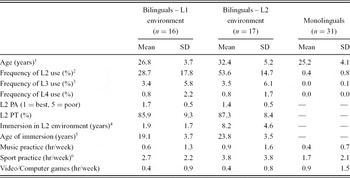
Sixty-five right-handed (Edinburgh Handedness Inventory) participants were recruited. Among them, 34 were successive French (L1) – German (L2) bilinguals living either in France (n = 17) or in Germany (n = 17), and 31 were French monolingual individuals. One bilingual participant was excluded due to missing data for a multiple regression analysis. By their own account, the participants had no history of current or past neurological or psychiatric illnesses; they had normal or corrected-to-normal vision and normal colour vision. They were paid 10€ per hour for their time. Table 1 displays several linguistic and non-linguistic aspects asked in a questionnaire before the start of the experiment.
Results from the evaluation of the participants on their language background and on activities such as practising music, doing sports that require high bimanual coordination, and playing computer/video games. Means and standard deviations (SDs) are indicated for each category.

L2 PA = Proficiency in German – Autoevaluation; L2 PT = Proficiency in German – Test (DAF – Deutsch als Fremdsprache); ∗ p < .05, ∗∗ p < .01, ∗∗∗ p < .001
1Bilinguals–L2 vs. Bilinguals–L1***, Bilinguals–L2 vs. Monolinguals***.
2All the three pairwise comparisons***.
3Bilinguals–L2 vs. Monolinguals**, Bilinguals–L1 vs. Monolinguals*.
4Bilinguals–L1 vs. Bilinguals–L2***, Bilinguals–L2 vs. Monolinguals***, Bilinguals–L1 vs. Monolinguals*.
5Bilinguals–L1 vs. Bilingual–L2***.
6Bilingual–L2 vs. Monolinguals*.
Bilingual participants
Sixteen successive French (L1) – German (L2) bilinguals (12 female) of an average age of 26.8 ± 3.7 years were tested in their L1 environment (Paris, France) and seventeen successive French (L1) – German (L2) bilinguals (15 female) of an average age of 32.4 ± 5.2 years were tested in their L2 environment (Hamburg, Germany, or Vienna, Austria). They were all late learners of their L2, German, which they had started to study by the age of 10 at secondary school in France. The mean AoA of German as their L2 was 11.0 ± 1.2 years. A criterion for accepting participants for the study was their regular exposure to German during the past three years and at present. Twenty-six out of 33 bilinguals (79%) reported using an additional L3 whereas only seven out of 33 bilinguals (21%) reported using an additional L4 on a daily basis.
Each bilingual participant was asked to assess their own proficiency in German on a five-point scale from excellent proficiency (1) to poor proficiency (5) in the categories Comprehension, Production, Reading and Writing. Furthermore, proficiency in German was evaluated with two standardized tests on their proficiency in German as a foreign language, including the DAF test (Das Zertifikat, DAF – Deutsch als Fremdsprache, Einstufungs- und Diagnostiktest). Their evaluated proficiency and objective scores are presented in Table 1. The two groups of bilinguals (L1 environment, L2 environment) differed on the following background measures: Bilinguals in the L2 environment were on average older (32.4 ± 5.2 years) than bilinguals in the L1 environment (26.8 ± 3.7 years; p < .001). They also reported a higher frequency of L2 use (53.6 ± 14.7% vs. 28.7 ± 17.8%; p < .001), a longer duration of immersion in an L2 environment (8.2 ± 4.6 years vs. 1.9 ± 1.7 years; p < .001), and a higher age of immersion in an L2 environment (23.8 ± 3.5 years vs. 19.1 ± 1.7 years; p < .001).
Monolingual participants
Thirty-one native French speakers (22 females) with an average age of 25.2 ± 4.1 years who had had little use of a foreign language during the past three years and at present (see Table 1) were selected.
As shown in previous studies, additional factors such as socio-economic status (Gathercole et al., Reference Gathercole, Thomas, Jones, Guasch, Young and Hughes2010; Morton & Harper, Reference Morton and Harper2007), musical practice (Bialystok & DePape, Reference Bialystok and DePape2009), video/computer game playing (Bialystok, Reference Bialystok2006) or physical activity requiring high coordination (A. Diamond & Lee, Reference Diamond and Lee2011) may influence the performance in a task on inhibitory control. Therefore, these factors were controlled for in the present study and participants of the two language groups did not differ significantly on either of these factors (Table 1).
Stimuli
An adapted version of the original Stroop task (Stroop, Reference Stroop1935) was used in the experiments. The task was a manual colour response task in which the participants were asked to identify the print colour of the stimuli. Depending on the condition, stimuli were colour words (e.g. “red”, “blue”, etc.) or non-colour words (e.g. “cat”, “dog”, etc.). All stimulus words were monomorphemic, monosyllabic words. The three different conditions were congruent, incongruent and neutral. In the congruent condition the meaning of the colour word and the print colour matched, in the incongruent condition the meaning of the colour word and the print colour differed and in the neutral condition, non-colour words were presented in equally varying print colours as in the congruent and incongruent conditions. In L1, French, the following four colour words were presented: ROUGE “red”, BLEU “blue”, JAUNE “yellow”, VERT “green” and in the L2, German, the four corresponding colour words were used: ROT “red”, BLAU “blue”, GELB “yellow”, GRÜN “green”. In the neutral condition, four non-colour words were presented in the same four print colours. This control condition was considered as neutral because stimuli did not include colour information, the critical semantic information causing an interference in a Colour Word Stroop task (for a similar use of the neutral condition, see Badzakova-Trajkov et al., Reference Badzakova-Trajkov, Barnett, Waldie and Kirk2009; Hanslmayr et al., Reference Hanslmayr, Pastötter, Bäuml, Gruber, Wimber and Klimesch2008; MacLeod & MacDonald, Reference MacLeod and MacDonald2000; Qiu et al., Reference Qiu, Luo, Wang, Zhang and Zhang2006). Initial letters of colour (congruent and incongruent conditions) and non-colour words (neutral condition) did not share initial letters. CHAT “cat”, CHIEN “dog”, MAIN “hand”, PIED “foot” were chosen as neutral words in L1, French, and their translation equivalents in L2 (German): KATZE “cat”, HUND “dog”, HAND “hand”, FUSS “foot”. The stimulus words, written in capitals, in “Calibri” font and in font size 48, were presented individually against a black background in the centre of the screen.
Procedure
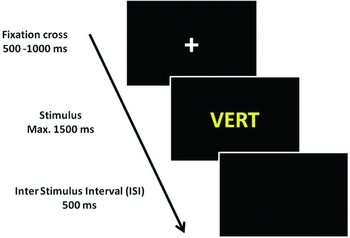
Some aspects of the stimulus presentation and the experimental procedure were taken from Bruchmann et al. (Reference Bruchmann, Herper, Konrad, Pantev and Huster2010). The stimulus presentation design was created with the program E-Prime 2.0 (Psychological Software Tools, Pittsburgh, PA). Each stimulus word was preceded by a fixation cross in the centre of the screen (Figure 1). The duration of the fixation cross varied between 500 ms and 1000 ms (500, 625, 750, 875, 1000 ms equally distributed and pseudo-randomized among the stimuli) in order to avoid systematic expectancy to be built up by the participants. The fixation cross was immediately followed by the stimulus, which was presented until one of the four colour response keys was pressed or maximally for 1500 ms if no key was pressed. The inter-stimulus interval (ISI) was 500 ms. Response time (RT) was defined as the interval between the stimulus onset and pressing a response key.
The timing of a trial in the manual version of a Stroop task is displayed.

Participants were seated in front of a laptop (Dell, 14″ screen) in a common writing position with both hands positioned on the keyboard. The room contained good lighting conditions. Written instructions were given to the subjects and repeated before running the experiment. The participants were asked to indicate as fast and as correctly as possible the print colour of the stimulus word by pressing one of the four response buttons. The colours were also indicated on the lower part of the screen to facilitate the colour-key-assignment. The keys D, F, J and K were chosen in order to allow the usual position of the hands on the keyboard. The keys had to be pressed with the index and middle fingers of the left and the right hand. The colour-finger-assignment was counterbalanced between the subjects so as to vary the fingers and the hand used for each colour but kept constant during the experiment for every single participant.
In order to allow the participants to learn the colour–key correspondences, two practice blocks of 40 trials each were presented before the six experimental blocks. For the bilinguals, a block with words in French was presented first, followed by a second block with words in German. For the monolinguals, both practice blocks consisted of words in French. Feedback on the percentage of correct answers was given after each practice and experimental block. If the accuracy was at least 80% after the second practice block, the experiment was started; if not, the two practice blocks were repeated.
The participants were tested in six blocks each containing 72 trials. In each block, there were 24 congruent stimuli, 24 incongruent stimuli and 24 neutral stimuli, presented in a pseudo-randomized order. A number of constraints were used for the pseudo-randomization. First, no more than three words of the same experimental condition were presented in succession. Secondly, no word and no print colour were repeated immediately. Third, the first stimulus of each block was a neutral one. The pseudo-randomized order of trials was created using the program Conan (Nowagk, Reference Nowagk1998). Moreover, for each bilingual participant a list was created in which the presentation order of the six blocks (three French and three German) was counterbalanced using the following constraint: No more than two blocks of one language were presented in succession. Monolingual participants saw six blocks in French, but only three of them were used for further analyses in order to match the number of blocks presented to the bilinguals in their L1. The three chosen L1 blocks were those corresponding to the distribution of the L1 block positions for the bilinguals. The participants could take a short pause between the blocks and continue when ready by pressing the spacebar. The experiment lasted about 25 minutes.
Before starting the experiment with the bilingual participants, a conversation in German was held for about 15 minutes between each participant and the experimenter, a German native speaker (the first author of the present study) in order to activate the second language of the participants. Moreover, a language history questionnaire had to be completed. The questionnaire was in German for the bilingual participants, in French for the monolingual participants. Both, the conversations and the questionnaire in German were intended to activate the L2 processing by switching the language processing mode to German (see Isel, Baumgaertner, Thrän, Meisel & Büchel, 2010).
Data analysis
Response time (RT) was defined as the interval between the onset of the stimulus word and the manual response on the keyboard. Time-out was set at 200 ms and at 1500 ms; if the participant responded before 200 ms or after 1500 ms, the response was coded as missing. We averaged the RTs for correct responses in the nine experimental conditions across participants and across items. We excluded RTs ± two standard deviations from each participant's mean in each experimental condition from the statistical analysis. The average percentage of outliers for bilinguals was 4.44 ± 1.03% in L1 and 4.62 ± 1.19% in L2, and for monolinguals 4.44 ± 0.98%.
We subjected the results of errors and response times to a three-way analysis of variance (ANOVA) in which Condition (C; three levels: congruent, incongruent, neutral) and Language (L; two levels: French, German) were considered as within-subjects factors, and Linguistic environment (E; two levels: bilingual in the L2 linguistic environment, bilingual in the L1 linguistic environment) as a between-subjects factor.
Then, to ensure that we were able to replicate the bilingualism advantage with a Stroop task, a two-way ANOVA in which Condition was considered as a within-subjects factor and Group (G; two levels: bilingual, monolingual) as a between-subjects factor (C3 × G2) was run on errors and RT. To test the effect of Language in the bilingual group, an additional two-way ANOVA in which Condition and Language were considered as within-subjects factors (C3 × L2) was calculated. For each ANOVA, Greenhouse-Geisser correction was applied where necessary for sphericity assumption violations and Bonferroni correction was used for post hoc tests.
Finally, two multiple regression analyses were conducted on RT in order to test the role of the frequency of foreign language use and other linguistic factors on the Stroop effect size, which constitutes the central question of the present study.
Five between-subject factors were included to analyse their respective part of variance on the Stroop effect (incongruent–congruent) in L1 and L2: the frequency of L2 use, of L3 use, the L2 proficiency, duration of immersion in an L2 environment, and age of immersion. Frequency of L3 use was considered to be a relevant predictor because 26 out of 33 bilinguals (79%) reported using an additional L3. In contrast, only 7 out of 33 bilinguals (21%) reported using an additional L4 on a daily basis. Thus, frequency of L4 use was not included as a predictor in the multiple regression analysis. A significance level of .05 was used for all statistical tests.
Results
Analyses of errors
As neither the main effect Linguistic environment (E; p > .10) nor the interaction between Linguistic environment and Condition and Language were significant (F < 1), data of the two groups of linguistic environments were collapsed for further analyses. For bilinguals, the averaged percentage of errors was 2.40 ± 2.23% in L1 and 2.10 ± 2.05% in L2, and for monolinguals 3.27 ± 3.11%.
Condition by Language Group interaction (C3 × G2)
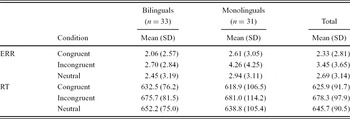
Error rates are displayed for L1 in Table 2. Repeated measures ANOVA (C3 × G2) with Condition (three levels: congruent, incongruent, neutral) as a within-subjects factor and Language Group (two levels: bilingual, monolingual) as a between-subjects factor showed a main effect of Condition (F1(2,124) = 4.812, MSE = 4.69, p < .05). This effect was due to significantly increased error rates in the incongruent condition (3.45 ± 3.65%) compared to the congruent condition (2.33 ± 2.81%; F1(1,62) = 10.10, MSE = 8.24, p < .01). There was no main effect of Language Group (p > .10) and no significant Condition by Language Group interaction (p > .10).
Error rates (ERR; %) and response times (RTs; ms) in the three experimental conditions (congruent, incongruent and neutral) with the standard deviations (SDs, in parentheses) for the two language groups (bilinguals, monolinguals) in L1 blocks of the Stroop task.

Condition by Language interaction (C3 × L2)
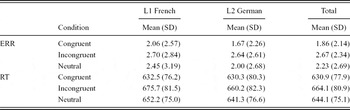
Error rates for bilinguals are displayed in Table 3. The ANOVA failed to show either a main effect of Condition (p > .10), a main effect of Language (p > .10) or a Condition × Language interaction (F < 1).
Error rates (ERR; %) and response times (RTs; ms) for L1 and L2 of bilinguals in the three experimental conditions (congruent, incongruent and neutral) with the standard deviations (SDs, in parentheses) for bilinguals in L1 and in L2 blocks of the Stroop task.

Analyses of RT
As neither the main effect Linguistic environment (E) nor the interaction between Linguistic environment and Condition and Language were significant (Fs < 1), data of the two groups of linguistic environments were collapsed for further analyses.
Condition by Language Group interaction (C3 × G2)
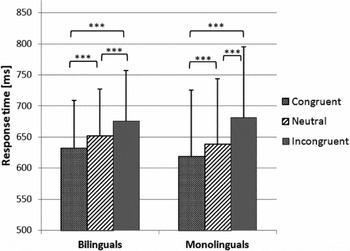
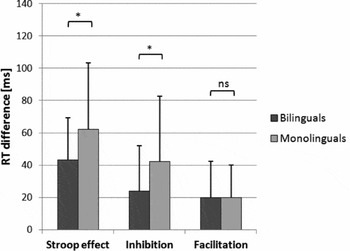
Response time data is displayed for L1 in Table 2 and Figure 2. The ANOVA showed a significant main effect of Condition (F1(2,124) = 96.43, MSE = 592.3, p < .001). This effect reflects that averaged response times were longer in the incongruent condition (678.3 ± 97.9 ms) than in the (i) congruent condition (625.9 ± 91.7 ms; Stroop effect = 52.4 ms; F1(1,62) = 151.91, MSE = 1168.15, p < .001) – mirroring the increased error rates in the incongruent condition (see section 3.1.1.) – and (ii) neutral condition (645.7 ± 90.5 ms; Inhibition effect = 32.7 ms; F1(1,62) = 58.11, MSE = 1189.90, p < .001). Moreover, further post-hoc tests showed that averaged response times were shorter in the congruent condition (625.9 ± 91.7 ms) compared to the neutral condition (645.7 ± 90.5 ms; Facilitation effect = 19.8 ms; F1(1,62) = 54.59, MSE = 459.05, p < .001). Further analyses indicated that the size of the Inhibition effect (incongruent–neutral) did significantly differ from the size of the Facilitation effect (F1(1,62) = 5.202, MSE = 1074.53, p < .05). In contrast, the main effect of Language Group was not significant (F < 1). Moreover, the ANOVA revealed a significant Condition by Language Group interaction (F1(2,124) = 3.99, MSE = 592.3, p < .05, η2 = .02), indicating that the effect size between conditions did vary across the two groups of participants (Figure 3). Post-hoc comparisons on the Stroop effect (incongruent–congruent) showed that this interaction was due to a larger Stroop effect in monolingual participants (62.1 ms) than among bilingual participants (43.3 ms; F1(1,62) = 4.85, MSE = 1168.15, p < .05, η2 = .04). The Inhibition effect (incongruent–neutral) mirrored the Stroop effect (incongruent–congruent), as it was significantly larger for the monolingual participants (42.2 ms) than for the bilingual participants (23.6 ms; F1(1,62) = 4.68, MSE = 1189.90, p < .05, η2 = .04). In contrast, the size of the Facilitation effect (neutral–congruent) did not differ significantly between the two groups (F < 1). In order to examine whether the differences in Stroop and Inhibition effect size between the two language groups are mainly due to RT differences in one of the experimental conditions (congruent, incongruent, neutral), independent samples t-tests were done on the RTs in each experimental condition. RTs did not differ between language groups either in the congruent, the incongruent, or the neutral conditions (ts < 1). This result suggests that group differences in Stroop and Inhibition effects cannot simply be attributed to RT differences in only one of the three experimental conditions (neutral, congruent, incongruent).
Mean response times (ms) and the standard deviations in the congruent, neutral and incongruent experimental conditions are displayed for bilinguals and for monolinguals in their L1.

Mean Stroop Effect (ms) (RTincongruent – RTcongruent; Response time difference between the incongruent and the congruent condition), Inhibition effect (RTincongruent – RTneutral) and Facilitation effect (RTneutral – RTcongruent) with their respective standard deviations are given for bilinguals and monolinguals in their L1.

Condition by Language interaction (C3 × L2)
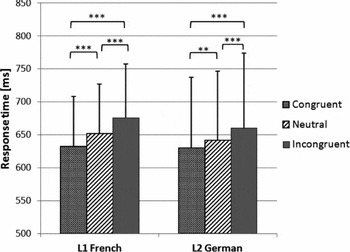
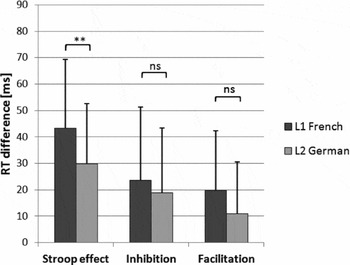
Response time data for the bilinguals’ L1 and L2 are displayed in Table 3 and Figure 4. The Stroop effect (incongruent–congruent) was predicted to be larger in the L1 than in the L2 due to the higher automaticity and activation of L1. A two-way repeated measures ANOVA (C3 × L2) with Condition (3 levels: congruent, incongruent, neutral) and Language (2 levels: French, German) as within-subjects factors showed a significant main effect of Condition (F1(2,64) = 54.90, MSE = 405.33, p < .001) but not of Language (p > .05). However, there was a significant Condition × Language interaction (F1(2,64) = 4.46, MSE = 171.19, p < .05). This interaction effect indicates that the Stroop effect (incongruent–congruent) was significantly larger in the L1 (43.3 ms) compared to the L2 (29.9 ms; F1(1,32) = 9.06, MSE = 327.4, p < .01; Figure 5). This can be interpreted in terms of higher automaticity/activation of the first language.
Mean response times (ms) and the standard deviations in the congruent, neutral and incongruent experimental conditions are plotted for bilinguals in their L1 and L2.

Mean Stroop Effect (ms) (RTincongruent – RTcongruent; Response time difference between the incongruent and the congruent condition), Inhibition effect (RTincongruent – RTneutral) and Facilitation effect (RTneutral – RTcongruent) with their respective standard deviations are indicated for L1 and L2 of bilinguals.

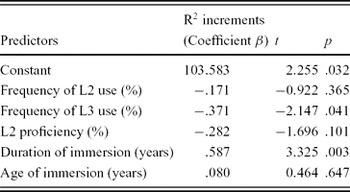
The impact of different linguistic factors on the Stroop and Inhibition effects in L1 (French)
A multiple regression analysis was conducted in order to determine which among the five linguistic factors we selected (i.e. frequency of L2 use, frequency of L3 use, L2 proficiency, duration of immersion in the L2 environment, and age of immersion) best account for the variance of the size of the Stroop effect (incongruent–congruent) in the L1 of the bilinguals. The results of the regression analysis indicated that the five predictors explained 27.1% of the variance of the Stroop effect size (Adjusted R2 = .271, F(5,32) = 3.377, p < .05, Cohen's f2 = .37; see Table 4). The Cohen's f2 of .37 indicates that this effect is in fact quite large. It was found that two variables significantly predicted the L1 Stroop effect size: the frequency of L3 use was negatively related to L1 Stroop effect size (β = –.371, p < .05), while the duration of the immersion in the L2 environment was positively related to L1 Stroop effect size (β = .587, p < .01). In contrast, for the L1 Inhibition effect (incongruent minus neutral), the model of multiple regression using the same predictors found none of the factors to be significant (F < 1).
Multiple regression analysis of L1 Stroop effect (RTincongruent – RTcongruent) size in bilinguals with frequency of L2 use, frequency of L3 use, L2 proficiency, duration of immersion in an L2 environment and age of immersion as predictor variables.

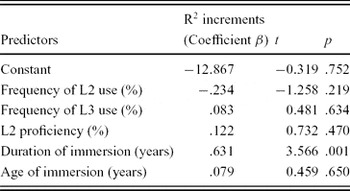
The impact of different linguistic factors on the Stroop and Inhibition effects in L2 (German)
A multiple regression analysis was also conducted in order to predict the size of the L2 Stroop effect (incongruent–congruent) from the following factors: frequency of L2 use, frequency of L3 use, L2 proficiency, duration of immersion in an L2 environment, and age of immersion. The results of the regression indicated that the five predictors explained 26.5% of the variance of Stroop effect size (Adjusted R2 = .265, F(5,32) = 3.311, p < .05, Cohen's f2 = .36). The Cohen's f2 of .36 indicates that this effect is also quite large. The duration of immersion in the L2 context was found to be positively related to the L2 Stroop effect size (β = .631, p < .001; Table 5). In contrast, for the L2 Inhibition effect (incongruent minus neutral), the model of multiple regression using the same predictors found none of the factors to be significant (F < 1).
Multiple regression analysis of L2 Stroop effect (RTincongruent – RTcongruent) size with frequency of L2 use, frequency of L3 use, L2 proficiency, duration of immersion in an L2 environment and age of immersion as predictor variables.

Discussion
Bilingual advantage on inhibitory control
In the present study, we examined the extent to which second language use impacts cognitive control. Our starting point was the hypothesis that the frequency of the L2 language use in successive bilingual individuals has an effect on their inhibitory control. To study the factor frequency of L2 use, we tested bilingual participants from two linguistic environments. Cognitive control was studied while successive French–German bilinguals living either in French or German linguistic environments performed a Stroop task on both French and German words. Moreover, an additional control group constituted of monolingual native French speakers who lived in France was tested. Our results provide a clear-cut picture: the current immersion in a second language environment, i.e. an environment with high frequency of L2 use, is not a sufficient condition for improving the efficiency of the inhibition mechanism, as our ANOVA failed to show a modulation neither of the Stroop effect (incongruent–congruent) nor of the Inhibition effect (incongruent–neutral) as a function of the linguistic environment. Multiple regression analyses indicated that the use of multiple languages did play a central role for training inhibition, not, contrary to our expectations, by the frequency of the L2 use, but surprisingly, by the frequency of the L3 use, instead. In addition, the duration of immersion in an L2 environment was also a determining factor for explaining the efficiency of the inhibitory control, as it was found to be positively related to the L2 Stroop effect size.
The frequency of the L3 language use was negatively correlated to the L1 Stroop effect (incongruent–congruent) size. The more the bilinguals used an additional third language, the smaller their Stroop effect was. This result indicates that bilinguals who are highly trained to control a third language on a daily basis are less disturbed by interferences between reading and colour naming in the incongruent condition of a Stroop task. This finding suggests that the frequency of daily language use might be a determining factor to account for the better capacities of bilingual individuals to inhibit inappropriate/distracting information in tasks involving the resolution of conflicts. Our data reinforce the idea proposed by J. Diamond (Reference Diamond2010) that additional language use beyond bilingualism might even increase a benefit on executive functions. Nevertheless, an alternative interpretation might be that additional language use of an L3 further decreases the respective language activation due to the reduction of the frequency of use of each language (Gollan, Montoya, Fennema-Notestine & Morris, Reference Gollan, Montoya, Fennema-Notestine and Morris2005); consequently the Stroop effect could decrease due to reduced interference.
However, given the absence of correlations between L1 and L3 (p > .10) as well as between L2 and L3 (p > .10) frequency of use, we can reasonably reject an interpretation in terms of decrease of language activation. Rather, our data suggest that the relation between L3 frequency of use and L1 Stroop effect size that we report here might be better explained in terms of an enhancement of inhibitory control due to the regular use of several languages.
Moreover, the observation in the present study that the duration of the immersion positively correlated with the Stroop effect in both languages constitutes an argument in favour of a model postulating increased inhibitory control rather than decreased language activation. It is likely that at the beginning of the immersion in an L2 environment, there is a huge challenge to control the language use as the control over languages is plausibly not yet automatized, and, therefore might require strong top–down inhibitory control. As the duration of immersion increases, the control processes may at least partially become automatized and top–down control gets less implicated. For this reason, in our study, maximal bilingual advantage was found in the case of short rather than long durations of immersion. Nevertheless, although the Stroop effect varies as a function of the duration of the immersion, it remains smaller than it does for monolinguals.
In addition to the positive correlation between the Stroop effect size and the duration of the immersion observed for both languages of the bilinguals (L1 and L2) the Stroop effects in the two languages were positively correlated (β = .460, p < .01). On the basis of this observation, the following rationale for attempting to separate between an inhibition and an activation account explaining the bilingual advantage is proposed: Language activation is supposed to vary with respect to language dominance, which is to a large degree dependent on the frequency of the use of each language as well as on the duration of the immersion in the respective language environment. If the Stroop effect size mainly depends on the language activation, the correlation between the Stroop effects in the two languages should be negative: increased activation of one language due to its frequent use should be accompanied with a reduced activation of the other language. In the present study, we found the reverse result (positive correlation) suggesting that bilingualism advantage could be explained by the differences in the inhibitory control.
Moreover, we were able to replicate the advantage of bilingualism both for the Stroop effect (incongruent–congruent) and for the Inhibition effect (incongruent–neutral) as already found in previous studies (Badzakova-Trajkov, Reference Badzakova-Trajkov2008; Bialystok, Reference Bialystok2006; Bialystok & DePape, Reference Bialystok and DePape2009; Costa et al., Reference Costa, Hernández and Sebastián-Gallés2008). This reinforces the idea that activities such as multiple language use are most likely to cause an improvement of the executive functions, even if young adults already have a high capacity (A. Diamond, Reference Diamond, Bialystok and Craik2006, Reference Diamond, Braddick, Atkinson and Innocenti2011). Overall, the bilingual participants performed the Stroop task better than the monolingual individuals. This was mainly due to the fact that bilinguals were less disturbed in the incongruent condition in comparison with the monolinguals as indicated by the significantly smaller Inhibition effect for the bilinguals (i.e. 23.6 ms) than for the monolinguals (i.e. 42.2 ms). Taken together, these results converge to show that in comparison with monolinguals bilinguals have better inhibitory control as they are more efficient in order to suppress distracting information when this information competes with the information needed to perform a cognitive task.
The absence of variation of the size of the Stroop effect in the course of the experiment suggests that the Stroop effect size does not depend on short-term practice of a Stroop task. In contrast, given the advantageous effect of bilingualism the Stroop effect size appears to be modulated by long-term training.
Effect of Language on the Stroop effect
A further hypothesis tested in the present study was that the interference of the automatic process of reading on the (more) controlled process of print colour naming should be stronger in L1 than in L2 due to the higher automaticity of L1 compared to L2. Therefore, we predicted a larger Stroop effect (incongruent–congruent) in L1 than in L2. Our data confirmed this prediction: A larger Stroop effect was found in the L1 as opposed to the L2. This finding can be interpreted within the framework of the temporal delay assumption, as derived from the BIA+ model (Dijkstra & Van Heuven, Reference Dijkstra and Van Heuven2002), i.e. that the access to phonological and semantic codes is assumed to be delayed in the L2 in comparison to the L1. Under this assumption, the L2 takes more time to be activated than the L1 in bilinguals. Due to slower lexical access in the L2, L2 words should interfere less in the Stroop task. Interestingly, the L1 remained the dominant language in the bilingual individuals we tested in the German linguistic environment as suggested by the larger effect in the L1 than in the L2. Note, however, that a change of language dominance has been shown to occur after a longer stay in the L2 environment. Indeed, Bahrick, Hall, Goggin, Bahrick and Berger (Reference Bahrick, Hall, Goggin, Bahrick and Berger1994), using different grammatical and vocabulary tests, found a change of dominance in favour of L2 for a stay in the L2 environment around 12 years. Attrition of L1, that is language loss, can be one of the consequences of longer stays in an L2 environment (Köpke, Reference Köpke2004, for a review; Schmid & Köpke, Reference Schmid, Köpke, Köpke, Schmid, Keijzer and Dostert2007).
Models on bilingual language processing
In the present section, we will attempt to discuss which of the two models of bilingual language processing (i.e. Inhibitory Control and Bilingual Interactive Activation models) can better account for the empirical data we have presented here.
The Inhibitory Control (IC) model (Green, Reference Green1998) postulates a higher-order level of attentional control being exerted both on linguistic and non-linguistic domains. In the IC model, this higher-order level of control is called the Supervisory Attentional System (SAS). The SAS is assumed to regulate the activation of lexical and phonological units. The justification of such a top–down inhibitory control in language selection relies on the assumption that first and second languages (and further languages for multilingual individuals) are initially co-activated (Brysbaert, Reference Brysbaert, Kinoshita and Lupker2003; Dijkstra, Reference Dijkstra2005). Consequently, this language co-activation requires top–down inhibitory control in order to avoid inter-lingual interferences. The language control process is executed via multiple levels of control. Activation of each language is regulated via language tags by their respective “language task schemas”, which are themselves controlled by the SAS. If the assumption that the SAS constitutes a general inhibitory control exerted on language selection in a multilingual environment is valid, then multiple language use may function as training to this control mechanism. Bilinguals may thus have an advantage over monolinguals in top–down inhibitory control. Furthermore, inhibitory control is expected to be more efficient in suppressing a less dominant language than a more dominant language in bilingual language use.
An alternative psycholinguistic model on bilingual language control is the Bilingual Interactive Activation + (BIA+) model (Dijkstra & Van Heuven, Reference Dijkstra and Van Heuven2002; Van Heuven et al., Reference Van Heuven, Dijkstra and Grainger1998). Like the IC model (Green, Reference Green1998), the BIA+ model postulates an initial co-activation of both languages in bilingual individuals. In the BIA+ model, all levels of inhibitory control on language selection and inhibition are specific to the language domain. Words of the non-target language are inhibited by so-called “language nodes”. Therefore, a crucial difference between the IC model and the BIA+ model lies in the localisation of the levels of control on language selection and inhibition. Whereas the IC model relies on the assumption of an active top–down inhibition, the BIA+ postulates an automatic inhibition, i.e. a lateral inhibition between language nodes. In this mechanism, as one language node accumulates more evidence, the node inhibits the lexical representations associated with the other language nodes; until, finally, the winner takes all. Thus, language selection in the BIA+ mainly relies on differences between activation levels of L1 and L2. Dijkstra and Van Heuven (Reference Dijkstra and Van Heuven2002) point out that, in bilingual language use, the L2 is generally activated to a lower level than the L1 (see temporal delay assumption). The difference in resting activation of the L1 and L2 is supposed to be due to differences in frequency of use as well as to language dominance.Footnote 4 Finally, following the assumption of a higher-order level of control being exerted both on linguistic and non-linguistic domains, the IC model can account for bilingual advantages either in tasks involving a linguistic component (e.g. Stroop task) or not (e.g. Simon task); in contrast, the BIA+ can only account for advantages in tasks involving a linguistic component.
Akin to the assumption of a temporal delay of lexical access in L2 for bilinguals made in the BIA+ model, Gollan et al. (Reference Gollan, Montoya, Fennema-Notestine and Morris2005) proposed that each of a bilingual's languages, including even their L1, is less activated at rest, and thus has weaker links to the conceptual level, than in monolingual language use. Likewise, Ivanova and Costa (Reference Ivanova and Costa2008) and Pyers, Gollan and Emmorey (Reference Pyers, Gollan and Emmorey2009) claimed that bilinguals’ disadvantages in lexical access in their L1 compared to monolinguals may be due to the reduced frequency of use devoted to each single language. Deducing from these hypotheses on frequency-dependent differences, a potential advantage of bilingualism in a task requiring the inhibition of linguistic information – like the Stroop task – may primarily be caused by the lower activation of each of the bilinguals’ languages. Top–down inhibition may therefore be more efficient on the lower activated L1 in bilinguals in comparison to monolinguals.
In our study, the observation of a bilingual advantage for performing tasks involving inhibitory control could be explained either by an inhibition theory (i.e. inhibit interference of the automatic process of reading on the more controlled process of colour naming) or by an activation theory (i.e. lower activation level of the L1 that would explain the reduced interference of reading on naming). However, given the assumption that bilingual or multilingual language use involves inhibition of the non-target language(s), the observation that the size of the Stroop effect in bilinguals was modulated by the frequency of the use of a foreign language, here the L3 not the hypothesized L2, reinforces the idea that inhibitory control rather than reduced language activation can account for the bilingual advantage found in the present study. Moreover, we showed that the reduced Stroop effect observed in bilinguals was due to a smaller Inhibition effect (incongruent minus neutral condition) in bilingual than in monolingual individuals, a further argument in favour of stronger inhibition in bilinguals than in monolinguals. However, whether the smaller interference effect observed in the incongruent condition for bilingual as compared to monolingual individuals was due to more efficient inhibition and/or a different activation level for L1 depending on the use of a second language remains an open question. Further investigation is needed into the functional architecture of the models of bilingual language processing. Altogether, the data from the present study are compatible with both inhibition and facilitation models. Therefore, we hypothesize that a hybrid functional architecture may give a better account for such data. Consequently, an experimental design that helps to distinguish between inhibitory and activation mechanisms, is needed in future research on this type of model of bilingualism. In order to disentangle the respective contribution of trained executive functions and language activation, future research should investigate executive functions using tests assumed to largely exclude the involvement of linguistic aspects (i.e. the Simon or Tower of Hanoi tasks). Such tests would allow us to isolate inhibitory control.
Conclusion
We hypothesized that frequency of L2 use, depending on linguistic environment, would have an effect on inhibitory control. We found that the use of multiple languages did play a central role for training inhibition. However, contrary to our expectations, inhibitory control was influenced not by the frequency of L2 use but, surprisingly, by the frequency of L3 use. Additionally, we showed that the duration of the immersion in an L2 environment is also a relevant predictor of inhibitory control. Furthermore, we were able to replicate a bilingual advantage employing a Stroop Colour Word task (usually used to test inhibitory control among the executive functions). Taken together, our data highlighted that those bilinguals with an additional third language appear to have a higher capacity for inhibiting interferences in cases of conflicts between competing information. Concretely, bilinguals with highly trained control mechanism seem to be able to suppress distracting information better when this information competes with the information needed to perform a cognitive task. Therefore, the present findings reinforce the idea that there is a general level of cognitive control involved in the control of multiple language use and consequently, that the capacity for inhibitory control can be improved by the use of more than one language. Further investigation with trilingual participants should be conducted in order to examine the inhibition processes in the case of multiple inter-lingual competitions. Finally, to decide between inhibition and facilitatory theories in psychology, and, in particular, to study the cognitive inhibition in a direct manner, future investigations in cognitive neuroscience should find a way to examine mechanisms of cognitive inhibition at a neurophysiological level. For this purpose, it would be relevant to perform measures of the activity of Gamma-aminobutyric acid (GABA) neurons (i.e. neurons inducing inhibition of target neurons) between brain regions assumed to support the control of other regions by turning them down. Furthermore, neuroimaging methods such as functional magnetic resonance imaging (fMRI) will help us validate inhibition models in psychology by determining which neuronal circuit supports cognitive inhibition (for the increasing number of studies examining the neural bases cognitive control in bilingual language use, see, e.g. Abutalebi, Della Rosa, Green, Hernandez, Scifo, Keim, Cappa & Costa, Reference Abutalebi, Della Rosa, Green, Hernandez, Scifo, Keim, Cappa and Costa2012; Garbin, Sanjuan, Forn, Bustamante, Rodriguez-Pujadas, Belloch, Hernandez, Costa & Ávila, Reference Garbin, Sanjuan, Forn, Bustamante, Rodriguez-Pujadas, Belloch, Hernandez, Costa and Ávila2010; Luk, Anderson, Craik, Grady & Bialystok, Reference Bialystok2010; Luk, Bialystok, Craik & Grady, Reference Luk, Bialystok, Craik and Grady2011; for reviews, see Abutalebi & Green, Reference Abutalebi and Green2008; Luk, Green, Abutalebi & Grady, Reference Luk, Green, Abutalebi and Grady2012). Recently, it has been argued that a fronto-subthalamic circuit, or some part thereof (e.g. inferior frontal cortices and subthalamic nucleus) could be recruited across a wide range of control mechanisms. Whether this circuit is also recruited for cognitive control remains to be studied in further cognitive neuroscientific research.