Introduction
Environmental response to climatic anomalies has been viewed as an indicator of global change. Increased irregular occurrences of weather extremes, such as increased intensity of storms, extended dry spells and a decrease of the polar ice-caps, have contributed to this belief (Schiermeier, 2007). The north-western Atlantic was considered a relatively stable environment compared to the southern Pacific where El Niño–Southern Oscillation occurred periodically. The coastal area lying between eastern Canada and Greenland, receiving cold water from the Arctic via the Davis Strait, was ice-bound during winter to spring but was ice-free in summer except for drifting icebergs. Commercial fishery off the Labrador coast was lucrative, with catches of Atlantic cod (Gadus morhua) exceeding thousands of metric tons. During the mid-1980s and early 1990s, below-normal air temperatures, reduced coastal ice-melt, an increased number of icebergs and extended periods of cloud cover were associated with prolonged lowering of the sea temperature in the coastal region of the north-western Atlantic, especially off the coast of Labrador, Canada (Drinkwater, Reference Drinkwater2004). These changes also coincided with an enhanced flow of low-salinity water from the Arctic Ocean and refreshing of the continental-shelf water (Frank et al., Reference Frank, Petrie, Choi and Leggett2005). Those anomalies triggered a trophic cascade that affected the food web, commencing with the zooplankton and capelin (Mallotus villosus), a prime forage species of Atlantic cod Gadus morhua (Carscadden et al., Reference Carscadden, Frank and Leggett2001, Reference Carscadden, Montevecchi, Davoren and Nakashima2002; Tittensor et al., Reference Tittensor, de Young and Tang2003; Lehodey et al., Reference Lehodey, Alheit, Barange, Baumgartner, Beaugrand, Drinkwater, Fromentin, Hare, Ottersen, Perry, Roy, van der Lingen and Werner2006; Greene & Pershing, Reference Greene and Pershing2007). Northern cod moved south and east, following out-migration of the capelin avoiding cold water (Carscadden et al., 2002). Only a fragment of the capelin stock remained, exhibiting a decrease in size and body condition and delayed spawning on the beaches in the 1990s in North Atlantic Fisheries Organization (NAFO) subareas 2J–3K.
During the 1990s, cod stock biomass plummeted as a result of poor recruitment and reduced growth, as did those of Greenland halibut, Reinhardtius hippoglossoides, and American plaice, Hippoglossoides platessoides, coinciding with the decline of capelin stocks (Carscadden et al., 2001, Reference Carscadden, Montevecchi, Davoren and Nakashima2002). Lesser commercially-important species, such as roughhead grenadier Macrourus berglax, broadhead wolffish Anarhichas minor, and witch flounder Glyptocephalus cynoglossus, also declined in the area (Gomes et al., Reference Gomes, Haedrich and Villagarcia1995). Seabirds, especially the black-legged kittiwake Rissa tridactyla, exhibited a decline in reproductive success, and fewer sightings of whales and porpoises were reported off the coast of Labrador (Davoren and Montevecchi, unpublished data, Department of Fisheries and Oceans, Canada, 2002). Mean weight of the anadromous Arctic charr Salvelinus alpinus, which fed on capelin during its sea-run phase, was also affected (Dempson et al., Reference Dempson, Shears and Bloom2002). Reduction of predation by cod on spider crab, Chionecetes opilio, and pink shrimp, Pandalus borealis, resulted in substantial commercial catches from the mid-1980s onwards (Dawe et al., 2005; Orr, Reference Orr2006). A warming trend appeared during the late 1990s, but the recovery of capelin and Atlantic cod stocks has been slow (Colbourne et al., Reference Colbourne, Craig, Fitzpatrick, Senciall, Stead and Bailey2006).
Atlantic cod, throughout its geographical range, and many other species of marine fish in the arctoboreal region, are infected with several parasites, including an intestinal acanthocephalan, Echinorhynchus gadi (Polyanskii, Reference Polyanskii1955; Appy & Burt, 1982; Hemmingsen & MacKenzie, Reference Hemmingsen and MacKenzie2001). Eggs voided by females in the hosts' faeces develop in filter-feeding crustaceans, such as copepods and amphipods, into larval forms, initially an acanthor and subsequently an acanthella. Young cod, capelin and several pelagic fish species become infected with E. gadi after ingesting the crustaceans, while older fish acquire it after consuming infected forage fish (Polyanskii, Reference Polyanskii1955; Valtonen et al., Reference Valtonen, van Maren and Timola1983; Marcogliese 1994). This commonly occurring parasite, reported previously in cod from the north-western Atlantic, declined in abundance coincident with changing environmental conditions in the mid-1980s and 1990s (Khan & Tuck, Reference Khan and Tuck1995; Lee & Khan, Reference Lee and Khan2000; Khan & Chandra, Reference Khan and Chandra2006). It appeared that fish to fish transmission of the parasite to subadult and adult cod offshore was interrupted. The decrease was attributed to a decline, or an absence, of capelin in the diet of cod sampled only off the Labrador coast and not the Grand (northern and southern) or St. Pierre Banks, where capelin still occurred (Khan & Chandra, Reference Khan and Chandra2006; Khan, Reference Khan2007). The present study was designed to ascertain whether a current warming trend in environmental conditions in the Labrador Sea, and return of some capelin, influenced the abundance and prevalence of E. gadi in cod off coastal Labrador in the NAFO subareas 2J and 3K. Additionally, the study included a comparison of current results in 2006 with those spanning almost three decades, including unpublished data for the years 1976, 1980 and 1990, and also of the abundance between different age groups and sexes.
Materials and methods
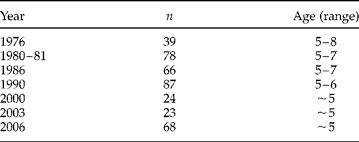
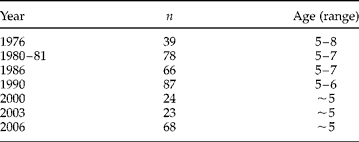
All samples of Atlantic cod, exceeding 40 cm length (4+years), were captured by research ships of the Department of Fisheries and Oceans (DFO) from 1977 to 2006 using a bottom otter trawl (see Khan & Tuck, Reference Khan and Tuck1995) in NAFO subareas 2J–3K (in the vicinity of the Hamilton and Belle Isle Banks) between mid-November and mid-March. However, the cod sampled in 1990 ranged in age from 3 to 8 years. Samples were frozen immediately after capture at − 30°C, thawed subsequently, within 3 months after capture, and the digestive tract examined for food and parasites following conventional methods. Acanthocephalans were separated, enumerated, preserved in 70% alcohol and 10% glycerol. These were later cleared in Rubin's fluid, mounted on glass slides with Canada balsam and examined microscopically. The number and age (in years) of cod examined for an acanthocephalan, E. gadi, sampled off the Labrador coast (NAFO subareas 2J and 3K) between 1976 and 2006 are shown in table 1. Amphipods, Gammarus spp., that remained intact in the stomach of cod, captured by trawl off coastal Labrador in 1990, were examined for cystacanths of the acanthocephalan, E. gadi.
Number (n) and age (years) of Atlantic cod examined for the acanthocephalan parasite, Echinorhynchus gadi, sampled off the Labrador Coast (NAFO divisions 2J and 3K) between 1976 and 2006.
Logarithmic transformation of the data was performed to remove variability. A one-way ANOVA was used to compare abundance and was followed by a post-hoc test (Scheffe's F-test) if the initial analysis was significantly different (P < 0.05). The chi-square test compared prevalence between groups from different years. Similar tests compared different age groups (1990 samples) and the sexes of comparable ages (1986 and 1990 pooled samples). Parasite terminology is used in accordance with that of Bush et al. (Reference Bush, Lafferty, Lotz and Shostak1997).
Results
The food of Atlantic cod varied considerably in some years, with capelin and crustaceans as the main prey while, occasionally, some were devoid of food contents. During the years 1977, 1980 and 1981, cod fed mostly on capelin and the stomach was consistently filled. While remnants of pink shrimp, Pandalus borealis, were observed, these were only a small fraction ( < 2%) of the stomach contents . During the periods of 1986 and 1990, a mixture of shrimp and unidentified fish remains were observed. Most of the stomachs (60%) examined in 2000 were empty, while others were only partially filled with remains of crustaceans, possibly pink shrimp, and unidentified fish. The fish was possibly sand lance Ammodytes sp., based on scale identification. A greater percentage of stomachs in 2003 and 2006 contained food that consisted of a mixture of crustaceans and fish remains, possibly sand lance.
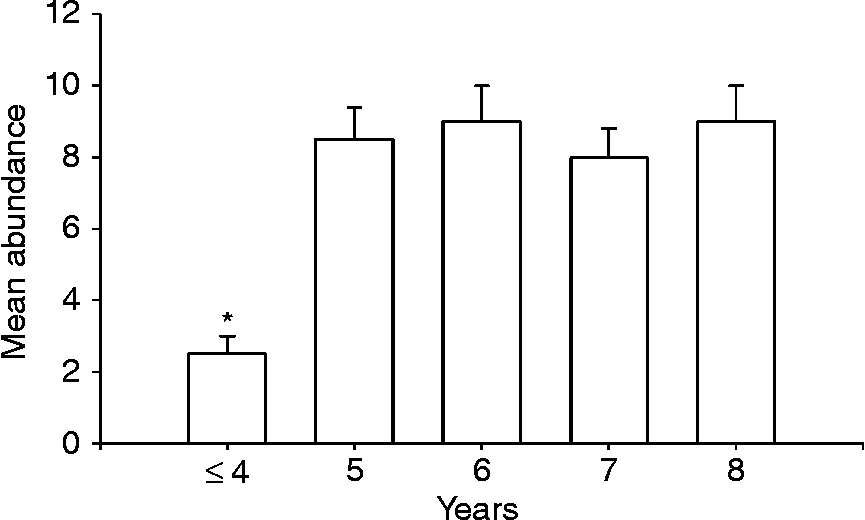
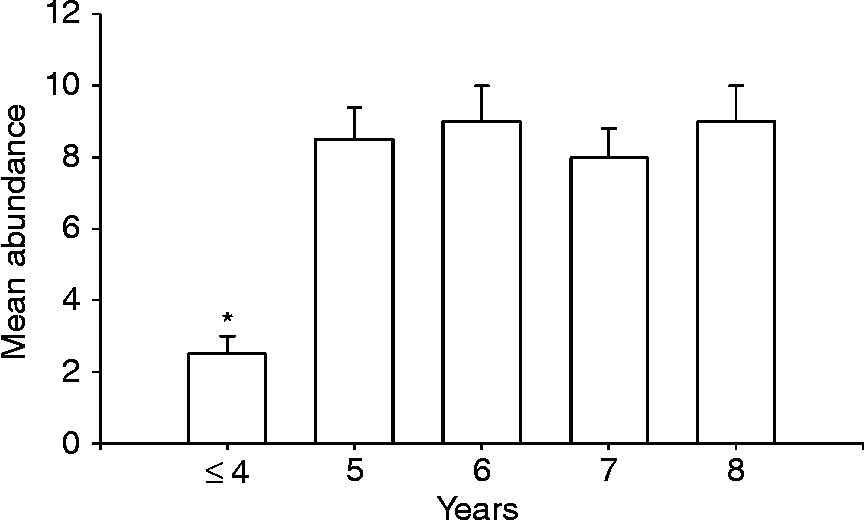
Since samples of cod examined in 1990 appeared to be smaller in number and total body length compared to previous years, a comparison was made between fish of different age groups to ascertain the relationship between age, sex and mean abundance of E. gadi. It was observed that fish older than 5 years harboured a significantly greater abundance of parasites than in the group aged 4 years or less (fig. 1). However, there was no apparent difference in the abundance of E. gadi among the dominant 5- and 6-year age groups or between male (7.1 ± 1.8, n = 54) and female (8.0 ± 2.1, n = 67) cod.
Comparison of the mean abundance (x = SE) of an acanthocephalan, Echinorhynchus gadi, in different age groups of Atlantic cod sampled in North Atlantic Fisheries Organization subarea 2J in autumn, 1990. The asterisk indicates a group that is significantly different (P < 0.05) from the others. Sample sizes for the age groups are as follows: ≤ 4 years (n = 15), 5 years (n = 14), 6 years (n = 15), 7 years (n = 15) and 8 years (n = 25) years.
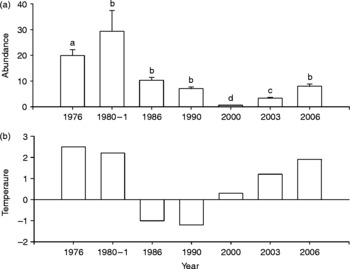
There appeared to be a decline in the mean abundance, but not prevalence, of E. gadi in relation to changes of the bottom oceanic temperature. A progressive decline in the abundance of E. gadi occurred from 1976 and 1980–81 onwards that coincided with the decrease of the water temperature (fig. 2). Mean values from 1986 onwards were significantly lower than in the earlier years, with the lowest level in 2000 and increasing slightly in 2003 and further in 2006. The latter increases were coincident with rising water temperatures. A time-lag was observed between the decrease in abundance and water temperature. An initial decline in temperature occurred in 1986 but the lowest levels in abundance were not observed until 2000. Similarly, rising water temperatures began in the late 1990s while modest increases of abundance of E. gadi were not apparent until 2003 and 2006. Only in the year 2000 was the prevalence significantly lower (33%) than in other years. Examination of 287 amphipods, Gammarus spp., which were recovered intact from the stomach of cod, less than 4 years old and examined in 1990, revealed that 0.01% (3) harboured cystacanths of E. gadi.
(a) Mean abundance of Echinorhynchus gadi in Atlantic cod sampled between 1976 and 2006. Different letters indicate significant differences (P < 0.05) between groups. See table 1 for sample sizes. (b) Water temperatures (°C).

Discussion
During 1985 and 1986, Atlantic cod had declined both inshore and offshore off the Labrador coast (Lilly et al., Reference Lilly, Parsons and Kulka2000). Residents encountered a severe shortage of fish, a staple of their daily diet. Ice conditions curtailed shipping until mid-summer when relief supplies arrived. Lee (Reference Lee1994) experienced severe difficulty in obtaining samples for a study on parasites of cod from the Labrador coast between 1985 and 1987. While 99.5% of the samples from northern and southern Labrador, both inshore and offshore, harboured an infection with the haemoflagellate, Trypanosoma murmanensis, the abundance of E. gadi had declined significantly from that in 1981 (Khan & Tuck, Reference Khan and Tuck1995; Lee & Khan, Reference Lee and Khan2000). These signs of the decline of the Labrador cod, other ground fish species and human hardship were not recognized until the early 1990s, when commercial catches were at an all-time low and a moratorium was imposed on the fishery (Rose, Reference Rose2005). Malmberg & Blindheim (Reference Malmberg and Blindheim1994) also reported that a dramatic decline of water temperature from years leading up to 1990 resulted in a decrease of cod stocks by 50% in Icelandic waters. This ‘great salinity anomaly’ was caused by polar water entering the east Greenland Current, culminating in a decrease of capelin stocks as well as recruitment and the spawning stock of cod by 67 and 75%, respectively. Despite the moratorium on fishing in offshore Labrador–east Newfoundland area (NAFO subareas 2J–3K–3L) and an increase of bottom-upwards water temperature recently, recovery of the cod fishery has been hampered by substantial by-catches in shrimp trawlers' nets, predation by seals (Phocidae) and low survival of mature fish after spawning (Department of Fisheries and Oceans, Canada, unpublished data). Consequently, it will be necessary to conduct a programme to sample cod stocks and temperature regimes on a regular basis to ensure that environmental changes are recognized before commercial fishery is resumed.
The presence of cystacanths in the amphipods, Gammarus spp., agrees with previous reports that these and other crustaceans serve as intermediate hosts of E. gadi (Valtonen & Crompton, Reference Valtonen and Crompton1990). Young cod, less than 30 cm in length, feed inshore during the summer, primarily on amphipods, Gammarus spp., and the prevalence and abundance of E. gadi tends to be greater than when feeding on copepods, Calanus spp. (Khan, unpublished data). Since the gammarids are widespread in their distribution, it is likely that these crustaceans are the prime intermediate hosts of E. gadi inshore, while fish predation offshore is the major route of transmission (Polyanskii, Reference Polyanskii1955; Valtonen & Crompton, Reference Valtonen and Crompton1990).
In the present study, abundance of E. gadi in Atlantic cod, 5 or more years of age, was significantly greater than in younger samples. In long-lived marine gadoids, some studies have revealed that parasitic infections increase with age of the fish (Polyanskii, Reference Polyanskii1955; Hemmingsen & MacKenzie, Reference Hemmingsen and MacKenzie2001). Polyanskii (Reference Polyanskii1955) observed that older Atlantic cod, haddock, Melanogrammus aeglifinus and pollock, Pollachius virens, harboured a greater abundance of E. gadi and other parasites than younger fish. The same study on cod in the Barents Sea revealed that substantial numbers of E. gadi only appeared when the fish fed on capelin. It was noted that an increase in the abundance of E. gadi in cod 3–5 years old occurred before decreasing in older fish in the Barents Sea (Karasev et al., Reference Karasev, Mitenev and Shulman1998; Hemmingsen & MacKenzie, Reference Hemmingsen and MacKenzie2001), while Buchmann (Reference Buchmann1995) observed that intensity of the parasite was greater in fish >81 cm in length examined in the North Sea. Valtonen & Crompton (Reference Valtonen and Crompton1990) reported that both the prevalence and abundance of E. bothniensis in Osmerus eperlangus increased with the length of its host.
Since cod, during winter, tend to feed mostly on crustaceans, then, samples examined prior to feeding on capelin should theoretically harbour fewer E. gadi, assuming that it has a short life span in its host (see Hemmingsen & MacKenzie, Reference Hemmingsen and MacKenzie2001). This was not evident in samples examined during late autumn and mid-winter taken in the Labrador Sea (Khan, unpublished data from 1980 to 1981). Lee & Khan (Reference Lee and Khan2000) did not observe any difference between years or season in cod sampled in three inshore and two offshore localities off coastal Labrador. Hemmingsen et al. (Reference Hemmingsen, Lile and Halvorsen1995) found no evidence of seasonality of E. gadi in cod from coastal waters of Norway. However, Scott (Reference Scott1985) observed a greater intensity of the parasite in pollock Pollachius virens, 40–49 cm in length, than in fish less that 39 cm or greater than 50 cm from the Scotian Shelf off eastern Canada, whereas Hoejgaard (Reference Hoejgaard1999) noted increasing infection with age in saithe ( = pollock).
The present study revealed no difference in the abundance of E. gadi between male and female Atlantic cod of comparable age. However, Buchmann (Reference Buchmann1988) reported a difference in the intensity of the parasite between the two sexes from the Baltic Sea (Bornholm Basin) only during March–April but not at three other intervals, viz., January–February, May–June or August, 1985. The study was based on fish length (39.5–49.5 cm) rather than age classes. Although distinct stocks of Atlantic cod have been identified in different geographical locations off the east coast of Canada, there is evidence that they do not represent homogeneous populations. The stocks not only intermingle but also grow at different rates (Fleming, Reference Fleming1960; Templeman, Reference Templeman1974). Moreover, females tend to grow faster than males after 4 years (Fleming, Reference Fleming1960). For example, a 5-year-class cod from Labrador (NAFO subarea 2J) is considerably smaller (total body length about 44 cm) than one of comparable age from an adjacent stock in the northern Grand Bank (NAFO subarea 3L; total body length, about 49 cm; see Fleming, Reference Fleming1960, Fig. 2). Additionally, males are about 2–3 cm smaller than females. Using age rather than length appeared to be more appropriate when comparing the abundance of E. gadi between the two sexes, in the present study, in order to avoid length-related bias. Consequently, the different results occurring between this study and that of Buchmann (Reference Buchmann1988) might be related to the method of comparison (age versus length) and also to the time of sampling (November off Labrador versus March–April in the Baltic Sea).
Decline in the abundance of E. gadi from the mid-1980s to the present time coincided with the change in climatic conditions that affected the oceanic environment off Labrador and the east Newfoundland shelf. Calanus finmarchicus, the most abundant zooplankton on which young cod and other pelagic species feed, declined rapidly as the water temperature decreased, as did capelin, which prefers warmer (2–7°C) than colder (0–1°C) water (Lilly et al., Reference Lilly, Almeida and Lear1984, Reference Lilly, Parsons and Kulka2000; Carscadden et al., 2001; Tittensor et al., Reference Tittensor, de Young and Tang2003; Rose, Reference Rose2005). Absence of this forage species, which moved from NAFO subareas 2J–3K, resulted in a trophic cascade that caused either mortality or out-migration from this area of many species of fish (Gomes et al., Reference Gomes, Haedrich and Villagarcia1995). Decline of E. gadi was directly associated with an absence of capelin in the diet of cod, since the infection can be acquired directly from this host (Polyanskii, Reference Polyanskii1955; Valtonen et al., Reference Valtonen, van Maren and Timola1983; Khan & Chandra, Reference Khan and Chandra2006). Recruitment and survival of cod in the Labrador Sea hinges on a high lipid intake, which is available only in capelin (Rideout & Rose, Reference Rideout and Rose2006). This fish species, observed during the 1990s, was smaller and spawned later in comparison to previous years (Davoren & Montevecchi, 2003). As a result, common murre, Uria aalge, chicks were in poor condition and seagulls, which normally scavenge on dead capelin after spawning, resorted to predation on the young of other sea birds (Davoren & Montevecchi, 2003). A paucity of capelin in the area implies that cod stocks and, consequently, E. gadi will remain below levels observed in the early 1980s unless the food web reverts its previous state.
As evidence of global warming accumulates, including the melting of the polar ice-caps and increasing temperature of the adjacent oceans, will prediction of the spatial and temporal abundance of cod (Drinkwater, Reference Drinkwater2005; Schiermeier, 2007) materialize? Drinkwater (Reference Drinkwater2005) has suggested that increased oceanic temperature in the Labrador Sea will result in increased abundance and northward extension of the range of Atlantic cod. However, this will hinge on an increase of its main prey, capelin, which is also a source of E. gadi infection (Polyanskii, Reference Polyanskii1955). Capelin feed on zooplankton that has returned currently to normal levels since declining in the mid-1980s and early 1990s, and one species, Calanus finmarchicus, has extended its range northwards (Schiermeier, 2007). The capelin stock has lagged behind and has not returned to its former level of the early 1980s (Lilly et al., Reference Lilly, Parsons and Kulka2000). Cod require a rich source of lipid, present in capelin, for rapid growth and reproduction (Rose & O'Driscoll, Reference Rose and O'Driscoll2002). Although there is, apparently, evidence of an inshore recovery of cod stocks, it is unlikely this will contribute to an increase of offshore stocks. Consequently, predictions on cod abundance and range extension appear premature in view of a paucity of capelin. Since variability of fish populations are influenced by climatic conditions, increasing evidence is now apparent that some of their parasites can still be useful as additional bioindicators of environmental shifts (Poulin & Mouritsen, Reference Poulin and Mouritsen2006).
In summary, the present study, conducted in a large, but specific oceanographic area, spanning three decades, has revealed that a commonly occurring marine fish parasite, an acanthocephalan, E. gadi, decreased in prevalence and abundance from the mid-1980s, coincident with a decline of its host, Atlantic cod, off coastal Labrador, Canada. This decline was attributed to climatic changes that occurred in the north-western Atlantic Ocean, affecting the abiotic conditions and culminating eventually in a trophic cascade of the food web. Parasite transmission in plankton-feeding forage species, primarily capelin, and top-level predators, including cod, was probably interrupted. Although oceanic conditions and zooplankton levels appear to be returning to normal, capelin, cod and E. gadi abundance continue to display marginal recovery. However, prevalence and abundance of the parasite has not been affected in three other areas of the eastern Canadian continental shelf during the past two decades (Khan, Reference Khan2007). Continuous influx of fresh water from the polar region through the Davis Strait might be affecting the abundance of zooplankton, including the copepod, C. finmarchicus, and in turn that of capelin and ultimately cod. Oceanographic studies might reveal the impact of the melting polar ice mass on the food web in the Labrador Sea. An additional study has linked parasitism in intertidal ecosystems to climate change (Poulin & Mouritsen, Reference Poulin and Mouritsen2006). In contrast, no clear relationship was observed in two parasites, an isopod (Cerathotoa sp.) and an acanthocephalan (Rhadinorhychus sp.) infecting the jack mackerel (Trachurus symmetricus) by El Niño events in the southern Pacific Ocean (George-Nascimento, Reference George-Nascimento2000, Reference George-Nascimento2007). These results suggest that the abundance of some parasites tends to be variable but can still be useful as indicators of environmental instability.
Acknowledgements
I am grateful for monetary support from the Natural Sciences and Engineering Council of Canada; The Department of Fisheries and Oceans, Canada, in St. John's, Newfoundland, for providing cod samples; C.V. Chandra for technical assistance; and to Ms C. Shortt and S. Wall for preparing the graphs and typing the manuscript, respectively.