Introduction
The links between depression and personality pathology are complex and generally have been understudied in older adults. The personality construct of neuroticism has been associated with increased risk of depression across the lifespan, including older age (Kendler et al., Reference Kendler, Gatz, Gardner and Pedersen2006). Whereas the term “neurotic” is used loosely by clinicians and the lay public, personality theorists have sought to provide clarity and definition to the term. For example, the Eysenck Personality Questionnaire includes a Neuroticism/Stability factor (Eysenck and Eysenck, Reference Eysenck and Eysenck1975). Costa and McCrae, as they studied personality and aging, developed the NEO-Personality Inventory (NEO-PI), with five personality factors, including neuroticism (Costa and McCrae, Reference Costa and McCrae1985). These assessments capture clinical characteristics such as a tendency to experience anxiety and negative mood states, particularly in the context of stress. This tendency to experience fluctuating negative mood states, such as depression, is separable from the experience of a more enduring syndromal depression.
Subsequent studies have documented the reliability and validity of the NEO-PI (McCrae and Costa, Reference McCrae and Costa1983; Cano-García et al., Reference Cano-García, Padilla-Muñoz and Carrasco-Ortiz2005). Within the NEO-PI, neuroticism as a construct was developed to identify individuals prone to psychological distress, and its “facets” (i.e. component subscales) consist of (1) Anxiety: level of free floating anxiety; (2) Angry Hostility: tendency to experience anger and related states, e.g. frustration and bitterness; (3) Depression: tendency to experience feelings of guilt, sadness, despondency and loneliness; (4) Self Consciousness: shyness or social anxiety; (5) Impulsiveness: tendency to act on cravings and urges rather than reining them in and delaying gratification; and (6) Vulnerability: general susceptibility to stress. Although neuroticism has been shown to decrease as we age (Costa and McCrae, Reference Costa and McCrae2006), it clearly has public health importance, as it limits quality of life and longevity (Lahey, Reference Lahey2009).
Limited research has examined the effects of neuroticism on the course of enduring syndromal depression and on brain structure and function. Neuroticism has been associated with worse mood outcomes in both non-geriatric depression (Bock et al., Reference Bock, Bukh, Vinberg, Gether and Kessing2010) and late-life depression (Canuto et al., Reference Canuto, Giannakopoulos, Meiler-Mititelu, Delaloye, Herrmann and Weber2009; Steffens et al., Reference Steffens, McQuoid, Smoski and Potter2013), although there are negative studies (Petersen et al., Reference Petersen2002). Beyond mood outcomes, neuroticism is associated with worse cognitive outcomes in older adults in some studies (Wilson et al., Reference Wilson, Bennett, Mendes de Leon, Bienias, Morris and Evans2005; Steffens et al., Reference Steffens, McQuoid, Smoski and Potter2013), though not in others (Wetherell et al., Reference Wetherell, Reynolds, Gatz and Pedersen2002; Jelicic et al., Reference Jelicic, Bosma, Ponds, van Boxtel, Houx and Jolles2003). In addition, imaging studies have found links between neuroticism and structural brain changes, specifically in the anterior cingulate cortex (ACC), the orbital frontal cortex (OFC), the middle frontal gyrus (MFG), the dorsomedial prefrontal cortex (PFC), hippocampus and the amygdala (Omura et al., Reference Omura, Constable and Canli2005; Wright et al., Reference Wright2006; DeYoung et al., Reference DeYoung, Hirsh, Shane, Papademetris, Rajeevan and Gray2010) and altered frontotemporal connectivity (Cremers et al., Reference Cremers2010; Fruhholz et al., Reference Fruhholz, Prinz and Herrmann2010), particularly with altered left amygdala-ACC connectivity (Cremers et al., Reference Cremers2010). Despite these interesting studies, there remain significant gaps in our knowledge of the mood and cognitive outcomes and the structural and functional correlates of neuroticism, particularly in the elderly. One intriguing inference from prior studies is a putative bidirectionality between neuroticism and brain changes in the elderly, with underlying structural and functional brain changes increasing risk of expressing a neurotic style, and neuroticism, possibly through increased susceptibility to stress, being associated with subsequent alterations in brain structure and function.
Given these knowledge gaps, we received support from the National Institute of Mental Health (NIMH) to further understand the relationships among depression, neuroticism and neuroimaging changes in older adults (age 60 or older). Our specific aims include: (1) determining acute response to standardized antidepressant medication treatment among older depressed adults with and without high neuroticism scores; (2): ascertaining differences in functional connectivity seen on functional magnetic resonance imaging (fMRI) between depressed and non-depressed subjects with high neuroticism scores, and between depressed subjects with and without high neuroticism scores; and (3) assessing two-year cognitive trajectories of depressed older adults scoring low and high on measures of neuroticism. In this paper, we present the methodology of the study, known as Neurobiology of Late-life Depression (NBOLD), as well as preliminary findings among two groups recruited to date: those with current major depression and a group of never-depressed control subjects scoring low on neuroticism measures. To characterize our sample, we employed both standard and less well studied clinical and cognitive assessments, the latter including experimental paradigms focused on emotional processing. For our baseline measures, we hypothesized that, compared with control subjects, the depressed group would score higher on measures of neuroticism and state and trait anxiety, score lower on measures of resilience and optimism, and report more childhood adverse experiences. We also hypothesized that subjects with late-life depression would exhibit a pattern of emotional processing performance distinct from non-depressed subjects.
Methods
Subjects
All subjects were enrolled in NBOLD, an NIMH funded R01 grant entitled “Neurobiology and Adverse Outcomes of Neuroticism in Late-life Depression” (MH096725) at the University of Connecticut Health Center (UCHC) and the Olin Neuropsychiatry Research Center at the Institute of Living at Hartford Hospital. The study was approved by the Institutional Review Boards of UCHC and Hartford Hospital. All subjects were provided information about the study, including a review of the consent form, and then provided written, informed consent to participate.
Depressed subjects have been recruited from clinic referrals, newspaper advertisements and community presentations. Non-depressed comparison subjects were recruited from a volunteer registry list housed in the Center on Aging at UCHC as well as newspaper advertisements and community presentations. Our recruitment strategy included monitoring for sufficient numbers of depressed and non-depressed subjects likely to score high in neuroticism; details are provided below.
Inclusion criteria for all subjects were age 60 or above, ability to read and write English, Mini-Mental State Examination (MMSE, (Folstein et al., Reference Folstein, Folstein and McHugh1975)) score 25 or greater. In addition, depressed subjects met criteria for major depression, single episode or recurrent.
Exclusion criteria for the study were: lifetime alcohol or drug dependence; conditions associated with MRI abnormalities such as hydrocephalus, benign and cancerous brain tumors, epilepsy, Parkinson's disease, Huntington's chorea, dementia, and demyelinating diseases; endocrine disorder other than diabetes mellitus; any physical or intellectual disability that may affect completion of self-rating instruments; established clinical diagnosis of dementia; other primary psychiatric disorders, e.g. panic disorder, social phobia, obsessive compulsive disorder, schizoaffective disorder, schizophrenia, bipolar disorder; and any metal or pacemaker in the body that might preclude MRI. In addition, current treatment with fluoxetine was an exclusion for the depressed group given its long wash-out period.
All participants were screened for depression using the Center for Epidemiologic Studies-Depression (CES-D) scale, using a score of 16 or greater as a cut-off for depression (Weissman et al., Reference Weissman, Sholomskas, Pottenger, Prusoff and Locke1977). To screen for neuroticism, we used the DS-14, a measure of tendency toward Negative Affectivity (NA, seven items) and social inhibition (seven items) (Denollet, Reference Denollet2005). NA correlated positively with NEO-PI neuroticism (r = 0.68), and scale-level factor analysis confirmed the construct validity of the DS14 NA scale against the NEO-PI (Denollet, Reference Denollet2005). Based on our preliminary analyses, a cut-off of ten or greater identified individuals high in NA. For the present study, we used the seven-item NA subscale of the DS-14, planning to oversample for those with the ≥10 cut-off among both depressed and non-depressed in order to ensure adequate numbers of individuals likely to score high in neuroticism. Oversampling has proven to be unnecessary among the depressed group, so we are currently only oversampling among the non-depressed controls. Our preliminary data showed that we likely would need to screen 500 control subjects in order to identify 25 controls meeting our criterion for neuroticism.
Upon enrollment and completion of baseline assessments, each participant was paid $100 for their time completing the MRI, cognitive test battery and experimental computerized measures (described below).
Baseline assessments
Trained clinical research assistants administered the Duke Depression Evaluation Schedule (DDES, (Landerman et al., Reference Landerman, George, Campbell and Blazer1989)) to each participant. The DDES contains items covering demographic data, life events, social support and coping, activities of daily living, self-rated depression severity, age of depression onset, and the Diagnostic Interview Schedule (DIS) sections for depression, mania, generalized anxiety disorder, somatization symptoms, and alcohol use (Robins et al., Reference Robins, Helzer, Croughan and Ratcliff1981). The DDES takes 1–2 h to administer. When necessary for the comfort of the patient, it is administered in more than one session. The DDES is completed in close temporal proximity to cognitive testing and neuroimaging studies, so that the psychometric and sociometric data contained within the DDES is considered contemporary with clinical, cognitive and imaging data. We administer the DDES using a specially programmed computer to ensure all items are covered, and that correct skip patterns are followed.
At study entry, each subject was interviewed by a study geriatric psychiatrist to establish a clinical diagnosis of major depression (for depressed subjects) or rule out history of mental illness (for comparison subjects). During the visit, the following assessments are completed: Montgomery–Ǻsberg Depression Rating Scale (MADRS, Montgomery and Asberg, Reference Montgomery and Asberg1979), 17-item Hamilton Depression Rating Scale (Hamilton, Reference Hamilton1960), the Clinical Global Impression severity scale, the Antidepressant Treatment History Form (Keller et al., Reference Keller1987; Sackheim et al., Reference Sackheim, Prudic, Devanand, Decina, Kerr and Malitz1990), and the Cumulative Illness Rating Scale (CIRS) (Linn et al., Reference Linn, Linn and Gurel1988), as modified for geriatric patients (Miller et al., Reference Miller1992). The MADRS will be our primary depression outcome measure.
Each subject completed several self-report measures, including the State-Trait Anxiety Inventory (Spielberger et al., Reference Spielberger, Gorssuch, Lushene, Vagg and Jacobs1983); the NEO-PI (Costa and McCrae, Reference Costa and McCrae1985) as a measure of neuroticism and other personality factors (Extraversion, Openness to Experience, Agreeableness, and Conscientiousness); the Carroll Depression Scale – Revised (Carroll et al., Reference Carroll, Feinberg, Smouse, Rawson and Greden1981; Carroll, Reference Carroll1998); the Adverse Childhood Experiences Scale (ACES, (Anda et al., Reference Anda, Butchart, Felitti and Brown2010)); the Brief Resilience Scale (BRS) (Smith et al., Reference Smith, Dalen, Wiggins, Tooley, Christopher and Bernard2008); and a measure of optimism/pessimism, the Life Orientation Test – Revised (LOT-R) (Scheier et al., Reference Scheier, Carver and Bridges1994).
Several experimental computerized measures were administered by a trained research assistant. These included a modification of the classic color-word Stroop test developed by Egner et al. (Reference Egner, Elkin, Gale and Hirsch2008) to measure cognitive and emotional attentional control. Specifically, subjects completed two versions of a task in which they were presented with faces depicting negative emotional expressions (fear) and positive emotional expressions (happiness). In version one, the cognitive interference task, subjects were asked to identify the gender of the face while ignoring the words “male” or “female” labeled across the face. Word and face parings were both congruent (e.g. the word male overlaid on a man's face) and incongruent (e.g. the word female overlaid on a man's face). In version two, the emotional interference task, subjects were asked to identify the face's emotional expression while ignoring the words “fear” or “happy” labeled across the face. Word and face parings were again both congruent (e.g. the word fear overlaid on a fearful face) and incongruent (e.g. the word fear overlaid on a happy face). Using these two versions enables the comparison of whether attention to task is selectively interfered with by either cognitive or emotional distractions. Subjects completed 80 trials (where faces were displayed for 1250 ms) of each version. Faces were identical during each version and gender and facial expressions were counterbalanced across trials. Mean reaction times were computed across congruent and incongruent trials for each version. Late-life depression is commonly associated with abnormalities in cognitive control and emotional regulation compared with age-matched controls. Deficits in simple motoric response speed are less often observed (Lockwood et al., Reference Lockwood, Alexopoulos and van Gorp2002). We therefore posited that both cognitive and emotional incongruent trials (requiring cognitive controls and emotional regulation) would result in slower reaction times for the depressed cohort but not controls, and no group reaction time differences would be evident in either version when trials were congruent (i.e. simple response speed in the absence of distraction).
Negative response bias was recorded on an emotional categorization test. All subjects were shown 60 personality characteristics deemed either to be either likable or dislikeable and were asked to categorize themselves according to each characteristic. Total number of positive and negative words endorsed was recorded. Preliminary evidence suggests neuroticism is correlated with anterior cingulate functioning during emotional categorization and this effect is independent that of major depression (Chan et al., Reference Chan, Harmer, Goodwin and Norbury2008). Thus, while not reported here, future analyses will examine shared neuroanatomical correlates of major depression and neuroticism in older adults.
Subjects also were administered a standardized cognitive assessment that is comprised of the Consortium to Establish a Registry in Alzheimer's Disease (CERAD) neuropsychological battery (Morris et al., Reference Morris1989), a collection of neuropsychological measures with normative standards for the elderly and established utility in longitudinal studies of cognitive impairment. (Welsh et al., Reference Welsh1994). The CERAD measures include the MMSE; language tasks consisting of category fluency (animal naming) and object naming (Kaplan et al., Reference Kaplan, Goodlass and Weintraub1983); constructional praxis and visual memory, requiring copy of four geometric designs, with delayed recall and delayed recognition procedures; and verbal learning and memory, consisting of immediate recall of three learning trials of a ten-item word list, delayed recall of the list, and recognition/discrimination of target words from non-target foils. The CERAD measures (minus the MMSE) are tallied to create a composite measure of global cognitive functioning (maximum score = 100). The CERAD battery is supplemented by other common neuropsychological measures used in clinical practice for assessing (1) immediate and delayed verbal memory (Logical Memory subtest of the Wechsler Memory Scale–Revised (Wechsler, Reference Wechsler1987)), (2) visual immediate memory (Benton Visual Retention Test) (Benton, Reference Benton1974), (3) verbal initiation/lexical fluency (Controlled Oral Word Association Test from the Multilingual Aphasia Examination) (Benton et al., Reference Benton, Hamsher, Varney and Spreen1983), (4) attentional/executive functions (Trail Making Test, (Reitan, Reference Reitan1992), Symbol Digit Modalites Test (Smith, Reference Smith1982), Digit Span subtest of the Wechsler Adult Intelligence Scale–Revised (Wechsler, Reference Wechsler1987), and a separate ascending Digit Span task modeled after the Digit Ordering Test) (Hoppe et al., Reference Hoppe, Muller, Werheid, Thone and von Cramon2000), and (5) premorbid verbal ability (Shipley Vocabulary Test) (Zachary, Reference Zachary1991). The current preliminary analyses included measures of global cognitive functioning (MMSE and CERAD Total Score). Considering late-life depression is usually characterized by mild deficits in executive functioning and processing speed (Lockwood et al., Reference Lockwood, Alexopoulos and van Gorp2002; Sheline et al., Reference Sheline2006), we did not expect to see significant group differences on these measures, but presently include them to better characterize our sample.
Laboratory assessment
On a separate day, each subject returned for fasting bloodwork that includes blood chemistry, complete blood count, lipid profile, serum homocysteine, serum folate and B12, and thyroid stimulating hormone. Blood is also stored for later DNA testing.
Neuroimaging
Following blood work, the subject is transported to the Olin Neuropsychiatry Research Center at the Institute of Living at Hartford Hospital for a brain magnetic resonance imaging scan. Future studies will describe the protocols related to structural and functional imaging acquisition, data processing and analysis.
Clinical follow-up of depressed subjects
Depressed subjects will be followed by a study psychiatrist every two weeks for 12 weeks. Once they have achieved remission (MADRS score < 10) and are stable on medications, they will be followed monthly for three months and then every three months. Otherwise, at the 12 week visit they will continue to be followed every two weeks until they achieve remission and are stable on medications. Subjects are initially offered treatment with sertraline 50 mg daily (25 mg daily for individuals 80 and older), with dosing increases every two weeks if needed, up to a maximum daily dose of 200 mg. At 12 weeks, subjects in remission will continue their dose of sertraline for up to two years. If not, there are options to add bupropion SR or switch to desvenlafaxine. Those individuals started on bupropion are administered 150 mg daily, which can be increased to 300 mg daily at 4 weeks and can be further increased to 400 mg at 8 weeks. Subjects are followed on bupropion SR for at least 12 weeks. If the choice is to switch to desvenlafaxine, subjects will be tapered off sertraline, with doses reduced by 50 mg every 3–4 days. This taper can be extended for concerns about discontinuation syndrome. After the taper, subjects will receive desvenlafaxine 50 mg every-other-day for at least 4 days then 50 mg a day. Assuming tolerability, this dose will be maintained for the 12-week period. At this second 12-week phase, subjects in remission are continued on their medication(s) for two years.
If, after this initial 24-week standardized treatment phase, a subject is not in remission, the subject is offered naturalistic antidepressant treatment using treatment guidelines previously established, including switching to another standard antidepressant and augmentation strategies (Steffens et al., Reference Steffens, McQuoid and Krishnan2002). They will be followed at clinically indicated intervals. Subjects may also be referred for psychotherapy at this phase.
Follow-up cognitive testing
Each subject will be administered annually the entire cognitive battery listed above. Those subjects with clear impairment on testing, and those for whom the study geriatric psychiatrist suspects clinically significant cognitive decline will be referred to the Memory Disorders Clinic at UCHC.
Sample size and recruitment
In our grant submission, we conducted power analyses to determine our sample size targets. Given three groups, we set an alpha of 0.05 divided by 3 = 0.01,667. Setting power at 0.80, based on preliminary data, our per-group target was 50. Herein we present data on the initial cohort recruited to date. Recruitment began in April 2013 and is expected to continue through April 2016.
Statistical analyses
Participants recruited to date include those with current major depression (n = 33), a group of never-depressed control subjects scoring low in neuroticism measures (n = 27), and a group of never-depressed control subjects scoring high in neuroticism measures (n = 3). For the latter group, we will only present summary characteristics given the small sample recruited to date.
We prepared the NEO PI-R data as follows. The NEO PI-R profile contains five domains: Neuroticism (N), Extraversion (E), Openness to Experience (O), Agreeableness (A) and Conscientiousness (C). The raw score of each domain was obtained by summing up all the scores of its component items. Each raw score was further converted into standardized T-score based on gender-specific norm, by following the formula:
 {\small{\begin{eqnarray*}
{\rm T} - {\rm score} &=& \frac{{\left( {{\rm Raw}\;{\rm Score} - {\rm Mean}\;{\rm of}\;{\rm Standard}\;{\rm population}} \right)}}{{{\rm SD}\;{\rm of}\;{\rm Standard}\;{\rm population}}}\\
&&^{*}10 + 50
\end{eqnarray*}}}
The gender-specific means and standard deviations, derived from a normative group of 500 men and 500 women, were provided in the manual by Costa and McCrae (Reference Costa and McCrae1992). A T-score ≥55 was used to identify control subjects scoring high in neuroticism (Costa and McCrae, Reference Costa and McCrae1985).
Analyses for this manuscript focus on contrasting depressed (versus) non-neurotic controls. Pearson χ 2 tests are used to assess associations between categorical variables. If the data are sparse and the expected cell counts are <5, exact p-values (e.g. Fisher's Exact Test) are reported. For numerical data, group comparisons are assessed using a two-sample t-test, after the distributions were found to be approximately normal and group sizes >25. For future analyses, with data that do not meet the normality assumptions for t-tests, have extreme values, or have limited distributions such as Likert scales, the appropriate non-parametric alternative (e.g. Wilcoxon Rank Sum Test) will be used. A two-sided alpha level of significance of 0.05 was used to evaluate statistical significance. All analyses were conducted using SAS version 9.4 (SAS, Inc., Cary, NC).
Results
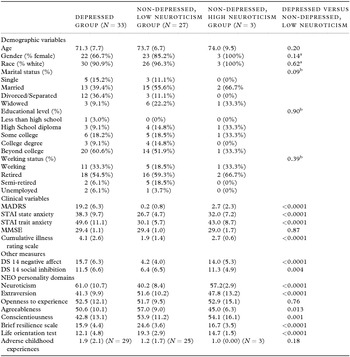
Baseline characteristics of the sample are shown in Table 1. Here, we present data on the depressed group as a whole, while the non-depressed comparison group was divided into “neurotic” versus “non-neurotic” based on their Neuroticism score on the NEO-PI. Overall, the sample was about 72 years old, predominantly white and female. This cohort had a high degree of educational achievement, with about 63% of controls and 70% of depressed participants had at least a college degree. Global cognitive functioning was similarly high (mean above 29) in both groups.
Characteristics of the sample

Note. Values represent means and standard deviations, with p-values from two-sample t-tests unless otherwise noted.
aFisher's exact test.
bExact p-values for Pearson χ 2 test.
The depressed group had significantly higher scores on the MADRS, STAI-state anxiety, STAI-trait anxiety and the CIRS (see Table 1). In respect to personality characteristics, compared to controls the depressed group scored significantly higher on the NEO domain of Neuroticism, significantly lower on the domains of Extraversion, Agreeableness, and Conscientiousness, and equivalently on the domain of Openness to Experience. In addition, depressed individuals reported a mean of 2.0 adverse childhood experiences compared with a mean of 1.2 for the non-neurotic controls (p = 0.18).
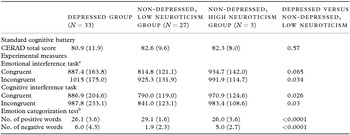
Depressed and control subjects were not significantly different on the CERAD neuropsychological composite measure. By contrast, significant group differences were observed on experimental “neuroscience” measures (see Table 2). Depressed subjects endorsed more negative words compared to controls on the emotional characterization test. Elsewhere, when compared with controls, depressed adults exhibited slower responding on a cognitive interference test requiring the identification of fearful or happy faces as male or female while ignoring the words “male” or “female” labeled across the face. In this small sample, no group by congruency effect was observed on this test. That is, depressed older adults exhibited slower processing speed compared with non-depressed subjects regardless of whether trials were congruent (e.g. the word male overlaid on a man's face) or incongruent (e.g. the word female overlaid on a man's face). By contrast, a group by congruency effect was observed on the emotional interference test where subjects were asked to identify the face's emotional expression while ignoring the words “fear” or “happy” labeled across the face. Response times were equivalent for controls and depressed subjects when tasked with identifying the emotional expressions of faces overlaid with congruent written emotions (e.g. the word fear overlaid on a fearful face). Yet, when the pairing between words and faces was incongruent (e.g. the word fear overlaid on a happy face), older adults with major depression were significantly slower than controls in identifying the face's emotion.
Performance on cognitive and experimental measures

Note. Values represent means and standard deviations, with p-values from two-sample t-tests.
a N = 30 in the depressed group. Three participants missing due hardware malfunction (N = 2) and premature discontinuation of the test (N = 1).
b N = 26 in the non-depressed low neuroticism group as this measure was added to the study after data collection was initiated.
In analyses not shown, we found no differences between the depression and control groups on laboratory measures of TSH, homocysteine, or folate.
Discussion
In this preliminary report from the NBOLD study, we report our methods for initial clinical and cognitive assessment, as well as our baseline assessments of neuroticism and other personality characteristics, resilience, and life orientation. We also report preliminary evidence describing behavioral results from experimental “neuroscience” measures of emotional processing.
Depressed participants not surprisingly scored higher on clinical measures of depression and anxiety. We also included several measures not normally part of most geriatric depression studies related to constructs of personality, adverse childhood experiences, optimism, and resilience. The depressed group scored quite differently than the control group on several personality domains, with older depressed adults showing higher scores on Neuroticism and lower scores on Extraversion, Agreeableness and Conscientiousness. The depressed cohort also showed less resilience and optimism as measured on the Brief Resilience Scale and the Life Orientation Test. To our knowledge this represents the first use of these instruments in this population; in the case of resilience, these cross-sectional findings suggest that depression might have a dampening effect on resilience, or that resilience might operate as a protective mechanism against developing depression and coping with other chronic illnesses in middle and later life (Fortinsky et al., Reference Fortinsky, Tennen and Steffens2013). Likewise, we found a non-significant trend for more adverse childhood experiences in the depressed group using the ACES, an instrument that is also underutilized in geriatric depression research.
The present findings of higher levels of increased neuroticism and less extraversion, agreeableness, and conscientiousness are consistent with prior studies of older depressed adults (Steffens et al., Reference Steffens, McQuoid, Smoski and Potter2013; Weber et al., Reference Weber2013). The interconnections among neuroticism, depression, and anxiety in older adults are complex and warrant ongoing investigation. Our preliminary evidence suggests higher levels of neuroticism in older adults with major depression are associated with reduced treatment response over time (Hayward et al., Reference Hayward, Taylor, Smoski, Steffens and Payne2013). Thus, the presence of neuroticism may mediate symptom severity in late-life depression. However, an alternative theory is that comorbid anxiety (especially rumination and worry) may moderate the association between neuroticism and depression (Roelofs et al., Reference Roelofs, Huibers, Peeters, Arntz and van Os2008). This theory is consistent with the notion of neuroticism as a primary manifestation of sensitivity to threat and punishment (DeYoung et al., Reference DeYoung, Hirsh, Shane, Papademetris, Rajeevan and Gray2010). In future analyses, we will be in a position to examine the complex relationships among depression, anxiety, neuroticism, and other personality factors.
Findings from experimental neuroscience measures were mixed in respect to the expected interaction between group and distracter stimulus (congruent or incongruent) across cognitive and emotional interference tests. Contrary to our hypothesis, depressed subjects responded slower on the cognitive interference test requiring gender identification of faces regardless of whether extraneous distracters (the words “male” or “female” overlaid on the face) were congruent or incongruent. Overall slower cognitive processing speed in the depressed cohort may explain the lack of congruency effect on this task. However, the expected congruency effect was observed during the emotional distraction test, in that depressed subjects were slower to identify faces as fearful or happy, but only under the incongruent condition (e.g. the word fear overlaid on a happy face). This latter finding is consistent with prior evidence that resistance to emotional distraction is enabled by top-down inhibition of the amygdala from the rostral anterior cingulate cortex (rACC) (Egner et al., Reference Egner, Elkin, Gale and Hirsch2008). Therefore, disrupted connectivity between the rACC and amygdala (representing a failure of amygdala inhibition) (Etkin et al., Reference Etkin, Egner, Peraza, Kandel and Hirsch2006) may explain slower response times in depressed compared to control subjects specifically during emotional interference (incongruent trials) but not emotionally neutral (congruent) conditions. Our future analyses will examine these behavioral paradigms in greater detail and provide corroborating evidence of functional connectivity.
We did not find significant cross-sectional differences between older adults with major depression and controls on a composite measure of cognitive functioning. This is consistent with evidence showing the vast majority of older adults with major depression do not experience global cognitive impairment (Morimoto et al., Reference Morimoto, Kanellopoulos, Manning and Alexopoulos2015). Instead, the cognitive profile of late-life depression is usually characterized by mild deficits in executive functioning and processing speed (Lockwood et al., Reference Lockwood, Alexopoulos and van Gorp2002; Sheline et al., Reference Sheline2006). While major depression may be a risk factor for later cognitive decline (Diniz et al., Reference Diniz, Butters, Albert, Dew and Reynolds2013), only a minority of older adults with major depression eventually develop dementia (Potter et al., Reference Potter, Wagner, Burke, Plassman, Welsh-Bohmer and Steffens2013). However, the combination of neuroticism and major depression may be especially detrimental to the cognitive well-being of older adults. Higher neuroticism, and the vulnerability to stress component in particular, was associated with a two-year decline in global cognitive functioning in older adults with major depression (Steffens et al., Reference Steffens, McQuoid, Smoski and Potter2013). Moreover, vulnerability to stress and trait anxiety were the only neuroticism components associated with the risk of Alzheimer's disease in non-depressed older adults (Wilson et al., Reference Wilson, Begeny, Boyle, Schneider and Bennett2011). Longstanding stress and anxiety may reduce hippocampal volume via glucocorticoid secretion thereby increasing susceptibility to cognitive decline and dementia (Tschanz et al., Reference Tschanz, Norton, Zandi and Lyketsos2013; Zannas et al., Reference Zannas2013; Mah et al., Reference Mah, Binns and Steffens2015).
There are some limitations of our method that are worth mentioning. First, our recruitment strategy, in which we monitor our depressed and non-depressed samples to ensure adequate numbers of subjects likely to score high in neuroticism, may lead to populations of older depressed and non-depressed adults that are not representative of the general population. Another limitation is that, although we initially administer a standardized six month treatment regimen, subjects not in remission at six months are offered naturalistic treatment. That is, the decision for treatment is made between psychiatrist and patient and may vary considerable from one patient to the next. In addition, we have not instituted guidelines for treatment of cognitive disorders although we suspect the prevalence of medications to treat cognitive symptoms (e.g. cholinesterase inhibitors) will be low. Finally, the evaluation period is currently limited to two years. Although this initially may seem a relatively short period to detect meaningful cognitive change in this cohort, our preliminary data revealed cognitive differences at two year interval (Steffens et al., Reference Steffens, McQuoid, Smoski and Potter2013).
The aim of the NBOLD study is to examine the relationships among depression, neuroticism, and neuroimaging changes in older adults. This study will primarily serve to elucidate: (1) the potential synergistic effect of neuroticism and major depression on treatment response and cognitive decline in older adults, and (2) the functional connectivity amongst limbic and frontal regions involved in emotional and cognitive processing. Ventromedial (VMPFC) behavioral dysfunction is not well-understood in late-life depression (Manning et al., Reference Manning, Gunning, McGovern, Kotbi and Alexopoulos2014), and we hope to clarify the association between VMPFC connectivity, neuroticism components (e.g. impulsivity, hostility), and clinical outcomes. Finally, by including resilience and life orientation, we will better understand how these protective factors may influence the experience of depression, neuroticism, and cognitive decline in late-life. Thus, this study will be well-positioned to characterize the course of clinical outcomes associated with neuroticism and depression in late-life.
Conflict of interest
None.
Description of authors’ roles
D. Steffens designed and obtained funding for the study and wrote the paper. K. Manning interpreted the results from neuroscience-based measures and assisted in writing the paper. R. Wu and J. Grady performed statistical analyses and assisted in writing the paper. R. Fortinsky H. Tennen interpreted results of measures of resilience and optimism and assisted in writing the paper.
Acknowledgments
The authors wish to acknowledge the following individuals who provided essential support to the NBOLD study: Ms. Alison Kleppinger for assistance in programming of computerized assessments and for creating data files for analyses; Ms. Jennifer Brindisi for leadership of the research staff, leading recruitment efforts, obtaining informed consent from participants, and shepherding the protocol through the UConn Health Institutional Review Board; Ms. Suzanne Crumb and Ms. Darlene Winkelman for programming the computerized assessments, managing participant flow, and administering standardized clinical and neuropsychological assessments; and Ms. Ruth LaCasse Kalish, Investigational Study Pharmacist, for expert assistance in setting up our medication protocol and assuring high quality in dispensing medications. The work on this study was done at UConn Health Center. It was supported by NIH grant R01 MH096725.