Introduction
Our understanding of how people cope with the diagnosis of cancer matured with recognition of the importance of meaning-based coping, alongside problem- and emotion-based approaches (Folkman & Moskowitz, Reference Folkman and Moskowitz2000). The meaning of life is established through the value and significance of each person's roles, accomplishments, sources of fulfillment, and connection to others (Lethborg et al., Reference Lethborg, Aranda and Bloch2006, Reference Lethborg, Aranda and Cox2007). Cancer, as with other life-threatening illnesses, creates an existential crisis that can challenge the meaning and value of any time that remains. Meaning and Purpose (MaP) therapy was theoretically designed to bring together concepts of meaning-based coping with the sense of coherence that people can make of their lives so that they can be empowered to live fully with true value, purpose, and determination (Lethborg et al., Reference Lethborg, Schofield and Kissane2012).
Early models of meaning-centered therapy (MCT) were grounded in existential psychotherapy (Yalom, Reference Yalom1980), well exemplified by logotherapy (Frankl, Reference Frankl1963) and supportive-expressive therapy (SET) (Spiegel, Reference Spiegel1993). Then psychoeducational models of meaning-centered interventions showed the value of a more structured mode of delivery (Breitbart & Poppito, Reference Breitbart and Poppito2014). Others blended MCT with active symptom management, with the Managing Cancer and Living Meaningfully program becoming known as CALM therapy (Lo et al., Reference Lo, Hales and Rydall2015). Our group worked steadily on the development of a brief, focused model of MCT, which began from a person-centered orientation, developed personalized goals, and built a patient's sense of his or her coherent story of strengths, accomplishments, purpose, and meaning in life. Although all of these models may overlap in content, they differ in dose of therapy, how psychoeducational they are, and the tenor adopted by the therapist. MaP is not psychoeducational nor focused on symptoms, but very patient-centered in style. The important variations in MaP from other models lie in its greater focus on setting goals and seeking new possibilities, acknowledging personal strengths, and appreciating life with its inherent choices. We initially piloted a four-session intervention of MaP therapy, which was qualitatively appreciated by participants, but failed to generate significant effect sizes (Lethborg et al., Reference Lethborg, Schofield and Kissane2018). We therefore strengthened the dose of our MaP intervention to a six-session model.
Here we report on a pilot trial of a six-session model of MaP therapy compared with usual care (UC) in the setting of advanced cancer. We sought to demonstrate feasibility, acceptability, and adequate effect sizes on measures of posttraumatic growth, life attitudes, depression, and demoralization to power a future randomized, controlled trial.
Methods
Overview and participants
In this pilot study, we randomized patients to undertake six sessions of MaP therapy or join a wait-list receiving UC. Given the exploratory nature of this trial, we did not screen for distress, but accepted all eligible patients with advanced cancer.
A convenience sample of patients was identified from the oncology and palliative care services of Cabrini Health in Melbourne, Australia, across 2015–2016. Inclusion criteria were patients with (1) advanced cancer whose prognosis was assessed at 12 months or less; (2) reasonable use of English; and (3) age >18 years. Exclusion criteria were (1) cognitive or psychiatric impairment likely to interfere with therapy and (2) pronounced frailty because of advanced disease rendering completion of study requirements unlikely. Treating cancer physicians confirmed that participants met eligibility criteria.
Eligible patients were approached in the chemotherapy day center or while hospital inpatients by trained research assistants. Those interested were either consented or given study materials to consider and followed-up by telephone. Once patients had provided informed consent, baseline measures (T1) were completed, and then consenting patients were independently (J.B.) randomized in a 1:1 ratio to intervention or wait-list control. Follow-up data collection was completed after intervention or wait-list control (T2) at 6–8 weeks after baseline. Those in the control arm who then wished to cross over and receive the intervention were able to do so; these patients completed a further postintervention set of questionnaires. Ethical approval was granted by the Cabrini Human Research Ethics Committee. Research assistants kept a study log of attendances at therapy, accessed the medical record for relevant medical data, and coordinated therapist assignment and supervision sessions.
Intervention
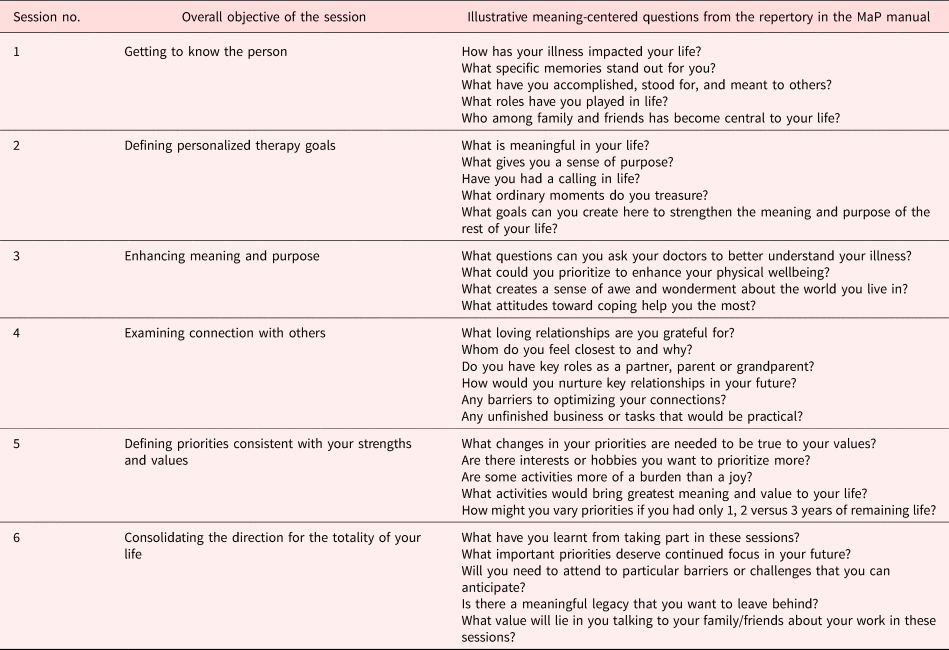
The therapy involved six manualized sessions, lasting 60 minutes each, and designed to be delivered by psycho-oncologists trained in the care of patients with cancer. The manual provided a step-like and easy-to-follow guide, session by session, with homework sheets prepared for the patient to take and sustain reflection between sessions. Illustrative meaning and purpose questions are shown in Table 1.
Overview of MaP therapy themes and illustrative meaning-centered questions

The first session focused on the story of the cancer and a narrative account of the person's life, with homework reviewing sources of accomplishment and the effect of cancer in creating concerns, challenges, and fresh priorities. The goals of therapy were then defined in session 2, reaching consensus about the concerns and priorities/goals that would be the focus of future work. Homework invited clarification of their “purpose in life” in future years, with reflection on “the attitude” that will be needed to achieve this. Session 3 aimed to enhance meaning and purpose through review of the body's needs, and the spiritual and the emotional domains of life that are meaningful for the person. Homework targeted the meaning of relationships, which then became the focus of session 4, considering interpersonal roles, developmental and adult relationships, barriers, and unfinished relational business. Homework after session 4 explored creative hobbies, appreciation of the world, and reprioritization of life's activities. Session 5 examined personal strengths, coping strategies, what was coherent in understanding the person's life, and what would be the key goals across varied, yet hypothetical, future timelines (e.g., 6, 12, and 18 months). Homework then reviewed what was learnt in the MaP therapy sessions, with the final session attempting to consolidate this understanding of the person's life, celebrating what has been accomplished, and considering how he or she will share the goals with relatives and friends.
Five psychologists were trained in a workshop to deliver the manualized model of therapy. Four key therapeutic strategies were illustrated and rehearsed: (1) the use of narrative; (2) personalized selection of meaning-centered questions from a repertoire of such questions to elicit meaning; (3) after due empathic acknowledgment, de-reflection from issues of grief and suffering back to sources of hope and meaning; and (4) a social focus on relational strengths.
Fidelity
Fidelity coding sheets were developed for each session to record adherence to the sequential components of the manualized model of therapy. Inter-rater reliability was tested with two coders (D.W.K., H.H.) rating a subsample of 18 sessions and confirming >80% agreement on ratings. Weekly peer group supervision sessions were conducted (D.W.K., S.B.) to review fidelity and application of the model, what worked well, and what proved challenging about any session. Use of weekly peer group supervision allowed therapists to learn from and mutually support one another, to optimize strategies to engage patients with homework, and to respond to the inventory of meaning-centered and purpose-seeking questions.
Measures
In the measures that follow, we selected specific subscales most suitable for our therapeutic goals, limiting patient burden to maintain retention of this medically ill cohort of participants.
Posttraumatic Growth Inventory
We used three of its five subscales in this study to assess positive outcomes after traumatic events: new possibilities (five items), personal strength (four items), and appreciation of life (three items). Items were rated on a 6-point Likert scale, ranging from 0 = no change to 5 = I experienced this change to a very great degree as a result of my cancer diagnosis and/or treatment. Higher scores reflect greater positive change. Internal consistency for these Posttraumatic Growth Inventory (PTGI) (Tedeschi & Calhoun, Reference Tedeschi and Calhoun1996) subscales was satisfactory, with new possibilities, Cronbach α = 0.75; personal strength, α = 0.80; and appreciation of life, α = 0.80. The PTGI has been used in earlier studies of meaning in the cancer setting (Lethborg et al., Reference Lethborg, Aranda and Bloch2006, Reference Lethborg, Aranda and Cox2007).
Life Attitude Profile – Revised
We used 4 of its 6 subscales in this study: purpose, coherence, choice, and goal seeking (G. T. Reker, Reference Reker2001). The purpose and coherence subscales are summed to create a measure of personal meaning. Higher scores correspond to greater positive change. These subscales have acceptable internal consistency with Cronbach α levels in this study for choice, α = 0.80; goal seeking, α = 0.76; purpose, α = 0.82; and coherence, α = 0.82. The Life Attitude Profile – Revised (LAP-R) (Reker & Peacock, Reference Reker and Peacock1981) has demonstrated acceptable concurrent validity with other measures of global meaning such as the Sense of Coherence Scale (r = 0.50) and the Purpose in Life Test (r = 0.82), and was used in our earlier studies (Lethborg et al., Reference Lethborg, Aranda and Bloch2006, Reference Lethborg, Aranda and Cox2007).
Brief Symptom Inventory
This is an 18-item, well-validated measure of psychological distress over the past 7 days. It contains three subscales of depression, anxiety, and somatization, with Cronbach alphas in this study of 0.83, 0.92, and 0.83, respectively. Each item is rated on a 5-point Likert scale from 0 = not at all to 4 = always. The Brief Symptom Inventory-18 (Derogatis, Reference Derogatis2000; Derogatis & Melisaratos, Reference Derogatis and Melisaratos1983) has been used in prevalence studies related to psychological distress (Stefanek, Derogatis, & Shaw, Reference Stefanek, Derogatis and Shaw1987; Zabora et al., Reference Zabora, Smith-Wilson and Fetting1990) and much of our earlier work. This instrument is noted for its brevity and ease of understanding.
Demoralization Scale-II
This is a 16-item measure of low morale with loss of meaning and poor coping. Items are rated on a 3-point Likert scale, covering never, sometimes, and often; scores range from 0 to 32, with high scores reflecting greater demoralization. Internal consistency for the total Demoralization Scale-II (DS-II) (Robinson et al., Reference Robinson, Kissane and Brooker2016a, Reference Robinson, Kissane and Brooker2016b) in this study showed Cronbach α = 0.94. It shows convergent validity with measures of quality of life, distress, and attitudes toward hastened death, and differentiates functional status and symptom burden. A clinically meaningful difference is 2 points (Robinson et al., Reference Robinson, Kissane and Brooker2016a).
Statistical analyses
Baseline characteristics of those completing the study and for the two arms were compared using a chi-square test for categorical variables and a t -test for continuous variables. Assumptions of normality and constant variance were assessed; no significant departures were evident.
Given the exploratory nature of this pilot work, completion of >70% of therapy sessions was set as desirable, but formal hypotheses were not specified for outcome variables. A sample of approximately 60 participants completing the study was considered adequate to deliver sufficient power to gauge the effect size of outcomes and thus power a future formal RCT.
The short-term effects of therapy were assessed using regression analyses in Stata 14 for each outcome measure adjusted for its baseline value (StataCorp, 2015). Parameter estimates are reported with 95% confidence intervals (CI 95%). The control group for the analysis was the UC group between their baseline (T1) and 6- to 8-week (T2) follow-up. The intervention group consisted of those randomized to MaP therapy from baseline to 6-8 weeks post therapy, plus those crossing over from the UC group after their 6- to 8-week follow-up, when they too received the MaP therapy intervention, to their postintervention follow-up 6 weeks posttherapy. Thus the 6- to 8-week outcome measures for the UC group were used as the final time point for assessing the effect of the intervention in the control group and as the pretherapy outcome measure for assessing the effect of the intervention. Generalized estimating equations were used to control for the lack of independence between observations on the control group using the Huber-White Sandwich Estimator as implemented in Stata to obtain robust standard errors for the estimates of effect. Effect sizes were calculated using Cohen d to provide guidance about the strength of effect given the exploratory nature of this pilot work
Results
Participants
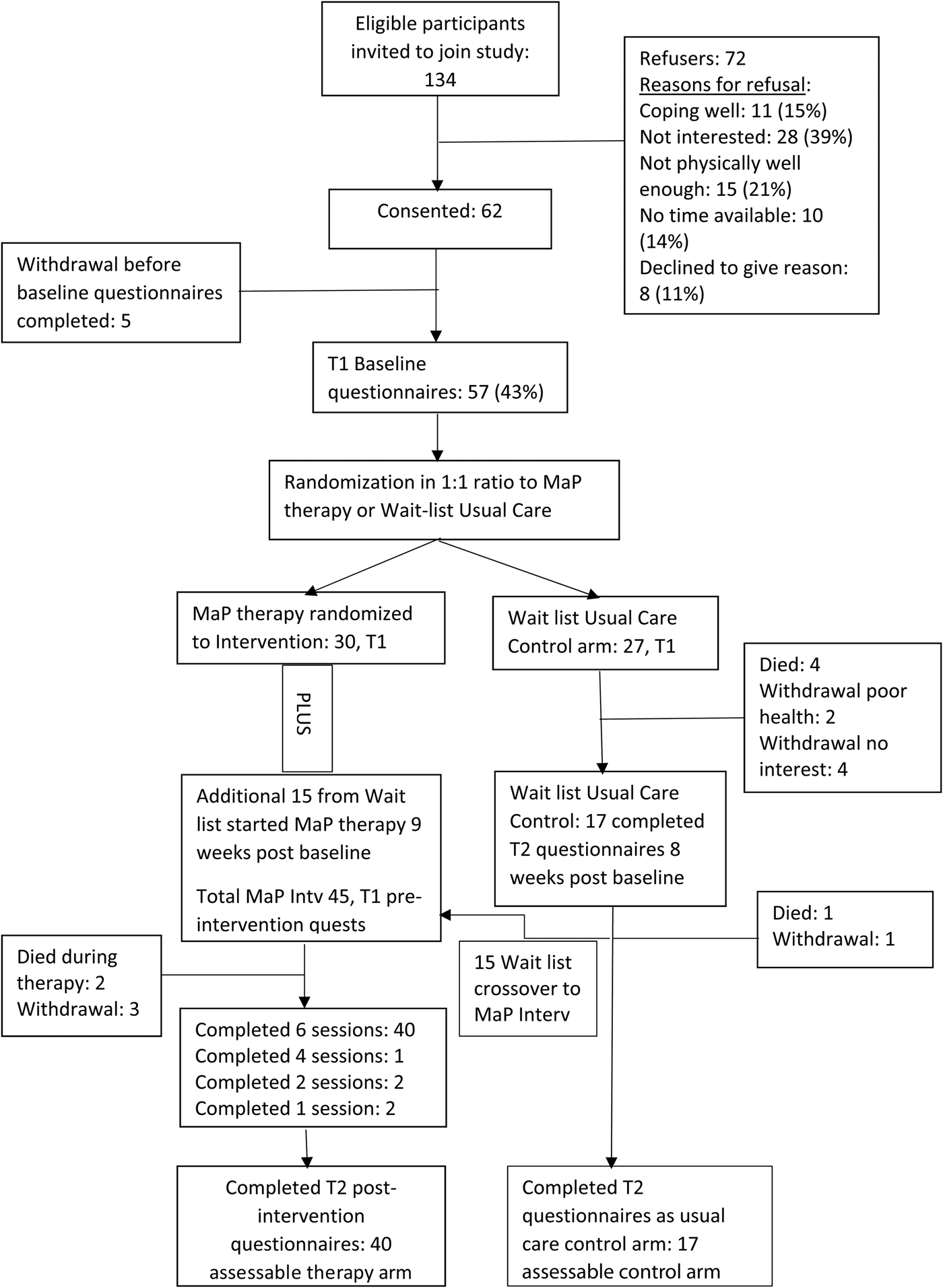
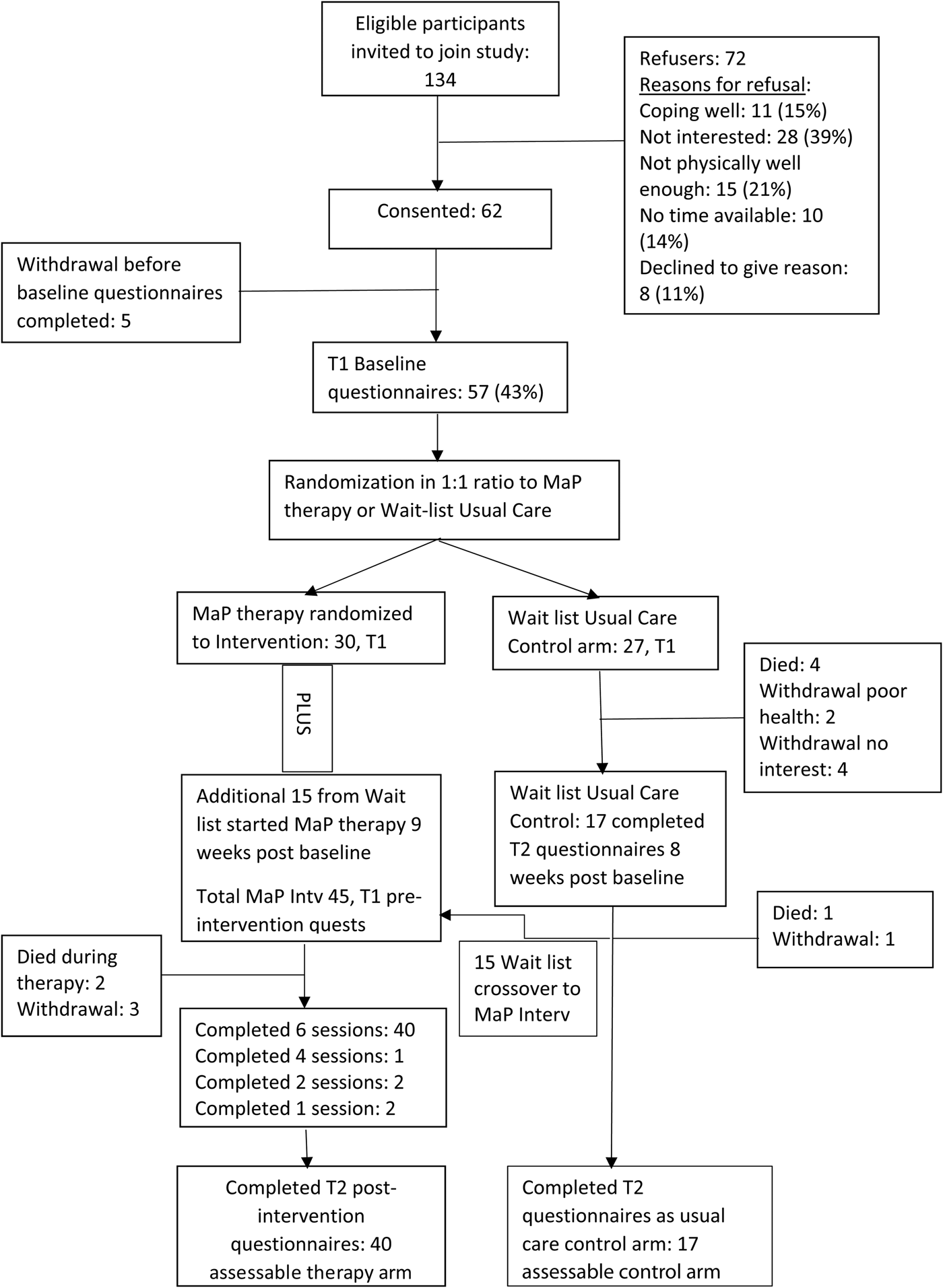
From 134 eligible patients with advanced cancer who were invited to join the study, 72 (54%) declined and 57 (43%) of the 62 consenting completed baseline measures as shown in the consort diagram (Figure 1). Reasons for refusal included disinterest (39%), lack of wellbeing (21%), lack of time (14%), and sense of coping well (15%). There were no significant age or gender differences between refusers and accepters and no significant sociodemographic differences between those who did/did not complete the intervention.
Consort flow diagram of participants in pilot RCT of Meaning and Purpose Therapy using a wait-list, crossover design. Intv, intervention; MaP, Meaning and Purpose; RCT, randomized controlled trial; T1, baseline measures; T2, 6 to 8 weeks.
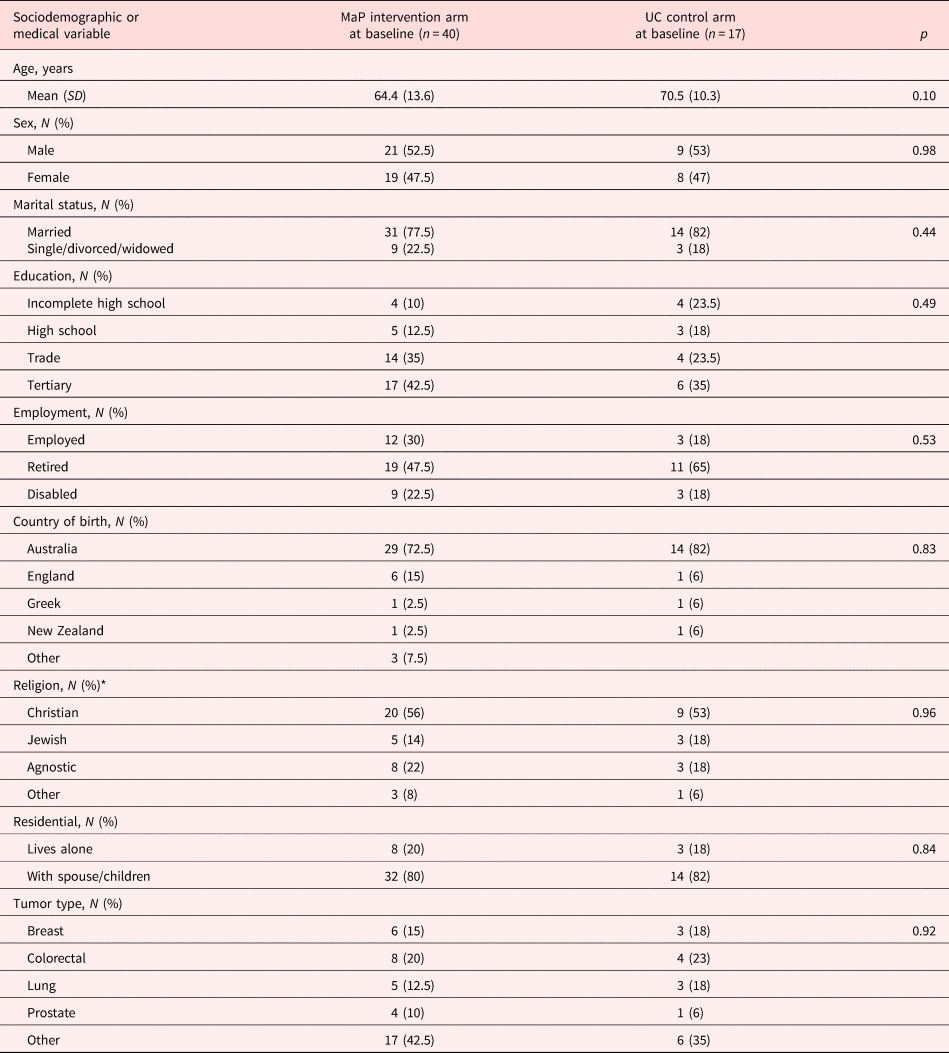
Participants had a mean age of 65 (SD = 12.9) years, 30 (53%) were male, 45 (79%) married, and 43 (75%) were Australian-born. As shown in Table 2, most were well educated, Christian, and living with a spouse or children. They suffered from the common types of advanced cancer. No significant differences were found at baseline for the sociodemographic and cancer characteristics between the two randomized arms. There were no significant baseline differences between study completers and noncompleters.
Sociodemographic features at baseline of a cohort of patients with advanced cancer randomized in a wait-list design to MaP Therapy or UC and then MaP therapy

*Some data missing.
MaP, Meaning and Therapy; UC, usual care.
Feasibility: Attrition and completion
Acceptability of the model and feasibility of delivering this therapy to patients with advanced cancer is evidenced by 40 (89%) completing the six sessions. Reasons for noncompletion included death for two patients, poor health for two, and one disliked the initial experience.
Intervention outcomes
A comparison of outcomes between the initial 25 participants (before addition of the crossover participants) receiving MaP therapy compared with the 17 control participants failed to show significant mean group differences in change scores. To illustrate, the between-group differences for mean change scores for PTGI new possibilities were 0.08 (CI 95% = –0.66, 0.82) and LAP-R goal seeking were 2.16 (CI 95% = –1.06, 5.38).
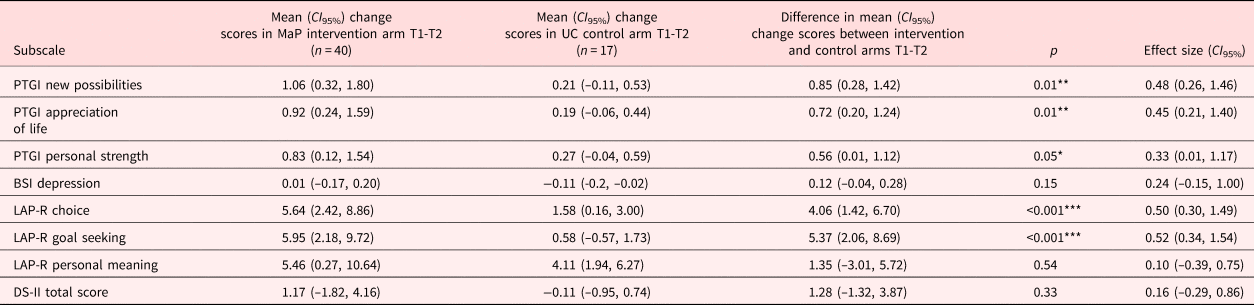
Once the 15 wait-list participants crossed over after their 6- to 8-week follow-up to receive the intervention, the MaP cohort arm was increased to 45 participants and better effect sizes emerged. On the PTGI, growth in awareness of new possibilities (Cohen d = 0.48 [CI 95% = 0.26, 1.46]), development of a deeper appreciation of life (Cohen d = 0.45 [CI 95% = 0.21, 1.40]), and growth of personal strength (Cohen d = 0.33 [CI 95% = 0.004, 1.17]) showed improvements in the intervention arm compared with controls (Table 3). The development of these effect sizes is for the sole purpose of calculating power for a formal phase 3 study. A future sample of 150 intervention and 150 control participants will be adequate to detect a medium effect size on these measures of the PTGI (Cohen d = 0.5, SD = 1.25, α = 0.01, β = 0.2).
Change score analysis using generalized estimating equations to compare MaP therapy versus UC control arms from T1 to T2 across a range of subscale scores (n = 57)

BSI, Brief Symptom Inventory; DS-II, Demoralization Scale-II; LAP-R, Life Attitude Profile-Revised; PTGI, Posttraumatic Growth Inventory; T1, preintervention; T2, postintervention.
* p ≤ 0.05
** p ≤ 0.01
*** p ≤ 0.001
On the LAP-R, improvements occurred in both having future-oriented choices (Cohen d = 0.50 [CI 95% = 0.29, 1.50]) and setting goals (Cohen d = 0.52 [CI 95% = 0.34, 1.55]). The development of personal meaning on the LAP-R is a composite score of LAP purpose and LAP coherence, whose effect size was not noteworthy in this study.
With respect to measures of depression and demoralization, the Brief Symptom Inventory depression subscale showed an effect size of 0.24 (CI 95% = –0.15, 1.00), and the DS-II an effect size of 0.16 (CI 95% = –0.29, 0.86).
Discussion
Because existential challenges are dominant for patients with advanced cancer, the development of structured, existentially oriented interventions that enhance meaning-centered coping has been important. A brief and targeted therapy optimizes efficiencies proportionally to the preciousness of time that remains for these patients. Our recruitment rate of 43% was comparable to other psychotherapy studies in advanced cancer and our model of MaP therapy delivered over six sessions proved feasible to deliver. The 89% retention rate to the completion of therapy was excellent. Where ill health necessitates admission to hospital, continuation of the therapy can be challenging, but manageable; however, compared with our earlier efforts with a four-session intervention, promising effect sizes have now emerged from this dose of intervention, with gains in goals, choices, and openness to new possibilities in life, and a clear benefit in positive appreciation of the value of life.
Not only has this intervention proven acceptable and feasible for the enrolled patients, but also of the noncompleters: two dropouts were caused by death, two from poor health, and only one withdrawal because of dislike of the experience. No model of therapy has a perfect fit with its recipients, and the loss of only 6% in this pilot because of perceived goodness-of-fit of the intervention is very promising indeed. The focus of the therapy on sustained meaning and purpose while life remains was welcome, with promising outcome benefits in retaining a sense of choice and goal-setting about the future. This outcome counters the passive helplessness that might easily develop at the end of life, promoting an appreciation of the value and beauty of life, and sustaining the possibility of worthwhile experiences in the time that remains. Nevertheless, the LAP-R personal meaning subscale did not significantly increase, and although the study was not adequately powered for such growth of meaning, the possibility exists that this is a trait measure of global meaning that will not be responsive to the intervention. A goal-oriented outcome targeting particular meaningful activities is clearly different to a deeper sense of global meaning, where this has been long held.
We trained therapists in an annual workshop and used five psychologists in the delivery of this model, which proved readily adopted and applied by clinicians with an understanding of illness and health. Supervision was nonetheless important to address patient resistance (e.g., completion of homework) and to help these clinicians truly appreciate each person as a unique individual. Supervision also helped ensure that the cancer story was well understood, the prognosis clarified, and thus that the therapists were empowered to know when to challenge evident patient pessimism. The instillation of realistic hope is grounded in an accurate knowledge of the trajectory of illness during treatment of advanced cancer. Furthermore, the model promotes a detailed understanding of the patient's life story, where a genuine appreciation of the strengths and accomplishments, alongside continuing roles and responsibilities, allows a coherent narrative to be reflected back to the person in an affirming and celebratory manner.
The dose of intervention has been crucial, with our earlier work failing to find sufficient benefit from four sessions, and only beginning to realize worthwhile outcomes once six sessions were delivered. It is conceivable that a stronger dose will further strengthen outcome benefits. This sits in balance with the burden on patients of weekly sessions, when parallel oncological care also places many demands for hospital attendance, tests, and chemotherapy treatments. We have been aware of the pilot work of studies such as CALM therapy, where in Toronto, modest effects were delivered from six sessions (Lo et al., Reference Lo, Hales and Jung2014, Reference Lo, Hales and Chiu2016), whereas in Ferrara, large effects were realized with 12 sessions (Caruso, Reference Caruso2014). Dose of therapy is clearly pertinent, and in the clinical world beyond trials, would be determined by patient need.
Is there something unique about this model of MCT? It is meaning-centered in its orientation, yet less psychoeducational than Breitbart's model of MCT (Breitbart et al., Reference Breitbart, Rosenfeld and Pessin2015), less focused on tracking emotion than Spiegel's SET (Kissane et al., Reference Kissane, Grabsch and Clarke2007; Spiegel & Classen, Reference Spiegel and Classen2000), not dependent on writing a legacy document in dignity therapy (Chochinov et al., Reference Chochinov, Kristjanson and Breitbart2011) and not including palliative symptom management that is woven into Rodin's CALM therapy (Lo et al., Reference Lo, Hales and Jung2014). Nevertheless, it uses a repertoire of meaning-centered questions that direct the patients’ reflection toward what matters most in their life. In keeping with Frankl's notion of the “will to meaning” (Frankl, Reference Frankl1963), special emphasis is placed on identifying intentionality to go forward in life with purpose and determination (Lethborg et al., Reference Lethborg, Schofield and Kissane2012). Thus, as well as aiming to summarize the coherent story of accomplishments and sources of fulfillment that is at the core of dignity therapy (Chochinov, Reference Chochinov2002), the model also has a strong orientation toward the future. It seeks to derive every ounce of benefit and value from whatever time remains for each individual. In this sense, it casts grief aside as premature and wasting the patient's time (albeit doing so in an empathic and sensitive manner), and unashamably asks what tasks remain, what roles are still important, what relationships matter, what love needs to be shared, and what focus on living life out to the full can be targeted.
There were several limitations to this pilot work. We took all available participants, rather than screening for distressed or depressed participants, which would be expected to increase the effect size further. Thus, we privileged feasibility of recruitment over maximizing demonstration of benefit through the use of a sample most in need. Our resultant effect sizes are modest for growth and goals, and not seen for outcomes such as depression and demoralization, where some “regression to the mean” potentially conceals such benefit. We cannot exclude that benefits result from nonspecific effects of therapy. A formal randomized trial controlling for attention would be needed to test the efficacy of the therapeutic model. We also used a wait-list design (Ronaldson et al., Reference Ronaldson, Adamson and Dyson2014), which created loss of independence for those participants crossing over to eventually receive the intervention, warranting statistical adjustment for this lack of independence from the awkwardness of design. We hold back from making any claim for significant benefits from this pilot work, whose purpose has been to provide data for powering a large efficacy-based, multisite study, using a higher risk sample recruited by screening for distress. Moreover, this pilot work is limited by a small sample size, and the need to pilot fidelity measures that were developed specifically for this intervention, as the model itself was expanded from our earlier, briefer therapeutic design. Ultimately, more sophisticated statistical analyses would be imperative to control for therapists, sites, dose, and patient-related levels in a generalized linear model. Despite these limitations, our preliminary work, thus far, has merit.
Conclusion
This model of MaP therapy has proven feasible and acceptable to patients and shows promise from six sessions of MaP therapy in assisting patients to consolidate worthwhile goals, openness to new possibilities in life, and a richer appreciation of the value of their life and its future. This pilot work prepares the way for formal randomized, controlled trials in the future.
Acknowledgment
This research was jointly supported by the Szalmuk Family and the Cabrini Foundation.