Introduction
A defining characteristic of most existing research on fertility regulation is ‘an assumption of women's primacy in fertility and contraceptive use’ (Greene & Biddlecom Reference Greene and Biddlecom2000, p. 81). Consequently, most of what is known about how and why methods are used is based on women's reports of their fertility-related beliefs, attitudes and experiences. However, with the growth of the AIDS epidemic there has been an increased emphasis on ‘reproductive health’ that encompasses men and women rather than women alone. This growing emphasis has led to a developing body of research directed at men, but has been less successful in generating research based on couples, where reports are obtained from both partners. Further, despite a growing awareness that differential decision-making power within sexual relationships affects the ability of individuals to meet their reproductive and/or disease prevention goals, few studies have explicitly examined how such power differences shape the contraceptive decision-making process. The analysis presented here addresses these gaps in knowledge.
In attempting to directly assess whether women are primarily responsible for a couple's contraceptive choice or whether men also have an important role, a number of studies asked men about their responsibility for these decisions. These analyses provide evidence that the majority of men in the US believe that family planning is a joint responsibility (Marsiglio, Reference Marsiglio1985; Sheean et al., Reference Sheean, Ostwald and Rothenberger1986; Marsiglio & Menaghan, Reference Marsiglio and Menaghan1987; Clark et al., Reference Clark, Zabin and Hardy1988; Grady et al., Reference Grady, Tanfer, Billy and Hanson1996). As Greene & Biddlecom (Reference Greene and Biddlecom2000) point out, another large body of research on couples attempts to assess the relative influence of each partner's birth desires by examining how partner disagreements on such desires are resolved. In general, the results of these studies suggest that the two partners' desires have an equal impact on subsequent fertility (Clark & Swicegood Reference Clark and Swicegood1982; Thomson and Williams Reference Thomson and Williams1982; Beckman et al., Reference Beckman, Aizenberg, Forsythe and Day1983; Miller & Pasta, Reference Miller and Pasta1995, Reference Miller and Pasta1996a; Thomson Reference Thomson1997).
Of particular relevance to decisions about contraception is a series of studies that offer some evidence about how husband–wife dominance in a couple's decision about contraceptive sterilization is related to their method choice. Specifically, the findings of these studies suggest that when the husband is dominant in the decision to terminate childbearing and/or adopt sterilization (as reported by the wife in most instances) the couple tends to choose a vasectomy, and when the wife is dominant in these decisions they tend to select a tubal ligation (Shain et al., Reference Shain, Miller and Holden1984; Miller et al., Reference Miller, Shain and Pasta1985). A related study by Thomson (Reference Thomson, Brinberg and Jaccard1989) suggests that the contraceptive decision-making process is relatively egalitarian. Further, she discovered what she termed an ‘equity rule’ in the contraceptive decision-making process such that the partner whose fertility goals are met by using contraception assumes more of the costs of contraception. For example, couples in which only the man wanted to use contraception were more likely to use the condom and less likely to use a coitus-independent female method.
Miller & Pasta (Reference Miller and Pasta1996b) also examined the relative influence of husbands and wives using the pill, condom or diaphragm on decisions regarding method discontinuation, adoption of a new method and consistency of use. The authors determined the relative effect on each outcome of the partners' own preferences and perceptions of their spouse's preferences. When they investigated gender and method differences in these effects, they found that own and perceived spouse preferences have relatively equal effects on the discontinuation and switching decisions.
A study by Gomez & Marin (Reference Gomez and Marin1996) reported that among their sample of unmarried Latinas, women felt more able to negotiate condom use with their partner by identifying it as their primary method of contraception. These results suggest that at least some groups define contraception as a woman's ‘sphere of influence’, giving women additional power in this decision-making domain. However, most studies of unmarried women suggest that males also have important influences on the method choices of many unmarried couples (Harvey, Reference Harvey2002, Reference Harvey2004, Reference Harvey2006; Harvey et al., Reference Harvey, Beckman, Browner and Sherman2002). Indirect evidence of such male influence is found in the fact that the method choices of unmarried couples tend to differ according to level of partner communication (Inazu, Reference Inazu1987; Wagstaff et al., Reference Wagstaff, Kelly, Perry, Sikkema, Solomon and Heckman1995; Harvey et al., Reference Harvey, Beckman, Doty, Severy and Miller1999), perceived male approval or support for using the method (Whitley & Schofield, Reference Whitley and Schofield1985; Oakley et al., Reference Oakley, Sereika and Bogue1991; Forste & Morgan, Reference Forste and Morgan1998) and male participation in family planning decisions (Reihman et al., Reference Riehman, Sly, Soler, Eberstein, Quadagno and Harrison1998).
Few studies examining the contraceptive choices of couples have obtained data from both the male and female partners in sexual relationships and instead rely on proxy reports of partner characteristics and preferences, reports that are often inaccurate (see a review of couples studies by Becker, Reference Becker1996). In addition, Blanc (Reference Blanc2001) points out that an important shortcoming of current research is that it has largely failed to explicitly assess the ‘effects of power relations on the question of whose preference dominates’ (p. 13). The major exceptions are in research focusing on condom use or microbicide acceptability for disease prevention (Fullilov et al., Reference Fullilov, Fulilov, Haynes and Gross1990; Cohen et al., Reference Cohen, Dent and Mackinnon1991; Gomez & Marin, Reference Gomez and Marin1996; Agnew, Reference Agnew1999; Pulerwitz et al., Reference Pulerwitz, Gortmaker and DeJong2000; Harvey, Reference Harvey2002; Bralock & Loniak-Griffin, Reference Bralock and Loniak-Griffin2007), and in studies of the choice between male and female sterilization (Shain et al., Reference Shain, Miller and Holden1984; Miller et al., Reference Miller, Shain and Pasta1985). However, these studies tend to model the impact of power in one-sex analyses.
This study addresses these gaps. Specifically, based on the reports of both members of married, cohabiting and dating heterosexual couples, it investigates how each partner's contraceptive method preferences affect what method they use and determines whose preferences dominate. Further, it examines the extent to which indicators of each partner's relationship power determine the relative weight that their preferences have in the method selection process. In undertaking this endeavour, power is operationalized as having multiple dimensions.
Methods
Data
The data used in this study are from the 2006 National Couples Survey (NCS), which was specifically designed to examine couples' contraceptive decision-making. Completed interviews were obtained from both partners of 413 married couples, 261 cohabiting couples and 335 dating non-cohabiting couples (2018 individuals), where the female is age 20–35 years and the male is age 18 or older. Other eligibility criteria were that the female was not currently pregnant or trying to get pregnant and neither partner was sterile. The survey used computer-assisted self-interviewing (CASI) to collect data from an area probability sample of household residents in four US cities and adjacent county subdivisions, including: Baltimore, MD; Durham, NC; St Louis, MO; and Seattle, WA. These sites provide diverse populations with respect to race, ethnicity, economic status and other factors influencing contraceptive decision-making. Within the four sites, segments were stratified by percentage black and segments with high minority concentrations were oversampled. Participants were recruited through door-to-door visits from female interviewers.
During the survey effort, 65% of households were successfully rostered for eligible couples, with age-eligible respondents located in 27% of rostered households. Where more than one age-eligible couple and/or unattached adult was present, a couple or unattached adult was randomly selected and screened for eligibility. If the selected person was married or cohabiting, the female partner was screened for couple eligibility, with 83% completing the screening. Among daters, 79% of selected (focal) respondents were successfully screened and if the respondent met the eligibility criteria, the person was asked by the field interviewers to recruit his/her non-resident partner. Due to human subjects concerns, dating partners were recruited indirectly by the focal respondent and if the partner agreed to be contacted, the field interviewer administered an eligibility screener, which was completed with 77% of the non-resident partners. Overall, 72% of eligible married/cohabitating couples and 94% of eligible dating couples completed the survey. The two partners were scheduled to take the survey contemporaneously, usually at their residence. Field interviewers took two laptop computers to the home and set up the partners in separate spaces to complete nearly identical questionnaires. The computer-assisted survey allowed the capture and resolution of many data inconsistencies during the interview process.
The analysis weights used in this study were separately constructed for each of the four study sites, with the sampling weights reflecting the probability of selection of each sampled address and of the couple sampled from that address and then adjusting these weights to account for non-response. The weights were then readjusted such that each site has an equal impact on the analysis.
Measures
The conceptualization of the method selection process that guides this research is shown in Fig. 1. As indicated, the method preferences of the partners are conceptualized as the proximate determinants of method choice and all personal characteristics affect method choice through those mechanisms. Consequently, if perfect measures of preferences were possible those factors would have only indirect effects and would not be necessary to include in the statistical models used in this study. However, factors affecting the relative relationship power of the two partners are important and are conceptualized as interacting with method preferences to determine the method choice of the couple. That is, relative power is viewed as weighting the effects of each partner's preferences with the more powerful partner's preferences having greater weight.
Conceptual model of the contraceptive decision-making process of couples.

The outcome measure used in this analysis is described below. Also discussed are the measures of sources of relationship power and the limited number of control variables that are employed. Because the measures used in this study are available for both partners, all of the personal characteristics and preferences are defined as identical measures for both the male and female partners and tested for inclusion in the statistical models. All relationship characteristics (including the method-use outcome variable) are based on the reports of the female partner to maintain comparability with most prior research, which is based on reports from women.
Method used at last sex
This outcome variable has five collapsed categories: no method (used by 29% of couples); pill (25%); condom, including condom used with a less-effective method (22%); dual use of the pill and condom (5%); and ‘other’ methods (18%). These method categories are used because method preference ratings are available for the pill, condom and ‘no method’ and the focus of this investigation is to examine how each partner's ratings of those methods affect their actual method choice. No other method for which ratings are available is used by enough couples to allow the definition of a separate method category for it.
Method preferences
Respondents rated methods they knew about on a 100-point scale, where 0 indicates all disadvantages and no advantages, and 100 indicates all advantages and no disadvantages. Although the survey obtained preference ratings for ‘no method’ and pill and condom, because some respondents indicated that they did not know about a method type a dummy variable indicating this event is also defined. Thus, method preference ratings are defined as splines, where if an individual does not know about a method the person is coded 1 on the dummy and 0 on the method rating scale, and others are coded 0 on the dummy and the rating they assigned to the method on the scale.
Power
Power is conceptualized as multi-dimensional. Structural Power is measured in terms of ‘partner difference in income’ (annual income in thousands of dollars) and ‘partner difference in years of formal schooling’. Personal annual income is derived from reports of wage rates, hours worked per week and months worked last year. When missing data did not allow this computation, reports of their total, pre-tax personal income in 2004 were used or, in a few instances, the partner's reported personal income was subtracted from a separate report of their total household income. Respondent's education is measured as years of formal schooling.
The measure of Relationship Commitment is based on a factor score generated through Common Factor Analysis using Varimax Rotation (eigenvalue=1.01) for each partner based on responses to two questions about commitment to their current relationship. They were asked (with response end points of 1=‘definitely me’ and 9=‘definitely him/her’), ‘Compared to [partner name], who is more committed to making your [marriage/relationship] last?’ and ‘Compared to [partner name], if it ever ended who's more likely to end your [marriage/relationship]?’
Relationship Alternatives is measured by a factor score (eigenvalue=1.80) using the procedure described above for the relationship commitment measures and based on responses to questions about the likelihood of finding an alternative partner if the ‘relationship broke up’. These questions (with responses ranging from 1=‘impossible’ to 4=‘certain’) are: ‘If you broke up this month, how likely is it that during the next year you could get another [husband/wife/ partner] better than [him/her]?’ and ‘If you broke up this month, how likely is it that during the next year you could get another [husband/wife/partner] as good as [him/her]?’ The partner difference in these scales is used, with a more positive score on the resultant combined scale indicating more female power because of greater alternatives and a more negative score indicating more male power.
Sex Role Egalitarianism is based on responses to eight items used in the King & King (Reference King and King1997) Sex Role Egalitarianism Scale, which were factor-analysed to define female and male scales (factor scores) tapping ‘traditional beliefs about control of spending and contraceptive decision-making’. Using the factor-analytic procedures described above, the items loaded heavily on one factor (eigenvalue=1.85). The items included responses (1=very strongly agree to 5=very strongly disagree) to items such as: ‘When husband is primarily responsible for supporting the household, he should have final say over major spending decisions’; and ‘A wife should take major responsibility for planning birth control.’
Personal and relationship characteristics
Since all individual and relationship characteristics are conceptualized as influencing method choice through their impact on method preferences, control variables would not be necessary if perfect preference measures were available. However, the preference measures employed in this study are unlikely to capture all aspects of method preference. Thus, a number of characteristics that have been shown in prior research to be related to the contraceptive method used by couples were tested for inclusion in the models.
Among the key individual characteristics included in this analysis are age (in years) and self-reported race/ethnicity, defined as a set of dummy variables (Hispanic, non-Hispanic black, or non-Hispanic non-black). A dummy variable indicating whether the individual lived with both parents in an intact family ‘most of the time’ when they were age 14 is included, as is a dummy variable indicating whether the respondent is very religious. Education and annual personal income are also considered as control variables. A wide range of other personal characteristics for both partners were also considered as possible control variables, but they were not statistically significant. The relationship variables included in the models are marital/relationship status (using dummy variables to differentiate couples who are married, cohabiting or dating) and relationship duration, defined as months since the partners started ‘seeing each other on a regular basis’.
Analytic approach
Contraceptive method choice involves selecting among a set of methods, including the use of no method of contraception. The choices are unordered, and researchers typically use a multinomial logit procedure for unordered outcomes. However, the data also contain information about the method choices themselves, and each respondent's overall preference ratings of the methods available. In order to incorporate this information into the analyses, in this part of the analysis a conditional logit model was used, which is a more general form of the multinomial logit model (McFadden, Reference McFadden and Zarembka1974). The primary difference between the multinomial and conditional logit models is that in the conditional logit model only one parameter is estimated for each characteristic of the outcomes (information about the people making the choices, such as income, is treated the same way in both models). Thus, in this analysis the conditional logit model generates one parameter for the effects of method ratings with that parameter providing an estimate of the extent to which such ratings influence method choice, controlling for other factors in the model.
The analysis is made somewhat more complicated because some respondents reported using some methods for which rating information was not collected, and other methods for which ratings data are available were used by too few people to be included as separate outcomes in the analysis. In this analysis, these two groups of methods were placed in a residual category defined as ‘other methods’. Excluding users of ‘other methods’ from the analysis could potentially introduce selection bias because they comprise a sufficiently large proportion of the sample. To address this issue, the conditional logit model is modified to permit the inclusion of an outcome for which no ratings are defined, and ‘other methods’ is treated as the omitted category. In a subsequent stage of the analysis a multinomial logit model is also estimated. It allows the effects of ratings to vary across methods, making it possible to determine, for example, whether the rating of condoms has a greater or lesser impact on selecting condoms than the rating of the pill has on selecting the pill. More information about the specification of both types of models is found in the Appendix.
Results
Marital status and gender differences
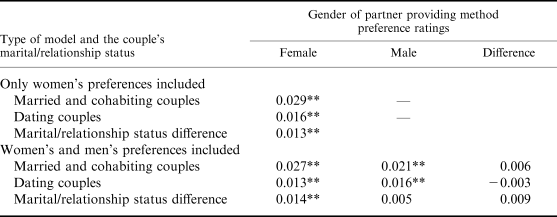
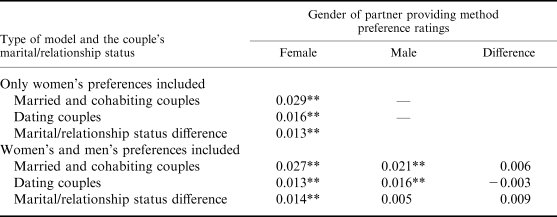
The results in Table 1 present the conditional logit coefficients (log odds) showing how men's and women's preference ratings of contraceptive methods are related to the likelihood that the couple is using that method. These coefficients estimate the extent to which ratings of methods affect the method chosen, controlling for other factors in the model (the personal and relationship characteristics described earlier).
Coefficients from conditional logit models showing relationship between female and male method preference ratings and the couple's method choice, by type of model and the couple's marital/relationship status
* Significant at p≤0.10;
** significant at p≤0.05.
The first model includes only the preference ratings of the female partners, excluding those of the male partners (top panel of Table 1). Separate estimates (via interaction terms) were obtained for married/cohabiting couples and dating couples. The test comparing the two indicates that women's ratings are significantly less important for the method choice decisions of women in dating relationships than for married and cohabiting women. Among married and cohabiting women, each unit increase in their method rating increases the log odds of using that method by 0.029. As a better example of the magnitude of this relationship, a woman with a rating that is ten points above the average rating for the method exhibits about a 12% increase in the likelihood of using it rather than an ‘other method’. In contrast, the figure for women in dating relationships is only 0.016, corresponding to about an 8% increase for a ten-point increase above the average rating for that method.
In the next step of the model estimation process, male method preference ratings are introduced into the model (lower panel of Table 1). These results show that men's ratings have a significant and independent association with the method choice of the couple and that the coefficients for women's preference ratings are not meaningfully altered by the introduction of the men's ratings. Moreover, the results indicate that the influence of men's ratings is not significantly lower than that of women's ratings. The results continue to show that the preference ratings of dating women have significantly less influence on method choice than married women's ratings, but that the influence of men's ratings is not significantly related to relationship status.
Differences by method type
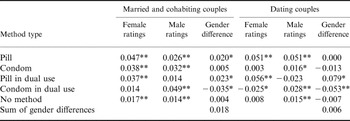
In this section, results from the multinomial logit model are presented. This model examines the effects of the ratings of a specific method on the likelihood of selecting that method, by allowing the effect of ratings to vary for different methods (allowing, for example, the association between ratings of the pill and use of the pill to differ from the association between the ratings of the condom and use of the condom). Because of the importance of men's ratings, and because of the significant marital status difference in the effects of women's ratings, shown in Table 1, in the remainder of the analyses both men's and women's method preference ratings are included and separate models are estimated for married/cohabiting and dating couples. Results from the multinomial logit model are shown in Table 2.
Coefficients from multinomial logit models showing relationship between female and male method preference ratings and the couple's method choice, by couple's marital/relationship status

* Significant at p≤0.10;
** significant at p≤0.05.
Among married and cohabiting couples, the results in Table 2 indicate that both men's and women's ratings matter for nearly all methods. The exceptions are women's ratings of the condom for dual-method use and men's rating of the pill for dual methods, although the effects are in the expected direction. Among married and cohabiting couples, significant gender differences are found for three method types (p=0.10). Women's pill ratings are more strongly related to the use of that method than men's pill ratings (0.047 compared with 0.026). Consistent with the results described above, women's pill ratings are also more important for dual-method use than men's pill ratings, and men's condom ratings are more important for dual-method use than women's condom ratings. However, the sum of the method-specific gender differences indicates no significant gender difference overall, a result that is consistent with the findings shown in Table 1. Thus, while there are gender differences in the influence of women's and men's ratings, overall these differences cancel out because women's ratings dominate for some methods and men's ratings dominate for other methods.
Among dating couples, the results are less consistent. A woman's rating of the pill is significantly positively related to the use of that method by itself, and also positively related to use of dual methods. However, a woman's rating of the condom is surprisingly negatively related (p=0.10) to use of dual methods. The man's ratings of the pill and ‘no method’ are significantly related to use of those methods, and his rating of the condom is significantly related to use of that method alone and, more importantly, as part of dual methods. Gender differences in the relationship between ratings of a method and use of the method tend to be smaller than were found for married and cohabiting couples. The exceptions are for dual methods. As was found for married and cohabiting couples, women's pill ratings are more important for dual-method use than men's pill ratings (p=0.10), and men's condom ratings are more important for dual-method use than women's condom ratings. Note that the gender differences related to dual use are significantly larger for dating couples than for married and cohabiting couples. Overall, however, the sum of the gender differences is small and non-significant, indicating no decision-making dominance by either sex for dating couples.
Method choice and sources of relationship power
In the next step of the analysis, measures of power are introduced (via interaction terms with ratings) to examine the extent to which the influence of a person's ratings varies by their power in the relationship. Two measures of structural power (income and education), two measures of power based on the nature of their relationship (relationship alternatives and relationship commitment), and gender role ideology that may define decision-making domains within the relationship are examined. Because of high multicollinearity among the different sets of interactions with method ratings, the influence of each measure of power is separately examined.
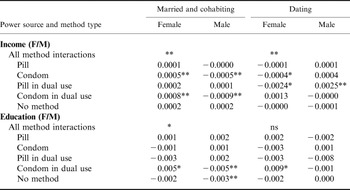
The top panel of Table 3 presents results for relative income and the lower panel results for relative education. Note that the significance level shown for ‘all method interactions’ indicates the statistical significance of change in model fit for the interactions considered as a set. The results suggest that for married and cohabiting couples, the influence of the woman's condom ratings increases for condom and dual-method use as her relative income rises and the influence of her partner's ratings declines. Also, the addition of the relative income interactions significantly improves the fit of the model.
Interaction coefficients from conditional and multinomial logit models showing the impact of structural measures of power on the relationship between female and male method preference ratings and the couple's method choice, by source of power and couple's marital/relationship status

ns, not statistically significant as a set;
* significant at p≤0.10;
** significant at p≤0.05.
In contrast to what was found for married and cohabiting couples, the results indicate that among individuals in dating relationships, the influence of their method ratings tends to decline as relative income increases. This relationship is found for women's ratings of the condom and both partners' ratings of the pill in dual-method use. For example, the negative coefficient for income and pill in dual-method use indicates that the greater women's income is relative to men's (i.e. larger F/M ratio), the smaller is her influence. Similarly, when men's income is greater than their female partners (i.e. smaller F/M ratio), the smaller is men's influence. These are relationships that are inconsistent with what would be expected on the basis of the hypothesized impact of relationship power.
The results in the bottom panel of Table 3 suggest that relative education alters the effects of ratings only for married and cohabiting couples (p=0.10). As the woman's education increases relative to her partner, the influence of her rating of the condom on the couple's dual-method use increases and the influence of his condom rating on that method type declines, and the influence of the man's rating of ‘no method’ also has a reduced influence.
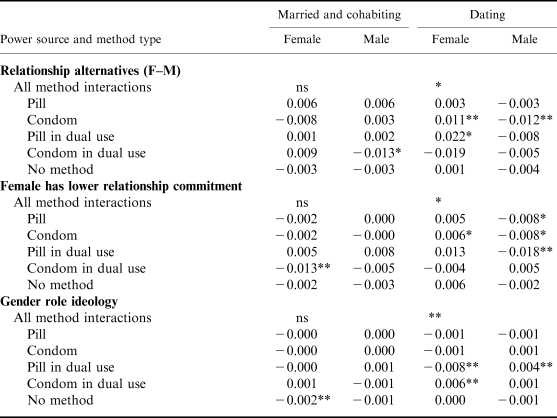
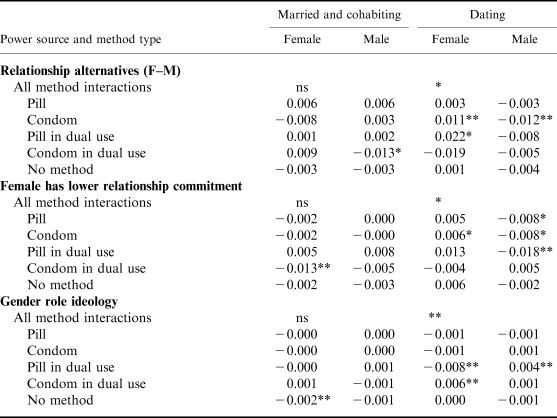
The results in Table 4 show that the effects of ratings do not vary significantly by relative relationship alternatives, relative relationship commitment or gender role ideology for married and cohabiting couples. In contrast, all of these factors are significantly associated with the influence of dating men's and women's ratings on method use. Overall, when dating men have lower relationship alternatives than their female partners, and thus less power in the relationship, they have less influence on method use. This influence is particularly large for the relationship between their ratings of the condom and the use of that method by itself. The female's rating of the pill also has more influence on dual use when she has more relationship alternatives than her male partner.
Interaction coefficients from conditional and multinomial logit models showing the impact of relationship-based measures of power and gender role ideology on the relationship between female and male method preference ratings and the couple's method choice, by source of power and couple's marital/relationship status
ns, not statistically significant as a set;
* significant at p≤0.10;
** significant at p≤0.05.
The middle panel of Table 4 shows that dating women's ratings have more influence, and men's ratings less influence, when the man is more committed than the woman. For men, the effects occur for ratings of the pill when used alone or as part of dual use, and for ratings of condom for condom use. For women, the effect is primarily through her condom ratings for use of that method by itself.
The results in the bottom panel of Table 4 show that gender role ideology significantly alters the effects of method ratings. They suggest that dating women's ratings of the pill have less influence on dual use, and their ratings of the condom have more influence on dual use, if they have more traditional beliefs. For dating men, in contrast, a more traditional ideology is associated with a stronger relationship between their ratings of the pill and dual-method use.
Discussion
The results presented here strongly support the argument that men's method preference ratings matter. Men's ratings have a significant effect on the method of contraception a couple uses, and their influence is equal to that of their female partners. Moreover, adding men's ratings to the model has little impact on the estimated effect of women's ratings, indicating that their effects are independent.
There are, however, gender differences in the influence of ratings for specific method types. Regardless of relationship type, in the use of dual methods women's ratings of the pill are more influential than their partners' rating of that method, and men's rating of the condom are more influential than women's ratings. Further, among married and cohabiting couples, women's ratings of the pill are more influential than men's for using that method alone. Thus, for married and cohabiting couples, pill use, whether alone or in combination with the condom, is more strongly influenced by women's ratings of that method.
The results also show that power in the relationship is important in that individuals with more power evidence greater influence in the method selection process. However, the sources of power that are relevant vary by relationship status. For married and cohabiting couples, the structural dimensions of power are important. Both higher relative education and higher relative income are associated with an increase in the influence of one's method ratings. However, relationship-based power sources (relationship alternatives and relationship commitment) have little impact on the influence of the ratings of those in marital and cohabiting relationships.
In contrast, structural power has either little (education) or conceptually inconsistent (income) effects on the influence of one's ratings for dating couples. When the female partner has greater relative income than her partner, her pill preference rating actually appears to have less influence over a couple's choice of dual methods while her partner's rating has more influence over that choice. Further, there is some evidence that the condom ratings of higher income women also have less influence over the use of that method type. These findings may be an example of what West & Zimmerman (Reference West and Zimmerman1987) refer to as ‘doing gender’. That is, women's behaviour of this type is understood as compensatory for their having a non-normative level of power. This explanation is consistent with those of Brines (Reference Brines1994) who finds that when women earn more than their male partners they sometimes effectively grant their partners some of that differential power in order to fulfil traditional gender normative roles.
The conceptual model, together with a review of the literature, suggests that traditional beliefs about sex roles within marriage may be associated with a division of decision-making power into male and female ‘spheres of influence’, with contraception falling within the female's decision-making domain. However, the results of this analysis do not provide support for this expectation. Gender ideology does not affect the influence of method ratings for married and cohabiting couples, and it has inconsistent effects among dating couples.
In considering these relationship status differences it is interesting that not only do women in dating relationships appear to have less power over a couple's method choice than married and cohabiting women, but their level of power relative to their male partners is more dependent on the nature of their relationship. Having relatively low commitment to the relationship or having more alternatives than their partners tends to increase their own decision-making power while at the same time reducing that of their male partners.
Method differences in how power affects the relationship between preference ratings and method choice are also important to consider. The measures of power employed here suggest that power affects method choice primarily through the influence of ratings of the condom. For married and cohabiting couples, about 75% of the statistically significant effects alter the influence of condom ratings on the use of the condom alone or as part of dual methods, while the figure for dating couples is about 45%. Also important is the fact that the power measures are more salient for the influence of ratings of the pill for dating couples than they are for married and cohabiting couples, while the reverse is true for ratings of using no method of contraception. These differences may be due to the fact that couples in less committed relationships tend to face higher costs to an unintended pregnancy.
Finally, it is important to consider the possibility that the results of the analysis are influenced by the fact that only the female partner's reports of the method the couple used are used in the analysis. Since partner discrepancies in reports of method use are sometimes observed, it is also possible that these separate reports are differently related to the method preference ratings of each partner. Consequently, an analysis was conducted (not shown) that used men's reports of method use instead of women's reports. In this investigation, it was found that the estimated effects of preference ratings on method use are robust regardless of whether male or female method use reports are used. Small differences are found for some specific method types (mainly dual methods) but the overall conclusions remain unchanged.
Acknowledgments
The research reported in this paper was supported by grants No. 1 R01 HD044708 and 1 R01 HD042432 from the US National Institute of Child Health and Human Development (NICHD). The authors wish to thank Professor Shelly Lundberg for her many helpful comments and suggestions.
Appendix
Contraceptive method choice involves selecting among a set of methods, including the use of no method of contraception. The choices are unordered, and researchers typically use a multinomial logit procedure for unordered outcomes, which takes the form:

where Pij is the probability that person i will select outcome (contraceptive method) j from a set of M choices, Xi are characteristics of person i, and βj are M−1 parameters to be estimated that vary with the choice options. Following Maddala (Reference Maddala1983), imposing normalization like αM=0, the multinomial logit model in Eqn (1) can be rewritten as:

However, the data also have other information about the method choices with each respondent's overall preference ratings of the methods available. McFadden (Reference McFadden and Zarembka1974) developed a conditional logit model that employs information about the choices which takes the form:

where Rij are person i's evaluation of outcome j (ratings of each method of contraception), and the β values are parameters to be estimated, with one parameter for each characteristic of the outcomes (one parameter indicating the effect of method rating on method selection). The models in Eqns (2) and (3) can be combined to form:

This more general model is also usually referred to as a conditional logit model. The estimates of the effects of method ratings (β) indicate the extent to which ratings influence method choice relative to the other factors in the model. As noted above in the Analytic Approach section in the Methods, Eqn (4) is modified to permit the inclusion of an outcome (‘other methods’) for which no ratings are defined.
Algebraically the conditional logit and multinomial logit models are equivalent in that either can be derived from the other (see Maddala, Reference Maddala1983, p. 42). The conditional logit model can be derived from the multinomial model by constraining certain parameters to be equal across outcomes. For example, if βj values in Eqn (2) for the multinomial logit are constrained to be equal (βj becomes β) then Eqn (2) becomes the conditional logit in Eqn (4). Similarly, if β values in Eqn (4) for the conditional logit model are allowed to vary across outcomes, (i.e. β becomes βj) the model in Eqn (4) becomes a multinomial logit model shown in Eqn (2). Consequently, a conditional logit model can be derived that can include ‘other methods’ even though ratings information is not available from the multinomial model by treating ‘other methods’ as the omitted category and constraining for the effects of ratings to be equal across all methods for which ratings are available. This model is identical to Eqn (4) except that β for ‘other methods’ is constrained to equal zero (an additional normalizing constraint). In addition, respondents were only asked to rate methods that they said they knew. To capture this in the model, a dummy variable was added that indicates whether a respondent is aware of each of the methods examined and is used as a spline function. Women who reported using a method obviously know about the method. To capture this aspect of the data the parameter values were set to a large negative number, to produce predicted probabilities near zero, so as to obtain estimates of the other parameters. Results were robust to the use of a variety of large negative numbers.
Models were also estimated that relax the constraint that the effects of ratings of methods are equal across all methods, allowing the parameters for ratings to vary across methods (i.e. the ratings of condom may have a greater or lesser impact on selecting condom than the ratings of pill have on selecting the pill). In keeping with the general approach of the conditional logit model, the cross-method effects are constrained to be zero (e.g. ratings of pill do not directly appear in the condom equation). This model can be written as:

where β is a diagonal matrix with non-zero elements that are interpreted as the effect of the rating of method j on the likelihood of selecting method j. In the Results section this model is referred to as the multinomial model.