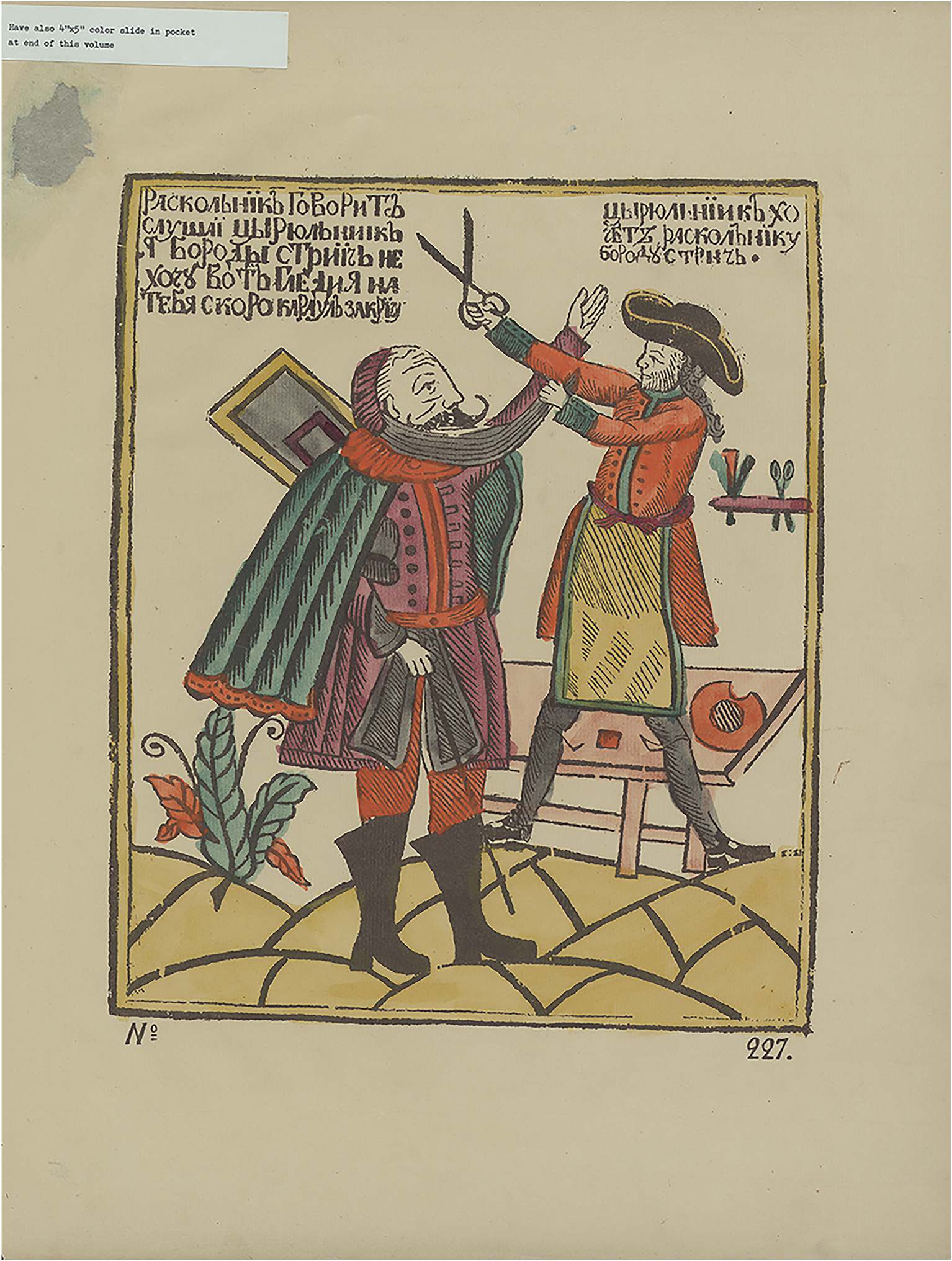
The anonymous eighteenth-century popular engraving (lubok) commonly known as “The Barber Wants to Cut the Beard of the Old Believer” is arguably one of the most famous images in Russian visual culture. (Figure 1). Since its creation, this single-sheet woodblock print has been reproduced countless times and has inspired numerous graphic artists, including most recently the illustrator of a glossy propaganda piece in the state-run news media outlet Russia Beyond.Footnote 1 And although this xylograph has previously been the object of art historical inquiry, neither the reasons for its popularity nor its comic potential have ever been fully explored by scholars of early modern Russian cultural history.Footnote 2 One of the main causes for this historiographical lacuna is the conviction that the meaning of this lubok is both self-evident and straightforward. For most viewers, it serves as a contemporary depiction of Peter I’s plan to westernize Russia, and of the popular protest that this imperious act of “progress through coercion” evoked among his disgruntled and long-suffering subjects.Footnote 3 In general, “[t]he image has come to be associated … with Peter’s attack on tradition and his attempt to give ‘barbaric’ Russia a new, civilized face.”Footnote 4 This interpretation, in turn, is indebted to the work of two giants of nineteenth-century Russian cultural history: Dmitrii Rovinskii (1824–1895), the jurist, collector, and amateur art historian who first proposed the Petrine-centric reading to which I have just alluded; and Vladimir Stasov (1824–1906), the influential cultural critic whose body of work contributed to the creation of a Russian national canon and enshrined the old-timey “popular pictures” analyzed by Rovinskii in the same pantheon as the music of the “Mighty Handful” and the art of the “Wanderers.”Footnote 5
Colorized nineteenth-century reproduction of an untitled print from a woodblock dating to the first half of the eighteenth century. Rovinskii, RNK: Atlas, I: 2 (no. 227). Rare Book Division, The New York Public Library. “Raskol’nik i tsiriul’nik” New York Public Library Digital Collections. URL: https://digitalcollections.nypl.org/items/510d47de-0b95-a3d9-e040-e00a18064a99.

Figure 1 Long description
The image depicts an eighteenth-century print featuring two men. On the left, a man with a long beard stands, wearing a cloak and boots. On the right, a barber, dressed in a hat and apron, holds scissors and reaches towards the man's beard. The scene is set on a tiled floor with a table and tools in the background. Above them, there is text in a decorative frame, adding context to the interaction. The print is numbered at the bottom corners.
The present article constitutes the first study specifically devoted to a sustained analysis of the historical context and the comical themes that informed the creation and circulation of the woodblock engraving that will hereafter be referred to as The Barber-Surgeon and The Schismatic. It argues that this well-known popular print is less a quaint, folksy illustration of Peter’s “cultural revolution” than a manifestation of the tastes of eighteenth-century Russian Orthodox city-dwellers, a social group that was the primary audience for this cheap, mass-produced, consumer product, and the one that would have found it both amusing and entertaining.Footnote 6 The first part of this article will critically review the arguments adduced by Rovinskii and Stasov about the Petrine origins of The Barber-Surgeon and The Schismatic and propose a somewhat later dating for its creation.Footnote 7 The second and third parts will provide literary and visual evidence for this alternative dating, as well as a new reading of the lubok itself. In the process, these sections will explore what about this popular print would have resonated with eighteenth-century Russian audiences and why contemporaries might have found it funny.
A Petrine Print?
In his pioneering, award-winning, multi-volume study of Russian popular prints, Rovinskii not only published a colorized reproduction of the eighteenth-century woodblock engraving under discussion, but also offered an argument for its dating and historical significance.Footnote 8 Rovinskii acknowledged that the original, black-and-white, inked version of this lubok came from the extensive collection of the Catherinian courtier Аdam Vasilʹevich Olsufʹev (1721–1784) and dated from mid-century.Footnote 9 Nevertheless, on the basis of external evidence (primarily government legislation), he argued that this popular print was “presumably composed by order of Peter I with the aim of ridiculing the stubbornness of the schismatics” (veroiatno sdelana po ukazu Petra I dlia osmeianiia raskolʹnichʹiago uporstva), the group of Russian Orthodox sectarians who called themselves Old Believers, but whom the imperial authorities labeled by a traditional religious slur for rebels against the Russian Orthodox Church.Footnote 10 According to Rovinskii, this single-sheet engraving was actually “the first” in a small series of popular prints commissioned by the government for the propagation of its views among the subjects of the Russian Empire.Footnote 11 He attributed the “smallness” of this series to the fact that Russia’s rulers generally did not care about the opinion of their subjects and that the bureaucrats responsible for administering the empire rarely bothered to prepare people’s minds for the introduction of new initiatives—an explanation that appears to be based more on his own experience as a liberal-minded official from the long-bygone era of the “Great Reforms” than on actual art historical analysis. For Rovinskii, the fact that this “edifying” (nazidatelʹnyi) engraving issued from the government, rather than the people, explained why it “never caught on and was never reprinted” (v khod ne poshla i povtorenii ne imela).Footnote 12
In his 1882 review of Rovinskii’s magnum opus, Stasov accepted the author’s basic premise, namely, that this lubok was a government-sponsored work of art, commissioned by none other than Peter I himself.Footnote 13 He agreed with Rovinskii’s dating, and even echoed Rovinskii’s confusion about the supposedly “European” clothing worn by the Schismatic, a character who (the critic claimed) would be difficult to identify if the accompanying inscription did not specifically mention his religious affiliation.Footnote 14 At the same time, Stasov posed a series of pointed questions that disputed Rovinskii’s explanation of the ostensible reasons for the print’s creation. If the aim of Peter and his government was to satirize Old Believers, Stasov asked, then why did the aggrieved Schismatic call on local law enforcement officials to come to his aid? Why would the imperial Russian government bother to commission a propaganda piece that had such an ambiguous message? And what was so funny about state-sponsored religious persecution anyway? Stasov briefly suggested an alternative interpretation, one based on the putative existence of an eighteenth-century popular anecdote unfamiliar to him and his nineteenth-century contemporaries.Footnote 15 However, he never identified any specific sources of this engraving and failed to articulate a clear counter argument to that advanced by Rovinskii. In so doing, Stasov missed an opportunity to engage with the work of scholars of early modern Ukrainian and Russian theater who were, at that very moment, unearthing and publishing precisely the kind of comic literary texts that, as I shall argue, are crucial for understanding the social milieu and the cultural context in which The Barber-Surgeon and The Schismatic was created.Footnote 16
Stasov’s skepticism about Rovinskii’s interpretation has been echoed by modern scholars, who have expanded on the nineteenth-century cultural critic’s analysis of the internal (stylistic and orthographic) evidence presented by the lubok. For example, in seeking to bolster’s Rovinskii’s claim about the Petrine origins of this print, Stasov had pointed out that the inscription was written using the “civil” type “invented” by Peter I in 1708, as opposed to the “old, Russian Slavonic script traditionally used by makers of lubki that issued from the common people.”Footnote 17 However, recent studies on literacy and the development of the Russian literary language have convincingly demonstrated that the new civil orthography did not enter common usage until the 1740s, more than thirty years after its introduction.Footnote 18 Furthermore, this typeface was rarely used by craftsmen who produced “written texts intended for entertainment,” such as “traditional novels and chapbooks, so-called lubok,” the literary counterparts to the inexpensive, popular, woodblock prints that also went by the same generic brand name. The business-savvy entrepreneurs who ran these commercial printing establishments continued to use a “more traditional graphic style and orthography” because they knew the “reading habits” of their “intended audience,” which was composed of “ordinary people” who were still “unfamiliar with text printed in the civil typeface.”Footnote 19 From this perspective, the fact that the engraver of The Barber-Surgeon and The Schismatic used the new civil orthography serves as an argument against the print’s supposed Petrine origins, rather than for it.
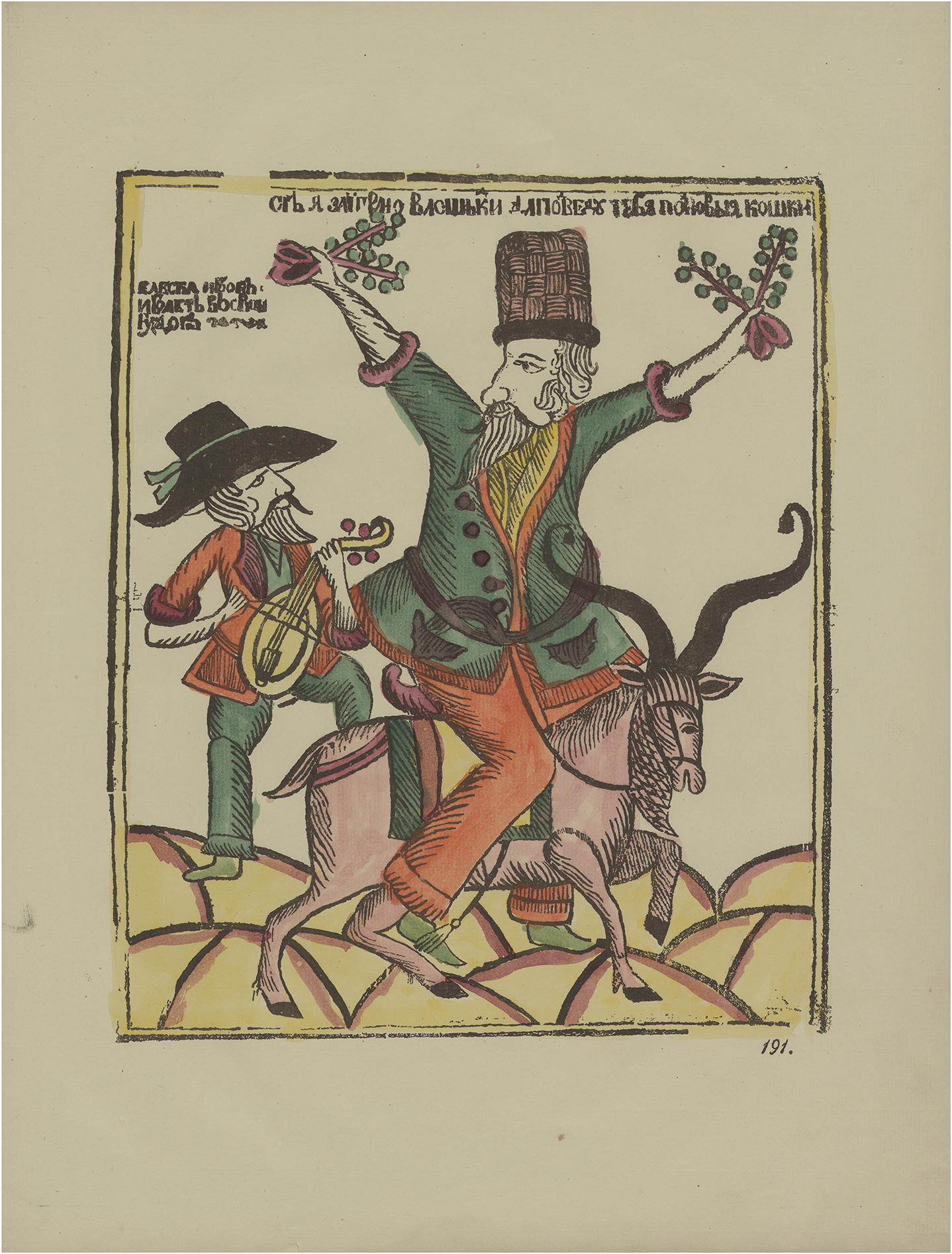
Similarly, art historians who tackled the thorny questions surrounding the dating and authorship of The Barber-Surgeon and The Schismatic have noted that this woodblock print bears the very same stylistic traits, and was probably created by the very same artist who depicted the obscenity-laced verbal exchange between two outlandishly dressed travelling minstrels, Savosʹka and Paramoshka, one of whom rides a goat, in the fashion of an earlier and more explicitly scatological woodblock print showing The Peasant Pashka and His Brother Ermoshka.Footnote 20 (Figure 2). This attribution begs the same questions raised by Stasov: why would Peter’s government commission a propaganda print against Old Believers from an engraver who worked in such a lowly popular style? And what possible message would such crude imagery convey to its contemporary audience? If, however, this print “should … be returned to the milieu of popular humor,” as Dianne Farrell has suggested, then an answer to these questions must explore, as I do below, the way Old Believers were represented in eighteenth-century Russian literary and visual culture, and why contemporary audiences would have found religious dissenters to be both comical and carnivalesque.Footnote 21
Perhaps the strongest argument against the Petrine-centric interpretation of The Barber-Surgeon and The Schismatic, however, comes from the fact that one of the chief legislative acts that Rovinskii cited to support his case contains evidence proving that the woodblock design could not have been created before 1722.Footnote 22 That was the year when the Senate issued a decree “On the collection of an extraordinary tax on bearded-men and on their [obligation to wear a] distinctive form of dress.”Footnote 23 This legislative document not only repeated the 1705 royal edict requiring bearded laymen to pay a tax on their facial hair but also mandated the “special” (osoboe), “old-fashioned” (staroe) type of clothing that they were to wear whenever they appeared in public. The officially-prescribed outfit consisted of three items of traditional Muscovite clothing: a collarless, open-front, semi-fitted caftan with long, tapering sleeves (zipun), which in this case was to be worn with a “glued standing collar” (stoiachim kleenym kozyrem); a long-sleeved, ankle-length, open-front, collarless coat (feriazʹ), which was fastened on the chest with loops or ties and usually worn without a belt; and, finally, a wide, ankle-length, collarless outer garment, fastened end-to-end, and often belted, with long sleeves containing slits for the arms (odnoriadka), which was to be worn with a “recumbent necklet” (s lezhachim ozherelʹem).Footnote 24 Crucially, for our purposes, the 1722 decree specified that unlike other beard-wearers, male “schismatics” (raskolʹshchiki) had to wear a “standing collar” made of “red cloth” (kozyri krasnogo sukna) as a humiliating sign of their inferior legal status: a telling detail that was added to the Senate’s decree on the initiative of Archimandrite Antonii (Ierofeich, 1674–1726) of Moscow’s Chrysostom (Zlatoustovskii) Monastery, one of the most prominent and vocal “experts” on the schism, who had lobbied for the adoption of some external sign, “so that the Orthodox would abhor [schismatics] like some abomination.”Footnote 25
Colorized nineteenth-century reproduction of an untitled print from a woodblock dating to the first half of the eighteenth century. Rovinskii, RNK: Atlas, I: 2 (no. 191). Rare Book Division, The New York Public Library. “Savos’ka i Paramoshka.” New York Public Library Digital Collections. Accessed May 10, 2025. digitalcollections.nypl.org/items/510d47de-0b75-a3d9-e040-e00a18064a99.

Figure 2 Long description
The illustration depicts two men in a stylized manner. One man is riding a goat, holding branches in both hands and wearing a tall hat and a long coat. The other man, standing beside him, is playing a stringed instrument and wearing a wide-brimmed hat and a coat. The background features a patterned design and there is text above the figures in a decorative frame.
In typical Petrine fashion, failure to comply with this decree resulted in a hefty fine, which, from 1724, was to be collected by a newly-instituted government agency known as the Schismatics’ Bureau (Raskolʹnicheskaia kontora).Footnote 26 However, the fact that Peter’s successors continually reiterated his peremptory demand for sartorial uniformity suggests that there was widespread passive disobedience and downright popular resistance to the implementation of the policy introduced by Russia’s first emperor. By the 1730s–40s, both the governors and the governed dropped all pretense that this sumptuary law was aimed at bearded laymen in general and, as a result, the state-mandated dress code came to be associated exclusively with the civil liabilities and public shaming practices incurred by “schismatics.”Footnote 27 Finally, in the early 1760s, this piece of discriminatory Petrine legislation was abandoned altogether (along with the Schismatics’ Bureau and the official use of the religious slur itself) by the self-avowedly more “enlightened” government of Empress Catherine II.Footnote 28 In other words, even a brief excursus into sartorial history not only demonstrates the speciousness of Rovinskii’s assertion about the strange “European” costume worn by the Schismatic, but also clarifies the chronological boundaries when the print could have been created.
In sum, although it is theoretically possible that the woodblock engraving of The Barber-Surgeon and The Schismatic was produced in the three-year period between the promulgation of Peter’s decree on state-mandated dress (1722) and his own demise (1725), it is more likely to have been created in the fifty-year period between the 1720s (the terminus ante quem) and the 1770s (the terminus ad quem), when it was acquired by Olsufʹev and added to his personal collection of Russian popular prints. If this hypothesis is correct, then such a re-dating seriously undermines Rovinskii’s argument about the Petrine origins of The Barber-Surgeon and The Schismatic, shifting the date of production to the reigns of the monarchs who succeeded Peter I on the Imperial Russian throne. And, in so doing, it leaves open the possibility that this single-sheet engraving was created for reasons other than that emperor’s personal animus against beard-wearing Old Believers. To discover what those other reasons might be requires paying attention to the literary and visual sources that informed the activity of both the producers and consumers of this xylograph. Unfortunately, since we do not know the identities of either party in this commercial transaction, we must rely on a historical reconstruction of the cultural context in which this artifact circulated.
The Barber of Moscow and His Clients
If we take a closer look at the possible original sources of The Barber-Surgeon and The Schismatic, we will see that its humor is less akin to a piece of official government propaganda than to a product of popular cultural entertainment, such as the “Rabbit of Seville” (Warner Bros., 1950), an animated theatrical feature in which Bugs Bunny (the “wacky, waskally wabbit”) dons the clothing of a barber and proceeds to shave the head of Elmer Fudd (his lisping, slow-witted nemesis) to the tune of Figaro’s aria from Gioachino Rossini’s The Barber of Seville (1816).Footnote 29 This similarity is not a coincidence, for all three cultural productions—the eighteenth-century Russian lubok, the nineteenth-century Italian opera buffa, and the twentieth-century American “Looney Tunes” cartoon—are informed by the tropes of commedia dell’arte, a theatrical form that flourished throughout Europe from the sixteenth through the eighteenth centuries. In the case of the Russian print, the proximate source for these familiar, pan-European tropes was the repertoire of so-called “interludes” (Lat. interludium, inter- ‘between’ + ludus ‘play’) or “intermedia” (Lat. intermedium ‘interval’), that is, humorous skits that were inserted between the acts of early modern theatrical productions and enacted on the stages of Orthodox seminaries, market fairs, and carnival campgrounds throughout the Russian empire and, especially, in its religiously and ethnically diverse borderlands with the Polish-Lithuanian Commonwealth and the Ukrainian Cossack Hetmanate.Footnote 30
Like their Ukrainian and Ruthenian counterparts, eighteenth-century Russian interludes featured staged conflicts between stock characters, often dressed in the guise of various ethnic and religious minorities. Among the latter were not only Poles, Gypsies, and Jews, but also Schismatics.Footnote 31 Judging by the surviving evidence, the earliest of which dates from the 1730s and 40s, the amateur actors who played the part of Schismatics appeared in costumes deliberately meant to reflect an outmoded, Muscovite style of dress, “grey beards” and all.Footnote 32 The Schismatics’ long beard was an especially important part of an actor’s wardrobe, serving less as a stage prop for the realistic representation of individual characters than as a familiar marker of otherness and a potential site of physical violence.Footnote 33 It was, in other words, a key element in the theatrical representation of the invidious comparison between the followers of “Old Belief” and those of the “Old Testament”—an analogy introduced into Russian Orthodox polemical literature at the beginning of the eighteenth-century by formally trained Ukrainian and Ruthenian clerics familiar with west European antisemitic tropes and legends.Footnote 34
As can be seen from the opening remarks of the titular character in the skit about “The Schismatic and his Fruits,” while on stage these ersatz Old Believers typically delivered a comical monologue bemoaning their fate in a religiously inflected language peppered with obsolete Church Slavonicisms.Footnote 35

Significantly, these complaints were directed not only against the “damned Nikonians,” who “trampled” on the “old faith” and pursued its followers into the deepest, darkest corners of the Russian empire—such as the “Brynsk forest” (v Brynskom lesu), the site of a famous Old Believer settlement, located along the banks on the shores of the Brynʹ River, “which even for a demon is impossible to locate” (nevozmoshno naiti bylo … idezhe i besu)—but also against contemporary urban mores and fashions.Footnote 36

However, even while railing against these new-fangled obstacles to true piety, the Schismatics who appeared in such skits seemed to thrive in the modern world, and came often into the city on various matters of business:Footnote 37

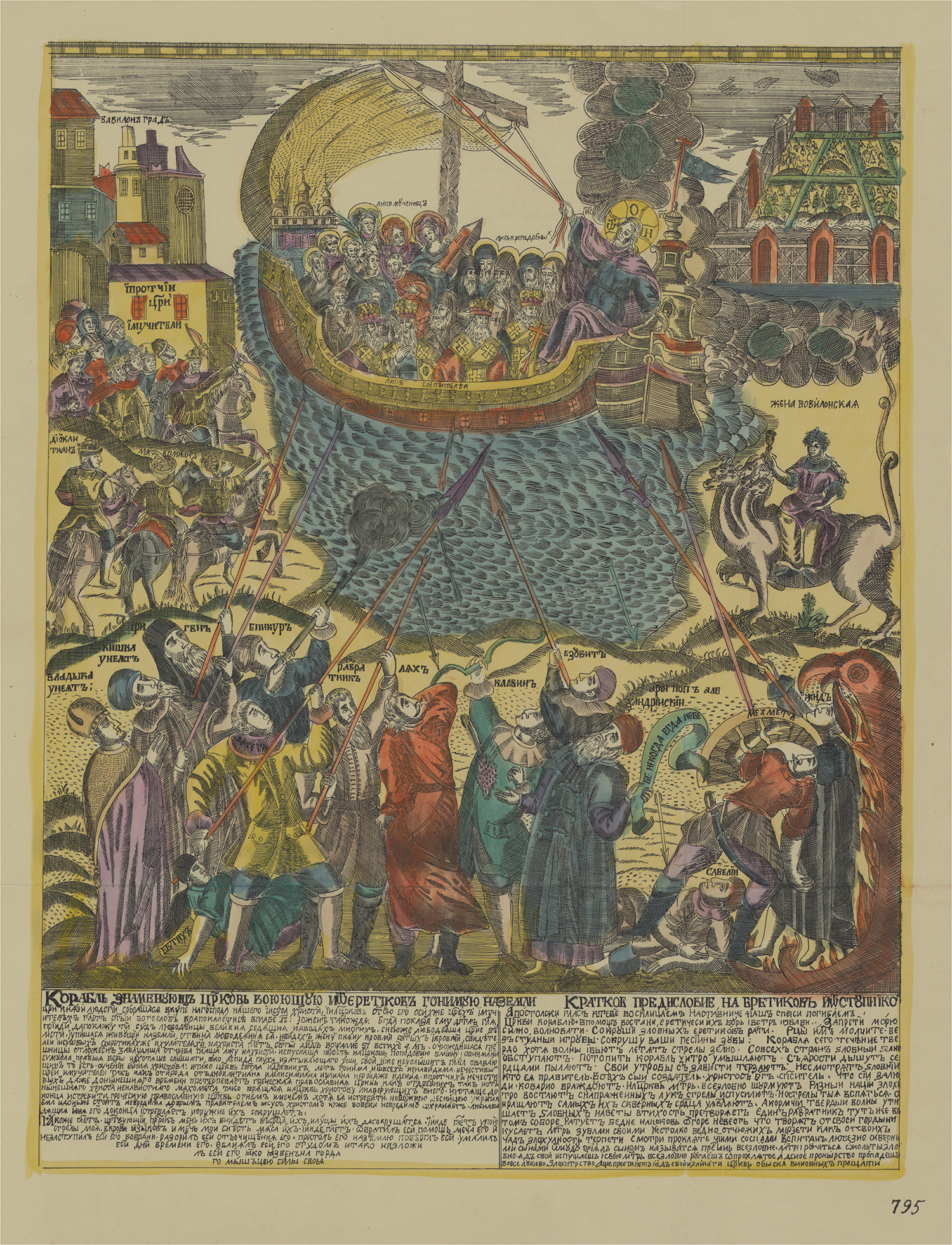
As the last lines of this monologue suggest, the Schismatics’ sanctimonious self-presentation clashed humorously with their secular (usually mercantile) profession, thereby transforming them into the very embodiment of the polemical equation between religious rebellion (raskol) and moral decay (razvrat): much like the bearded, traditionally-dressed, home-grown Russian Sectarian (razvratnik, in the now-obsolete sense of “destroyer, subverter,” “instigator of unrest, rebel,” rather than simply someone who is “ruined, vicious, and perverse”) who appears in a contemporary engraving among the foreign “apostates” and “heretics” besieging the “Ship of the Church Мilitant.”Footnote 38 (Figure 3).
Colorized nineteenth-century reproduction of an untitled copperplate etching from the first half of the eighteenth century. Rovinskii, RNK: Atlas, 3 (no. 795). Rare Book Division, The New York Public Library. “Korabl’, znamenuiushchii tserkov’ voiuiushchuiu i ot eretikov gonimuiu na zemle.” New York Public Library Digital Collections. Accessed September 21, 2025. digitalcollections.nypl.org/items/fcb6c360-c5fd-012f-a523-58d385a7bc34.

Figure 3 Long description
The etching shows a large ship filled with numerous people, some holding religious symbols. The ship is surrounded by various figures, including men and women, some on horseback and others holding weapons or banners. Several animals, including a dragon-like creature, are present. In the background, there are buildings and a church-like structure. The scene is lively, with people engaged in various activities. At the bottom, there is a block of text in a decorative font, providing context or description related to the image. The etching is detailed, capturing a historical or allegorical scene with intricate designs and characters.
Such individual monologues were usually followed by other, multi-actor skits, including ones in which Schismatics became the recipients of verbal and physical abuse at the hands of “properly” (meaning, Russian-) speaking characters, like the locally elected law-enforcement officials whom the rulers of the geographically extensive and perennially under-governed empire routinely tasked with policing the streets of its own urban centers.Footnote 39 More often than not, this cast of additional characters also included a comical trickster figure, the Russian version of the clownish and crafty manservants from the commedia dell’arte tradition. As is the case with Bugs Bunny and Figaro, during the course of a single theatrical presentation, such trickster figures could assume different roles and occupations, including those of barbers. In this guise, they usually appeared as the servants or assistants of the Doctor, another stock character of commedia dell’arte, who was typically depicted as a foreign-born charlatan or quack, more interested in his patients’ money than in their health.Footnote 40 This pairing is not as incongruous as it sounds: in early modern Europe, a barber, or more properly, barber-surgeon, was not just a hairdresser. He was also a low-level medical practitioner, who assisted formally trained, diploma-bearing physicians with minor surgical procedures (lancing boils, administering clyster-enemas, pulling teeth); operations that were performed using his very own hands, as is suggested by the etymology of tsiriulʹnik, a Russianized Polish loanword (< Pol. cyrulik) of the Latinized Greek term for “surgeon” (< Lat. chirurgus < Gk. cheirourgos, cheir ‘hand’ + ergon ‘work’).Footnote 41
Whether because of their direct, hands-on approach, or their interstitial position in the doctor-patient relationship, the barber-surgeons who populated the early modern Russian stage sought to trick and ridicule both the gullible client and the greedy foreign doctor who overcharged him. For example, in one interlude from the 1730s, the Jester (shut), acting in the capacity of the foreign doctor’s “translator” (tolmach), attempts to administer a clyster to cure a patient’s cough and sore throat.Footnote 42 In another, the Russian Harlequin (arlekin) disguises himself as a doctor and uses a fireplace hand-bellows (mekh) to cure his patient’s shortness of breath (udushʹe).Footnote 43 In both cases, the literal butt of the trickster’s jokes is a grumpy old man representing the commedia dell’arte stock character Pantaloon, a cunning, avaricious, yet frequently deceived merchant.Footnote 44 Not surprisingly, in yet another interlude from the period, the very same stock character becomes a victim of the scissors-wielding Harlequin disguised as a “fashionable barber” (barbier po mode):Footnote 45

The text does not specify the nature of the stage tricks played by Harlequin on Pantaloon, but they were undoubtedly ones associated with the commedia dell’arte figures of the mischievous servant/barber and his hapless master/client. Although I have not been able to find a specific, eighteenth-century Russian interlude containing a humorous exchange between a Barber-Surgeon and a Schismatic, there is no reason why the creator of the lubok could not have tapped into the lore associated with these two stock characters when he came up with the idea for his design. In fact, depicting both popular theatrical characters—the Pantaloon-like Schismatic and the Harlequin-like Barber-Surgeon—in a single image may have been one of the very things that made this comic design so innovative and so potentially profitable.
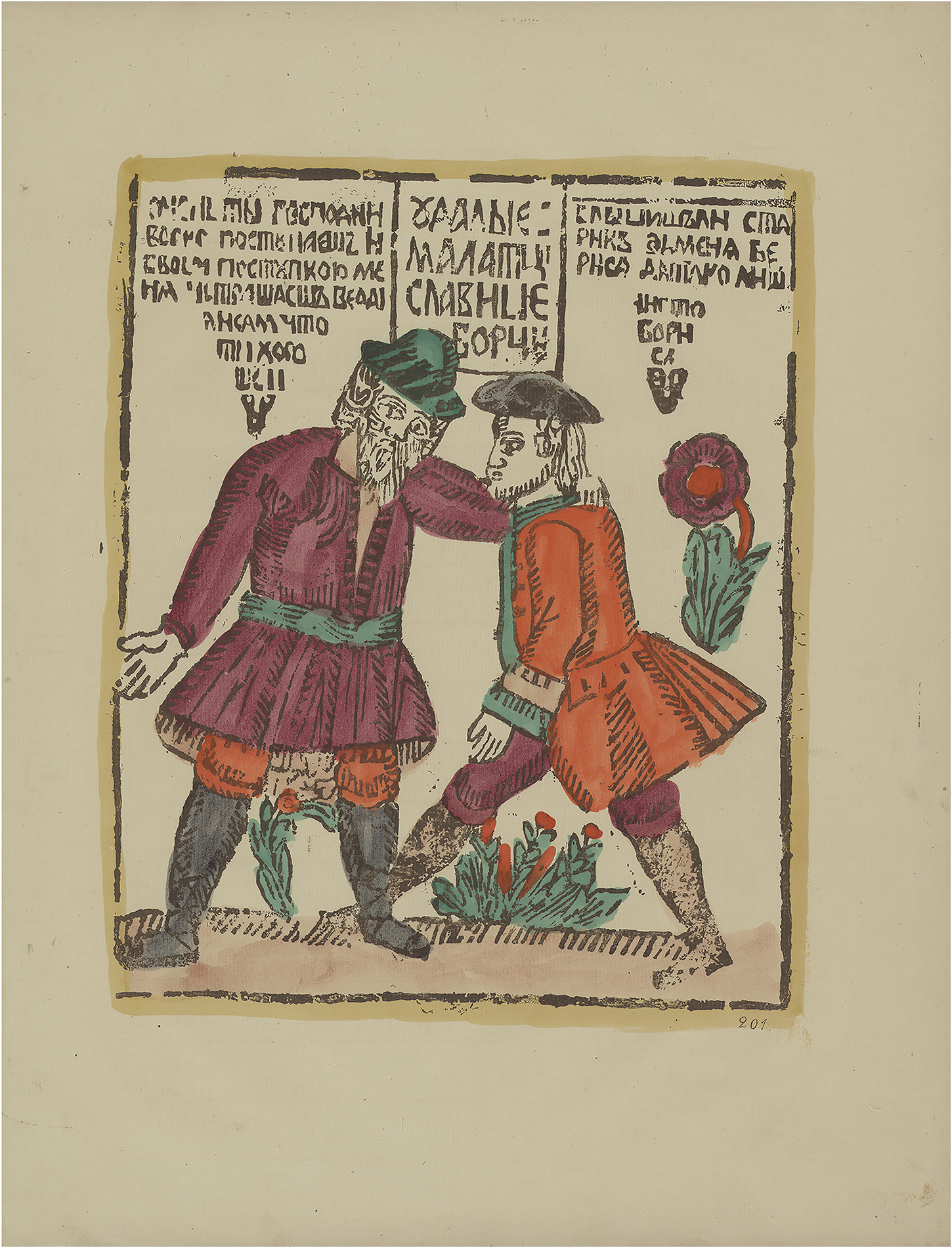
Colorized nineteenth-century reproduction of an untitled print from a woodblock dating to the first half of the eighteenth century. Rovinskii, RNK: Atlas, I: 2 (no. 201). Rare Book Division, The New York Public Library. “Bortsy.” New York Public Library Digital Collections. Accessed May 10, 2025. digitalcollections.nypl.org/items/510d47de-0b7d-a3d9-e040-e00a18064a99.

Figure 4 Long description
Two men are depicted in traditional attire, engaged in a wrestling stance. The man on the left wears a long tunic and a hat, while the man on the right is dressed in a similar style with a different color scheme. They are positioned facing each other, with the man on the left extending his arm toward the other. Surrounding them are floral elements, including a large flower on the right. Above them, there is text in a decorative style, divided into sections, with each section containing different phrases. The background is plain, emphasizing the central figures and text.
Brave Brawlers and Headless Beardies
Since many eighteenth-century Russian prints were local adaptations of widely-circulating (often west European) originals, it is possible that the motif of the battling barber, so prominently on display in the lubok under consideration, had a foreign prototype.Footnote 46 Be that as it may, the other, explicitly visual, source of inspiration for the design of the comical stand-off depicted in The Barber-Surgeon and The Schismatic was the conventional representation of wrestling, bare-knuckle fighting, and public brawling in Russian popular culture. This activity was a staple form of entertainment not only at festive social gatherings, but also amateur theatrical performances.Footnote 47 It was also frequently represented in cheap popular prints, which, perhaps not surprisingly, were also sold at holiday fairs, where fighting, both fictional and actual, was often on display.Footnote 48 Comic brawlers, such as the two characters depicted below, (Figure 4) were the eighteenth-century Russian equivalents of the gimmicky personae adopted by today’s professional wrestlers and mixed martial art fighters (Dwayne “The Rock” Johnson, “Tank” Abbot, Conor “The Notorious” McGregor). In this engraving, for example, we see a confrontation between a large, bearded “Old Man” (starik) in traditional Russian clothing and a diminutive, stubble-chinned “Gentleman” (gospodin) in the latest foreign fashions: an unequal match-up that echoes the one depicted in the face-off between the Schismatic and the Barber-Surgeon.Footnote 49
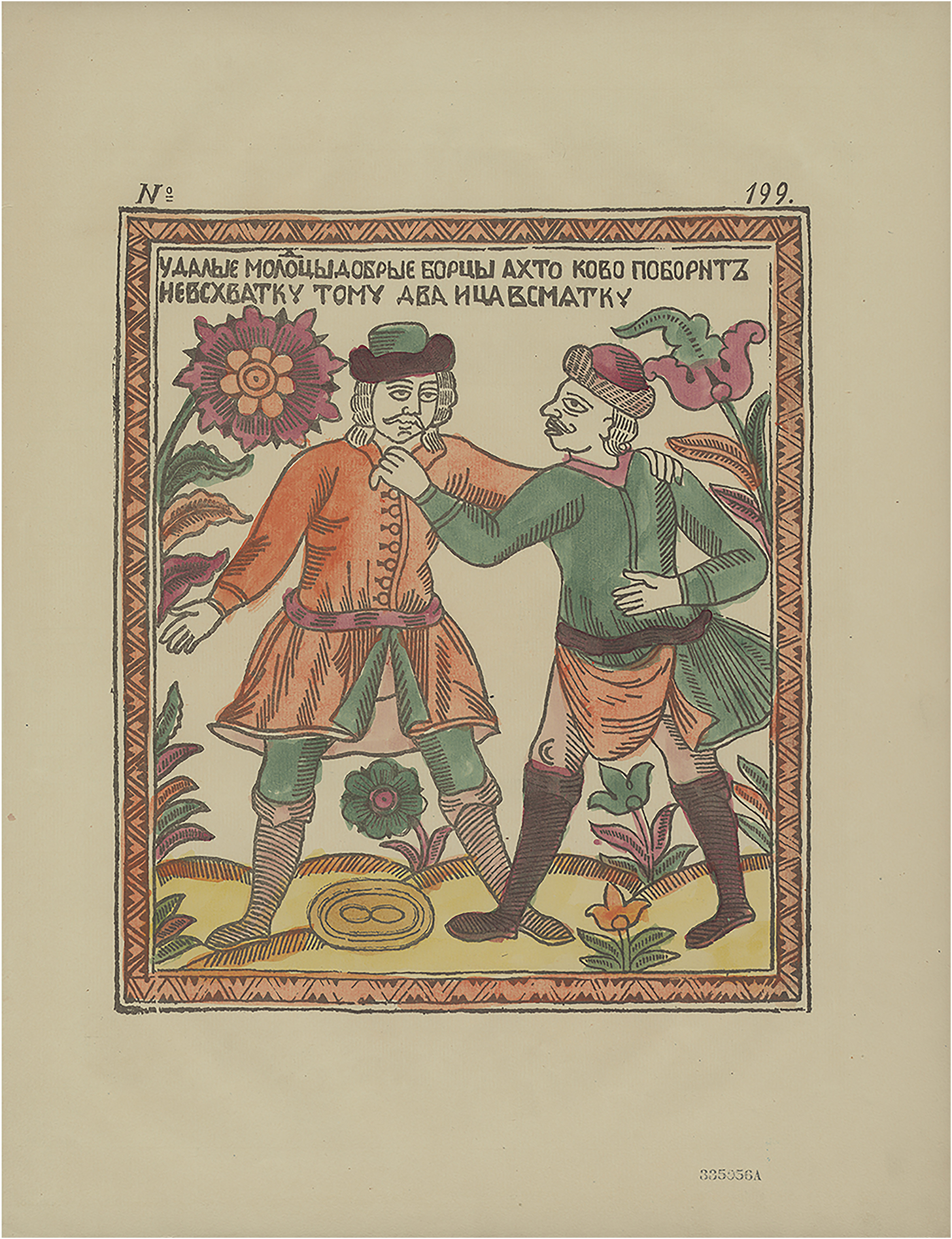
Brawlers could also be members of popular comedy duos, like Foma and Erema, the woe-begone brothers whose misadventures were familiar to early modern Russian audiences from minstrel shows and popular folk songs long before they became fixed on the pages of an early eighteenth-century manuscript codex, and certainly long before they appeared in Russian popular prints.Footnote 50 This comic pair was less like Bugs Bunny and Elmer Fudd and more like a saltier version of trash-talking wrestlers, who routinely rely on elaborate personal insults to ridicule, intimidate, and demoralize their opponents. This is most apparent in the following lubok, (Figure 5) which is accompanied by an inscription that plays on the dick joke implicit in the Russian idiom for “ball busting,” containing as it does a rhyming pun on the word vsmiatku, which can refer to a soft-boiled egg (iaitsa vsmiatku), a readiness to do something with full dedication, or a willingness to reduce something to a completely flattened state (rasshibitʹsia vsmiatku).Footnote 51 To ensure that even those viewers who could not read the text would still get the joke, the designer of this print not only depicts the wrestlers in a stance that opens the folds of their caftans at the groin, but also positions one of them directly above a plated pair of poultry eggs, a euphemistic allusion to testes (the two oval-shaped male reproductive organs located in the scrotum) that also appears in eighteenth-century interludes, such as the comical dialogue between a Polish “lord” and the Harlequin who serves as his Russian “cook.”Footnote 52
Colorized nineteenth-century reproduction of an untitled print from a woodblock dating to the first half of the eighteenth century. Rovinskii, RNK: Atlas, I: 2 (no. 199). Rare Book Division, The New York Public Library. “Bortsy.” New York Public Library Digital Collections. Accessed May 10, 2025. digitalcollections.nypl.org/items/510d47de-0b7c-a3d9-e040-e00a18064a99.

Figure 5 Long description
The illustration shows two men in traditional attire, engaged in a dynamic pose. The man on the left is wearing a tunic and boots, while the man on the right is in similar attire, gesturing towards the other. The background features stylized floral patterns. Above them, there is a block of text in a decorative frame. The scene is bordered by a patterned frame and the numbers 'No. 199' are visible at the top corners.
The same kind of crude sexual humor also informed the design of the lubok depicting the wrestling match between the Barber-Surgeon and the Schismatic. And, as in the abovementioned print, the designer of The Barber-Surgeon and The Schismatic ensured that the point would not be lost on any of his potential paying customers. For literate consumers, the text in the upper right-hand corner—“The Barber-Surgeon Wants to Trim the Schismatic’s Beard” (Tsiriulʹnik kho // chet raskolʹniku // borodu strichʹ)—not only explicitly identifies both characters, but, like a written stage direction in the script of a comical interlude, also articulates the motivations that set up the confrontation graphically depicted in the print. The text in the upper left-hand corner constitutes the Schismatic’s reply, which can be roughly translated as follows:

The prompt in this rhyming couplet betrays its theatrical origins as much as does the threat of calling the cops, who, as we noted above, typically appeared on stage at the very end of scenes involving a brawl between the main comic characters, as if to restore law-and-order to the topsy-turvy world of an interlude and resume the action of the play.Footnote 54
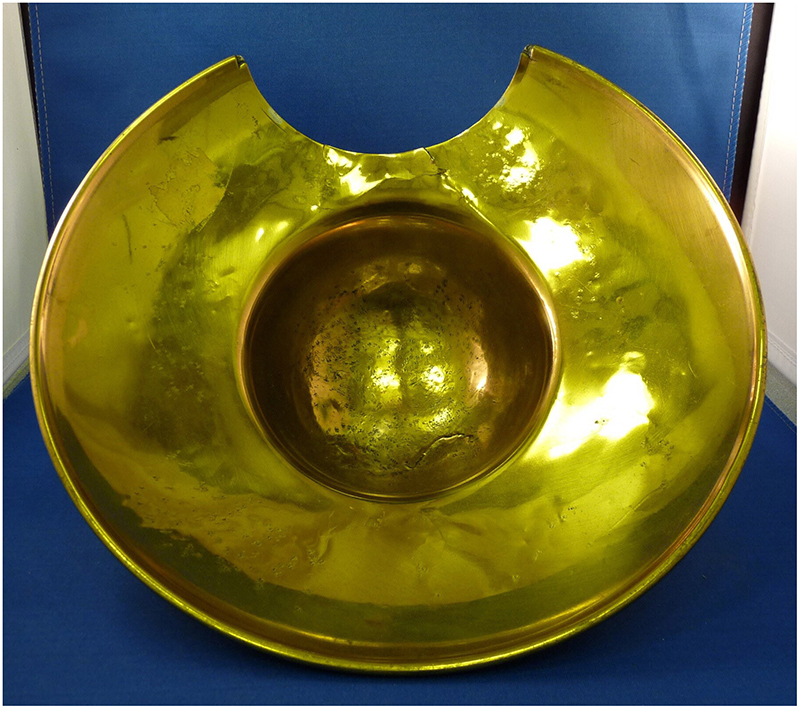
Those customers who could not read the accompanying text could use the visual cues introduced by the lubok’s designer to identify the characters and see the humor of the situation. The Schismatic was easily identified not only by the obligatory long, flowing beard and the old-fashioned Muscovite clothing but, also, and perhaps most crucially, by the prominent, government-mandated, standing collar (which would have been painted red when it was colored-in by knowing customers). The Barber-Surgeon, on the other hand, is identifiable by the giant pair of scissors that he brandishes over the head of the Schismatic (Fig. 1), as well as the various tools of his trade, which are shown lying on the table next to him. Prominent among these is a “bleeding bowl,” (Figure 6) a device used to collect blood during therapeutic bloodletting–a surgical procedure that was generally prescribed by licensed practitioners of Galenic medicine but administered by barber-surgeons. The prominence of the bleeding bowl, and the defensive way in which the protesting Schismatic holds his walking stick against his groin, suggests that at least part of the humor of this print lay in a comical misunderstanding of the Barber-Surgeon’s intentions on the part of the Schismatic, who is depicted as if he were protecting himself as much from a threat to his manhood as to his beard. This misunderstanding is based on the polysemic nature of Russian verb strichʹ, which can refer both to “cutting [something] off” (srezatʹ) and “trimming around” it (obrezatʹ).Footnote 55 The resulting double-entendre inverts the upper and lower spheres of the carnivalesque body and, in a rhetorical move reminiscent of Mikhail Lomonosov’s “Hymn to the Beard” (1756/57), substitutes pubic for facial hair, and the phallus for the beard, in effect, eliding beard-trimming (strizhka) with foreskin-removal (obrezanie).Footnote 56 In so doing, this visualization of an obscene joke not only mocks the conflation of masculinity and piety that informed “traditional” Orthodox prohibitions against beard-shaving, but also rephrases, in humorous and popular form, official diatribes against the “stubbornness” and “hypocrisy” of bearded “schismatics,” as well as anyone else who mistook outward religious observance for the inward “circumcision of the heart” (Rom. 2:28–29) required of true believers in the Russian imperial cult.Footnote 57
Barber surgeon-style bleeding bowl, ca. 17th century. History of Medicine artifacts collection, 1550-2000s, David M. Rubenstein Rare Book & Manuscript Library, Duke University. URL: idn.duke.edu/ark:/87924/r4r20s586.

Figure 6 Long description
A barber surgeon-style bleeding bowl featuring a semicircular cutout at the top. The bowl has a concave center and a wide, flat rim. It is designed to collect blood during therapeutic bloodletting procedures. The bowl is placed against a blue background, highlighting its reflective surface.
Abstruse as it may sound, this politically expedient theological argument would have been familiar not only to former students of Moscow’s Slavonic-Greco-Latin Academy, such as Lomonosov, but also anyone who was aware of the polemical, anti-sectarian teachings of Dimitrii (Danylo Savych-Tuptalo [1651–1709]), the Ukrainian-born Orthodox prelate who served as metropolitan of Rostov and Iaroslavlʹ and went on to become the first saint to be canonized during the Synodal period of the Russian Orthodox Church.Footnote 58 Metropolitan Dimitrii devoted an entire section of his infamous book-length Inquiry into the Schismatic Brynsk Faith to a discussion of the spiritual dangers posed to faithful followers of Christ (khristiane) by idolatrous ignoramuses who worship beards (borodiane).Footnote 59 Significantly, Dimitrii’s chapter “On Beards” began with an anecdote that drew a startling analogy between beard-shaving and decapitation. This short, attention-grabbing, personal story—a homiletic device commonly used to make a theological concept more concrete and understandable—was supposedly based on an actual event that took place during the metropolitan’s annual visit to his see “in the summer of 1705,” just a few months after the promulgation of the first Petrine decree on beards:Footnote 60

In Dimitrii’s telling, this quick-witted response silenced the two bearded men who accosted him in the street in front of the cathedral church, but unsettled some of the “honorable city-dwellers” (chestnye grazhdane), who had followed him back to his residence. In fact, this incident sparked a “lively debate about the pros and cons” of heeding the royal decree on beard-shaving (razglagolʹstvie dovolʹno o bradobritii i nebradobritii), especially in light of its soteriological implications. During the course of this discussion, Dimitrii realized that many members of his entourage, including some of his very own congregants, “doubted their salvation because of their shaved beards” (sumniatsia o spasenii svoem obritykh radi brad), “as if they had lost the image and likeness of God, and were no longer in the image and likeness of God”—a theological position that skirted dangerously close to the heretical notion that God has a physical human form or body (anthropomorphism).Footnote 61 In order to allay their doubts, and to correct such errors, the metropolitan offered the following exhortation (uveshchevakh ikh):

The moral that the metropolitan drew from this personal anecdote—to render unto Caesar what was Caesar’s and leave questions of faith in the hands of Christ (and His ordained ministers)—was hardly a radical innovation. But the unexpected way that this familiar biblical teaching (Mat. 22:15–22; Mark 12:13–17; Luke 20:20–26) was phrased showed that Dimitrii had mastered the rhetorical techniques that post-Reformation Orthodox clerics trained in the Baroque milieu of the Kyiv Mohyla Academy had adopted from their confessional rivals, the better to preach to their flock in the language and linguistic register that they could understand, whatever their social status or level of education.Footnote 62
The Inquiry’s chapter “On Beards” displayed just such a two-tiered approach. Dimitrii’s excursus into biblical and patristic writings on male facial hair, which made up the majority of the text, was meant for those few “pious and reasonable readers” who could appreciate the Orthodox cleric’s encyclopedic erudition and recognize the classical roots of the contrast between the everlasting soul and the mortal body (symbolized by the beard).Footnote 63 The short, humorous anecdote that preceded this extended discussion, by contrast, aimed at the many simple folk who could not understand his writings, but who could derive enjoyment from hearing a verbal exchange that sounded like it could have come straight out of a comical interlude featuring a confrontation with a bearded unbeliever (whether Schismatic or Jew). For just as in the theatrical dialogues discussed above, it is the sanctimonious “obtuseness” (nevezhestvo) of his two interlocutors that is exposed and derided in the anecdote related by Dimitrii, who, it must be recalled, was himself the author of Orthodox “school plays.”Footnote 64 Indeed, the witty analogy between shaving and decapitation appears to have gotten its humorous charge, at least in part, from the prelate’s punning use of the colloquial term for someone who had more hair than brains (Rus. bezgolovyi, “stupid,” lit. “headless”)—one of the many “ironic paroemias playing on the mythological connection of the concept ‘beard’ and ‘mind’” that “appear in all Slavic languages.”Footnote 65 As Lomonosov’s “Ode to the Beard” demonstrates, it is also possible that, at for least for some members of Dimitrii’s audience, this analogy evoked the carnivalesque equation of the head and the genitals—an interpretive stratagem whose upside-down logic transforms decapitation into the implicit inverse of castration.
Whatever the case may be, Metropolitan Dimitrii’s rhetorical combination of religious didacticism and popular humor obviously struck a chord with eighteenth-century Russian readers of the Inquiry into the Schismatic Brynsk Faith.Footnote 66 For example, echoes of Dimitrii’s “ironic paroemia” on the “connection of the concept ‘beard’ and ‘mind’” can be found in the third stanza of Lomonosov’s “Hymn to the Beard,” which employs this same trope to mock the Old Believers of Kerzhenets: a religious community whose geographical location and proximity to several major fairs allowed it not only to survive repeated attempts to disrupt its way of life, but even to thrive:Footnote 67

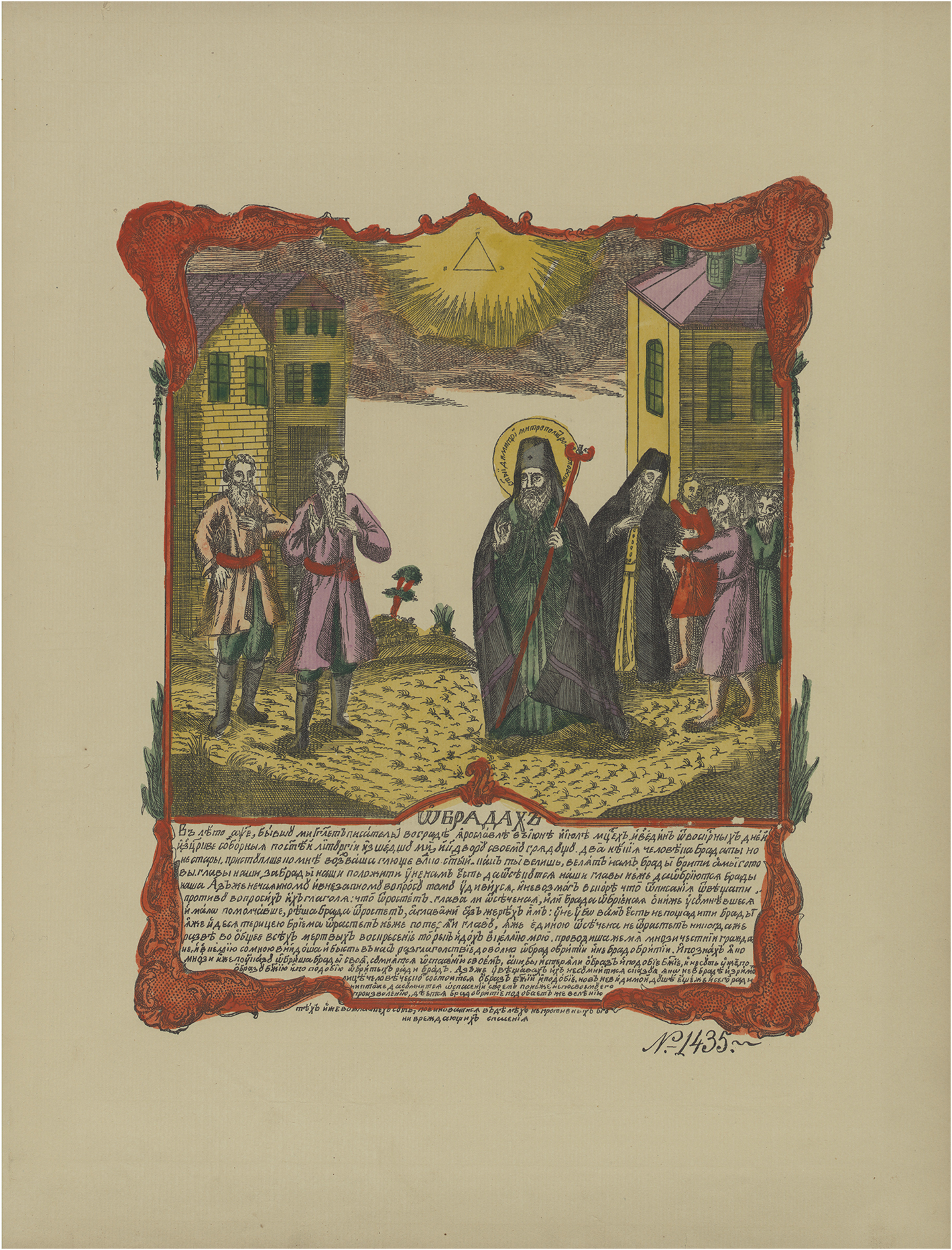
The above-cited excerpt from Dimitrii’s chapter “On Beards” was even quoted verbatim in several different copper-plate engravings, which were produced after his elevation to sainthood in 1757.Footnote 69 One of these engravings visually re-enacts the historical anecdote recounted in Dmitrii’s polemical Inquiry, which, perhaps not coincidentally, was republished just a couple of years before his canonization.Footnote 70 (Figure 7). The engraving in question depicts the conversation between St. Dimitrii and two bearded men in traditional Russian dress as taking place in front of a crowd of onlookers. The good, Orthodox people of Iaroslavlʹ are shown coming out of the cathedral church, which is located at the farthest remove from the prelate’s opponents, on the right side of the print and, by pictorial convention of Russian icon-painting, of God Himself.Footnote 71 In this way, the engraver not only presents a visual synopsis of the anecdote from Dimitrii’s Inquiry for those of his customers who could not read it, but also effectively models the relationship between the print’s audience and the targets of its derisive laughter.
Colorized nineteenth-century reproduction of an untitled copperplate etching from the second half of the eighteenth century. Rovinskii, RNK: Atlas, 3 (no. 1435). Rare Book Division, The New York Public Library. “Sv. Dmitrii Rostovskii “o bradakh”.” New York Public Library Digital Collections. Accessed May 10, 2025. digitalcollections.nypl.org/items/510d47de-0cac-a3d9-e040-e00a18064a99.

Figure 7 Long description
The etching depicts a religious scene with a central figure wearing a halo, suggesting a saintly or holy status. This figure is engaged in conversation with two men dressed in traditional attire, positioned to the left. The men appear attentive, with one holding his beard. To the right, a group of onlookers, including a woman and a child, observe the interaction. The background features two buildings, one on each side and a landscape with a sunburst at the top center, symbolizing divine presence or enlightenment. Below the scene, there is a block of text, possibly providing context or narrative related to the depicted event. The entire image is framed with ornate borders.
Might the wood block print depicting the farcical face-off between the Schismatic and the Barber-Surgeon also have been created at that same moment in time as the steel engraving of the recently canonized St. Dimitrii, that is, when they would have been most topical and, hence, most likely to sell well? And if so, what exactly is the relationship between the Schismatic in the lubok and the bearded interlocutors in Dimitrii’s Inquiry, the Kerzhentsian Brother in Lomonosov’s “Hymn to the Beard,” and the figure of “Ivan Danilovich,” the bawdy Old Believer in the cycle of obscene erotic poems associated with the circle of A.V. Olsufʹev, the collector of said popular print? Unfortunately, despite some intriguing leads, we still do not know the answers to these questions.Footnote 72 What we do know, and what I have tried to argue in this article, is that the significance of this unique cultural object can best be understood when approached from the perspective of its creator and his customers, rather than its nineteenth-century interpreters. Doing so allows us to see that the printmaker’s use of the religious slur was not metaphorical or incidental to the design of the single-sheet engraving. It was as integral to the humor of his composition as the literary tropes of commedia dell’arte and the visual conventions of representing popular wrestlers. In turn, this suggests that in eighteenth-century Russia, Old Believers were not just the victims of state-sponsored religious persecution. They were also the butt of crude jokes by their neighbors. In other words, the “othering” of Old Believers was as much a product of urban popular culture as of inflammatory church rhetoric and intolerant government legislation.
But a contextualized reading of The Schismatic and the Barber-Surgeon provides more than a concrete example of how this commercially produced item of early modern print culture could bind Russian Orthodox city-dwellers of all social strata into an imagined community of “pious and reasonable” sons of the imperial church and state by re-circulating negative stereotypes about cultural outsiders. It also leads us to consider why Rovinskii, Stasov, and the numerous people who still accept their interpretation, both in Russia and beyond, insist that this print epitomizes Peter I’s “cultural revolution.” What’s really at stake in such a narrative? What does it emphasize and what does it conceal? And whom does it benefit? As I see it, the Rovinskii/Stasov interpretation may fail to explain the print’s carnivalesque sense of humor or why its audience’s laughter is explicitly directed against a member of a stigmatized and officially persecuted religious minority. But what it does do is provide a reading that reiterates the “Great Man” theory of history and perpetuates the idea of Russia’s uniquely violent and illiberal path to modernity, with everything that such a Sonderweg ideology entails.Footnote 73 In questioning the Petrine-centric thesis first advanced by Rovinskii and Stasov, therefore, I seek to contribute as much to the critical reevaluation of the intellectual legacy left by these two giants of nineteenth-century Russian cultural history as of the eighteenth-century lubok that has served as the focus of this article.
Ernest A. Zitser is the author of The Transfigured Kingdom: Sacred Parody and Charismatic Authority at the Court of Peter the Great (Cornell University Press, 2004; Russian translation: Novoe Literaturnoe Obozrenie, 2008) and the general editor of ВИВЛIОθИКА/Vivliofika (ISSN 2333-1658), https://iopn.library.illinois.edu/journals/vivliofika/index, an open access, peer-reviewed, scholarly journal devoted to the culture and history of the Russian Empire during the long eighteenth century.