Nomenclature
- UAV:
-
unmanned air vehicle
- BSO:
-
back-tracking search optimisation
- MSE:
-
mean squared error
- ANN:
-
artificial neural network
1.0 Introduction
With their technological capabilities, unmanned aerial vehicles (UAVs) meet the requirements of both military and civilian applications. Many fields such as robotics, electronic hardware and software contribute to UAV technologies [Reference Arik, Turkmen and Oktay1–Reference Traub6].
Today, UAVs can perform their tasks as semi-autonomous or fully autonomous, with UAV systems with simple or advanced security protocols. The sizes of UAVs designed for different tasks also differ. Fixed and rotary wing types of UAVs in mini size are widely produced. However, in large size, fixed-wing types are generally produced more widely due to the difficulties of application and use.
In the production of UAVs or helicopters, designs that concern sub-disciplines such as aerodynamics, structure-strength and materials science are carried out. Then, expert production engineers and technicians produce the UAV or helicopter, whose sub-designs are completed. After manufacturing, the autopilot phase is carried out by expert control engineers using the technical data of the produced UAV or helicopter. At this phase, either a new autopilot is manufactured, or the parameters of an existing autopilot are adjusted. These work packages often require simultaneous consideration of design and manufacturing activities and control system activities to achieve optimal flight performance.
The use of optimisation methods makes a great contribution to different problem solutions involving parameters that need to be handled simultaneously. By using many different heuristic algorithms, parameters with minimum and maximum values can be estimated optimally under certain conditions. The use of heuristic algorithms in many studies such as aerodynamic design, thrust system design, increasing endurance and range, and autonomous system design offers a good alternative to designers in obtaining the best-desired solution [Reference Arik, Turkmen and Oktay1–Reference Konar4, Reference Traub6].
In the literature, there are many studies about rotary wing air vehicles [Reference Fusato and Celi7–Reference Oktay and Sultan12]. In one of the studies presented, some structural parameters of the helicopter were revised and the performance was tried to be improved [Reference Grigoriadis, Carpenter, Zhu and Skelton9, Reference Grigoriadis, Zhu and Skelton10]. In another study, rotor dynamics and flight dynamics were simultaneously optimised using some design parameters [Reference Fusato and Celi7]. In another study, vibration loads on the rotor hub, which is the main source of helicopter vibration, were reduced by using the main variables such as the torsional stiffness of the helicopter blade [Reference Ganguli8]. In another study, some parameters of the helicopter and the output variance were simultaneously examined using a constrained controller, and the redesign of the helicopter to minimise the control energy was discussed [Reference Oktay and Sultan12]. In another study, it was tried to obtain the optimum thrust-torque ratio by changing the blade parameters [Reference Konar4]. In another study, a model based on back-tracking search optimisation (BSO)-based artificial neural network (ANN) has been proposed to maximise the performance and flight time of the UAV’s brushless motor [Reference Konar13].
In this study, it is aimed to maximise the autonomous flight performance of the unmanned helicopter produced in Erciyes University Faculty of Aeronautics and Astronautics by using innovative methods. A dynamic model of this unmanned helicopter having some features, such as medium range, medium altitude, medium endurance and electrically driven, has been produced. However, there are many parameters that affect autonomous flight performance. In this study, helicopter blade parameters and autopilot parameters, which significantly affect autonomous flight performance, are determined as inputs, and autonomous performance parameters are determined as outputs. The blade length (b), blade mass density (m), blade chord width (c) and blade twist angle (t) of the unmanned helicopter and the proportional (P), integral (I), derivative (D) gain coefficients of the lateral axis of the autopilot are selected as input parameters of the dynamic model. Settling time (s), rise time (r) and maximum overshoot (o), which are autonomous performance parameters, are determined as output parameters of the dynamic model. This dynamic model with complex relations is determined as a cost function of the algorithm and integrated into the BSO algorithm. However, in order to obtain reasonable results during the optimisation process, certain limit values have been applied for helicopter blade parameters and autopilot parameters. These limits are set so that the helicopter blade parameters do not change more than ±5% from the nominal values and the autopilot gain coefficients do not change more than ±25% from the recommended values. Thus, the gain parameters of the autopilot system were calculated to minimise the autonomous performance index together with helicopter variables simultaneously. In other words, optimum input values are calculated by considering the autonomous performance parameters simultaneously and at equal importance with the BSO algorithm.
With this study, the simultaneous optimisation of the electric unmanned helicopter rotor system and the flight control system has been realised together for the first time in the literature. Thus, it is ensured that design and manufacturing activities and control system activities are handled simultaneously in order to achieve maximum flight performance. In addition, the BSO algorithm was used for the first time in the literature for this purpose, and the results emphasised that heuristic methods can be used as an alternative method in the literature.
2.0 Dynamic model of our unmanned helicopter
Helicopters include one or more rotors and two or more rotor blades. Helicopters can fly via this rotor and blades. The helicopters do not require forward acceleration like airplanes thanks to their vertical take-off and landing capabilities. While the source of lift in aircraft is wings, the source of lift in helicopters is rotor blades rotating around a mast. This gives helicopters the ability to take-off and land vertically without the need for a runway. For this reason, helicopters can generally be used in areas where fixed-wing aircraft cannot land. Besides being able to take-off and land vertically, they are used to perform tasks that require time or work intensity thanks to their ability to hover for a long time [Reference Leishman14–Reference Seddon and Newman17].
The power required in helicopters is produced by the rotor. A helicopter rotor consists of mast, hub and rotor blades. The mast is a hollow cylindrical metal shaft extending upwards and driven by the transmission. At the top of the mast is the connection point of the rotor blades, called the hub. The rotor blades are attached to this hub in a number of different ways and constitute the necessary lift. For this reason, it is very important to select the blades with optimum features.
In this section, dynamic model and some properties of our unmanned helicopter are explained briefly.
2.1 Dynamic model and some properties of our unmanned helicopter
To capture the main physics and essential dynamics, we derived the dynamic model of the unmanned helicopter from a finite set of ordinary differential equations. The model of our helicopter, whose photo is given in Fig. 1, has a rather complex structure as it includes the fuselage, fully articulated (i.e. with four blades) main rotor, tail rotor, landing gear, empennage and main rotor downwash. There are 29 dynamic equations in the model, including 9 fuselage, 3 static main rotor downwash, 16 blade flapping and lead-lagging and an additional flight path angle algebraic equation [Reference Fusato and Celi7–Reference Grigoriadis, Zhu and Skelton10].
Photo of the manufactured helicopter.

During the obtaining of the dynamic model of the helicopter, many sources related to the helicopters were utilised [Reference Leishman14–Reference Prouty16, Reference Bramwell, Done and Balmford18–Reference Watkinson27]. At first, Newton’s second law and the law of conservation of angular momentum (Euler’s law) were used in order to obtain the force and moment equations of the helicopter, respectively. The dimensionless force and moment equations are given in Equations (1) and (2), respectively. The process of non-dimensioned is widely used in studies on helicopters for ease of calculation. Here, X, Y, Z are the longitudinal, lateral and vertical forces in the x- y- and z- directions in the airplane axis set, respectively. L, M, N are the rolling, pitching and yawing moments in the x- y- and z- directions, respectively. All sub-components of the helicopter contribute to these forces and moments.
 \begin{align}&\frac{d}{{d\psi }}\hat u + {{\hat q}_{}}\hat w - {{\hat r}_{}}\hat v + \frac{{g\sin \left( {{\theta _A}} \right)}}{{{\Omega ^2}_{}R}} = \frac{X}{{{\Omega ^2}_{}{R_{}}{M_a}}}\nonumber\\[5pt]&\frac{d}{{d\psi }}\hat v + {{\hat r}_{}}\hat u - {{\hat p}_{}}\hat w - \frac{{g\cos ({\theta _A})\sin \left( {{\phi _A}} \right)}}{{{\Omega ^2}_{}R}} = \frac{Y}{{{\Omega ^2}_{}{R_{}}{M_a}}}\\[5pt]&\frac{d}{{d\psi }}\hat w + {{\hat p}_{}}\hat v - {{\hat q}_{}}\hat u - \frac{{g\cos ({\theta _A})\cos ({\phi _A})}}{{{\Omega ^2}_{}R}} = \frac{Z}{{{\Omega ^2}_{}{R_{}}{M_a}}}\nonumber\end{align}
 \begin{align}&\frac{d}{{d\psi }}\hat p - {{\hat q}_{}}\hat r\left( {\frac{{{I_{yy}}}}{{{I_{xx}}}} - \frac{{{I_{zz}}}}{{{I_{xx}}}}} \right) - \frac{{{I_{xz}}}}{{{I_{xx}}}}\left( {{{\hat p}_{}}\hat q + \frac{d}{{d\psi }}\hat r} \right) = \frac{L}{{{I_{xx}}_{}{\Omega ^2}}}\nonumber\\[5pt]&\frac{d}{{d\psi }}\hat q - {{\hat p}_{}}\hat r\left( {\frac{{{I_{zz}}}}{{{I_{yy}}}} - \frac{{{I_{xx}}}}{{{I_{yy}}}}} \right) + \frac{{{I_{xz}}}}{{{I_{yy}}}}\left( {{{\hat p}^2} - {{\hat q}^2}} \right) = \frac{M}{{{I_{yy}}_{}{\Omega ^2}}}\\[5pt]&\frac{d}{{d\psi }}\hat r - {{\hat p}_{}}\hat q\left( {\frac{{{I_{xx}}}}{{{I_{zz}}}} - \frac{{{I_{yy}}}}{{{I_{zz}}}}} \right) - \frac{{{I_{xz}}}}{{{I_{zz}}}}\left( {{{\hat q}_{}}\hat r - \frac{d}{{d\psi }}\hat p} \right) = \frac{N}{{{I_{zz}}_{}{\Omega ^2}}}\nonumber\end{align}
Sub-components such as main rotor, fuselage, empennage and landing gear play the most effective role in helicopter dynamics. Equation (3) refers to the kinematic equations of the helicopter. In Equation (4), the expression of the infinitesimal aerodynamic force acting on a blade at an x dimensionless distance from the blade root of any of the blades connected to the helicopter main rotor is presented. By integrating this expression along the blade root, the total aerodynamic force acting on that blade can be found. The sub-index F seen in this equation indicates that the force is obtained on the axis of flapping. The blades of the unmanned helicopter are produced with 2 degrees of freedom as feathering and fluttering. In this study, the forward-reverse movement is neglected as it has little contribution to helicopter dynamics. The moment affecting the infinite small blade element is given in Equation (5). Similarly, this moment expression is integrated along the blade to obtain the total aerodynamic moment acting on the blade.
 \begin{align} & \hat p = \frac{d}{{d\psi }}{\phi _A} - \frac{d}{{d\psi }}{\psi _A}\sin \left( {{\theta _A}} \right)\nonumber\\[5pt]&\hat q = \frac{d}{{d\psi }}{\psi _A}\cos ({\theta _A})\sin \left( {{\phi _A}} \right) + \frac{d}{{d\psi }}{\theta _A}\cos ({\phi _A})\\[5pt]&\hat r = \frac{d}{{d\psi }}{\psi _A}\cos ({\theta _A})\cos ({\phi _A}) - \frac{d}{{d\psi }}{\theta _A}\sin \left( {{\phi _A}} \right)\nonumber\end{align}
 \begin{align}{d_F}F_{aero}^{} = \frac{{\gamma {I_b}}}{{2{R^3}}}\left[ {\begin{array}{*{20}{c}}0\\[3pt]{ - \left( {\theta _{}^{}U_T^{^2}{ - _{}}{U_P}_{}{U_T}} \right)\dfrac{{{U_P}}}{{{U_T}}}{}_{}{ - _{}}\dfrac{1}{{{a_0}}}\left( {{\delta _0} + {\delta _2}{{\left( {\theta - \dfrac{{{U_P}}}{{{U_T}}}} \right)}^2}} \right)}\\[5pt]{{\theta _{}}U{{_T^{^2}}_{}} - {}_{}{U_P}_{}{U_T}}\end{array}} \right]dx\end{align}
 \begin{align}{d_F} M_{aero}^{} = {\left[ {\begin{array}{ccccccc}0 & & & {}{ - x{R_{}}{{({d_F}F_{aero}^{})}_{III}}} & & & {}{x{R_{}}{{({d_F}F_{aero}^{})}_{II}}}\end{array}} \right]^T}\end{align}
In Equations (6) and (7), a state-space model is presented for cruising flight with a specific speed of 10km/h. Using the numerical values given in Equations (6) and (7), the state-space model to be used in the simulation of the helicopter can be created. The state-space model is in the form of
 $\dot x = Ax + Bu$
,
 $xy = Cx + Du$
. Using the A matrix, the flight dynamics modes of our nominal unmanned helicopter are obtained [Reference Ren, Ge, Chen, Fua and Lee26]. Also, state variables and control elements are presented in Equations (8) and (9).
 \begin{align}{A_{10}} = \left[ {\begin{array}{*{20}{c}} \mbox{-3.7571e-3} & {}\mbox{-4.5367e-4} & {}\mbox{-2.5697e-4} & {}\mbox{-2.4461e-3} & {}\mbox{-8.7688e-4} & {}\mbox{3.2019e-5} & {}0 {} & {}\mbox{-5.1688e-4} {} & {}0 {} & {}\mbox{2.9857e-5} & {}\mbox{2.2572e-6} & {}\mbox{-7.1653e-2} & {}\mbox{-6.4565e-4} & {}\mbox{-6.4481e-4} & {}\mbox{1.0518e-4}\\\mbox{5.0593e-4} & {}\mbox{-2.4107e-3} & {}\mbox{5.0678e-5} & {}\mbox{9.9473e-4} & {}\mbox{-2.6639e-3} & {}\mbox{-2.2717e-2} & {}\mbox{5.1638e-4} & {}\mbox{-7.2025e-7}& {}0 {}&\mbox{2.6344e-6} & {}\mbox{6.9718e-5} & {}\mbox{-7.2925e-4} & {}\mbox{5.0157e-5} & {}\mbox{8.0935e-2} & {}\mbox{7.3005e-4}\\\mbox{6.9742e-5} & {}\mbox{5.2214e-6} & {}\mbox{-6.2141e-3} & {}\mbox{-9.0886e-5} & {}\mbox{2.2885e-2} & {}\mbox{1.8526e-8} & {}\mbox{2.2926e-5} & {}\mbox{1.6222e-5} & {}0&\mbox{-1.0353e-1} & {}\mbox{-2.2797e-3} & {}\mbox{7.0122e-5} & {}\mbox{4.7094e-8} & {}\mbox{1.0130e-5} & {}\mbox{1.2243e-7}\\\mbox{-2.3661e-2} & {}\mbox{6.4710e-2} & {}\mbox{-3.1532e-3} & {}\mbox{-5.7314e-2} & {}\mbox{8.8674e-2} & {}\mbox{-6.9175e-3} & {}0&0 & {}0&\mbox{1.1332e-3} & {}\mbox{-2.9127e-3} & {}\mbox{3.4232e-2} & {}\mbox{2.2289e-2} & {}\mbox{-3.7745} & {}\mbox{-3.4245e-2}\\\mbox{-1.1152e-1} & {}\mbox{-2.1140e-2} & {}\mbox{-1.3231e-2} & {}\mbox{-7.8454e-2} & {}\mbox{-5.2497e-2} & {}\mbox{-1.1927e-10} & {}0&0 & {}0&\mbox{2.4985e-3} & {}\mbox{-1.8535e-4} & {}\mbox{-3.3409} & {}\mbox{-3.0305e-2} & {}\mbox{-3.0258e-2} & {}\mbox{-1.9747e-2}\\\mbox{-2.0369e-3} & {}\mbox{9.2391e-2} & {}\mbox{3.1551e-1} & {}\mbox{-4.4414e-2} & {}\mbox{9.2267e-3} & {}\mbox{-1.8715e-2} & {}0&0 & {}0&\mbox{7.0729e-5} & {}\mbox{-1.8535e-1} & {}\mbox{-5.9529e-4} & {}\mbox{2.5422e-3} & {}\mbox{-5.0443e-1} & {}\mbox{-4.0437e-3}\\0 & 0 & 0 & {\rm{1}} & {}\mbox{1.3934e-3} & {}\mbox{-3.1385e-2} & 0 & 0 & 0 & 0 & 0 & 0 & 0 & 0 & 0\\0 & 0 & 0 & 0 & \mbox{9.9902e-1} & {}\mbox{4.4355e-2} & 0 & 0 & 0 & 0 & 0 & 0 & 0 & 0 & 0\\0 & 0 & 0 & 0 & \mbox{-4.4377e-2} & {}\mbox{9.9951e-1} & 0 & 0 & 0 & 0 & 0 & 0 & 0 & 0 & 0\\0 & 0 & 0 & 0 & 0 & 0 & 0 & 0 & 0 & 0 & 1 & 0 & 0 & 0 & 0\\\mbox{-7.0425e-4} & {}\mbox{-1.7752e-3} & {}\mbox{2.0293} & {}\mbox{2.2742e-2} & {}\mbox{2.7555e-4} & {}\mbox{7.3075e-7} & {}0&0 & {}0&\mbox{-4.0838} & {}\mbox{-1.1317} & {}\mbox{-6.8539e-3} & {}\mbox{-2.1490e-5} & {}\mbox{4.1207e-4} & {}\mbox{-1.6096e-2}\\0 & 0 & 0 & 0 & 0 & 0 & 0 & 0 & 0 & 0 & 0 & 0 & 1 & 0 & 0\\\mbox{-1.6723e-1} & {}\mbox{1.0373e-1} & {}\mbox{-1.9094e-2} & {}\mbox{2.8262} & {}\mbox{1.5241} & {}\mbox{-1.7292e-10} & {}0&0 & {}0&\mbox{-4.3009e-2} & {}\mbox{-6.5480e-4} & {}\mbox{-7.9274} & {}\mbox{-1.1756} & {}\mbox{-1.1759} & {}\mbox{-2.0286}\\0 & 0 & 0 & 0 & 0 & 0 & 0 & 0 & 0 & 0 & 0 & 0 & 0 & 0 & 1\\\mbox{9.9925e-2} & {}\mbox{9.9317e-2} & {}\mbox{5.8161e-2} & {}\mbox{1.5171} & {}\mbox{-2.8113} & {}\mbox{-1.0029e-2} & {}0&0 & {}0&\mbox{1.7079e-3} & {}\mbox{-3.6425e-2} & {}\mbox{1.1809} & {}\mbox{2.0323} & {}\mbox{-8.5560} & {}\mbox{-1.1813}\end{array}} \right]\end{align}
 \begin{align}{B_{10}} = \left[ {\begin{array}{cccccccccc} \mbox{-7.5251e-6} &&& {}\mbox{2.9914e-4} {} &&& {}\mbox{-1.8460e-4} &&& {} {}\mbox{5.8177e-13}\\\mbox{-4.2867e-5} &&& {} {}\mbox{-8.8132e-5} &&& {} {}\mbox{-3.3865e-4} &&& {} {}\mbox{2.6913e-4}\\\mbox{1.0532e-3} &&& {} {}\mbox{-1.0382e-7} &&& {} {}\mbox{-1.2207e-4} &&& {} {}\mbox{1.6965e-8}\\\mbox{2.0993e-3} &&& {} {}\mbox{-3.9155e-2} &&& {} {}\mbox{1.5894e-2} &&& {} {}\mbox{-6.3348e-3}\\\mbox{1.3902e-3} &&& {} {}\mbox{1.4041e-2} &&& {} {}\mbox{3.4658e-2} &&& {} {}\mbox{-1.0922e-10}\\\mbox{3.2517e-1} &&& {} {}\mbox{-4.4095e-3} &&& {} {}\mbox{8.2065e-3} &&& {} {}\mbox{-1.2337e-1}\\0 &&& {} {}0 {} &&& {}0 {} &&& {}0\\0 &&& {} {}0 {} &&& {}0 {} &&& {}0\\0 &&& {} {}0 {} &&& {}0 {} &&& {}0\\0 &&& {} {}0 {} &&& {}0 {} &&& {}0\\\mbox{1.5991} {} &&& {}\mbox{6.7585e-5} &&& {} {}\mbox{4.6626e-2} &&& {} {}\mbox{6.6919e-7}\\0 {} &&& {}0 {} &&& {}0 &&& {} {}0\\\mbox{2.1455e-3} {} &&& {}\mbox{1.6191} &&& {} {}\mbox{5.0247e-2} {} &&& {}\mbox{-1.5835e-10}\\0 &&& {} {}0 &&& {} {}0 {} &&& {}0\\\mbox{9.6306e-2} &&& {} {}\mbox{-5.6764e-2} {} &&& {}\mbox{1.6225} {} &&& {}\mbox{-9.1840e-3}\end{array}} \right]\end{align}
Here, the first three variables in the x vector are the velocity components in the three axes, the next three variables are the angular velocity components in the three axes, the next three variables are the orientation angles in the three axes, and the next three variables are the collective, longitudinal circular and laterally circular flapping angles and velocities, respectively. In addition, the vector u consists of collective, lateral and longitudinal circular main rotor pitch controllers and tail rotor control, respectively.
 \begin{align}x = \left[ {\begin{array}{}{\hat u} & {}{\hat v}& {}{\hat w}& {}{\hat p}& {}{\hat q}& {}{\hat r}& {}{{\phi _A}}& {}{{\theta _A}}& {}{{\psi _A}}& {}{{\beta _0}} {}&{{{\dot \beta }_0}}& {}{{\beta _c}}&{}{{{\dot \beta }_c}} {}&{{\beta _s}}& {}{{{\dot \beta }_s}}\end{array}} \right]\end{align}
 \begin{align}u = \left[ {\begin{array}{}{{\theta _0}}& {}{{\theta _c}}& {}{{\theta _s}}& {}{{\theta _T}}\end{array}} \right]\end{align}
Some basic data of the unmanned helicopter used in the study are as follows: main rotor diameter is 1.5m, helicopter mass is 5kg, pitching moment of inertia is 3,849,417.1 × 10−9kg.m2, yaw moment of inertia is 3,884,419.78 × 10−9kg.m2, rolling moment of inertia is 93,550.65 × 10−9 kg.m2.
In Equation (10), the trim vector used to obtain the numerical values of the state-space model for 10km/h is given. Here, respectively, the first two terms are the trim values of the pitch and roll angles of the whole helicopter in radians, the next three terms are the trim values in radians of the collective, longitudinal circular and laterally circular components of the flapping angles of the helicopter blades. The next three terms are the trim values in radians of the collective, longitudinal circular and laterally circular components of the pitch angles of main rotor, and the next one term is the trim value in radians of the pitch angle of tail rotor, respectively. The last three components are trim values in radians for terms related to main rotor down deflection.
 \begin{align}{}_{10km/h}{x_0} = [\underbrace {\mbox{-4.4369e-2,-3.1406e-2}}_{{\theta _{{A_0}}},{\phi _{{A_0}}}}{\rm{,}}\underbrace {\mbox{2.7289e-3,-3.4427e-4,-3.3386e-4}}_{{\beta _{{0_0}}},{\beta _{{c_0}}},{\beta _{{s_0}}}},\underbrace {\mbox{1.3770e-1,-8.2354e-4,-2.3317e-3,1.6655e-1}}_{{\theta _{{0_0}}},{\theta _{{c_0}}},{\theta _{{s_0}}},{\theta _{{T_0}}}},\underbrace {\mbox{2.2692e-2,1.9861e-2,8.0780e-1}}_{{\lambda _{{0_0}}},{\lambda _{{c_0}}},{\chi _0}}]\end{align}
3.0 Problem definition and methods
In this section, simultaneous design, problem formulation and BSO algorithm are explained.
3.1 Problem definition
In this study, the changing of b, m, c, t of the electrically driven unmanned helicopter before the flight and the determining optimally of autopilot P, I, D gain coefficients were considered. In response to these helicopter variables selected as input, the autonomous performance parameters such as s, r and o were minimised. That is, a cost function with complex relations was obtained, where the helicopter variables are the input and the autonomous performance parameters are the output.
It is not analytically possible to take derivatives of this cost function, which has complex relations, according to the selected variables. For this reason, optimisation techniques are used to solve problems that have a complex relationship or cannot be directly related. In this study, the BSO algorithm is preferred to overcome this difficult problem that has complex relationship. These algorithmic methods have been used successfully in complex and constrained optimisation problems before. Thus, the gain parameters of the autopilot system were calculated simultaneously with the selected helicopter variables to minimise the autonomous performance index.
3.2 Problem formulation
The equation for the problem of determining autonomous performance parameters (settling time, rise time, maximum overshoot) by using helicopter parameters (blade length, blade mass density, blade chord width and blade twist angle) and autopilot system parameters (P, I, D gain coefficients) simultaneously is given in Equation (11).
 \begin{align}op{t_{helicopter\;param,\,\,control\;param}}J = {f_{\min \,\,(settling\;time,\,\,rise\;time,\,\,\max .overshoot)}}\end{align}
Here, J represents the jacobian matrix. In addition, there are certain limits on helicopter blade parameters and autopilot gain coefficients in the cost function expressed by Equation (1). The first of the limits is that the helicopter blade parameters cannot change more than the range of ±5 percentage of their nominal values determined by the manufacturer. The second of the limits is that the autopilot gain coefficients cannot change more than the range of ±25 percentage of the suggested value. The reason for these limits is that it allows making minor changes to the existing design to improve performance, rather than a design from scratch.
3.3 BSO algorithm
The BSO algorithm is a swarm-based evolutionary algorithm. The BSO algorithm provides global solutions by avoiding local solutions in optimisation problems. The study of the algorithm is based on five basic phases – initial values, first selection phase, mutation, crossing and second selection phase [Reference Civicioglu28–Reference Civicioglu, Besdok, Günen and Atasever30].
The initial value is defined by Equation (12). Here, P is the population size, D is the dimension of the problem. Pi,j represent a target individual in the population, and lowj and upj represent the lowest and highest limit values in the solution space, respectively.
 \begin{align}{P_{i,j}} \sim U\left( {lo{w_j},u{p_j}} \right)\end{align}
The first selection phase determines the oldP historical population to calculate the search direction. Thus, the BSO algorithm stores the values obtained in the past for use in the next decision-making mechanism. With the determination of oldP, population members are randomly reordered.
In the mutation (M) phase, the initial values of the mutant population are calculated by Equation (13). Here the F value adjusts the amplitude of the search matrix. Thus, the previous experiences are used to determine the search direction.
 \begin{align}M = P + F\left( {oldP - P} \right)\end{align}
The crossing phase gives the final version of the population to be evaluated. Among the population members evaluated, those with good values according to the optimisation problem are used to identify the target population individuals. The BSO algorithm also uses the restriction mechanism to prevent mutated population individuals from exceeding their solution space limits.
The second selection phase is the phase where the update is done and the good one is selected. The global best value is checked again in each iteration by comparison with all population individuals. If any individual’s cost function value is better than the current global best value, then the new global best value will be the position of this individual. The BSO algorithm can be easily applied to several engineering problems due to its very easy applicability [Reference Konar13, Reference Civicioglu28–Reference Civicioglu, Besdok, Günen and Atasever30].
4.0 Simulation results
Determining the input and output parameters in optimisation methods is the first step. In this study, the data of the electric unmanned helicopter produced in Faculty of Aeronautics and Astronautics, Erciyes University was used. b, m, c and t of the electrical unmanned helicopter and the P, I, D gain coefficients of the autopilot were selected as input parameters. Autonomous performance parameters consisting of s, r and o were also selected as output parameters. Thus, a model with complex relations having seven inputs and three outputs was obtained. The block diagram of the obtained model is given in Fig. 2.
Block diagram of the obtained model.

BSO algorithm was used to solve the cost function consisting of the model with complex relations. In the BSO algorithm, certain limits are applied to the input parameters and it is requested to obtain the minimum autonomous performance index from the algorithm. It has been adjusted so that the helicopter blade parameters (b, c, m, t) do not change more than ±5% from the nominal values, and the autopilot gain coefficients (P, I, D) do not change more than ±25% from the recommended values. The reference values of the input parameters used in the optimisation process are given as: b is 75cm, m is 0.2kg/m, c is 4.35cm, t is −0.14rad, P is 50, I is 5 and D is 50. Colony size and iteration, which are the control parameters of the BSO algorithm, were chosen as 50 and 500, respectively. To determine the optimisation performance realised with the BSO algorithm, MSE was chosen as the performance criterion.
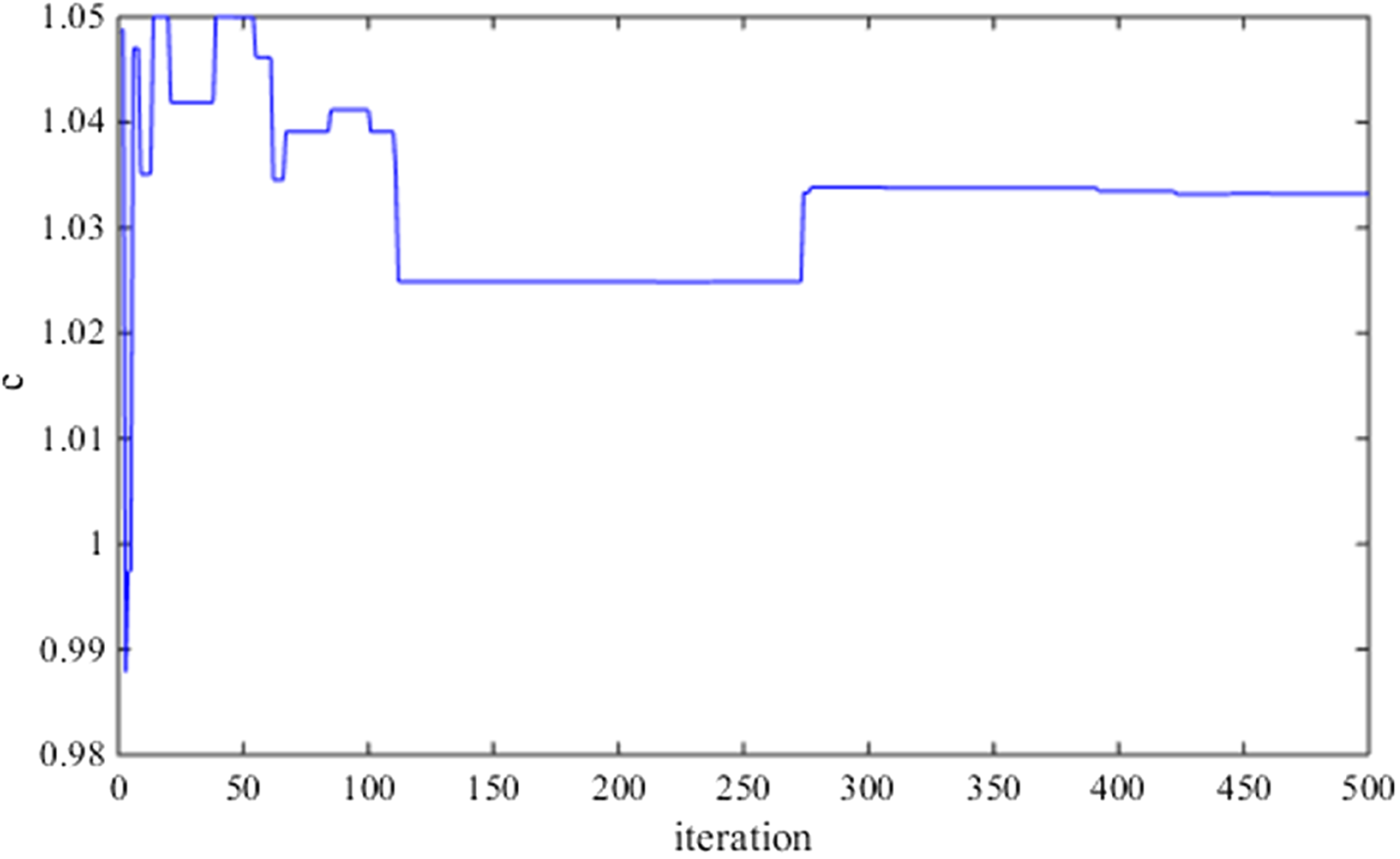
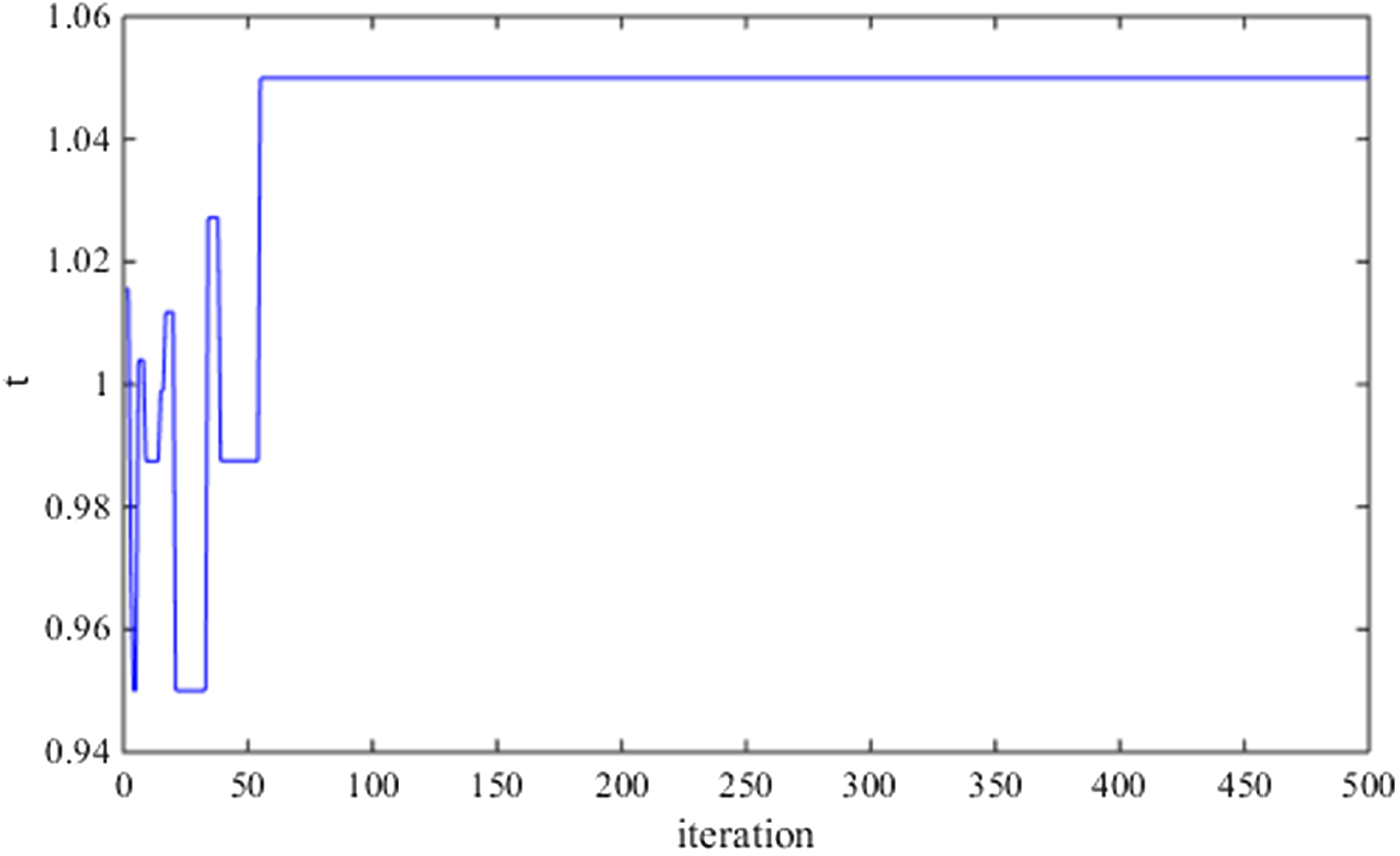
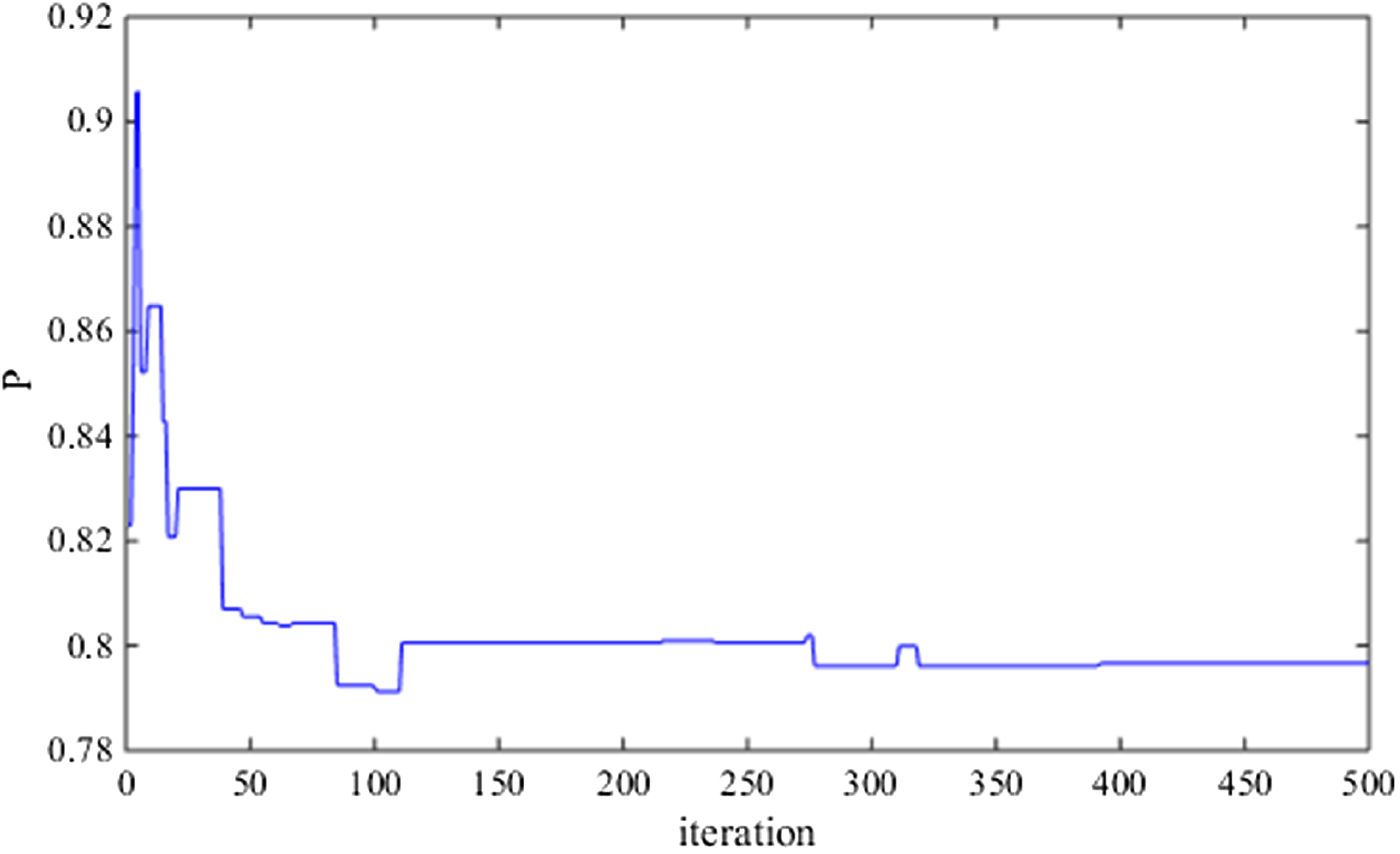
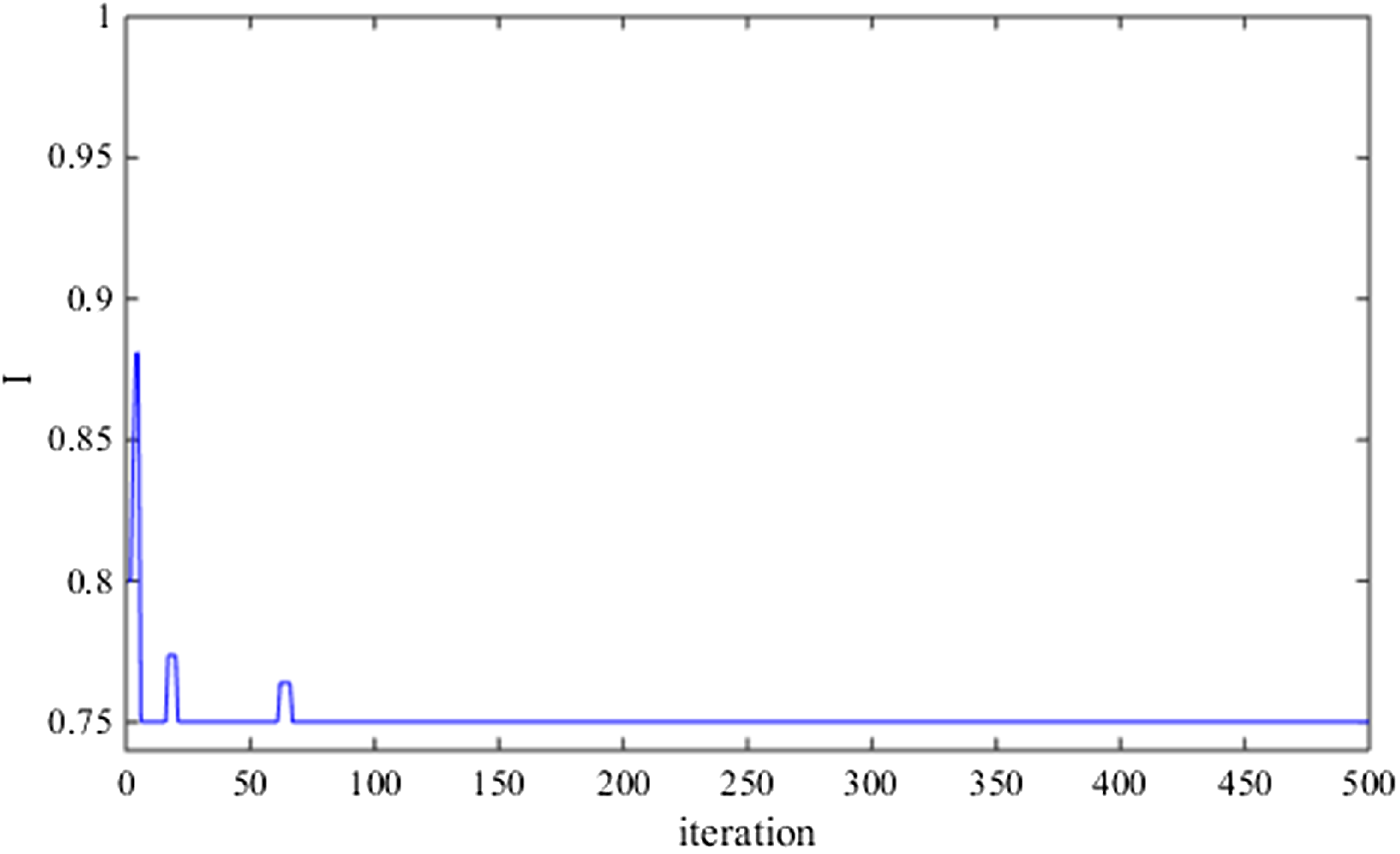
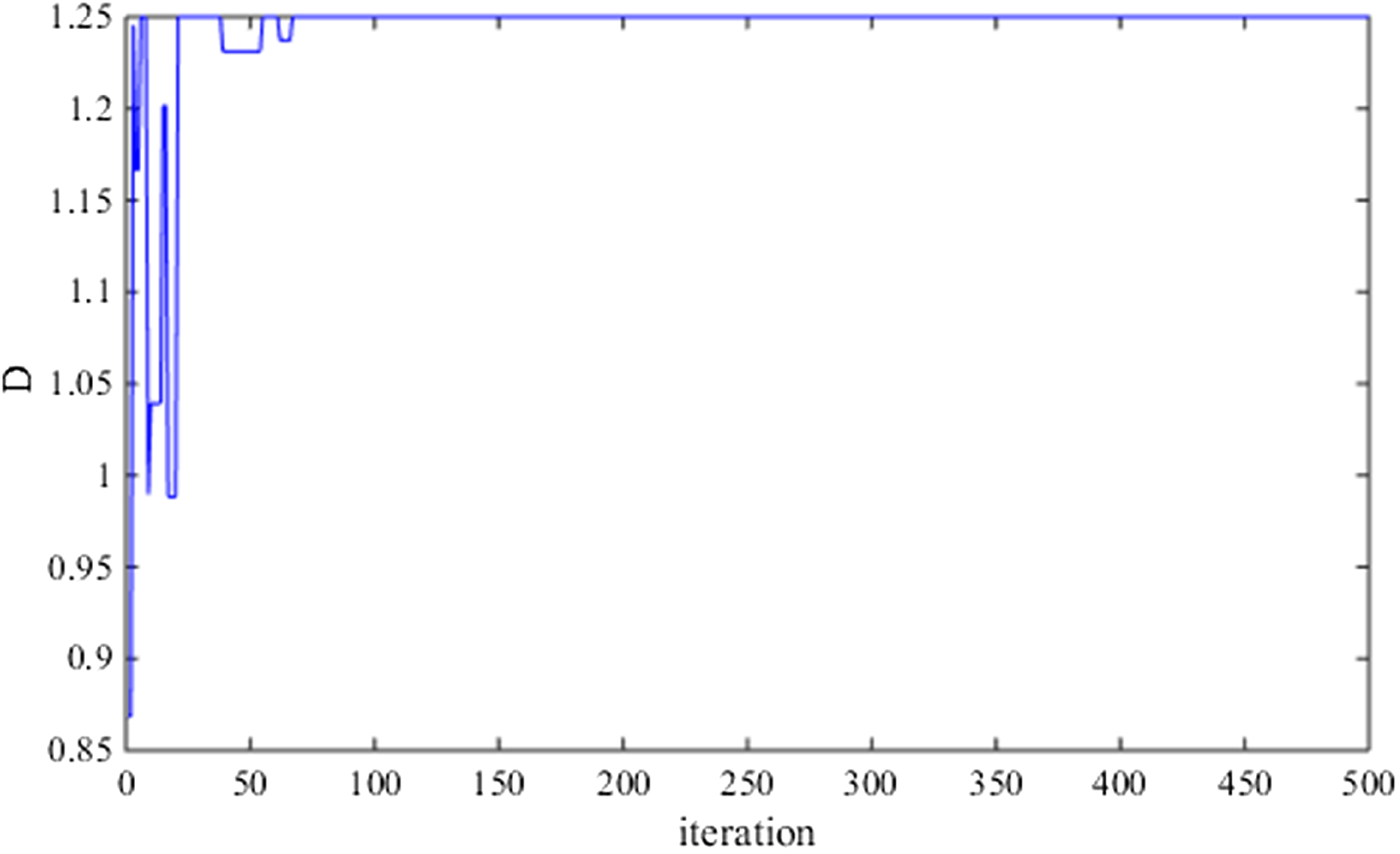
As a result of BSO algorithm-based simulations, the input coefficients b, c, m, t, P, I, D were obtained as 1.026, 1.033, 0.950, 1.05, 0.796, 0.750, 1.25, respectively. In response to these input values, s, r and o that are autonomous performance parameters were calculated as 13.3151, 14.3859 and 1.2647, respectively.
In the BSO-based optimisation process, the changes of the coefficients of the input variables versus iteration are given in respectively from Fig. 3 to Fig. 9.
The change graph of blade length coefficient versus iteration.

The change graph of blade mass density coefficient versus iteration.

The change graph of blade chord width coefficient versus iteration.

The change graph of blade twist angle coefficient versus iteration.

The change graph of proportional gain coefficient versus iteration.

The change graph of integral gain coefficient versus iteration.

The change graph of derivative gain coefficient versus iteration.

When the results are examined, the coefficients of b, c and t tend to increase, while coefficient m tends to decrease. The fact that these results are satisfactory in terms of design improvement in practical application reveals the effectiveness of the method.
5.0 Conclusions
The development of technology has greatly influenced the development of fixed or rotary wing unmanned aerial vehicles and has encouraged the design of different sizes and types of aircraft for different missions.
In this study, it is aimed to maximise the autonomous flight performance of the unmanned helicopter produced at Erciyes University. First, a dynamic model of this unmanned helicopter, which is electrically driven, was created. The reason for this is that there is no direct relationship between the input and output variables selected in the study. This dynamic model is used as a cost function in the BSO algorithm. In addition, simulations can be performed using wide limit values with optimisation algorithms. However, in this study, some limit values have been applied to the input values in order to obtain reasonable results in terms of practical applicability. New simulations can be performed by changing these limit values to various reasonable limit values in different studies. With the objective function created with the limit values determined in this study, the gain parameters of the autopilot system are calculated simultaneously with the helicopter variables to be of equal importance. The simulation results of our proposed model are presented in tables and figures. When the results are examined, it is seen that the obtained values are in the desired value ranges. This supports the success of the BSO algorithm in the optimisation process. The results also showed that the modeling provided an improvement of 29.92%. Therefore, it has been shown that this innovative method proposed in this study will be an alternative method for designers.
Data availability statement
All data used during the study are available from the corresponding author by request.
Acknowledgment
This work was supported by Research Fund of Erciyes University Scientific Research Projects (BAP) Coordination Unit under Project Number: FBA-2018-7640.