Women's representation in elected and appointed positions is often seen as a matter of justice and equity (Burrell Reference Burrell1997). Beyond symbolic representation, many believe that a greater presence of women in institutions that have traditionally been controlled by men can facilitate the attention to issues that disproportionately affect women (Dahlerup Reference Dahlerup1988; Dodson and Carroll Reference Dodson and Carroll1991; Kanter Reference Kanter1977). As the election of women has grown in the past decade, researchers have shown a renewed interest in understanding under what conditions women's descriptive representation can produce more effective substantive representation of women's interests. A number of feminist scholars argue that increasing the descriptive representation of women in legislatures is essential to remedy existing inequalities suffered by women (Mansbridge Reference Mansbridge1999). But electoral practices aimed at increasing women and minorities in office, such as majority-minority districts or gender quotas throughout European and Latin American countries, have produced varied results concerning the substantive representation of women and minority interests. Understanding the electoral and institutional features that strengthen or attenuate women's representation, therefore, merits further study.
This research examines the influence of electoral systems on the substantive representation of women in the context of the United States. We examine how multimember districts (MMD) influence the structure of legislative collaboration, especially on issues that disproportionately affect women. Drawing on the extant literature on the relationship between electoral systems and legislative decision making, we argue that MMDs establish the capacity for women to work collaboratively to advance a women's issue agenda (given an increase in the number of women winning seats) and provide incentives for female legislators (regardless of their ideological or partisan leanings) to cultivate a “women's issue agenda” that distinguishes them from copartisans and facilitates their reelection goals. We examine the effect of electoral systems on women's policy representation through a case study of the Arizona state legislature, which uses a mixed electoral system in the House and Senate.
Using social network analysis, this research examines the effect of electoral rules on patterns of legislative collaboration, especially on issues that disproportionately affect women. We find a strong effect of gender in shaping legislators' cosponsorship of legislation addressing “women's issues” in MMDs (i.e., the Arizona House) but not in single member districts (SMDs—i.e., the Arizona Senate). We compare these patterns of legislative collaboration on women's issues to all issues and state welfare issues not specifically related to women's issues. We find that partisanship and ideology, but not gender, primarily influence welfare cosponsorship networks as well as cosponsorship networks overall; however, gender is the predominant factor shaping collaboration on “women's issues.” These results shed further light on how electoral rules influence women's representation and have normative implications for the broader concern of representation in the United States. That is, electoral rules are not neutral with respect to who gets elected and their incentives to advance particular policies. Thus, attention to electoral rules that foster incentives for legislators to respond to women as a constituency may be just as important as increasing the number of women in office.
THEORETICAL FOUNDATIONS
Theories of representation often focus not only on what kinds of policies are enacted, but also on who our elected officials are. If we assume that legislators' backgrounds and experiences influence their behavior, then the underrepresentation of women in elected office raises concerns regarding the policy representation of women as a group. Despite mixed evidence of male and female legislators espousing distinct voting records,Footnote 1 contemporary research has found ample evidence that gender shapes the agenda-setting stage of the legislative process (Barnello and Bratton Reference Barnello and Bratton2007; Thomas Reference Thomas1994). Much of the earlier research on women's substantive representation focused on whether an increased number of women in legislatures corresponds to more legislation focused on issues that disproportionately affect women. This research often assumed that one could articulate what a “women's agenda” is and that female legislators act cohesively to promote that agenda. Studies demonstrate that female officeholders are more likely to give higher priority to legislation that affects women (Balla and Nemacheck Reference Balla and Nemacheck2000; Bratton and Haynie Reference Bratton and Haynie1999; Dodson and Carroll Reference Dodson and Carroll1991; Saint-Germain Reference Saint-Germain1989; Swers Reference Swers1998; Thomas Reference Thomas1994).
Despite their interest in this agenda, however, women's legislative actions do not always reflect the pursuit of this agenda. Reingold (Reference Reingold2000), for example, finds that the connection between descriptive and substantive representation of women is strong in some instances but much weaker in other circumstances. Examining cosponsorship across nine state legislatures, Bratton and Rouse (Reference Bratton and Rouse2011) find that gender shapes legislative cosponsorship in only four of the states. More recently, Osborn (Reference Osborn2012) argues that understanding women's substantive representation requires taking into account how political parties shape the types of alternatives they offer to solve women's policy problems and use their institutional prerogatives to constrain and influence which policy proposals become laws.
Efforts to explain why in some instances female legislators pursue a feminist agenda yet in other cases are indistinguishable from their male colleagues lead scholars to critical mass theory. Critical mass theory suggests that the percentage of women serving in the legislature may explain the variable relationship between women's descriptive and substantive representation. Some have found that more bills concerning “women's issues” are introduced and passed in legislatures with more women (Bratton Reference Bratton2005; Thomas Reference Thomas1991; Reference Thomas1994). Moreover, researchers have found that a growing number of female representatives produces increases in both the number and rate of enactment of bills focused on women's issues (Saint-Germain Reference Saint-Germain1989; Vega and Firestone Reference Vega and Firestone1995). These researchers argue that when women reach a “critical mass,” there will be a more supportive legislative environment where women move beyond token status and have a greater capacity to pursue an agenda focused on “women's issues.” Underlying critical mass theory is the assumption that once minorities grow in number, they display more cohesive behavior.
Others argue that a growth of women in the legislature could have a variety of effects on legislative decision making and outcomes. Bratton (Reference Bratton2005) argues that an increase in female representation could also influence men's legislative behavior, leading to more male legislators also focusing on women's issues. Other researchers, however, argue that there could be a backlash as women rise in numbers, resulting in the obstruction of women's policy priorities (Hawkesworth Reference Hawkesworth2003) or that the likelihood of women acting as a cohesive legislative group declines as their numeric representation increases (Carroll Reference Carroll2001). Kanthak and Krause (Reference Kanthak and Krause2012) argue that gains in minority and female legislators may lead to a “diversity paradox,” whereby minority group members experience a backlash as they ascend beyond token status. They maintain that for women and minority groups to achieve gains in terms of policy, not only must they reach sufficient size in the legislature, but they also must conquer the coordination problems that come with greater numbers.
The factors enhance and strengthen the linkage between descriptive and substantive representation remains in question. There is variation in the extent to which the presence of women in office translates into greater attention to women's issues and ambiguity in the causal mechanisms underlying the correlations between descriptive and substantive representation. Thus, it is necessary to develop and test theoretical expectations about when increasing the number of female legislators will provide the kind of representation sought by advocates and practitioners. Rather than questioning whether women matter for legislative politics, we believe that establishing expectations regarding when and why women's presence is expected to change legislative priorities and policy adoption is important.
MULTIMEMBER DISTRICTS AND INCENTIVES AND CAPACITY TO CULTIVATE A WOMEN'S AGENDA
Previous research examining the linkage between descriptive and substantive representation of women has sometimes focused on the behavior of legislators with less consideration of the institutional or electoral context within which the behavior occurs. New Institutionalism informs us of the critical role that institutional arrangements have on legislative behavior and warns against studying political behavior within a vacuum (March and Olsen Reference March and Olsen1989). This warning seems particularly important for the study of gender in legislative institutions, as legislative scholars have long noted the powerful effect of the electoral connection as well as internal norms and institutions on legislative behavior (Mayhew Reference Mayhew1974). Research has shown that electoral opportunities and constraints for women are structured largely by macrolevel factors, such as the electoral system or party recruitment strategies (Sanbonmatsu Reference Sanbonmatsu2002). There has been less attention devoted to the effect of electoral rules on women's incentives to distinguish themselves from their copartisans by pursuing a women's agenda.
Institutional explanations of women's representation have focused primarily on the effect of electoral systems on the number of women in elected office. Early comparative work examined differences between proportional representation and single-member district systems on the descriptive representation of women (Norris Reference Norris1985; Rule Reference Rule1987). These studies have largely demonstrated that PR systems elected more women than did single-member district systems. More recently, other features of electoral systems have been examined, including district magnitude (i.e., number of persons elected per district) and nominating processes. Examining fourteen state legislatures with mixed district systems, Darcy, Welch and Clark (Reference Darcy, Welch and Clark1985) found that women seeking office are more likely to seek office and win election in MMDs compared to SMDs. Others (Arceneaux Reference Arceneaux2001; Carroll Reference Carroll1994; Matland and Brown Reference Matland and Brown1992) have demonstrated a correlation between the use of MMDs and the election of women to state legislatures. Matland and Studlar (Reference Matland and Studlar1996) maintain that MMDs produce a contagion effect in which interparty competition induces party elites to nominate female candidates. Others, however, argue that PR is the main facilitator of women's representation (Norris Reference Norris1985; Welch and Studlar Reference Welch and Studlar1990).
The increased presence of women in elected office facilitated in some instances by MMDs, combined with evidence that women tend to advance a distinctive legislative agenda focused on women's issues (particularly as their numbers increase in the legislature), suggests that MMDs may enhance the capacity of female legislators to influence the legislative agenda and to choose to do so by introducing legislation that seeks to benefit women as a group. We posit two possible mechanisms (one indirect and one direct) by which MMDs may enhance the linkage between women's descriptive and substantive representation. First, a substantial literature has demonstrated that MMDs are positively associated with the election of women to office. Critical mass theory suggests that as the number of women in elected office increases beyond a “critical mass,” attention to women's policy concerns will increase (Childs and Krook Reference Childs and Krook2008). Thus, there may be an indirect link between MMDs and women's substantive representation. In modeling this relationship, however, we must be careful to account for ideological heterogeneity and extremism that may also result from MMDs (Cox Reference Cox1990; Richardson, Russell, and Cooper Reference Richardson, Russell and Cooper2004). Rather than assuming that all women will espouse a similar view about women's rights or choose to advance a women's issue agenda, we can empirically test whether Republican women and Democratic women work collaboratively to pursue a women's issue agenda or whether the structure of collaboration on women's issues is primarily defined by partisanship (or ideology) with Democratic women and Democratic men working together to advance feminist issues.
The second way in which electoral institutions (specifically, MMDs) may affect women's substantive representation is through direct influence upon the incentives that legislators face to distinguish themselves from their copartisans, which will influence the kind of legislative agenda they espouse. Prior research maintains that electoral rules have a prominent role in the position-taking incentives of candidates and parties. How electoral rules allocate legislative seats among the many candidates influences how beneficial it is for politicians to distinguish themselves from their copartisans. In the comparative literature, research demonstrates that in systems that foster intraparty competition, as the district magnitude increases (i.e., more individuals are elected per district), the incentives to build a personal vote increase (Carey and Shugart Reference Carey and Shugart1995). As the number of other copartisans from which a candidate must distinguish herself increases, it becomes more important to build an individual reputation, and candidates are motivated to promise particularistic benefits to an ever smaller group of voters in order to be reelected. Thus, the link between descriptive and substantive representation is shaped by the incentives that the electoral systems provide for legislators, especially female legislators, to cultivate a “women's issue agenda.” Some female legislators may experience group consciousness and harbor a sense of “linked fate” with women as a group that spurs them to act as champions of women's issues, and they will seek to represent women of their own volition. Others may not view themselves as advocates of women as a group and will, therefore, only act for women when sufficient incentives exist to do so. We posit that these incentives are shaped in large part by electoral rules that shape the nature of legislative competition. It is theoretically possible that women's issues could contribute to a partisan platform that distinguishes legislators from competitors in other parties. It is, therefore, reasonable to hypothesize that the link between descriptive and substantive representation is stronger in systems that encourage legislators to cultivate party reputation. In this case, we expect male and female Democrats promoting a women's agenda more so than female Republicans and Democrats.
Alternatively, under electoral rules that encourage legislators to cultivate a personal vote, championing women's issues can serve as a tool that differentiates a female representative from her male copartisans among voters within her district; thus, we may see bipartisan collaborations among female legislators. Despite the majority of legislators throughout the world being elected from multimember districts, only fifteen U.S. state legislative chambers currently use this selection method. Within MMDs, the structure of elections varies significantly. The basic types of multimember systems include bloc, bloc with abstention, staggered, cumulative, and post/seat-designated (Richardson, Russell and Cooper Reference Richardson, Russell and Cooper2004). According to Cox (Reference Cox1990), the variation across these different types of systems has important consequences for legislative behavior. Specifically, post (e.g., Washington, Idaho, and Maryland houses) and staggered elections do not pit legislators against one another since the post elections designate a seat A or seat B (which do not overlap), and staggered elections entail legislators from the same district being up for reelection in alternating years. The staggered and postdesignated MMDs function as single-member districts (Squire and Hamm Reference Squire and Hamm2005).
Cumulative MMD elections allow voters to stack more than one vote on a single candidate or to separate their votes; however, this system has not been employed in U.S. state legislative elections since Illinois reformed its system in 1982 (Adams Reference Adams1996). Bloc elections consist of a free-for-all in which every candidate is placed on the ballot, and the two highest vote-getters win the election. Bloc abstention elections permit voters to cast one vote and abstain with their other vote if they choose. For our purposes, we are most interested in MMDs structured by bloc or bloc abstention rules. The structure of the bloc/bloc abstention system provides intraparty competition and encourages legislators to distinguish themselves from their copartisans. We hypothesized earlier that these incentives would induce female legislators to cultivate a “women's agenda” as a way to distinguish themselves from competitors.
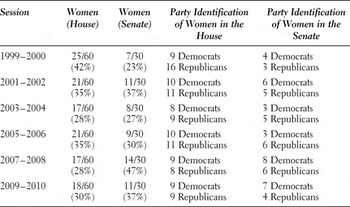
The state of Arizona provides an ideal case study with which we can assess the influence of MMDs (structured by bloc abstention rules) on legislators' propensity to pursue a women's policy agenda. The mixed electoral system, which uses MMDs for the House and SMDs for the Senate, provides a unique opportunity to isolate the effect of district magnitude on legislative behavior holding other variables constant. Arizona is comprised of 30 legislative districts, of which each district elects one state senator and two state representatives. Each voter has two votes that she may cast in the state house election (yet she may not “stack” those votes on one candidate). The two state house candidates who receive the most votes win the seats. State senators are elected from standard single-member districts in which the candidate who is first past the post wins. Age and residency requirements for the House and Senate candidates are the same. In addition to the key electoral variation, Arizona also provides a good test case to examine the role of gender in shaping legislative behavior, as a large number of women have been active in Arizona politics, and there are sufficient cases of women in each party to avoid conflating the independent roles that party and gender may play in shaping legislative behavior. Table 1 presents the percentage of women serving in the Arizona House and the Arizona Senate from 1999–2010.
Women's representation in the Arizona legislature (1999–2010)

The percentage of women serving in the Arizona legislature fluctuates from mid-20% to mid-40% over the period examined. The percentage of women serving in the House is generally higher, except for the 2001–2002 legislative session. This is consistent with prior research that demonstrates that more women are elected in multimember systems than those using single-member districts. The partisan distribution of women shows balance across chambers and sessions. Indeed, during 1999–2000, there were nine Democratic women and sixteen Republican women serving in the Arizona House, while four Democratic women and three Republican women served in the Senate. This breakdown is consistent for the other legislative sessions that we examine.
ASSESSING THE SUBSTANTIVE REPRESENTATION OF WOMEN'S ISSUES: A NETWORK APPROACH
We posit that MMDs will enhance the relationship between the descriptive and substantive representation of women by providing both the capacity and incentives for female legislators to cultivate a women's policy agenda to distinguish themselves from copartisans. Before proceeding with our analysis, we first must discuss how we will examine women's substantive representation as measured through cosponsorship activities of legislators. Scholars frequently model legislators' agenda-setting activities by the percentage of the bills sponsored by legislators on a particular issue. This measure assumes that all bills are equal and that cosponsorship decisions are independent from one another. We argue that agenda-setting and cosponsorship are inherently social acts whereby legislators build relationships with other members to advance their policy priorities. Legislators have important incentives to seek out cosponsors of their proposals since, as Krutz (Reference Krutz2005) notes, the likelihood that a measure receives serious attention is enhanced by recruiting bill cosponsors.
Just as legislators have incentives to build coalitions within the legislature, electoral institutions also influence the behavior of legislators. In particular, institutions can influence the way in which policy makers interact with one another in the pursuit of their particular interests (i.e., choices over collaborative relationships). Legislators are driven by a desire to satisfy their constituency's preferences so they maintain their positions as elective representatives. It is especially important to note that legislators from MMDs share geographic constituencies, which should alter their incentives for collaboration (Gross Reference Gross2009). The MMD system provides natural allies with whom legislators can collaborate to secure policy benefits and retain electoral gains. Given the fact that in MMDs, the risk of turnover is higher, collaborative efforts among legislators become an electorally motivated incentive that legislators interested in fulfilling their static ambitions use. This suggests that legislators sharing districts would be more inclined to work together and also more willing to cross party lines to build linkages. It appears that both party identification and gender will shape collaboration in MMDs.
In MMDs, legislators will work together and cross party lines when the incentives outweigh the costs. Legislators recruit their colleagues to help advocate for certain issues, and those legislators, in turn, often become advocates for these policies, and over time may influence others to join them on these issues or others important to them or their constituents. Women not only offer a unique perspective, but also will seek out other women with whom to collaborate and advocate these issues unique to the female experience. Moreover, in the process of advocating women's policy interests, female legislators often bring these issues to the attention of male colleagues, who may lend support once the case is made for such legislation. Thus, issue entrepreneurship may often be guided by legislators' personal experiences and social identity and may explain why women might often seek out other women (even across party lines) to pursue policies that disproportionately affect women in society.
Legislative collaboration, however, is very likely also enhanced by shared partisan and ideological proclivities or shared interests among constituencies. The processes that shape the relational ties formed among legislators during the pre-floor (“agenda-setting”) stages of the legislative process can help us glean insight into how legislators build coalitions early in the process, how and why particular issues receive attention while others do not, and finally, through analysis of reciprocity in cosponsorship, we may uncover information about the power dynamics present in legislatures.
Although the processes giving rise to legislative cosponsorship are inherently relational, much of the current research on legislative agenda-setting fails to take into account the interdependencies, or systematic clustering, among observations. Conventional approaches treat legislators' decisions to cosponsor legislation as independent observations. But this assumption is questionable, as all legislators do not have the same propensity to cosponsor with another given legislator, nor do legislators have the same propensity to join as a cosponsor on a given piece of legislation. In addition, the relationship entails directionality with one or two legislators typically writing a bill and other legislators joining on (cosponsoring) to show their support for the measure. Social network analysis offers a powerful approach for incorporating both the dependencies between dyads (i.e., pairs of legislators) and directionality of the relationship into our models of legislative cosponsorship.
Social network analysis concerns relationships defined by links among nodes. In this case, nodes represent legislators; however, nodes may also be organizations, interest groups, voters, or states. Network analysis is comprised of a set of tools to examine the associations (or relationships) among nodes rather than the attributes of particular nodes. Social network analysis relies upon the following principles: nodes (i.e., legislators) and their behavior are mutually dependent, connections or ties between nodes can serve as channels to transmit material and/or nonmaterial products (e.g., information, beliefs, money, etc.), and consistent patterns of association among nodes establish structures that can constrain the behavior of other nodes or create opportunities for other nodes. Given the interdependent nature of the legislative process, social network analysis may offer some powerful tools for understanding the connections among legislators. We can ascertain which legislators tend to work together via mutual cosponsorship and where clear divisions may occur (by party, gender, etc.).
Despite the advantages that social network analysis holds for legislative research, current congressional literature lags considerably behind other fields in incorporating social network analysis. Some research, however, has examined the social connectedness of legislators through bill cosponsorship. Fowler (Reference Fowler2006a) develops a measure of “connectedness” from bill cosponsorships that he uses to predict voting on legislation. Fowler (Reference Fowler2006b) and Cho and Fowler (Reference Cho and Fowler2010) use the same measure in subsequent studies to predict legislative influence and productivity of different congresses, respectively. Porter et al. (Reference Porter, Mucha, Newman and Friend2007) have studied legislator linkages through the committee system, and Victor and Ringe (Reference Victor and Ringe2009) examine legislative networks that develop through the caucus system.
Although the growing literature on social networks has illuminated some of the partisan and ideological characteristics that shape legislative behavior, there is still relatively little research on the role of gender, or social identity more generally, in the formation of policy networks. To understand how and under what conditions gender influences legislative agenda-setting behavior, we must gain a much deeper understanding of the relationships that develop among legislators within the broader context within which they initiate legislative proposals. We maintain that in order for gender to be a salient dimension of legislative behavior, there must be legislators who espouse a gender-conscious perspective that they bring to bear on legislative decision making and that this is a function of electoral rules. Thus, we will use social network analysis to examine the nature and structure of cosponsorship behavior in the Arizona House and Senate. Specifically, we will first focus on who is most central in advancing women's issues (compared to state welfare issues and all bills more generally). Then, we will estimate a model that predicts the propensity of members to cosponsor legislation with one another given their party affiliation, gender, ideology, and a number of other controls.
DATA AND CODING
We examine the effect of MMDs on the substantive representation of women through a case study of cosponsorship in the Arizona House of Representative and the Arizona Senate during 1999–2010 (six legislative sessions). We argue that cosponsorship of legislation represents a social connection among members that is distinct from other actions taken by legislators, such as roll call voting, which is constrained by the legislative agenda. To test our key hypotheses, we examined each bill and coded legislation according to whether it concerns a “women's issue” or was related to state welfare (a baseline issue area). We expect Democratic and Republican women to collaborate on “women's issues” but partisanship to structure cosponsorship on state welfare issues more generally.
As a starting point for developing our coding scheme of what constitutes a “women's issue,” we draw upon prior scholarship (Dodson and Carroll Reference Dodson and Carroll1991; Jones Reference Jones1997; Schwindt-Bayer and Mishler Reference Schwindt-Bayer and Mishler2005) to determine which issues have typically been viewed as those that disproportionately affect women as a group. The general issues identified as women's issues include bills concerning children and families, health care/public health, education, and social security. Since these topics in some cases are very general, however, we required that each bill be read thoroughly to determine whether the content actually affected the well-being of women or concerned an area of women's rights, such as abortion, insurance coverage for mammograms, maternity health, pay equity, maternity leave, and domestic violence. Elderly issues were coded as a “women's issues” only if related specifically to women, such as the provision of services for elderly women.Footnote 2
Although our primary interest is the collaborative networks on women's issues, an analysis that only examines legislative behavior on “women's issues” introduces bias due to selection on the dependent variable. Indeed, one could argue that women's propensity to work collaboratively is not isolated to women's issues, and perhaps gender will also inform the cosponsorship decisions on myriad other issues. Further, one might argue that because female legislators typically are seen as more liberal than their male counterparts, women may be just as likely to work together on other types of issues, such as social-welfare issues more broadly (not just those concerning women). Indeed, Swers (Reference Swers2002) finds that female Republican legislators were consistently more active cosponsors of state welfare legislation compared to male Democratic legislators. This raises the question of whether ideology or social identity is the mechanism that leads Democratic and Republican women to cosponsor. Following the work of Swers (Reference Swers2002), we also examine legislative cosponsorship on both women's issues and state welfare issues in addition to cosponsorship patterns for all bills. Since women's issues and state welfare issues are quite similar except for the fact that women's issues explicitly concern women as a group, this provides us with an opportunity to discern whether the patterns we witness are an artifact of Republican women simply being more socially liberal (and, therefore, more prone to cross party lines on social issues regardless if the issue affects women as a group) or whether their identity as women motivates them to cross party lines when they otherwise would not.
We defined state welfare issues as bills primarily dealing with the following: Medicare, Medicaid, civil rights/race, employment/wage rates, housing, elderly, aid to families with dependent children, general assistance, community development, health and hospitals, public welfare, social security, temporary assistance for needy families, primary care clinics/urgent care centers, food stamps, long-term care, family assistance/family leave insurance, dental and other health services, worker's compensation, senior citizens, minimum wage, unemployment, equal rights, emergency medical services, and other services/copayments. The categories of state welfare issues and women's issues were mutually exclusive (i.e., no double coding of issues as both).
Two research assistants coded each of the 6603 bills introduced during the 1999–2010 period, and the overall intercoder reliability for the two coders was 89%. In the Arizona House, sponsorship of women's issues peaked at about 21.5% during the 1999–2000 session. The lowest percentage of women's issues was sponsored during the 2005–2006 session, when only 14.7% of bills sponsored dealt with women's issues. In the Arizona Senate, the highest sponsorship rate of women's issues (22.5%) occurred during the 1999–2000 session, and the lowest rate of sponsorship was found in the 2007–2008 session (17.2%). Meanwhile, sponsorship of state welfare issues in the Arizona House ranged from 7% (2003–2004) to 9% (1999–2000), and the range was from 7% (2005–2006) to 11% (2003–2004) in the Senate.
In addition to the bill sponsorship data, we also compiled data on the attributes of the individual legislators (e.g., partisan affiliation, leadership, committee assignments, district, and gender), characteristics of the bills (i.e., whether it was a “women's issue”), and district-specific census data (e.g., urban district classification, median income, education level). We also collected roll-call data, which we used to create NOMINATE scores (Poole and Rosenthal Reference Poole and Rosenthal1997), which may serve as a proxy for legislators' ideology. To estimate legislators' W-NOMINATE scores, we used roll-call data from all competitive votes (at least 5% voting on one side) during each legislative session.
ANALYSIS AND RESULTS
Assessing Centrality Across Issues
We consider bill cosponsorship to represent an implicit social relationship between legislators. Each cosponsorship matrix consists of each legislator's decision to join as a cosponsor on each bill (1 = cosponsor, 0 = not). From these cosponsorship data, we create an affiliation matrix (M × M, where M is the number of legislators in the chamber) by counting, for each individual legislator i and j, the number of instances where i cosponsors j's bill. Each cell in the affiliation, or adjacency, matrix represents the number of times a legislator cosponsors another legislator's bill. This matrix is asymmetric since we include information about the direction of the cosponsorship relationship. The total number of bills on which legislators have cosponsored represents the strength of their social network tie. Those who have cosponsored together more frequently have a stronger tie than those infrequently cosponsoring legislation together. Methodologists have developed a variety of techniques that allow us to examine not only the average likelihood of agreement between any two legislators, but also a measure of legislative power based on a social-network definition of influence, called centrality.
Social network analysis provides various centrality indices that help characterize the extent to which any given actor plays a central role in the network (Freeman Reference Freeman1979). Centrality is a concept derived from graph theory that seeks to describe the most “important” node(s) in a graph. Each individual legislator in the chamber is represented by a node; connections between individuals occur when a legislator cosponsors another legislator's bill. An individual's importance is calculated as a function of these links in the context of the graph. Centrality measurements have been used in previous research to ascertain legislative influence when it is not possible to observe network connections directly, but instead to rely upon implicit influences, such as cosponsorship of legislation (Fowler Reference Fowler2006a).
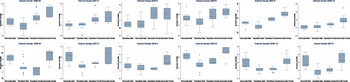
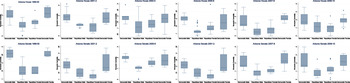
We first compare the distribution of the Bonacich centrality scores across the different electoral systems of the Arizona House (MMD) and the Arizona Senate (SMD).Footnote 3 In the figures, we divide legislators based on their gender and party affiliation to facilitate comparisons across these groups. In addition, we estimate the Bonacich centrality measures for women's issues alone and state welfare issues alone.Footnote 4 This will provide us with a basis to compare the activities of legislators by partisan affiliation and gender to uncover who is most active and “central” in the cosponsorship networks across two issue subsets. Figures 1 and 2 provide box plots of the legislators' Bonacich centrality scores for the Arizona House and Senate. Figure 1 displays the distribution of Bonacich centrality scores for only bills coded as women's issues. Figure 2 shows the distribution of Bonacich centrality scores for only bills coded as state welfare issues (note that these were coded so that they do not overlap women's issues).
Bonacich centrality of Arizona state representatives and senators on women's issues.

Bonacich centrality of Arizona state representatives and senators on welfare issues.

If, indeed, MMDs encourage female legislators to work together collaboratively in pursuit of a women's issue agenda, then we would expect to see much higher Bonacich centrality scores for Democratic and Republican female representatives compared to their male counterparts in the House. We would also anticipate that gender differences may not be as stark in the Arizona Senate (due at least in part to their use of single-member districts), and perhaps party will play a more central role given the electoral rules. Examining Bonacich centrality scores by gender and party in Figure 1, the centrality scores for men and women appear substantially different in the Arizona House but much less so for men and women in the Arizona Senate. In the Arizona House during the 1999–2000 session, we see a mean centrality score of 0.217 and 0.178 (with standard deviation of 0.052 and 0.045) for Democratic and Republican female state representatives, respectively. The mean centrality score is 0.134 and 0.088 (with standard deviation of 0.031 and 0.045) for Democratic and Republican male state representatives, respectively. Consistently, in the Arizona House, Democratic women have the highest mean centrality scores on women's issues with Republican women following. We performed a Kolmagorov-Smirnov (K-S) test for equality of distribution for each session by party and then by gender. The K-S test for equality of distribution reveals statistically significant differences in the distributions for Republican and Democratic representatives in every session except 2001–2002. The K-S test also revealed significant differences between male and female state representatives except for the 2003–2004 session.
We now examine the distribution of Bonacich centrality scores on welfare issues. We anticipate partisan differences will emerge on welfare issues, and previous research also suggests that gender may emerge on welfare issues as well (Swers Reference Swers2002). Figure 2 displays the centrality scores by gender and party on welfare issues. Welfare issues appear much more structured by partisanship than gender, and this seems consistent across the House and the Senate. In the Arizona House during the 1999–2000 session, we see a mean centrality score of .228 and .138 (with standard deviations of .053 and .037, respectively) for Democratic and Republican female state representatives on welfare issues, respectively. The mean centrality score is .201 and .100 (with standard deviation .048 and .044, respectively) for Democratic and Republican male state senators on welfare issues, respectively. The Democrats seem much more active in the sponsorship of legislation concerning welfare; however, the Republicans are not completely inactive, as we would expect to see conservative measures concerning welfare programs as well. We again performed a K-S test for equality of distribution for each session by party and then by gender. The K-S test for equality of distribution reveals statistically significant differences in the distributions for Republican and Democratic senators in every session. But the K-S test failed to uncover statistically significant gender differences on welfare issues.
The Statistical Analysis of Cosponsorship Networks
We now turn to a multivariate analysis to examine the factors that explain legislators' propensity to form ties across different electoral systems and policy domains. We assume that (1) legislators are not acting independently from one another and that (2) one can systematically account for these dependencies that develop among legislators. Given the assumptions of our theory, we must adopt a statistical approach that can allow for the network structures (or dependencies among the legislators) to be modeled. Until recently, generalized linear models were typically employed on relational data, ignoring the violation of the assumption of conditional independence of observations. More recent methodological innovations geared toward analysis of relational data, however, have altered our approaches for analyzing the properties of networks (Goodreau, Kitts, and Morris Reference Goodreau, Kitts and Morris2009). We draw upon random graph theory, which asks what properties we expect when ties between actors form at random. The simplest random graph is the Bernoulli random graph, in which each edge in the graph has an independent probability of being a 1 or 0. Because most networks are characterized by clustering, we may want to know what the graph looks like, conditional on other features of the graph. Effectively, we want to know, “What is the probability of observing the graph we have, given the set of all possible graphs with the same number of edges?”
We estimated a series of temporal Exponential Random Graph Models (modeling all policy areas, women's issues only, and state welfare issues only) to test our main hypotheses associated with how gender shapes the formation of policy cosponsorship networks in the diverse electoral systems (MMD versus SMD). While ERGM's are ideal for network data, they suffer from a couple of limitations, namely degeneracy problems, sensitivity to missing data, and the inability to model networks over time (Cranmer and Desmarais Reference Cranmer and Desmarais2011). Since the network we examine is observed longitudinally, we utilize an extension of the ERGM known as the temporal Exponential Random Graph Model (TERGM). This model was developed by Hanneke and Xing (Reference Hanneke and Xing2007) and has been extended by Desmarais and Cranmer (Reference Desmarais and Cranmer2012). We interpret the parameters in the same fashion as the ERGM.
The dependent variable of our model is the sociomatrix of cosponsorship among legislators. Social networks are often characterized by local clustering. From a theoretical perspective, sociological theories suggest a propensity for homophily (or nodes with similar attributes to form ties) or assortative mixing among actors in a network. The theory advanced above suggests particular tendencies for legislators to develop ties with one another (i.e., assortative mixing), and we expect that differences in the districts from which legislators are elected in the Arizona House and Senate will shape their incentives to develop particular ties with one another (or to advance particular kinds of issues to distinguish themselves from copartisans). Our theory suggests that legislators' tendencies for assortative mixing based on shared social identity (gender), partisan and ideological proclivities, and proximity (such as shared committee membership) will depend on the electoral rules, which structure the incentives for legislators to collaborate with one another. In addition to these tendencies of selective mixing, others have suggested endogenous factors that shape the processes by which ties are formed (Goodreau, Kitts, and Morris Reference Goodreau, Kitts and Morris2009). Transitivity and reciprocity are common features of networks and are common in the legislative arena (Fowler Reference Fowler2006a). For example, legislators may rely on cues (e.g., a friend of a friend is my friend), thus enhancing the occurrence of triad closure, which leads to transitivity. Goodreau, Kitts, and Morris (Reference Goodreau, Kitts and Morris2009) explain that the tendency for triad closure in networks may stem from multiple sources, including proximity effects (so, two legislators connected with one another because of their relationship with a third—e.g., leadership) or cognitive processes (e.g., two legislators are connected through their agreement with a third legislator). We include a term for geometrically weighted edgewise partnered shared distribution (GWESP), which captures transitivity structures in networks.Footnote 5 To capture dyadic dependence, we also include the geometrically weighted dyadic shared partner (GWDSP), which is a function of the number of dyads which have k partners in common.Footnote 6 Moreover, we include a parameter to control for network reciprocity, which implies the tendency for legislator i and j to cosponsor each other's legislation.Footnote 7
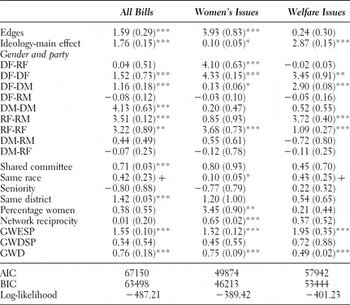
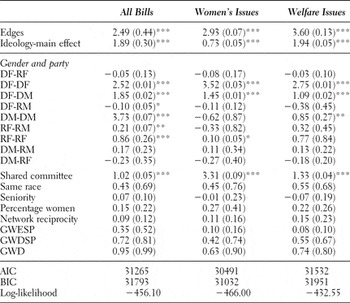
The results of the exponential-family random graph model of cosponsorship in the Arizona House of Representatives are presented in Table 2; Table 3 presents the results of the Arizona Senate. We estimate the model for all legislative bills, only women's issues, and only state welfare issues broadly defined. Comparing results for the Arizona House and Senate, we see that gender emerges as a salient predictor of legislative cosponsorship on women's issues in the House but not in the Senate, as we expected. Moreover, this effect is present even after controlling for ideology, which has a significant effect on cosponsorship across all issues, as well as a number of other individual factors that might otherwise explain the effect. The third column of Table 2 provides the estimates of the model of cosponsorship on women's issues among Arizona representatives. We find that ideology and race have significant main effects on legislators' propensity to cosponsor legislation concerning women's issues. When we examine the relationships by gender and party, we find that Democratic and Republican women have a significant likelihood of joining together to cosponsor legislation concerning women's issues. The likelihood that a Republican woman and Democratic woman form a tie on a bill concerning a “women's issue” is about 60 times that of a Republican man cosponsoring with another Republican man (i.e., the baseline category). Likewise, the likelihood of a Democratic woman cosponsoring legislation concerning “women's issues” with another Democratic woman is about 76 times that of the baseline category. When we examine those same relationships for state welfare issues, we find that the coefficient for Republican Female and Democratic Female is negative and does not reach statistical significance. We find that female representatives work across party lines on women's issues but not on state welfare issues or all issues, suggesting that a shared social identity emboldens women to work toward the advancement of issues that disproportionately affect women regardless of party affiliation or ideology. The effect of women cosponsoring with other women is also much greater in magnitude than the effects by party.
Temporal exponential random graph model for Arizona House of Representatives (1999–2010)

Note: Levels of significance: ***p < 0.001; **p < 0.01; *p < 0.05; +p < 0.10
Temporal exponential random graph model for the Arizona Senate (1999–2010)

Note: Levels of significance: ***p < 0.001; **p < 0.01; *p < 0.05
For comparison, the second and fourth columns of Table 2 provide the ERGM for all issues and welfare issues only, respectively. Here, we see that partisanship has a much more significant effect on legislators' decisions to cosponsor with one another than gender. In particular, we find that Democratic women and Democratic men have a strong propensity to cosponsor with one another on all issues and welfare issues but that the effect is not significant for women's issues. We find a similar effect for the propensity of Republican men and Republican women to cosponsor legislation. Race exerts some effect on cosponsorship, while legislators from the same district are only more likely to cosponsor legislation when we pool all bills. The percentage of women in the chamber is not a significant predictor of cosponsorship decisions in the pooled model or on welfare issues alone.
The terms introduced to control for endogenous tendencies are significant in the Arizona House models. The significance reveals the tendency toward triad closure in each of the models (i.e., if legislator A frequently cosponsors with legislator B and legislator B frequently cosponsors with legislator C, then there is a strong likelihood for legislators A and C to cosponsor legislation). The term for network reciprocity is positive and significant in the models for only women's issues and welfare issues in the Arizona House of Representatives. This indicates a high likelihood that legislators cosponsor each other's bills as opposed to one-sided relationships.
The results of the ERGM for the Arizona Senate reveal more partisan structuring on all sets of issues. For example, we find that Democratic women and men have a strong propensity to collaborate on legislation, while the relationship between Democratic women and Republican women is not statistically significant in the Arizona Senate models (and is, in fact, negative). This finding supports our theory that MMDs offer incentives for female legislators of different ideological and partisan stripes to come together to advance women's issues. At the same time, this is a surprising result given the higher level of ideological polarization witnessed in the Arizona House versus the Arizona Senate in voting behavior. Legislators who share committee assignments have a greater likelihood of cosponsoring legislation, and this is consistent across all issues examined. Race emerges as a marginally strong predictor of cosponsorship on women's issues. The percentage of women in the chamber does not reach conventional levels of statistical significance in the Senate models. The network statistics that were included to control for endogenous effects are not significant in the Senate models. We find that women tend to work together to advance women's issues but that the linkage between descriptive and substantive representation is conditional on electoral rules. MMDs give incentives for legislators to engage in women's policy representation.
CONCLUSION
Scholars have long noted the importance of electoral rules for legislative behavior. This research set out to examine how one particular electoral institution—district magnitude (i.e., the use of SMDs versus MMDs)—shapes the substantive representation of women. Although prior research has demonstrated that the use of MMDs facilitates the election of women to office, much less research has examined the consequences for the substantive representation of women's issues.
In this paper, we used social network theory to examine how the use of single-member or multimember districts should affect women's substantive representation. Based on Bonacich power centrality scores and an exponential-family random graph model, we compare legislative cosponsorship networks in the Arizona House, which relies upon multimember districts, and the Arizona Senate, which uses single-member districts across issue domains. The effect of gender in structuring women's issue cosponsorship networks was quite pronounced in the Arizona House, which is consistent with our theory. Specifically, we find that Democratic and Republican women are much more active (higher Bonacich centrality scores) or central on women's issues. In addition, when we examine legislators' propensity to cosponsor together based on demographic and partisan variables, we see a strong relationship emerge among female legislators, in which women are much more likely to cosponsor legislation concerning women's issues with one another, especially in bipartisan fashion. This effect is present even after controlling for the effect of ideology but is unique to women's issues.
This research seeks to bring institutions back into the study of gender effects in legislatures by utilizing the interesting institutional variation that the Arizona legislature affords—a comparison of legislators elected under single-member districts and those elected under multimember districts. Future research may extend this work to examine how legislative collaboration is influenced by changes in electoral rules from single-member districts to multimember districts to further isolate the mechanisms that enhance or diminish the substantive representation of women. The findings of this research suggest that a switch to multimember districts may offer the capacity and incentives for female legislators to collaborate to advance a women's issue agenda that distinguishes them from their copartisans. But the type of multimember districts (i.e., the manner in which elections are structured) surely will also affect the capacity and incentives for legislators to cosponsor one another's legislation.