Introduction
Anxiety disorders are the most common of all psychological disorders affecting older adults (Gum et al., Reference Gum, King-Kallimanis and Kohn2009). Though prevalence rates vary widely, epidemiologic studies suggest that approximately 10% of older adults suffer from an anxiety disorder at any given time (Ayers et al., Reference Ayers, Sorrell, Thorp and Wetherell2007). Evidence from both prospective and cross-sectional research demonstrates that late-life anxiety disorders are associated with serious negative consequences, including increased social and functional impairment, sleep difficulties, and poorer quality of life (Wetherell et al., Reference Wetherell, Roux and Gatz2003; Brenes et al., Reference Brenes2005; Diefenbach et al., Reference Diefenbach, Tolin and Gilliam2012). Even sub-syndromal levels of anxiety and worry have been linked to these same negative consequences (Diefenbach et al., Reference Diefenbach2003; Wetherell et al., Reference Wetherell, Roux and Gatz2003). Due to the strong association between anxiety and poorer well-being in later life, accurate assessment of anxiety among older adults is a critical public health issue.
As with most mental illnesses, prevalence estimates of anxiety in later life are lower compared to those found in younger adulthood (Gum et al., Reference Gum, King-Kallimanis and Kohn2009). Among older adults, most studies have found no association between anxiety symptoms and advancing age (e.g. Pachana et al., Reference Pachana, Byrne, Siddle, Koloski, Harley and Arnold2007); however, at least one study found a curvilinear association between age and anxiety, with symptomology decreasing slightly until mid-70s and then increasing again in later life (Teachman, Reference Teachman2006). As in younger adulthood, late-life anxiety disorders have been found to be more prevalent among women (Beck and Averill, Reference Beck, Averill, Heimberg, Turk and Mennin2004) and medical populations (e.g. Tolin et al., Reference Tolin, Robison, Gaztambide and Blank2005). Residents of long-term care facilities represent a sub-population of older adults who are particularly at risk for anxiety and other psychological disorders. Nursing homes have been described as psychiatric facilities without adequately trained mental health professionals (Rovner et al., Reference Rovner, German, Broadhead and Morriss1990). With regard to anxiety in long-term care, there are many factors to consider that may explain or influence high prevalence rates. For example, anxiety often develops in response to medical illnesses, which are common in long-term care settings. Some evidence suggests that anxiety in long-term care is more strongly associated with health-related variables (e.g. stroke, pain, and negative life events) rather than care-related variables (e.g. length of stay, perceived adequacy of care; Smalbrugge et al., Reference Smalbrugge, Pot, Jongenelis, Beekman and Eefsting2005). Rates of anxiety in long-term care may also be explained, in part, by cognitive impairment, as anxiety is more common among adults with dementia than those without (Seignourel et al., Reference Seignourel, Kunik, Snow, Wilson and Stanley2008). In general, the literature regarding the impact and prevalence of anxiety and worry in these settings is far less developed compared to that of depression. However, initial research has indicated that increased anxiety symptoms are associated with greater functional impairment, pain, and loneliness, as well as decreased well-being in nursing home residents (Smalbrugge et al., Reference Smalbrugge, Pot, Jongenelis, Beekman and Eefsting2005; Reference Smalbrugge, Pot, Jongenelis, Gundy, Beekman and Eefsting2006). The prevalence of anxiety disorders in long-term care settings is largely unknown, with some estimates ranging from 0% to 20% (Smalbrugge et al., Reference Smalbrugge, Pot, Jongenelis, Beekman and Eefsting2005). There are a number of possible explanations for this wide variability, including threats to internal validity (e.g. studies using assessment tools not designed for use with older adults) and external validity (e.g. studies excluding participants with cognitive impairment).
Even with accurate epidemiologic data regarding anxiety disorders in long-term care facilities, prevalence rates likely reflect an underestimate of individuals with clinically relevant anxiety symptoms. This notion is supported by studies that have found associations between sub-syndromal symptoms of anxiety and serious negative health consequences among older adults, including fatigue, distress, and impairment (Diefenbach et al., Reference Diefenbach2003; Wetherell et al., Reference Wetherell, Roux and Gatz2003). Moreover, current diagnostic criteria and many screening instruments do not account for age-related differences in late-life anxiety. One age-related difference in anxiety is prevalence of disorders, as generalized anxiety disorder is the most common anxiety disorder in older adulthood, whereas social phobia is the most common anxiety disorder among younger age groups (Bryant et al., Reference Bryant, Jackson and Ames2008). Older adults also tend to use less pathology-laden terms for anxiety and worry, such as “fret” or “concern” (Stanley and Novy, Reference Stanley and Novy2000), which may be detrimental to the sensitivity of diagnostic tools not designed with older adults in mind. In addition, older individuals are more likely to emphasize the somatic symptoms of anxiety disorders (e.g. gastrointestinal distress) compared to cognitive or behavioral symptoms (e.g. worry, avoidance; Lenze et al., Reference Lenze2005). This tendency represents an added barrier to the accurate detection of anxiety in late life, especially because of the high rates of medical illnesses and prescription drug use (i.e. side effects of medications may resemble anxiety symptoms) among older adults. Further, somatic symptoms of many anxiety disorders often overlap with symptoms of normal aging (e.g. fatigue, sleep disturbance, and difficulty concentrating). Because somatic symptoms of anxiety may be confounded with normal aging, side effects of medications, or medical illness, anxiety assessment tools developed with younger adults may be inappropriate for use with older adults (Kogan et al., Reference Kogan, Edelstein and McKee2000).
These important issues point to the need for older adult specific anxiety screening tools that can be used in long-term care facilities. To date, only three such tools have been developed: the Geriatric Anxiety Scale (GAS; Segal et al., Reference Segal, June, Payne, Coolidge and Yochim2010), the Adult Manifest Anxiety Scale–Elderly Version (AMAS-E; Reynolds et al., Reference Reynolds, Richmond and Lowe2003), and the Geriatric Anxiety Inventory (GAI; Pachana et al., Reference Pachana, Byrne, Siddle, Koloski, Harley and Arnold2007). Though each of these measures has demonstrated promise for detecting clinically significant symptoms of anxiety among older adults, none have been adequately evaluated in a long-term care setting. Each of the aforementioned tools has its advantages; however, the present study focuses on the GAI.
The GAI is a 20-item screening tool for anxiety and worry designed particularly for older adults. The instrument has a dichotomous agree/disagree response format and uses language commonly employed by older individuals to describe anxiety (e.g. “nerves,” “butterflies in my stomach”). The dichotomous response format was selected so that the GAI could also be used with individuals with mild cognitive impairment (Pachana et al., Reference Pachana, Byrne, Siddle, Koloski, Harley and Arnold2007). Thus far, the instrument has demonstrated sound psychometric properties in various populations of older adults, including community-dwelling, treatment-seeking, and international samples. With respect to long-term care facilities, one study established initial evidence of predictive validity and found that scores on the GAI were not related to level of cognitive functioning in this setting (Boddice et al., Reference Boddice, Pachana and Byrne2008). However, this study did not examine several important psychometric properties, including reliability, convergent validity, or discriminant validity.
An added advantage to the GAI is that a short-form (five items) has been developed and initially validated in a sample of community-dwelling older adults (GAI-SF; Byrne and Pachana, Reference Byrne and Pachana2011). The availability of a brief version of the GAI may increase the frequency of its use in settings such as long-term care facilities and primary care, where many responsibilities of healthcare staff are time-sensitive. Furthermore, shortened forms of screening tools may reduce the cognitive demand placed on patients and increase the likelihood of cooperation with testing. Yet, no study has examined the psychometric properties of the Geriatric Anxiety Inventory–Short Form (GAI-SF) in long-term care.
The purpose of the current study was to evaluate the psychometric properties of the GAI and the GAI-SF in a long-term care setting, where psychiatric disorders have become increasingly common (Rahman et al., Reference Rahman, Grabowski, Intrator, Cai and Mor2012). We were also particularly interested in determining whether the GAI-SF could replace the full GAI for detecting clinically relevant symptoms of anxiety and worry among residents of long-term care. Internal consistency, concurrent validity, discriminant validity, predictive validity, and optimal cut-off scores were assessed for both the full and abbreviated versions of the screening tool. With regard to assessment measures for late-life anxiety, Hersen and Van Hasselt (Reference Hersen and Van Hasselt1992) highlighted the need for tools that distinguish anxiety from depression. Recent studies have continued to find a high degree of comorbidity between anxiety and depression among older adults (Byers et al., Reference Byers, Yaffe, Covinsky, Friedman and Bruce2010); therefore, the present study examined the relations between the GAI (and its short form) and a measure of geriatric depression, and measures of executive functioning and adaptive behavior. Both versions of the GAI were expected to be moderately correlated with depressive symptoms and weakly correlated with measures of executive dysfunction and adaptive behaviors. It also was hypothesized that each form of the GAI would be associated with anxiety diagnosis, suggesting predictive validity.
Methods
Participants
Participants were 75 adults residing at a state-operated nursing home. The mean age of the residents was 69.60 years (SD = 10.76, range 52–94 years). Though some of the residents were younger than 60 years old, we opted to include these participants because their level of impairment was more similar to older adults than to middle-aged adults; hence, the GAI may be a more appropriate measure to use than one that has been normed for use with community-dwelling middle-aged adults. There were 39 women (52%) and 36 men (48%). Sixty-nine residents identified as Caucasian (92.0%), with three residents identified as African American (4.0%), one resident as Asian American (1.3%), and two residents as mixed race (Caucasian and African American; 2.7%). The ethnic makeup of the sample is reflective of the ethnic makeup of the region. Residents had psychiatric diagnoses in the following categories: dementia (n = 35, 46.7%), psychotic disorders (n = 35, 46.7%), mood disorders (n = 19, 25.3%), anxiety disorders (n = 10, 13.3%), substance abuse (n = 4, 5.3%), sleep disorders (n = 1, 1.3%), and mental retardation (n = 2, 2.7%). Twenty-four residents (32.0%) had two psychiatric diagnoses and four residents (5.3%) had three psychiatric diagnoses.
Measures
Geriatric Anxiety Inventory (GAI; Pachana et al., Reference Pachana, Byrne, Siddle, Koloski, Harley and Arnold2007). The GAI is a 20-item self-report measure of anxiety symptoms over the past week. Each item is rated “agree” or “disagree.” Higher scores indicate greater anxiety symptoms. The psychometric properties of the GAI have been examined in various samples, including community-dwelling older adults (Pachana et al., Reference Pachana, Byrne, Siddle, Koloski, Harley and Arnold2007; Byrne et al., Reference Byrne, Pachana, Goncalves, Arnold, King and Khoo2010), older adults seeking outpatient clinical services (Pachana et al., Reference Pachana, Byrne, Siddle, Koloski, Harley and Arnold2007), and older adults in various nations including Australia, New Zealand, Spain, Portugal, and the United States (Pachana and Byrne, Reference Pachana and Byrne2012). In a combined sample of clinical and non-clinical older adults, a cut-off score of 10 yielded specificity of 84% and sensitivity of 75% for detecting generalized anxiety disorder (GAD), and a cut-off score of 8 was optimal for detecting any anxiety disorder (80% specificity and 78% sensitivity; Pachana et al., Reference Pachana, Byrne, Siddle, Koloski, Harley and Arnold2007). Regarding internal consistency, Cronbach's α was 0.91 in a sample of non-clinical community-dwelling older adults and 0.93 in a sample of older adults seeking outpatient psychogeriatric services (Pachana et al., Reference Pachana, Byrne, Siddle, Koloski, Harley and Arnold2007). Among older adults seeking psychiatric services, one-week test–retest reliability was excellent (r = 0.91; Pachana et al., Reference Pachana, Byrne, Siddle, Koloski, Harley and Arnold2007). Concurrent validity has been established through strong correlations with the State-Trait Anxiety Inventory (STAI) (r = 0.80; Spielberger et al., Reference Spielberger, Gorsuch and Luchene1970) and with the Goldberg Anxiety Scale (r = 0.70; Goldberg et al., Reference Goldberg, Bridges, Duncan-Jones and Grayson1988) in a psychogeriatric sample (Pachana et al., Reference Pachana, Byrne, Siddle, Koloski, Harley and Arnold2007). In a sample of community-dwelling older adult women, discriminant validity has been established through weak to moderate correlations with the Mini-Mental State Examination (MMSE; Folstein et al., Reference Folstein, Folstein and McHugh1975) (r = −0.11), health status (r = −0.28), subjective memory function (r = −0.20), and social support (r = −0.18; see Byrne et al., Reference Byrne, Pachana, Goncalves, Arnold, King and Khoo2010).
Geriatric Anxiety Inventory–Short Form (GAI-SF; Byrne and Pachana, Reference Byrne and Pachana2011). The GAI-SF contains five items and is derived from the original 20-item GAI. A cut-off score of 3 yields specificity of 87% and sensitivity of 75% for detecting GAD in a sample of community-dwelling older women (Byrne and Pachana, Reference Byrne and Pachana2011). Cut-off scores for detecting any anxiety disorder have not been determined. Internal consistency was good (α = 0.81; Byrne and Pachana, Reference Byrne and Pachana2011). Moderate correlations with the STAI (r = 0.48) and strong correlations with the GAI (r = 0.88) provide evidence for concurrent validity. Weak to moderate correlations with the Geriatric Depression Scale (r = 0.37), MMSE (r = −0.04), age (r = −0.05), and level of education (r = 0.08) provide support for discriminant validity of the GAI-SF (Byrne and Pachana, Reference Byrne and Pachana2011). Test–retest reliability of the GAI-SF has not been examined.
Geriatric Depression Scale–15 item (GDS-15; Sheikh and Yesavage, Reference Sheikh, Yesavage and Brink1986). The GDS-15 contains 15 items asking about various depressive symptoms over the past week. The original 30-item GDS (Yesavage et al., Reference Yesavage1983) was developed specifically for use with older adults. Given overlap between depressive symptoms and health problems, the GDS eliminates items that assess somatic symptoms (Yesavage et al., Reference Yesavage1983). Items are rated “yes” or “no,” and higher scores indicate greater depressive symptoms. A cut-off score of 5 has been recommended to detect major depression, with specificity of 89% and sensitivity of 92% in a mixed sample of community-dwelling older adults and adults seeking treatment for depression (Sheikh and Yesavage, Reference Sheikh, Yesavage and Brink1986), specificity of 72% and sensitivity of 91% in older adult primary care outpatients (D’Ath et al., Reference D’Ath, Katona, Mullan, Evans and Katona1994), and specificity of 78% and sensitivity of 72% in older adult home healthcare patients (Marc et al., Reference Marc, Raue and Bruce2008). Test–retest reliability over 7–14 days was 0.85 in a sample of community-dwelling older adults (Steiner et al., Reference Steiner1996). Strong correlations (r = 0.78; Herrmann et al., Reference Herrmann1996) with the Montgomery–Asberg Depression Rating Scale (Montgomery and Asberg, Reference Montgomery and Asberg1979) and with the 30-item GDS (r = 0.89; Lesher and Berryhill, Reference Lesher and Berryhill1994) provide evidence for concurrent validity. Discriminant validity has been shown through weak to moderate correlations with positive affect (r = −0.16), self-reported health (r = −0.26), and somatic complaints (r = 0.33) among older adults in Beijing (Boey, Reference Boey2000). Internal consistency has been examined in several populations including functionally impaired primary care patients (α = 0.75; Friedman et al., Reference Friedman, Heisel and Delavan2005), older adults receiving home care (α = 0.80; Marc et al., Reference Marc, Raue and Bruce2008), and adults receiving rehabilitation services (α = 0.74; Pomeroy et al., Reference Pomeroy, Clark and Philp2001). Internal consistency in the present study was 0.76.
Executive Interview (EXIT; Royall et al., Reference Royall, Mahurin and Gray1992). The EXIT is a 25-item clinician-administered assessment of behavioral indices of executive dysfunction, such as perseveration, utilization behaviors, frontal lobe disinhibition, and intrusions. The measure takes about 15 minutes to administer and includes tasks such as verbal fluency, Luria Hand Sequence, verbal trail-making, and serial order reversal. Higher scores indicate greater impairment in executive functioning. A cut-off score of 15 suggests clinically significant impairment, with specificity of 83% and sensitivity of 93% in detecting disruptive behaviors in a mixed sample of community-dwelling older adults, nursing home residents, and older adults in residential care (Royall et al., Reference Royall, Mahurin and Gray1992). Test–retest reliability of the EXIT has not been examined. The EXIT demonstrated excellent inter-rater reliability (r = 0.90; Royall et al., Reference Royall, Mahurin and Gray1992). Convergent validity has been established through moderate to strong correlations with other measures of executive control function, including the Wisconsin Card Sorting Task (r = 0.54; see Royall et al., Reference Royall, Mahurin and Gray1992), Trail Making Part B (r = 0.64; see Royall et al., Reference Royall, Mahurin and Gray1992), and the Stroop test (r = 0.40; see Stockholm et al., Reference Stockholm, Vogel, Gade and Waldemar2005). The EXIT is also strongly correlated with frequency of disruptive behaviors (r = 0.79; Royall et al., Reference Royall, Mahurin and Gray1992). Discriminant validity has been established through weak correlations with the GDS-15 (r = −0.22) in a sample of psychogeriatric outpatients and older adults referred to adult protective services (Schillerstrom et al., Reference Schillerstrom, Salazar, Regwan, Bonugli and Royall2009). In a sample of older adults presenting to a memory clinic, internal consistency was 0.85 (Royall et al., Reference Royall, Mahurin and Gray1992). In the present study, internal consistency was 0.73.
Adult Functional Adaptive Behavior Scale (AFABS; Pierce, Reference Pierce1989). The AFABS is a 14-item clinician-administered measure of limitations in functional behaviors, including grooming, dressing, walking, managing money, and social engagement. The AFABS takes about ten minutes to administer and is completed by a collateral informant. The AFABS is relatively quick to administer and was developed specifically for use with older adults, making it well suited for use with a nursing home population. Items are rated as “independent,” “mild,” “moderate,” or “severe.” Lower scores indicate greater difficulties in adaptive functioning. Test–retest reliability and inter-rater reliability for the AFABS have not been examined. Convergent validity has been established via strong correlations with the Vineland Adaptive Behavior Scale (r = 0.71; Sparrow et al., Reference Sparrow, Balla and Cicchetti1984) and the AAMD Adaptive Behavior Scale (r = 0.85; Nihira et al., Reference Nihira, Foster, Shellhaas and Leland1974) among older adults with mental retardation (Kerby et al., Reference Kerby, Wentworth and Cotton1989). Discriminant validity also has not been examined. Among older adults receiving outpatient medical services, internal consistency was strong (α = 0.95; Spirrison and Pierce, Reference Spirrison and Pierce1992). For the present study, internal consistency was 0.87. Per the policy of the facility, the AFABS is administered to all residents as part of the assessment battery.
Procedure
This study was approved by and conducted in accordance with the institution's Institutional Review Board. This study involved a review of medical records. The GAI was published in 2007 and was first used at the facility in 2008. Resident records from 2008 to May 2012 were reviewed by two graduate level psychology students. Completed assessment measures were kept in alphabetical order in a filing cabinet at the facility. Each resident's paper record was searched for a completed GAI. If a completed GAI was located, the reviewers then gathered data from the GDS, AFABS, and EXIT, if available. Answers to the questionnaires were de-identified and entered into a data file. Information regarding the resident's age at the time of the assessment, gender, ethnicity, and psychiatric diagnoses was also recorded.
The psychiatric diagnoses of the residents were based on an assessment that is part of routine care. In accordance with the policy of the state-operated nursing home, residents completed a battery of questionnaires administered by graduate level psychology students supervised by a licensed Ph.D. level psychologist. The AFABS was completed by a direct-care staff member on behalf of the resident. The measures were administered as part of the residents’ initial intake evaluation. Some residents also completed annual state-mandated evaluations in cases of serious and persisting mental illness. For residents with serious and persisting mental illness, only the most recently completed assessments were included in the present study. All administrations occurred between July 2008 and May 2012.
Diagnoses were made by a graduate level psychology student and reviewed by a licensed Ph.D. psychologist. All diagnoses were based in part on an assessment battery developed specifically to answer the referral question and a clinical interview, and mental status examination with each resident. Observations of the resident were also conducted as part of the assessment. When the reliability of the resident's self-report was questionable due to significant cognitive impairment, interviews with staff and family members were also conducted.
Results
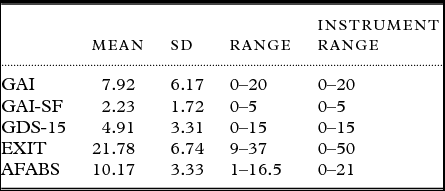
Missing data for each measure were as follows: GAI (1.8%), GDS (1.3%), EXIT (3.6%), and AFABS (0.7%). Because few of the data were missing, missing items were replaced with mean imputation. Descriptive statistics for each questionnaire are presented in Table 1. Using a cut-off score of 10 on the GAI as recommended by Pachana et al. (Reference Pachana, Byrne, Siddle, Koloski, Harley and Arnold2007), 36 residents (48%) met the criteria for clinically significant anxiety symptoms. Using Byrne and Pachana's (Reference Byrne and Pachana2011) recommended cut-off score of 3 for the GAI-SF, 34 residents (45%) met criteria for clinically significant anxiety symptoms.
Descriptive statistics for assessment measures
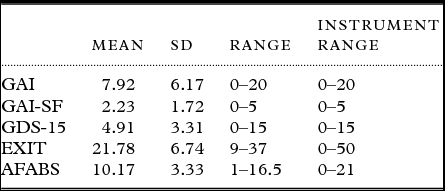
Note: GAI = Geriatric Anxiety Inventory; GAI-SF = Geriatric Anxiety Inventory–Short Form; GDS-15 = Geriatric Depression Scale–15 item; EXIT = Executive Interview; AFABS = Adult Functional Adaptive Behavior Scale. N = 75 for the GAI, GDS-15, and AFABS. N = 49 for the EXIT.
Reliability
Internal consistency for the GAI was evaluated using Cronbach's α, yielding an α coefficient of 0.92. We also examined internal consistency using Cronbach's α for the five-item GAI-SF, which resulted in an α coefficient of 0.73.
Validity
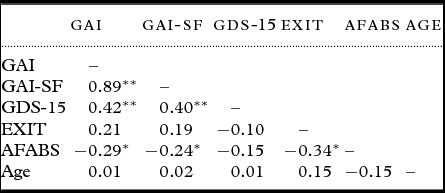
To examine concurrent validity, Pearson product–moment correlation analyses were conducted with scores on the GAI and GAI-SF. A strong correlation was found between the GAI and the GAI-SF (see Table 2). Next, we conducted Pearson product–moment correlation analyses to examine the relation between the GAI, GAI-SF, and other measures (GDS-15, EXIT, and AFABS) for evidence in support of discriminant validity. Results from these analyses are also displayed in Table 2. Moderate correlations were found between the GAI and the GDS-15 and between the GAI-SF and the GDS-15. Weak correlations were found between the GAI and the AFABS and between the GAI and the EXIT. Weak correlations were also found between the GAI-SF and the AFABS and the GAI-SF and the EXIT. Additional examinations of discriminant validity were accomplished by conducting Pearson product–moment correlation analyses on age and scores on the GAI and GAI-SF. Weak correlations between the GAI and age, and between the GAI-SF and age were found.
Intercorrelations among scores on the assessment measures

Note: GAI = Geriatric Anxiety Inventory; GAI-SF = Geriatric Anxiety Inventory–Short Form; GDS-15 = Geriatric Depression Scale–15 item; EXIT = Executive Interview; AFABS = Adult Functional Adaptive Behavior Scale.
**p < 0.01, *p < 0.05.
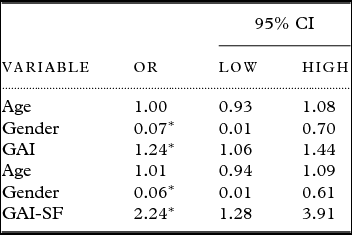
Next, we examined evidence for predictive validity of the GAI by conducting a logistic regression analysis with GAI scores predicting an anxiety disorder diagnosis. Anxiety disorders were dummy-coded (0 = no anxiety disorder diagnosis, 1 = presence of an anxiety disorder). In the regression analysis, age and gender were included as control variables. GAI scores predicted an anxiety disorders diagnosis, odds ratio (OR) = 1.24, 95% CI = 1.06–1.44 (see Table 3). The odds ratio indicates that a one-unit change in GAI score increases the likelihood of receiving an anxiety disorder diagnosis by 24%.
Results of logistic regression analyses predicting anxiety disorder diagnoses

Note: OR = odds ratio; CI = confidence interval; GAI = Geriatric Anxiety Inventory; GAI-SF = Geriatric Anxiety Inventory–Short Form.
*p < 0.05.
To examine evidence for predictive validity of the GAI-SF, we conducted a second logistic regression analysis with GAI-SF scores predicting an anxiety disorder diagnosis; age and gender were again included as control variables. GAI-SF scores predicted an anxiety disorders diagnosis, OR = 2.24, 95% CI = 1.28–3.91 (see Table 3). The odds ratio shows that a one-unit change in GAI-SF score more than doubled the likelihood of receiving an anxiety disorder diagnosis.
Sensitivity and specificity
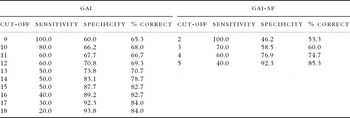
Finally, we used receiver operating characteristic (ROC) analyses to examine the ability of the GAI and GAI-SF to discriminate between individuals who met criteria for at least one anxiety diagnosis and those that did not, and to examine sensitivity and specificity at various cut-off scores. For the GAI, the area under the curve (AUC) was 0.79 (95% CI = 0.68–0.90). For the GAI-SF, the AUC was 0.78 (95% CI = 0.64–0.91). Sensitivity and specificity at various cut-off scores for the GAI and GAI-SF, as well as the percentage of individuals correctly classified at each score, are presented in Table 4. We have presented a range of cut-off scores so that the readers can determine which combination of sensitivity and specificity would work best for their purposes. By maximizing the sum of sensitivity and specificity, the optimal cut-off score for the GAI is 9 (i.e. a score of 9 or greater indicates an anxiety disorder) and the optimal score for the GAI-SF is 2.
Sensitivity and specificity of the GAI and GAI-SF at various cut-off scores

Note: GAI = Geriatric Anxiety Inventory; GAI-SF = Geriatric Anxiety Inventory–Short Form; % correct is the percentage of all participants in the study who were correctly classified as having an anxiety disorder or not having an anxiety disorder based on the cut-off score.
Discussion
The assessment of anxiety in long-term care setting is challenging in light of the high prevalence of comorbid mental and physical health disorders, multiple medications that can produce symptoms of anxiety, and of the high prevalence of functional disabilities. Perhaps more important is the paucity of age-appropriate measures that have been demonstrated to be psychometrically sound when used with long-term care residents. The present study examined the psychometric properties of the GAI and GAI-SF with residents at a long-term care facility. In addition, sensitivity and specificity were examined through ROC analyses for each version of the GAI. The results are very promising, suggesting that both the GAI and the GAI-SF are suitable for the measurement of anxiety with older adults in long-term care settings. In addition, the GAI-SF could readily replace the GAI if a brief screening instrument is desired. The psychometric properties of the GAI-SF were quite comparable to those of the GAI. In addition, the shorter length of the GAI-SF is an advantage for older adults are who easily fatigued or distracted when completing lengthy or multiple assessment instruments. A discussion of each of the psychometric properties examined for the GAI and GAI-SF follows, with a more general discussion of our findings, limitations of our study, and future directions.
With regard to reliability, the internal consistency of both instruments was evaluated via coefficient α. The internal consistency of the GAI is quite strong, whereas that of the GAI-SF is somewhat weaker though certainly adequate (DeVellis, Reference DeVellis2012). The small number of items on the GAI-SF may have contributed to its lower coefficient α in light of the positive relation between α and number of test items (Carmines and Zeller, Reference Carmines and Zeller1979).
Because of the potential utility of the GAI-SF in long-term care settings due to its brevity, the concurrent validity of the short-form was examined using the full scale GAI as the criterion measure of anxiety. The obtained strong relation between the GAI and GAI-SF supports the concurrent validity of the GAI-SF. This finding is particularly welcome for nursing facilities seeking a brief anxiety screening instrument. In light of the stress that can accompany the transition and adjustment to long-term care facilities (e.g. Tobin, Reference Tobin, Markides and Cooper1989; Hodgson et al., Reference Hodgson, Freedman, Granger and Emo2004), a very brief anxiety measure that can be administered soon after admission could be quite valuable as one index of the extent to which the resident is adjusting to the transition. One caveat to this recommendation is the absence of test–retest reliability data with nursing home populations.
Support for the discriminant validity of the GAI and GAI-SF is evidenced by the medium correlations between the GAI and the GDS-15, and the GAI-SF and the GDS-15. The medium correlation between the two versions of the GAI and GDS-15 was anticipated in light of the conceptual overlap between anxiety and depression in older adults (Beekman et al., Reference Beekman, de Beurs, van Balkom, Deeg, van Dyck and van Tilburg2000). Further evidence of discriminant validity is provided via the small correlations between the two GAI measures and the measures of adaptive functioning (AFABS), executive functioning (EXIT), and age. The relative strength of the relations between the two versions of the GAI and the GDS-15 and the relations between the GAI measures and the AFABS and EXIT also support the validity of the GAI and GAI-SF. One would expect measures of the same construct (i.e. anxiety and depression) to be more strongly related to each other than to measures of other constructs (i.e. adaptive behavior and executive functioning) using the same method (Campbell and Fiske, Reference Campbell and Fiske1959).
The evidence in support of the predictive validity of both the GAI and GAI-SF is strong. This finding for the GAI is consistent with that of Boddice et al. (Reference Boddice, Pachana and Byrne2008), who found a strong association between the GAI and anxiety disorder diagnoses in a small group of nursing home residents. Pachana et al. (Reference Pachana, Byrne, Siddle, Koloski, Harley and Arnold2007) also found strong correlations between GAI scores and scores on other measures of anxiety. This strong validity evidence for the GAI-SF is significant in the present study because we were especially interested in the possibility of using the GAI-SF for anxiety screening in long-term care.
The GAI was not explicitly developed as a diagnostic assessment instrument (Pachana et al., Reference Pachana, Byrne, Siddle, Koloski, Harley and Arnold2007). Nevertheless, sensitivity and specificity were calculated in the present study for both the GAI and GAI-SF, principally because of the focus on their use as screening instruments for nursing home residents. We have presented sensitivity and specificity values for both instruments at various cut-off points on each of the scales in recognition of the tradeoff between sensitivity and specificity, and the notion that the “best” cut-off score for any particular setting or practice may differ from that of others. Our cut-off score on the GAI differs slightly from that recommended by Pachana et al. (Reference Pachana, Byrne, Siddle, Koloski, Harley and Arnold2007), who found the optimal cut-off score (i.e. balance between sensitivity and specificity) on the GAI for detecting any anxiety disorder was 8. The optimal cut-off score on the GAI-SF for detecting any anxiety disorder has not been determined in previous studies. The difference in cut-off scores can be likely attributed to the differences in the nature of the samples, as the present data were gathered with a nursing home sample.
At the optimal cut-off score, sensitivity was relatively strong for the GAI and more modest for the GAI-SF. Specificity was relatively lower than sensitivity for both instruments. Neither instrument appears to be ideal for diagnostic purposes in light of the AUC values obtained, which is not a particular problem in light of the intended use of these instruments. In long-term settings, these instruments are most likely to be used for detecting significant anxiety symptoms, as opposed to diagnosing anxiety disorders, and both the GAI and GAI-SF appear to adequately detect anxiety.
These results suggest that the GAI and GAI-SF would be suitable tools for addressing anxiety in long-term care, particularly in light of the challenges of assessing anxiety in this setting. The present results also bode well for researchers who seek an economical method for identifying older adults in long-term care facilities that might be suitable participants for older adult anxiety research. One is cautioned, however, that neither of these instruments was developed for use with residents with significant cognitive impairment. Impaired memory, in particular, can compromise the reliability of self-reported experience of anxiety over even brief periods of time. In such cases, a combination of direct observation and self-report might yield a more reliable and valid assessment of anxiety. Seignourel et al. (Reference Seignourel, Kunik, Snow, Wilson and Stanley2008) provide an excellent critical review of the literature on anxiety in dementia, including the appraisal of instruments commonly used for this purpose. The challenges of assessing anxiety in this population are discussed, as is the absence of a suitable, valid, and reliable assessment instrument.
Finally, the reader is reminded that the principal purpose of the present study was to examine the psychometric properties of the GAI and GAI-SF because these properties can vary across population samples. The validity resides with the test scores obtained in the present study and other studies, not with the instruments themselves (Messick, Reference Messick1995). For this reason, it is important to examine psychometric properties across samples when the characteristics of the population with which one intends to use an assessment instrument differ from those with which the instrument was standardized.
Limitations and future directions
The sample of participants in the present study included a substantial number of participants with serious mental illness, which may not be representative of any particular nursing home population today. However, the number of individuals entering nursing homes with mental disorders has increased substantially since the deinstitutionalization of psychiatric patients in the 1960s and 1970s, and continues today (Rahman et al., Reference Rahman, Grabowski, Intrator, Cai and Mor2012). An examination of 1.2 million nursing home admissions in 2005 (Grabowski et al., Reference Grabowski, Aschbrenner, Feng and Mor2009) revealed 27.4% to have diagnoses of schizophrenia, bipolar disorder, major depressive disorder, or anxiety disorders. The assessment of anxiety of individuals with psychotic disorders poses a potential problem, particularly with individuals with schizophrenia. Anxiety disorders are often comorbid with psychotic disorders, with rates ranging from 0% to 43%, depending on the particular anxiety disorder and characteristics of the samples (Braga et al., Reference Braga, Petrides and Figueira2004). The challenge to the discriminant validity of an anxiety assessment instrument is the differentiation of anxiety disorders that are comorbid with psychotic disorders (e.g. schizophrenia and bipolar disorder) and “anxiety-like symptoms” due to psychotic disorder (Braga et al. Reference Braga, Petrides and Figueira2004).
The mean age of the present sample was young, which could be due to the fact that a substantial proportion of the participants had psychotic disorders with symptoms that are impairing enough to warrant long-term skilled nursing care. However, the young age of the sample also limits the generalizability of the results to the oldest old. Members of many racial groups were included in the present sample, though the vast majority of participants were Caucasian. Replication of the present study with a sample of residents with less severe pathology and greater ethnic/racial diversity would be helpful in establishing the generalizability of the present findings.
Conclusion
In summary, both the GAI and GAI-SF yielded adequate psychometric properties when used with a sample of long-term care residents. Support for the use of the GAI-SF in place of the GAI is strong, which is encouraging for those who are seeking a very brief anxiety screening instrument for use in nursing facilities.
Conflict of interest
None
Description of authors’ roles
L. A. Gerolimatos designed the study, collected portions of the data, conducted statistical analyses, and wrote portions of the paper. J. J. Gregg helped design the study, collected portions of the data, and wrote portions of the paper. B. A. Edelstein helped design the study, supervised the data collection, and wrote portions of the paper.