Introduction
Bisphenol A (BPA) is used widely, mainly as a monomer in the industrial production of polycarbonate plastics, epoxy resins, and as a non-polymer additive to other plastics (Bing-zhi et al. Reference Bing-zhi, Hua-qiang, Lin, Sheng-ji and Nai-yun2010). The annual production of BPA is ~6.8 million tonnes (Jandegian et al. Reference Jandegian, Deem, Bhandari, Holliday, Nicks, Rosenfeld, Selcer, Tillitt, Vom Saal, Vélez-Rivera, Yang and Holliday2015) and release into the environment has exceeded 450 tonnes per year (USEPA 2010). Concentrations of BPA were reported to be between 0.001 and 20 mg/m3 in groundwater, between <0.001 and 92 mg/m3 in surface water, and between <0.24 and 492 μg/kg on a dry-weight basis in sediments (Careghini et al. Reference Careghini, Mastorgio, Saponaro and Sezenna2015). A maximum concentration of 17.2 mg/L was detected in waste landfill leachates (Laatikainen et al. Reference Laatikainen, Bryjak, Laatikainen and Sirén2014). Many studies reported that even at very low concentrations, BPA can provoke endocrine disruption and affect health, therefore, especially reproduction (Okugbe and Songhe Reference Okugbe and Songhe2019). In accordance with standardized toxicological testing procedures, government agencies in the United States (US Environmental Protection Agency, USEPA), Canada (Health Canada), and Europe (European Food Safety Authority, EFSA) have established tolerable daily intake levels, ranging from 25 to 50 μg of BPA/kg of body weight/day (Kinch et al. Reference Kinch, Ibhazehiebo, Jeong, Habibi and Kurrasch2015). Among the various methods developed to remove BPA from wastewaters (Liang et al. Reference Liang, Zhang, Feng, Li, Huang, Dong, Li and Guan2015), adsorption has significant advantages such as its efficiency, low operating cost, high selectivity, easy handling, etc. (Crini Reference Crini2006). In recent years, the application of clay materials as adsorbents has attracted much attention due to their natural abundance, large specific surface area, layered structure, and large ion exchange capacity (Bergaya et al. Reference Bergaya, Detellier, Lambert, Lagaly, Bergaya and Lagaly2013). The adsorption efficiency of clays can be enhanced by intercalation with cationic surfactants, which increases the interlayer space and modifies the surface charge, thus making the clay an organophilic adsorbent for some hydrophobic compounds (Bergaya and Lagaly Reference Bergaya, Lagaly, Brigatti and Mottana2011). HDTMA is preferred to other surfactants (Neel and Bowman Reference Neel and Bowman1992) because of its low cost and efficiency as a modifying agent for commercial clays used in the adsorption of pollutants, especially BPA (Zhu et al. Reference Zhu, Zhu, Zhu, Ge and Wang2009; Liu et al. Reference Liu, Wu, Zhu and Tran2016).
The purpose of the current study was, therefore, to synthesize an organo-clay from a natural Tunisian clay under microwave irradiation and without sodium pre-exchange, then to test the potential performance of the prepared organo-clay for the removal of harmful pollutants, such as BPA, from aqueous solutions. The hypothesis was that synthesized organo-clay will adsorb a significant amount of BPA at ambient temperature.
Experimental
Materials
The crude clay used in this study was from the El Hicha-Gabes region of Tunisia. The purified clay (HP) has been the subject of previous studies and it is known to be a smectite with a chemical composition of 52.61% SiO2, 14.28% Al2O3, 11.70% CaO, 8.50% Fe2O3, 0.81% K2O, 0.37% SO3, and loss on ignition of 11.81%. The cation exchange capacity (CEC) of HP is 86.5 meq/100 g (Sassi et al. Reference Sassi, Lafaye, Amor, Gannouni, Jeday and Barbier2018). Hexadecyltrimethy-lammonium bromide (HDTMA) was purchased from Alfa Aesar (Karlsruhe, Germany). BPA was purchased from Sigma-Aldrich (St. Louis, Missouri, USA) and both were used without further purification; their principal relevant physicochemical properties are listed in Table 1. All other reagents used were of analytical grade. A domestic microwave oven (model ME711K, Samsung, Shenzhen, Guangdong, China) with continuous power and a frequency of 2.45 GHz was used to prepare the modified clay.
Physicochemical characteristics of BPA and HDTMA
 |
Preparation of Organo-Clay Samples
For the preparation of organo-clay, a given mass (g) of HP was added to the HDTMA solution. After magnetic stirring for 30 min, the suspension was irradiated in the microwave to induce the organophilization of the clay. After that, the organo-clay was separated by centrifugation and washed with distilled water repeatedly until a negative AgNO3 test for bromide was attained. Finally, the solid was dried at 65°C for 10 h, ground manually into powder, and stored in tightly closed bottles.
Determination of the Optimal Conditions for the Organophilization Process by Microwave Irradiation
In order to optimize the conditions for the synthesis by microwave, various parameters were considered such as irradiation conditions (Power (P), time (t i)), activation ratio (AR = HDTMA/clay (g/g)), and solid/liquid ratio (S/L = clay mass/volume of HDTMA solution (g/100 mL)). The influence of each parameter was studied by varying one parameter while keeping the others constant. To target the optimal preparation parameters, all samples of HMH were evaluated by a BPA adsorption test using the following conditions: 0.05 g of organo-clay into 100 mL of BPA at 100 mg/L and contact time for 2 h at ambient temperature under magnetic stirring.
Adsorption Experiments
The BPA adsorption experiments were performed in batch reactors by adding known amounts of HMH to 100 mL samples of BPA solution at the given initial concentration without pH adjustment (~6.5 except when the effect of pH was studied). The mixtures were agitated continuously by a magnetic stirrer. After various times and at equilibrium, the samples were filtered through 0.45 μm PES membranes and then the filtrates were analyzed using a UV-visible spectrophotometer (T60 UV VIS Spectrophotometer, PG instruments Ltd, Alma Park, Wibtoft, Lutterworth, UK)) at λmax = 276 nm. The amount of BPA adsorbed onto HMH was determined using the following equation:

where q t (or q e) is the amount of BPA (mg/g) at adsorption time t (or at equilibrium); C 0 and C t (mg/L) are the concentrations of BPA at the start and after a known time t, respectively; V (L) is the volume of BPA solution; and W (g) is the HMH dosage.
The sorption efficiency (%) of BPA (R) was calculated by applying the following equation:

Clay saturated by adsorbed BPA was labelled as HMS.
Characterization of Clays
To assess the effect of HDTMA on the purified clay properties, HP, HMH, and HMS were characterized by SEM, FTIR, XRD, and surface area analysis (BET method). The SEM analyses were conducted using a TEM/STEM JEOL 2100 UHR 200kV JEOL (Lab6) instrument (JEOL Ltd, Akishima, Tokyo, Japan) at a resolution of 0.14 nm, to examine the surface texture and morphology. The FTIR spectra in the mid-infrared region (MIR) were examined to identify the surface functional groups. The spectra were collected using a Magna-IR 760 Nicolet 760 spectrometer (Woodland, Texas, USA) equipped with a KBr beam splitter and a DTGS-KBr detector, with wavenumbers ranging from 400 to 4000 cm–1, resolution of 4 cm–1, and a co-addition of 100 scans. KBr pellets were prepared by mixing (sample (mg)/KBr (mg)) powder at a ratio of 1/150, pressing, and then heating in an oven overnight at 110°C before analysis. In order to determine the basal spacing (d 001) values, XRD was applied. The XRD patterns of HP and HMH were recorded using a PANalytical “Empyrean” diffractometer (Lelyweg, Almelo, Netherlands) equipped with a fast Xcelerator detector with CuKα radiation at 45 kV and 40 mA, over a 2θ range of 3–30°2θ. The BET specific surface area and pore structure parameters were measured by N2 adsorption using a Micromeritics Tristar 3000 instrument (Norcross, Georgia, USA) at 77 K. The pore sizes were determined using the BJH method. Before analysis, the clay samples were out-gassed overnight under N2 at 90°C using a Micromeritics (Norcross, Georgia, USA) Asap 2010 degasser.
Results and Discussions
Optimization of the Clay Organophilization Process by Microwave Irradiation
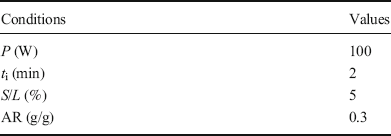
A preliminary study showed that the HP did not take up a realistic amount of BPA (~2 mg/g after 24 h of contact time). To improve its capacity to adsorb, HP was modified with HDTMA under microwave irradiation. To optimize the organophilization conditions, various samples were prepared by varying P from 100 to 300 W, t i from 2 to 6 min, AR from 0.1 to 0.4, and S/L from 1 to 10%. Each prepared sample was tested as an adsorbent of BPA and the values of sorption efficiency obtained indicated that the increase of P from 100 to 300 W, while keeping t i at 2 min (Fig. 1a) or varying t i from 2 to 6 min at fixed P of 100 W (Fig. 1b), did not improve the BPA removal efficiency. To save time and energy, the lowest irradiation conditions (100 W, 2 min) were selected for the further work.
Effects of the synthesis parameters of organo-clay on the efficiency of removal of BPA (R): a power of irradiation, b duration of irradiation, c activation ratio (AR), and d solid/liquid ratio (S/L)

The BPA removal efficiency (Fig. 1c) increased sharply with increase in AR up to 0.3; above that, further increase was insignificant (59.7% for AR = 0.3 vs. 63% for AR = 0.4). The activation ratio of 0.3 (g/g) was taken as optimal. In addition, the results obtained (Fig. 1d) showed clearly that the adsorption efficiency increased by increasing the S/L ratio from 1 to 5% but decreased when the ratio was 10%; the latter may be due to the fact that there was insufficient heating (100 W, 2 min). The 5% ratio for S/L was selected, therefore, for further work. Note that this value is larger than that applied usually, 1–2%, in classic methods of clay modification, according to the literature; this finding was very significant because it allowed the use of less water. Finally, use of the microwave technique enabled the modification of the clays with a surfactant under very mild conditions (Table 2), thus making this process very simple, effective, and economical.
Optimal conditions for HMH synthesis assisted by microwave heating

Characterization of the Clays
SEM.
Scanning electron microscopy was used to examine the change in morphological features of modified compared with purified clay. The SEM image of HP (Fig. 2a) shows that the clay has a compact morphology with irregular flakes. After modification (Fig. 2b), the structure was transformed into small layered flakes with a soft appearance, suggesting the occupation of the intraparticle space by HDTMA molecules, as reported by Meera et al. (Reference Meera, Sankar, Murali, Jaisankar and Mandal2012). After adsorption of BPA (Fig. 2c), the clay structure became agglomerated, indicating a high density of adsorbed BPA molecules on the surface of the modified clay as reported by Zhang et al. (Reference Zhang, Zhang, Wu, Sun and Li2015).
SEM images of: a HP, b HMH, and c HMS. Scale bars = 1 μm

FTIR Spectra and XRD Patterns.
Infrared spectroscopy was used to study changes in the clay structure after modification by HDTMA. The FTIR spectra of HP and HMH (Fig. 3a) showed peaks at 3621 and 3411 cm–1 which were assigned to the O–H stretching vibration of the silanol (Si–OH) groups and HO–H vibration of the water molecules fixed on the clay surface. For HMH, two new peaks appeared at 2924 and 2853 cm–1, which were attributed to the asymmetric and symmetric stretching vibrations of –CH2, also seen in the HDTMA spectrum, indicating that HDTMA molecules were introduced successfully into the clay network. The peak at 1621 cm−1 was attributed to the −OH bending vibrations of adsorbed water present in the purified clay (Erdem et al. Reference Erdem, Özcan and Özcan2010). The intensity of this band for HMH was less than that for HP, suggesting that the surface property of purified clay had become more hydrophobic due to the presence of HDTMA. The peak at ~1431 cm–1 was associated with the –CH2 deformation peak, whereas the absorption peaks at 1034, 520, and 469 cm–1 were assigned to the Si−O, Al−O−Si, and Si−O−Si stretching and bending vibrations of dioctahedral clay, respectively (Farmer and Russell Reference Farmer and Russell1964; Farmer Reference Farmer1974).
a FTIR spectra and b XRD patterns of HP and HMH

The results above were corroborated by comparing the XRD patterns of purified clay with those of the modified clay. The XRD patterns, restricted to the range 2 to 30°2θ (Fig. 3b), revealed that HP has a basal spacing of 14.99 Å, which increased to 22.07 Å in HMH. This significant increase in the d 001 value proved the successful intercalation of HDTMA between the clay layers. According to Zhang et al. (Reference Zhang, Zhang, Wu, Sun and Li2015), a basal spacing of 22.07 Å indicates that the HDTMA molecules are deposited in lateral bilayers or pseudo-trimolecular layers between the clay layers. This arrangement of the surfactant molecules was key in terms of understanding the adsorption mechanism.
Textural Parameters.
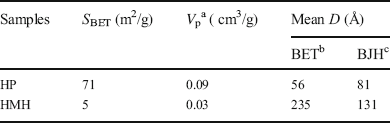
The Brunauer-Emmett-Teller (BET) method was applied to HP and HMH clays to elucidate the effect of HDTMA on the textural parameters such as specific surface area (S BET) and pore volume (V P). The results of N2 adsorption isotherms (Table 3) indicated clearly that the surface area, as well as the pore size of the HMH, had decreased significantly after modification. This decrease was due to the intercalation of HDTMA which led to increases in the average pore diameter of HMH and caused an interlayer expansion (as shown by XRD analysis), so that surfactant molecules inhibited the passage of N2 molecules, causing a decrease in the S BET to 5 m2/g (He et al. Reference He, Zhou, Martens, Kloprogge, Yuan, Xi, Zhu and Frost2006).
Specific surface area (S BET), pore volume (V p), and pore diameter (D) of HP and HMH

a Barrett-Joyner-Halenda (BJH) desorption cumulative pore volume of pores between 1.7 and 300 nm in diameter.
b Adsorption average pore diameter (4V/A by BET).
c BJH desorption average pore diameter.
Adsorption Experiments
Experiments were carried out to study the effect of some of the operating parameters (pH, contact time, adsorbent dose, solution temperature, and initial BPA concentration) on BPA adsorption by HMH.
Effect of Initial Solution pH.
pH is an important parameter in adsorption processes because it can affect both the adsorbent and adsorbate structure and thus the adsorption mechanism. The effect of pH on BPA adsorption was studied at room temperature, with an initial BPA solution concentration of 100 mg/L, an HMH dose of 0.5 g/L, and over a wide range of initial pH from 2 to 10 (adjusted by adding dilute HNO3 or NaOH).
The results obtained after 2 h of reaction (Fig. 4a) indicated that the amount of BPA adsorbed onto HMH was not influenced significantly by the initial pH value and remained practically constant whatever the pH value (2–10). These results were in good agreement with those reported by Park et al. (Reference Park, Sun, Ayoko and Frost2014) and could be explained by the speciation of BPA and the nature of the surface charge of the organo-clay. The pKa values of BPA, ranging from 9.6 to 10.2, involving the ionization of BPA, occurred at ~pH 9–10 to form the bisphenolate anion (Bautista-Toledo et al. Reference Bautista-Toledo, Ferro-García, Rivera-Utrilla, Moreno-Castilla and Vegas Fernández2005). The introduction of an organic cation (HDTMA) into the clay network caused enhancement of the hydrophobicity or organophilic nature of the surface (Li et al. Reference Li, Burt and Bowman2000). The hydrophobic nature and positively charged surface created by loaded HDTMA molecules were responsible for adsorption of BPA. In addition, organo-clays which were intercalated with more surfactants or with longer surfactant molecules such as HDTMA were reported (Li et al. Reference Li, Burt and Bowman2000) to be less influenced by the solution pH because of the increase in positive charge. The possible interaction of BPA with the HMH was thus attributed to the hydrophobic nature of the modified clay. In light of these results, all the adsorption tests were carried out, without adjustment, at pH ~6.5 (natural pH of the BPA solution).
Effects of various parameters on the adsorption of BPA by HMH: a initial pH (pHi); b contact time and temperature; c BPA initial concentration; and d HMH dose

Effect of Contact Time and solution temperature.
The effects of adsorption time and temperature on the removal of BPA were studied to determine the impact of equilibrium time and temperature on the amount adsorbed. BPA solutions (100 mg/L) were mixed with 0.5 g/L of organo-clay at three different temperatures: 296, 303, and 328 K. Analysis of samples taken at different times indicated that the BPA adsorption capacity (q t) increased quickly over the first 30 min, then continued to increase slowly (Fig. 4b). Equilibrium was reached after 180 min of contact, which demonstrated the good affinity of HMH for BPA. In addition, the results revealed that when the temperature increased from 296 to 328 K, the amount of BPA adsorbed decreased from 162 to 140 mg/g. The best results were, thus, obtained at room temperature. Similar results were reported by Liu et al. (Reference Liu, Ma, Li and Qin2009) for BPA adsorption onto activated carbon. Those authors attributed this behavior to the exothermic physisorption mechanism for which the low temperature favors adsorption. In addition, overheating may disrupt the progress of the adsorption process and lead to an increase in the desorption kinetics.
Effect of Initial BPA Concentration.
The effect of initial concentration of BPA on adsorption was investigated at 296 K and pH 6.7. The initial concentration of BPA was varied from 20 to 100 mg/L while keeping the HMH dose equal to 0.5 g/L. The analysis of the remaining BPA in solution after 3 h of reaction (Fig. 4c) revealed that whatever the initial BPA concentration, the amount adsorbed increased rapidly over time to reach near-equilibrium after 20–30 min and continued to increase very slowly until equilibrium was reached. When the initial concentration increased, the amount adsorbed increased also. As the initial concentration increased, the driving force of mass transfer increased, thus resulting in greater adsorption of the BPA.
Effect of Adsorbent Dose.
The influence of the HMH dose on the removal of BPA from solutions was studied by applying different concentrations of HMH ranging from 0.15 to 0.90 g/L to BPA solutions at an initial concentration of 100 mg/L. The results obtained (Fig. 4d) demonstrated that at constant initial BPA concentration, the increase in the adsorbent dose enhanced the BPA percentage uptake. The boost in removal efficiency was associated with the largest surface area of HMH and the increased number of available adsorption sites when the largest adsorbent dose was applied. At greater HMH doses, some of the adsorption sites remained unoccupied, resulting in a decrease in the BPA adsorption capacity expressed as mg/g of organo-clay (Gupta and Rastogi Reference Gupta and Rastogi2008).
Kinetic Study
In order to understand the adsorption kinetics of BPA onto HMH, three kinetics models were applied: pseudo-first order, pseudo-second order, and intraparticle diffusion. The equations of the linear form of these models are:
Pseudo-first order kinetics model (Lagergren Reference Lagergren1898):

Pseudo-second order kinetics model (Ho and McKay Reference Ho and McKay1999):

Intraparticle diffusion model (Weber and Morris Reference Weber and Morris1962):

where q e and q t are the amounts of BPA adsorbed (mg g–1) at equilibrium and time t (min), respectively. k1 (min–1) is the first-order rate constant and k2 (g/mg.min) is the second-order rate constant, ki (mg/g.min1/2) is the intraparticle rate constant, and C (mg.g–1) is a constant related to the external diffusion resistance. The values of these parameters (Table 4) were determined from the intercepts and slopes of the linear plots (Fig. 5).
Kinetic parameters for BPA adsorption onto HMH

Kinetic models for the adsorption of BPA onto HMH at 296 K: a pseudo-first order; b pseudo-second order; and c inter-particle diffusion

Comparison of the correlation coefficient results (Table 4) indicated that the model with the best fit was the pseudo-second order model (R2 = 0.998) compared to the pseudo-first order model (R2 = 0.992). In addition, the q e values (q e cal) calculated using the pseudo-second order model were very close to the experimental values (q e exp) with an error percentage of 6.3%. In the investigation of the diffusion mechanism, the R2 values obtained from the intraparticle diffusion model exhibited good correlation (R2 = 0.964) suggesting the presence of an intraparticle diffusion mechanism during BPA adsorption onto HMH. The linear plot of q t vs. t 1/2 (Fig. 5c) does not pass through the origin, suggesting that the intraparticle diffusion was not the sole rate-limiting step and a film or external diffusion may be involved in the adsorption process (Karger and Ruthven Reference Karger and Ruthven1992).
Adsorption Isotherms
Adsorption isotherms are useful for understanding the adsorption mechanism. In the current study, adsorption isotherms of BPA onto HMH were interpreted by applying the classic Langmuir and Freundlich models. The Langmuir model is based on a fixed number of available sites on the adsorbent surface, all having the same energy. Adsorption occurs as a monolayer because one site can fix only one molecule and the adsorption energy is constant. The Langmuir model in linear form has the following expression (Langmuir Reference Langmuir1918):

where q e (mg/g) is the BPA adsorption capacity at equilibrium, C e (mg/L) is the equilibrium concentration of BPA in solution, q max (mg/g) is the maximum monolayer adsorption capacity, and KL (L/mg) is the Langmuir constant related to the energy of adsorption.
In addition, the Langmuir model can be evaluated by a dimensionless constant separation factor (R L) that is defined by:

where KL is the Langmuir constant and C 0 (mg/L) is the initial BPA concentration. The R L value reflects the nature of the adsorption process to be favorable (0 < R L <1), unfavorable (R L >1), linear (R L = 1), or irreversible (R L = 0).
The Freundlich model is applicable when the adsorption is multilayer and the adsorbate surface is heterogeneous with exponential distribution of active sites. The Freundlich isotherm equation can be presented as follows (Freundlich Reference Freundlich1906):

where KF and n (Freundlich constants) are associated with the capacity and intensity of adsorption, respectively.
Analysis of experimental data at equilibrium at 296 K by the models above gave straight lines (Fig. 6) which permitted determination of the equations and the parameters of the corresponding isotherms, their correlation coefficients (R2), and the value of the dimensionless separation factor (R L) (Table 5). According to the R2 values, the Langmuir model (Fig. 6a) is more suitable than the Freundlich model (Fig. 6b) with a maximum adsorption capacity equal to 217.39 mg/g. This finding suggested the homogeneous distribution of the active sites on the HMH surface in accordance with the Langmuir hypotheses. The R L value of 0.38 also indicates a strong interaction between HMH and BPA.
Plots of a Langmuir and b Freundlich isotherm models for BPA adsorption onto HMH

Adsorption isotherm parameters for BPA adsorption by HMH

Adsorption Thermodynamics
Thermodynamics were investigated for greater insight into the adsorption mechanism. The experimental data of the BPA adsorption onto HMH, obtained at different temperatures ranging from 296 to 328 K, were exploited to evaluate the thermodynamic parameters such as enthalpy (∆H°), entropy (∆S°), and Gibbs’ free energy (∆G°) using the following equations:


where R is the ideal gas constant (8.314 J/mol K) and T is the temperature in Kelvin. K d is the distribution coefficient for the adsorption. In order for Eq. 10 and 11 to be valid, K d = K eq, the true thermodynamic equilibrium constant, which is true only if the relevant activity coefficients either cancel one another or are equal to unity. For the purposes of the present study, the latter was assumed. As demonstrated previously (Milonjic 2007; Salvestrini et al. Reference Salvestrini, Vincenzo, Pasquale, Silvana and Sante2014; Najafi et al. Reference Najafi, Moradi, Rajabi, Asif, Tyagi, Agarwal and Gupta2015), K d is dimensionless. Consequently, when q e is used in mg/g, the equilibrium concentration of BPA in the solution at equilibrium (C e) should be expressed in mg/mL. The values of q e, C e, and K d as a function of temperature (Table 6) indicated that the distribution coefficient increased with increasing temperature. The variation of lnK d vs. 1/T (Fig. 7) yielded a straight line from which and according to Eq. 10 the values of ∆H° and ∆S° (Table 6) were determined from the slope and intercept of the plot, respectively.
Thermodynamic parameters for the BPA adsorption by HMH

Estimation of thermodynamic parameters for BPA adsorption onto HMH

The negative values of ∆G° calculated by Eq. 11 (Table 6) implied that the BPA adsorption was spontaneous, and more favorable at high temperature. Similar results were obtained by Li et al. (Reference Li, Zhan, Lin, Jiang and Xi2014). The negative value of ∆H° suggested that BPA adsorption onto HMH was exothermic. The exothermic nature was also proved by the decrease in the amount adsorbed with increasing temperature. Based on the ∆H° value, the adsorption process is taken to be physical, if ∆H° < 25 kJ/mol, or chemical, when ∆H° > 40 kJ/mol (Krishna et al. Reference Krishna, Murty and Prakash2000). The value of ∆H° was equal to –5.63 kJ/mol, indicating, therefore, that the adsorption of BPA onto HMH was a physisorption process, which implied the easy regeneration of the saturated HMH. The positive values of ∆S° suggested that the state of the adsorbed BPA molecules was less ordered than in solution (Bereket et al. Reference Bereket, Arog and Özel1997).
Comparison of BPA Adsorption Capacity with other HDTMA-modified Clays
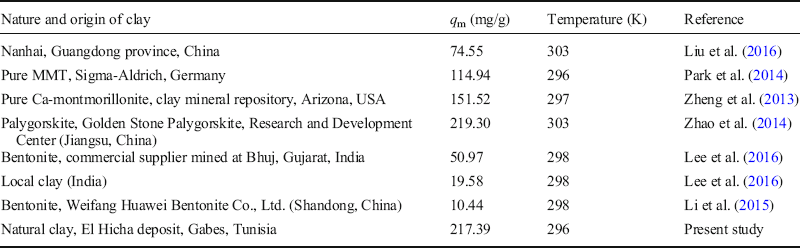
The BPA adsorption capacity values of various modified commercial clays (Table 7) proved that the HMH prepared in the present study has one of the largest adsorption capacities for BPA. Only palygorskite can rival it. HMH can, therefore, be employed successfully as a cheap and environmentally friendly adsorbent for the treatment of wastewaters polluted by BPA and probably other phenolic compounds.
Adsorption capacity for BPA by HMH in comparison with other HDTMA-clays

Conclusions
Conventionally, clay modification is carried out by heating a mixture of the clay and the surfactant solution for 2 to 24 h at 60–80°C. In order to reduce the heating time to a few minutes (and to reduce energy consumption), a domestic microwave oven was used. The microwave technique provided a uniform heating rate, allowing the preparation of the unique material more quickly. Without acid activation or sodium exchange, the natural Tunisian clay was modified successfully with HDTMA using microwave irradiation at optimal conditions of 100 W for 2 min with an activation ratio of 0.3, and a solid:liquid ratio of 5%. The success of the HDTMA intercalation between the clay layers was proven by BET, SEM, FTIR, and XRD analysis. The study of BPA adsorption by the organo-clay prepared here revealed that the amount of BPA adsorbed increased when its initial concentration, the dose of adsorbent, and the contact time increased, and decreased slightly when the temperature increased. The impact of the pH variation between 2.6 and 10 was not significant. The kinetics of adsorption followed well the pseudo-second order kinetics model, and the Langmuir model followed the experimental data better than the Freundlich model, giving a maximum monolayer adsorption capacity of 217.39 mg/g. The adsorption of BPA onto HMH was spontaneous, exothermic, and not controlled solely by intraparticle diffusion. In conclusion, the Tunisian natural clay may be used successfully, following intercalation by HDTMA, as a cheap and environmentally friendly adsorbent for the removal of BPA (and possibly other organic pollutants) from wastewaters.
Acknowledgments
The authors are grateful to the PHC-Maghreb project (16/MAG 11), University of Gabes, Tunisia, and the University of Poitiers, France, for financial support of the Research Project.
Compliance with Ethical Standards
Conflict of Interest
On behalf of all authors, the corresponding author states that there is no conflict of interest
Funding
Funding sources are as stated in the acknowledgments.