Introduction
Although considerable improvements have been achieved for in vitro embryo technologies over the last years, the embryo yields still remain much lower than those of in vivo produced embryos (Farin & Farin, Reference Farin and Farin1995). This is caused by differences between in vitro and in vivo environments for oocyte maturation. The maturation potential of an oocyte, which plays a key role not only in its maturation but also in its fertilization and early embryo development, is changing during follicular development.
The estrus cycle of cows is usually characterized by two or three follicular waves. Each wave involves follicular growth, stagnation, dominance and regression phases. In the growth phase a cohort of 20–24 follicles, at least 4 mm in diameter, begins to grow and one of these is selected to be the dominant follicle. The dominant follicle produces factors that inhibit its counterparts in the same wave and suppress their growth (Ginther et al., Reference Ginther, Wiltbank, Fricke, Gibbons and Kot1996). This effect is more apparent in 6–8 mm follicles than in smaller follicles (Hendriksen et al., Reference Hendriksen, Vos, Steenweg, Bevers and Dieleman2000). In non-ovulatory waves, all follicles, including dominant ones, become atretic and undergo apoptosis (Hendriksen et al., Reference Hendriksen, Vos, Steenweg, Bevers and Dieleman2000, Mihm & Austin, Reference Mihm and Austin2002, Mihm et al., Reference Mihm, Crowe, Knight and Austin2002) and in the last wave the dominant follicle ovulates.
The size of a follicle and the level of its atresia determine the quality of oocyte cytoplasm and, consequently, the ability of this oocyte to resume meiosis, to be fertilized and cleave in vitro (Hyttel et al., Reference Hyttel, Fair, Callesen and Greve1997). During follicular growth, RNA molecules and proteins are synthesized and accumulated in oocyte cytoplasm and stored for early embryo development (Gandolfi & Gandolfi, Reference Gandolfi and Gandolfi2001, Lonergan et al., Reference Lonergan, Fair, Corcoran and Evans2006, Sirard et al., Reference Sirard, Richard, Blondin and Robert2006).
As concerns meiotic competence, bovine embryos for in vitro production are generally prepared from heterogeneous populations of oocytes. They are selected only on the basis of their morphological evaluation. Recently, a selection by the metabolic activity of oocytes has been described (Alm et al., Reference Alm, Torner, Lohrke, Viergutz, Ghoneim and Kanitz2005).
Some authors have studied the developmental competence of oocytes in relation to different sizes of follicles (Pavlok et al., Reference Pavlok, Lucas-Hahn and Niemann1992, Lonergan et al., Reference Lonergan, Monaghan, Rizos, Boland and Gordon1994,) and ovarian cycle status (Varisanga et al., Reference Varisanga, Sumantri, Murakami, Fahrudin and Suzuki1998, Hagemann et al., Reference Hagemann, Beaumont, Berg, Donnison, Ledgard, Peterson, Schurmann and Tervit1999, Machatkova et al., Reference Machatkova, Jokesova, Horky and Krepelova2000, de Wit et al., Reference de Wit, Wurth and Kruip2000). In agreement with this, it has been shown in our previous studies that the developmental competence of oocytes increases with an increasing follicle size and is also influenced by the phase of follicular wave. More oocytes were able to develop to the blastocyst stage, when they were recovered in the growth phase, as compared with the dominant phase (Machatkova et al., Reference Machatkova, Krausova, Jokesova and Tomanek2004).
The aim of this study was to characterize fertilization in the populations of oocytes with different meiotic competence derived from large, medium and small follicles collected in the growth and the dominant phase of the first follicular wave. This was based on a comparison of the efficiency and kinetics of the oocyte fertilization process.
Materials and Methods
Synchronization of donors
A total of 36 cows were used as oocyte donors. The estrus cycles of these donors were synchronized by two doses of PGF2α at an interval of 11 days. Ovulation was stimulated by one dose of hCG (1500 IU, Organon Co, Holland) on the day of estrus onset (Day 0). Animals were slaughtered in the growth (day 3, n = 18) or in the dominant (day 7, n = 18) phase of the first follicular wave. A pair of ovaries from each donor was examined for their ovarian status and transported, at 27 °C, to the laboratory.
Evaluation criteria for the growth and dominant phases included the presence of a hemorrhagic corpus luteum with signs of ovulation and no follicle larger than 11 mm in diameter and the presence of an advanced corpus luteum and two large follicles, 14–15 and 8–11 mm in diameter, respectively. The experiment was carried out in three replicate procedures.
Oocyte isolation
Oocytes in either the growth or the dominant phase were collected from large (11–15 mm) and medium-sized (6–10 mm) follicles by aspiration and from small (2–5 mm) follicles by total slicing of the ovarian cortex.
The oocytes were evaluated morphologically and all collected oocytes except for heavy atretic ones without cumulus cells were used.
Oocyte maturation and fertilization
Procedures were carried out according to the standard protocol (Machatkova et al., Reference Machatkova, Krausova, Jokesova and Tomanek2004). Oocytes were matured in TCM-199 medium (Earle's salt), supplemented with 50 IU/ml penicillin, 50 μg/ml streptomycin, 0.20 mmol/1 sodium pyruvate (Sigma), gonadotropins (P.G. 600, 15 IU/ml, Intervet) and 5% estrus cow serum (ECS) in four-well plates (Nunclon Intermed) for 24 h.
Spermatozoa of the same bull were used for oocyte fertilization in all experiments. Motile spermatozoa were isolated by the swim-up method using modified Tyrode's medium (SP-TALP) from frozen-thawed sperm. Oocytes were fertilized for 24 h in modified Tyrode's medium (IVF-TALP), supplemented with 10 μg/ml heparin and 75 μg/ml kanamycin (Sigma), containing 1 × 10⁶ spermatozoa/ml. All procedures were carried out at 39 °C in a humidified atmosphere and 5% CO2.
Evaluation of oocyte fertilization
Twenty-four hours after fertilization, oocytes were denuded from cumulus cells by vortex, fixed in aqueous glutaraldehyde solution, 2.5 % (v/v) and stained with bisbenzimide 332 58 Hoechst solution (10 μg/ml in 0.154 mol/1 sodium chloride and 0.015 mol/1 trisodium citrate buffer). The oocytes were rinsed once in Dulbecco–PBS, stained at room temperature for 10 min and rinsed again three times in Dulbecco–PBS. Wet slides with oocytes in 5 μl glycerin buffer solution were prepared and examined by epifluorescence (×400; L 420 barrier filter).
The efficiency of fertilization was evaluated by the percentages of normally fertilized, abnormally fertilized (polyspermy or pronuclei fragmentation) and unfertilized oocytes from all inseminated oocytes.
The kinetics of fertilization was assessed by percentages of oocytes developing to pronuclei, syngamy or first-cleavage stages from normally fertilized oocytes.
Statistical analysis
The data were analysed by the chi-squared test, using the SPSS, Version for Windows software (SPSS Inc.).
Results
Efficiency of oocyte fertilization
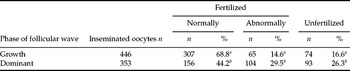
There was a difference in fertilization efficiency between oocytes derived from growth-phase (GP) oocytes and those derived from dominant-phase (DP) oocytes. In the GP oocytes, the proportion of normally fertilized oocytes was significantly higher (p ≤ 0.01) and the proportions of abnormally fertilized and unfertilized oocytes were significantly lower (p ≤ 0.01) than in the DP oocytes (Table 1).
Fertilization efficiency of oocytes derived from the growth and the dominant phase of follicular wave

Values with different superscripts within the column are significantly different (a ,b p ≤ 0.01).
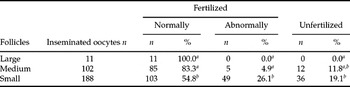
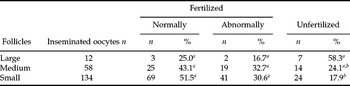
The differences in fertilization efficiency between the GP and DP oocytes were also found in relation to follicular size. In the GP oocytes, the proportions of normally fertilized oocytes in the oocytes from large and medium follicles were significantly higher (p ≤ 0.01) than the proportion of normally fertilized oocytes from small follicles. A significant difference (p ≤ 0.01) in the percentage of unfertilized oocytes was only between oocytes from large and those from small follicles (Table 2). Contrary to the GP oocytes, in the DP oocytes the percentage of normally fertilized oocytes was higher in oocytes from small follicles than in those from medium-sized and large follicles, but the differences were not significant. The percentage of unfertilized oocytes was lower in oocytes from small follicles than in those from large follicles and this difference was significant (p ≤ 0.01; Table 3).
Fertilization efficiency of oocytes derived from different sized follicles collected in the growth phase

Values with different superscripts within the column are significantly different (a ,b , p ≤ 0.01).
Fertilization efficiency of oocytes derived from different sized follicles collected in the dominant phase

Values with different superscripts within the column are significantly different (a,b p ≤ 0.01).
Kinetics of oocyte fertilization
The kinetics of oocyte fertilization differed between GP and DP oocytes. In the GP oocytes, the proportion of cleaved oocytes was significantly higher (p ≤ 0.01) and the proportion of pronuclei-stage oocytes was significantly lower (p ≤ 0.01), as compared with the DP oocytes (Table 4).
Fertilization kinetics of oocytes derived from the growth and the dominant phase of follicular wave

Values with different superscripts within the columns are significantly different (a,b p ≤ 0.01).
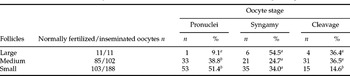
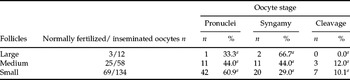
The differences in fertilization kinetics between the GP and DP oocytes were also found in relation to follicular size. In the GP oocytes, the proportion of pronuclei-stage oocytes was significantly lower (p ≤ 0.01) and the proportion of cleaved oocytes was significantly higher (p ≤ 0.01) in oocytes from large follicles in comparison with these proportions in oocytes from small follicles (Table 5). In the DP oocytes, no significant differences in the proportions of pronuclei- and cleavage-stage oocytes were found amongst oocytes from all three categories of follicles (Table 6).
Fertilization kinetics of oocytes derived from different sized follicles collected in the growth phase

Values with different superscripts within the columns are significantly different (a,b p ≤.01).
Fertilization kinetics of oocytes derived from different sized follicles collected in the dominant phase

aNo significant differences were found.
Discussion
Oocytes obtained from ovaries of cows slaughtered without regard to their ovarian status and follicle size represent a widely heterogeneous population subsequently used for in vitro embryo production. This population includes oocytes at various stages of follicular development, i.e., growth, stagnation, dominance and regression. It is well known that 90% of oocytes in this population complete meiosis when matured in vitro, but only 30% of the oocytes are able to continue their development to the blastocyst stage after in vitro fertilization. This low embryo production is due to the inability of some oocytes to accomplish cytoplasmic maturation and undergo successful fertilization and subsequent development (Leibfried-Rutledge, Reference Leibfried-Rutledge1999). It has been suggested that low meiotic competence and incomplete cytoplasmic maturation are associated with embryo losses (Arlotto et al. Reference Arlotto, Schwartz, First and Leibfried-Rutledge1996, Sirard, Reference Sirard2001).
Our previous studies have shown, in accordance with other reports (Hagemann Reference Hagemann1999, Machatkova et al. Reference Machatkova, Krausova, Jokesova and Tomanek2004), that embryo development is more efficient when oocytes with greater meiotic competence are derived from follicles larger than 6 mm collected in the growth phase of the first follicular wave. On the basis of these results we assumed that also the efficiency of fertilization might be improved for these oocytes.
In this study we examined the efficiency and kinetics of fertilization in bovine oocytes isolated from three different follicle-size categories of the growth and the dominant phase. As donors of oocytes and spermatozoa, we used cows with defined follicular development and in in vitro system tested bull in order to standardize the paternal influence on the course of fertilization (Eid et al., Reference Eid, Lorton and Parrish1994; Ward et al., Reference Ward, Enright, Rizos, Boland and Lonergan2002).
Our results show that a higher efficiency of fertilization and accelerated kinetics of cleavage can be achieved in oocytes with greater meiotic competence collected in the growth phase, as compared with those with lesser meiotic competence collected in the dominant phase. They also confirm that a higher embryo yield is not related only to greater meiotic competence of an oocyte, but also to its greater capability of being fertilized. In our experiments, at 24 h after insemination, the rate of cleaved oocytes derived from the growth phase was higher more than twice in comparison with the rate of dominant phase-derived oocytes.
It is known that the meiotic and developmental competence of an oocyte increase with a growing size of the follicle (Hagemann et al., Reference Hagemann, Beaumont, Berg, Donnison, Ledgard, Peterson, Schurmann and Tervit1999, Gandolfi & Gandolfi, Reference Gandolfi and Gandolfi2001). An interference between follicle size and duration of fourth cell cycle in developing embryos has recently been described by Lequarre et al. (Reference Lequarre, Vigneron, Ribaucour, Holm, Donnay, Dalbies-Tran, Callesen and Mermillod2005). However, no information has so far been available on the relationship between the size of a follicle and the ability of its oocyte to be fertilized.
In this study we observed that oocytes collected from the three defined size categories of follicles had different ability to be fertilized. In the growth phase-derived oocytes, the proportion of normally fertilized oocytes increased from small to large follicles while in the dominant phase-derived oocytes this trend was reversed. This can be explained by a negative influence of the dominant follicle, which seems to be selective, because we found that fertilization efficiency was less negatively affected in oocytes from small follicles than in those from medium and large follicles. These results are in agreement with the findings made by Hendriksen et al. (Reference Hendriksen, Vos, Steenweg, Bevers and Dieleman2000) who reported more apparent inhibitory effects of the dominant follicle on oocytes from 6–8 mm follicles than on those from small follicles.
Dominko & First (Reference Dominko and First1992) and Iwata et al. (Reference Iwata, Hashimoto, Ohota, Kimura, Shibano and Miyake2004) demonstrated that embryo development was improved in oocytes that extruded the polar body earlier in the process of maturation. In our previous study we described that embryo development was faster in oocytes with greater meiotic competence (Machatkova et al., Reference Machatkova, Hanzalova, Horakova, Reckova and Hulinska2006). Nevertheless, until now no data on the kinetics of fertilization in oocytes with different meiotic competence has been published.
In this study we found that, in growth phase-derived oocytes, fertilization was accelerated in oocytes from large follicles, as compared with those from small follicles. On the other hand, in dominant phase-derived oocytes, fertilization in oocytes from large follicles was delayed in comparison with oocytes from small follicles.
In conclusion: (i) efficiency and kinetics of fertilization process differ in relation to oocyte's meiotic competence; (ii) efficiency of fertilization is higher and first cleavage is accelerated in the greater-meiotic competent oocytes compared with the lesser-meiotic competent oocytes; and (iii) improved development of embryos from oocytes with greater meiotic competence is associated with a more effective fertilization process.
Acknowledgements
This study was supported by grants MZE 0002716201 and 1B44018 from the Ministry of Agriculture of the Czech Republic.