INTRODUCTION
What is the impact of religious repression on forced migration? Historically, many religious communities — including British Puritans, French Huguenots, Dutch Mennonites, and European Jews — have chosen exodus in response to government repression. Yet, there has been little cross-national research on forced migration due to religious repression at the end of the 20th century and the beginning of the 21st century. Occasional media reports focusing, for example, on the flight of Uighurs from China and Christians from Iran suggest that some religious groups may still be fleeing repression in parts of the world today. But how widespread is this phenomenon? And can religious repression be disentangled from other factors driving forced migration, such as political upheavals and economic conditions?
Assessing the impact of religious repression on migration is undoubtedly a challenge, because 29% of all countries in the world have high government restrictions on religion (Pew Research Center 2014) and the restrictions come in various forms and are put in place by governments for varying reasons. Moreover, religious repression often occurs in the context of more widespread political repression and power struggles, as in Iran, Sri Lanka, and China; in the context of sectarian violence, as in Nigeria and parts of Indonesia; and in the context of ethnic conflicts, as in Armenia and Bosnia.
Notwithstanding these challenges, this article contends that there is a discernible connection between the level of religious restrictions in a country and the number of individuals leaving the country as forced migrants. We will draw on recent work in religion and politics to theorize that religious repression has a kind of “multiplier effect” on general political repression, increasing the number of people leaving a country. And we will test the hypothesis that some types of religious repression have more impact on forced migration than others. Specifically, we will show that discrimination against religious minorities, as well as policies that effectively ban a religious group's existence, have a stronger effect on the aggregate number of forced migrants than do government regulations on general religious activity.
The article proceeds in three parts. First, we discuss the existing work on forced migration and outline how religious repression theoretically contributes to forced migration in the aggregate. We then present the research design of the article and the findings from the quantitative tests. Finally, we discuss avenues for future research and the implications of the study.
FORCED MIGRATION AND THE POLITICS OF RELIGION
Determinants of forced migration can be differentiated in aggregate- and individual-level factors. Studies on aggregate determinants of forced migration have revealed that the strongest effects are associated with domestic and international armed conflict, as well as genocide and politicide (Davenport, Moore, and Poe Reference Davenport, Moore and Poe2003; Moore and Shellman Reference Moore and Shellman2004; Reference Moore and Shellman2006; Reference Moore and Shellman2007; Rubin and Moore Reference Rubin and Moore2007; Schmeidl Reference Schmeidl1997). A second set of state-level factors include political repression and human rights violations (Aga Khan Reference Aga Khan1981; Apodaca Reference Apodaca1998; Davenport, Moore, and Poe Reference Davenport, Moore and Poe2003; Gibney, Apodaca, and McCann Reference Gibney, Apodaca, McCann and Schmid1996; Hakovirta Reference Hakovirta1986; Moore and Shellman Reference Moore and Shellman2004; Rubin and Moore Reference Rubin and Moore2007; Smyser Reference Smyser1987; Zolberg, Suhrke, and Aguayo Reference Zolberg, Suhrke and Aguayo1989). Lastly, other studies point to the role of economic underdevelopment and poverty (Davenport, Moore, and Poe Reference Davenport, Moore and Poe2003; Neumayer Reference Neumayer2005; Rubin and Moore Reference Rubin and Moore2007). Some studies have explored individual-level determinants of forced migration through decision-theoretic arguments. This approach holds that individuals have a choice between staying and leaving — assessing the costs and benefits of both options — given their information about the likelihood of experiencing physical harm (Adhikari Reference Adhikari2012; Reference Adhikari2013; Davenport, Moore, and Poe Reference Davenport, Moore and Poe2003; Edwards Reference Edwards2009; Kunz Reference Kunz1973; Melander and Öberg Reference Melander and Öberg2006; Moore and Shellman Reference Moore and Shellman2004; Reference Moore and Shellman2006; Reference Moore and Shellman2007).
While there is an interest in exploring other causes of forced migration than armed violence (see Adhikari Reference Adhikari2012), few quantitative studies have specifically analyzed religious repression even though most definitions and conceptions of refugees include religious factors (Bernard Reference Bernard1976; Davenport, Moore, and Poe Reference Davenport, Moore and Poe2003; UNHCR 2010). In addition, Goździak and Shandy (Reference Goździak and Shandy2002, 130) point out that “the relationship between religious persecution and refugees is central to the definition of a refugee, has been long considered of importance as a root cause of flight, and should be of equal importance in protection of refugees.”
Forced migration studies have so far addressed religion through measures of religious diversity or religious affiliation of refugees (see Neumayer Reference Neumayer2005; Schmeidl Reference Schmeidl1997), but not religious repression. This is problematic, because religious identity-based variables can overlap with economic, political, cultural, social, and racial factors. Therefore, if correlations between religious identity and forced migration are observed, they may be due to one or more of these overlapping factors rather than to religious aspects (Fox Reference Fox2008, 35). Furthermore, scholars investigating the impact of human rights violations have used measures focusing on physical harm rather than on state restrictions (Gibney, Apodaca, and McCann Reference Gibney, Apodaca, McCann and Schmid1996; Melander and Öberg Reference Melander and Öberg2006; Rubin and Moore Reference Rubin and Moore2007). This approach addresses only physical persecution and does not help to elucidate whether forced migration may be related to other kinds of repressive government policies.
Religion should be investigated more closely as a determinant of forced migration, for several reasons. Most broadly, religion is a strong force in people's individual and collective lives that can have significant effects on politics and society (Casanova Reference Casanova1994). Recent works on the politics of religion have demonstrated the important and complex manner in which religion affects phenomena as varied as democratization, interstate conflict, terrorism, civil wars, and even international systems change (Banchoff Reference Banchoff2008; Driessen Reference Driessen2010; Hassner Reference Hassner2003; Henne Reference Henne2012; Horowitz Reference Horowitz2009; Moghadam Reference Moghadam2008/2009; Nexon Reference Nexon2009; Philpott Reference Philpott2007; Toft Reference Toft2007). When religion is restricted, the consequences can be equally strong. Some studies have suggested that government restrictions on religion can exacerbate social tensions, provoking unrest and civil conflict, and can influence states' international behavior (Grim and Finke Reference Grim and Finke2011; Henne Reference Henne2013; Toft, Philpott, and Shah Reference Toft, Philpott and Shah2011). It is therefore necessary to consider religious restriction also as a likely factor contributing to forced migration.
CONCEPTUALIZATION
Forced Migration
In explaining why individuals leave their homes, the literature distinguishes forced migrants who cross state boundaries and who become dislocated within their home country. The former are commonly referred to as a refugees. A refugee is an individual who:
owing to well-founded fear of being persecuted for reasons of race, religion, nationality, membership of a particular social group or political opinion, is outside the country of his nationality and is unable or, owing to such fear, is unwilling to avail himself of the protection of that country; or who, not having a nationality and being outside the country of his former habitual residence as a result of such events, is unable or, owing to such fear, is unwilling to return to it (UNHCR 2010, Article 1).
The latter groups are identified as internally displaced persons (IDPs), defined by the UNHCR as
“persons or groups of persons who have been forced or obliged to flee […] and who have not crossed an internationally recognized State border” (UNHCR 2007, 6).
As we focus in this article on state-wide policies, it is reasonable to assume that displacement includes the crossing of borders to escape these policies, and therefore we are interested mainly in refugees. This does not rule out the possibility that religious repression also could lead, in some circumstances, to IDPs.
Religious Repression
We define religion as a “[…] system of beliefs and practices oriented towards the sacred or supernatural, through which the life experiences of groups of people are given meaning and direction” (Smith Reference Smith and Smith1996, 5). That is, religion encompasses individual beliefs, the identity of an individual or community, and the practices of an individual or community. Accordingly, we refer to a “religious community” as a community that self-identifies by religion (e.g., Muslims in India). However, this does not indicate that religion is the only determinant of a given community or that this community is homogenous in terms of belief or practice.
Religious repression is a set of actions and laws by governments that inhibit the ability of individuals to practice their religion or threaten the safety and integrity of religious communities.Footnote 1 A state can repress religious groups in various ways. First, it can do so by regulating religion through administrative burdens like registration requirements and tax codes, but also restrictions on proselytism or public worship (Grim and Finke Reference Grim and Finke2011; Fox Reference Fox2008). Second, it can do so through religious discrimination, typically against minority religious groups; state discrimination can occur either directly through the disenfranchisement of specific groups by the state, or indirectly, through favoritism toward a certain religion (Fox Reference Fox2008). Third, the state can completely ban religious groups and their practices, and by declaring them illegal, it can sanction harassment and violence against those that are perceived to be in violation of the ban (Grim and Finke Reference Grim and Finke2011).
Religious repression is a particular variety of governmental curbs on individual or collective belief and behavior, and it is distinct from general political repression. First, it is distinct in its focus. Religious repression specifically impinges on religious belief and practice. While general political repression often limits the activities of various kinds of groups (in many cases including religious groups), religious repression targets religious activities; for example, Russia not only restricts the ability of religious groups (as well as other groups) to challenge the state, it also limits proselytism by Protestant missionaries. Second, it differs in its causes. Religious repression is similar to general political repression which is often a response to a perceived threat to government actors, institutions, or practices (Davenport Reference Davenport2007, 2). For example, a government can seek to repress a religious community it believes to be politically or ideologically threatening, as China has done in the case of the Uighurs and Tibetans. Eventual displacement may then be a function of strategic choices to oust parts of the population that are assumed to be associated with an opposing faction (see Steele Reference Steele2011). At the same time, religious repression may be more complex, sometimes reflecting the predominant beliefs of society toward non-majority religions or a widely-shared desire to maintain a traditional lifestyle, as in Iran or Saudi Arabia. And even if governments are motivated solely by political concerns, enforcing religious restrictions still affects a society's religious practice. Thus, the specific nature of religious restrictions and the importance of religion in societies can result in religious restrictions having a strong effect not only on minorities but also on the general society, even if general political repression is already present.
RELIGIOUS REPRESSION AND FORCED MIGRATION
Religious Regulations
Governments can repress religion by regulating religious practices through administrative burdens like registration requirements and tax codes, as well as through restrictions on specific activities, such as proselytism or public worship. These regulations are a milder form of religious repression, as they limit specific aspects of religious practice but do not declare an entire religion and its practice illegal. While religious regulations can target a specific minority, they often regulate religious activity for all members of a population.
As decision-theoretic studies of forced migration have stressed, individuals make calculated decisions of whether they stay or leave in response to increasing pressures, depending on the expected costs and benefits of leaving. Religious regulations limit religious freedom but do not make religious practice impossible or illegal. Thus, the substantial costs of fleeing would outweigh the potential (but not guaranteed) benefits attained from greater religious freedom. Therefore, we do not expect religious regulations, in the aggregate, to contribute greatly to refugee movement.
H1:
As religious regulation increases, the amount of people leaving does not grow significantly in size.
Minority Religion Discrimination
Some states enact laws that discriminate against religious minorities, but do not directly affect majority groups. This includes forced observance of the religious laws of the majority group, restrictions on public dress or religious education, state surveillance that does not apply to the majority groups, and even forced conversions. These practical and legal restrictions undermine the communities' quality of life and thus directly threaten the viability and integrity of their religious beliefs and identities.
Discrimination against religious minorities is more threatening than general religious regulation, so it is more likely that this discrimination will cause individuals to choose to flee. Because religious minorities often represent a relatively small share of a state's population, however, we expect that the discrimination against minorities will lead to a small — but discernible — increase in refugees.
H2:
As discrimination against religious minorities increases, the amount of people leaving grows by a relatively small amount.
Religious Bans
Religious repression also can take the form of a general ban on a particular religious group or groups. This kind of repression is probably the most drastic and likely influences members of both minority and majority religious groups to leave. First, by declaring a religion illegal, governments may sanction harassment and violence against targeted individuals or communities. This creates a dangerous environment for all members of the targeted group. Such bans also may push out members of the majority group who do not share the social hostilities or religious extremism associated with, or created by, the government restrictions (Grim and Finke Reference Grim and Finke2007; Reference Grim and Finke2011). The push factor in this case may be the strongest, and hence we expect religious bans to have a significant and pronounced effect on the number of individuals forced to leave their home state:
H3:
As the level of religious bans increases in severity, the amount of people leaving grows significantly in size.
RESEARCH DESIGNFootnote 2
We examine the relationship between government religious repression and forced migration with a quantitative analysis, using a compiled dataset and a negative binomial regression, with numerous robustness checks.
Dependent Variable
The dependent variable, Forced Migration, is the outflow of refugees originating annually in a specific country, or the “forced migration flow.” Refugee data come from the UNHCR statistical population database (2012). We use data from 1990 to 2008 — the years in which the explanatory variables are available.Footnote 3 We follow several other studies and use a flow measure as opposed to a stock measure of forced migrants (Melander and Öberg Reference Melander and Öberg2006; Moore and Shellman Reference Moore and Shellman2004; Rubin and Moore Reference Rubin and Moore2007). Using Moore and Shellman's (Reference Moore and Shellman2004) approach, we calculate the first difference of the forced migration stock between one year and the previous year, setting all negative values to zero to focus only on outflows. However, we used the log of the forced migration stock as an alternate dependent variable in a robustness check.
Explanatory Variables
We use several measures of religious repression to capture the varying effects of different types of repression. Previous studies have highlighted a variety of institutional, practical, and legal restrictions on religious communities, as outlined above (Fox Reference Fox2008; Grim and Finke Reference Grim and Finke2007; Reference Grim and Finke2011). We use three explanatory variables to represent these differences from the Religion and State dataset maintained by Jonathan Fox,Footnote 4 and include observations from 1990 to 2008. The three variables are: Religious Regulation, a semi-continuous measure of official regulations on religious practice that runs from 0 to 87; Minority Religion Discrimination, a semi-continuous measure of official discrimination against minority religions that runs from 0 to 90; and Religious Bans, a six-level ordinal variable measuring the intensity of official restrictions on religion.Footnote 5 These three measures allow us to analyze the effects of various kinds of religious repression on forced migration. Assessing the impact of different types of religious repression separately also prevents an inappropriate combination of rather heterogeneous phenomena.Footnote 6
Control Variables
We include numerous control variables to account for influential determinants as found in previous studies, and to assess competing explanations and potential confounders. We address the effects of economic development on forced migration through logged GDP (the gross domestic product per capita of a country based on purchasing power parity and current international dollars), using World Bank data (2013). We control for population size using logged Population, also provided by the World Bank. For overall state repression, we use the Political Terror Scale (2010), which is a scale from 0 to 5 that measures the intensity of political terror, referred to as Political Terror (Gibney et al. Reference Gibney, Cornett and Wood2013).Footnote 7 In addition, we control for Regime Type, using the Democracy and Dictatorship Revisited dataset, developed by Cheibub, Gandhi, and Vreeland (Reference Cheibub, Gandhi and Vreeland2010).Footnote 8 This variable is a six-level regime classification, running from parliamentary democracy at 0, to monarchic democracy at 6. We use the Uppsala Conflict Data Program's (2013) measure of conflict intensity, referred to as Conflict Intensity, to address the effects of conflict.Footnote 9 This variable codes minor armed conflict as 1 and war as 2; we code all countries in which conflict did not occur as 0.
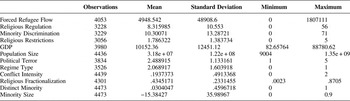
To capture other effects related to religion, we use Alesina et al.'s (Reference Alesina, Devleeschauwer, Easterly, Kurlat and Wacziarg2003) religious fractionalization measure — referred to as Religious Fractionalization — to measure the effects of religious diversity.Footnote 10 In addition, we use data from the Minority at Risk Dataset (2009) constructing the dummy variable Distinct Minority to control for the existence of religiously-distinct minorities in a given country. This variable codes the absence of minorities and minorities that are part of the majority religion, or part of a sect within the same religion as the majority religion, as 0 and minorities that adhere to a completely different religion than the majority as 1. From the Minority at Risk Dataset we also use the size of these groups for the variable Minority Size, which is expressed as a population percentage. Table 1 provides a descriptive overview over the variables used.
Descriptive Statistics

Methods
We use a negative binomial regression with standard errors clustered by country to study the effects of religious restriction on forced migration. We follow several other studies of forced migration and conceptualize forced migration as a series of interdependent events (i.e., the probability of one instance of forced migration occurring is closely connected to others in the community fleeing), calling for an estimator that deals with positively correlated count data (Melander, Öberg, and Hall Reference Melander, Öberg and Hall2009; Moore and Shellman Reference Moore and Shellman2004). We cluster standard errors by country to account for the repeated observations for each country over time.Footnote 11
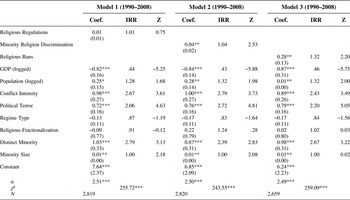
We run three main models, each with a different explanatory variable (Table 2); because of the significant collinearity among the different measures of religious restriction, including them in the same model may be problematic. Model 1 includes all control variables and Religious Regulations. Model 2 follows this specification, but with Minority Religion Discrimination instead. Model 3, finally, features Religious Bans.
Negative Binomial Regression for Forced Migration Flows
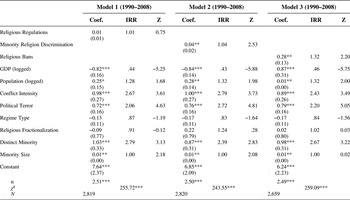
Note: IRR = incidence rate ratio; GDP = gross domestic product. Standard errors in parentheses. ***p < 0.001, **p < 0.01, *p < 0.05.
Robustness Checks
We run over 50 robustness checks — using alternate specifications on all three models — to address potential issues with the variables, data, and models. One addresses potential issues with pooling data from 1990 to 2008 by including a dichotomous variable in the model indicating the observation is from the 1990s. Other robustness checks use alternate control variables, including: a measure of the aggregate importance of religious belief from the World Values Survey (WVS) data (2013); alternate measures of conflict intensity, including the three-year and ten-year maximum intensity level using Uppsala data (2010), and a measure of events of genocide using data from the Political Instability Task Force (PITF) Dataset (2014).Footnote 12 From World Bank data, we use measures of the poverty gap at two dollars a day; the Gini coefficient measure of income inequality; the level of population growth; and the urban population level. In addition, we employ the control variables linguistic and ethnic fractionalization, using the Alesina et al. (Reference Alesina, Devleeschauwer, Easterly, Kurlat and Wacziarg2003) data, a dummy variable for “non-Western” countries to address differences among regions, and models with Regime Type and Political Terror included separately to account for multi-collinearity among these variables. We also include a robustness test excluding the five cases with the highest moving average of outflow to account for outliers. Moreover, we run a robustness check using the logged forced migration stock, rather than the flow, as an alternative dependent variable measure. Finally, we use alternate models to control for the effect of differing estimation methods; we use a zero inflated negative binomial regression, a negative binomial generalized estimating equation, and a random effects negative binomial model.
FINDINGS
Our statistical findings suggest strong support for the theorized effects of religious repression on forced migration. Minority Religion Discrimination and Religious Bans were significant at the 0.01 level in the models with a positive sign for the coefficient, indicating that higher levels of religious restrictions of these types corresponded to greater refugee movement. Religious Regulations were not significant for refugee movement.
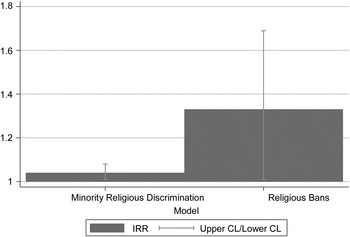
The substantive effects of these variables, reported as incidence rate ratios (IRRs), also indicate the importance of religious repression. The IRRs express the percentage of change that a one-unit increase in the independent variable unfolds on the dependent variable. A value above 1.00 indicates an increase, whereas a value below 1.00 indicates a decrease. As Figure 1 shows, the IRRs of 1.32 for religious bans and 1.04 for the discrimination of religious minorities suggests that a one-unit increase in religious bans produces a 32% increase in the predicted count of people leaving, while a one-unit increase in the discrimination against religious minorities increases the outflow by only 4%. This is a substantial change in the case of religious bans; however, it is not the highest relative to the other IRRs. Figure 1 shows the substantive effects of both variables.
Substantive significance of religious repression variables (with 95% CIs).

The Religious Bans and Minority Religion Discrimination variables remained significant at the 0.01 level in the vast majority of the 54 robustness checks.Footnote 13 The countries that were the largest contributors to forced migration were Colombia, Rwanda, Sudan, Iraq, and Afghanistan. Even when excluding these cases — which might have driven results — in a robustness check, the findings hold up. Both, Religious Bans and Minority Religion Discrimination were not significant in the robustness check controlling for income distribution and the robustness check using the alternative dependent variable refugee stock. Religious Bans was the only not significant variable when controlling for the WVS item. This is likely due to issues with the data, however, as the WVS measures includes few countries, resulting in a significant loss in observations when included in the model.Footnote 14
These findings provide strong support for the theorized impact of religious repression. Religious repression is not insignificant in forced migration, or epiphenomenal to other factors, as its persistent significance in the face of the control variables suggests. But not all types of religious repression have strong effects on forced migration. Outright bans on religions have the strongest effect, as these make life most difficult for religious groups. Minority discrimination has a significant but smaller effect, as the ramifications of such policies are felt by a smaller percentage of the population. Religious regulations, while likely significant in other areas of political and social life, did not have a significant effect on forced migration, likely due to their minimal detrimental effects compared to the other variables.
Some alternative explanations for forced migration are valid, although these other factors do not undermine or explain the significance of religious repression. Political Terror and Conflict Intensity were significant and positive in all models, as were Distinct Minority and Minority Size. These variables all had significant effects on forced migration, as can be expected, but they do not account for the effects of religious repression.
Our findings do, however, weaken some other alternative explanations on the relationship between religion, religious restriction, and forced migration. The apparent effects of religious restrictions are not due to the importance of religion in society or religious diversity. When controlling for religious fractionalization, the findings for the independent variables remained stable and significant in all robustness checks. And the robustness check assessing the importance of religion in society did not undermine all of the findings (see above).
CONCLUSIONS
State-driven religious repression tends to increase forced migration. Government restrictions on religion target the beliefs and practices of individuals and groups — particularly religious minorities, but also in some cases the religious majority — making people more likely to flee than would be the case absent religious repression. This effect is apparent even when controlling for other causes of forced migration, such as armed violence or general human rights violations.
The findings also provide some insight into the complexity of religious repression's effects. The milder and more focused religious repression is, the less likely it is to lead to an increase in refugee outflow. The more extreme and indiscriminate religious restrictions are, the more they motivate flight. Moreover, religious repression, while significant in predicting refugee outflows even when controlling for other variables, does not explain all aspects of forced migration. Conventional explanations, such as political repression and armed conflict, remain valid.
There are of course some caveats to our findings. We focus on religious repression at the aggregated country level. As a result, we are unable to assess whether religious repression has different effects at the individual level of forced migration based on individual religiosity or a specific minority group. Future research with more detailed data should address more individual-level and group-level mechanisms; this includes the combination of push and pull factors, such as whether there is migration from highly-restrictive countries to less-restrictive countries, and whether specific religious identities alter cost-benefit calculations. In addition, the importance of communal ties should receive greater attention (Adhikari Reference Adhikari2012; Reference Adhikari2013; Edwards Reference Edwards2009).
Moreover, there are many potential issues involved in refugee data, as the definition of who constitutes and is counted as a refugee is problematic (Edwards Reference Edwards2009, 29, 33). This is a problem all studies on forced migration share, however, and it is unlikely that issues with missing or inaccurate numbers are sufficiently related to government restrictions on religion to undermine this article's findings. Finally, the time frame of this study is limited to the post-Cold War era due to data availability. While the article is unable to provide a historical context, it does cover contemporary forced migration.
Despite these caveats, our findings can speak to broader theoretical debates in the study of religion and politics as well as forced migration. The findings support studies that emphasize the significant effect of religious repression on societies (Grim and Finke Reference Grim and Finke2011; Henne Reference Henne2013; Toft, Philpott, and Shah Reference Toft, Philpott and Shah2011). Most of these studies have focused on extremism, political violence and foreign policy, but our findings show religious repression can also contribute to cross-border issues like forced migration. Likewise, existing studies on forced migration are correct in their focus on state repression, armed conflict, and other factors (Adhikari Reference Adhikari2012; Reference Adhikari2013; Davenport, Moore, and Poe Reference Davenport, Moore and Poe2003; Moore and Shellman Reference Moore and Shellman2004; Reference Moore and Shellman2006; Reference Moore and Shellman2007; Rubin and Moore Reference Rubin and Moore2007), but future studies should incorporate into their analyses the relationship between religion and state and more nuanced assessments of political repression.
Supplementary materials and methods
To view supplementary material for this article, please visit http://dx.doi.org/10.1017/S1755048314000522.