Early institutional rearing has a lasting impact for some children, even after adoption into a loving home. In particular, postinstitutionalized (PI) children are at an increased risk of poor social development and disordered social behavior. Although preadoption conditions, particularly institutional care and age at adoption, have been found to predict increased risk for social deficits, delays, and impairments (e.g., Hawk & McCall, Reference Hawk and McCall2010; Kadlec & Cermak, Reference Kadlec and Cermak2002), little attention has been paid to whether postadoption parenting can moderate or ameliorate associations between early adverse care and psychosocial functioning among these children.
Between 1999 and 2009 there were over 213,000 children adopted into the United States from a foreign country (US Department of State, 2009). Many of these children came from countries that used institutional or orphanage care. Although there are variations in care from one institution to the next and even within institutions, it can be expected that institutional care has limitations making it less optimal than family care. Some studies have reported that infants and young children are typically cared for in relatively large groups with ratios of six to eight infants or more per caregiver. Caregivers are not assigned to a particular infant and rotate on shifts such that an infant may experiences over 20 persons caring for them per week. Caregiving tends to be perfunctory and routinized rather than contingent on the child's signals, and there is little responsive one on one interaction between caregivers and infants (Smyke et al., Reference Smyke, Koga, Johnson, Fox, Marshall and Nelson2007; The St. Petersburg–USA Orphanage Research Team, 2005). From a developmental psychopathology perspective, studies with children being adopted from such institutions can be considered “experiments of nature” and provide unique insight into both typical and atypical development (Cicchetti, Reference Cicchetti2003). As these children experience a circumscribed period of early deprivation followed by a dramatic shift in environment when they are adopted into a family, this population allows for specific examination of the effects of early deprivation on socioemotional development, in contrast to populations such as maltreated and neglected children in which early deprivation typically is confounded with ongoing adverse rearing conditions. A developmental psychopathology framework posits that both normative and atypical processes inform one another (Cicchetti, Reference Cicchetti2003; Rutter & Sroufe, Reference Rutter and Sroufe2000) and emphasizes the importance of describing the mechanisms through which early experience shapes later adaptation (Cicchetti & Toth, Reference Cicchetti and Toth2009). Within this framework, socioemotional outcomes in internationally adopted PI children have implications for understanding the fundamental processes by which early experience influences socioemotional development in both typically developing and at-risk populations. Notably, interventions designed to improve psychosocial care by reducing the number of staff caring for each child and increasing caregiver responsiveness to child signals have been shown to improve both cognitive and social development, even when physical care (nutrition, medical care) is not altered (e.g., The St. Petersburg–USA Orphanage Research Team, 2008), thus providing insight into possible mechanisms operating to produce institutional rearing effects.
Following adoption or fostering into families, marked improvement in all domains of functioning are typically observed in PI children (van IJzendoorn & Juffer, Reference van IJzendoorn and Juffer2006). Nonetheless, for many children deficits in some areas persist. Although internalizing and externalizing behavior problems are common among children reared in psychosocial adversity, these are not of particular note among PI children (Juffer & van IJzendoorn, Reference Juffer and van IJzendoorn2005). Rather, years following adoption these children appear to be at risk for problems of social relatedness (Rutter, Kreppner, & O'Connor, Reference Rutter, Kreppner and O'Connor2001). Impairments have been noted in performance on theory of mind tasks (Colvert et al., Reference Colvert, Rutter, Kreppner, Beckett, Castle and Groothues2008; Tarullo, Bruce, & Gunnar, Reference Tarullo, Bruce and Gunnar2007), on measures of emotion perception and understanding (Fries & Pollak, Reference Fries and Pollak2004), and in attachment-related functioning (e.g., Chisholm, Reference Chisholm1998; O'Connor, Rutter, & The ERA Study Team, Reference O'Connor and Rutter2000). Impaired social relatedness also was noted in earlier work on PI children who were adopted from institutions that were stimulating enough to sustain normal cognitive development, but that had significant staff turnover and a philosophy discouraging the staff from forming attachments to particular children (Tizard, Reference Tizard1977; Tizard & Hodges, Reference Tizard and Hodges1978). These data suggest that problems of social relatedness may be based in deficits in adult–child relationships in institutionalized settings (Gunnar, Reference Gunnar, Nelson and Luciana2001). This conclusion is consistent with attachment theory (Bowlby, Reference Bowlby1969/1982, Reference Bowlby1973, Reference Bowlby1980), according to which inconsistency in care should lead the child to view adults as unreliable people who cannot be trusted in threatening or uncertain situations nor serve as reliable bases of exploration in new environments.
Given the general paucity of stable, responsive caregiver–child relationships for children reared in institutions, the question of whether these children can form secure attachment relationships following adoption or fostering has received attention. The current evidence suggests that PI children do form discriminating attachments to adoptive or foster parents; however, they are at risk for disorganized/disordered and insecure attachments, particularly if placed after 2 years of age (Chisholm, Reference Chisholm1998; O'Connor et al., Reference O'Connor and Rutter2000; Smyke, Zeanah, Fox, Nelson, & Guthrie, Reference Smyke, Zeanah, Fox, Nelson and Guthrie2010). The risk for reactive attachment disorders (RAD) also has been examined. Among children in institutional care, both the inhibited and disinhibited forms of RAD have been observed (Smyke, Dumitrescu, & Zeanah, Reference Smyke, Dumitrescu and Zeanah2002); however, following adoption or fostering, it is the disinhibited form that has been described most often (e.g., Rutter et al., Reference Rutter, Kreppner and O'Connor2001).
The core features of disinhibited attachment disorder involve atypical responses to strange or unfamiliar adults, according to the Diagnostic and Statistical Manual of Mental Disorders—Fourth Edition, Text Revision (American Psychiatric Association, 2000) and the International Classification of Diseases and Related Health Problems—Tenth Revision (World Health Organization, 1992). Children who meet criteria for disinhibited attachment disorder are overly friendly with strangers to the point of making the stranger feel uncomfortable with the child's forwardness. They may be willing to go home with complete strangers, seek physical contact from or proximity to strangers, or otherwise display behaviors that are generally only appropriate with people the child knows well (O'Connor & Zeanah, Reference O'Connor and Zeanah2003; Zeanah, Boris, & Lieberman, Reference Zeanah, Boris, Lieberman, Sameroff, Michael and Miller2000). Together these behaviors have been termed indiscriminate friendliness or disinhibited social approach (for discussion, see Bruce, Tarullo, & Gunnar, Reference Bruce, Tarullo and Gunnar2009). There is currently an argument over whether these behaviors reflect failure of the child to form a discriminating attachment to the caregiver, a critical criterion in the definition of RAD, as there is good evidence that indiscriminate friendliness in PI children can co-occur with secure attachment relationships to foster or adoptive parents (Chisholm, Reference Chisholm1998), and a recent study found no association between indiscriminate friendliness and attachment-related behaviors (Bruce et al., Reference Bruce, Tarullo and Gunnar2009). Emerging evidence indicates that attention problems, which are not necessarily a feature of disordered attachment, may contribute to indiscriminate friendliness. Indiscriminate friendliness is correlated with behavioral measures of attention deficits, including poor inhibitory control (Bruce et al., Reference Bruce, Tarullo and Gunnar2009; Roy, Rutter, & Pickles, Reference Roy, Rutter and Pickles2004). In previous work with the sample of children studied here, an observational measure of indiscriminate behavior (initiating physical contact and making personal remarks to a stranger) was associated with EEG hypoactivation (Tarullo, Garvin, & Gunnar, Reference Tarullo, Garvin and Gunnar2011). Note that EEG hypoactivation has been observed in children with attention-deficit/hyperactivity disorder and as a predictor of attention-deficit/hyperactivity disorder symptoms in the Bucharest Early Intervention Project, a study of children reared in infancy in Romanian orphanages. This work suggests the importance of experience-expectant development in that the typical experience for members of our species is to be cared for in a manner conducive to the formation of an attachment relationship as well as to have sensory stimulation, among other experiences relevant to other domains of development (McLaughlin et al., Reference McLaughlin, Fox, Zeanah, Sheridan, Marshall and Nelson2010).
Regardless of whether indiscriminate behavior should or should not be viewed as reflecting disordered attachment relationships with foster or adoptive parents, it is a remarkably persistent feature of atypical social behavior for many PI children. It has been observed years following removal from institutional care (e.g., Hodges & Tizard, Reference Hodges and Tizard1989; Kreppner et al., Reference Kreppner, Kumsta, Rutter, Beckett, Castle and Stevens2010; Tizard & Hodges, Reference Tizard and Hodges1978). The persistence of indiscriminate behavior is consistent with evidence that children reared in institutions have lower levels of argonine vasopressin and fail to exhibit differential oxytocin responses to contact with their adoptive mother versus a stranger (Fries, Ziegler, Kurian, Jacoris, & Pollak, Reference Fries, Ziegler, Kurian, Jacoris and Pollak2005). These neuropeptides have been shown in animal studies to facilitate social learning (habituating to repeated presentations of a novel peer) and formation of social bonds (Lim & Young, Reference Lim and Young2006). Disturbances in the regulation of these neuropeptides in some PI children may result in a more superficial approach to people and more indiscriminate sociability. Beyond the physical danger that indiscriminate behavior with strangers may pose, these behaviors also may herald difficulties in negotiating relations with peers as the child develops (see Hodges & Tizard, Reference Hodges and Tizard1989). Furthermore, this work reflects the concept inherent in the study of developmental psychopathology that behaviors considered to be abnormal may be extreme, or distorted, versions of typical behaviors (Cicchetti, Reference Cicchetti2003). Behaviors that may improve a child's ability to gain individualized attention in an institutional setting, and thus be appropriate in that circumstance, can be maladaptive when a child is adopted into a loving home. Thus, it will be important not only to understand the preadoption factors predicting risk of indiscriminate behavior, but also to determine whether postadoption interventions may reduce expression of such behavior.
Similar concerns arise for other social deficits for which PI children are at risk, including problems in perceiving and understanding emotions in themselves and others. Studies of children in institutions have shown that although they can discriminate facial expressions of peak emotions, event-related potentials show markedly smaller amplitudes and longer latencies for occipital components associated with face processing; furthermore, several years after placement in foster care, these event-related potential differences from family reared children are only partially ameliorated (Moulson, Fox, Zeanah, & Nelson, Reference Moulson, Fox, Zeanah and Nelson2009). Examined several years after adoption, PI children also have trouble labeling emotion expressions and accurately matching expressions to emotion-eliciting scenarios (Fries & Pollak, Reference Fries and Pollak2004). Because emotion understanding is a critical social skill, deficits in this domain might be expected to impair these children's social relationships with peers. Impaired social relationships, particularly immaturity in social relations with peers, have been noted for PI children (e.g., Gunnar & van Dulmen, Reference Gunnar and van Dulmen2007).
Postadoption Parenting
Despite decades of research on PI children, there is surprisingly little information on postadoption parenting and its role, or lack thereof, in whether social or cognitive deficits are observed years after adoption. At 7 years of age, children adopted internationally into The Netherlands were better adjusted socially and academically if their parents scored higher on observational measures of sensitivity assessed both in infancy and concurrently (Stams, Juffer, Rispens, & Hoksbergen, Reference Stams, Juffer, Rispens and Hoksbergen2000). However, as the children in the study were all adopted quite early, typically before 3 months, and had experienced only family or foster care, these results may not pertain to the role of parenting in recovery from prolonged institutional deprivation. In contrast, Croft, O'Connor, Keaveney, Groothues, Rutter, & The ERA Study Team (Reference Croft, O'Connor, Keaveney, Groothues and Rutter2001) examined parenting during a semistructured interaction task at ages 4 and 6 years for children adopted from Romanian institutions before 24 months of age. Compared to similar measures for parents and children adopted intracountry before 6 months of age, their results showed that the parents of PI children were more negative than control parents at the 4-year but not at the 6-year assessment; that child cognitive delay was associated with poorer parenting scores; and that over time the improvement in child functioning accounted for the improvement in parenting scores, rather than the reverse. However, in this study IQ was the only measure of child functioning; thus, it is not clear whether postadoptive parenting might impact later developing social competencies.
Although parenting has been examined in only one study of PI children, demographic factors and family risk measures associated with parenting have been examined in several studies. Chisholm (Reference Chisholm1998) reported that 3 years postadoption and in conjunction with lower IQ, lower socioeconomic status but not parent education predicted insecure attachment relationships among children who were 8 months or older when adopted from Romanian institutions. In this study, indiscriminate friendliness was related neither to child IQ nor to family demographic factors (sosioeconomic status or parental education), but was related to whether or not the child was reported to be a favorite in the institution. The English–Romanian Adoption Study, which has followed Romanian adoptees up through 15 years of age, examined numerous family risk factors and their association with significant postinstitutional impairments (Castle, Beckett, Rutter & Sonuga-Barke, Reference Castle, Beckett, Rutter and Sonuga-Barke2010). They found no evidence that qualities of the parent's relationship, family level stress measures, or socioeconomic status were associated with child impairments. Overall, they argued that the families they studied were remarkably resilient in the face of the significant challenges posed by disturbed behavior among many of the children. Findings such as this, and evidence of very significant rebounds in child physical, cognitive, and socioemotional functioning after adoption, have led to the conclusion that adoption is an effective intervention for children reared early under conditions of deprivation (van IJzendoorn & Juffer, Reference van IJzendoorn and Juffer2006). Nonetheless, it has been argued that parents of PI children may need to be even more sensitive than parents of nonadopted (NA) children or those who have not experienced early deprivation in order to promote more typical patterns of socioemotional functioning (Ames & Chisholm, Reference Ames, Chisholm, Bailey, Bruner, Symons and Lichtman2001). Furthermore, even small variations in parenting may be expected to be associated with child outcomes during periods of rapid neurobehavioral change such as is observed in the months following removal from institutional care.
Present Study
The goals of the present study were to examine parenting quality soon after arrival in the family for children adopted following prolonged periods of institutional care and to determine whether parenting, either alone or in interaction with indices of child functioning, predicted socioemotional functioning a year or more following adoption. Two indices of socioemotional functioning were obtained: indiscriminate friendliness and emotion understanding. Parenting was assessed at 18 months using the Emotional Availability (EA) Scales (Biringen, Reference Biringen1998). The EA Scales were used because they were designed to incorporate multiple views of EA into a scheme that is useful for research. Previous studies have found a relationship between EA and attachment security among both typically and atypically developing children, validating this measure (Easterbrooks & Biringen, Reference Easterbrooks and Biringen2000; Koren-Karie, Oppenheim, Dolev, & Yirmiya, Reference Koren-Karie, Oppenheim, Dolev and Yirmiya2009). Furthermore, a psychometric study has found EA to be stable across short periods of time (Bornstein, Gini, Suwalsky, Putnick, & Haynes, Reference Bornstein, Gini, Suwalsky, Putnick and Haynes2006).
Initiation of joint attention (IJA; Mundy, Delgado, Hogan, & Doehring, Reference Mundy, Delgado, Hogan and Doehring2003) was used to index child socioemotional functioning at 18 months. IJA was chosen as a child index for several reasons. First, the acquisition of joint attention is one of the major socioemotional developmental tasks of infancy. IJA reflects the child's interest in establishing a joint focus of attention for the sole purpose of sharing the experience (Mundy et al., Reference Mundy, Delgado, Hogan and Doehring2003) and thus may be an important building block of the PI child's relationship with the adoptive parent. Second, previous studies have shown that IJA is associated with parenting quality (Hane & Fox, Reference Hane and Fox2006; Vaughn et al., Reference Vaughn, Mundy, Block, Burnette, Delgado and Gomez2003), is impaired in children with disordered parent–child relationships (Claussen, Mundy, Mallik, & Willoughby, Reference Claussen, Mundy, Mallik and Willoughby2002; Schecter et al., Reference Schechter, Willheim, Hinojosa, Scholfield-Kleinman, Turner and McCraw2010), and may be suppressed in children adopted late from institutional care (Bruce, Kroupina, Parker, & Gunnar, Reference Bruce, Kroupina, Parker and Gunnar2000). Third, IJA is a preverbal measure, and thus is appropriate for use with children who are just learning to speak the parent's language, as is the case for PI toddlers. Fourth, joint attention is believed to establish a psychological platform out of which skills such as language, executive functions, and theory of mind develop (Mundy, Sullivan, & Mastergeorge, Reference Mundy, Sullivan and Mastergeorge2009), all of which are developmental domains in which PI children are at elevated risk of enduring problems.
PI children and their parents were examined in comparison to two other groups. One group consisted of NA children whose parents were of roughly comparable educations and incomes to families who adopt internationally. The other group consisted of children who were adopted internationally, but had spent most of their preadoption lives in family or foster care. This latter group served as an adoption control. Due to the policies of countries with foster care compared with those with institutional care for wards of the state, children adopted from foster care typically arrive in their adoptive home at a younger age than their institutionally reared counterparts.
The study was designed to address the following questions:
1. Does parenting quality for PI children during the months following adoption differ from that for family reared (foster or NA) children?
2. Does parenting quality observed at this time predict indiscriminate friendliness and/or emotion understanding assessed 18 months later?
3. Does IJA predict indiscriminate friendliness and/or emotion understanding either directly or as moderated by parenting quality?
4. Are any of these predictions particular to PI children, or do they also hold for children adopted from foster care and/or NA children?
Method
Participants
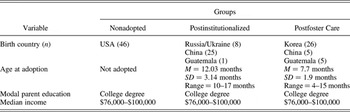
The sample included 119 (35 male) children who were 18 months (M = 18.9, SD = 0.56) at the first assessment, 30 months (M = 31.4, SD = 0.66) at the second assessment, and 36 months (M = 36.6, SD = 0.70) at the third assessment. There were three groups: PI, post foster care (PFC), and NA. Other data on these participants has been reported previously (Tarullo et al., Reference Tarullo, Garvin and Gunnar2011). The inclusion criteria for the PI group (N = 35, 31 female) were adoption at or after 10 months of age (range = 10–17 months) and having spent 75% or more of preadoption life in institutional care, whether an orphanage, hospital, or other form of institution. In addition, children in this group could have spent no more than 2 months in family-based care prior to adoption. This group is disproportionately female as it comprised all qualified, willing participants adopted in the geographical area and this was a heavily female population, based in large part on many children being adopted from China, most of whom were female. The inclusion criteria for the PFC children (N = 38, 15 females) were that 75% of their preadoption life was spent in family-based care (biological relatives or foster care) and no more than 2 months in institutional care. All children in the NA group (N = 46, 38 females) were full term, born in the United States, and reared by their biological families. Children in this group were matched, based on age and gender, to children in the PI group. Exclusion criteria for all groups were facial morphology indicative of prenatal alcohol exposure or significant genetic or prenatal anomalies (e.g., Down syndrome, cerebral palsy; for procedures, see Loman, Wiik, Frenn, Pollak, & Gunnar, Reference Loman, Wiik, Frenn, Pollak and Gunnar2009). Four children were excluded. The adopted children differed by group in terms of their countries of origin (see Table 1) as at the time of the study most countries invested in either institutional care or a foster system for children who were wards of the state. Due to this difference in the type of care by country, there is also a difference between the groups in terms of the age at adoption (t = 7.01, df = 71, p < .001) because countries with a foster system tend to permit earlier adoptions than those with institutional care.
Demographic characteristics of participants by group

Note: Parents failed to supply birth country information for one postinstitutionalized and two post foster care children.
Recruitment
The internationally adopted children were recruited through the international adoption registry of the International Adoption Project. During the period of recruitment for this study, the registry consisted of families who had adopted through the largest adoption agencies in the state in which the study was conducted. Families adopting internationally through these agencies were sent a letter a month after they brought their child home. The letter described the research being conducted with internationally adopted children and invited them to join a registry of families who were interested in being contacted about research. Once the parents had indicated their desire to be part of the registry, they were contacted for participation and inclusion and exclusion criteria were determined. Children meeting criteria were recruited for the study with approximately 75% acceptance rate for the families of internationally adopted children. Parents of NA children were identified through a registry of parents interested in child development research, and also were contacted by phone for recruitment, with acceptance being lower at about 50% of those meeting criteria.
Procedure
First assessment: 18 months
Following consent, Experimenter 1 took the family into a room in which a table was set up with one chair on each side. The parent was asked to hold the child on his/her lap close to the table while Experimenter 1 sat across the table. It was at this time that the paradigm for the Early Social Communication Scales (ESCS) was conducted (see below). In this room, a video camera was encased in a compartment mounted on the wall and was controlled from another room, so as to cause minimal distraction to the participants. After several additional tasks not used in these analyses were conducted (see Tarullo et al., Reference Tarullo, Garvin and Gunnar2011), the parent and child were brought back to the room, which now contained a blanket and toys. At this time, the dyad was instructed to play “as they normally would at home” and the experimenter left the room. After 10 min of free play, the session was concluded, the child was able to select a prize and the parent was given a $5 gift certificate.
Second assessment: 30 months
This is the only session for which the parent and child did not come to the laboratory; rather, the entire session was conducted via the phone and mail. Once a consent form had been signed and returned to the investigators, a phone interview was arranged with the parent to assess indiscriminate friendliness and other problems of social relatedness. The experimenter called the parent from a phone that was equipped with a recording device that made an audio recording to cassette.
Third assessment: 36 months
At 36 months, a parent brought the child back to the laboratory. After the consent process, an investigator went into the room to conduct several tasks, including a task of emotion knowledge (Denham, Reference Denham1986). Several other tasks were completed that are not presented in the present paper (see Tarullo et al., Reference Tarullo, Garvin and Gunnar2011). The session concluded with the parent receiving a $5 gift card and the child a small toy.
Measures
IJA
IJA was assessed at 18 months using the ESCS (Mundy et al., Reference Mundy, Delgado, Hogan and Doehring2003). These scales involved a semistructured infant–experimenter task lasting 20 min, during which time an experimenter presented several toys to the child as the child sat on the parent's lap. The experimenter was across the table from the dyad and the child was close to the table. The nature of the toys was such that they required motoric ability of which 18-month-old children are generally not capable, such as windup toys with small cranks, and the children therefore could not operate the toys on their own. After the researcher demonstrated the use of the toy, or after the child requested the toy (whichever came first), the toy was given to the child for exploration. The session was videotaped and then coded using the revised ESCS (Mundy et al., Reference Mundy, Delgado, Hogan and Doehring2003). IJA was the subscale of the ESCS used in this report. IJA accounts for the child making social bids to the experimenter such as pointing or holding up a toy while making eye contact. The sessions were coded by trained undergraduate coders who achieved intercoder reliability at a kappa of 0.80 using training tapes coded by Mundy's group. In addition, 20% of the sample was coded by two coders for reliability (κ = 0.70 for IJA; Tarullo, Reference Tarullo2007).
EA Scales
EA was assessed at 18 months during the laboratory visit using a video recording of a 10-min free play interaction between the parent and the child. The EA Scales (Biringen, Reference Biringen1998) were used to assess parenting quality. EA is a dyadic measure meant to assess the EA of the partners to one another (Biringen & Robinson, Reference Biringen and Robinson1991). There have been several editions of the EA Scales. The version used in this report assesses six scales: parental sensitivity (1–9), parental nonintrusiveness (1–5), parental nonhostility (1–5), parental structuring (1–5), child involving of parent (1–7), and child responsiveness to parent (1–7). As is evidenced by the title of each subscale, four of these measures refer specifically to the parent and two to the child. Parental sensitivity is meant to subsume several dimensions, including the parent's accurate interpretation and perception of the child's cues and suitable responsiveness to these cues; the expression of a range of affectivity, primarily positive, and an ability to regulate the child's affect; and the ability to negotiate mismatched events. A primary feature of this code is that it does not just assess parental sensitivity, but in particular, the emotional feature of this sensitivity (Biringen & Robinson, Reference Biringen and Robinson1991).
EA Scales were coded by several researchers who have been approved as reliable to code by Beringen after an extensive training period. Spot checks on coding reliability among coders were conducted on over 20% of the sample through the coding process. All coders maintained reliability within one point on sensitivity, child involving of the parent, and child responsiveness to the parent (9-point, 7-point, and 7-point scales, respectively) and within half a point on the other scales (5-point scales). If two coders disagreed on the scores for a particular dyad, the coders would watch the session together and agree upon new scores. This form of assessing reliability is appropriate for this sample based on two factors: precedent in the field (e.g., Bornstein et al., Reference Bornstein, Gini, Putnick, Haynes, Painter and Suwalsky2006) and the relative restriction of range of outcomes making it problematic to use correlation coefficients.
Preliminary analyses indicated that the EA Scales were so highly intercorrelated as to create problems of significant collinearity when entered into the planned regression analyses. Therefore, to obtain a measure of parenting EA, we subjected the four parent scales to a principal factor analysis. The results yielded one factor with an eigenvalue of 2.93 that accounted for 74% of the variance. The individual scales loaded as follows: sensitivity (0.93), structuring (0.89), nonintrusiveness (0.90), and nonhostility (0.69). The lower loading for nonhostility was due to 92% of the families scoring 5 (the lowest level of hostility). The factored score was produced, labeled parent EA and used in the regression analyses. Parent EA was separated from child EA in an effort to address issues of collinearity. Even though the measure has been labeled “parent EA” it is still a dyadic measure due to the nature of the EA Scales. Thus, how the parent scored might well be different if she was interacting with a different child. When parent EA was found to be a significant predictor or moderator, based on planned comparison analyses, follow-up analyses were conducted examining all but the nonhostility scale separately. Nonhostility was not examined separately because of its restricted range.
Because excluding the child scale might impact results, we examined their association with the parent EA measure. Child responsiveness to parent and child involving of parent were highly correlated with parent EA for the total sample (r = .72 and r = .69, dfs = 117, ps < .001) and within the PI group (r = .81 and r = .82, dfs = 34, ps < .001). Thus, it was determined that child EA was largely interdependent with parent EA scores, consistent with the philosophy of the instrument, and problems of collinearity would prohibit entering the child and parent scores into the same regression analyses to predict later functioning. In contrast, parent EA and IJA were only modestly associated (r = .21, df = 117, p < .05), thus confirming that IJA could be examined as a facet of child functioning in regression analyses with parent EA.
Parent interview
When the child was 30 months of age, the parent was interviewed using a semistructured interview designed by Rutter, O'Connor, and colleagues to assess attachment problems in PI children (e.g., O'Connor, Bredenkamp, Rutter, & The ERA Study Team, Reference O'Connor, Bredenkamp and Rutter1999; O'Connor et al., Reference O'Connor, Marvin, Rutter, Olrick and Britner2003). The parents were asked a series of questions about their child's typical behaviors to provide data for three subscales roughly reflecting inhibited attachment problems (e.g., failure to seek comfort, range = 0–8), disinhibited or indiscriminate friendliness behavior (e.g., wandering off in a strange setting, friendliness with strangers, range = 0–8), and separation problems (range = 0–30). Interviews were coded by three researchers trained to reliability on each subscale. Over 20% of the present sample was coded by at least two coders to ensure maintenance of reliability (κ = 0.85–0.90 for indiscriminate, κ = 0.78–0.93 for inhibited attachment problems, κ = 0.92–0.94 for separation). The focus of the present analysis was on disinhibited or indiscriminately friendly behaviors; however, preliminary analyses were performed to determine whether inhibited behaviors also were reported for PI children, and thus should be included in our analyses. There were no significant group differences on inhibited behaviors, F (2, 92) = 8.86, ns, and these problems were rarely noted (M = 0.48 on scale of 0–8). Disinhibited/indiscriminate friendly behaviors were positively skewed and were thus log10 transformed after adding a constant of 1 prior to analysis. These behaviors did differ by group, F (2, 92) = 4.0, p < .05, η = 0.08, with post hoc tests indicating that PI children (M = 0.22, SD = 0.27) scored higher than PFC children (M = 0.06, SD = 0.15), although not significantly higher than NA children (M = 0.15, SD = 0.21). When more severe behaviors were isolated (e.g., willing to go with a stranger, willingness to wander off without parent), PI children scored higher than NA children, F (210) = 2.68, p = .070. Finally, raw scores of greater than 4 may be considered evidence of significantly disordered behavior, and the only children to score in this range were in the PI group (10%). Thus, preliminary analyses supported our focus on indiscriminate behavior as a particular issue for some PI children.
Emotion knowledge
Emotion knowledge was coded based on Denham's (Reference Denham1986) emotional understanding tasks, which have been validated for use with 2- and 3-year-old children. At 36 months, children completed the emotion labeling task to assess receptive and expressive identification of basic emotions (happy, sad, angry, fearful) depicted on felt faces (possible range = 0–8). They then participated in an affective perspective taking task consisting of 20 vignettes an experimenter enacted using words and puppets. Following each vignette, children were asked to point to the felt face that showed how the puppet character was feeling. For each vignette the children were scored as to whether they correctly identified the emotion depicted by the puppet character (possible range = 0–20). The measures of emotion labeling and affective perspective taking were highly correlated (r = .52, p < .001), so they were converted to standard scores and combined to yield a composite emotion understanding score.
Missing data and attrition
Missing data due to problems in scheduling and in three cases from technical difficulties with the videotaping resulted in missing data at one session or another for 36%, 42%, and 32% of PI, PFC, and NA children, respectively. Some participants, for example, were not able to participate in the 30-month assessment, but did participate in the 36 month assessment. Analyses of whether those with missing data differed from those with no missing data were conducted for each of the predictive measures in the study; none of these analyses were significant (ps > .10). Thus, data were assumed to be missing at random, in accordance with the definition presented by Rubin (Reference Rubin1976). Although this assumption is difficult to prove, evidence indicates that incorrectly assuming missing at random has little impact in the estimates and standard errors in most realistic situations (Schafer & Graham, Reference Schafer and Graham2002).
Analysis plan
Preliminary analyses indicated sex differences only for parent EA; however, based on these differences, sex was included in planned regression analyses. Parent EA at 18 months was first analyzed for group and sex differences using general linear models with Bonferroni post hoc tests in SPSS. Both overall main effect of group and planned comparison between PI and NA groups were examined. If either was significant, we followed up by examining the individual EA Scales, with the exception of nonhostility as discussed above. Imputation was not used for these analyses because of the small amount (n = 3) of missing data. Regression analyses were performed in SAS with both indiscriminately friendly behavior and emotion understanding as dependent variables. Sex was entered as a control variable in these analyses. Group was analyzed as two dummy variables examining PFC and PI groups relative to NA children. Parent EA and IJA were entered as predictor variables, along with their interaction with one another and individually with each of the dummy group variables. Finally, three-way interactions were computed with each dummy group variable, parent EA and IJA. Full models were first evaluated, and then to stabilize coefficients, if higher order interactions were nonsignificant for both PI and PFC groups, they were removed. The model was rerun. If two-way interactions were nonsignificant, they were also removed and the model rerun.
These regression analyses were conducted using multiple imputation to account for missing data rather than listwise deletion. The missing data were imputed in multiple data sets based on the observed values with noise added to the estimate in order to preserve the variance in the sample (Schafer & Graham, Reference Schafer and Graham2002). After the multiple data sets were derived, analyses were conducted on each separately; the results were then converged automatically (SAS, 2002–2003). The benefit of multiple imputation is that the parameters, including mean and standard deviation estimates, are unbiased (Streiner, Reference Streiner2002). When considering multiple imputation, the question arises regarding how many data sets should be imputed. It is standard, depending on the sample size and percent missing, to impute between 2 and 10 data sets (von Hipel, Reference von Hipel2003). In addition, SAS provides output indicating the efficiency of data sets and therefore the numbers of imputation may be tested in order to detect the point where imputing more data sets becomes redundant (SAS, 2002). Based on this information, 10 data sets were imputed for the regression analyses described below.
Results
Descriptive statistics
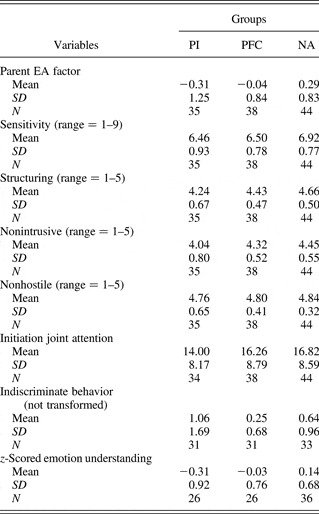
Please refer to Table 2 for descriptive statistics of all observed variables.
Descriptive statistics of the observed variables by groupa

Note: PI, postinstitutionalized; PFC, post foster care; NA, nonadopted; EA, emotional availability.
a A table with all descriptive measures is available from the corresponding author.
Parent EA
Group and sex differences were examined for the factor derived parent EA measures yielding a significant effect of sex, F (1, 111) = 6.35, p < .01, η = 0.54; M males = −0.29, SD = 0.93; M females = 0.12, SD = 1.01. The effect of group was marginally significant, F (2, 11) = 2.62, p = .078, η = 0.45; see Table 2. Planned Bonferroni post hoc comparisons indicated that parent EA scores for PI children were lower than for NA children, p < .05. Similar analyses were done for all of the EA parent scales except the nonhostility subscale (excluded due to lack of range) to examine whether any of the individual scales exhibited a group difference. No significant group difference were noted for sensitivity, F (2, 111) = 1.57, ns. However, significant group differences were noted for structuring, F (2, 111) = 3.75, p < .05, η2 = 0.063, and nonintrusiveness, F (2, 111) = 3.07, p = .05, η2 = 0.04. Post hoc tests revealed that parents of PI children scored lower on structuring and nonintrusiveness (they were more intrusive) than parents of NA children. Interactions of sex by group were not significant in any of these analyses. Due to the difference in the amount of time adopted children spent with their adoptive families based on group differences, age at adoption was also investigated as a predictor of parent EA. Among the internationally adopted children, age at adoption was not a significant predictor of parent EA.
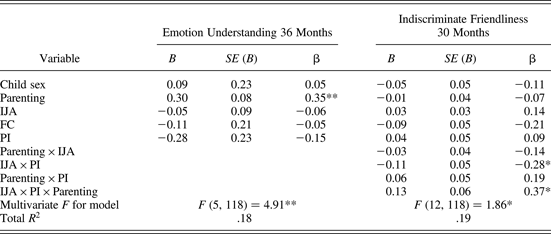
Prediction of emotion understanding and indiscriminate friendliness
Table 3 depicts the intercorrelations of the observed variables (without imputation) in the planned regression analyses. Table 4 depicts the results of the two regression analyses. There were no significant effects of sex in either analysis. Notably, there were no significant interactions of PFC group with any of the other variables, so these factors in the regression have not been shown in Table 4 to simplify the presentation. For emotion understanding, none of the interactions were significant, and thus the model was simplified to exclude interaction factors. The only significant factor was parent EA. Higher parent EA scores predicted higher emotion understanding. Because this effect was not qualified by group, it appears to be a general association with more sensitive, supportive parenting during the toddler period.
Intercorrelations of the observed variables in the regression analyses

Note: EA, emotional availability; IJA, initiation of joint attention; IF, log10 indiscriminate friendliness. Age at adoption was correlated at −.92 with group (PI = 1, PFC = 2, NA = 3), with 0 coded for adoption age for nonadopted children. Thus, in the regression analyses, age at adoption could not be controlled as it accounted for nearly all of the variance associated with group.
*p < .05. **p < .01.
Summary of regression results (N = 119)
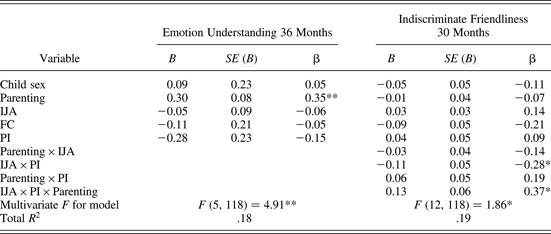
Note: IJA, initiation of joint attention; FC, foster care; PI, postinstitutionalized; F, R 2, and standardized regression coefficients were derived by averaging across imputations. For emotion understanding, none of the interactions were significant and thus the model was rerun without interaction terms. For both emotion understanding and indiscriminate friendliness, interactions with post foster care were all nonsignificant and are not displayed in order to simplify presentation.
*p < .05. **p < .01.
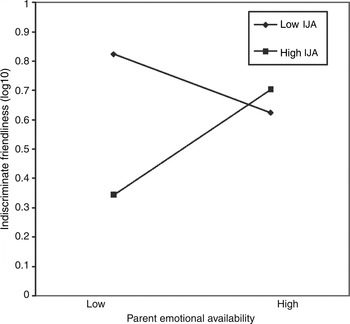
As reported in the Method Section, parents of PFC children reported less indiscriminate friendliness than did PI parents. There was also a significant interaction of parent EA and IJA and a three-way interaction of these factors with PI versus NA comparison. To unpack the three-way interaction, the regression was recomputed within the PI and NA groups separately, entering sex, parent EA, IJA, and the interaction of parent EA and IJA. The model was not significant for the NA group, but the model including the interaction of parenting and IJA was significant for the PI group (p = .05). Figure 1 depicts the interaction of IJA and parent EA plotted according to procedures in Aiken and West (Reference Aiken and West1991). As can be seen, at lower levels of parent emotional availability, 18-month IJA negatively predicted 30-month indiscriminately friendly behavior, although at higher levels of parental EA no association between 18-month IJA and 30-month indiscriminate behaviors was noted.
Plots of the regression coefficients for the postinstitutionalized children showing that indiscriminate behavior at 30 months reflected lower 18-month initiation of joint attention (IJA), moderated by the parent's emotional availability to the child.

Both regressions were followed up by examining separately parental sensitivity, structuring, and nonintrusiveness. The results were consistent with the summary variable in all cases with emotion understanding being associated with sensitivity (β = 0.33, p < .05), structuring (β = 0.28, p < .05), and nonintrusiveness (β = 0.25, p < .05) when these EA scores were examined separately. For indiscriminate friendliness, the three-way interaction for the PI versus NA group reported using the summary parent EA measure was significant when sensitivity (β = 0.34, p < .05), structuring (β = 0.29, p < .05), and nonintrusiveness (β = 0.34, p < .05) were examined separately.
Discussion
The results of the present study indicate that variations in parenting assessed soon after adoption using the EA Scales predict aspects of social functioning in PI children at least 18 months postadoption. This was true despite evidence that adoptive parents were able, within the first months after adoption, to create relationships in which the parent was emotionally available to the child. Nevertheless, even within the restricted and high range of EA that we observed, EA at 18 months predicted higher child scores on tasks of emotion understanding at 36 months and moderated the association between lower scores on IJA at 18 months and indiscriminately friendly behavior at 30 months.
Parents of PI children did score lower than parents of NA children on the summary EA measure. When each of the scales comprising this measure was analyzed separately, parents of PI children did not differ from parents of NA children on sensitivity or hostility (rarely observed), but did have lower scores on structuring and higher scores on intrusiveness. Although longitudinal work is needed to examine whether these differences diminish or increase over time, it seems likely that as in the work by Croft and colleagues (Reference Croft, O'Connor, Keaveney, Groothues and Rutter2001), they reflect the challenges of parenting a child who is in the process of recovering from the negative effects of institutional care. There is good evidence in the literature that children with significant developmental delays and more negative behaviors can stimulate and sustain nonoptimal patterns of parenting (e.g., Cook, Schoppe-Sullivan, Buckley, & Davis, Reference Cook, Schoppe-Sullivan, Buckley and Davis2009; Floyd & Philippe, Reference Floyd and Phillippe1993). The findings that PI parents did not differ in sensitivity and were not more hostile in their interactions than were parents of the other children well may be very hopeful signs for these children. That differences were noted for the parent's ability to help structure the child's activities without being intrusive is probably not surprising, given that both parent and child were just learning to read one another's signals. In addition, given previous work on PI children, we can assume that the children's behavior and competencies were changing rapidly in these first months post adoption (Gunnar, Reference Gunnar, Nelson and Luciana2001), thus perhaps making it difficult for the parent to keep up with the changing needs of the child for structure and help.
Nonetheless, even the small variations in parental EA that we noted at 18 months did appear to be predictive of aspects of socioemotional behavior when the children were 30 and 36 months of age. Across all groups, parental EA predicted children's scores on the Denham (Reference Denham1986) emotion understanding tasks at age 3 years. Prior research has shown that maltreated children, whose caregivers tend to be emotionally unstable and unpredictable (Rogosch, Cicchetti, Shields, & Toth, Reference Rogosch, Cicchetti, Shields, Toth and Bornstein1995), have deficits in emotion knowledge (e.g., Pears & Fisher, Reference Pears and Fisher2005; Pollak, Cicchetti, Hornung, & Reed, Reference Pollak, Cicchetti, Hornung and Reed2000; Rogosch et al., Reference Rogosch, Cicchetti, Shields, Toth and Bornstein1995). Of particular interest in the present study is that despite the restricted and high range of scores in our sample, the relationship between EA and emotion understanding still was present. This finding is congruent with evidence linking attachment security and parental sensitivity to emotion understanding among typically developing children (de Rosnay & Harris, Reference de Rosnay and Harris2002; Ereky-Stevens, Reference Ereky-Stevens2008; Steele, Steele, Croft, & Fonagy, Reference Steele, Steele, Croft and Fonagy1999). One mechanism for this association may be that dyads scoring higher in EA are likely to have more references to emotion in their discourse. Emotional discourse has been found to relate to attachment security (Raikes & Thompson, Reference Raikes and Thompson2008), and Raikes and Thompson (Reference Raikes and Thompson2006) found that the relationship between attachment and emotion knowledge among preschool children living in poverty was mediated by mother–child emotion references in conversation.
We did not note a significant effect of group on emotion understanding, which is inconsistent with earlier work by Fries and Pollak (Reference Fries and Pollak2004). However, Tarullo and colleagues (Reference Tarullo, Bruce and Gunnar2007) also found no group difference between PI and NA children at 6 and 7 years in emotion understanding. The inconsistency of these results may suggest that delays in emotion understanding are subtle. The developmental psychopathology perspective underscores the importance of considering developmental timing of social and relational deprivation (Cicchetti & Toth, Reference Cicchetti and Toth2009). We do not know if there is a sensitive period for developing the social cognitive skills assessed on the Denham (Reference Denham1986) task; however, others have suggested that adoption before 2 years of age may carry fewer risks than adoption beyond that age period (van IJzendoorn & Juffer, Reference van IJzendoorn and Juffer2006). It may also be that the parents in the present study compared to those in the Fries and Pollak (Reference Fries and Pollak2004) study were better able to establish emotionally available relationships with their PI child and thus were better able to support their recovery from deprivation.
The results for indiscriminate friendliness were more complex. In contrast to previous work (O'Connor et al., Reference O'Connor and Rutter2000), many fewer PI children (only 10%) were reported to have high numbers of disinhibited symptoms. There may be at least two reasons for this difference. First, the children studied by O'Connor and colleagues (Reference O'Connor and Rutter2000) were from some of the most globally depriving circumstances imaginable. We do not have accurate information on the degree of deprivation experienced by the children in the present study, although parents adopting during the same period as the present study typically describe preadoption care as adequate to only moderately depriving (Loman et al., Reference Loman, Wiik, Frenn, Pollak and Gunnar2009). Furthermore, a previous analysis of the children in the present study (Tarullo et al., Reference Tarullo, Garvin and Gunnar2011) indicated that heights and weights upon arrival in their adoptive families were close to World Health Organization norms, in contrast to the children studied by O'Connor who were severely growth delayed at adoption. Thus, it is possible that in more depriving circumstances even more children might develop indiscriminate behavior because it was useful in attracting attention and gaining scarce resources and therefore more adaptive in those circumstances compared to the institutions. Second, discussions of indiscriminate friendliness as a problem behavior are now prevalent on websites frequented by parents who adopt internationally. The families in the present study also went through adoption agencies that provided classes to prepare families for the types of behaviors their children might exhibit. Although parents who adopted children from Romania in the early 1990s were described as being pleased that their children were so friendly with strangers (Chisholm, Reference Chisholm1998), our experience today is that parents are deeply concerned about these behaviors. Thus, it is possible that parents are acting to curb socially forward behavior in internationally adopted children and what they are doing is effective. Indiscriminate friendliness does seem to be an extreme end of a normative behavior in that it was observed, at least in low levels, among all groups, highlighting the developmental psychopathology perspective that abnormal behaviors are distortions or extremes of normative behaviors (Cicchetti, Reference Cicchetti2003). That being said, when more severe instances of these types of behaviors were investigated separately, none of the NA children showed the more extreme behaviors. However, we noticed in interviews about the child's attachment-related behaviors that many parents of internationally adopted children were highly aware of how their children “should” be behaving and some seemed very cautious about describing behavior that might indicate problems in the child's attachment relationship with the parent.
Even if an underrepresentation, the results indicated that indiscriminate behavior was related to the parent's EA to the child, but the association varied by group. For the NA children, higher scores were associated with lower parent EA scores. Because the NA children were not described as engaging in the most atypical behaviors with strangers (e.g., willing to wander off with a stranger), this association may reflect relations with less stranger wariness. Using the EA Scales in a sample of typically developing children, researchers have noted significantly positive correlations between EA scores and behaviorally inhibited responses on stranger approach tasks (Kertes et al., Reference Kertes, Donzella, Talge, Garvin, Van Ryzin and Gunnar2009). Thus, the inverse association of EA and indiscriminate friendliness in the present study for NA children is consistent with previous work and may indicate that when the parent–child relationship is more supportive and close, children without a history of deprivation (i.e., low risk, NA children) are more cautious around and wary of strangers. Furthermore, this finding may also be considered in the context of adaptation. Children in institutions may be adaptive in their social behaviors during the time in which they are institutionalized and be sensitive to small modifications on the part of caregivers in order to maintain this adaptability. When adopted these slight differences in EA may be amplified among PI children and thus reflected in EA acting as a buffer against low levels of IJA in predicting indiscriminate friendliness.
IJA has been viewed as an index of the development of the social brain in studies of children with autism (Mundy et al., Reference Mundy, Sullivan and Mastergeorge2009). For PI children, IJA at 18 months predicted indiscriminately friendly behavior at 30 months, but only for those children receiving less emotionally available parenting. Previous work has indicated that adoption late in the second year is associated with depressed expression of IJA among PI children (Bruce et al., Reference Bruce, Kroupina, Parker and Gunnar2000). The PI children in the present study were adopted before this age and showed a similar level and range in IJA to NA children. Nonetheless, the range was large (2 to 34 IJA bids among the PI children), and thus we might expect IJA among PI children to form one of the tools or skills available to the child to enhance postadoption social learning. First, the child's propensity to initiate joint attention should facilitate the formation of a more emotionally available parent–child relationship. Conversely, lack of interest or facility in acting to establish a joint focus of attention should make relationship formation more challenging. Although this might be true, we observed only a modest association between the composite parenting EA and child IJA that did not differ in magnitude between PI, PFC, or NA groups. Either individual differences in IJA make only small contributions to postadoption parenting, or some of the parents we observed were able to work around child differences in IJA to remain emotionally available to the child. Second, PI children whose IJA propensities were more intact might be expected to exhibit fewer social problems later on than PI children with fewer propensities to seek joint attention with others. This was the case for the PI children who experienced less emotionally available parenting. Given the relatively high quality of parenting, even among those scoring lower on parent EA, and the fact that IJA scores were not suppressed for PI children as a whole, this finding is consistent with arguments that PI children may need even more sensitive and emotionally available parenting than nondeprived children (Ames & Chisholm, Reference Ames, Chisholm, Bailey, Bruner, Symons and Lichtman2001). This finding is consistent with a developmental psychopathology perspective that children's functioning is influenced by both prior and current experience, and suggests a mechanism that may aid in recovery for children who experienced early deprivation in that even a slight improvement in parental sensitivity and EA may assist a child in self-correcting behaviors indicative of problems pertaining to social relatedness.
Limitations
There are several limitations of the present study. The first is that our internationally adopted groups vary from the expected percentages of country of origin based on national data (US Department of State, 2009) in that we had an overrepresentation of Korean adoptees and an underrepresentation of Guatemalan and Russian adoptees based on the data from the years in which our participants were adopted. In contrast, as most of the research on emotion understanding and indiscriminate behavior in PI children has been conducted with Eastern European children, this limitation can be seen as a strength because it broadens the scope of the work.
The second limitation of the present study has to do with the measure of disinhibited attachment or indiscriminately friendly behaviors. Not only was the measure based on parent report, with the concerns that arise when parents are the source of information, but also there are no currently agreed upon research instruments for assessing behaviors associated with reactive attachment disorder. We used the set of questions developed by O'Connor and colleagues (Reference O'Connor, Bredenkamp and Rutter1999). Alternatively, we could have used the Disturbances of Attachment Interview (Zeanah & Smyke, Reference Zeanah, Smyke, Zuckerman, Lieberman and Fox2002). We chose the O'Connor instrument because, at the time this study was instituted, there were no published data on the Zeanah and Smyke interview with PI children. Although these interviews cover many of the same issues with regard to indiscriminate behavior, there is currently no evidence comparing their validity against observational measures of indiscriminate behavior. Likewise, there is no agreed upon protocol for assessing indiscriminately friendly or disinhibited attachment behavior in the laboratory, although this has been done (Bruce et al., Reference Bruce, Tarullo and Gunnar2009; Tarullo et al., Reference Tarullo, Garvin and Gunnar2011; Tizard & Rees, Reference Tizard and Rees1975). The problem with these protocols is that they are fairly consistent with protocols used to assess shyness or behavioral inhibition, and there is no agreed upon coding scheme that differentiates typical variations in shyness or sociability with strangers from atypical behaviors indicative of disinhibited behavior as these may be considered on a continuum from normative to atypical (see Tarullo et al., Reference Tarullo, Garvin and Gunnar2011). Thus, although we assessed indiscriminate behaviors in the children in this report, it is not clear that we used the best method to do so or even what the best method is. This problem relates to the broader issue of uncertainty about the various classifications of reactive attachment disorder, particularly whether the disinhibited type reflects failure to form a discriminating attachment to caregivers or is the expression of some other problem in social relatedness (Zeanah, Smyke, & Dumitrescu, Reference Zeanah, Smyke and Dumitrescu2002).
A third limitation of the present study is the confounding of culture and preadoption care. As was mentioned previously, at the time the study was conducted there were differences, by country, as to the type of care provided for wards of the state. It was highly unusual, for example, to find a child adopted from China who had experienced foster care rather than institutional care. Of course, were it possible, it would have been preferable to sample equally from foster and institutional care in each country represented in our sample. Even in light of this limitation, it is unclear that cultural differences would significantly impact the level of indiscriminate friendliness among children reared in institutional settings.
Next it is important to note that we had more girls than boys in this study. This was largely because we had a large number of children adopted from institutions in China and we were matching to the PI group. It would have been preferable to have similar numbers of boys and girls in the sample, particularly given the main effect of gender that we noted. Finally, children adopted from foster care overseas were adopted at a younger age than those adopted from institutional care. It would have been preferable to hold age of adoption constant, but to contrast a low adversity foster care group with the PI group to have an adoption comparison. Unfortunately, most children adopted from foster care overseas arrive in the families earlier than those adopted from institutions, and the foster care children who arrive late have typically been exposed to significantly adverse early care conditions before they are placed in foster care. Thus, they would not provide the lower adversity, foster care group we needed as an adoption comparison. The present sample represents typical age demographics for both PFC and PI children. Although age at adoption in our study did not predict to parent EA it is certainly possible that for children adopted at a later age this could be a more important factor. To further address this concern, it would be worthwhile to include a sample of children adopted immediately after birth in future studies in order to account for the experience of adoption above and beyond the experience of early experience in institutional or foster care settings.
Conclusions
Despite these limitations, the present study provides several insights. As expected given the rapid improvement of PI children upon placement in adoptive homes, for the most part the quality of parenting we observed was sensitive and supportive of the child. This was the case even though previous work with these children revealed marked differences in neurobiological functioning relative to children reared from birth in families comparable to the families formed through international adoption (e.g., Tarullo et al., Reference Tarullo, Garvin and Gunnar2011). Despite this generally high range of parenting quality, parent EA at 18 months predicted emotion understanding at 36 months and, for the PI children, parent EA reduced associations between lower IJA scores at 18 months and higher disinhibited/indiscriminate friendliness behavior at 30 months. Thus, it may be that, consistent with arguments by Ames and Chisholm (Reference Ames, Chisholm, Bailey, Bruner, Symons and Lichtman2001), parents of children adopted from conditions of deprivation may need to provide even more supportive care than is needed for nondeprived children in order to enhance their social development. There are currently intervention trials underway designed to enhance parenting among families who adopt children from institutions overseas (M. Dozier, personal communication). Based on the present results, such interventions may prove to be effective in reducing at least some of the adverse sequelae of early institutional deprivation.