In very low birth weight infants, persistence of a patent ductus arteriosus is associated with a three- to eight-fold higher mortality and with increased risk for intraventricular haemorrhage and bronchopulmonary dysplasia.Reference Noori, McCoy and Friedlich 1 – Reference Benitz 4 Because of this risk, several prospective studies have been conducted to identify the optimal timing and type of therapies to promote closure of the patent ductus arteriosus.Reference Gournay, Roze and Kuster 5 , Reference Gudmundsdottir, Johansson, Hakansson, Norman, Kallen and Bonamy 6 Despite the underlying physiological rationale, these studies failed to demonstrate improvement in clinical outcomes with earlier therapy for patent ductus arteriosus, possibly due to heterogeneity in diagnosis. A limitation of these studies is that they did not specifically address the role and timing of echocardiography in diagnosing patent ductus arteriosus and initiating therapy.
Although echocardiography is the gold standard diagnostic tool for patent ductus arteriosus, it may not always guide the management of hospitalised infants.Reference Baylen, Meyer, Kaplan, Ringenburg and Korfhagen 7 In a randomised controlled study comparing disclosure and non-disclosure of echocardiography reports in infants at ⩽30 weeks’ gestational age, non-disclosure did not alter the prevalence of drug therapy for patent ductus arteriosus or time to regain birth weight.Reference DeMauro, Cohen, Ratcliffe, Abbasi and Schmidt 8 Another randomised controlled study in infants of gestational age <32 weeks that used serial echocardiography from day of life 3 onwards did not demonstrate any difference in mortality between infants in whom patent ductus arteriosus was treated early or late.Reference Van Overmeire, Van de Broek, Van Laer, Weyler and Vanhaesebrouck 9 In a more recent prospective observational study conducted in Europe, however, echocardiography before the first 3 days of life was associated with lower mortality as well as greater exposure to therapies for patent ductus arteriosus.Reference Roze, Cambonie and Marchand-Martin 10
The purpose of the present study was to evaluate the association between early echocardiography and outcomes in a large cohort of very low birth weight infants hospitalised in North American neonatal ICU. We hypothesised that early echocardiography is more likely to lead to appropriate and prompt therapy for patent ductus arteriosus, which may be associated with improved outcomes.Reference Roze, Cambonie and Marchand-Martin 10
Materials and methods
Data source
The data source for our study was the Pediatrix Medical Group clinical data warehouse. This data warehouse captures data collected in the shared electronic health record of 362 neonatal ICU in North America managed by the Pediatrix Medical Group. Data are extracted from admission notes, daily progress notes, and discharge summaries, and include information about diagnoses, procedures, diagnostic tests, including laboratory evaluations, and medications received. After extraction, data are transferred to the data warehouse for quality improvement and research initiatives.Reference Spitzer, Ellsbury, Handler and Clark 11
We included all inborn infants at gestational age ⩽28 weeks and birth weight <1500 g who were discharged between 1997 and 2013. We excluded infants who had been discharged from the neonatal ICU or had died within the first 7 days of life and those with major congenital anomalies. The Duke University Institutional Review Board gave approval for the conduct of this study and granted a waiver of written informed consent.
Definitions
We defined day of birth as day of life 0. We defined early echocardiography as echocardiography performed on days of life 2 to 6. We did not include echocardiography performed on the first 2 days of life because many of these investigations were likely performed to rule out other structural CHD. Infants who did not undergo early echocardiography served as the comparator group. We defined patent ductus arteriosus on the basis of documentation of any diagnosis of patent ductus arteriosus in the medical record. We defined medical patent ductus arteriosus treatment as exposure to ibuprofen or indomethacin, starting after day of life 1. This age cut-off was chosen to avoid inclusion of courses administered as prophylaxis for the prevention of intraventricular haemorrhage. We defined surgical therapy as patent ductus arteriosus ligation performed at any time during hospitalisation. We defined any therapy for patent ductus arteriosus as receipt of either medical or surgical therapy for the same.
In addition to basic clinical and demographic data, we extracted data on whether infants were on invasive mechanical ventilation – either conventional or high-frequency ventilation – oxygen dependency – fraction of inspired oxygen >21% – or inotropic support – dopamine, dobutamine, epinephrine, norepinephrine, phenylephrine, or milrinone – on day of life 2. If respiratory support data were missing on day of life 2, we imputed the value recorded on day of life 1. We reported early echocardiography and patent ductus arteriosus therapies by sites for those contributing ⩾50 infants to the study cohort.
The primary outcome of interest in the present study was death after day of life 7, but before discharge or day of life 120. Secondary outcomes included the development of medical or surgical necrotising enterocolitis, grade 3 or 4 intraventricular haemorrhage, and bronchopulmonary dysplasia, defined on the basis of gestational age – as previously described – in isolation or as a composite outcome.Reference Trembath, Hornik, Clark, Smith, Daniels and Laughon 12 , Reference Kliegman and Walsh 13
Statistical analysis
We described continuous and categorical study variables with medians and interquartile ranges, and as counts and proportions. To compare variable distribution across groups, we used the Wilcoxon rank-sum, χ2, and the Fisher exact tests as appropriate. To characterise the association between early echocardiography, patent ductus arteriosus therapy, and outcomes, we performed a multivariable logistic regression analysis stratified into five infant categories: all infants, infants diagnosed with patent ductus arteriosus, infants not diagnosed with patent ductus arteriosus, infants who received patent ductus arteriosus therapy, and infants who did not receive patent ductus arteriosus therapy. Covariates incorporated in all models included gestational age, race/ethnicity, gender, mode of delivery, receipt of antenatal steroids, receipt of inotropes on day of life 2, mechanical ventilation on day of life 2, and discharge year. Gestational age and race/ethnicity were considered as categorical variables; gender, mode of delivery, receipt of antenatal steroids, need for inotropes, and mechanical ventilation were considered as binary variables, and the discharge year was treated as a continuous variable. We used random effects to account for site-specific differences. To evaluate the effect of exclusion of echocardiograms performed in the first 2 days of life, we performed a sensitivity analysis by repeating multivariable regression models after inclusion of all echocardiographies performed from days of life 0 to 6. We performed all statistical analyses in Stata 14.1 (StataCorp, College Station, Texas, United States of America) and considered p-values<0.05 to be statistically significant.
Results
Infant characteristics
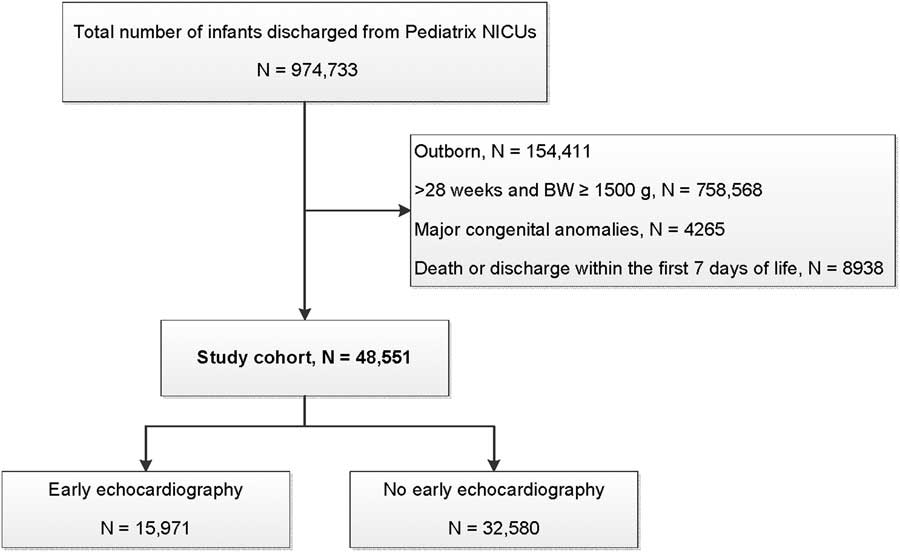
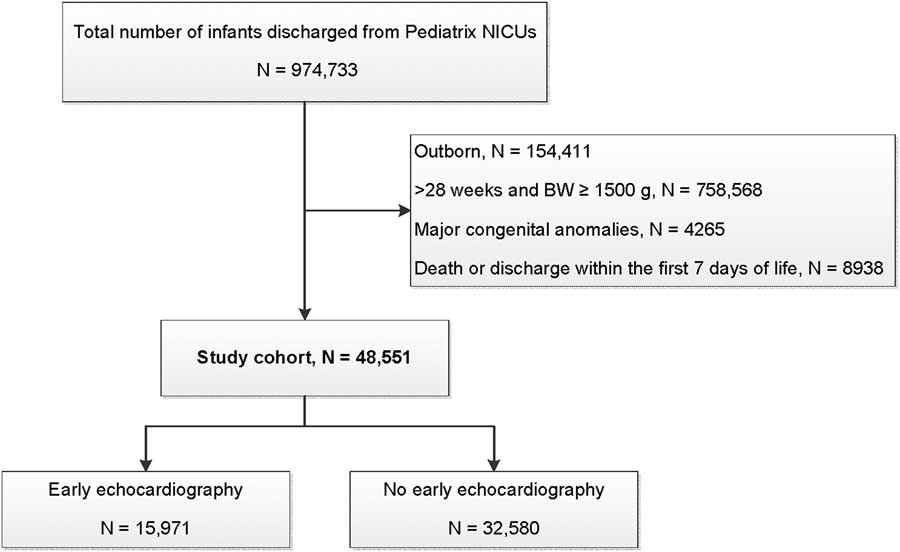
A total of 48,551 infants met our inclusion criteria over the study period (Fig 1). Of these infants, 15,971 (33%) underwent early echocardiography. The median postnatal age at the time of early echocardiography was 3 days (interquartile range 2, 4). Among the 32,580 infants who did not undergo early echocardiography, 8048 infants (25%) eventually received an echocardiography at a median postnatal age of 14 days (9, 29).
Study inclusion diagram. NICUs=neonatal intensive care units; BW=birth weight.
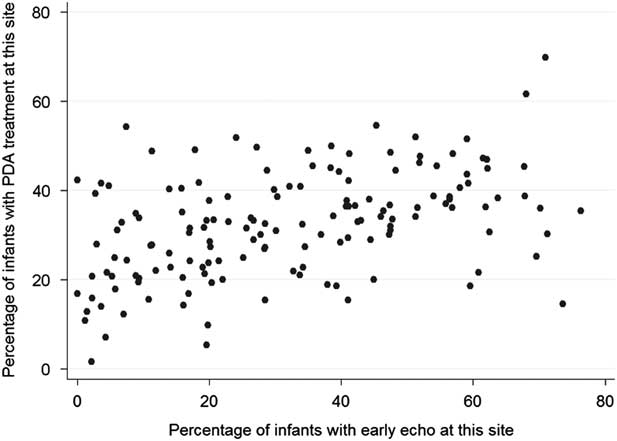
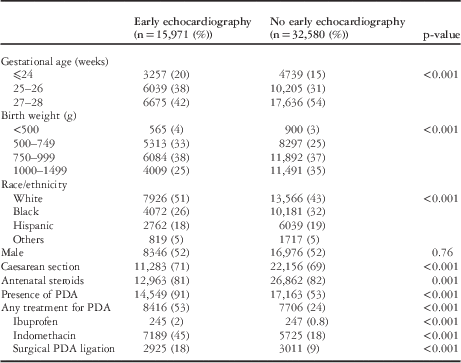
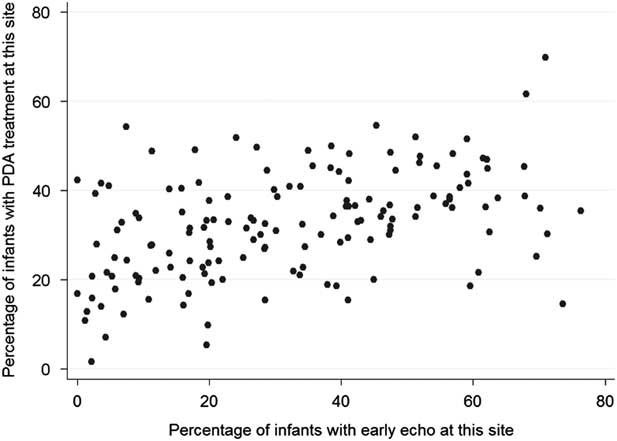
Infants who had undergone early echocardiography were less mature and had a lower birth weight compared with those who had not undergone early echocardiography (Table 1). Infants who had undergone early echocardiography were more likely to be diagnosed with a patent ductus arteriosus compared with those who had not (14,549/15,971 [91%] versus 17,163/32,580 [53%], p<0.001) (Table 1). Infants who had undergone early echocardiography were also more likely to require oxygen support (10,360/15,971 [65%] versus 16,015/32,580 [49%], p<0.001) and invasive mechanical ventilation on day of life 2 (11,941/15,971 [75%] versus 17,254/32,580 [53%], p<0.001). A total of 16,122 (33%) infants received medical or surgical therapy for patent ductus arteriosus at a median postnatal age of 4 days (2, 9). For those infants who received patent ductus arteriosus therapy, the median postnatal age at first therapy was earlier in infants who had undergone early echocardiography compared with those who had not (3 days [2, 6] versus 6 days [3, 12], p<0.001). For those infants who had undergone early echocardiography, the median duration from echocardiography to the start of patent ductus arteriosus therapy was 0 days (0, 2). The proportion of infants receiving any therapy for patent ductus arteriosus was higher among infants who had undergone early echocardiography compared with the proportion of those who had not (Table 1). Both early echocardiography and patent ductus arteriosus therapy use varied significantly across sites (Fig 2). Among sites with at least 50 infants included in our analysis, early echocardiography use and patent ductus arteriosus therapy use ranged from 0 to 76% and from 2 to 70%, respectively.
Percentage of infants with early echocardiography and patent ductus arteriosus (PDA) therapy by site. Each dot represents a site. Only sites with ≥50 infants are included in this graph.
Demographic and clinical characteristics.

PDA=patent ductus arteriosus
Outcomes
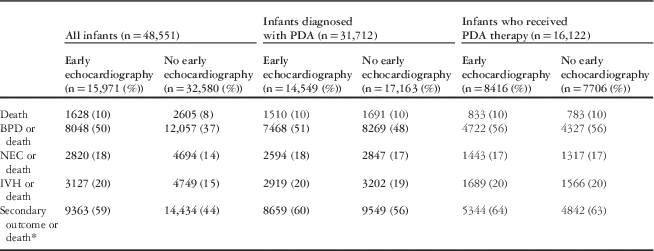
Mortality was higher among infants who had undergone early echocardiography compared with that in those without (1628/15,971 [10%] versus 2605/32,580 [8%], p<0.001). In addition, the proportion of infants who had any major comorbidity, such as bronchopulmonary dysplasia, necrotising enterocolitis, and/or intraventricular haemorrhage, was higher among those who had received early echocardiography compared with the proportion of those who had not (8577/15,971 [54%] versus 13,223/32,580 [41%], p<0.001) (Table 2).
Clinical outcomes stratified according to infant groups.
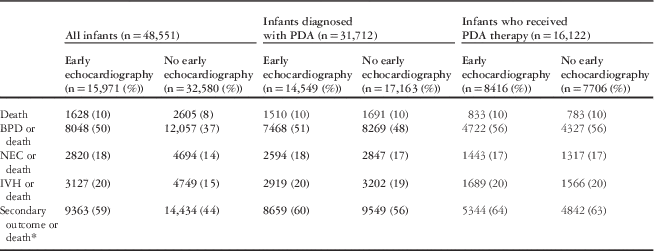
BPD=bronchopulmonary dysplasia; IVH=grade 3 or 4 intraventricular haemorrhage; NEC=necrotising enterocolitis; PDA=patent ductus arteriosus
Numbers in bold indicate the presence of statistical significant difference between the groups with and without early echocardiography (all p<0.005)
* Death or any of the secondary outcomes
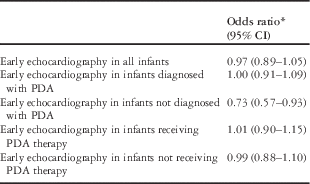
On multivariable analysis including all infants, the group of infants who had received early echocardiography did not have an increased risk for mortality (adjusted odds ratio 0.97, 95% confidence interval 0.89–1.05) (Table 3). Early echocardiography remained unrelated to mortality when infants were stratified by receipt of patent ductus arteriosus therapy. Infants who had received early echocardiography but were not diagnosed with patent ductus arteriosus had a lower risk for mortality (adjusted odds ratio 0.73, 95% CI 0.57–0.93). In a sensitivity analysis including all echocardiographies performed from days of life 0 to 6, none of the infant groups who had undergone early echocardiography – either all or stratified by patent ductus arteriosus therapy – had an increased risk for mortality.
Adjusted odds ratios (and 95% confidence intervals [CI]) for mortality.
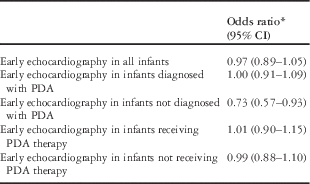
PDA=patent ductus arteriosus
* Adjusted for gestational age, race/ethnicity, gender, caesarean section, antenatal steroids, mechanical ventilation on day of life 2, inotropic support on day of life 2, discharge year and site. Reference for all regression is infants without early echocardiography
Discussion
In the current large cohort of very low birth weight infants, we found that early echocardiography performed on days of life 2 to 6 was associated with increased diagnosis of and therapy for patent ductus arteriosus, but was not associated with decreased odds of mortality after adjusting for infant characteristics. This remained true in the subset of infants diagnosed with a patent ductus arteriosus, and in those receiving therapy for patent ductus arteriosus. However, we found that early echocardiography was associated with decreased mortality in the subgroup of infants not diagnosed with a patent ductus arteriosus.
Presence of patent ductus arteriosus may lead to left-to-right shunting of blood with consequent pulmonary over-circulation and decreased systemic cardiac output. Clinical consequences of this altered circulation include intraventricular haemorrhage, necrotising enterocolitis, and death.Reference Noori, McCoy and Friedlich 1 , Reference Hamrick and Hansmann 14 These outcomes are most commonly observed among infants of gestational age ⩽28 weeks due to the delayed closure of the patent ductus arteriosus in this population.Reference Noori, McCoy and Friedlich 1 , Reference Sellmer, Bjerre and Schmidt 3 To promote patent ductus arteriosus closure and mitigate complication risk, pharmacological, interventional, and surgical strategies have been developed. Despite the availability of these treatment options, the optimum treatment strategy for patent ductus arteriosus therapy remains a matter of debate. Although this controversy is fuelled by numerous factors, including the paucity of randomised, placebo-controlled clinical trials, the timing of patent ductus arteriosus therapy may play an important role in balancing the risk–benefit ratio of therapeutic interventions.Reference Jones, Craven, Attia, Thakkinstian and Wright 15 , Reference Gudmundsdottir, Johansson, Hakansson, Norman, Kallen and Bonamy 16 Early treatment requires the diagnosis of patent ductus arteriosus before the onset of clinical symptoms. Such a diagnosis is best made using echocardiography.Reference Kluckow and Evans 17 , Reference Alagarsamy, Chhabra, Gudavalli, Nadroo, Sutija and Yugrakh 18 As a result, the timing of echocardiography may influence the outcomes associated with patent ductus arteriosus in premature infants.
Despite the fact that early echocardiography was associated with an increase in both medical and surgical treatment for patent ductus arteriosus, it was not associated with decreased mortality. This was also true in the subgroups of infants diagnosed with patent ductus arteriosus or in those receiving therapy for it. These findings differ somewhat from the recently completed Etude Epidémiologique sur les Petits Ages Gestationnels 2 study (EPIPAGE 2), a prospective cohort study of 1513 infants of gestational age ⩽28 weeks that was conducted in Europe in 2011.Reference Roze, Cambonie and Marchand-Martin 10 In this study, in-hospital mortality in infants receiving early echocardiography, defined as being performed before day of life 3, was 14.2%, compared with 18.5% in those not receiving early echocardiography, and the odds of mortality calculated from a propensity-matched analysis were 0.73 (95% CI 0.54–0.98). In the same cohort of infants, a confirmatory instrumental variable analysis failed to reproduce the significance in the association between early echocardiography and in-hospital mortality (adjusted odds ratio 0.62, 95% CI 0.37–1.04). The authors also found that the decrease in mortality was mainly accounted for by infants not treated for patent ductus arteriosus (mortality 13.9 versus 20.6%). A difference in mortality was not observed in the subset of infants who displayed clinical signs of a patent ductus arteriosus and were subsequently treated. Early echocardiography, however, was associated with decreased mortality among those infants not treated for patent ductus arteriosus (adjusted odds ratio 0.62, 95% CI 0.40–0.96). Although the primary outcome analysis of our cohort differed from the EPIPAGE 2 findings, possibly due to differences in the timing of early echocardiography, we observed similar results in our subgroup analyses, with decreased mortality in the subset of infants receiving early echocardiography who were not diagnosed with a patent ductus arteriosus. These findings suggest that early echocardiography may primarily benefit infants without a haemodynamically significant patent ductus arteriosus requiring therapy.
The lack of a consensus definition for a haemodynamically significant patent ductus arteriosus is an obstacle to the identification of diagnostic and therapeutic strategies and, as observed in the present cohort, leads to substantial variability in clinical practice across neonatal ICU. To facilitate decision making, investigators have proposed individualised and rational disease-staging criteria that combine echocardiography and clinical parameters.Reference McNamara and Sehgal 19 Others have suggested that laboratory markers such as the B-type natriuretic peptide may be of benefit.Reference El-Khuffash, Slevin, McNamara and Molloy 20 The control arm of the EPIPAGE 2 study included infants who underwent echocardiography later; further, echocardiographic characteristics of a patent ductus arteriosus were recorded for all subjects and included in the propensity score estimation.Reference Roze, Cambonie and Marchand-Martin 10 Because the present cohort included infants who had never undergone echocardiography in the control group, and because details of the echocardiography were not routinely collected in the clinical data warehouse, we were not able to adjust for echocardiographic characteristics in the analysis. We did, however, include the severity of illness surrogates – including exposure to mechanical ventilation and inotropic support; however, we acknowledge that these are not specific to the diagnosis of a patent ductus arteriosus. We also chose to repeat our analysis in the possibly more uniform cohort of infants deemed by their clinicians to require patent ductus arteriosus therapy, as this may be assumed to represent a cohort of infants with a more clinically significant patent ductus arteriosus. In this cohort, we again did not find an association between early echocardiography and mortality.
In infants not diagnosed with patent ductus arteriosus, we noted a lower risk for mortality in those who had undergone echocardiography, compared with the risk for mortality in those who had not. An explanation for this finding is that early echocardiography in this subset of infants may identify other significant diagnoses such as ventricular dysfunction or structural abnormalities, or may provide estimates of ventricular afterload or preload, guiding clinical management. Earlier identification of these diagnoses, in addition to excluding the presence of patent ductus arteriosus, may then lead to better outcomes. Our study, although not designed to evaluate this hypothesis, provides some preliminary evidence supporting this assumption. We found that 21% of infants who had undergone early echocardiography but had not been diagnosed with a patent ductus arteriosus either had discontinuation or initiation of an inotrope on the day of, or 1 day after, echocardiography. In a study of 241 infants with a mean gestational age of 38 weeks (with a range from 24 to 42) admitted to the neonatal ICU, echocardiography changed the therapeutic management in at least 66% of infants.Reference Kadivar, Kiani, Kocharian, Shabanian, Nasehi and Ghajarzadeh 21 This included infants with a patent ductus arteriosus alone, but also those with other diagnoses including primary pulmonary hypertension, left ventricular dysfunction, and major cardiac structural abnormalities.Reference Kadivar, Kiani, Kocharian, Shabanian, Nasehi and Ghajarzadeh 21 There is an increasing awareness of the utility of echocardiography in critically ill neonates. In a large survey of 247 neonatal ICU medical directors, the majority of respondents endorsed the utility of functional echocardiography and the need for training in this skillset.Reference Schachinger, Stansfield, Ensing and Schumacher 22 Functional echocardiography may help assess cardiac function as well as systemic and pulmonary blood flow and pressures, and rule out the presence of shunts.Reference de Waal and Kluckow 23 In a small cohort of 20 infants (mean gestational age 27.8±5.3 weeks) in a level-3 neonatal ICU who had pulmonary hypertension associated with pre-term premature rupture of membrane, investigators found that the use of functional echocardiography led to earlier diagnosis of the need for treatment for pulmonary hypertension with improved outcomes.Reference Shah and Kluckow 24
Early echocardiography did not decrease the risk for secondary outcomes in this study. This is consistent with the findings of the EPIPAGE 2 study, in which the prevalence of severe intraventricular haemorrhage, bronchopulmonary dysplasia, or necrotising enterocolitis did not differ between infants with and those without early echocardiography.Reference Roze, Cambonie and Marchand-Martin 10 In fact, secondary outcomes were more prevalent among all infants in our cohort who had undergone early echocardiography, including the subgroup of infants diagnosed with a patent ductus arteriosus. Among infants who had received therapy for patent ductus arteriosus in our cohort, there was no significant association between early echocardiography and the risk for secondary outcomes. It is particularly interesting that despite the plausible physiological changes in mesenteric blood flow during medical therapy for patent ductus arteriosus, we did not find an association between the timing of echocardiography and necrotising enterocolitis in infants receiving patent ductus arteriosus therapy.Reference Christmann, Liem, Semmekrot and van de Bor 25 This is consistent with findings from a small prospective study of 127 infants of gestational age <32 weeks who were randomised to receive early, defined as day 3 of life, or late indomethacin treatment.Reference Van Overmeire, Van de Broek, Van Laer, Weyler and Vanhaesebrouck 9 Investigators of this randomised study did not find any difference in the incidence of necrotising enterocolitis and localised gut perforation between the two groups. The association between early echocardiography and the risk for secondary outcomes may be further complicated by the relationship between surgical patent ductus arteriosus therapy and the development of these outcomes. In a study from the Canadian Neonatal Network involving 3556 infants of gestational age ⩽32 weeks, patent ductus arteriosus ligation was independently associated with a two-fold increased risk for composite adverse outcomes of mortality and the presence of severe intraventricular haemorrhage of grade 3 or 4, periventricular leukomalacia, severe retinopathy of prematurity (stages 3, 4, or 5), and/or bronchopulmonary dysplasia.Reference Mirea, Sankaran and Seshia 26
As with all observational studies, our findings should be interpreted in the context of its limitations. The data source did not contain information on the treatment threshold and the exact indication for patent ductus arteriosus therapy, which may include the degree of haemodynamic and respiratory compromise or presence of other end-organ dysfunction, and is most likely different across the neonatal ICU included in this cohort. To account for site-specific differences, we performed a random-effect multivariable analysis. In addition, we lack information on conservative, non-specific treatment strategies used in infants in whom patent ductus arteriosus was diagnosed but not directly treated. In particular, fluid restriction is a commonly used non-specific treatment strategy that may be effective even when compared with more aggressive interventions.Reference Letshwiti, Semberova, Pichova, Dempsey, Franklin and Miletin 27 We did not have access to details of the echocardiographic reports for further quantification of the size and potential haemodynamic significance of the patent ductus arteriosus, and relied on clinical diagnoses as documented by the treating neonatologist. Further, our study was designed to evaluate the association between early echocardiography, management of patent ductus arteriosus, and outcomes. We did not intend to evaluate the impact of early echocardiography on other medical interventions not targeted at patent ductus arteriosus closure. It can, therefore, only be speculated as to why mortality was lower among infants not diagnosed with a patent ductus arteriosus who had undergone early echocardiography: changes in inotrope management, early initiation of enteral feeds or a more liberal fluid and total parenteral nutrition use, and other interventions may explain the association, but these are beyond the scope of this paper. Finally, we included only infants who survived beyond day of life 7 so as to reduce censoring bias in the performance of the echocardiogram. We acknowledge, however, that the first week of age is a period of high risk for mortality in premature infants and caution against extrapolating these results to infants who do not survive this period. Despite these limitations, our study cohort included a very large number of very low birth weight infants managed as per standard of care in neonatal ICU across the United States of America, and used routine clinical data reflective of real-life practices. This allowed a pragmatic examination of the utility of early echocardiography and patent ductus arteriosus treatment in very low birth weight infants.
Conclusion
In this cohort study of very low birth weight infants, early echocardiography was associated with improved diagnosis of patent ductus arteriosus but not with decreased odds of mortality. This remained true in the subset of infants diagnosed with patent ductus arteriosus and among those who received therapy for patent ductus arteriosus. Mortality was lower among infants not diagnosed with patent ductus arteriosus who received early echocardiography.
Acknowledgements
None.
Financial Support
R.G.G. receives salary support for research from National Institutes of Health (NIH) training grants (5T32HD043728-10 and 5T32HD043029-13) and NIH awards (HHSN 275201000003I, HHSN 272201300017I). M.M.L. is supported by the US government for his work in paediatric and neonatal clinical pharmacology (HHSN267200700051C, Principal Investigator: Benjamin), the NICHD (K23 HD068497), and the National Heart, Lung, and Blood Institute (R34 HL124038). P.B.S. receives salary support for research from the NIH and the National Center for Advancing Translational Sciences of the NIH (1R21HD080606-01A1 and UL1TR001117), the National Institute of Child Health and Human Development (HHSN275201000003I and 1R01-HD081044-01), and the Food and Drug Administration (1R18-FD005292-01). C.P.H. receives salary support for research from the National Center for Advancing Translational Sciences of the NIH (UL1TR001117) and the US government for his work in paediatric and neonatal clinical pharmacology (Government Contract HHSN267200700051C, Principal Investigator: Benjamin under the Best Pharmaceuticals for Children Act).
Conflicts of Interest
P.B.S. is a consultant for Astellas Pharma and Abbvie, and receives grant support from Cempra Pharmaceuticals (subaward to HHS0100201300009C) and Shionogi, and other industry support for neonatal and paediatric drug development (www.dcri.duke.edu/research/coi.jsp).
Ethical Standards
The authors assert that all procedures contributing to this work comply with the ethical standards of the relevant national guidelines.