1 Introduction
In Reference Gibbs1898, Joseph Arthur Gibbs (1867–99) published A Cotswold Village, where he commented on the ‘language of the country’ (p. 85) and highlighted the ‘mysteries of the dialect’ (p. 85), which a labouring friend had communicated to him. It was distinguished, he wrote, by ‘[t]he incessant use of “do” and “did”’ (p. 85), while ‘“I” for “me”’ (p. 86) was another distinctive peculiarity of the ‘Gloucestershire talk’ (p. 85). An educated Londoner himself, Gibbs’ metalinguistic guidance on how to speak ‘true “Glarcestershire”’ (p. 86) largely referred then to salient features of the dialect that he reproduced secondhand. Like other authors before him, Gibbs illustrated his linguistic account with phrases and short stories that drew on such forms to recreate and record regional speech at a time when it was menaced by dialect levelling.Footnote 2 Indeed, the nineteenth century saw the publication of an unprecedented amount of vernacular writing in response to common fears of dialect loss, which, as Beal (Reference Beal and Hodson2017: 18) explains, was likewise compounded with ‘an increase in awareness of linguistic diversity’. As with other nineteenth-century dialects, contemporary data on Gloucestershire speech remain characteristically scarce, and stories like those quoted by Gibbs nearly constitute what little evidence we can find.
Literary representations of dialect have traditionally been neglected on account of their unreliability for historical linguistic purposes. As is well known, they are mediated through the experience of literate authors (cf. Fairman Reference Fairman2007: 192), which makes it difficult to access and adequately reconstruct authentic usage of lower-class dialect speakers. In addition, as Wolfram & Schilling (Reference Wolfram and Schilling2016: 345) note, ‘authors typically have other goals in mind that are related to the development of character and voice’, and thus the language reproduced can be taken as ‘hypothetical, imagined speech … [with] no association with a real-life speech event’ (Schneider Reference Schneider, Chambers and Schilling2013: 61). Despite this widespread criticism, research has persuasively shown that literary representations of older dialects preserve traces of orality that can cast useful light onto their past if treated cautiously and examined against other evidence (e.g. García-Bermejo Giner Reference García-Bermejo Giner, Giner and Sánchez-García2008; Maguire Reference Maguire2020). As an intentional practice, dialect writing evokes and recreates (socio)linguistic differences by means of selected features that inform us about the characteristics of a dialect, show dialect awareness as well as ideas about and attitudes towards regional speech, while they offer a glimpse into the salience and enregisterment of the linguistic forms writers choose to represent.
This article seeks to illustrate what dialect writing can tell us about the speech of nineteenth-century dialect speakers. It focuses on representations of south-western dialects, which, unlike those of northern speech, await further investigation.Footnote 3 I explore instances of literary dialect and dialect literature from the Salamanca Corpus (SC, 2011–), which is the first electronic corpus of texts containing literary representations of dialects from all over England from the sixteenth to the mid twentieth century. Shorrocks (Reference Shorrocks, Klemola, Kytö and Rissanen1996: 386) defines literary dialect (LD) as ‘the representation of non-standard speech in literature that is otherwise written in standard English … and aimed at a general readership’, whereas dialect literature (DL) comprises ‘works composed wholly (sometimes partly) in a non-standard dialect, and aimed essentially, though not exclusively, at a non-standard-dialect speaking readership’.Footnote 4 My purpose is twofold. On the one hand, to show that dialect writing can improve our knowledge of contemporary south-western dialects by examining its contribution to the record of two grammatical features. Even though periphrastic do (e.g. he do try) and pronoun exchange (e.g. she be overlookin’ of we) have been well reported in the literature (e.g. Ihalainen Reference Ihalainen and Burchfield1994; Jones & Tagliamonte Reference Jones and Tagliamonte2004; Wagner Reference Wagner2004; Hernández Reference Hernández, Hernández, Kolbe and Schulz2011; Klemola Reference Klemola2018), information about their distribution and contexts of use prior to the SED remains rather obscure. In fact, Wagner (Reference Wagner, Bergs and Brinton2012: 926) highlights that early accounts of dialect tend to discuss these features ‘in terms of their presence (or absence)’ with little information (if any at all) about their ‘frequencies (relative and absolute) and distributional patterns’. Unlike some previous research that has scrutinised isolated dialect specimens, this article examines larger samples of dialect speech and undertakes a ‘frequentist approach’ (de Both Reference de Both2019: 5) to determine whether literature can shed light on the nineteenth-century frequency and distribution of these two grammatical features. On the other hand, the article places this evidence within the frameworks of enregisterment (Agha Reference Agha2003) and indexicality (Silverstein Reference Silverstein2003). My purpose is to show that these sociolinguistic models productively inform our understanding of dialect speech circulated in nineteenth-century literary texts. I argue that it can be read not only as a reflection of the linguistic perceptions of mediator writers, but also as a set of dynamic indexical associations between place, speaker and speech.
The article is divided as follows. Section 2 provides an overview of nineteenth-century dialect writing and pays attention to the linguistic resources employed to recreate differences of speech. Then I describe the SC and the texts selected to explore do periphrasis and pronoun exchange in south-western dialects. Section 4 presents the data, which are analysed in terms of the geographical distribution and frequency of these two grammatical features. Section 5 focuses on the sociolinguistic reading of the data. Like the other articles in this special issue, this article contributes to current dialogue on speech representations in Late Modern English (LModE) text types, while showing that dialect writing can be taken as historical linguistic evidence in its own right.
2 Representing dialect speech in nineteenth-century dialect writing
2.1 An overview of nineteenth-century dialect writing
Hodson (Reference Hodson2017a: 1) underlines that ‘[t]he nineteenth century witnessed a proliferation and elaboration in the literary uses of dialect beyond anything seen before’ (see also Blake Reference Blake1981: 127–75; García-Bermejo Giner Reference García-Bermejo Giner, Heselwood and Upton2010: 32–6). The push of the standard, the spread of education along with increased social and geographical mobility had an immediate impact on the change of attitudes towards regional speech, which framed the trajectories along which dialects and their literary representation developed during this time. Dialect levelling and an enhanced consciousness of dialect diversity encouraged philological work on regional speech and motivated the literary conservation of dialects. Edward Slow (1841–1925) regretted in the preface to Wiltshire Rhymes and Tales (Reference Slow1894) that ‘the good old fashioned Wiltshire folk who use the dialect in all its simplicity, and purity, are becoming scarce’ and ‘the time is not far distant when our good old county patois, as a language, will be blotted out’.Footnote 5
In this context, an exceptional amount of localised dialect literature was written in which dialects spoke for themselves, alongside literary dialect where they were employed as social indexes of minor and lower-class characters in the tradition of earlier centuries. But the nineteenth century likewise saw the circulation of an important number of literary dialects where the vernacular voices of the main speakers proved critical to place stories about the communities where the dialect represented was used. A keener sense of linguistic awareness and attention to detail feature in novels such as Maxwell Gray's (1846–1923) Ribstone Pippins (Reference Gray1898), which offers evidence on the dialect of the Isle of Wight regarding uninflected be (e.g. they be ourn) and the pronunciation of some consonant groups like /θr-/ (e.g. droo ‘through’). An anonymous review of Gray's novel published in Literary News (Reference Gray1898) described it as ‘rather puzzling’ (p. 115), and indeed the author selected generic features that were found in dialect speech more widely. Contemporary writers like Gray saw these representations as authenticating practices rather than as detailed records of real language, whereby they achieved authenticity effects regarding provincial values, speakers and speech.
Similarly, dialect literature conceived of the use of dialects in terms of their instrumental capacity to delineate character while protecting traditions and vernacular voices before they were lost. Philip Klitz's (1805–44) The Veniz'n Mark, or the Lost Child (Reference Klitz1850) thus preserved the dialect of ‘the native forest tongue’ (p. 73) in Hampshire, one of whose ‘chief peculiarities … consists in the corrupt employment of its pronouns’ (p. 74) and where it was common that ‘the letters th are detained in order to be sent into the world preceded by a d, by which process thick becomes “dthick”’ (p. 74). A native of Lymington (south Hampshire), Klitz relied on the representation of this peculiar sound along with examples of voiced fricatives (e.g. vorren ‘foreign’) and r-variants for past tense be in third-person singular contexts: he wur the pride. They underpin Klitz's (re)construction of the ‘vorrest voak’ (p. 74) that gave meaning to the local legend he narrates. At the same time, dialect literature provided models to perform linguistic and cultural difference as well as a sense of place, which writers like Hamilton Kingsford (1831–1914) (aka Outis) strove to construct for the Worcestershire dialect with the series of ‘Vigornian monologues’ published in Berrow's Worcester Journal during 1895–6: ‘[t]hey have been an attempt’, he wrote, ‘to supply some vernacular literature, of which there is a very great dearth; … and at the same time to convey some faint notion of the line of thought taken by the ordinary country mind’ (Reference Kingsford1896: v). As in this case, other provincial periodicals like the North Devon Journal published the work of local writers, who, like Roger Giles in The Gude Old Times in Welcombe (Reference Giles1885–6), played a pivotal role in legitimising the use of the vernacular; it ‘offered a medium for the expression of ownership of place’ and culture, as Edney (Reference Edney and Trower2011: 59) notes with regard to Lancashire. In this vein, Beetham (Reference Beetham2009: 24) states that ‘the journalists and writers who helped to create a Lancashire identity in periodical print made central to that identity the easy movement between standard and dialect writing’.
2.2 Linguistic devices
The shift between the standard and the dialect that Beetham (Reference Beetham2009) refers to crucially underpinned the construction of dialect identities other than the Lancastrian. In this process, as Schneider & Wagner (Reference Schneider and Wagner2006: 46) point out, ‘[l]anguage choice and linguistic encoding are an essential element … and by necessity this includes the use of local vernacular language forms’. As in other periods, nineteenth-century dialect writing crafted linguistic identity through a set of resources that attempted to signal variation from the norm. Writers deliberately relied upon a number of linguistic peculiarities that report on their salience as well as on their ‘cultural locality’ (Silverstein Reference Silverstein1998: 405). Their linguistic choices had an effect on how the audience responded to and engaged with the dialect representations, not only in terms of what they said but also, and more importantly, how they said it.Footnote 6 In this sense, writers, who had varying degrees of proximity to the dialect represented, acted as linguistic mediators and evaluators in recreating how dialect speakers spoke or, at least, how people imagined they spoke. Of course, dialect awareness had some impact on the linguistic choices that we can find in nineteenth-century literature because increased consciousness of dialect variety refined the inventories writers employed and audiences understood. Just as dialect writing is not a timeless construct ‘equally available for everybody to read and derive the same meaning’ (Hodson Reference Hodson2020: 190), ideas and perceptions about dialects at the time explain linguistic choices and the strategies behind their representation.
These strategies comprise respellings, local words and non-standard grammar. All of them can be taken as instances of authenticating practices (Bucholtz Reference Bucholtz2003: 408) as well as of ‘implicit metapragmatic commentary on norms of speech’ (Agha Reference Agha2007: 197). Honeybone (Reference Honeybone2020: 221–5) explains that the representation of dialect sounds is constrained by at least eight factors, which range from the salience of a dialect feature and its degree of enregisterment, to the writers’ ability to perceive sound distinctions, the type of representation and what is possible in terms of orthography, especially in those cases in which there are no sound-to-spelling correspondences in the reference standard. An example of this inescapable limitation can be found in Mary Hartier's (1861–1936) recreation of the ‘fine Devonshire accent’ (p. 435) in Village Craft (Reference Hartier1895). The dialect is here described in terms of ‘the broad lengthened vowels, the French eu and the unstinted sound of the r's’ (p. 435), the latter of which are otherwise hard to read from forms such as marnin ‘morning’ and varmer ‘farmer’. Like Hartier, writers often relied on dialect respellings to evoke actual differences of pronunciation (e.g. [dr-] for /θr-/ in droo, [v] for /f/ in vorren), along with instances of eye dialect (e.g. espeshully ‘especially’) and diacritics like diaeresis to represent a ‘sort of disyllable’ (Jennings Reference Jennings and Brayley1834: 173) in Somerset heät ‘heat’. Even though it is clear that such forms cannot capture nuanced shades of pronunciation like ‘the unstinted sound of the r's’, respellings such as droo and vorren reflect interesting characteristics of the spoken word and are indeed valuable for what they can tell us about the realisation of /θr-/ in the Isle of Wight and the voicing of /f/ in Hampshire. In addition, as Clark (Reference Clark2020: 105) highlights, spelling choices depict ‘links to a framework of social identity’ to the extent that they signal salient features that evoke meanings associated with the dialect represented. It is worth noting that some of these respellings reflect a longstanding literary tradition and were thus conventionalised, acting as indexes whereby the features they evoked were claimed as peculiar to the dialect represented despite changing realisations and the fact that their meanings may have been reworked (see Ruano-García Reference Ruano-García, Kytö and Smitterbergforthcoming).
The representation of dialect lexis and grammar also builds upon selected features understood as distinctive of the variety represented. Unlike respellings, however, lexical and grammatical choices involve less authorial elaboration and intervention yet seem likewise constrained by tradition in some cases. Words such as gan/gang ‘to go’, lass ‘girl’ and mun ‘must’ have been conventionalised in representations of the northern dialects since the Early Modern English period, to which LModE writers contributed other items like nowt ‘nothing’ and summat ‘something’, which were recurrently used (Ruano-García et al. Reference Ruano-García, Sánchez-García, García-Bermejo Giner and Hickey2015: 144–5). In fact, such traditional items were indexically powerful resources not only to evoke northernness, but also the transitional character of dialects like that of Derbyshire, which lies at the crossroads between the Midlands and the North. In this regard, Schintu (Reference Schintu2022) has found that mun, nowt and summat are core constituents of the Derbyshire repertoire in representations published during 1850–1950. This is not meant to imply that writers’ choices of lexis were limited and hardly informative of the characteristics of dialects in all cases. The available evidence reports on varying degrees of lexical detail, which can also be read in terms of salience, the localisedness of specific items, knowledge of the dialect and the perceptual abilities of the writers.
These factors, or a combination of them, may have been at work in the representation of distinctive dialect grammar. Unlike lexis and spelling, the representation of morphosyntactic features has received little scholarly attention and remains virtually uncharted evidence of the grammar of historical English dialects (see, however, García-Bermejo Giner Reference García-Bermejo Giner, Fernández-Corugedo, Tazón Salces, Suárez Lafuente, Alas García and López1991; Asprey Reference Asprey2020).Footnote 7 Research so far has chiefly scrutinised isolated samples of dialect speech, focusing on the presence/absence of specific features. Their frequencies, distribution and patterns of use have rarely been investigated, often because of the dearth of texts representative of some varieties. The increasing availability of material in corpora like the SC encourages us to interrogate the evidence from this angle in order to determine whether, on the one hand, dialect writing can prove beneficial in reconstructing aspects of grammar. On the other, it allows us to ascertain whether representations of dialect morphosyntax pattern with the observations and norms circulated in contemporary dialect glossaries and grammars. At the same time, it can help us identify if the grammatical encoding reflects authorial perceptions of specific features and how they were evaluated. The following sections address these questions in relation to periphrastic do and pronoun exchange in nineteenth-century representations of the five south-western dialects.
3 The Salamanca Corpus: texts selected for analysis
As already noted, the SC is the first digital corpus of English dialect texts written between 1500 and 1950. It was launched in 2011 with the aim of contributing to the collaborative endeavour to reconstruct the linguistic history of regional speech, one that remains fragmented and poorly understood. For this purpose, the ongoing compilation of the SC seeks to recover and digitise older and hardly accessible dialect texts. In particular, it is concerned with instances of dialect writing, both literary dialects and dialect literature produced by non-canonical writers and that comprise prose, verse and drama, along with glossaries and word lists, some of which remain unpublished (see further García-Bermejo Giner Reference García-Bermejo Giner and Vázquez-González2012). In the case of dialect writing, the criteria behind the selection of texts considers Hickey's (Reference Hickey and Hickey2010: 8–11) parameters to validate historical material for the analysis of non-standard varieties. These parameters include: text-internal scope (e.g. complete for texts written entirely in dialect), author of the text (e.g. outsider in some cases of literary dialect), language of the text (e.g. intrinsic to the author in examples of dialect literature), approach to language (e.g. construed, as in literary dialect), etc. The SC thus offers literary texts with varying degrees of dialect in accordance with the two types of representation considered.
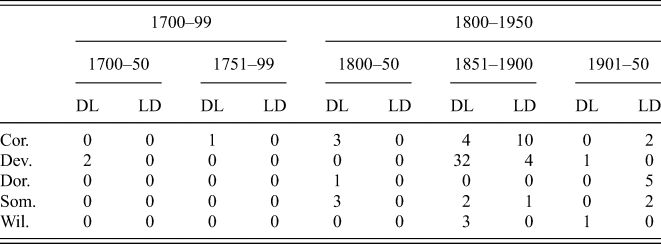
One of the major challenges behind the compilation of the corpus lies in its representativeness regarding dialects and chronology. The scarcity of material representative of some varieties and time periods accounts for variation as far as the amount of data is concerned. The long-standing literary pedigree of northern dialects such as Yorkshire and Lancashire has made it possible to find many texts representative of these varieties from different chronological periods and genres. Other varieties like Hampshire and the Isle of Wight provide us with comparatively fewer vernacular writings, which complicates our endeavour to shed some light on the history of such dialects. At the time of writing, the southern element of the SC is small if compared with northern varieties. Table 1 shows the distribution of south-western texts in the LModE section of the corpus according to dialect, type of representation and chronology per time periods of fifty years.Footnote 8
Distribution of LModE south-western texts in the SC (as of December 2022)

Clearly, evidence from the eighteenth century is hardly available, whereas samples of nineteenth-century speech are greater in number, notably during the second half of the century. This is especially remarkable in Cornwall and Devonshire, in which latter case a high percentage of the texts recorded were produced by Roger Giles.
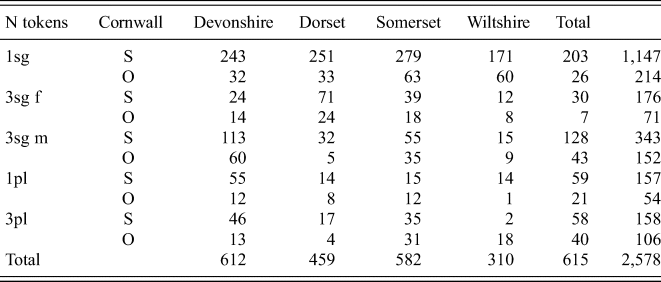
Some further specimens representative of south-western dialects are currently being prepared for inclusion in the SC. Some of them have been selected for the analysis of periphrastic do and pronoun exchange. We may refer to the anonymous ‘Epistle from Roger Coulter, of Dorsetshire, to his Friend Giles Bloomfield’ (Reference Bloomfield1802) and James O. Halliwell's (1820–99) A Collection of Pieces in the Dialect of Zummerzet (Reference Halliwell1843). Like these two texts, the materials analysed here have been selected according to two main criteria. Firstly, I have sought to select one text from the first and another one from the second half of the nineteenth century written by different authors so as to provide a balanced sample of material with regard to the five dialects examined. Nevertheless, this has not been possible given the uneven distribution or lack of texts, as in Dorset, which has no specimens from the period 1851–1900, and Wiltshire with no evidence from the first half of the nineteenth century. In order to make up for the SC scarcity of material in these cases, the Dorset data include texts from the early twentieth century, whereas additional specimens from 1851–1900 have been included in the case of Wiltshire. Secondly, prose texts and dialogues, some of them written in verse, have been selected for scrutiny. I have focused on instances of dialect literature given their higher degree of vernacularity, but yet again this has not been feasible in dialects like Dorset. Specimens of literary dialect have been included instead, selecting the dialect passages found in them. This has also been the case for Somerset so as to compensate for the small size of the representation written by James O. Halliwell in 1843. The appendix provides further details about each of the texts included in the analysis. As displayed in table 2, it is based on a total of thirteen texts, which amount to c. 37,200 words. Even though it is not a particularly large sample, it may help us provide some insight into the distribution and frequency of periphrastic do and pronoun exchange, especially when the history of these two grammatical features remains rather obscure.
SC data for analysis

4 Grammatical variation in representations of south-western speech
4.1 Periphrastic do
As is well known, periphrastic do is one of the grammatical hallmarks of the traditional dialects of the South-West of England, where it was used as a tense carrier and marker of habitual aspect (Wagner Reference Wagner2004, Reference Wagner, Bergs and Brinton2012).Footnote 9 Possibly originated in ME south-western dialects (Filppula et al. Reference Filppula, Klemola and Paulasto2008: 55–9), Ihalainen (Reference Ihalainen and Burchfield1994: 225) explains that it refers to the unstressed use of the auxiliary in affirmative declarative sentences, which, unlike in standard English, remained alive in south-western speech during the nineteenth century, as in:
(1)
(a) So then Ant Blanch and hem ded talk and jeast (Cor_1).Footnote 10
(b) She do jump the ditches into the corn veild (Som_2).
As example (1b) shows, periphrastic do is not inflected for third-person singular subjects, nor does it carry sentence stress, as signalled by <e> in ded ‘did’ in example (1a). This is substantiated by Barnes (Reference Barnes1886: 22), who remarks that in Dorset ‘do unemphatical is pronounced as de in French’, whilst Jago (Reference Jago1882: 57) explains that ‘the Cornishman in saying, “I do know,” does not use the word do with emphasis, as in ordinary English’.
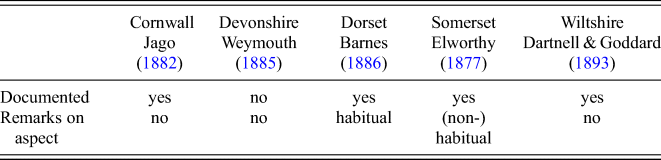
Table 3 shows that preverbal do commonly features amongst the observations recorded in nineteenth-century accounts of south-western dialects, except in Devonshire, where -s was used ‘not only in the third person singular, but in other parts also of the present tense, as I writes for I write’ (Weymouth Reference Weymouth1885: 53). Generalised -s was likewise noted as a distinctive peculiarity of north Wiltshire: here, as Dartnell & Goddard (Reference Dartnell and Goddard1893: xix) point out, ‘the rule is to employ the simple tenses instead, merely altering the person, as “I minds un.”’, whereas ‘the periphrastic tenses are often used in S. Wilts., as “I do mind un,”’. The following examples that Ellis (Reference Ellis1889: 44–5) cites from the Wiltshire locality of Christian Malford showcase these grammatical peculiarities while they support later observations:
(2)
(a) her would tell ye where her found this ere drunken beast as her do call her husband.
(b) it isn't no odds to I, nor nobody else as I knows of.
Some nineteenth-century accounts of do periphrasis in south-western dialects

Examples such as (2a) suggest that do periphrasis was employed as a marker of habitual aspect, which Barnes (Reference Barnes1886: 23) notes for the dialect of Dorset in present and past contexts to indicate ‘repetition or continuation’. He writes that ‘She beät the child, is beat at some one time’, while ‘She did beät the child, is was won't to beat’. Similarly, Wagner (Reference Wagner2007: 256) remarks that Elworthy (Reference Elworthy1877: 257–8) was the first in ‘clearly categoriz[ing] do as carrier of tense and aspect distinctions’ in the dialect of west Somerset, although his categorisation and terminology are problematic.Footnote 11 As can be seen from table 3, the habitual function of preverbal do is not commented on in other works (see further Wagner Reference Wagner2007: 259–60). This does not necessarily mean that do was not employed as a marker of habituality in Wiltshire or Cornwall, whilst the available evidence makes it difficult to make generalisations on the basis of isolated examples like (2a). Though historically valuable, they cannot be taken to imply that do periphrasis occurred in all declarative sentences where simple present and past verbs were involved, nor that it was employed with the same frequency in all south-western dialects.
Klemola's (Reference Klemola2018) analysis of the SED Basic Material supports the south-western distribution of this grammatical feature, with a focal area stretching from west Wiltshire to east Somerset, being likewise attested in west Cornwall, Dorset and Gloucestershire. These dialects are indeed included within the core areas of do periphrasis along with Monmouthshire, whilst ‘Central Cornwall, West Somerset, East Wiltshire, West Hampshire and parts of Herefordshire’ (p. 271) constitute what Klemola (Reference Klemola2018) refers to as the peripheral areas, where the SED records no instances of periphrastic did. Similarly, de Both (Reference de Both2019: 28–9) shows that data from the Freiburg Corpus of English Dialects (FRED, 2000–5) corroborate the SED findings insofar as do periphrasis is favoured in the dialects of Cornwall, Wiltshire and Somerset, where Jones & Tagliamonte (Reference Jones and Tagliamonte2004) found that periphrastic did was still used at the turn of the twenty-first century by older speakers to encode habitual meaning. As Klemola (Reference Klemola1996: 100–1) shows, however, the SED includes occurrences of do periphrasis in present contexts to mark habitual and non-habitual aspect, which would indicate that it was not an exclusive function of this feature, as Wagner (Reference Wagner2007: 265) also points out. In fact, Kortmann (Reference Kortmann and Kortmann2004: 256) explains that it is likewise employed to indicate a single event and as a tense carrier ‘in temporal or conditional clauses’, where, he notes, ‘do is most frequently used as an analytic tense marker, again however mostly in habitual contexts’. In the same vein, de Both's (Reference de Both2019: 26–7, 32) recent study concludes that in the FRED data unstressed do favours habitual aspect and often patterns with relative pronouns and noun phrases, while it generally occurs with verbs of Germanic origin (see Jones & Tagliamonte Reference Jones and Tagliamonte2004: 99–105 on other constraints).
Whether or not periphrastic do was geographically distributed as later reports indicate awaits further investigation, as also do the contexts where it was employed. Given the paucity of alternative records that capture naturally occurring speech, representations of dialect may provide a missing link in the nineteenth-century history of this grammatical feature.
Table 4 displays the SC data scrutinised for the analysis of periphrastic do.
SC data for the analysis of periphrastic do

In order to retrieve the cases of do periphrasis, all instances of positive declarative sentences with present and past verbs have been manually identified and later annotated according to whether preverbal do is employed, thus counting the number of declaratives with do and did. As table 4 shows, they amount to 281 examples, excluding instances of emphatic do (3a–b), as well as examples of proverbal do, as in sentence (4) below. As already pointed out, the data have been explored from a frequentist approach, so that the 281 tokens of periphrastic do have been quantified in relation to all the possible cases in which preverbal do/did are likely to occur: they amount to 1,810. It is worth noting that for this purpose instances of conversational interjections such as (5) have been excluded from the analysis (see de Both Reference de Both2019: 17).
(3)
(a) But this I will say: Silas do—he do look after his business (Som_3) [italics in the original].
(b) I never did hear such nonsense-talk in my life! (Dor_3).Footnote 12
(4) you uphold en, that you do (Dev_1).
(5) You darlen! My darlen, I mean (Dor_2).
The data have also been annotated manually for dialect and aspect, in which case a distinction has been made between habitual and non-habitual. In accordance with Godfrey & Tagliamonte (Reference Godfrey and Tagliamonte1999: 105), habitual meaning in present contexts is taken to include verbs that refer to ‘an event that takes place repeatedly’; in past contexts, it points to
[a] situation which is characteristic of an extended period of time, so extended in fact that the situation referred to is viewed not as an incidental property of the moment, but, precisely, as a characteristic feature of the whole period. (Comrie Reference Comrie1976: 27–8, cited in Jones & Tagliamonte Reference Jones and Tagliamonte2004: 109)
Example (6a) illustrates habitual meaning in present contexts, whereas (6b) does it for past contexts:
(6)
(a) he do most in general ax veyther an’ mother an’ aal on us to come to zupper wi’ he about Christmas time (Wil_2).
(b) You did only see Silas a-foot once a week when he did waddle to church (Som_3).
Otherwise, verbs have been coded as non-habitual, including occurrences of punctual and continuous situations (see (7)–(8), respectively) and examples in which do seems to be used as a tense marker, as in (9):Footnote 13
(7) He clunk't the brandy, we tha gin ded drink (Cor_1).
(8) I da hate such cross vawk (Som_2).
(9) Bit lore, wen thay did meet wurden there zim battles ta be zure (Wil_3).
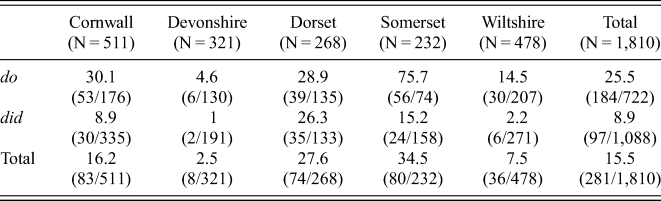
Quantification of the data shows that periphrastic do is employed in 15.5 per cent (281/1,810) of all possible cases recorded, with 184 occurrences of do and 97 of did, which amount to 25.5 and 8.9 per cent of the total number of 722 present and 1,088 past declaratives, respectively. Taken together, the data suggest that do periphrasis is not particularly frequent in the texts analysed, which would in some way indicate that it may have been less widespread than contemporary records seem to imply. This is also the case for later periods, when de Both (Reference de Both2019: 20) has found 4.1 per cent of occurrences in a dataset comprising 2,048 tokens. Table 5 shows, however, that there is variation across the nineteenth-century dialects considered. Clearly, representations of Somerset speech show the highest frequency of do, followed by Cornwall and Dorset, where it is employed in some 30 per cent of cases. By contrast, do is comparatively rare in the Wiltshire material and, especially, in Devonshire, which, as we have seen, was a do-less area.Footnote 14
South-western distribution of periphrastic do (percentage)

Comparison with the SED thus points to some stability over time, with Somerset as one of the focal areas and Devonshire showing a gap in the south-western distribution of periphrastic do. The exception seems to be Wiltshire, which, as we have seen, falls within Klemola's (Reference Klemola2018) core area, at least the west of the county. It is yet worth noting that two of the three Wiltshire representations analysed are specimens of the dialect of the north of the county, where ‘the rule is to employ the simple tenses instead’ (Dartnell & Goddard Reference Dartnell and Goddard1893: xix).Footnote 15
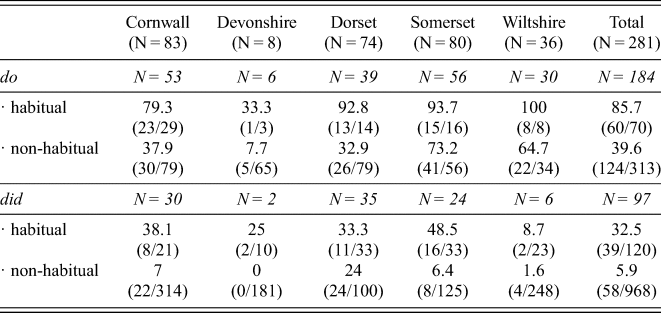
As can be seen in table 5, occurrences of did are comparatively less frequent in the representations of all dialects. Dorset texts show the highest incidence before Somerset and Cornwall specimens, whilst it is sparsely attested in Wiltshire and virtually absent from the Devonshire material. Table 6 shows, however, that in all of them periphrastic did seems to have been favoured to mark habitual aspect, especially in Somerset, Cornwall and Dorset, with more than 30 per cent of all the possible past declaratives expressing habituality collected from these texts.Footnote 16
Aspect (percentage)

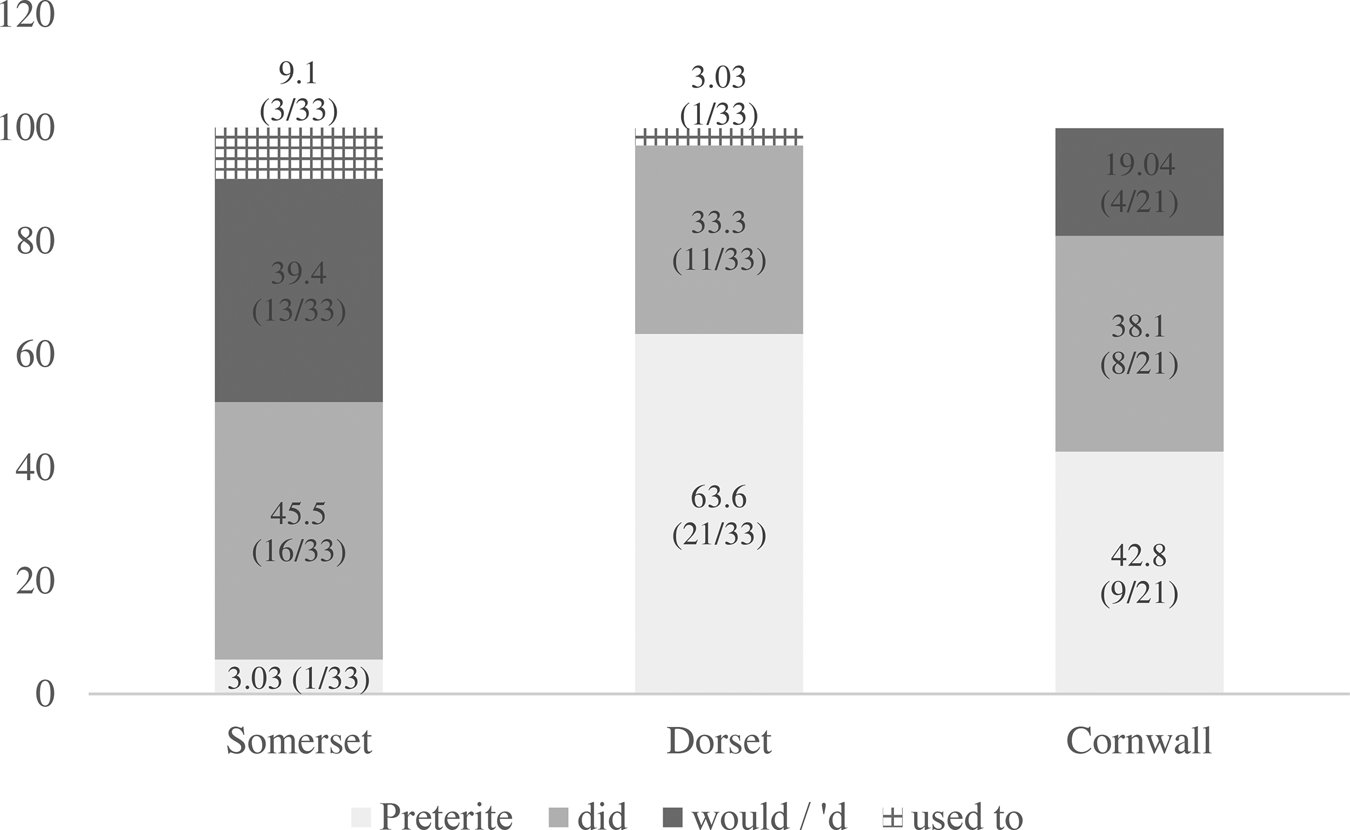
Figure 1 shows that, unlike in Jones & Tagliamonte's (Reference Jones and Tagliamonte2004) Somerset corpus, periphrastic did predominates in representations of this dialect, followed by would, used to and preterite verb forms, which are yet more common in Dorset texts to mark habitual aspect (e.g. (11)). The Cornwall material likewise shows preference for preterites and did, whereas would is more sparsely employed in examples such as (12):
(11) he was a man, was Jan, and I vor one allus honoured he (Dor_2).
(12) fur jest as Neddy wud cum 'pon un, 'way wud go Billy agen (Cor_2).
Distribution of habitual past forms in Somerset, Dorset and Cornwall texts (percentage)

Table 6 indicates that instances of did are also found to mark non-habituality, though on a clearly less frequent basis. It should be noted that in the representations of the Dorset dialect non-habitual did occurs to a comparatively higher degree, especially to encode punctual aspect in narration contexts (e.g. (13)), where it likewise seems to be used as an analytic tense marker in temporal clauses like (14):
(13) poor wold Ann Kerley what was born and bred here, and did get married to a Little Branston man an’ all (Dor_3).
(14) an’ when the bwoys did see I, they did pelt I wi’ stones and call I witch (Dor_3).
Concerning present contexts, table 6 shows that periphrastic do is clearly used to express habituality, though not exclusively. Representations of Somerset and Dorset speech suggest that it is thus employed almost categorically in all the positive declaratives where habituality is potentially expressed. Even though the total number of tokens of habitual do in each dialect is not large enough for robust generalisations, the data may prove useful as it ties in with later evidence that likewise reports on the tendency of do to mark habituality. In the same vein, the SC indicates that preverbal do also encodes non-habitual aspect, which, as we have seen, has likewise been noted with regard to the SED data. Such examples are especially noteworthy in texts representative of the Somerset and Wiltshire dialects, where non-habitual do is found with important frequencies. It is employed to mark continuous aspect, as we have seen in example (8), with some isolated occurrences such as (15), which points to a punctual event:
(15) Well, taakin about he da bring inta me yead wat I promised var ta tell ee about (Wil_3).
Despite the obvious limitations of the dataset, nineteenth-century representations of dialect not only report on and testify to the presence of a localised feature that was commonly evaluated as characteristic of south-western speech. As we have seen, quantification of authorial choices to construct dialect grammar also reveals patterns of distribution and frequency that seem to accord with later evidence to an interesting degree. The literary recreation of do periphrasis can thus be read within the writers’ broader attempt to index south-westernness in the texts examined, while it seems to reflect its contemporary uses, or at least how writers evaluated and understood that south-westerners used it. Such is also the case for pronoun exchange.
4.2 Pronoun exchange
Pronoun exchange (PE) is another distinctive characteristic of the grammar of south-western dialects (Wagner Reference Wagner, Bergs and Brinton2012), which has also been reported in the West Midlands as well as in the North-East and East Anglia (Beal Reference Beal and Kortmann2004; Trudgill Reference Trudgill2004). Ihalainen (Reference Ihalainen and Burchfield1994: 231) explains that it refers to ‘cases where subject forms of pronouns are used for object pronouns and object forms for subject pronouns’, as in:
(16)
(a) vather coud'n avoord ta put I ta school (Som_1).
(b) And then sez him to Ant, “Shall we go in […]” (Cor_1).
PE has traditionally been associated with the expression of emphasis (Wakelin 1991: 114–15), though recent work based on the SED and the FRED corpus has indicated that it is not confined to such uses (Wagner Reference Wagner2004: 157–9; Filppula et al. Reference Filppula, Klemola and Paulasto2008: 106–17), pointing instead to additional syntactic and pragmatic factors (see Hernández Reference Hernández, Hernández, Kolbe and Schulz2011: 125).
PE was the subject of extensive comment in early dialect accounts, where it is evaluated as a salient grammatical feature that was distributed across the paradigm. To my knowledge, the earliest observations can be found in Robert Wight's manuscript glossary Horae Subsecivae (Reference Wight1777–8), where hire ‘her’ is glossed as a corrupted Devonshire form for she in ‘Where is Hire gone?’ (3), whereas ‘Us for We […] [a]nd We for Us’ are cited from the dialect in sentences such as ‘Us live at Exeter &c.’ (p. 454). In this vein, Weymouth (Reference Weymouth1885: 50) observes that ‘Him, when unemphatic, is en or ’n … [b]ut if emphasis is needed, Devonshire used he … So for the feminine’. This is indeed marked as characteristically Devonshire by Jago (Reference Jago1882: 59), who reports that in east Cornwall ‘we hear people saying her for she’ as ‘[t]he Devon dialect drives back the Cornish from the east of the County’. Similarly, Barnes (Reference Barnes1886: 19) notes that ‘[w]hen a pronoun in an objective case is emphatical, it is given in its nominative shape instead of its objective case … “Gie'e the money to I, not he”’, which Dartnell & Goddard (Reference Dartnell and Goddard1893: 124) likewise record in Wiltshire, where ‘I, he, and she do duty as accusatives’.
As in the case of periphrastic do, all of these valuable comments testify to the presence of exchanged pronouns in south-western speech, yet they cannot be taken to indicate that PE occurred in all possible cases where pronouns were involved nor that it operated to the same degree and that it affected the same forms in all dialects. In fact, observations like ‘it [i.e. us] is com[mon] in Exmoor dist[rict], but in Somerset is heard less frequently’ (Elworthy Reference Elworthy1886: 793) offer an unclear picture concerning its cross-dialectal frequencies, let alone of the syntactic contexts that may have favoured the exchange.
Wagner's (Reference Wagner2004: 158) investigation of the SED material points out, in the first place, that subject forms occurred more frequently in object slots than vice versa, with an incidence of 55 to 20 per cent. Secondly, she finds that locations where subject-for-objects are commonly attested have low frequencies of objects employed as subjects, and vice versa. Thirdly, subject-for-objects were more frequent in the easternmost counties, especially in Wiltshire, whereas object-for-subject forms were more often recorded in East Cornwall and Devonshire, which Filppula et al. (Reference Filppula, Klemola and Paulasto2008: 110) describe as a core area. As a matter of fact, Robinson (Reference Robinson2018: 246–50) remarks that subject her is the most commonly documented form in the SED sound recordings followed by subject them and subject us, especially in Devon, where it survives ‘albeit only among older speakers’ (p. 248). Interestingly, Robinson (Reference Robinson2018) explains that in both the SED and the BBC Voices data exchanged pronouns occur more frequently in tag questions, which Wagner (Reference Wagner2002: 8) likewise finds together with interrogative contexts, adjacent to verbs and after prepositions.
The SC data for the nineteenth century point in the same direction. The analysis is based on the dataset described in section 3 (see table 2); a total of 2,578 tokens have been collected, excluding occurrences of second-person pronouns and those employed in the passages reflecting the voice of the standard-speaking characters in cases of literary dialect. Table 7 displays the variable contexts for pronoun exchange in the dialects examined.
Variable contexts for pronoun exchange: SC data

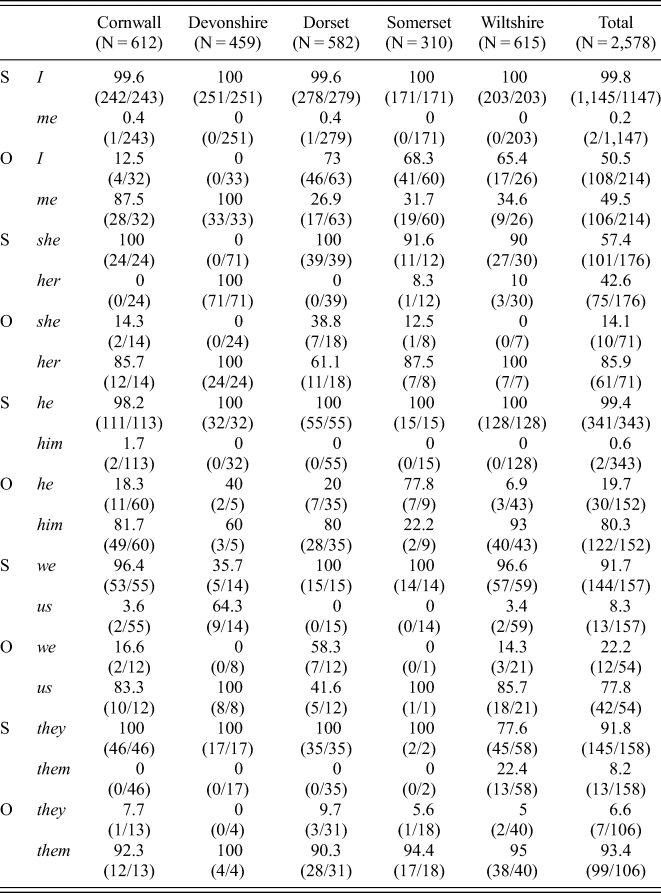
Quantification of the data shows that this grammatical feature is found in 10.5 per cent of all possible cases, with a total of 272 examples. This suggests that representations of south-western speech relied on exchanged pronouns to a comparatively lesser degree than on periphrastic do, although both of them seem to have been low-frequency features, at least in the texts analysed.Footnote 17 There are yet important dialectal differences both in terms of frequency and the contexts in which PE seems to have been more likely to occur.
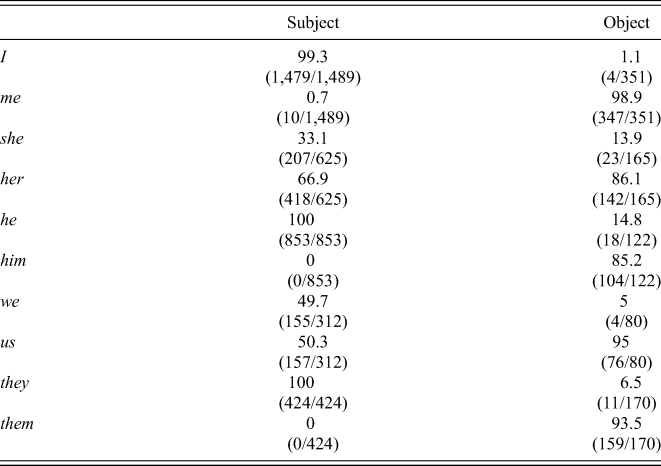
As displayed in table 8, frequently documented forms in the SC are object I, subject her, object he and subject us, object I and subject her being the most common contexts where PE occurs if we consider the overall number of examples, with 108 and 75, respectively. Clearly, their distribution indicates that PE was not represented regularly in all dialects nor across the paradigm. While her is the only recorded subject form in Devonshire texts, it is not found in the Cornwall and Dorset materials, with just a few isolated occurrences in Somerset and Wiltshire. Here, object I is preferred over me, which is also the case in Somerset and Dorset, where object he is likewise attested; in most dialects, however, standard him seems to have been the preferred choice in object slots. This likewise holds for subject us, which is rare in south-western representations, except in Devonshire, where it is favoured over we. Contexts like subject I, subject he and subject they pattern almost categorically with the standard in all cases.
South-western distribution of pronoun exchange (percentage)

Overall, the data indicate, firstly, that subject-for-object forms are more frequently used than object-for-subject pronouns, with 167 and 105 examples, respectively (c. 28 to 5.3 per cent of all possible cases). Secondly, subject-for-object pronouns are more often documented in representations of the easternmost dialects of Wiltshire, Dorset and Somerset, whereas object pronouns are more often employed as subjects in western varieties, especially in Devonshire, where subject-for-objects are rare. Thirdly, standard subject she is absent from Devonshire.
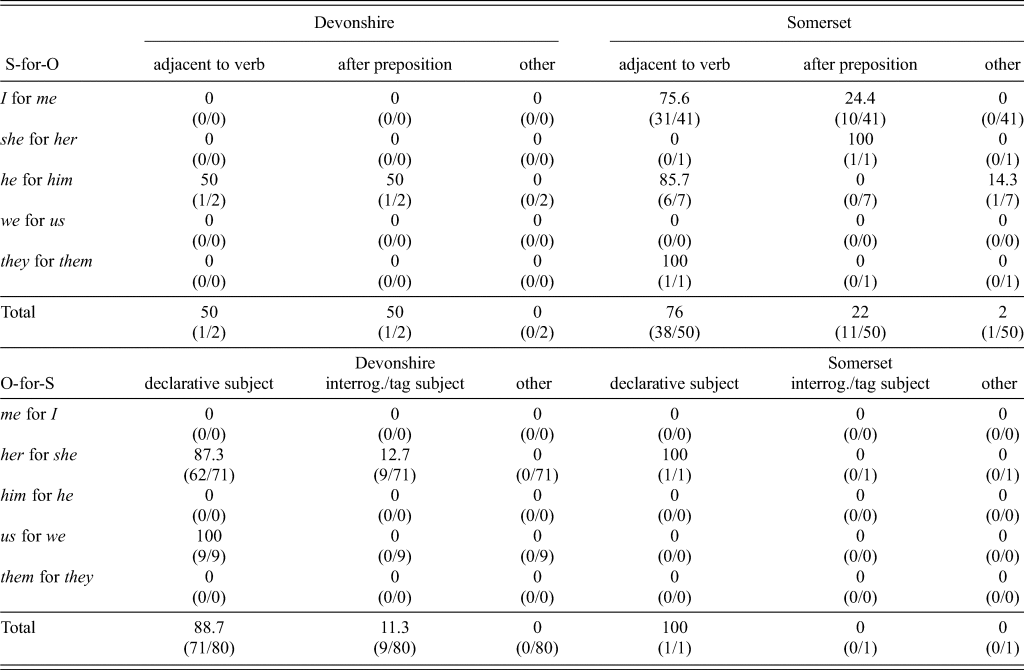
Concerning the syntactic contexts where PE is used, the SC shows, on the one hand, that it is common for subject-for-object forms to occur adjacent to verbs (e.g. (17a)), and after prepositions, as in example (17b):
(17)
(a) I wouldn't go to zee they! (Som_1).
(b) ’Tis no manner o’ use to maake a joke avoore he (Dev_2).
On the other hand, object-for-subjects are found mostly in declarative sentences, as in example (18a), and in a few tag questions and instances of interrogatives like (18b):
(18)
(a) Us must clear out of this or Mrs. Pat'll be vor turnin’ us out (Dev_2).
(b) What did her zay to et, good-now? (Dev_1).
Table 9 displays the syntactic distribution of exchanged pronouns in representations of Devonshire and Somerset as examples.
Syntactic distribution of pronoun exchange (percentage)

As with do periphrasis, if we compare the data with the SED we can see some distributional continuity over time in at least two respects. Firstly, the syntactic environments of PE as documented in the SC show some correspondence with later evidence, as ‘the tendency clearly is for “exchanged” pronouns adjacent to verbs to be emphatic’ (Wagner Reference Wagner2002: 12). In the second place, the geographical distribution of exchanged pronouns ties in with the West Country divide between subjects for objects, and vice versa, as well as with the prevalence of Devonshire as the heartland of subject her.
Interestingly, LModE Devonshire data from EDD Online largely accord with the SC. This is hardly surprising given that EDD relied on a substantial amount of dialect writing, but also on a remarkable number of private helpers and glossaries that seem to confirm the literary data discussed here. Table 10 shows that her and us are the most frequent choices in the corresponding subject contexts, whereas subjects are rarely employed in object slots. Exceptions are she and he, the latter of which is also recorded in literary representations of the dialect. Unlike in the SC, subject her is employed together with standard she in the EDD Online data. The categorical preference for subject her in dialect writing could be taken to reflect the writers’ evaluation of this exchanged pronoun as a highly distinctive characteristic of Devonshire speech, one that was probably enregistered in the nineteenth-century representations of the dialect.
Pronoun exchange in LModE Devonshire (EDD Online; percentage)

5 Enregisterment and indexicality in nineteenth-century representations of south-western speech
The interrelated models of enregisterment and indexicality have gained remarkable attention over the past years to explore representations of speech circulated in dialect writing, largely because of their ‘power to explain the circumscription of a dialectal “voice” in the public imagination’ (Picone Reference Picone, Cook and Ryan2016: 334). Agha (Reference Agha2003: 231) describes enregisterment as ‘processes through which a linguistic repertoire becomes differentiable within a language as a socially recognized register of forms’. It is, as Agha & Frog (Reference Agha, Frog, Agha and Frog2015: 15) explain, a ‘reflexive process through which register formations are differentiated from each other and emerge as apparently bounded sociohistorical formations for their users’. Such registers can be traced back to and accounted for by sociohistorical practices whereby specific linguistic forms take on and index sociocultural meaning, and thus ‘metapragmatically circulate and reproduce in social interaction, permeating discourse’ (Hernández-Campoy Reference Hernández-Campoy2016: 150). These metapragmatic activities include dialect writing in which selected items are claimed as distinctive of a variety, as we have seen. Enregisterment can thus be taken to indicate the construction of dialects linked with a range of meanings and values relating to place, linguistic correctness, social class, gender, etc. As Johnstone (Reference Johnstone, Montgomery and Moore2017: 284) emphasises, ‘[f]or variationist sociolinguists, the concept of enregisterment can be of use in the exploration of linguistic variation linked with contextual variation of any kind’.
Enregisterment is coupled with Silverstein's (Reference Silverstein2003) three orders of indexicality, which refer to ascending levels of ‘linguistic awareness and reflexivity’ (Clark Reference Clark2020: 108) (see further Johnstone et al. Reference Johnstone, Andrus and Danielson2006). First-order indexical links exhibit the correlation between a linguistic form and a social category, which is rarely observable for insiders to the speech community. At the second order, there is awareness of the link between that linguistic feature and its meaning, which speakers interpret and employ variably according to context. Thus, they style-shift as they become aware that using specific features carries specific meanings. Third-order indexicality shows enregisterment of those socially meaningful features, which are the object of overt comment and public representation, and are thus ‘deployed as part of deliberate and reflexive identity performances’ (Bucholtz & Lopez Reference Bucholtz and Lopez2011: 681) that include dialect writing. Indeed, literary representations of dialect show speakers’ awareness of, as well as ideas about and attitudes towards, regional speech in the form of metalanguage, either explicitly with remarks about the dialect or implicitly in the self-conscious act of the representation itself (see Beal Reference Beal2009; Cooper Reference Cooper, Honeybone and Maguire2020; Ruano-García Reference Ruano-García2020; Schintu Reference Schintu2022).
In this language-ideological context, the conscious representation of the grammatical features discussed in this article can be interpreted as implicit metalanguage on dialect. It echoes their contemporary evaluation and labelling as characteristic of south-western speech, while it also reflects that they were core constituents of a repertoire-in-use, where such forms were recontextualised to enact linguistic identity and perform an ‘image of personhood’ (Agha Reference Agha2007: 177). The representations scrutinised can thus be seen as metadiscursive practices in the typification of dialect and character: they involve intentional linguistic choices and can be read as a reflexive construction of south-western identities that employs language purposefully. Not only does reflexivity operate at the level of the writer, who used dialect agentively to make meaning by recreating others’ speech and character. We could also see it work in respect of the fictional speaker, who, as a representation of a dialect user, employs dialect to align themselves and show their ‘perceptions of groupness’ (Agha Reference Agha2007: 135). In this sense, the representations of south-western dialects reproduce contemporary models of behaviour, which build on a wide range of pre-established linguistic associations with place, not only physical but likewise social and perceived. As pointed out in section 2, some of them have been conventionalised in the representation of dialect and have ‘take[n] on sufficient meaning to participate in processes of enregisterment’ (Eckert Reference Eckert2012: 97). This seems to be the case with do periphrasis and pronoun exchange. Both of them are deployed as indexical resources to construct and reproduce, on the one hand, south-western speech. As we have seen, they are recurrently employed in the texts analysed, possibly speaking to the fact that writers’ and readers’ associations between these two features and the dialects represented remained stable during the nineteenth century. On the other hand, both grammatical forms were selected within the writers’ endeavour to evoke south-westernness. This was accomplished by attributing them to a specific social persona because, in the words of Slow (Reference Slow1894: n.p.), ‘it does not seem possible to depict certain traits of character without the use of the vernacular’.
The south-western character of these representations took different shapes in different dialects, while the available evidence suggests that the meanings indexed by these two grammatical peculiarities were shared in most cases. Even though there is little in the form of qualitative commentary in this regard, we are informed that ‘Dorset men are laughed at for what is taken as their misuse of pronouns’ (Barnes Reference Barnes1886: 17), which was likewise a characteristic of the speech of ‘the Devonshire peasant’, who ‘confounds the nominative with the accusative’ (Bowring Reference Bowring1866: 26). A source of derision or curiosity as exchanged pronouns may have been, such comments, which mirror the commonly received view amongst outsiders, were counterbalanced by voices pointing to their honourability, also of the ‘frequent use of the word do’ that Jago (Reference Jago1882: 57) noticed in Cornwall. They were qualified as ‘grammatical peculiarities’ (Elworthy Reference Elworthy1886: vi) of West Country speech, one that, in the words of Worth (Reference Worth1886: 335), exhibited ‘the remains of a nobler and purer dialect’. Their noble and genuine purity, Elworthy (Reference Elworthy1886: vi) pointed out, was actually substantiated by the fact that they featured amongst the ‘many forms of grammar and syntax which have long become obsolete in literature’, at least in west Somerset and Devonshire, where they were also seen as ‘genuine archaisms’ (Weymouth Reference Weymouth1885: 63).
This was compounded with and reflected in the local colouring of the representations, which were crafted against the backdrop of common references and ideas about the places where these grammatical features were employed. They include the Ding Dong Mine in one of William Sandys' Specimens of Cornish Provincial Dialect (Reference Sandys1846), Barleigh, a fictional Dorset village that took the narrator of Agnus' Jan Oxber (Reference Agnus1902) ‘a backward leap to the days when our grandfathers were in their prime and our fathers troublesome boys’ (p. 9), and ‘the straggling hamlet of Fuzzacott’ (p. 253) that Mary Hartier (Reference Hartier1896) described as a ‘bleak and barren a spot as could be found in the West Country … [with] a rare beauty of its own’ (p. 253). Of course, such references proved instrumental in shaping the south-western taste of these representations, giving meaning, a sense of place and of authenticity to the members of the speech communities inhabiting the mining and rural districts described.
In this regard, we may refer to two broad types of character that are made to use these two grammatical features. On the one hand, the figure of the Cornish miner, the ‘“Cousin Jacky's,” as you Lunnoners do caal us!’ ([Various authors] 1882: 3), who Sandys (Reference Sandys1846: 22) typified as ‘clathing hard and rough black’ with ‘hes faace rud like hes beard’. Their speech, as Jago (Reference Jago1882: 53) underlines, is one of the ‘two dialects in the County’, the other being that of the husbandman. He, on the other hand, emerges as a speaker type that embodies the conservative values linked with the dialect and the place. Yet the social identity of the peasant, of the rural speaker varies across the South-West, at least in the texts analysed. The representations of Devonshire abound with ‘country people’ (Palmer Reference Palmer1837: 1), ‘some round and ruddy, others lined and seamed with age and toil’ (Hartier Reference Hartier1896: 254), whose ‘elasticity of temperament’, Hewett (Reference Hewett1892: viii) wrote, was ‘brimful of fun, and [they] bubble over with laughter-provoking jokes’. Their fondness for superstition seems to have likewise been a characteristic of the Dorset ‘pore labouren volks’ (Agnus Reference Agnus1902: 20), resolute and skilful people who, unlike the rural Somerset man, do not carry ludicrous overtones. Indeed, representations like those of Jennings (Reference Jennings1825) and Halliwell (Reference Halliwell1843) rely on comic types in the tradition of the ‘rude and ignorant clown’ (Baynes Reference Baynes1861: 4) that talks ‘genuine Zoomerzet’ (p. 6) and embodies ‘everything that is rude and clumsy in rustic life’ (p. 6). Yet some nineteenth-century representations of the dialect such as Raymond's Gossip Corner (Reference Raymond1907) contest this figure and associate the dialect with speakers that are ‘not specially humorous, but rather stolid’ (Elworthy Reference Elworthy1886: xii), ‘slow-going and self-contained to a proverb[, who] look with distrust and suspicion’ (Baynes Reference Baynes1861: 27), just as Zebedee Luke does, one of the millers in Raymond's novel. An insider, Raymond, like Elworthy, resisted the long-lasting scheme of social values linked with the dialect and character of Somersetshire, basically because ‘this is a libel’ (Elworthy Reference Elworthy1875: 20) (see also Cooper Reference Cooper2023). Similarly, Jefferies (Reference Jefferies1892: 38) underscored the delusion of the ‘popular belief, which represents the [Wiltshire] farmer as rude and ignorant, a pot-bellied beer-drinker, and nothing more’. The Wiltshire speakers that give voice to the dialect are more complex in their character, showing agency in the rustic affairs and anecdotes in which they are involved. Some of them, however, retain the humorous connotations that were also linked with the peasants’ substitution of ‘v for f, and z for s’ (Britton Reference Britton1825: 369).
Like these enregistered pronunciation forms, periphrastic do and pronoun exchange thus acted as semiotic devices in association with specific ‘characterological figure[s]’ (Agha Reference Agha2007: 177). In other words, they were selected along with other recognisable south-western features to index ‘a way of being and acting associated not just with a social identity in an abstract sense, but with its embodiment in a character, imagined or actually performed’ (Johnstone Reference Johnstone, Montgomery and Moore2017: 285). This way, these two distinctive peculiarities activated a set of dynamic indexical relations between place, speaker and speech both concerning the social embodiment of the values associated with using them, as well as with respect to how they were evaluated in the varieties represented. The varying frequencies with which they are employed in these texts may be also taken to reflect varying degrees of salience or at least how local they were perceived in these south-western dialects. Even though this remains a question for detailed study, cases like Devonshire subject her speak to the strong indexical ties that there existed between this form and this dialect, as well as with the imagined peasant that inhabited the barren moors of Hartier's Fuzzacott. Her grammatical encoding of the dialect, like that of the other south-western representations, was therefore a meaningful indexical resource based on enregistered features that contemporary audiences were able to read against prevalent sociocultural and linguistic norms.
6 Conclusion
It follows from the previous discussion that nineteenth-century representations of dialect offer fertile ground to explore the speech of south-western speakers from at least two complementary perspectives. While the documentation of specific linguistic forms adds to the record of the dialects represented, it also reveals authorial perceptions of those features and how they were evaluated. As we have seen, nineteenth-century dialect writing preserves records of speech that inform our historical understanding of grammatical phenomena like periphrastic do and pronoun exchange. Quantification of writers’ linguistic choices points to the fact that both of them were low-frequency features, whose distribution and use in the material analysed largely patterns with later evidence. Thus, the findings suggest that do periphrasis was associated with the expression of habitual meaning, though not exclusively, especially in present contexts and in the dialects of Somerset, Cornwall and Dorset, whereas Devonshire emerges virtually as a do-less area, where pronouns her and us were strongly favoured in subject contexts. This way, the data have proved useful to approach morphosyntactic dialect variation in the past, which, unlike other areas such as phonology and vocabulary, remains understudied in the case of dialect writing. In a similar way, the article has shown that the representation of dialect morphosyntax can be read within third-wave sociolinguistic models, just as other studies have done with regard to respellings and lexis. Indeed, as we have seen, the features analysed were employed as indexicals that evoked ideas of south-westernness and that linked the dialect with a recognisable type of speaker with yet a different character across the South-West. Not only do the data provide us with a valuable glimpse into the social meanings of these morphosyntactic traits. They also inform us that both of these traits played an important role in social practices that (re-)circulated south-western dialects as enregistered varieties during this time. By commonly including them in their representations, writers reproduced, shaped and encoded ideas of linguistic variation, at least of the South-West and regarding these two grammatical features.
Dialect writing can therefore add interesting angles to ongoing work on LModE speech and its representation. As this article hopes to have shown, it may help us reconstruct or at least make better sense of the fragmented history of some features, while it can improve our knowledge of the ‘other’ Late Modern Englishes and their perceptions. It is expected that future work may benefit from the increasing availability of specimens of older dialects and thus contribute to the historical narrative of people's speech as well as of their shared assumptions about how they spoke.
Appendix
Cor_1. Sandys, William. 1846. Specimens of Cornish provincial dialect. London: John Russell Smith. [5,644 words]
Cor_2. [Various authors]. 1882. Cornish tales, in prose and verse. By various authors. Truro: Netherton and Worth. [3,860 words]
Dev_1. Palmer, Mary. 1837. A dialogue in the Devonshire dialect. London: Longman, Rees, Orme, Brown, Green and Longman. [4,517 words]
Dev_2. Hartier, Mary. 1896. An evening with Hodge. English Illustrated Magazine 15 (June), 253–9. [2,819 words]
Dor_1. Anonymous. 1802. Epistle from Roger Coulter, of Dorsetshire, to his friend Giles Bloomfield, the Suffolk farmer's boy. In Bloomfield, Robert, The remains of Robert Bloomfield, vol. I, 153–4. London: Baldwin, Cradock, and Joy. [227 words]
Dor_2. Agnus, Orme. 1902. Jan Oxber. Boston: L. C. Page & Co. [3,314 words]
Dor_3. Francis, Mary E. 1905. Dorset dear: Idylls of country life. London: Longman, Green & Co. [3,466 words]
Som_1. Jennings, James. 1825. Observations on some dialects in the West of England, particularly Somersetshire … poems and other pieces exemplifying the dialect. London: Printed for Baldwin, Cradock, and Joy. [1,646 words]
Som_2. Halliwell, James O. 1843. A collection of pieces in the dialect of Zummerzet. London: John Russell Smith. [919 words]
Som_3. Raymond, Walter. 1907. Gossip corner. London: J. M. Dent. [2,938 words]
Wil_1. Akerman, John Y. 1853. Wiltshire tales. London: John Russell Smith. [2,189 words]
Wil_2. Anonymous, . 1873. Gwoin’ rayhter too fur wi’ a veyther. In Dartnell, George E. & Goddard, Edward H., A glossary of words used in the county of Wiltshire, 212–13. London: Published for the English Dialect Society. [489 words]
Wil_3. Slow, Edward. 1894. The fifth series of Wiltshire rhymes and tales in the Wiltshire dialect. Wilton: E. Slow. [5,167 words]