Introduction
Terrorism has been a world-wide public health concern for many decades. It can be defined as “the threatened or actual use of illegal force and violence by a non-state actor to attain a political, economic, religious, or social goal through fear, coercion, or intimidation.” 1 Since 2001, the world has encountered an increase in terrorist attacks on civilian targets. Reference Court, Edwards, Issa, Voskanyan and Ciottone2 Global terrorism subsequently peaked in 2014 and 2015, both relating to the number of attacks and to casualty tolls. 1,3 Terrorist attacks are mostly unpredictable and have the potential to cause high numbers of casualties. Shootings, bombings (suicide and otherwise), vehicle ramming, drone-attacks, and use of unconventional weapons (including chemical, biological, radiological, and nuclear [CBRN] weapons) are examples of modalities used in these attacks. Reference Tin, Margus and Ciottone4 When terrorists use unconventional attack modalities, it often results in unique injury patterns which require a specific and adequate medical response. Reference Arnold, Örtenwall and Birnbaum5
The rising incidence of terrorist attacks combined with their mass casualty potential is associated with increased demands on health care systems and has led to an increased awareness of the threat to first responders, health care workers, and facilities. Reference Court, Edwards, Issa, Voskanyan and Ciottone2 Target types can be decisive for the medical response, and some target types are more vulnerable than others. For example, it has been shown that transport modalities, mass gatherings, and educational facilities represent significant target types. Reference Tin, Barten, De Cauwer and Ciottone6-Reference Tin, Issa and Ciottone8 Furthermore, while hospitals and health care facilities generally serve as safe havens for the victims of terrorist attacks, they are sometimes selected as primary targets by terrorists. Hospitals are particularly vulnerable to acts of terrorism due to their easy accessibility and comparatively low security standards. Moreover, the continuous presence of patients and staff during day and night increase the likelihood of multiple casualties. Such attacks significantly disrupt the availability and continuity of medical care. Reference McNeilly, Jasani, Cavaliere, Alfalasi and Lawner9
In order to improve the counter-terrorism preparedness of health care facilities and health care workers, it is critical to learn from past events and to review the present knowledge base. Therefore, counter-terrorism medicine (CTM) was introduced as a research priority and subspecialty within disaster and emergency medicine in 2015. 10 Since then, several CTM studies have been published, including studies assessing terrorist attacks on health care-related targets. For this study, the aim was to systematically map the existing research on terrorist attacks targeting health care facilities, health care workers, and first responders, and to identify opportunities to improve future research efforts and health care response to terrorist attacks.
Methods
Search Strategy
This study utilized a methodology for a scoping review according to the Preferred Reporting Items for Systematic Reviews and Meta-Analyses (PRISMA) guidelines extensions to identify peer-reviewed articles in accordance with the defined inclusion criteria (Supplementary Material; available online only). Reference Tricco, Lillie and Zarin11,Reference Moher, Liberati, Tetzlaff and Altman12 The systematic search for relevant literature was performed through the use of multiple electronic databases, including PubMed (National Center for Biotechnology Information, National Institutes of Health; Bethesda, Maryland USA); Cochrane (Wiley; Hoboken, New Jersey USA); and Embase (Elsevier; Amsterdam, Netherlands). These electronic databases were selected to cover a broad range of articles without overwhelming the search with irrelevant material. Key terms were carefully chosen, and an experienced librarian was consulted. The following search and MeSH terms were used: Terrorism; Terrorist attack; Healthcare institution; Healthcare worker; Hospital; Emergency room; Emergency department; Primary caregiver; Primary care provider; Medical staff; Paramedic; First responder; Emergency responder; Emergency medical service; Emergency medical technician; Ambulance; Police; and Firefighter. Other articles were additionally identified through the “Cited by” section in PubMed, as well as in the reference lists of included citations of earlier found articles, according to the snowballing method. Searches were conducted in February-March 2023. The full search strategy is provided in Appendix 1 (available online only). All identified articles were uploaded in Endnote V20 (Clarivate Analytics; Philadelphia, Pennsylvania USA) and duplicate papers were deleted. The remaining articles were subsequently reviewed by reading the title and/or abstract. Two researchers reviewed the articles independently of each other, using the program Rayyan.ai (Rayyan; Cambridge, Massachusetts USA) for blinding. A third reviewer was consulted if there were any discrepancies. Data charting was performed in duplicate using forms that were tested by the team before their use. The full study protocol is available upon request.
A scoping review design was chosen for its ability to identify research gaps and to examine how past studies on terrorist attacks against health care have been conducted. 13
Study Selection
Selection of articles was performed through the inclusion criteria: (1) studies available in English; (2) studies which were peer-reviewed; (3) studies reporting on terrorism (including: shootings, bombings, explosions, biological, chemical, nuclear, cyber, and hybrid warfare); (4) studies on terrorist attacks targeting health care facilities, health care workers, or first responders (including paramedics/emergency medical technicians [EMTs], firefighters, and police officers); and (5) “terrorism” defined as “the threatened or actual use of illegal force and violence by a non-state actor to attain a political, economic, religious, or social goal through fear, coercion, or intimidation.” Reference Court, Edwards, Issa, Voskanyan and Ciottone2
Articles were excluded based on: (1) studies that lack of content on terrorist attacks; (2) studies that only describe preparedness for (possible) attacks; (3) studies on mental health and psychosocial impact after the attack; (4) studies published before the year 2000; and (5) studies of which the abstract or full text was not accessible.
Statistical Analysis
The data from the included articles were extracted, comprising of the time frame, number of attacks, number of injured, number of fatalities, target type, and weapon modalities. Ratios were computed for the respective target groups based on the number of injured and fatalities.
Methodological Quality Assessment
Methodological quality assessment was performed on all included articles, rated on their methodological quality applying the GRADE-CERQual (Confidence in the Evidence from Reviews of Qualitative Research) method. Reference Lewin, Booth and Glenton14
Results
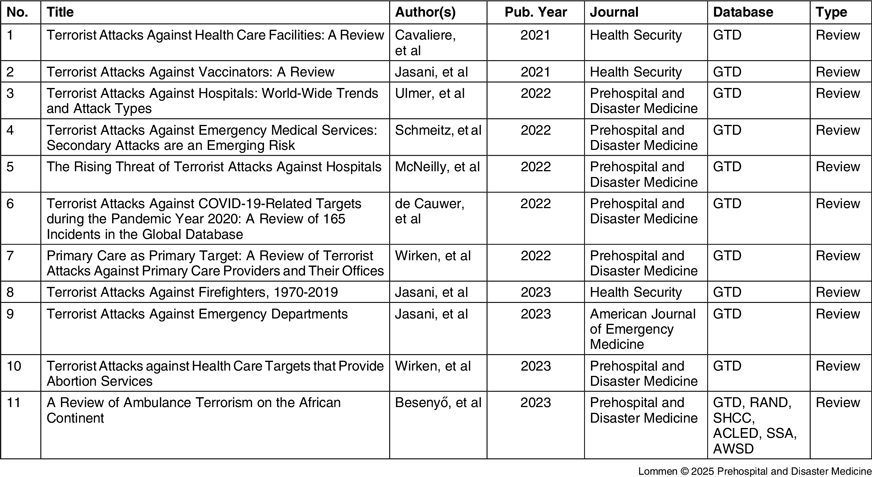
The initial search resulted in 4,656 records, including 2,777, 1,843, and 36 entries from PubMed, Embase, and Cochrane Library, respectively. A total of 1,381 duplicate records were removed. Another 85 articles were excluded because they were published before the year 2000. In total, 3,190 articles were reviewed based on title and abstract, resulting in the exclusion of 3,153 records. Of the remaining 37 articles, the eligibility was checked by reading the full texts. This resulted in the exclusion of another 26 records based on the following reasons: no full text available; no form of terrorism; or the record reported about a terrorist threat, but no actual attack took place. Finally, 11 articles were included in this scoping review. The full identification process is shown in Figure 1. All of these articles were database reviews and all of them were published in or after 2001 (Table 19, Reference Cavaliere, Alfalasi, Jasani, Ciottone and Lawner15–Reference Besenyő, Barten, De Cauwer, Tin and Gulyás24 ). Seven articles were published in Prehospital and Disaster Medicine, three in Health Security, and one in American Journal of Emergency Medicine. Six articles focused on some kind of health care facility, two on hospitals, and three on first responders.
Identification of Studies via Databases.

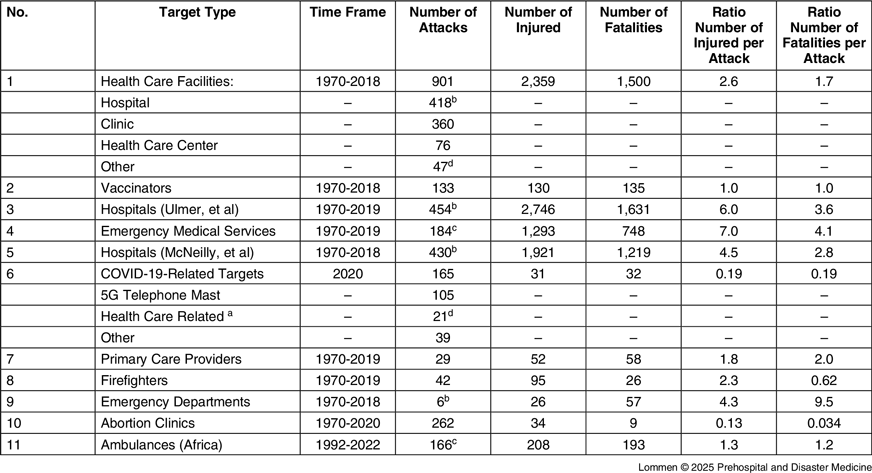
The different health care-related target types and their corresponding number of attacks are shown in Table 2. The table also includes number of injured people and the number of fatalities per attack, as well as the calculated injury and fatality ratio per attack. All articles combined, reported on a total number of 2,772 attacks. However, a single attack could be included in multiple studies and the precise extent of overlap could not be established. Divided by target type, there were 901 attacks on health care facilities, 430-454 on hospitals, 262 on abortion clinics, 184 on Emergency Medical Services (EMS), 166 on ambulances (Africa), 165 on COVID-19-related targets, 133 on vaccinators, 42 on firefighters, 29 on primary care providers, and six on emergency departments (EDs); Figure 2. The highest injury rate per attack was found in attacks on EMS (901 attacks; 2,359 injured; injury ratio per attack 6.0). The highest fatality rate was attributed to attacks on EDs (six attacks; 57 fatalities; fatality rate per attack 9.5). The lowest injury and fatality rates were found in attacks on abortion clinics (262 attacks; 34 injured; injury ratio per attack 0.13; nine fatalities; fatality ratio per attack 0.034).
Included Articles in Scoping Review

Abbreviations: GTD, Global Terrorism Database; RAND, RAND Database of World-Wide Terrorism Incidents; SHCC, Safeguarding Health in Conflict Coalition Database; ACLED, Armed Conflict Location and Event Data; SSA, Social Security Administration Database; AWSD, Aid Worker Security Database.
Target Type with Number of Attacks, Number of Injured, Number of Fatalities, and Calculated Ratio Number of Injured or Fatalities per Attack

a Aid workers, quarantine/isolation center, hospital, testing center or medical doctor.
b The referenced studies likely show significant overlap in the number of attacks on hospitals.
c The referenced studies likely show significant overlap in the number of attacks on ambulances.
d Please note that miscellaneous categories may also include attacks on hospitals or Emergency Medical Services.
Bar Chart Showing the Ratio Number of Injured or Fatalities per Attack. Abbreviation: EMS, Emergency Medical Services.

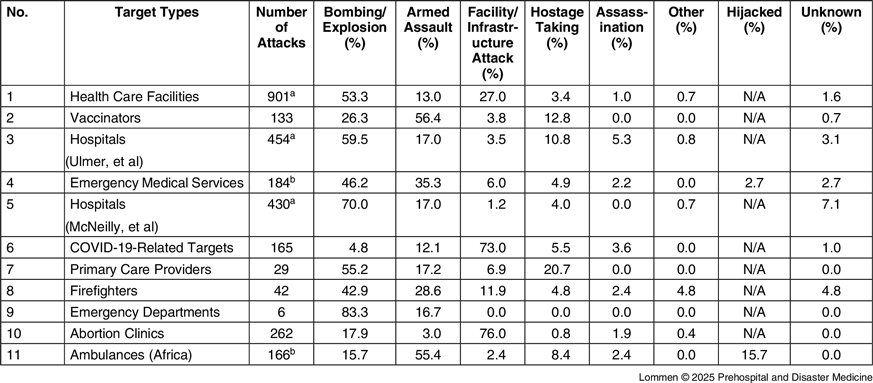
Table 3 delineates the attack types divided by target type. Hijacking was only a valid category in the articles reporting on terrorist attacks on EMS. Overall, the most common attack type was bombing and explosions (42.9%-83.3%; 5-480 attacks). The only exceptions were attacks on COVID-19-related targets and abortion clinics, where facility/infrastructure attacks were most commonly reported (73.0% and 76.0%; 120 and 166 attacks, respectively), and attacks on vaccinators, where armed assault was most commonly reported (56.4%; 75 attacks). A study reporting on ambulance terrorism in Africa also reported armed assault as the most common attack type (55.4%; 92 attacks), whilst this was not the case in a global study on terrorist attacks against EMS.
Percentage of Attack Type per Target Type

a The referenced studies likely show significant overlap in the number of attacks on hospitals.
b The referenced studies likely show significant overlap in the number of attacks on ambulances.
Whereas the study on COVID-19-related targets only assessed data from the year 2020, all other studies covered a wider time frame. Of these, most showed an increase in terrorist attacks during the past decade (2011-2020). The highest number of attacks occurred in 2014 and coincided with the world-wide peak in terrorism. An exception to this trend was found in a study on attacks against abortion clinics (no. 10), which peaked during the years 1984-1997. One study (no.9) investigated attacks on EDs, but the small sample size of six incidents did not allow assessment of temporal trends.
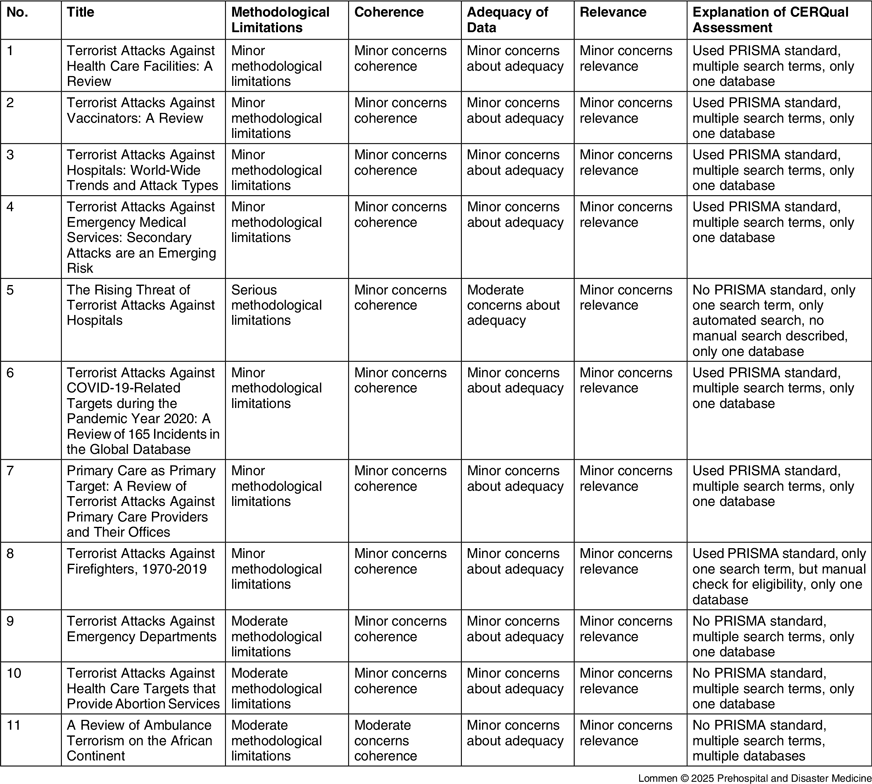
Methodological quality assessment of the included studies is shown in Table 4.
Methodological Quality Assessment

Abbreviation: PRISMA, Preferred Reporting Items for Systematic Reviews and Meta-Analyses.
Discussion
Currently, CTM is an emerging research niche within the field of disaster and emergency medicine, aimed at addressing the health care consequences of terrorism. This scoping review identified 11 studies focusing on terrorist attacks against health care facilities, health care workers, and first responders. All studies reported an increase of terrorist attacks against health care-related targets during the respective study periods. Nonetheless, there were discrepancies between the included studies regarding methodology and reported outcomes, highlighting the need for more standardized reporting of CTM research.
Overall, an increase in terrorist attacks targeting health care was reported from 2008 onwards, with a peak around 2014. This trend is consistent with findings in broader terrorism literature that associate surges in violence with political instability and global conflict escalation during that period. Furthermore, McNeilly, et al found that attacks on health care facilities disproportionately increased when compared to attacks against other targets. Reference McNeilly, Jasani, Cavaliere, Alfalasi and Lawner9 However, inconsistencies emerged, especially in the three studies examining attacks on hospitals. Despite analyzing nearly identical time frames, the studies reported different totals (n = 418, 430, and 454). These discrepancies may be partially explained by differences in inclusion criteria, target definitions, and the scope of search strategies – for example, the use of a single search term (“hospital”) versus multiple search terms (“hospital,” “clinic,” or “ward”). A particularly notable difference is the reported number of injuries and fatalities. Ulmer, et al included casualties among perpetrators (four injuries; 199 fatalities), while it remains unclear whether McNeilly, et al applied the same approach. Nevertheless, the large discrepancy – 825 more injuries and 412 more fatalities reported by Ulmer, et al – cannot be fully explained by this factor alone. Therefore, it could be argued that the differences are largely explained by different search strategies, with dissimilar datasets as a result. This is further supported by the methodological quality assessments, which showed that studies reporting lower numbers of casualties also scored lower on the quality assessment.
First responders, including EMS and firefighters, are another important target type. Vulnerability can be explained by the lack of structural boundaries and that they are sometimes dispatched to hazardous environments. Three of the included articles dealt with attacks against first responders (EMS, firefighters, and ambulances in Africa). Reference Schmeitz, Barten and van Barneveld18,Reference Jasani, Cavaliere, Tian, Liang and Lawner21,Reference Besenyő, Barten, De Cauwer, Tin and Gulyás24 The study on terrorist attacks against EMS globally and the review of ambulance terrorism in Africa likely have considerable overlap. However, the article focusing on the African continent utilized multiple databases instead of the Global Terrorism Database (GTD) only. Firefighters were included in this analysis, because in some countries, firefighters also have the role of performing initial medical aid (eg, EMT, emergency medical responder, or paramedic). Potentially, there also is some overlap between the two studies that focused on EMS and the study that assessed attacks on firefighters. Apparent from the studies was that secondary attacks are emerging as a trend (39 attacks during the last decade). Reference Schmeitz, Barten and van Barneveld18 The study by Schmeitz, et al describes the emerging risk of secondary attacks on EMS during terrorist incidents. These attacks target first responders and medical teams after the initial event, increasing the danger and complicating the response efforts. Secondary attacks can exacerbate the impact of the original attack by disrupting critical medical aid. It stresses the importance of improving preparedness and protection for EMS personnel in the face of this growing threat. In addition, Jasani, et al observed that there is a trend of stealing ambulances and subsequently using them to carry out attacks. Reference Jasani, Alfalasi, Cavaliere, Ciottone and Lawner25 This particular study was not included in this analysis because this attack type did not follow the strict definition of attacks against health care.
The COVID-19 pandemic has underlined the vital importance of robust public health systems, and that undermining of public health has the potential to have a wide-spread impact on the community. While attacks against public health initiatives have existed since the early ages, this phenomenon has been further exacerbated by the pandemic, which also played a pivotal role in the creation of a new form of terrorism against health care workers. Far-left, far-right, conspiracy thinkers, and extremist groups used the pandemic as a motive for their terrorist acts. Reference De Cauwer, Barten and Tin19 In 2020 alone, there were 165 attacks against COVID-19-related targets. Most of these attacks (n = 105) were targeted against 5G telephone masts, which is beyond the scope of this study. However, at least 21 attacks were targeted against health care workers or facilities (aid workers, quarantine/isolation center, hospital, testing center, and medical doctor). Reference De Cauwer, Barten and Tin19 A large proportion of these attacks was motivated by conspiracy thinking, which is of concern.
With regards to methodological quality assessment, several recommendations can be made. First, nearly all included studies used the GTD as a single database. The only exception was a study on ambulance attacks in Africa, where additional databases were used and combined. While the GTD is one of the most comprehensive open-access terrorism databases available, exclusive reliance on this single database introduces several potential biases, including common source bias. Given that the GTD has specific inclusion criteria that may exclude relevant incidents, selection bias is a particular concern. Furthermore, the findings in this study indicate that despite utilizing the same database, variations in the number of injuries and fatalities can still arise. To deepen the discussions of the scope of health care-related terrorist attacks and to better enable comparisons between target types, documentation of attacks should be improved. Future CTM research on terrorist attacks against health care could benefit from the use of additional databases, Reference Bowie26 including institutional reports, regional terrorism databases, and grey literature. Doing so would strengthen the validity of findings, enhance consistency across studies, and provide a more complete understanding of the scope and nature of terrorist threats.
Limitations
This scoping review is prone to multiple limitations. First, there is undefinable but perhaps considerable overlap between some studies (ie, the article on health care attacks also contains attacks on hospitals which creates overlap with the articles on hospitals). This means that the data could not be aggregated. Because the level of dependence between the data sets of the different articles was unknown, this also hampered statistical analysis for all studies combined. Second, most studies are (largely) based on the GTD. This increases the likelihood of common source bias. While the GTD may be the most comprehensive terrorism database available, it is also subject to some limitations. These include the questionable completeness of the GTD during the first few decades (1970-1989). Therefore, an under-estimated number of attacks is presumed during this period. Moreover, the GTD relies on media reports and is therefore subject to selection bias. High-quality media platforms likely have a larger reach, which may influence inclusion rates of media reports. Further, some geographic regions may be under-represented in the GTD, low- and middle-income countries in particular, impairing the generalizability of this dataset. Finally, the GTD does not report on state-sponsored terrorism.
Another limitation of this scoping review is the absence of studies addressing cyber terrorism. Despite the growing of number cyber-attacks which pose significant and escalating threats to health care systems, disrupting hospital operations and compromising sensitive patient data. This hiatus may be explained because the search term “terrorism” was not sufficient to identify terroristic cyber-attacks. Moreover, cyber-attacks are often categorized under cyber-crime rather than terrorism. Cyber-attacks and cyber-crime are not included in the GTD and many other terrorism databases. Including “cyber terrorism” as a search term and broadening the scope to relevant cyber security databases could have provided a more comprehensive view of emerging threats in the digital domain.
Moreover, only studies published after 2000 were included in this review. Although the authors are confident that there were no relevant studies before that date, it is theoretically possible that older studies are missed as a result. Further, authors of the included studies were not contacted to clarify methodological discrepancies or inconsistencies. The exclusion of non-English publications may represent another limitation. Finally, the study protocol only allowed the inclusion of peer-reviewed studies, excluding grey literature such as institutional reports. Although this may have led to the omission of critical first-hand data on terrorism against health care, this also allowed for a focused and methodological quality assessment of the present CTM literature.
Conclusion
This scoping review included 11 studies focusing on terrorist attacks against health care facilities, health care workers, and first responders. Nearly all studies were exclusively based on the GTD. An increase of attacks on health care-related targets was consistently reported by all studies in this review, but there were significant discrepancies in reported outcomes. In order to improve counter-terrorism preparedness and the future protection of health care workers, CTM research may benefit from a more standardized and transparent approach to document and analyze terrorist attacks, as well as the inclusion of additional databases other than the GTD.
Conflicts of interest/funding
The authors attest not to have any financial or other relationships that could be construed as a conflict of interest. None of the authors received specific funding for this manuscript.
Supplementary Materials
To view supplementary material for this article, please visit https://doi.org/10.1017/S1049023X25101313