Introduction
In mutualistic interactions, the ‘effectiveness’ of the mutualistic partners is a key consideration in order to understand the evolution of this process (e.g. the effectiveness of seed-dispersing animals in producing seedlings; Loayza & Rios Reference Loayza and Rios2014). Mutualisms are composed of the immediate outcomes of the interactions (i.e. quantity component) and by the delayed outcomes once the interactions have concluded (i.e. quality component) (Schupp et al. Reference Schupp, Jordano and Gómez2017). By measuring these components, and their corresponding subcomponents, effectiveness can be assessed through quantification of the impact on demography and fitness of the selected side of the interaction (Schupp et al. Reference Schupp, Jordano and Gómez2017).
Seed dispersal mutualism involves the removal, transport and deposition of seeds and the harvest and use of resources provided by plants (Janzen Reference Janzen1983). From the plant perspective, the seed dispersal effectiveness refers to the number of new recruits (e.g. trees) due to the activity of a disperser (Schupp et al. Reference Schupp, Jordano and Gómez2017) and is a key process for survival and maintenance of species and populations (Janzen Reference Janzen1970). Among the strategies that plants have evolved to ensure the dispersal of their genes, the production of fleshy-fruits to attract animal frugivores is one of the most common in tropical ecosystems (Howe & Smallwood Reference Howe and Smallwood1982) with between 50 and 90% of canopy and sub-canopy trees producing fruits being dispersed mostly by birds and mammals (Jordano Reference Jordano and Fenner2001).
Among mammals, key taxonomic taxa such as bats (Lobova et al. Reference Lobova, Mori, Blanchard, Peckham and Charles-Dominique2003) and primates (Corlett Reference Corlett1998) have been highlighted due to the high diversity of frugivorous species (Stoner et al. Reference Stoner, Riba-Hérnandez, Vulenic and Lambert2007). Frugivorous bats represent an exceptional case, as they comprise a high percentage of animal biomass (Emmons & Feer Reference Emmons and Feer1997) and many plant species have evolved adaptations in their dispersal strategies in order to match the foraging preferences of these volant mammals (e.g. Ficus spp. and Artibeus jamaicensis; Hodgkison et al. Reference Hodgkison, Ayasse, Häberlein, Schulz, Zubaid, Mustapha, Kunz and Kalko2013).
The functional roles of fruit-eating bats in the dispersal and survival of several plant species are well understood, especially for those plant species that produce fleshy fruits with small seeds (Muscarella & Fleming Reference Muscarella and Fleming2007). In contrast, additional work needs to be done in order to disentangle the functional role of these bat species in mutualistic interactions with species that produce seeds that cannot be swallowed by the animals (hereafter large seeds). On this bat–plant interaction, bats transport fruits to night feeding roosts in order to eat the fleshy part and usually (see exception in Villalobos-Chaves et al. Reference Villalobos-Chaves, Padilla-Alvárez and Rodríguez-Herrera2016a) discard the large seeds underneath (Docters Van Leeuwen Reference Docters van Leeuwen1935, Janzen et al. Reference Janzen, Miller, Hackforth-Jones, Pond, Hooper and Janos1976).
Current information available on the functional role of small bats on seed dispersal mutualism with large-seeded plant species suggests that, for example, several species of leaf-tent roosting bats (Phyllostomidae: Stenodermatinae) are able to safely manipulate and effectively disperse large seeds at leaf-tents that serve as night feeding roosts, positively influencing their survival probabilities (Melo et al. Reference Melo, Rodríguez-Herrera, Chazdon, Medellin and Ceballos2009, Romo et al. Reference Romo, Tuomisto and Loiselle2004, Sugiyama et al. Reference Sugiyama, Comita, Masaki, Condit and Hubbell2018). These works represent important efforts in disentangling this mutualism; nevertheless, in order to better understand it, multiple information gaps should be filled. These gaps are related for example with the role of animal behaviour (e.g. movement, predation risk) in shaping seed dispersal patterns (Côrtes & Uriarte Reference Côrtes and Uriarte2013, Russo et al. Reference Russo, Portnoy and Augspurger2006) and the qualitative components (i.e. germination and recruitment) of the seed dispersal effectiveness framework (Schupp et al. Reference Schupp, Jordano and Gómez2017).
In this research, by quantifying and characterizing the seed rain generated by the Neotropical leaf-tent roosting bat Artibeus phaeotis and by incorporating measurements of animal movement (Côrtes & Uriarte Reference Côrtes and Uriarte2013), we explored the interaction between the seed dispersal role of the species and their foraging behaviour in a Costa Rican dry forest. We focused our seed dispersal sampling in large seeds (i.e. ≥ 8 mm length), as their mutualistic interactions with bats have been poorly or not documented despite the potential influence of these animals in shaping large-seeded Neotropical plant communities. Here, we tested the hypothesis that Artibeus phaeotis foraging activity influences density, diversity and distance effects of the seed rain of large seeds. We predicted that the feeding activity of Artibeus phaeotis will strongly influence density (1) and diversity metrics (2), as night feeding roosts will have a higher density and a higher number of large seed species than the control plots. Moreover, we also predicted that as Artibeus phaeotis is able to create day and night feeding roosts, the leaf-tents and the foraging areas of bats will be in close proximity to food resources (3).
Methods
Study site and focal study species
Our study was conducted between 2012–2015 at Palo Verde National Park (10°18N, 85°48’W; hereafter Palo Verde), located in Guanacaste province, Costa Rica. Palo Verde lies within the Tropical Dry Forest life zone and its average annual rainfall and temperature are approximately 1440 mm and 26°C respectively (Holdridge Reference Holdridge1967). Seasonality is well defined, with a dry season extending from December to April–May of each year. Palo Verde is mostly covered by seasonal wetlands, and mature, early and late-successional forest (Slud Reference Slud1980).
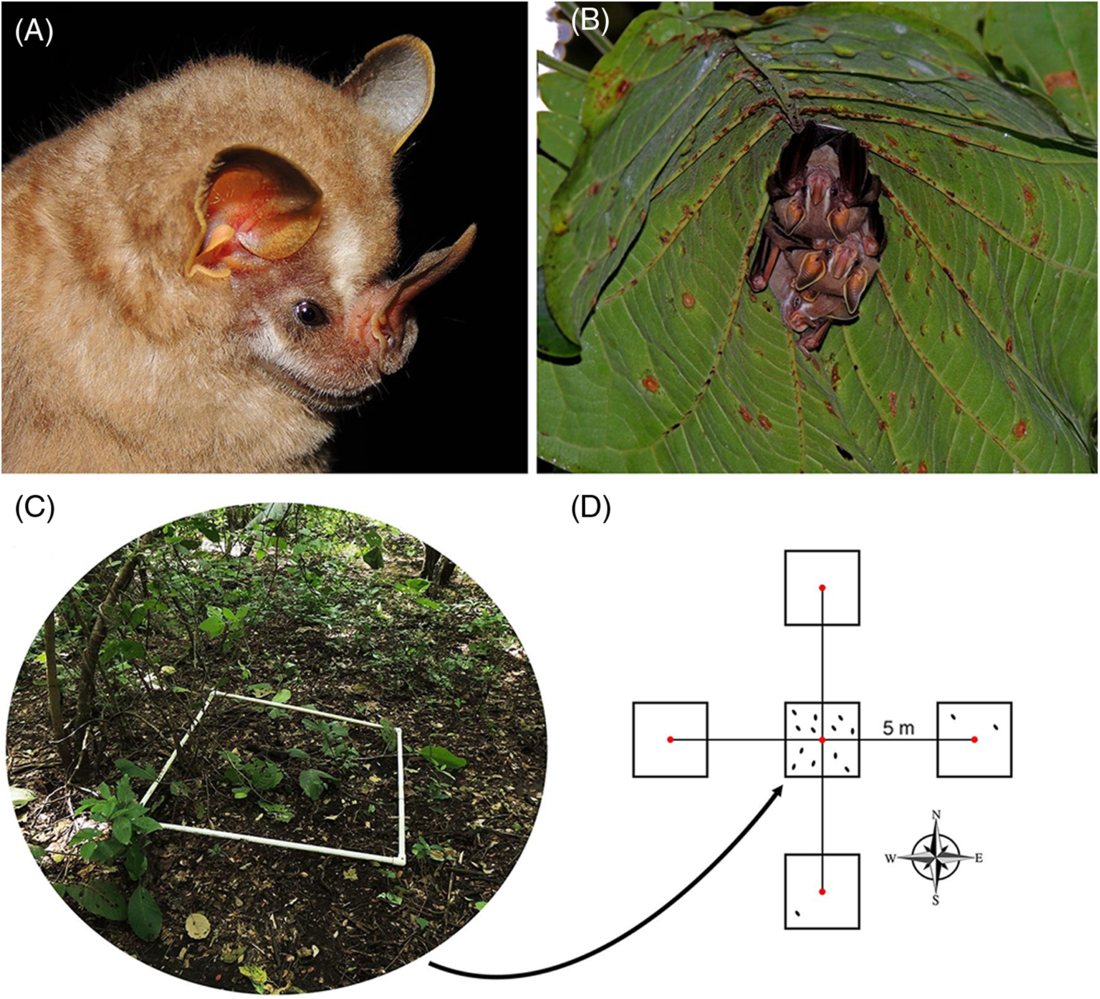
We focused our study on the Pygmy fruit-eating bat, Artibeus phaeotis, a small-bodied bat (9–15 g) that is one of the most common to abundant fruit-eating bat species at Palo Verde (Stoner & Timm Reference Stoner, Timm, Frankie, Mata and Vinson2004). The diet of A. phaeotis consists primarily of fruits, and occasionally pollen and insects (Raymond Heithaus et al. Reference Raymond Heithaus, Fleming and Opler1975). Artibeus phaeotis uses modified leaves or leaf-tents as day and night feeding roosts (Rodríguez-Herrera et al. Reference Rodríguez-Herrera, Medellin and Timm2007; Appendix 1), however, it has been found roosting in other places such as caves and in the canopy foliage (Timm Reference Timm1985).
Seed rain characterization and quantification
Based on the behaviour of eating fruits with large seeds and then dropping the seeds beneath the night feeding roosts, we used leaf-tents associated with our focal study species to characterize and quantify the seed rain generated by A. phaeotis. We looked for leaf-tents in established trails of Palo Verde and at the resource availability plots (see next section for details). Leaf-tents located were georeferenced, tagged (using a permanent mark) and scanned for large seeds on 1 m2 of soil surface immediately beneath the leaf-tent (hereafter leaf-tent plots) and at four control plots of the same sampling area (1 m2) that were established in the four cardinal directions and at 5 metres away from the centre of each leaf-tent plot (Appendix 1). We included in our analysis only those leaf-tents with the presence of large seeds, and, in order to avoid contamination of the leaf-tent plots and control plots, we verified for the presence of large-seeded trees in a circle plot of 15 m radius surrounding each leaf-tent found. In positive cases of presence, leaf-tent plots and control plots were excluded from the analysis.
Foraging behaviour of bats
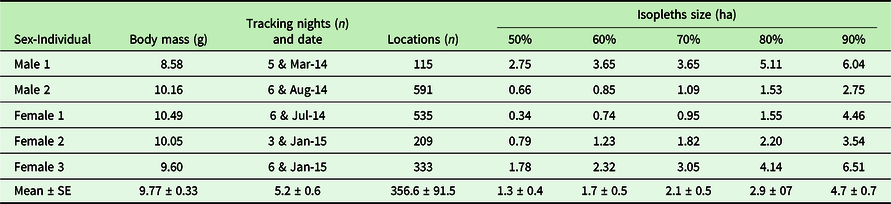
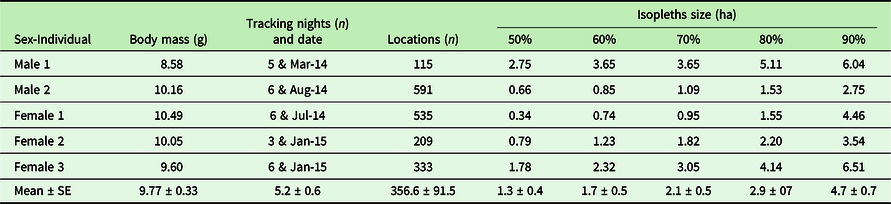
A total of five individual bats (two adult males and three non-pregnant/non-lactating adult females; Table 1) were captured at night using mist nets and employed for the radio-tracking sessions. Upon capture, bats were placed in soft cloth bags for further processing. Each animal was fitted with a radio-transmitter (model LB-2X, Holohil Systems, Carp, Ontario, Canada) glued to the dorsal fur between the scapulae (Audet Reference Audet1990) using a latex adhesive (Osto-Bond; Montreal Ostomy; Montreal, Canada). Transmitter mass was 0.31 g, a weight that represents <3% of the body mass of the smallest radio-tracked individual (Table 1). After the bats were held in bags for 20 min to ensure that the glue securely bonded the transmitter to the fur, they were released at the point of capture.
Demographic information, sampling effort and size of utilization distribution areas used by Artibeus phaeotis in Palo Verde, Costa Rica.
We used two TRX-1000WR tracking receivers and two three-element directional yagi antenna (Wildlife Materials, Murphysboro, Illinois, USA) to find the day roost of the bats and to monitor their foraging behaviour at night, usually between 1730 h and 0000 h. Azimuths from the position of the observer to the bearing determined with the directional antenna were measured to the nearest degree using compasses (Suunto, Helsinki, Finland) and global positioning systems (Garmin Corporation, Olathe, Kansas).
Locomotion and stationary locations of the bats were distinguished by detection of varying signal strength or of a steady signal at a fixed directionality for at least 30 s respectively (Rothenwöhrer et al. Reference Rothenwöhrer, Becker and Tschapka2010). Because bats usually rest during several minutes at the same point, stationary locations were registered only once (the first time) to avoid overestimation, meanwhile, locomotion locations were recorded every minute (De Solla et al. Reference De Solla, Bonduriansky and Brooks1999). If two or more bats were within effective telemetry range, tracking data were taken every 3 min (independently of the activity of the bats) as rotating signal reception between multiple tagged bats was possible. Each radio-fix was recorded in a digital voice recorder (Olympus VN-3100PC; Olympus Europa Holding GmbH, Hamburg, Germany) and included records of time, signal strength from an analog meter, gain setting from gradations calibrated on the gain dial, the GPS position of the observer, and the activity of the bat (locomotion or stationary).
Telemetry bearings for stationary or flying bats were estimated using the relationship between distance and signal strength (i.e. homing (single bearing); Bonaccorso et al. Reference Bonaccorso, Todd, Miles and Gorresen2015) or by triangulation (i.e. multiple bearings). Both estimations were performed while avoiding topographical features and by frequently moving to improve radio-signal strength and proximity to bat activity. After comparison, the estimated accuracy of triangulation or homing positions were similar (i.e. ± 30 m error) below the upper limit of 300 metres. Spatial locations were calculated using LOAS 4.0 (Ecological Software Solutions, Urnäsh, Switzerland), filtered in order to analyse only those under the error limit established above (i.e. 300 m) and then classified into locomotion or stationary.
All locations were then analysed with the adehabitatHR package (Calenge Reference Calenge2006) in R (R Core Team 2018) using a non-parametric kernel method (adaptive local convex hulls; Getz et al. Reference Getz, Fortmann-Roe, Cross, Lyons, Ryan and Wilmers2007) to construct the utilization distribution of the monitored animals. Utilization distribution demarcates regions in space with different probabilities of usage (hereafter isopleths) and their values are associated with concepts such as the Home range (isopleths between the 50–90% range) or the Core areas (isopleths ≤50% range).
Resource availability
We used 25 × 25 m plots (625 m2) located in the area of maximum density of telemetry locations detected for each monitored bat (i.e. ≤50% isopleths) in order to explore the relationship between the foraging behaviour of animals and the spatial distribution of food and roost resources. In these sampling areas, we looked for adult (i.e. diameter at breast height ≥5 cm) large-seeded tree species and for leaf-tents that may serve as potential night feeding roosts. Trees were classified based on the fruiting phenophase observed following methods from Fournier (Reference Fournier1974) and each tree and leaf-tent located was georeferenced and tagged.
Data analysis
To test our first and second prediction (bats feeding activity will significantly influence density and diversity metrics), we employed a Kruskal–Wallis rank-sum test to compare the density and the richness of large seeds per square metre of the forest floor at leaf-tent plots and control plots. Furthermore, as richness estimations do not consider abundance of species into account (Jost Reference Jost2006), we calculated the effective number of species (i.e. alpha diversity) in each metacommunity (i.e. leaf-tents and controls) and plotted metacommunity composition using a non-metric multidimensional scaling (NMDS) based on the function metaMSD (Oksanen et al. Reference Oksanen, Blanchet, Friendly, Kindt, Legendre, McGlinn, Minchin, O’Hara, Simpson, Solymos, Henry, Stevens, Szoecs and Wagner2017) for visual comparison. Kruskal–Wallis rank-sum tests, the effective number of species and the NMDS analysis were performed in R (R Core Team 2018) with simple functions and using the entropart package (Marcon & Herault Reference Marcon and Herault2015), with q=1 as the order of diversity (i.e. species are weighed in proportion to their frequency) and the vegan package (Oksanen et al. Reference Oksanen, Blanchet, Friendly, Kindt, Legendre, McGlinn, Minchin, O’Hara, Simpson, Solymos, Henry, Stevens, Szoecs and Wagner2017) respectively.
Finally, our third prediction was assessed by plotting and visually inspecting with the help of QGIS (QGIS Development Team 2018) the locations of the leaf-tents, the fruiting trees and the foraging areas of the monitored bats.
Results
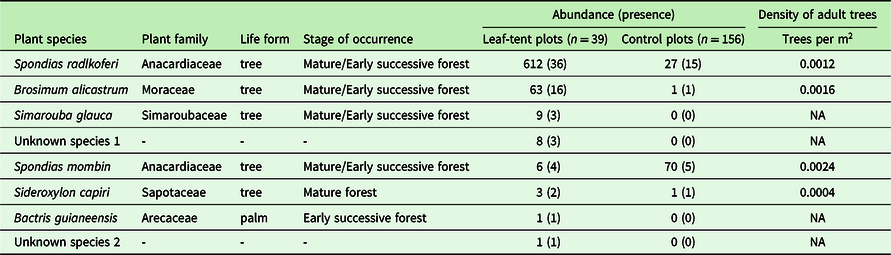
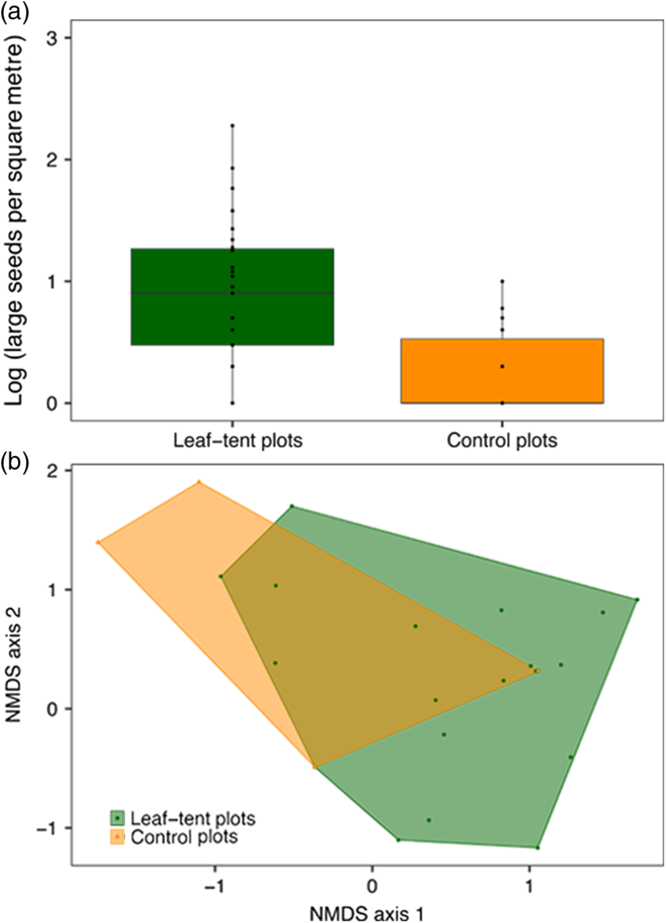
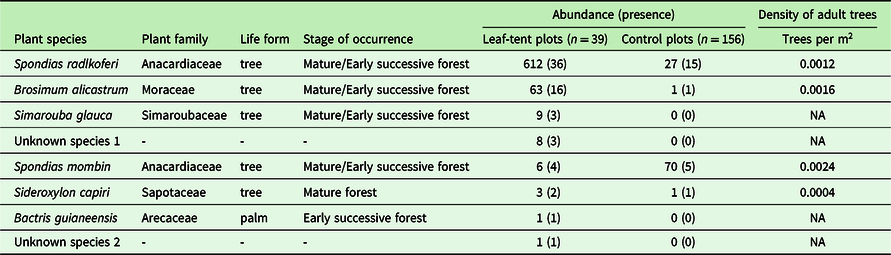
From 121 leaf-tents that were found at the study site, only 39 of them had large seeds at the leaf-tent plots. In total, we detected 703 large seeds belonging to eight different plant species (Table 2); most of them with adults showing a life form of trees that can be found at successional and mature forests of the area (Chavarría et al. Reference Chavarría, González and Zamora2001). As predicted (prediction 1), the seed rain generated by A. phaeotis had a significant impact on seed density (H = 24.72, df = 1, P = 6.6e-07), as bats deposited higher densities of large seeds at leaf-tent plots (mean ± SE = 18.0 ± 5.3 seeds/m2) than at control plots (0.3 ± 0.1 seeds/m2) (Figure 1a).
Ecological information and quantitative measurements of dispersal activity of each large-seeded plant species found at leaf-tent plots, adjacent control plots and resource availability plots at Palo Verde during 2012–2015.
Artibeus phaeotis feeding activity significantly increases the density (a), but does not significantly change the metacommunity composition (b) of large-seed plant species at leaf-tent plots in comparison with control plots.

Bats feeding activity also had a positive impact on diversity metrics (prediction 2) such as species richness (H = 24.12, df = 1, P = 9.5e-07), as leaf-tent plots had higher values (1.7 ± 0.1 species/m2) when compared with control plots (0.1 ± 0.02 species/m2). Nevertheless, when taking the species abundances into account, the analyses showed that leaf-tent plots had a lower alpha diversity (α = 1.7) than control plots (α = 2.5) and that the composition of the metacommunities is highly similar (Figure 1b).
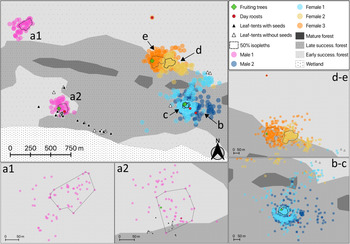
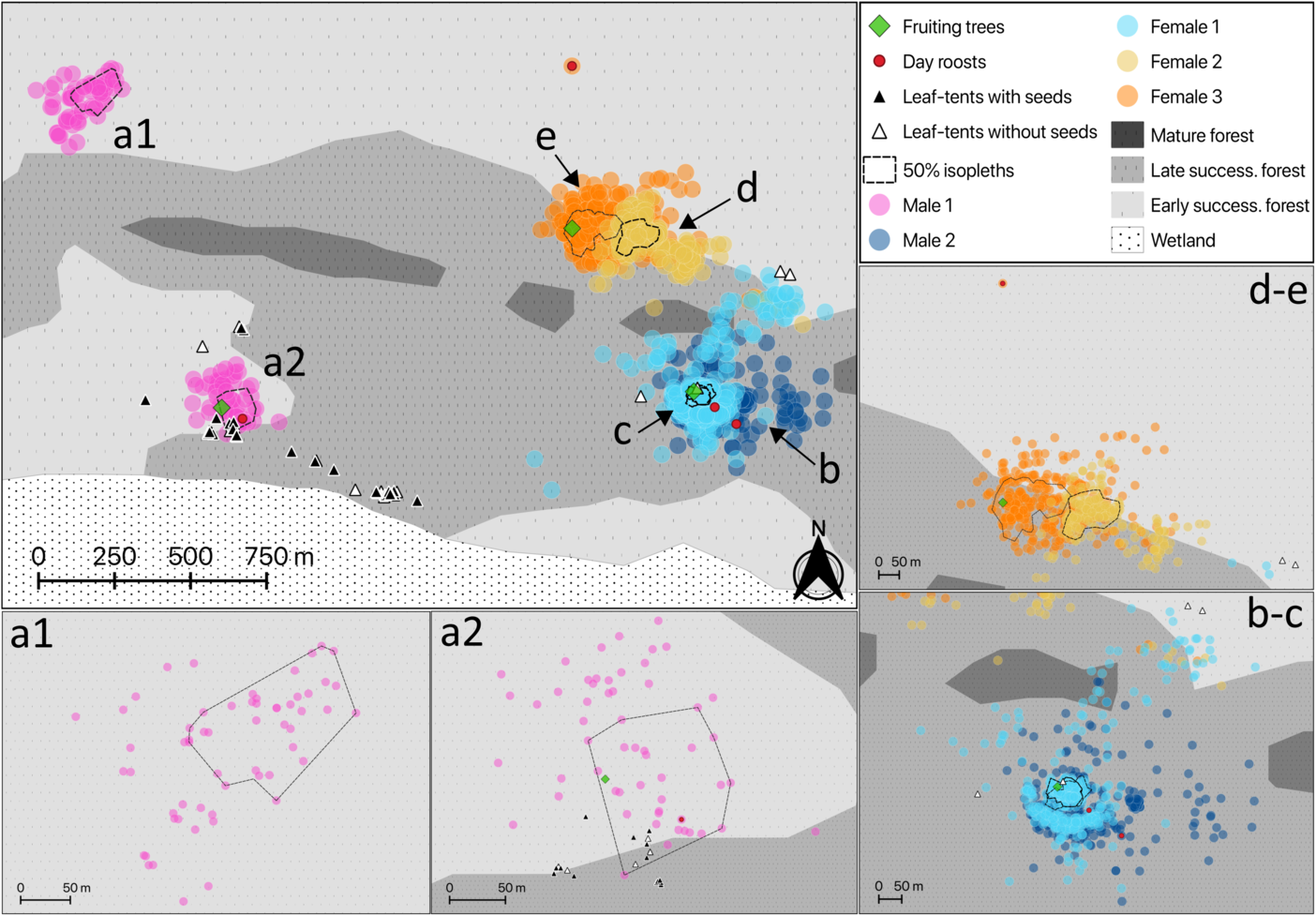
Finally, after following tagged bats for several consecutive nights (5.2 ± 0.6 nights), we found that the foraging behaviour of A. phaeotis is usually restricted to single and small home range areas (Table 1, Figure 2) where foraging activities are concentrated in close proximity to fruiting trees (Figure 2). Moreover, most of the monitored bats used roosts different from leaf-tents to shelter during daylight and to feed during the night. These roosts were detected in the canopy foliage and were also located near (218.1 ± 106.8 m) trees producing fruits during our sampling periods (i.e. Spondias radlkoferi (2 trees) and Sideroxylon capiri (1 tree), Figure 2). These results partially support our third prediction, indicating that bats do perform foraging activities close to food resources but do not rely exclusively on resources for leaf-tent construction.
Foraging behaviour of five Artibeus phaeotis at Palo Verde, Costa Rica. Spatial movements of male 1 (a1-a2), male 2 (b), female 1 (c) and female 2 (d) and female 3 (e) are usually characterized by short-distance foraging trips from day roosts to fruiting trees and by a seed rain located at leaf-tents and surrounding maternal plants.
Discussion
Our evidence supports the hypothesis that A. phaeotis influences to some extent the density, diversity and distance-dependent effects of the seed rain of large-seeded plants species in the seasonally dry forest of Costa Rica.
As demonstrated by density and richness estimators, the feeding activity of bats creates dense clumps of several large seeds under some leaf-tents. These sites (i.e. leaf-tent plots) are approximately 60% denser and 15% richer per square metre of forest floor than sites away from the direct influence of the bats (i.e. control plots) supporting our first and second prediction. Moreover, as large-seeded trees were not detected in the surroundings of leaf-tents with the presence of large seeds, and the metacommunities of both the leaf-tents and the control plots are highly similar, we hypothesized that large seeds at control plots may be the result of post-dispersal events occurred at large seeds beneath leaf-tents. In Palo Verde, post-dispersal of large seeds may be due to biotic factors (e.g. rodents, peccaries) or abiotic factors (e.g. heavy rain). Long-term studies are needed to document post-dispersal events and to investigate the implications of post-dispersal events on this mutualistic system.
Positive or negative density (e.g. intra-specific competition) or richness (e.g. interspecific competition) effects at leaf-tent and control plots may also need further attention; as previously demonstrated for several Neotropical tree species dispersed by bats or other animals, the implications of density and richness metrics may vary among plant species (Howe Reference Howe1989, Melo et al. Reference Melo, Rodríguez-Herrera, Chazdon, Medellin and Ceballos2009, Russo & Augspurger Reference Russo and Augspurger2004). In this sense, future efforts should be focused on measuring qualitative components of the seed dispersal effectiveness (Schupp et al. Reference Schupp, Jordano and Gómez2017) of at least two large-seeded plant species detected in our study, as they strongly dominated the seed rain at leaf-tent plots (i.e. S. radlkoferi and Brosimum alicastrum; Table 2).
The relationship between the foraging behaviour of bats and the spatial location of leaf-tents and food resources showed that A. phaeotis does not completely rely on leaf-tents for day roosting nor for feeding during the night, partially supporting our third prediction. It seems that, at least in Palo Verde, A. phaeotis is not a tent-specialist and that the use of alternative resources such as the canopy foliage may have selective advantages for the bats in terms of foraging efficiency. For example, as the preferred resource for leaf-tent construction (Coccoloba caracasana; 84% of all leaf-tents) is spatially aggregated, the use of alternative resources is expected in order to reduce commuting distances to feeding areas.
In a cost/benefit context, the use of a specific day or feeding night roost at a certain distance from the food sources is the result of a decision-making process to enhance individual fitness (Mitchell & Powell Reference Mitchell and Powell2004, Reference Mitchell and Powell2012) through an efficient use of each plant resource provisioning (i.e. both quantitative and qualitative components – Schupp et al. Reference Schupp, Jordano and Gómez2017). Based on our observation, we expect that this pattern may be repetitive but not fixed. For example, as spatio-temporal distribution of food resources varies, the overlapping probability between the leaf-tent distribution and the foraging areas of bats will increase. These can be achieved by increasing the number of monitored bats and monitoring time, and by encompassing more sampling area in order to increase the detection probability of focal fruiting trees.
The use of small activity areas and the possible use of night roosts at close proximity to maternal trees producing fruits suggests that A. phaeotis is likely to behave as a short-distance disperser of large-seeded plant species. Implications of this spatial pattern of seed deposition, from both the plant and the animal perspective, need to be elucidated using proxies of performance. For example, by measuring density and distance effects on seedling survival (Sugiyama et al. Reference Sugiyama, Comita, Masaki, Condit and Hubbell2018), fruit nutritional value (Wendeln et al. Reference Wendeln, Runkle and Kalko2000) and energy intake of animals (Thomas Reference Thomas1984), stronger conclusions can be made regarding how adaptive the seed dispersal carried out by A. phaeotis on a specific plant species is, and how those selective pressures have influenced fruit trait evolution (Hodgkison et al. Reference Hodgkison, Ayasse, Häberlein, Schulz, Zubaid, Mustapha, Kunz and Kalko2013), survival and diversification of Neotropical large-seeded plant species.
Strong selective pressures may be acting on both sides of the mutualistic interaction between Neotropical bats and some large-seeded plant species. Evidence collected here and in other similar studies (Melo et al. Reference Melo, Rodríguez-Herrera, Chazdon, Medellin and Ceballos2009, Villalobos-Chaves et al. Reference Villalobos-Chaves, Bonaccorso, Rodríguez-Herrera, Cordero-Schmidt, Arias-Aguilar, Todd and Ortega2016b) highlights the case of S. radlkoferi as a potential bat-dispersed tree. From the plant perspective, bats are important as they shape density and distant effects of the seed rain of this species (Melo et al. Reference Melo, Rodríguez-Herrera, Chazdon, Medellin and Ceballos2009, Villalobos-Chaves et al. Reference Villalobos-Chaves, Bonaccorso, Rodríguez-Herrera, Cordero-Schmidt, Arias-Aguilar, Todd and Ortega2016b, this study), but in order to selectively feed on this resource, plants also have to offer quality resources to attract abundant and likely effective dispersers like bats. From the animal perspective, S. radlkoferi trees may offer bats a qualitative resource, especially because A. phaeotis individuals have to fly with approximately 83.6% of their body mass each time that they carry one S. radlkoferi fruit (Villalobos-Chaves Reference Villalobos-Chaves2016). As revealed by our resource availability plots (Table 2), this feeding selective preference becomes more evident if we consider that at the study area, S. radlkoferi trees are less abundant and dense than trees of Spondias mombin, a closely related species primarily dispersed by diurnal mammals and birds (Janzen Reference Janzen1985).
In conclusion, by integrating quantitative information about the seed rain and observations and measurements of the movement of a small frugivorous bat species, A. phaeotis, we were able to enhance the understanding of pieces of this complex mutualistic interaction. Our data support the evidence that frugivorous tent-roosting bats significantly and disproportionally (i.e. by dispersing some seed species more than others) influence the quantitative component of the seed dispersal effectiveness framework (Schupp et al. Reference Schupp, Jordano and Gómez2017). Animal movement information helped us to uncover spatial patterns of seed deposition and resource distribution, information that contributes to the task of disentangling the seed dispersal mutualism and to propose hypotheses about the evolution of plant-animal interactions. Finally, efforts to understand the functional roles of resilient fauna on maintenance and evolution of plant communities and plant species traits are necessary and encouraged, especially when defaunation trends due to anthropogenic pressures are considered (Bello et al. Reference Bello, Galetti, Pizo, Magnano, Rocha, Lima, Peres, Ovaskainen and Jordano2015, Farwing et al. Reference Farwing, Schabo and Albrecht2017).
Acknowledgements
We appreciate the assistance of OTS staff at Palo Verde, and of L. Girón, M. Díaz-Morales, G. Barrantes, E. J. Fuchs, G. Ávalos and D. Calubaquib during several steps of this project.
Financial support
Funding to develop this research was provided by grants and scholarships from Rufford Small Grants for Nature Conservancy, Red Latinoamericana para la Conservación de los Murciélagos (RELCOM) and Bat Conservation International (BCI).
Appendix 1
Details of the focal bat species and the sampling design used in this research. (A, B) Artibeus phaeotis rostrum and individuals roosting in a leaf-tent, and (C, D) Leaf-tent sampling design to detect and collect large seeds dispersed by bats at leaf-tent plots and their respective control plots. Red points indicate the centre of each 1m2 sampling plot.