


Introduction
The rise of robotic performers in modern art spaces marks a notable shift in how we understand performance, presence and agency (Dixon Reference Dixon2007; Parker-Starbuck Reference Parker-Starbuck2011). Works like Madeline Gannon’s Mimus (Reference Gannon2016), where an industrial robot interacts with visitors through seemingly curious behaviours, or the humanoid android Alter 3 (Ikegami et al., Reference Ikegami, Masumori and Ishiguro2018) performing operatic vocals, illustrate robots’ ability to evoke emotional and aesthetic responses usually associated with human performers. However, although significant scholarly attention has explored the visual, kinetic and interactive aspects of robotic performance (Jochum et al. Reference Jochum, Millar and Nuñez2017; Hoffman Reference Hoffman2019), the role of sound, especially as a scenographic and dramaturgical element, remains less examined.
Sound in robotic performance extends far beyond functional feedback or atmospheric background music. As demonstrated in works such as Louis-Philippe Demers and Bill Vorn’s Inferno (Reference Demers and Vorn2015–2017), in which mechanical exoskeletons generate immersive sonic environments through amplified servos and synthesised layers, sound actively constructs the performative identity of machines (Demers and Vorn Reference Demers and Vorn2015). Despite sound’s evident importance in these works, we lack a comprehensive theoretical framework for understanding how the sonic design strategies operate scenographically in robotic contexts.
This theoretical gap matters because sound fundamentally alters the ontology of robotic performance. A silent industrial arm moving through space reads primarily as a mechanical apparatus; add synthesised breathing sounds or melodic tones synchronised to its movements, and it transforms into something resembling a character, agent or subject (Fitter and Kuchenbecker Reference Fitter, Kuchenbecker, Agah, Cabibihan, Alves-Oliveira and Eyssel2016). Sound does not merely enhance robotic performance; it constitutes a primary medium through which machines become legible as performers. Within Organised Sound itself, Robinson et al. (Reference Robinson, Velonaki and Bown2022) have argued that electroacoustic music practice provides aesthetic and ethical considerations for designing the sonic language of robotic agents in HRI. The present paper extends this discourse by foregrounding sound’s scenographic function and its role in constructing space, robotic presence and affect in performance contexts. Closely related work by Tabački (Reference Tabački2024) theorises the robot as a scenographic body through the figure of an uncanny ‘silent scream’, arguing that the machine’s visual and kinetic presence generates a specific scenographic form of ontological unease. This framework complements Tabački’s analysis by examining the sonic dimension: whereas Tabački’s robot is constituted by what it cannot utter, this framework analyses how sound actively constructs the robotic scenographic body Tabački identifies as the ground of machine performance.
This paper addresses this gap by proposing a framework that positions sound as scenography in robotic performance. Drawing on expanded conceptions of scenography that encompass the spatial, temporal and sensorial dimensions of theatrical experience (McKinney and Palmer Reference McKinney and Palmer2017), I argue that sound operates as a scenographic force that constructs robotic presence, agency and affect. Through analysis of documented robotic artworks and synthesis of existing theory from sound studies (LaBelle Reference LaBelle2018; Schulze Reference Schulze2018), performance theory (Hann Reference Hann2018) and human-robot interaction research (Breazeal Reference Breazeal2003; Hoffman and Ju Reference Hoffman and Ju2014), this paper develops a heuristic framework identifying four overlapping, analytically non-parallel compositional tendencies: mechanical mimicry, contrapuntal composition, procedural soundscapes and voice synthesis.
Methodology
This paper develops a theoretical framework through interdisciplinary synthesis and inductive case study analysis, proceeding through three stages.
First, I synthesise relevant literature across four domains: scenography theory (McKinney and Palmer Reference McKinney and Palmer2017; Hann Reference Hann2018), sound studies (LaBelle Reference LaBelle2018; Schulze Reference Schulze2018), posthuman performance theory (Barad Reference Barad2007; Parker-Starbuck Reference Parker-Starbuck2011) and human-robot interaction research (Breazeal Reference Breazeal2003; Hoffman Reference Hoffman2019) to identify theoretical gaps regarding sound’s scenographic function.
Second, through systematic comparison of sonic design approaches, I inductively identify four heuristic compositional tendencies, mechanical mimicry, contrapuntal composition, procedural soundscapes and voice synthesis.
Third, I apply the framework to four case studies (Inferno, Mimus, Alter 3 and The Blind Robot) selected for their (1) substantial documentation, (2) distinct sonic strategies and (3) critical recognition within robotic art and HRI communities.
The categories emerge from observed patterns rather than being imposed a priori. It should, however, be acknowledged that the boundary between induction and exemplification is porous: the case studies were selected in part because they exemplify the identified patterns clearly. The framework is therefore best understood as an evidence-grounded theoretical proposition rather than a strict inductive discovery; the inductive base for each strategy is further extended through brief comparative reference to additional documented works within the framework section itself.
The methodology relies entirely on secondary sources, artist statements, exhibition catalogues, scholarly literature and documentation, rather than direct fieldwork or audience studies. Claims about sonic effects and audience experiences are analytically inferred rather than empirically documented and should be understood as theoretically grounded hypotheses awaiting empirical testing. Acoustic analysis of publicly available video documentation, including spectrographic and waveform examination, as conducted for the Inferno and The Blind Robot case studies, provides one additional form of empirical grounding, as detailed in the case study section.
Theoretical foundations
Scenography as a multisensory practice
Traditional scenography focused primarily on visual design: sets, lighting and spatial arrangements (Aronson Reference Aronson2005). However, contemporary scenographic theory has expanded to encompass what McKinney and Palmer (Reference McKinney and Palmer2017) term ‘scenography expanded’, acknowledging that theatrical environments are constructed through multiple sensory modalities operating simultaneously and in relation. Hann (Reference Hann2018) argues for scenography as a dynamic, relational practice in which meaning emerges from the interaction of materials, bodies, technologies and perceptions.
This expanded conception proves particularly relevant for robotic performance, where the absence of traditional scenic elements often necessitates alternative strategies for constructing theatrical space. The theory of atmospheres as quasi-objective affective states distributed across environments provides a useful lens: robotic performances frequently rely on atmospheric construction, through lighting, spatial arrangement and, crucially, sound, to establish mood, proximity and presence (Böhme Reference Böhme and Thibaud2017).
The concept of ‘sensory scenography’ emphasises how non-visual sensory experiences fundamentally shape spatial perception in performance contexts (McKinney and Palmer Reference McKinney and Palmer2017). Drawing on architectural phenomenology (Pallasmaa Reference Pallasmaa2012), this approach argues that sonic, haptic and even olfactory dimensions actively construct scenographic experience rather than merely supplementing visual design. This theoretical shift from ocularcentrism to multisensory design thinking creates conceptual space for understanding sound as scenography, not decoration, but constitutive material.
Sound studies and sonic materialism
Embodied approaches to sonic perception demonstrate how timbre and acoustic qualities shape bodily and cognitive responses to sound (Leman Reference Leman2008), a principle particularly relevant when considering how audiences physically experience robotic sounds. LaBelle (Reference LaBelle2018) argues sound constructs ‘acoustic territories’, actively carving out spheres of operation and attention rather than passively filling space. This resonates with earlier work on ‘aural architecture’, which demonstrates how acoustic properties fundamentally shape spatial experience and social interaction (Blesser and Salter Reference Blesser and Salter2007).
Schulze’s (Reference Schulze2018) concept of the ‘sonic persona’ proves particularly valuable for analysing robotic performance. Identities and agencies can be constructed through sonic signatures, characteristic sounds that become associated with particular entities or actors. In robotic contexts, mechanical sounds, synthesised voices or musical motifs can function as sonic personas, making machines recognisable, distinct and seemingly intentional.
The concept of acousmatic sound, sound without a visible source (Schaeffer Reference Schaeffer2017), also matters here. When robotic sound sources are hidden, diffused or ambiguous, they create spatial ambiguity and heightened attention. Landy’s (Reference Landy2007) framework for understanding sound organisation provides valuable analytical tools for examining how robotic soundscapes structure temporal and spatial experience, particularly regarding how audiences navigate between syntactic listening (following structural relationships) and associative listening (drawing on cultural references). Smalley’s (Reference Smalley2007) concept of ‘space-form’, the ways spectral space evolves through gravitational forces, planes of levitation and perspectival positioning, offers vocabulary for analysing how robotic soundscapes construct theatrical environments. Conversely, tightly coupling sound to visible mechanical action (what might be called ‘revealed acoustics’) produces different perceptual and affective effects, potentially increasing visceral, kinaesthetic responses (Leman Reference Leman2008; Leman and Maes Reference Leman and Maes2015).
Critical sound studies also caution against naïve celebration of sonic effects. Sound technologies always carry cultural, political and economic dimensions (Sterne Reference Sterne2012). Applied to robotic performance, this suggests we must attend to how sonic design choices encode gender (through voice synthesis), cultural identity (through musical idioms) or power relations (through volume, control and acoustic dominance).
Posthuman performance and machine agency
Posthuman performance theory challenges anthropocentric models of theatrical presence, exploring how nonhuman entities, animals, objects and technologies can function as performers (Barad Reference Barad2007; Braidotti Reference Braidotti2013). Within robotic art specifically, questions of machine creativity and computational agency shape how robots are understood as creative performers rather than mere tools (Gemeinboeck and Saunders, Reference Gemeinboeck and Saunders2013). Parker-Starbuck’s (Reference Parker-Starbuck2011) work on ‘cyborg theatre’ demonstrates how digital and mechanical systems do not merely assist human performers but become co-agents in performance-making.
This shift requires reconceptualising agency, presence and liveness. Arguments for distributed cognition across human and technical systems suggest agency emerges relationally rather than residing in discrete entities (Hayles Reference Hayles2017). Applied to robotic performance, this implies that robotic ‘expressivity’ or ‘emotion’ need not be authentic internal states but can emerge through designed behaviours, audience projection and systemic interactions.
Hoffman (Reference Hoffman2019) identifies ‘movement design’ as central to constructing robotic social presence, demonstrating how timing, rhythm and gestural quality shape perceived intentionality. However, such research focuses primarily on kinetic dimensions, largely overlooking sound’s parallel role. Research on robotic performance explores how rhythm and temporality span movement and sound across multiple modalities (Knight Reference Knight, Mutlu, Bartneck, Ham, Evers and Kanda2011), but comprehensive integration remains absent. The concept of ‘material dramaturgy’ (Bartneck et al. Reference Bartneck, Belpaeme, Eyssel, Kanda, Keijsers and Šabanović2020) proves useful here: the idea that material properties themselves carry dramaturgical weight. In robotic performance, the sounds robots make (or have made for them) constitute part of their material dramaturgy, shaping narrative, affect and meaning alongside their physical forms and movements.
Sound in human-robot interaction
Human-robot interaction (HRI) research has investigated sound primarily through functional lenses, speech interfaces, auditory feedback and warning signals (Dautenhahn Reference Dautenhahn2007). The field has been substantially consolidated by Savery’s (Reference Savery2023) edited volume Sound and Robotics, which surveys speech, non-verbal audio and robotic musicianship, representing the most comprehensive parallel framework from an HRI perspective. Robinson et al. (Reference Robinson, Bown, Velonaki, Dunstan, Koh, Turnbull Tillman and Brown2023a) provide a complementary map of the ‘robot soundscape’, charting how sound uttered, performed and associated with robot movement serves distinct communicative goals, an orientation focused on HRI legibility rather than the dramaturgical and scenographic strategy that organises the present framework. Inaugurating a dedicated ACM THRI special issue on sound in HRI, Robinson et al. (Reference Robinson, Pelikan, Watanabe, Damiano, Bown and Velonaki2023b) identified the absence of frameworks engaging artistic and dramaturgical sonic strategies as a key research gap, the precise gap the present paper addresses. Marynowsky et al. (Reference Marynowsky, Knowles, Bown, Ferguson, Dunstan, Koh, Turnbull Tillman and Brown2023) propose musical genres, opera, ambient/glitch and disco as analytical platforms for robotic performance, where their genre-based framework foregrounds cultural reception and performance tradition, and the present strategy-based framework foregrounds scenographic function and dramaturgical effect, making the two approaches complementary rather than competing. Work on sociable robots demonstrated how vocalisations, even non-linguistic sounds, can convey emotional states and shape interaction quality (Breazeal Reference Breazeal2003).
Research on voice design in HRI demonstrates how vocal characteristics (pitch, speed and tone) significantly influence robot perception, including judgements about gender, competence and trustworthiness (Lee et al. Reference Lee, Nass and Brave2000). This work raises critical questions about anthropomorphism and design ethics that prove central to the framework proposed here.
Synthesis: towards sonic scenography in robotic performance
Synthesising these theoretical streams, we can conceptualise sound in robotic performance as simultaneously:
-
1. Scenographic material that constructs spatial and affective environments (from scenography theory)
-
2. Material agency that actively shapes perception and territory (from sound studies)
-
3. Performative element that constructs posthuman presence and distributed agency (from posthuman theory)
-
4. Social signal that mediates human-robot relationships (from HRI research)
Framework: four compositional strategies
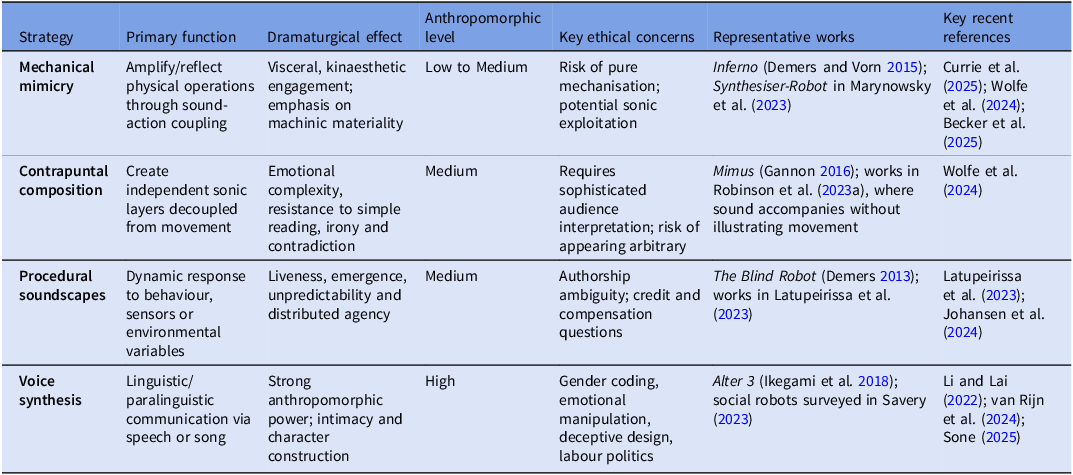
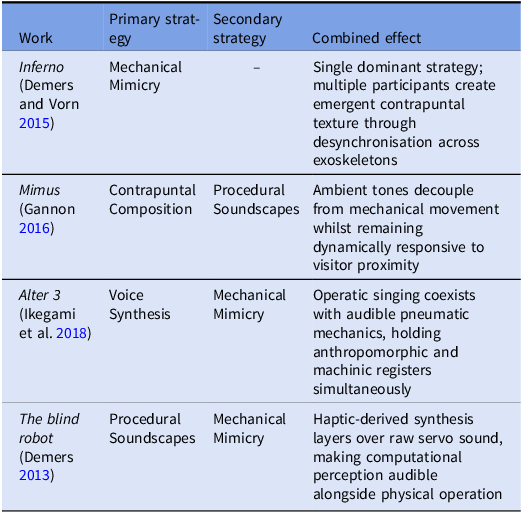
This section develops a four-part heuristic framework, analytical rather than taxonomic in intent, identifying distinct sonic strategies observable in documented robotic performances. It should be noted that these strategies do not all operate at the same analytical level: mechanical mimicry describes a mode of coupling between sound and physical action; contrapuntal composition describes a dramaturgical relationship between sonic and kinetic elements; procedural soundscapes describe a mode of generation; and voice synthesis primarily functions as an anthropomorphic signal. The strategies are therefore best understood as overlapping tendencies rather than fully parallel, mutually exclusive categories; a multi-dimensional reclassification separating coupling, generation and anthropomorphic effect was considered but not pursued, as the existing categories more closely reflect how artists and practitioners describe their own sonic decisions, preserving the framework’s utility for design practice alongside its analytical function. To be explicit: the framework is offered as a heuristic instrument for critical analysis, not a stable taxonomy. The four strategies name recurring tendencies in documented practice, and their boundaries are permeable rather than fixed. Whilst real performances may blend multiple strategies, distinguishing them analytically clarifies their different dramaturgical functions and theoretical implications (Figure 1). The combinatory possibilities across all four strategies are illustrated in Figure 2, which maps their overlapping zones of hybrid practice. Table 1 presents a comparative overview of the four strategies, summarising their primary functions, dramaturgical effects, anthropomorphic levels, key ethical concerns, representative works and key recent references. The spatial deployment of sound, loudspeaker placement, spatialisation, reverberation and silence constitutes a further scenographic dimension that the present framework addresses only implicitly. How sonic territories are distributed across performance space, and how silence functions as dramaturgical punctuation, represent necessary extensions that would align the framework more fully with the spatial premises of contemporary scenographic theory (Blesser and Salter Reference Blesser and Salter2007; Böhme Reference Böhme and Thibaud2017).
Conceptual positioning of sonic strategies in robotic performance.

Strategy combinations in robotic performance. Each circle represents one of the four heuristic compositional tendencies; overlapping zones denote hybrid approaches in which two or more strategies operate simultaneously. Case study works are positioned within their primary strategy zones. The central zone represents the theoretical maximum, a performance employing all four strategies concurrently.

Sonic strategies in robotic performance: a comparative framework

Note: Strategies are not mutually exclusive; many robotic performances employ multiple approaches simultaneously or sequentially. They are also analytically non-parallel, operating at different levels of description: coupling (mechanical mimicry), dramaturgical relation (contrapuntal composition), mode of generation (procedural soundscapes) and anthropomorphic signalling (voice synthesis).
The two axes and their strategy positions are labelled in the figure. Hybrid combinations are mapped in Table 2 and Figure 2.
Strategy combinations in the case study works

Note: Strategies are not mutually exclusive. Works typically privilege one primary strategy whilst drawing on secondary approaches; the primary strategy establishes the dominant sonic character and dramaturgical logic.
Strategy 1: mechanical mimicry and sonic embodiment
Analytical focus: Mechanical mimicry involves designing sounds that directly reflect, amplify or abstract the robot’s physical operations, friction, torque, acceleration and resonance. Works inclining towards this tendency treat robotic bodies as potential sound sources, either using actual mechanical sounds (amplified, processed or bare) or creating synthesised sounds that mimic mechanical qualities.
Theoretical basis: This strategy builds on theories of embodied cognition and kinaesthetic empathy. When sound appears to emanate from physical action, audiences may experience heightened bodily identification, sensing robotic effort, resistance or momentum through acoustic cues. Research demonstrates that sound-action coupling strengthens perceived causality and intentionality, making gestures seem more purposeful (Jensenius et al. Reference Jensenius, Wanderley, Godøy, Leman, Godøy and Leman2010).
Recent empirical work reinforces this basis: Currie et al. (Reference Currie, Giannaccini and Bach2025) demonstrate that consequential robot sounds produce measurable illusory distortions in the perception and prediction of robot motion, direct evidence that sound actively constitutes robotic presence rather than merely accompanying it. Wolfe et al. (Reference Wolfe, Su and Wang2024) further show that acoustic parameters can be dimensionally mapped to robotic emotional expression, validating the principle that sound-action coupling shapes perceived intentionality.
Leman and Maes’s (Reference Leman and Maes2015) concept of embodied music cognition suggests that sounds become part of how bodies, human or machine, are perceived and experienced. Understanding minimal conditions for robotic expressivity becomes crucial when considering which sonic elements are essential for audiences to perceive intentionality and presence.
Dramaturgical function: Mechanical mimicry typically emphasises robots’ machinic nature rather than hiding it. Amplified servo whines, metallic clanks or pneumatic hisses foreground mechanical physicality, creating visceral, sometimes uncanny effects. This strategy can:
-
• Heighten presence through multimodal sensory engagement
-
• Create kinaesthetic empathy as the audience ‘feels’ mechanical effort
-
• Establish rhythm and temporality through mechanical cadences
-
• Blur intentional/incidental sound, creating ambiguity about agency
Spectral variations: Works inclining towards mechanical mimicry span from raw mechanical sound through amplified and processed variants to synthetic mimicry designed to evoke mechanical qualities.
Critical considerations: Whilst mechanical mimicry can create powerful visceral effects, it risks reinforcing perceptions of robots as purely mechanical, potentially limiting emotional engagement. There is also an aesthetic politics here: what counts as an ‘honest’ machine sound versus an ‘enhanced’ or ‘beautified’ sound? Designers must consider whether foregrounding mechanical noise serves thematic purposes or merely exploits sonic novelty. Empirically, Becker et al. (Reference Becker, Braach, Clasmeier, Kaufmann, Ong and Ahrens2025) find that more natural-sounding robot audio elicits higher trust and compliance, complicating any straightforward celebration of raw machine acoustics. Marynowsky et al. (Reference Marynowsky, Knowles, Bown, Ferguson, Dunstan, Koh, Turnbull Tillman and Brown2023) confirm the strategy’s range from raw industrial noise to aestheticised mechanicity.
Strategy 2: contrapuntal composition
Analytical focus: Contrapuntal composition decouples sound from direct mechanical action, creating independent sonic layers that coexist with, but do not directly illustrate, robotic movement. Sound and motion become separate ‘voices’ in a polyphonic composition, sometimes synchronising, sometimes diverging, creating tension, counterpoint or complementarity.
Theoretical basis: As a heuristic tendency, contrapuntal composition draws on musical theories of counterpoint, the combination of independent melodic lines applied spatially and temporally to robotic performance (Xenakis Reference Xenakis1992). It also resonates with Brechtian alienation effects, where aesthetic distancing prevents simple emotional identification, encouraging critical reflection (Mumford Reference Mumford2009).
From a dramaturgical perspective, contrapuntal composition allows for complexity and ambiguity. A robot might move frantically whilst calm music plays or vice versa, creating irony, contradiction or layered meaning. This mirrors how film scores sometimes work against rather than with visual action to create sophisticated emotional effects (Chion Reference Chion1994).
Dramaturgical function: Contrapuntal strategies typically:
-
• Create emotional complexity through contrast or contradiction
-
• Resist single interpretations by offering multiple affective registers
-
• Establish independence between sonic and kinetic elements
-
• Generate narrative possibility through juxtaposition
-
• Prevent anthropomorphic reduction by refusing simple expression
Compositional techniques: These include asynchrony of temporal scales, timbral contrast between mechanical and organic sounds, affective opposition (harsh movement with gentle sound) and narrative layering.
Critical considerations: Works inclining towards contrapuntal composition require sophisticated audience reading capabilities. If viewers expect tight sound-action coupling, contrapuntal approaches may read as technical failures rather than artistic choices. There is also a risk of seeming arbitrary rather than meaningfully structured. Designers working with contrapuntal approaches should ensure sufficient interpretive clues exist for audiences to recognise intentional counterpoint rather than accidental mismatch. Robinson et al.’s (Reference Robinson, Bown, Velonaki, Dunstan, Koh, Turnbull Tillman and Brown2023a) survey of robot soundscape categories identifies works in which sound accompanies but does not directly illustrate robot movement, precisely contrapuntal composition, confirming the strategy’s presence across HRI and artistic contexts beyond the Mimus case.
Strategy 3: procedural and generative soundscapes
Analytical focus: Procedural soundscapes involve systems where sound generation responds dynamically to robotic behaviour, sensor input or environmental variables. Rather than pre-composed fixed scores, audio emerges through computational processes, creating partially unpredictable, evolving sonic environments.
Theoretical basis: This strategy connects to theories of emergence and systems aesthetics (Bown et al. Reference Bown, Eldridge and McCormack2009). The concept of ‘machine musicianship’ describes computational systems that generate music through interactive processes rather than playback. Applied to robotic performance, this creates feedback loops where robot behaviour influences sound, which may in turn influence robot behaviour (if the system includes audio input) or audience perception, potentially affecting subsequent interaction (Rowe Reference Rowe2004).
Generative approaches also align with posthuman theories emphasising distributed agency. Procedural and dynamic audio strategies have been extensively developed in video game contexts, where sound must respond in real-time to unpredictable player actions (Collins Reference Collins2008). Emmerson and Landy (Reference Emmerson and Landy2016) offer methodologies for emergent sonic structures; game audio techniques, parameter mapping, layering systems and adaptive engines translate productively to robotic performance contexts. Latupeirissa et al. (Reference Latupeirissa, Panariello and Bresin2023) provide empirical support for this approach, finding that audiences prefer robot sounds characterised by acoustic complexity and identifiable material sources, qualities that layered procedural soundscapes are well-positioned to deliver.
Dramaturgical function: Procedural strategies typically:
-
• Create liveness and unpredictability within structured parameters
-
• Emphasise emergence over a fixed narrative
-
• Respond to context (environment, audience, robot state)
-
• Blur composition and improvisation boundaries
-
• Distribute agency across system components
Technical approaches: Technical implementations include parameter mapping from robot state to synthesis, algorithmic and machine learning composition, environmental sensing and audience-driven sonic evolution.
Critical considerations: Procedural systems can become either monotonous or chaotic if not carefully designed. There is tension between legibility (the audience’s understanding of some relationship between behaviour and sound) and surprise. Additionally, who is credited as the author when systems generate sound autonomously?
Strategy 4: voice and vocalisation
Analytical focus: Voice synthesis strategies employ speech, singing or voice-like sounds to create linguistic or paralinguistic communication. This includes text-to-speech systems, recorded human voices played through robots, synthesised singing or abstract vocalisations suggesting human utterance without clear semantic content.
Theoretical basis: Voice is perhaps the most powerful anthropomorphising signal (Nass and Brave, Reference Nass and Brave2005). Linguistic and paralinguistic theories suggest voice conveys not just semantic information but also social identity, emotional state and relational stance (Lee et al. Reference Lee, Nass and Brave2000). The Reeves and Nass (Reference Reeves and Nass1996) ‘media equation’ hypothesis demonstrates that people respond to vocal agents socially, even when consciously aware of artificiality.
Eidsheim (Reference Eidsheim2019) and Cavarero (Reference Cavarero2005) ground voice as material production rather than transparent expression, positioning robotic voice as a site for questioning authenticity and being, effects that synthesised voices foreground precisely through their constructed character.
Dramaturgical function: Voice strategies typically:
-
• Enable dialogue or apparent communication
-
• Create the strongest anthropomorphic effects through linguistic suggestion
-
• Establish character or personality through vocal qualities
-
• Generate intimacy through the voice’s traditional association with interiority
-
• Raise uncanny valley concerns when the voice-body mismatch is pronounced
Vocal spectrum: This ranges from clear speech and singing synthesis through processed human voice and abstract vocalisation to whispers and sighs, suggesting life without linguistic content.
Ethical considerations: Voice synthesis raises particularly acute ethical questions. Li and Lai (Reference Li and Lai2022) propose ‘mechanomorphic’ voice design, voices that signal machine rather than human identity, as an ethical alternative to anthropomorphic synthesis. The practical difficulty of any universal prescriptive solution is demonstrated by van Rijn et al. (Reference van Rijn, Mertes, Janowski, Weitz, Jacoby and André2024), who engaged 2,505 participants in tuning robot voices to match robot appearances and found that voice-appearance congruence is culturally variable and context-dependent. These theoretical tensions have acquired concrete urgency: the 2024 dispute between actor Scarlett Johansson and OpenAI over the ‘Sky’ voice and Tennessee’s ELVIS Act (2024), protecting performers against unauthorised voice cloning, crystallises as public flashpoints the ethical concerns that this section identifies.
Voice is never neutral; choices about vocal qualities encode social meanings and power relations (Mori et al. Reference Mori, MacDorman and Kageki2012). Designers must navigate these ethical dimensions thoughtfully, recognising that vocal design carries political and social weight beyond aesthetic considerations. The range of social robots surveyed in Savery (Reference Savery2023), from speech-interface platforms to singing machines, confirms voice synthesis as the dominant strategy in commercial and social robotics, while also demonstrating wide variation in how anthropomorphic the vocal design choices are.
Case study analysis
This section applies the heuristic framework to the analysis of documented robotic artworks, demonstrating how established works employ these sonic approaches and what dramaturgical effects result.
Inferno (Louis-Philippe Demers & Bill Vorn, Reference Demers and Vorn2015–2017)
Work description: Inferno Footnote 1 places audiences inside robotic exoskeletons that control their movements. The installation premiered at ELEKTRA in Montreal (2015) and toured internationally (Figure 3). Participants become animated by machines, their bodies moved by pneumatic and motorised systems whilst standing on a large platform.
Inferno (Louis-Philippe Demers and Bill Vorn, Reference Demers and Vorn2015–2017). Participants wearing robotic exoskeletons in the immersive performance environment. The mechanical systems control participants’ bodily movements whilst generating the overlapping acoustic field central to the work’s scenographic strategy. Image courtesy of Gridspace and ELEKTRA Montreal. Used with permission.

Sonic approach: Inferno primarily employs mechanical mimicry. The work amplifies actual mechanical sounds, servo motors, pneumatic releases and mechanical joints, creating an immersive industrial soundscape. These sounds are minimally processed, presenting relatively ‘raw’ mechanical noise that reinforces the work’s themes of technological control and bodily mechanisation (Demers and Vorn Reference Demers and Vorn2015). The cumulative effect across multiple participants creates a dense acoustic texture of overlapping machine rhythms.
Spectrographic analysis of publicly available documentation footage confirms this character: the spectrogram reveals yellow-orange saturation from 0 to 3,000 Hz and sustained green energy extending to approximately 12,000 Hz, with near-silence above this range. Distinct event clusters correspond to successive phases of participant activation across the installation. Broadband vertical transients above 8,000 Hz indicate pneumatic pressure releases; the overall amplitude saturation corroborates the described immersive, overwhelming acoustic character (Figure 3a).
Spectrogram of Inferno (Demers and Vorn, Reference Demers and Vorn2015). Yellow-orange saturation across 0–3,000 Hz and sustained green energy to 12,000 Hz confirm the broadband, high-amplitude industrial acoustic character. Discrete event clusters reflect successive phases of exoskeleton activation across participants.

Scenographic analysis: Sound functions scenographically in several ways:
-
1. Spatial Construction: The mechanical sounds surround participants, constructing an acoustic environment that extends beyond visual limits. Even when not seeing other participants’ exoskeletons, one hears the distributed mechanical field, a spatialisation effect produced by multiple sound sources distributed across the platform space, creating a sense of inhabiting a larger machine system. The absence of centralised loudspeakers, with sound instead emanating from the bodies of participants themselves, constitutes a deliberate scenographic decision: acoustic and bodily space coincide, making spatialisation inseparable from physical occupation.
-
2. Temporal Pacing: Machine rhythms establish temporal structure, creating a sense of collective mechanical choreography even when individual experiences vary. The sonic synchronisation and desynchronisation of multiple exoskeletons create complex temporal patterns.
-
3. Visceral Affect: The harsh, industrial acoustic quality reinforces themes of control, mechanisation and loss of autonomy central to Inferno’s conceptual framework. The sounds are intentionally uncomfortable, not aestheticised or softened.
-
4. Kinaesthetic Coupling: Because sounds emanate from mechanisms directly controlling participants’ bodies, sound-body relationships are literal and immediate, heightening embodied experience. Participants hear their own mechanisation, potentially creating profound awareness of technological mediation.
Critical interpretation: Inferno’s choice to foreground mechanical sound rather than masking it with music or abstract soundscapes serves dramaturgical purposes. The work explores themes of technological control and bodily autonomy; the ‘honest’ mechanical sound reinforces these themes by refusing to beautify or obscure machine domination. This creates what might be called ‘acoustic honesty’, a rejection of sonic mediation that parallels the work’s rejection of bodily autonomy. Inferno has continued to evolve across subsequent iterations. The ISEA 2023 presentation was augmented with video and robotic cameras alongside the exoskeletons, extending the mechanical actor network to include machines that observe and document as well as machines that move (ISEA Symposium Archives 2023). The Lunchmeat Festival/MUTEK Prague presentation (September 2024) integrated participants’ robotic prostheses more fully into sound-image production in real time. These augmentations demonstrate that the work’s sonic strategy is not static but iteratively expanded, raising questions about how the introduction of robotic cameras and sound-producing, light-emitting, actively moving machines changes the acoustic ecology of the performance space.
Mimus (Madeline Gannon, Reference Gannon2016)
Work description: Mimus Footnote 2 features an industrial robotic arm (ABB IRB 6700) that appears to observe and interact with gallery visitors through programmed ‘curious’ behaviours. Exhibited at the Design Museum London (Reference Gannon2016), the robot is enclosed behind a cage but can extend towards visitors, following their movements and appearing to study them (Figure 4).
Mimus (Madeline Gannon, Reference Gannon2016). A visitor engages with the ABB IRB 6700 industrial robot through the glass enclosure at the Design Museum in London. The barrier creates the graduated proximity zones that the work’s procedural soundscape acoustically marks. Image courtesy of Madeline Gannon. Used with permission.

Sonic approach: Based on available documentation, Mimus employs contrapuntal composition alongside elements of procedural soundscapes. Whilst the robot’s mechanical sounds are audible, the primary soundscape consists of ambient electronic tones and textures that shift in response to visitor proximity and robot behaviour but do not directly illustrate mechanical action.
Scenographic analysis:
-
1. Affective Layering: The sonic environment creates an ambient, contemplative mood distinct from the robot’s sometimes rapid movements. This contrast can generate emotional complexity. The robot moves with industrial speed, but the sound suggests gentleness or curiosity (Gannon Reference Gannon2016). The disconnect between kinetic intensity and sonic calm creates productive tension.
-
2. Spatial Intimacy: Documentation suggests sound responded to visitor proximity, with acoustic qualities reportedly shifting as visitors approached. This creates graduated spheres of engagement, with sound subtly guiding visitors’ understanding of safe versus intimate distances. The gallery setting, with sound emerging from a single robot within an enclosed cage rather than spatially distributed speakers, focuses acoustic attention toward a single point, a different spatial logic from Inferno’s distributed field and one that reinforces the work’s dramaturgical emphasis on the dyadic encounter.
-
3. Anthropomorphic Suggestion: The gentle, tonal sound design (rather than harsh mechanical noise) encourages perception of the robot as potentially friendly or curious, supporting the work’s exploration of human-robot empathy. The acoustic choices are analytically interpreted here as predisposing visitors towards sympathetic interpretation, though this effect has not been audience-tested.
-
4. Ambiguity Preservation: By not tightly coupling sound to motion, the work maintains ambiguity about the robot’s ‘intentions’; sound does not simply illustrate but adds an independent interpretive layer.
Critical interpretation: Mimus demonstrates how contrapuntal strategies can shape affective reception. The work explores whether people can develop empathy for industrial robots (Gannon Reference Gannon2016). The sonic choices, privileging ambient musicality over mechanical harshness, support this empathetic aim, potentially ‘softening’ the robot perceptually. This raises important questions about sonic manipulation: does gentle sound design authentically reveal the robot’s personality, or does it aesthetically engineer emotional responses that would not naturally occur? The claims made here regarding sound-proximity responsiveness in Mimus are inferred from available exhibition documentation; they should be treated as analytically plausible interpretations requiring verification through direct technical documentation or artist interview rather than as facts.
Alter 3 (Ikegami Lab, Ikegami et al. Reference Ikegami, Masumori and Ishiguro2018)
Work description: Alter 3 is a humanoid android developed by roboticists Takashi Ikegami, Hiroshi Ishiguro, Kohei Ogawa, Atsushi Masumori, Norihiro Maruyama and Itsuki Doi (Ikegami et al. Reference Ikegami, Masumori and Ishiguro2018), designed to perform operatic singing (Figure 5).Footnote 3 The android has a silicone face and torso mounted on a mechanical armature. Using air compressors and an artificial vocal tract, it generates a singing voice, performing pieces from the operatic repertoire.
Alter 3 (Ikegami et al., Reference Ikegami, Masumori and Ishiguro2018). The android performs with a live orchestra, its mechanical armature visible beneath the performance stage lighting. The coexistence of visible machine structure with operatic vocal performance stages the ontological ambiguity central to this case study’s analysis. Image courtesy of Takashi Ikegami/Alternative Machine Inc. Used with permission.

Sonic approach: Alter 3 centrally employs voice synthesis, specifically singing synthesis. The android’s vocal mechanism physically produces sound through pneumatic control of artificial vocal cords and resonant chambers, creating surprisingly convincing operatic vocals given the mechanical production method (Ikegami et al. Reference Ikegami, Masumori and Ishiguro2018).
Scenographic analysis:
-
1. Ontological Disruption: The combination of lifelike humanoid form, operatic vocal performance and visible mechanical components creates profound ontological ambiguity. Sound (the singing voice) signals humanity and emotion, whilst form oscillates between human likeness and obvious artificiality. Audiences may experience perceptual confusion about what kind of entity they are encountering. The concert hall or gallery setting amplifies this ambiguity spatially: the android’s voice, projected through an acoustic vocal tract rather than loudspeakers, originates from the body itself, a spatial co-location of sound source and visible form that heightens rather than resolves the ontological uncertainty.
-
2. Vocal Presence: Voice is traditionally associated with interiority, soul and authentic expression (Cavarero Reference Cavarero2005). Alter 3’s vocal performance thus stages a fundamental question: can machines possess the expressive authenticity typically attributed to human vocalists? The android’s capacity to produce operatic sound, a genre demanding technical virtuosity and emotional depth, challenges assumptions about what machines can express.
-
3. Uncanny Effect: The near-but-not-quite-human vocal quality creates uncanny valley effects (Mori et al. Reference Mori, MacDorman and Kageki2012). The voice is good enough to sound intentional and expressive, but retains sonic artefacts, marking it as artificial, creating perceptual dissonance.
-
4. Performance Tradition: By engaging specifically with opera, a genre associated with peak human vocal achievement and emotional expression, Alter 3 provocatively stages questions about art, humanity and technological capability.
Critical interpretation: Alter 3 demonstrates voice synthesis’s power to anthropomorphise and generate affective responses. The android’s singing performances demonstrate the capacity to generate emotional responses in audiences despite obvious artificiality. This raises ethical questions: Is it appropriate to engineer emotional responses to machines through voice? Does vocal performance by robots trivialise human artistic achievement or expand possibilities for machine creativity?
Alter 3’s behavioural repertoire develops through interaction: Masumori et al. (Reference Masumori, Maruyama and Ikegami2021) demonstrate that the android builds memory from imitating human motion, generating emergent movement patterns that reflect the specific humans it has encountered. Alter 3’s work has since evolved substantially through Keiichiro Shibuya’s android opera series, which introduced a new android figure, AI-generated dialogue and shōmyō Buddhist chanting. Sone (Reference Sone, Sone and Savery2025) offers a direct critical counterpoint, arguing that the sonic and dramaturgical choices of these operas reproduce ‘self-Orientalisation’ and exoticised voice design rather than interrogating cultural hierarchies. This critique bears on the framework’s ethical concerns regarding voice synthesis: sonic choices encode cultural identities and power relations in ways that demand scrutiny beyond purely aesthetic evaluation.
The Blind Robot (Louis-Philippe Demers, Reference Demers2013)
Work description: The Blind Robot is an interactive performance where a robotic system gently touches and explores a volunteer participant’s face, ‘seeing’ through haptic sensation. The robot’s manipulators slowly map facial features whilst the participant remains still (Figure 6).Footnote 4
The Blind Robot (Louis-Philippe Demers, Reference Demers2013). A participant remains still while the robotic manipulator explores facial features through haptic sensing. The intimate gallery setting and the participant’s stillness reflect the atmosphere of vulnerability and trust that the work’s procedural sonic environment constructs. Image courtesy of Louis-Philippe Demers. Used with permission.

Sonic approach: Based on documentation, The Blind Robot combines procedural soundscapes with elements of mechanical mimicry (Strategy 1). The work generates real-time audio derived from haptic sensor data, touch pressure, position and movement to inform synthesised tones and textures. Simultaneously, the robot’s actual mechanical sounds remain audible, creating dual sonic streams (Demers Reference Demers2013).
Spectrographic analysis reveals energy concentrated between 0 and 12,000 Hz, with maximum intensity in the 0–4,500 Hz range, consistent with low-to-mid-frequency servo and motor activity. Above approximately 13,000 Hz, there is near-silence, distinguishing this acoustic profile clearly from Inferno’s broadband industrial saturation. Discrete periodic spike events correspond to individual joint actuations rather than continuous noise, reflecting the slow, precise character of haptic exploration (Figure 6a).
Spectrogram of The Blind Robot (Demers, Reference Demers2013). Energy concentrated below 12,000 Hz with discrete periodic transients corresponding to robotic arm joint actuations, confirming the quiet, measured acoustic environment characteristic of the work’s haptic-sonification approach.

Scenographic analysis:
-
1. Haptic Sonification: The translation of touch into sound creates a synaesthetic experience, making tactile interaction audible to participants and witnesses. This multimodal mapping enhances intimacy and phenomenological complexity, allowing audiences to ‘hear’ the robotic touch that only the participant can feel.
-
2. Intimacy Construction: The quiet, careful sonic environment, kept deliberately low in amplitude and localised to the immediate participant-robot space rather than filling the gallery, constructs an atmosphere of intimacy and vulnerability appropriate to the face-touching interaction. This close-proximity acoustic chamber is itself a scenographic decision: reverberation and spatial diffusion are suppressed so that sound, like touch, remains between two bodies rather than addressed to the room.
-
3. Process Revelation: Because sound changes in response to touch data, the sonic environment reveals aspects of the robotic ‘seeing’ process, making computational perception somewhat legible. Audiences may gain acoustic insight into how the robot gathers and processes information.
-
4. Temporal Stretching: The slow pace of exploration, reflected in a gradually evolving soundscape, creates dilated temporality, encouraging sustained attention to small perceptual details.
Critical interpretation: The Blind Robot demonstrates how procedural sound can enhance conceptual clarity whilst building atmosphere. The work explores machine perception and human vulnerability; sonic choices support both dimensions. Sonifying haptic data makes abstract computational processes tangible, translating invisible sensor readings into audible phenomena that audiences can track and interpret.
Meanwhile, gentle sonic treatment cultivates an atmosphere enabling vulnerable human participation. Participants must remain still whilst a machine touches their faces, an act requiring trust. The sonic design supports this trust by avoiding threatening sounds, instead creating contemplative acoustic space.
Comparative synthesis
Analysing these cases through the heuristic framework reveals several recurring patterns:
Strategy distribution: Works may employ multiple strategies simultaneously (Figure 2). The Blind Robot combines mechanical mimicry and procedural soundscapes; Mimus blends contrapuntal compositions with procedural elements. However, works typically privilege one primary approach that establishes a dominant sonic character.
Dramaturgical alignment: As a heuristic tendency rather than a fixed correspondence, sonic strategies broadly align with thematic concerns. Inferno’s focus on mechanisation suits mechanical mimicry’s visceral industrial aesthetic. Mimus’s exploration of empathy benefits from the contrapuntal composition’s emotional complexity. Alter 3’s investigation of expression requires voice synthesis’s anthropomorphic power. The Blind Robot’s themes of perception and intimacy are well-served by procedural sonification.
Anthropomorphic gradient: The case studies demonstrate a gradient of anthropomorphic effect consistent with the framework’s heuristic distinctions, though these patterns should be read as interpretive tendencies rather than predictive laws. Inferno (mechanical mimicry) emphasises the machinic nature with minimal anthropomorphism. Mimus and The Blind Robot (contrapuntal/procedural approaches) occupy the middle ground, neither fully mechanising nor fully humanising robots. Alter 3 (voice synthesis) produces the strongest anthropomorphic effects, with audiences readily attributing emotion and intentionality despite obvious artificiality.
Discussion: implications and future directions
Implications for design practice
The framework offers practical guidance for designers at the intersection of robotics, sound and performance (see also Samani et al. Reference Samani, Lalioti, Serbanescu, Chicau, Polydorou and Rodosthenous2024):
Designers can apply the framework by selecting strategies aligned with thematic intentions; works exploring machine nature suit mechanical mimicry, and those investigating complex emotional states suit contrapuntal approaches. Strategies are productively combined: Table 2 demonstrates that hybrid approaches generate richer sonic environments than single strategies alone. Different strategies carry different audience risks, from the visceral but potentially alienating effects of mechanical mimicry to the anthropomorphic deception risks of voice synthesis.
Emerging development
The rapid growth of neural audio synthesis, where Johansen et al. (Reference Johansen, Browning, Brumpton, Donovan and Rittenbruch2024) propose ‘robotic blended sonification’ bridging mechanical mimicry and procedural soundscapes in real time, whilst Naseck et al. (Reference Naseck, Blanchard, Lavakare, Lecamwasam and Paradiso2025) demonstrate generative AI music driving kinetic robotic sculpture at scale, is best understood as a cross-cutting technological shift reconfiguring all four strategies rather than constituting a fifth one. If AI can now process a robot’s own consequential sounds in real time, the boundaries between mechanical mimicry, procedural soundscapes and voice synthesis become genuinely permeable, suggesting the framework’s categories should be understood as provisional analytical coordinates rather than stable classifications, open to revision as practice evolves.
Theoretical contributions
The framework advances understanding across four intersecting domains, doing so as a heuristic analytical instrument rather than a taxonomy: the four strategies are overlapping orientations for analysis, not fixed classifications. It extends scenographic theory by demonstrating acoustic-spatial construction as constitutive rather than supplementary. It contributes to sound studies by showing how sound shapes the ontological status of nonhuman entities in performance. It enriches posthuman performance theory by demonstrating that presence and agency emerge through multimodal design. And it bridges the gap between HRI’s functional sound research and the dramaturgical and artistic dimensions that the discipline has largely overlooked, precisely the gap that Robinson et al. (Reference Robinson, Pelikan, Watanabe, Damiano, Bown and Velonaki2023b) identified as a research priority.
Critical ethical considerations
The framework surfaces important ethical questions that demand ongoing attention:
Anthropomorphic manipulation: When sound design triggers empathetic or emotional responses to machines, is this manipulative? Should designers disclose sonic techniques intended to generate particular effects? This echoes broader debates about affective computing and emotional AI (Turkle Reference Turkle2011). If designers use voice, musical associations or other sonic techniques to engineer emotional responses, do audiences have the right to know about these techniques? Designers must navigate tension between artistic effectiveness and ethical honesty.
Voice politics: Voice synthesis raises particularly complex issues. Gendered, racialised or class-marked vocal choices encode social meanings. Whose voices are appropriate for robots? How do vocal choices reinforce or challenge social hierarchies? Most commercial robots employ feminine-coded voices, often for service roles, reinforcing gender stereotypes about emotional labour and servitude.
Questions of vocal labour also matter: When human voices are sampled to train synthesis systems, are voice actors and singers properly compensated? Do they retain control over how their voices are used?
Sonic deception: Some sonic strategies, particularly sophisticated voice synthesis, might deceive audiences about robotic capabilities. These questions touch on deeper philosophical issues about subjectivity, expression and the role of external performance in constituting identity (Žižek Reference Žižek2014). If robots can perform emotion convincingly, does this challenge our assumptions about the relationship between internal states and external expression? Whilst designers can argue that emotional responses do not require authentic interiority, there remains ethical tension between aesthetic effectiveness and honest representation.
Authorship and labour: In procedural and generative systems, who deserves authorial credit? When algorithms generate music or when machine learning systems trained on human-created audio produce new sounds, questions of ownership, compensation and attribution become complex. If generative systems produce marketable artworks, how should revenue be distributed amongst software developers, training data providers and human supervisors?
Accessibility: Sonic design decisions affect accessibility. Heavy reliance on sound may exclude deaf or hard-of-hearing audiences. Voice-based interaction may marginalise non-native speakers or those with speech-processing differences. Designers should consider how sonic choices include or exclude various audiences and whether alternative access modes (visual, haptic) can provide equivalent experiences.
Limitations and future research
Empirical validation: Throughout the case study analyses, effects described, such as ‘intimacy’, ‘kinaesthetic coupling’ and ‘anthropomorphic suggestion’, are theoretically grounded interpretations, not empirically verified outcomes. They should be understood as hypotheses awaiting systematic audience-based testing. Allen et al.’s (Reference Allen, Drummond and Kulić2025) large-scale study (N = 182) demonstrates empirically that mechanical robot sounds produce negative affective responses, underscoring the need for careful design of mechanical mimicry strategies.
Secondary-source methodology: This framework is constructed entirely from existing documentation, artist statements, exhibition catalogues and scholarly literature rather than direct observation or original fieldwork. Whilst this approach enables broad comparative analysis, it means that claims about sonic effects and audience experiences are analytically inferred rather than empirically documented. The analysis of Mimus explicitly acknowledges this limitation; the same caveat applies across all four case studies.
Cultural specificity: Case studies primarily represent Western and Euro-American contexts. Japanese robot theatre traditions and Indian robotic performance practice are absent from the case studies; future research should examine how traditions such as rāga-based timbre or Japanese ma (negative space/silence) might generate additional categories.
Temporal dynamics: The framework addresses compositional strategies but less thoroughly examines temporal dynamics, how sonic strategies unfold over performance duration, structure attention and anticipation, create dramaturgical arcs and manage energy levels.
Additional strategies: As a heuristic device, the framework does not claim to exhaust all possibilities. Future practice may reveal additional approaches not captured here, for instance, silence as a strategic choice, acoustic ecology approaches incorporating environmental sound or entirely novel hybrid strategies emerging from new technologies.
Conclusion
Theoretical contributions
This paper has proposed a theoretical framework for analysing sound design in robotic performance through the lens of scenography, identifying four heuristic compositional strategies, overlapping analytical tendencies rather than fixed types, namely mechanical mimicry, contrapuntal composition, procedural soundscapes and voice synthesis. By positioning sound as a scenographic force rather than mere accompaniment, this framework contributes to emerging scholarship at the intersections of sound studies, performance theory, robotics and human-robot interaction.
The framework demonstrates that sound is not supplementary to robotic performance but constitutive of it, shaping ontology, presence and affect in ways that visual and kinetic analysis alone cannot capture. It extends scenographic theory into technological performance contexts, grounds abstract posthuman theory in documented practice and connects electroacoustic music traditions to an emerging domain of robotic art.
Methodological reflections
This framework was developed through interdisciplinary synthesis and inductive case study analysis, with spectrographic examination of documentation footage providing one form of direct acoustic evidence. The strength of this approach lies in enabling broad comparison across documented practice; its limitation is that claims about audience experience remain analytically inferred rather than empirically verified. The spectrographic analysis of Inferno and The Blind Robot demonstrates that acoustic documentation, even from publicly available video, can ground theoretical claims in observable sonic data, a methodological model for future comparative work.
Ethical imperatives
The framework raises critical ethical questions that demand ongoing attention. Voice synthesis raises the most acute concerns: choices about vocal qualities encode social meanings and power relations, and the engineering of anthropomorphic affect raises questions about deception and consent that designers must navigate thoughtfully. Equally, procedural and generative systems raise unresolved questions of authorship, compensation and attribution when autonomous algorithms produce commercially valuable sonic work.
Questions of accessibility, whether sonic design choices systematically exclude deaf or hard-of-hearing audiences; of cultural representation, whose sonic traditions are valorised and whose are erased; are not incidental but central to an ethically informed practice of robotic sound design.
Closing reflection
Sound shapes how we understand machines as performers, companions or co-inhabitants of shared spaces. As robots increasingly populate theatres, galleries, homes and streets, sonic design will play a crucial role in mediating human-robot relationships. By attending systematically to sound’s scenographic functions – how it constructs space, presence, agency and affect – we can develop more sophisticated, thoughtful and ethically informed approaches to robotic performance.
The four strategies outlined here offer starting points for critical analysis and creative practice. Yet they represent not endpoints but invitations: to listen more carefully to robotic performances, to experiment with acoustic possibilities and to continue theorising how sound makes machines meaningful in the theatrical encounter.
Data availability statement
This theoretical study did not generate or analyse datasets.
Acknowledgements
The author gratefully acknowledges the owners of the four case studies: Prof. Louis-Philippe Demers (THE BLIND ROBOT-2013 and INFERNO-2015-2017); Prof. Bill Vorn (INFERNO-2015-2017); Prof. Madeline Gannon (MIMUS-2016); Prof. Takashi Ikegami, Prof. Hiroshi Ishiguro, Prof. Kohei Ogawa, Dr. Atsushi Masumori, Dr. Norihiro Maruyama, and Dr. Itsuki Doi, and Alternative Machine Inc. (ALTER 3-2018), who permitted the inclusion of their robotic inventions and used their artwork for the research, along with Dr. Yuji Sone for providing the chapter “Keiichiro Shibuya’s android opera: the theatrics of exoticism”; artistic director of EVM Elektra Virtual Museum Mr. Alain Thibault for providing and giving permission to use the photo of ‘INFERNO-2015’; and the head of Archive at Ars Electronica, Ms. Anita Halbartschlager, who addressed the author’s inquiry to Prof. Louis-Philippe Demers. The author also acknowledges the VC, Prof. Raghavendra Prasad Tiwari; the DIA, Prof. Ramakrishna Wusirika; and Asst Prof. Dr. Charu Yadav, of the Central University of Punjab, Bathinda, for allowing the PhD research, along with former president of ICCR, Dr. Vinay Prabhakar Sahasrabuddhe, and Mr. Prahlad Dixit, Education Officer, HCI, Chittagong. The author also acknowledges the Indian Council for Cultural Relations, Government of India; the Central University of Punjab, Bathinda; and its library for providing access to various databases and, additionally, acknowledges both reviewers and the editor of ‘Organised Sound’, Prof. Emeritus Leigh Landy, for cooperation and valuable comments and guidance. The author also acknowledges the Organised Sound journal for keeping the availability of papers to cite. The author also acknowledges Cambridge University Press and Dr. Thirumal Narayanasamy for making corrections for the final version and being supportive for the publication.
Funding statement
This research received no specific grant from any funding agency in the public, commercial or not-for-profit sectors.
Competing interests
The author declares no conflicts of interest.
Permissions and Copyright Clearance
Status: Of the 8 figures, 4 original figures (Figure 1, Figure 2, Figure 3a, Figure 6a) were created by the author, and 4 photographic figures (Figures 3, 4, 5, 6) have been reproduced with permission from the respective rights holders.
Artwork References:
All 4 artworks (Figures 3–5) discussed in this manuscript are referenced for scholarly purposes under fair use/fair dealing provisions:
-
1. Mimus (Gannon, Reference Gannon2016) – Use: Critical analysis and scholarly discussion.
-
2. Inferno (Demers and Vorn, Reference Demers and Vorn2015-Reference Demers and Vorn2017) – Use: Critical analysis and scholarly discussion.
-
3. Alter 3 (Ikegami et al., Reference Ikegami, Masumori and Ishiguro2018) – Use: Critical analysis and scholarly discussion.
-
4. The Blind Robot (Demers, Reference Demers2013) – Use: Critical analysis and scholarly discussion.
The author confirms that 4 original figures and 2 tables are his own work and properly attributed. All third-party materials are used within fair use/fair dealing guidelines. All necessary permissions have been obtained where required. All copyright holders have been properly acknowledged.