Radiological emergencies comprise an important category of public health emergency. While generally considered a low-likelihood event, the potential consequences of a radiological emergency could be catastrophic for both the affected community and the greater country. Communicating preparedness strategies for radiation emergencies is particularly challenging; previous research indicates there is a low level of self-efficacy for radiological emergencies among the general public, and that public knowledge of protective measures against radiological threats is the lowest among potential disaster types. Reference Becker1,2 A host of factors include the lack of control people feel about exposure to radiation, that nuclear power generation and radiation equipment is a man-made technology compared with natural events such as geological or weather threats, and that the health effects from radiation exposure can disproportionately affect children. 3 In his seminal publication on risk perception, Paul Slovic presents a visual display of 81 hazards plotted on 2 axes, unknown risk and dread risk (perceived likelihood of death or catastrophe). Reference Slovic4 Nuclear weapons (war), nuclear reactor accidents, and nuclear weapons fallout had the highest dread risk of the 81 hazards. Reference Slovic4
For those charged with communicating to the media and the public in a radiological emergency, such as government officials and first responders, differences in terminology and the challenge of communicating scientific uncertainty can increase the likelihood of misunderstandings. Reference Svendsen, Yamaguchi and Tsuda5 During the 2011 Fukushima disaster in Japan, a large amount of radioactive material was released from the Fukushima Daiichi Nuclear Power Plant. The health risks from this disaster to the general population in the United States were portrayed as low in domestic media while the level of uncertainty was emphasized. Reference Pascale6,Reference Nakayama, Sato and Sugita7 However, public concern was high in certain US communities: while the US Centers for Disease Control and Prevention (CDC) recommended that potassium iodide, a medical countermeasure for certain radioactive isotopes, not be taken by residents in the United States as levels of radioiodine in the environment were low, the demand for over-the-counter potassium iodide exceeded supplies on the US West Coast. Reference Whitcomb, Ansari and Buzzell8
Radiation emergencies can also occur in settings outside of a nuclear power plant. One potential scenario is the detonation of a radiological dispersal device (RDD), otherwise known as a “dirty bomb.” An RDD could not generate an atomic blast; however, such a device could spread radiological material in the area around the blast site. 9 Unlike a nuclear power plant located at a fixed location, an RDD could potentially occur in any community. While an RDD event has never occurred in the United States or elsewhere, we can learn about public perception and behavior from other unintentional releases of radiological material. In the Goiânia accident that occurred in Brazil in 1987, in which 4 people died following exposure to a source of cesium-137 taken from a closed radiotherapy clinic, sensationalist media reporting immediately following the incident resulted in misinformation communicated to the public, exacerbating public fear of the incident. 10
There are steps the public can take to reduce the potential risk of exposure, and radiation preparedness experts incorporate these messages into risk communication with responders and with the public. Risk communication messaging for radiological emergencies has evolved over time. Current messaging from US federal agencies such as the Environmental Protection Agency (EPA), the Department of Homeland Security (DHS), and the CDC recommends to “Get Inside. Stay Inside. Stay Tuned.” in a radiological emergency, referring to listening for guidance from officials by means of radio, television, or social media. 11
Given the numerous possible scenarios related to emergency preparedness for a radiological event, prioritizing which topics to communicate to the public before, during, and after a radiological emergency is critical for emergency planners. One approach to ranking these topics is to leverage a tool, such as a multi-criteria decision analysis (MCDA), to identify priorities for data collection and educational intervention. The MCDA methodology has been used to prioritize diseases for resource allocation purposes in cases where quantitative risk assessments are unavailable. Reference O’Brien, Taft and Geary12,Reference Cox, Sanchez and Revie13 Similarly, because there has never been a detonation of an RDD and other radiation emergencies have rarely occurred, there are limited data on which risk reduction measures should be prioritized when communicating to the public.
To prioritize topics to communicate to the public about radiological emergency preparedness, a survey was fielded to radiation preparedness experts, state and local officials, and journalism academics and practitioners. Survey respondents indicated their message prioritization based on their professional opinions of the importance of communicating about each of a list of public preparedness topics before a radiological emergency such as an RDD. The surveys also assessed opportunities and challenges in communicating with the public before a radiological emergency, providing a broader foundation on which to build a plan for emergency preparedness and response communications.
METHODS
Sample
The 3 groups described above—radiation preparedness experts, state/local health and emergency management officials, and media professionals—perform different roles in communicating risk avoidance measures to the public. To collect information about their perspectives, the following 3 groups of stakeholders were surveyed: experts in radiological emergency preparedness, response, and communication; state/local health and emergency management officials; and journalists and journalism academics.
Sample Size
The intention of the survey was to collect detailed responses to a questionnaire from experts and practitioners with considerable experience in the field. For this study, purposive sampling using a typical case sampling strategy was used. Previous research on purposive sampling has found that saturation may occur following 12 interviews. Reference Guest, Bunce and Johnson14 An initial target was set for 13 responses each from the radiation preparedness expert group and the state/local officials. A lower target of 6 responses was set for the journalist group, given the challenge of reaching these individuals with a survey.
Identifying Respondents to Receive the Survey
Individuals invited to participate in the survey were identified through a review of recent publications in peer-reviewed journals and professional literature on topics in radiological emergency preparedness; attendance at recent meetings related to radiation and nuclear preparedness (National Academies of Sciences workshops, National Association of County & City Health Officials Preparedness Summit); agency affiliations; and recommendations from other survey participants. State/local officials and journalists working in 3 major metropolitan areas in the United States were originally selected and invited to participate. The major metropolitan areas of interest were located in Virginia: Norfolk, Richmond, and Alexandria. These cities were selected based on an existing generic planning scenario for an RDD prepared by the US Department of Health and Human Services (HHS 2015). However, during the fielding of the survey, the geographic area where respondents were located was expanded to include other states.
Survey Instruments
Three surveys were prepared to tailor questions to each expert group, with overlap in the questions asked across the 3 surveys. Informal cognitive testing was performed on the surveys for state/local officials and journalists to ensure that questions were understood by respondents as intended. Given similarities between the instruments for preparedness experts and state/local officials, only 1 instrument was tested. To complete this testing, the survey instruments for state/local officials and journalists were reviewed by an external party who was asked to describe the perceived intention of the question, as well as any recommendations to improve clarity. Following testing, the surveys were piloted in the 3 groups; however, responses to the pilot were only received from the radiation preparedness expert and state/local official groups. The final surveys were fielded to all 3 expert groups from April to May 2019.
Criteria
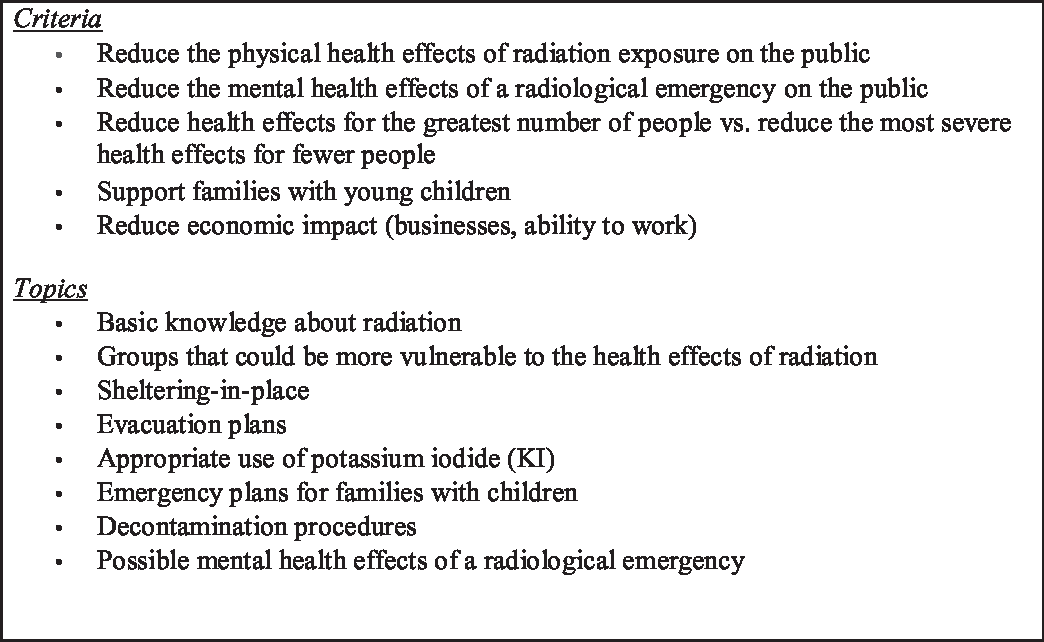
To prioritize topics to communicate to the public before a radiological emergency, 5 criteria were used to assess 8 radiological public preparedness topics (Figure 1). Criteria were worded as potential positive outcomes in a radiological emergency that could result from enhanced preparedness (eg, reducing the physical health effects of radiation exposure on the public). Criteria were also identified following a review of the literature and represent potential impacts on health and society following a radiological emergency. Criteria were assessed using a 5-point Likert scale ranging from “Extremely important” to “Not important,” with an additional “Don’t Know” option. Respondents were then asked to assess the importance of communicating each topic for achieving the positive outcome (criteria), for example, how important is communicating basic knowledge about radiation to reducing physical health effects from radiation exposure. This approach follows the methodology for an MCDA described in other studies. Reference O’Brien, Taft and Geary12,Reference Cox, Sanchez and Revie13
Criteria and Topics to Communicate to the Public Before a Radiological Emergency.

Analysis
The MCDA was completed by assigning values to the criteria ranging from 0.0 (“Don’t know”) to 0.9 (“Extremely important”), followed by taking the mean to calculate weights. This follows the process described by Cox et al. (2013) Reference Cox, Sanchez and Revie13 in their risk-ranking exercise that compared MCDA tools to prioritize infectious diseases associated with climate change; the authors found consistent ranking results comparing this approach to others. A mean value for each topic and criteria was calculated, accounting for the number of experts who responded to each survey question. Following the methodology of Cox et al., a linear weighted sum was then calculated for the scores across the criteria to arrive at a final ranking. Reference Cox, Sanchez and Revie13 Additional survey questions were analyzed to provide descriptive statistics. A modified framework approach Reference Pope, Ziebland and Mays15 was used to analyze responses to open-ended survey questions related to communication challenges in radiation emergencies.
The study was submitted for consideration by the Johns Hopkins Bloomberg School of Public Health Institutional Review Board and classified as nonhuman subjects research.
RESULTS
Experience With and Knowledge About Radiation Preparedness
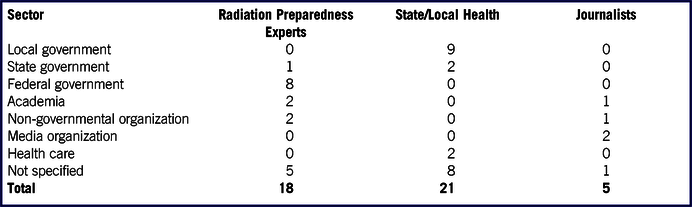
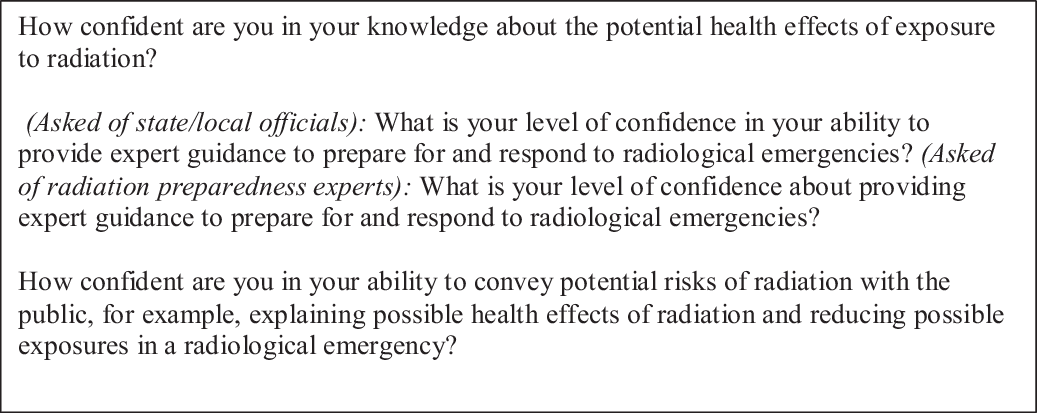
A total of 44 participants completed the surveys (Table 1). Respondents were asked a series of questions about their confidence in their knowledge about radiation; in their knowledge about the health effects of radiation; in their ability to convey information to the public about radiation; and in their organization’s ability to prepare and respond to radiation emergencies (for state/local officials) (Figure 2). Slightly more than half (56%; n = 10) of radiation preparedness expert respondents reported being “very confident” in their knowledge about the potential health effects of radiation exposure, compared with 38% (n = 8) of health and emergency management officials. Journalists reported being “moderately confident” (40%; n = 2) or “slightly confident” (60%; n = 3) in their knowledge about the potential health effects of radiation. Journalists were also asked about their level of confidence in their ability to convey potential risks of radiation with the public; 20% (n = 1) said they felt “very confident,” 40% (n = 2) “moderately confident,” 20% (n = 1) “slightly confident,” and 20% (n = 1) were “not confident at all.”
Employment Sector by Respondent Group

Survey Questions for Self-assessment of Respondents’ Confidence Related to Radiological Effects and Radiological Emergency Preparedness.

When asked about their level of confidence in providing expert guidance to prepare for and respond to a radiological emergency, most health and emergency management officials said they were “very confident” (35%; n = 7) or “moderately confident” (40%; n = 8). Fifty-six percent of radiation preparedness experts (n = 10) said they were “very confident,” and 33% (n = 6) were “moderately confident.” Health and emergency management officials reported greater confidence in their ability to convey potential risks of radiation to the public (38% [n = 8] were “very confident”), compared with their level of confidence in their organization’s ability to prepare for and respond to a radiological emergency (10%; n = 2 were “very confident”).
Most radiation preparedness experts said they had worked with a state or local health or emergency management office on radiation preparedness (71%; n = 10); similarly, most health and emergency management officials surveyed reported having worked with a radiation preparedness or radiation risk communication expert outside of their organization (85%; n = 11).
Multi-criteria Decision Analysis
Criteria
Responses from the radiation preparedness experts and state/local officials were combined for the MCDA because there were minimal differences between the 2 groups’ self-reported confidence in radiation knowledge. Reducing the physical health effects of radiation exposure on the public was ranked the most important criterion, followed by reducing mental health effects and reducing health effects for the greatest number of people versus reducing the most severe health effects for fewer people. The remaining 2 criteria were ranked last: supporting families with young children and reducing economic impact.
Prioritized Topics
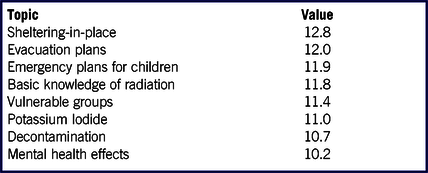
Sheltering-in-place and evacuation plans were found to be the top 2 topics of importance to communicate with the public about before a radiological emergency (Table 2), while communicating about mental health effects was ranked last. The survey question about sheltering-in-place used in the MCDA was the first time that sheltering-in-place was described in the survey, reducing the likelihood that question order impacted respondents’ selections.
Topics Ranked by Multi-criteria Decision Analysis

Communicating with the Public in a Radiological Emergency
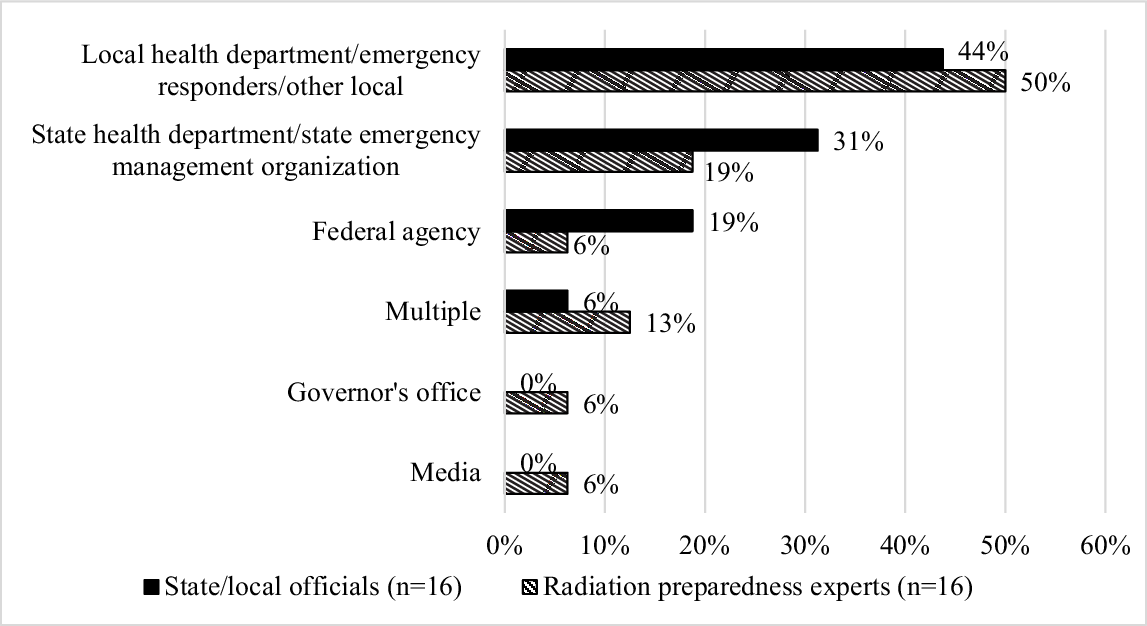
Respondents in the radiation preparedness expert and state/local official groups were asked, “Which organization is most effectively positioned to provide information to the public about a radiological emergency?” The most frequently selected response for both groups were local officials and responders, followed by state officials (Figure 3). As a respondent from the state and local official group remarked: “Basically anyone who is local. Most people won’t trust state or federal authorities regardless of their credentials.”
Organizations Believed to Be Most Effectively Positioned to Provide Information to the Public About a Radiological Emergency, by Respondent Group.

To provide more context for the results, responses from the group of state/local officials were further analyzed by whether the respondent’s organization was based in an area with high population density, defined as 1000 or more people per square mile, or not. This measure was used as a proxy for differences by rural and urban settings. 16 Estimated population density in 2017 for cities and counties was accessed online through Open Data Network (ODN). 17
Locality information was able to be determined for 10 respondents who worked with local communities. Among 4 rural-based respondents, 3 said that local entities would be positioned to communicate with the public. Among the 5 urban respondents, responses were divided between local emergency responders (2) and state health departments (2), with the remaining respondent citing multiple entities. One respondent covered districts that were both rural and urban and cited federal agencies as best positioned.
Journalists were asked a similar question: “In gathering information about a radiological emergency, which organization would you trust the most as a source of information?” Three of the 5 said that federal agencies would be the trusted organizational level, with a fourth identifying both academics and federal agencies; the fifth respondent listed radiation protection specialists.
Communication Challenges in a Radiological Emergency
Respondents from the radiation preparedness expert group and the state/local official group were asked the open-ended question: “What do you perceive to be the most significant challenges in communicating with the public during a radiological emergency?” A total of 15 responses from the radiation preparedness experts and 18 responses from the state/local officials were received for this question. Responses were assessed following a modified framework approach for qualitative analysis. Reference Pope, Ziebland and Mays15 Following familiarization with the data, a thematic framework of concepts was developed, followed by indexing and charting the data and finally mapping associations that could be identified among themes. Reference Pope, Ziebland and Mays15
The 4 main elements of the framework were challenges associated with communications infrastructure in an emergency, accuracy of the information, lack of public trust, and lack of public knowledge before or during an emergency.
Communications Infrastructure
Respondents in both groups identified breakdowns in communications infrastructure during an emergency as a significant potential challenge in a radiological emergency. The inability to communicate by smartphones and Internet in an emergency given the widespread dependency on these forms of communication was highlighted as a challenge as well.
Lack of Public Knowledge
Seven respondents in the state/local officials group identified challenges in the level of knowledge and awareness about radiation among the public. There was a distinction between not knowing about radiation (eg, “Fundamental lack of understanding about radiation and its effects on humans and pets.”), and a sense of apathy or complacency toward radiation preparedness. As a respondent in this group noted: “We practice radiological incidents with nuclear power plants four times per year. During these drills we've found that the general public do not understand the alerting mechanisms (sirens, WEA [Wireless Emergency Alerts], EAS [Emergency Alert System], etc.) and many do not even know they are located within the EPZ [emergency planning zone] of a nuclear power station. We are working on ways to ameliorate this situation, but there seems to be a general disinterest in learning basic radiological preparedness.”
In addition to complacency, some respondents identified fear as a barrier to communicating effectively. More respondents from the radiation preparedness expert group identified this as a concern (4 of 15 responses), compared with the state/local health officials (2 of 18 responses).
Accuracy of Information
Accuracy of information was further delineated by respondents into false information (eg, “false and misleading information via social media,” “Uninformed ‘experts’ conveying wrong information”), and a lack of unified messaging among responder communities.
Lack of Trust
The importance of public trust and the lack of trust in the government were identified as a theme by 2 respondents from the sample of state/local officials. This did not emerge as a theme from the radiation preparedness experts.
DISCUSSION
In a purposive sample of radiation preparedness experts and state/local health and emergency management officials, the most valuable topics to communicate to the public before a radiological emergency were identified as sheltering-in-place and evacuation plans. These results highlight the need for additional information gathering from the public about awareness of key public health message topics. Evaluation of awareness of and intended adherence to guidance such as “Get Inside. Stay Inside. Stay Tuned.” could assist local and state health departments in their preparedness planning for radiological emergencies and tailor messaging to their communities. For example, if a health department determines that awareness of key preparedness messages is low in the community, an educational campaign could be designed to increase visibility of messages in public spaces, on social media, and through community organizations. Similarly, if community members identify barriers to adhering to guidance in a possible radiological emergency, communications can be tailored to address those barriers, such as well-publicized evacuation routes, emergency preparedness plans at schools, and instructions for decontaminating people and pets.
Mental health effects of radiological emergencies can include mild, moderate, and severe symptoms of psychological distress such as insomnia, anxiety, and posttraumatic stress disorder. Reference MCCormick, Tajeu and Klapow18 A 2006 report found that mental health concerns, such as depression and anxiety, were the leading public health issue following the nuclear disaster at Chernobyl. Reference MCCormick, Tajeu and Klapow18 While reducing the mental health effects of a radiological emergency was ranked highly as a criterion, communicating about mental health effects ranked low in comparison to other topics. Some work has been conducted on providing psychological first aid training before emergencies to groups, such as leaders in faith-based organizations Reference McCabe, Semon and Thompson19 ; however, more research in this area could provide helpful interventions to address mental health needs before, during, and after a radiological emergency.
One difference among the 3 groups was in their identification of the organization that would be most effectively positioned to provide information about a radiological emergency. These findings reflect the perspectives of practitioners, rather than where the public may seek information. Local officials and responders, as well as state officials, were selected by the greatest number of respondents from the radiation preparedness expert and state/local official groups. This finding is supported by an existing survey of state, territorial, tribal, and local emergency preparedness coordinators, which found that 73.7% of respondents said that providing information to the public was a priority for public health departments in responding to radiation emergencies—more than conducting epidemiological surveillance (60.5%), coordinating screening and decontamination (47.4%), or conducting environmental health monitoring (44.7%). 20 In contrast, federal agencies were selected by the journalist group as a trusted source of information.
The result of this question raises questions about the operational needs of a state or local organization to communicate effectively in a radiological emergency. Within the context of this survey, respondents in the state/local officials group indicated greater confidence in their own ability to convey risks to the public, compared with the level of confidence in their organization’s ability to prepare for and respond to a radiological emergency. In addition to an organization’s capacity to respond, a study of Medical Reserve Corps volunteers found that first responders may be less aware of responsibilities during a radiological emergency, such as an RDD, compared with other threats. Reference Errett, Barnett and Thompson21 Furthermore, many responders working today did not receive exposure to Cold War-era messaging about radiation terminology and strategies to prevent exposure to radiation. Reference Ingram22
Within the survey described here, fewer than 6 in 10 of the radiation preparedness experts and fewer than 4 in 10 state/local officials said they were “very confident” in their knowledge about the potential health effects of exposure to radiation. This suggests that, even among this expert population, there may be a need for additional training and educational opportunities to increase confidence in practitioners’ knowledge about the health effects of radiation exposure. State and federal agencies can assess how best to share responsibilities for communication with local agencies by addressing some of the communication challenges identified in this survey, such as by developing cross-cultural educational materials. Many radiological emergency preparedness materials intended for a general audience are written at a higher reading level than recommendations of a reading level at the sixth grade in the US educational system or lower for this type of information. Reference Bass, Gordon and Maurer23
Communications channels are an important consideration when designing awareness and education campaigns before an emergency as well as when delivering critical information during an emergency response. In a poll of attendees at the 2018 IAEA symposium, 58% said that Twitter was the most effective social media platform in conveying emergency communication to the largest audience. 24 In a review of 12 Community Assessments for Public Health Emergency Response (CASPER), a health needs assessment methodology designed by the CDC to measure household emergency preparedness, response, and recovery, the study found that preferred sources of communication in an emergency varied, with social media a primary source of information in some households (range, 3.2%-41.8%). Reference Wolkin, Schnall and Nakata25 The US Department of Health and Human Services has indexed a set of resources on using social media in emergency management. 26 State and local health departments can strengthen social media channels and partner with organizations and individuals with a strong social media presence to ensure consistent messages are shared in an emergency situation. While there is recognition that social media is a communication medium that can be leveraged to disseminate emergency information, it can also assist with spreading misinformation or incomplete information Reference Locke27 —concerns that were shared by the respondents to this survey.
Incorrect information can contribute to lack of trust in the spokesperson delivering the message. Reference Seeger, Pechta and Price28 Building trust can be an effective strategy in the preparedness phase. The Trust Determination Model highlights the role of trust in the messenger in communicating risk effectively. Reference Covello29 Lack of public trust was identified in this survey of practitioners as a potential communication challenge in a radiological emergency. This is supported by findings from a study of messaging about RDDs conducted among low-literacy populations that found high levels of distrust in information from an authority, particularly nonlocal authorities. Reference Bass, Gordon and Maurer23 Given the role that health departments play in communicating with the public about radiation emergencies, the Trust Determination Model could be incorporated into behavior change and communications models that health departments are already using in their work.
LIMITATIONS
One potential consequence of the purposive sampling methodology is the lack of statistical generalizability. Reference Guest, Bunce and Johnson14,Reference Palinkas, Horwitz and Green30 The results from this expert survey could be used to inform the development of further surveys and assessments of key groups, including emergency management stakeholders, health physicists, and the general public. The smaller target sample size for journalists (n = 6) could have impacted the interpretation of the findings due to an inability to reach saturation in the responses. However, this survey was unable to receive responses from the target number of journalists. The findings presented here could lead to additional focused work with this group. The sample of state and local officials may have skewed to those with a higher level of knowledge of radiation; repeating the exercise with a larger sample may be beneficial.
CONCLUSIONS
Sheltering-in-place and evacuation plans were identified as 2 topics to focus future community data collection and awareness/education campaigns to improve radiological emergency preparedness. The results from the survey data also provide insights into communication challenges. Building and maintaining trust with the public before a radiological emergency could impact how messages are interpreted and followed. When creating messaging and planning for community radiological emergency preparedness, public health officials and emergency planners should determine who the trusted spokespeople are to communicate about readiness and response for these types of emergencies.
Acknowledgments
The views presented are those of the authors and not necessarily the institutions with which they are affiliated.
Funding
The analysis and authorship of this manuscript was completed within normal operating budgets.
Conflicts of Interest
The authors have no conflicts of interest to report.