INTRODUCTION
Sowing date determines environmental conditions for seedling emergence and vegetative phase that impact on flowering time and seed yield (Summerfield et al., Reference Summerfield, Roberts, Ellis and Lawn1991). The phenological development of crops from emergence to flowering time is largely controlled by temperature and photoperiod. Flowering time is a critical phenological stage for subsequent plant reproductive phase of several grain and forage legumes (Craufurd and Wheeler, Reference Craufurd and Wheeler2009; Del Pozo et al., Reference Del Pozo, Ovalle, Aronson and Avendaño2000; Iannucci et al., Reference Iannucci, Terribile and Martiniello2008). Forage legumes of genus Lotus are of great interest for sustainable production of agricultural systems. Lotus tenuis, L. corniculatus and L. pedunculatus are extensively used as forage in many temperate grasslands and pastures of different countries (Blumenthal and McGraw, Reference Blumenthal, McGraw and Beuselinck1999; Escaray et al., Reference Escaray, Menendez, Gárriz, Pieckenstain, Estrella, Castagno, Carrasco, Sanjuán and Ruiz2012; Fairey and Smith, Reference Fairey, Smith and Beuselinck1999; Vignolio et al., Reference Vignolio, Cambareri, Petigrosso, Murillo and Maceira2016). These species have economic potential because they fix atmospheric nitrogen via symbiosis, improve soil fertility, optimize the forage quality of pasture and grasslands have high nutritive value and voluntary feed intake of beef cattle (Blumenthal and McGraw, Reference Blumenthal, McGraw and Beuselinck1999; Escaray et al., Reference Escaray, Menendez, Gárriz, Pieckenstain, Estrella, Castagno, Carrasco, Sanjuán and Ruiz2012; Vignolio et al., Reference Vignolio, Cambareri, Petigrosso, Murillo and Maceira2016). Lotus spp. are also used in mixture with Festuca arundinaceae when it is infested with Acremonium coenophilum to dilute forage toxicity (Romano, Reference Romano2016).
Through sowing date, plants can be exposed to different environmental conditions of temperature and photoperiod that influenced flowering time (Craufurd and Wheeler, Reference Craufurd and Wheeler2009; Del Pozo et al., Reference Del Pozo, Ovalle, Aronson and Avendaño2000; Egli and Bruening, Reference Egli and Bruening2006; Iannucci et al., Reference Iannucci, Terribile and Martiniello2008; Vignolio et al., Reference Vignolio, Cambareri and Maceira2010). When sowing later, long-day plant species need less accumulated degrees-days for flowering than those sown earlier (Del Pozo et al., Reference Del Pozo, Ovalle, Aronson and Avendaño2000). In fact, temperature and phototoperiod that prevail during flower production and subsequent reproductive phase determine seed yield (Iannucci et al., Reference Iannucci, Terribile and Martiniello2008; Summerfield et al., Reference Summerfield, Roberts, Ellis and Lawn1991). For example, flower abortion occurs if flowering peak takes place when the environmental conditions are not the optimum to assimilate production (Chaichi and Tow, Reference Chaichi and Tow2000; Iannucci et al., Reference Iannucci, Di Fonzo and Martiniello2002).
Quantitative relationships to predict the rate of progress to flowering time (1/f, where f is days from emergence to first flowering) were proposed in herbages legumes using linear model as function of temperature and photoperiod (Del Pozo et al., Reference Del Pozo, Ovalle, Aronson and Avendaño2000; Iannucci et al., Reference Iannucci, Terribile and Martiniello2008; Papastylianou and Bilalis, Reference Papastylianou and Bilalis2011; Summerfield et al., Reference Summerfield, Roberts, Ellis and Lawn1991). Then, the prediction of flowering time using thermal, photoperiod and photothermal models provides information about crop management decisions such as optimal environmental regimes for crop growth and production (Iannucci et al., Reference Iannucci, Terribile and Martiniello2008; Papastylianou and Bilalis, Reference Papastylianou and Bilalis2011).
Lotus tenuis is a long-day plant spread through seeds (Pomar and Mendoza, Reference Pomar and Mendoza2008). This species is sown in autumn or spring and it is managed under defoliation for forage, seed production or dual purpose (Cambareri, Reference Cambareri2010; Vignolio et al., Reference Vignolio, Cambareri and Maceira2010; Reference Vignolio, Cambareri, Petigrosso, Murillo and Maceira2016). Although flowering time is considered critical for plant reproduction, little is known about the effects of sowing date and defoliation on L. tenuis reproductive phase (Vignolio et al., Reference Vignolio, Fernández and Castaño2006; Reference Vignolio, Cambareri and Maceira2010; Reference Vignolio, Cambareri, Petigrosso, Murillo and Maceira2016). Lotus tenuis flowers time can be affected by defoliation (Vignolio et al., Reference Vignolio, Fernández and Castaño2006; Reference Vignolio, Cambareri and Maceira2010; Reference Vignolio, Cambareri, Petigrosso, Murillo and Maceira2016). Lotus tenuis and L. corniculatus flowering can be synchronized through defoliation; a flush of large numbers of flowers in a short time determines a more uniform seed ripening (Vignolio et al., Reference Vignolio, Cambareri, Petigrosso, Murillo and Maceira2016). However, if most flowers and pods are produced in a shorter time, this can produce abort of these organs, because competition by assimilates increases (Egli and Bruening, Reference Egli and Bruening2006).
Our objectives were to determine if flowering time (a) is affected by sowing date; (b) can be predicted through equations using temperature and photoperiod and (c) is affected by defoliation applied at vegetative stage.
MATERIALS AND METHODS
Field site
Data used in this study were obtained from experiments carried out, during the years 1989 to 2016 at the Unidad Integrada Balcarce (Estación Experimental Agropecuaria, Instituto Nacional de Tecnología Agropecuaria Balcarce, Facultad de Ciencias Agrarias, UNMdP, Buenos Aires, Argentina, 37°45′S and 58°18′W, 130 m above sea level). Lotus tenuis plants were obtained from seed inoculated with Rhizobium loti (N2-fixing strain 733). The soil was well-drained, Typic Argiudoll and the tests were performed on the upper 0.15 m (Soil Survey Staff-USDA, 1999). Climate is temperate, humid–subhumid. Annual average and median precipitations from 1989 to 2015 were of 908 and 636 mm, respectively. Weather data were provided by the EEA INTA Balcarce meteorological station. Average air temperature increased from 1989 to 2015 and annual average air temperature was 0.84 °C higher in 2015 than in 1989 (Supplementary Figure S1, available online at https://doi.org/10.1017/S0014479717000126).
Description of the experimental design
In one set of experiments, L. tenuis was sown in pots of 4 litres (Vignolio et al., Reference Vignolio, Maceira and Fernández1996) and 2 litres (Vignolio et al., Reference Vignolio, Fernández and Maceira2002), one plant per pot, with 12 and 10 replications, respectively. According to the soil analysis, pH (soil:H2O, 1:2.5) was 6.90 and 6.60 and soil had 13.13 and 12.60 ppm P (Bray 1 method) and 5.0 and 2.7% organic matter (Walkley and Black method) (Vignolio et al., Reference Vignolio, Maceira and Fernández1996; Reference Vignolio, Fernández and Maceira2002), respectively. Other experiment was done in containers (60 × 40 × 20 cm of length, width and height), 12 replications and 12 plants per container (Romano, Reference Romano2016). Soil analysis revealed 53 ppm P, 4.3% organic matter and 30.1 ppm NO3−N. Irrigation was according to plant water needs. Pots and containers were kept outdoors.
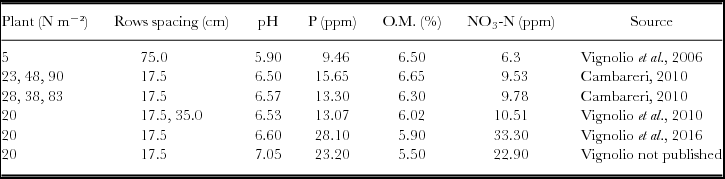
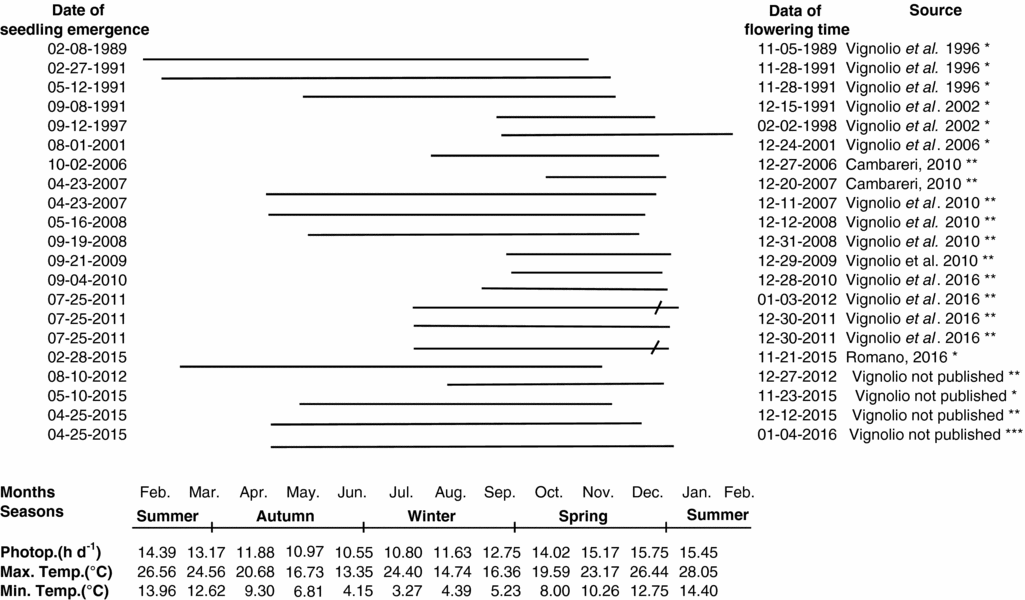
Field experiments were performed in plots from 2001 to 2016. Table 1 shows details about plant density, rows spacing and soil analysis. The plots were of 6 × 2 m (Cambareri (Reference Cambareri2010) and 4.0 × 1.4 m (Vignolio et al., Reference Vignolio, Cambareri and Maceira2010, Reference Vignolio, Cambareri, Petigrosso, Murillo and Maceira2016). Crop defoliation data were obtained from plants defoliated at vegetative stage (Vingolio et al., Reference Vignolio, Cambareri and Maceira2010). Two defoliation intensities were applied low (LDI) and high (HDI), reducing crop height by 54 and 75% compared to plant height before defoliation, respectively (Vignolio et al., Reference Vignolio, Cambareri, Petigrosso, Murillo and Maceira2016). Figure 1 synthetizes seedling emergence date, flowering time, photoperiod, air temperature, two defoliation events, data sources and L. tenuis cultivars. The experiments were kept free of weeds by hand removal without modifying the crop architecture, protected from herbivores attack and irrigated. The criteria were based on irrigation plus rainfall which replaced evapotranspiration (Vignolio et al., Reference Vignolio, Cambareri, Petigrosso, Murillo and Maceira2016). Symptoms of water deficit and pests were not detected. Pollination was provided by honey bees (Apis mellifera). Lotus tenuis seedling emergence was during the first 7 days after sowing.
Plant density, rows spacing and soil analysis of different experiments conducted with Lotus tenuis. References: pH (soil: H2O, 1: 2.5); P, phosphorus (Bray 1 method) and O.M., organic matter content (Walkley and Black method).

Schedule of Lotus tenuis growth period from seedling emergence to flowering time. References: monthly means of maximum (Max.) and minimum (Min.) air temperature (Temp.) and photoperiod (Photop.). Temperature data are average from the years 1989 to 2015. Reference: /, indicate defoliation; *, Chaja; **, Pampa INTA and ***, Ruta 226 Lotus tenuis cultivars.

Flower time as function of temperature and photoperiod
Quantitative relationships describing time from seedling emergence date to first flowering (hereafter flowering time) as a function of temperature (T), photoperiod (Ph) and accumulated growing degree-days (AGDD) were performed using linear model (Del Pozo et al., Reference Del Pozo, Ovalle, Aronson and Avendaño2000; Iannucci et al., Reference Iannucci, Terribile and Martiniello2008; Papastylianou and Bilalis, Reference Papastylianou and Bilalis2011; Summerfield et al., Reference Summerfield, Roberts, Ellis and Lawn1991). Relative contributions of temperature (thermal model, 1/f=a1+b1*T), daylength (photoperiod model, 1/f=a2+b2*Ph) and with both temperature and daylength (photothermal model, 1/f=a3+b3*T+c3*Ph) were determined. Data a1, a2, a3, b1, b2, b3, c1, c2 and c3 are constants to each function and 1/f was calculated as the inverse of the duration in days from emergence to first flowers. Photoperiod was defined as daylength (h) from sunrise to sunset and it was calculated from seedling emergence to flowering time. Mean daily temperature (T) was obtained as
 $$\begin{equation}
{\rm{T}} = ((({{\rm{T}}_{{\rm{max}}}} + {{\rm{T}}_{\min }})/2) - {{\rm{T}}_{\rm{b}}}),
\end{equation}$$
where Tmax and Tmin were the maximum and minimum air temperatures, respectively. Tb is the base temperature of 5 °C (Cambareri, Reference Cambareri2010). Thermal time (Tt, °C day) and Tb requirements for flowering were both estimated from thermal model (Iannucci et al., Reference Iannucci, Terribile and Martiniello2008; Papastylianou and Bilalis, Reference Papastylianou and Bilalis2011) as
 $$\begin{equation}
{{\rm{T}}_{\rm{b}}} = - {{\rm{a}}_1}/{{\rm{b}}_1},
\end{equation}$$
 $$\begin{equation}
{{\rm{T}}_{\rm{t}}} = 1/{{\rm{b}}_1}.
\end{equation}$$
AGDD between seedling emergence and defoliation, flowering time, pod initiation and harvest time was calculated as the sum of the mean daily temperature. Negative values were not included in the calculus (Papastylianou and Bilalis, Reference Papastylianou and Bilalis2011). The relationship between photoperiod and percentage of umbels with flowers was evaluated.
Data analysis
Pots and containers were randomly arranged. Each experiment in plots were a randomized complete block design. The data were analysed using analysis of variance (ANOVA) at the 5% level of probability. Linear function was used to describe the relationship between umbels with flowers and umbels with pods, 1/f and temperature, photoperiod and both, photothermal.
RESULTS
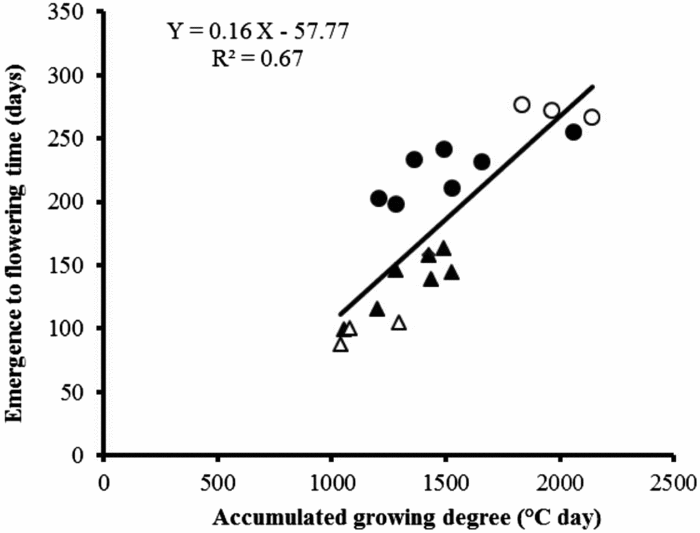
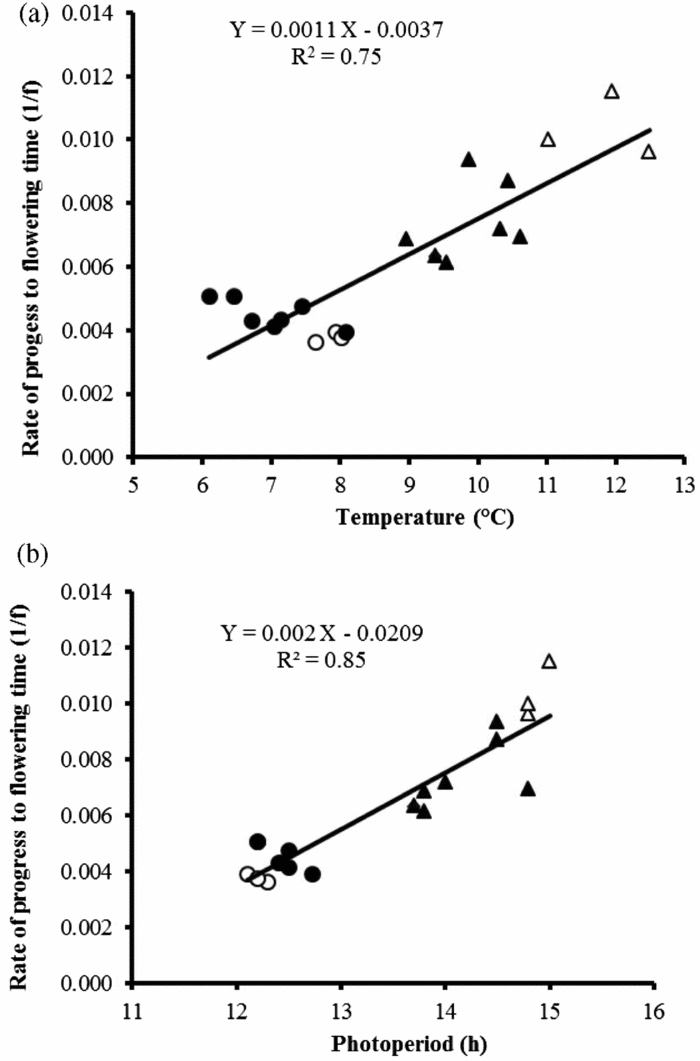
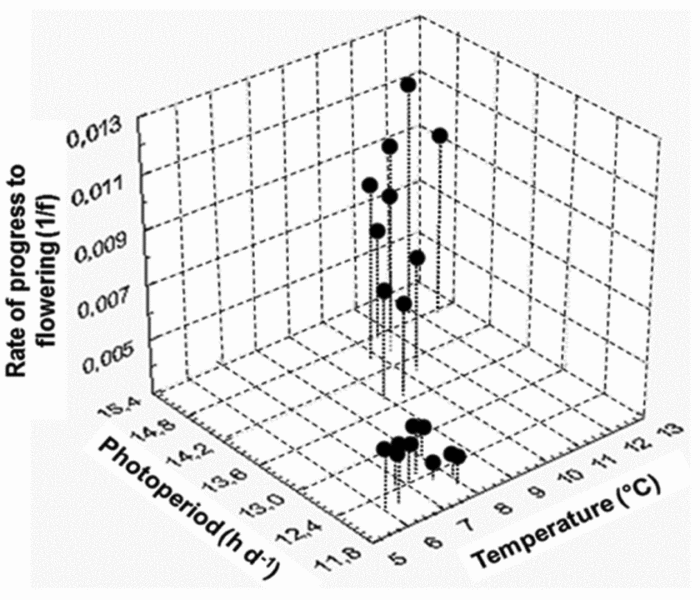
There was a great influence of temperature and photoperiod on L. tenuis flowering time according to seedling emergence. The number of days from seedling emergence to beginning of flowering decreased with increasing of photoperiod. When seedling emergence occurred between late summer and early spring, the number of days from seedling emergence to flowering decreased. Flowering time was among 100 to 260 days for late (spring) and early (at the end of summer) sowing, respectively (Figure 2). AGDD had a linear and positive effect (R²=0.67) on seedling emergence to flowering time (Figure 2), and different AGDD were required when seedling emergence was in early spring (1000 °C day), autumn (1400 °C day), winter (1500 °C days) and at late summer (1900 °C day). The rate of progress from emergence to first flowering (1/f) was linearly related to average temperature (R²=0.75, Figure 3a) and photoperiod (R²=0.85, Figure 3b). As shown in Figure 4, when temperature and photoperiod were included in the analysis (photothermal model), also significant response was recorded, 1/f=−0.02+0.00006*T+0.002024*Ph (R²=0.92; P<0.0001). Base temperature (Tb) and thermal time (Tt) requirements for L. tenuis flowering were 3.4 and 909 °C day, respectively.
The relationship between accumulated growing degree-day and rate of progress from seedling emergence to flowering time in Lotus tenuis. References: seedling emergence in summer, ○; autumn, ●; winter, ▲ and spring, ∆ (see Figure 1).

The relationship between (a) average air temperature and (b) photoperiod and rate of progress from seedling emergence to flowering time in Lotus tenuis. References: seedling emergence in summer, ○; autumn, ●; winter, ▲ and spring, ∆ (see Figure 1).

Effects of photoperiod and mean temperature on rates of progress from seedling emergence to flowering time in Lotus tenuis.

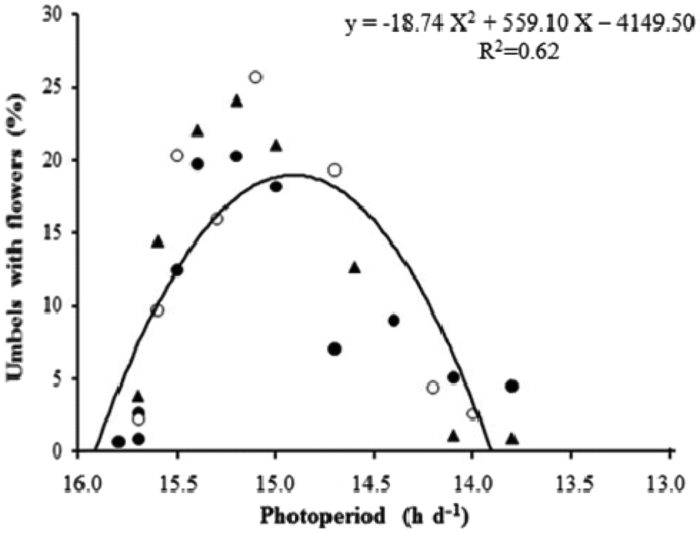
The beginning and ending of flowering coincided with a photoperiod of approximately 15.8 h d−1 (December) and 13.8 h d−1 (early March), respectively. Flowering peak occurred between photoperiod of 15.1 and 15.2 h d−1 (January) and it was best described by a quadratic function (R²=0.62; Figure 5).
Relationship between the photoperiod and percentages of umbels with flowers produced by Lotus tenuis crops. References: control experiment of the years, 2009/2010, ●; 2010/2011, ▲ and 2011/2012, ○.

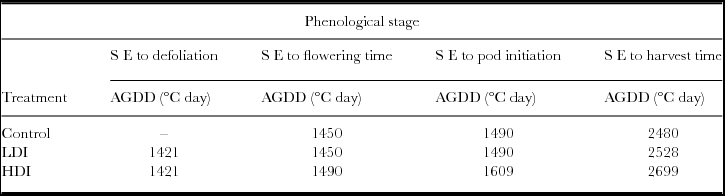
Defoliation intensities retarded flowering time. Floral initiation was earlier in control and LDI (1450 °C day) than in HDI (1490 °C day) treatment (Table 2). Defoliation delayed pod initiation and harvest time (Table 2).
Accumulated growing degree-days (AGDD) for of Lotus tenuis plants defoliated at different intensities and recorded at different phenological phase. Treatments were an uncut Control, a low (LDI) or high (HDI) defoliation intensity (Vignolio et al., Reference Vignolio, Cambareri, Petigrosso, Murillo and Maceira2016). Reference: seedling emergence, S. E.

DISCUSSION
The different seedling emergence (or sowing dates) provided a wide range of environmental conditions to examine the performance of L. tenuis, which showed phenotypical plasticity in flowering time. As the emergence time was delayed, L. tenuis crops were exposed to higher air temperature and longer photoperiod, resulting in a shortening of the number of days for the beginning of flowering. When sown later, plant species of long-day, such as different ecotypes of Medicago polymorpha, needed less accumulated growing degree days for flowering that those sown earlier (Del Pozo et al., Reference Del Pozo, Ovalle, Aronson and Avendaño2000). With increasing day-length and air temperature during vegetative growth, its development is hastened shortening its cycle (Andrade, Reference Andrade1995; Beuselinck and McGraw, Reference Beuselinck and McGraw1988; Papastylianou and Bilalis, Reference Papastylianou and Bilalis2011).
Temperature and photoperiod are factors controlling plant phenological development (Craufurd and Wheeler, Reference Craufurd and Wheeler2009; Del Pozo et al., Reference Del Pozo, Ovalle, Aronson and Avendaño2000). Flowering is the most critical stage in different legume crops because it determines pod production and seed yield (Egli and Bruening, Reference Egli and Bruening2006; Iannucci et al., Reference Iannucci, Terribile and Martiniello2008; Vignolio et al., Reference Vignolio, Cambareri, Petigrosso, Murillo and Maceira2016). Our studies showed that the threshold photoperiod of L. tenuis for flowering time was 15.8 h day−1, approximately the same reported for L. corniculatus (Steiner, Reference Steiner2002). Pomar and Mendoza (Reference Pomar and Mendoza2008) reported that the optimal flower production of L. tenuis requires 16 h day−1 photoperiod but 14 h day−1 could be sufficient to ensure an adequate production of flowers. Our results showed that flower initiation of L. tenuis was also modulated by the temperature. Temperature alone explained 75% of the observed variation in rate of progress to flowering (1/f). Base temperature (Tb) requirement for flowering for L. tenuis was 3.36 °C. This value was in agreement with the results reported by Iannucci et al. (Reference Iannucci, Terribile and Martiniello2008) in Trifolium alexandrinum (3.5 °C) and Hedysarum coronarium (3.9 °C). Thermal time (Tt) requirement for L. tenuis flowering (909 °C day) is in agreement with the results reported by Iannucci et al. (Reference Iannucci, Terribile and Martiniello2008) in Onobrychis viciifolia (880 °C day) and Trifolium resupinatum (871 °C day), both long-day Fabaceae species (Papastylianou and Bilalis, Reference Papastylianou and Bilalis2011). When temperature and photoperiod were both included in the analysis, a significant response was recorded. Again, our results are in agreement with that reported in different herbages legumes, such as M. polymorpha, T. alexandrinum, T. resupinatum, Vicia sativa and V. villosa (Del Pozo et al., Reference Del Pozo, Ovalle, Aronson and Avendaño2000; Iannucci et al., Reference Iannucci, Terribile and Martiniello2008). Therefore, L. tenuis flowering analysis should be done in terms of photothermal responses rather than temperature or photoperiod alone (Del Pozo et al., Reference Del Pozo, Ovalle, Aronson and Avendaño2000; Iannucci et al., Reference Iannucci, Terribile and Martiniello2008).
Parameters b3 and c3 in the photothermal model used in this study were positive. This is indicative that the rate of progress to flowering was accelerated by warmer conditions and longer photoperiod (Butler et al., Reference Butler, Gerald, Evers, Hussey and Ringer2002; Iannucci et al., Reference Iannucci, Terribile and Martiniello2008; Papastylianou and Bilalis, Reference Papastylianou and Bilalis2011). When L. tenuis was sown early (autumn or winter), plant flowered with a photoperiod and temperature average lower than those plants sowed later (spring). L. tenuis sowed later needs less AGDD for flowering than when the crop was sowed early. These results are in agreement with previous experiments where flowering time of L. tenuis sown in same year, was earlier in autumn than in spring (Vignolio et al., Reference Vignolio, Cambareri and Maceira2010). With increasing day-length and air temperature during vegetative growth, crop development is hastened, shortening its cycle. Reduction in vegetative and reproductive phases was also reported in Lotus corniculatus, Trifolium subterraneum, T. resupinatum, Phaseolus vulgaris, Medicago sativa, Zea mays, Glycine max and Helianthus annuus when they were sowed late (Andrade, Reference Andrade1995; Beuselinck and McGraw, Reference Beuselinck and McGraw1988; Papastylianou and Bilalis, Reference Papastylianou and Bilalis2011).
Under defoliation conditions, L. tenuis showed plasticity in the production of reproductive organs. Different AGDD requirement was recorded for flowering and pod peaks according to defoliation conditions (Vignolo et al., Reference Vignolio, Cambareri, Petigrosso, Murillo and Maceira2016). For example, flowering peak was later under LDI than HDI condition, however, seed yield was not significantly affected because self-compensation increased harvest index (Vignolio et al., Reference Vignolio, Cambareri, Petigrosso, Murillo and Maceira2016). L. tenuis flowering is indeterminate and this attribute confers, through phenotypical plasticity, the capacity to compensate the vegetative and reproductive biomass under different environmental conditions such as defoliation and sowing date (Vignolio et al., Reference Vignolio, Fernández and Castaño2006; Reference Vignolio, Cambareri and Maceira2010; Reference Vignolio, Cambareri, Petigrosso, Murillo and Maceira2016). As L. tenuis plants were irrigated, plants showed phenotypic plasticity in flowering time mainly in response to environmental conditions such as photoperiod and air temperature. The average air temperature from 1989 to 2015 was increasing (Figure S1) and L. tenuis phenotypic plasticity in flowering time can provide responses to new environments scenarios associated with global warming.
L. tenuis flowering, pod set, and physiological maturity occur simultaneously. When flowers and pods are using the same source of assimilate, this can increase abortion of reproductive organs (Egli and Bruening, Reference Egli and Bruening2006). L. tenuis flowers abortion was not affected by treatments. Approximately, 74% of flowers per umbels developed pods. L. tenuis produces many more flowers than mature pods. Reproductive regulation was principally through of aborting of some flowers per umbel and not through of umbels with all flowers or pods.
CONCLUSION
Lotus tenuis showed differential sensitivity of flowering time to sowing date, being modulated by photoperiod and temperature conditions. Flowering time occurred when a threshold of thermal time of 909 °C day and the photoperiod of 15.2 h d−1 was reached and pod production began with 1450 °C day. According to the sowing date, L. tenuis growth cycle was bounded among 100 and 260 days. Defoliation intensities in vegetative stage retarded flowering time, which was earlier in control and low defoliation (1450 °C day) than in high defoliation treatment (1490 °C day). Phenotypic plasticity in flowering time in response to both, temperature and photoperiod, provides a convenient management schedules through sowing time.
Acknowledgements
We thank María Rosa Desirello and Sara Garfinkel for critical reading of the text. This work was supported by the Facultad de Ciencias Agrarias, Universidad Nacional de Mar del Plata-Estación Experimental Agropecuaria Balcarce, Instituto Nacional de Tecnología Agropecuaria (Proyectos AGR 484/15).
SUPPLEMENTARY MATERIAL
To view supplementary material for this article, please visit https://doi.org/10.1017/S0014479717000126