Introduction
In Sweden, entitlement for support is assessed by a social worker in an assessment process. Central to the assessment process is the assessment meeting with a representative of the care agency where different kinds of support are discussed. In an assessment meeting with a representative for the agency, the person with dementia must negotiate his or her needs and wishes facing the agency's possibilities. Integrity and self-government are central in the Swedish social services act (Ministry of Health and Social Affairs 2001), and also if a person is diagnosed with dementia he or she has the legal right to make the final decision about the use of supportive services. The negotiation during the assessment meeting has great impact on future social care and support, which makes these meetings an interesting case for interactional studies.
Communication is an important tool in the assessment process in institutional settings (Linell Reference Linell1990). In the assessment meeting, the professional and the client have different positions, and how they engage in the communication is dependent on these positions. The professional poses questions to the client, who is supposed to give a response, then the response is evaluated by the professional, who decides whether the answer is sufficient to accomplish the assessment or if the answer must be further developed (Hydén Reference Hydén and Puide2000). In this light, the interaction may be claimed to be asymmetrical (Linell Reference Linell1990; Linell and Gustavsson Reference Linell and Gustavsson1987).
Discrimination of older people based on negative age-related stereotypes is a well-established phenomenon (Andersson Reference Andersson2008), referred to as ageism (Butler Reference Butler1969). People tend to adjust their language and speech style depending on whom they address. A basic assumption of research on ageism is that younger conversational partners have been found to sometimes go too far in adjusting their speech style towards older adults. These adjustments are based on negative stereotyped conceptions of older adults rather than on the individuals' needs for adjustments (Harwood Reference Harwood2007). Younger conversational partners lower their expectations of the older adults' intellect, competence and health status because of negative stereotypes on ageing. This reflects a less respectful and a more dominant approach towards the older adult (Hummert and Mazloff Reference Hummert and Mazloff2001).
To alter speech styles based on negative stereotypes rather than on personal skills may be considered disrespectful and is referred to as elderspeak, patronising talk or secondary baby talk (Harwood Reference Harwood2007). Caporael and colleagues first described this phenomenon in the 1980s (Caporael Reference Caporael1981; Caporael and Culbertson Reference Caporael and Culbertson1986; Caporael, Lukaszewski and Culbertson Reference Caporael, Lukaszewski and Culbertson1983). These studies comprised naturalistic data, but they focused mainly on the linguistic and phonetic properties of the phenomenon, and no interactional analysis was carried out. Analysis of interaction is often made according to conversation analytic methods, CA (Hutchby and Wooffitt Reference Hutchby and Wooffitt1997). CA is a theory and methodology that is becoming increasingly common for analyses of interaction involving people with communicative disabilities (Goodwin Reference Goodwin2003). A fundamental methodological principle in CA concerns how a participant's perspective may be brought to the fore by means of targeting what the participants themselves make relevant in the interaction (Hutchby and Wooffitt Reference Hutchby and Wooffitt1997).
Typical characteristics of elderspeak are simplified grammar and vocabulary. Other typical characteristics or elements of elderspeak are the use of endearing terms, increased volume, reduced speaking rate, use of repetition, and use of a high and a variable pitch (Harwood Reference Harwood2007). Elderspeak has been argued to work as a self-fulfilling prophecy where the older adult's communicative skills and competence is diminished if the younger conversational partner treats the older person as less competent (Savundranayagam et al. Reference Savundranayagam, Ryan, Anas and Orange2007). Professionals who address older care recipients with elderspeak are perceived as more frustrated, less competent, less confident and less helpful (Ryan and Bourhis Reference Ryan and Bourhis1991).
There are also positive aspects of adjusting speech styles towards older adults when these adjustments are based on the individual's needs rather than on negative stereotypes of older adults (Hummert and Mazloff Reference Hummert and Mazloff2001). Kemper et al. (Reference Kemper, Othick, Gerhing, Gubarchuk and Billington1998b) showed that when younger care-givers spontaneously used elderspeak they enhanced the older adults' performance, but when communication became connected to a routine task, the use of patronising talk became more distinctive, and the older adults perceived themselves as less competent. Some features of elderspeak may also enhance interaction, e.g. optimally placed stress and repetitions (Cohen and Faulkner Reference Cohen and Faulkner1986; Kemper and Harden Reference Kemper and Harden1999). Elderspeak may be beneficial for communication since it reduces processing demands through slow rate and simplified syntax and vocabulary (Kemper Reference Kemper1994). Communication in the institutional context often follows routinised interactional patterns, and thus institutionalised older adults are likely to be exposed to this kind of negative patronising talk (Kemper et al. Reference Kemper, Othick, Gerhing, Gubarchuk and Billington1998b). In the context of health care, elderspeak may impose a feeling in older adults of being ignored and of being perceived as less important (Hummert and Mazloff Reference Hummert and Mazloff2001). Furthermore, the physical context has an impact on whether stereotypes reinforce positive or negative perception of older adults. A dependent older care recipient in a hospital setting attracts more elderspeak than an older adult who lives at home (Hummert et al. Reference Hummert, Shaner, Garstka and Henry1998).
In previous research on language abilities, especially language comprehension, it has been demonstrated that persons with dementia have problems with both verbal and non-verbal comprehension, leading to problems in interaction (Rousseaux et al. Reference Rousseaux, Sève, Vallet, Pasquier and Mackowiak-Cordoliana2010). The knowledge of these problems has resulted in care-giver programmes to support communication in interaction with persons with dementia, and evaluations of these programmes have shown that care-givers' knowledge of interactional strategies that support memory and communication had positive effects on communication outcome measures (Broughton et al. Reference Broughton, Smith, Baker, Angwin, Pachana, Copland, Humphreys, Gallois, Byrne and Chenery2011). Nevertheless, assumptions about communication problems in persons with dementia may also have negative consequences; when addressing persons with dementia, younger conversational partner lower their grammatical complexity, repeat and provide more extended instructions, but also interrupt the person with dementia more often to request clarifications (Kemper et al. Reference Kemper, Finter-Urczyk, Ferrell, Harden and Billington1998a). Elderspeak has also been shown to increase resistance to personal care (Williams et al. Reference Williams, Herman, Gajewski and Wilson2009).
Previous research has focused on the outcome of speech adjustments at the group level with experimental and quantitative designs. With a few exceptions (Williams et al. Reference Williams, Herman, Gajewski and Wilson2009), most of these studies (Hummert and Mazloff Reference Hummert and Mazloff2001; Hummert et al. Reference Hummert, Shaner, Garstka and Henry1998; Kemper et al. Reference Kemper, Finter-Urczyk, Ferrell, Harden and Billington1998a; Ryan and Bourhis Reference Ryan and Bourhis1991; Savundranayagam et al. Reference Savundranayagam, Ryan, Anas and Orange2007) have been based on non-naturalistic data (e.g. using actors and made-up scripts, situations or vignettes) to research how younger adults address older people and how older people perceive the way they are addressed. Elderspeak may also be used as a means to position older people as less competent in interaction than younger persons. However, how positions emerge throughout interaction has not been taken into consideration in the elderspeak area. Features of elderspeak might therefore have been overlooked. Thereby, it is interesting to use naturalistic data and to conduct an interactional analysis to study how persons with dementia are positioned by others in assessment meetings, and how they position themselves when applying for supportive services.
One way to understand the recovery of social identity of a person with dementia (Sabat and Harré Reference Sabat, Harré, Harré and Van Langenhove1999), and as a way to understand the marginalisation of power and status of the person with dementia in decision-making situations, is to use positioning theory (Bartlett and O'Connor Reference Bartlett and O'Connor2010). Positioning is an ‘assignment of fluid “parts” or “roles” to speakers in the discursive construction of personal stories that make a person's action intelligible and relatively determinate as social acts' (Van Langenhove and Harré Reference Van Langenhove, Harré, Harré and Van Langenhove1999: 17). Self and other ascriptions of position usually occur naturally in the social context and are mainly a conversational phenomenon; they emerge progressively throughout conversation (Davies and Harre Reference Davies and Harre1990). A dominant position in conversation may force other participants into unwanted or unpleasant positions (Harré and Van Langenhove Reference Harré, Van Langenhove, Harré and van Langenhove1999). For a client with dementia who applies for supportive services, stigmatisation could be argued to be double. Because of the dementia diagnosis they are not only treated as older adults but also as having decreased cognitive capacities and thereby decreased capacities to engage in decision-making. This might affect how the person with dementia is positioned in the assessment meeting.
How other persons interact with persons with dementia affects how they are positioned and how they position themselves. Kitwood (Reference Kitwood1990) argues that a person with dementia might be disabled by others' unintended actions and attitudes towards them; these attitudes are culturally acquired. Kitwood refers to this as ‘malignant social psychology’. A malignant social psychology signifies features of the care environment that damage the personhood of the person with dementia. Furthermore, a person with dementia attracts more malignant social psychology than older adults who have not been diagnosed with dementia (Kitwood Reference Kitwood1997).
Sabat (Reference Sabat, Downs and Bowers2008) discusses something similar: ‘malignant positioning’. The actions of the person with dementia are often attributed to the disease rather than interpreted in relation to the situation that the person with dementia faces. Cultural stereotypes about persons with dementia and the interpretation of their actions as symptoms (Sabat Reference Sabat, Hughes, Louw and Sabat2006) may cause a negative position, which can affect the other conversational partners' communication towards the person with dementia. Due to communicative problems, persons with dementia may not be able to object to how others position them (Sabat Reference Sabat, Hughes, Louw and Sabat2006).
Aim
The overall aim of the present paper is to investigate if and how the person with dementia may be orally positioned by others, and how persons with dementia position themselves while participating in assessment meetings to gain access to supportive services. In this paper we will use detailed interactional analysis of naturalistic conversational data to explore interaction in the assessment meeting; how the person with dementia is positioned by the other participants is of special interest.
Method
Data collection
Consecutive sampling was used to collect data from 12 assessment meetings in two Swedish municipalities by the first author. The assessment meeting was then audio-recorded and later transcribed. Of these 12 assessment meetings, five were then selected using pre-established criteria, specifically that they were assessment meetings with two older adults where one of them was diagnosed with dementia. In each of these five assessment meetings (Table 1), there are two older conversational partners present (spouse or sibling); i.e. two older adults where one of them has been diagnosed with dementia. This makes it possible to investigate if the person with dementia is orally positioned differently than the other older adult in the assessment meeting. Thereby we excluded seven assessment meetings from the analysis because there was no other older person present than the person with dementia to investigate if they were positioned differently. The duration of the assessment meetings varied from 17 to 57 minutes with an average of 34 minutes. The assessment meetings took place in different settings; three out of five were held in institutional settings, and the other two took place in the homes of the persons with dementia. All names of persons and places are fictive. Ethical approval for this study was obtained through the Regional Ethical Review Board (Dnr 2011/493-31).
Demographic profile of the participants

Note: PWD: person with dementia.
Data analysis
The transcriptions follow the tradition of CA (Hutchby and Wooffitt Reference Hutchby and Wooffitt1997), which means that transcriptions are made in exact accordance with what the participants actually said, and translations are made as directly as possible (see the Appendix for the transcription conventions). Transcriptions were analysed by analysis of interaction, and interactional phenomena used to position the person with dementia were identified. The analysis of interaction was carried out by scrutinising the recordings and the transcriptions sequentially, searching for patterns in the use of interactional phenomena such as ignoring contributions, talking instead of another participant in the interaction or using of collective pronouns. This analysis was inspired by CA methods (Hutchby and Wooffitt Reference Hutchby and Wooffitt1997). Analyses were made separately by the two authors in order to validate the results.
All audio-recordings were analysed by perceptual analysis, i.e. listening to them several times, and transcriptions were read repeatedly by both authors separately to reach a sufficient understanding of the interaction. Both authors then identified interactional phenomena used to position the persons with dementia orally or used by the persons with dementia to position themselves orally. In order to calibrate the analysis, one of the previously excluded cases was analysed by both authors together. Both authors separately analysed the data again to conduct the final categorisation. The occurrence frequency of each interactional phenomenon was counted.
Results
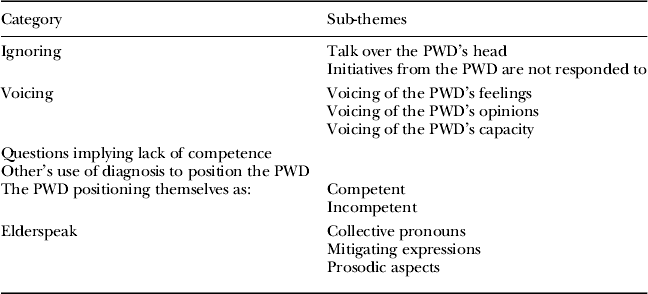
In the present data, we identified six phenomena (Table 2) functioning to position the person with dementia as an individual with less interactional competence than the other participants in the interaction.
Interactional phenomena by category and sub-themes
Note: PWD: person with dementia.
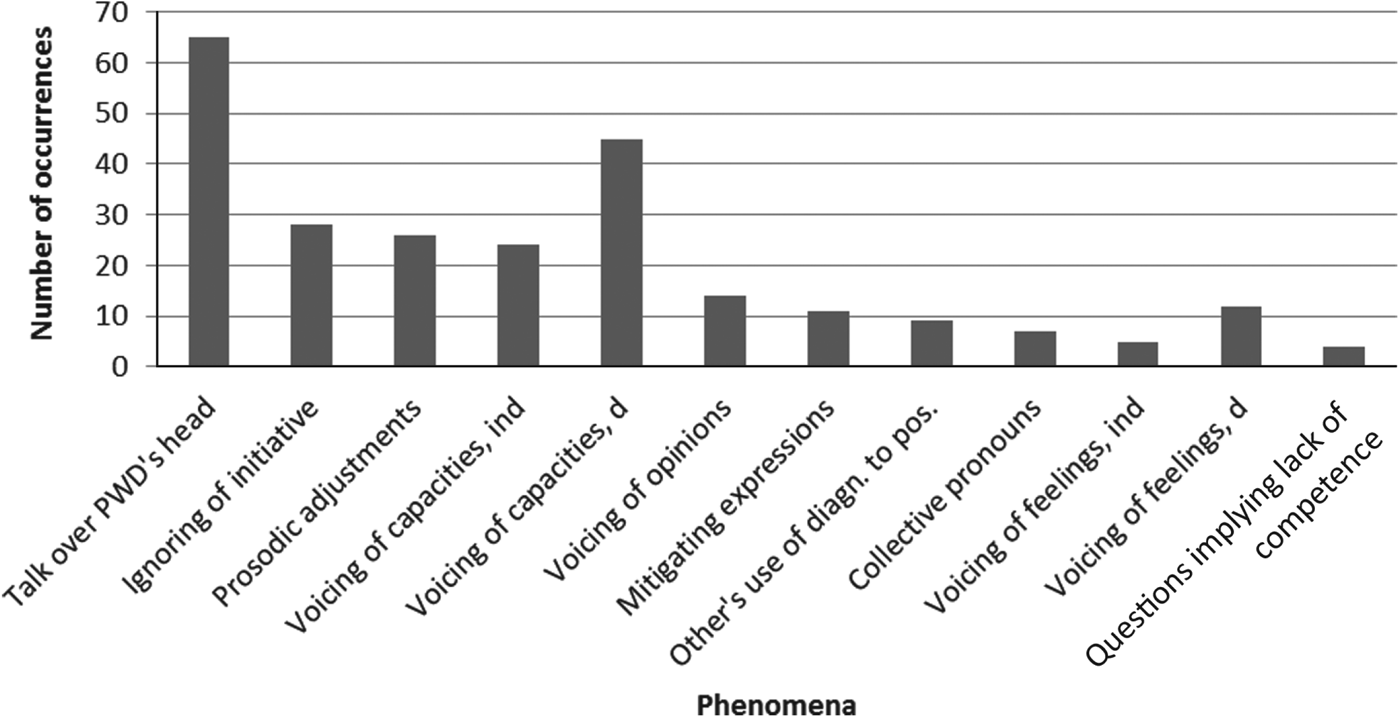
One of the most common phenomena (Figure 1) is that the other participants talk over the head of the person with dementia. There are also frequent instances where the other participants in the interaction (directly or indirectly) voice the capacities, opinions and feelings of the person with dementia. Interactional contributions from the person with dementia are also ignored by the other participants on several occasions in the data. These three phenomena overlap each other to some extent, since all of them concern ways of marginalising persons with dementia in interaction, and also ways to express things on behalf of the person with dementia. However, it makes sense to treat them as different phenomena as they do slightly different interactional jobs. Another way of diminishing the competence of the person with dementia is to pose questions indicating that the person with dementia is not oriented to person, time or location. There are also examples when the person with dementia is labelled by others as a person with dementia, and their behaviour is explained by the diagnosis. In the present data, there are also several examples of features previously described as elderspeak; collective pronouns, mitigating expressions, and prosodic aspects (high pitch, modifications of pitch range and loud speech).
Number of occurrences of interactional phenomena.
There are also several examples of the persons with dementia positioning themselves as either competent or incompetent in the data. On ten occasions in the material, the persons with dementia position themselves as competent, and on six occasions they position themselves as incompetent. In the following, each of the above-identified phenomena is described and exemplified. The means by which the older persons with dementia react and reposition themselves in relation to the examples of malign positioning and elderspeak are also taken into consideration.
Ignoring the person with dementia
The first identified phenomenon used to position the person with dementia as less interactionally competent than the other participants is to ignore the person with dementia. Either the other participants talked over the head of the person with dementia, or they did not respond at all to initiatives taken by the person with dementia. The first example illustrates how the other participants talk over the head of the person with dementia, who is a man diagnosed with Lewy body dementia. This example is taken from a sequence when the possibilities of staying at a short-term facility are discussed.
Example 1
Case 5 (SW: social worker. PWD: person with dementia. W: wife)
1. SW: mm mm just det aa och då tänkte jag på
yeah right eh and then I thought of
2. W: mm
3. SW: på hur tråkigt det än är att komma ifrån varann
of how hurtful it may be to be apart from each other
4. W: mm
5. SW: men om du vill göra någonting då
but if you want to do something then
6. W: mm
7. SW: eller åka bort nån natt
or go away some night
8. W: aa
yeah
9. SW: eller så
or so
10. W: mm
11. SW: i och med ((harklar)) att du inte vill lämna Olle ensam hemma
now when ((clears throat)) you don't want to leave Olle home alone
12. W: nä det går inte nu nä
no that doesn't work now no
13. SW: nä det förstår jag
no I understand that
14. W: nä nä
no no
In this example, the social worker brings up the possibilities for the person with dementia to stay a couple of nights at a short-term facility, but it is brought up mainly as a possibility for the wife (lines 5 and 7). The wife mainly responds minimally throughout the sequence, and the person with dementia is sitting at the table during the sequence, but is left out of the conversation. The social worker states that the wife does not want to leave the person with dementia alone in line 11, where he also talks about the person with dementia in the third person by using his first name. The wife responds to this by a confirmation in line 12, which gets a double confirmation by the social worker in line 13 and yet another confirmation by the wife in line 14.
Example 2 demonstrates how the initiative of the person with dementia is ignored by the other participants of the conversation. The person with dementia is a woman of 74 years who was diagnosed with dementia about five years ago. The example is taken a few minutes into the recording, and they are discussing the design of the residential home.
Example 2
Case 2 (SW: social worker. PWD: person with dementia. H: husband. D: daughter)
1. SW: samtidigt e de ett sånt här litet trinettkök kokskåp och
at the same time there is a little kitchenette and
2. PWD: va har ja för nåt?
what do I have?
3. H: ja
yes
4. D: ja
yes
5. SW: badrum o
bathroom an
6. H: ja de e jättebra
yes that's very good
In this example, the social worker is describing the kitchen in the residential home in line 1, which the person with dementia responds to with a request for clarification in line 2. This request is ignored and the husband and the daughter respond minimally to the social workers' initial contribution in lines 3 and 4. In lines 5 and 6, the conversation about the design of the apartment continues, and the person with dementia is more or less left out of the conversation.
Voicing of the feelings, capacity or opinions of the person with dementia
The second, and perhaps even more salient, way of positioning the older adult with dementia in a depersonalising way is to directly or indirectly either voice the feelings, capacity or opinions of the person with dementia as in Example 3, or to talk about the capacity of the person with dementia in his or her presence and over his or her head, as in Example 4.
Example 3 is from an assessment meeting between a social worker, a nurse, an 83-year-old man who has had memory and communication problems for a couple of years, his wife and their daughter.
Example 3
Case 7 (SW: social worker. PWD: person with dementia. D: daughter. N: nurse. W: wife)
1. PWD: ja de va de d dddd d rrrrr ddd så bra
yes it was it dddd d rrrrr ddd so good
2. D: de syns på ögonen tycker ja att han e stirri i sina ögon
it shows in the eyes I think that he is agitated in his eyes
3. N: mm
4. SW: m kanske känner oro för de här ska va
m maybe feels worried for how this will turn out
5. W: mm
In this example, the person with dementia expresses that something is good, but it is to some extent hidden in a row of unintelligible syllables, in line 1. This contribution does not get any explicit response; in line 2 the daughter voices the feelings of her father expressing that his eyes look agitated. This is confirmed by the nurse's ‘mm’ in line 3, and the social worker makes a more explicit voicing of the feelings of the person with dementia in line 4, which is confirmed by the wife in line 5.
Example 4 is taken from an interaction involving the same participants as in Example 2.
Example 4
Case 2 (SW: social worker. PWD: person with dementia. H: husband. D: daughter)
1. SW: mm mm mm ja just de ja så e de ja ja hur e de (.) Ann-Sofie har inga hjälp eller insatser?
mm mm mm yeah right yeah so it is yeah how is it (.) Ann-Sofie has no help or interventions?
2. PWD: va har ja inte?
what don't I have?
3. SW: eller
or
4. H: nä de e ju ja själv som
no it is I myself that
5. D: mm
Example 4 illustrates how the person with dementia is positioned as less competent by the fact that the question about her home situation is posed to her husband in line 1. However, the person with dementia resists this position by responding to the question herself in line 2. This response is ignored by the social worker, who seeks confirmation from her husband. The husband answers the question in line 4, and the daughter confirms this answer in line 5.
Questions implying lack of competence
The third phenomenon used to position the person with dementia as less competent is identified in the posing of questions in a way that implies a lack of competence.
Example 5 shows how the person with dementia is addressed by a question assuming that persons with dementia have problems remembering things about themselves, such as where they have been or what they have done. This interactional phenomenon may be an example of how participants innocently treat the persons with dementia in a depersonalising way that diminishes their feeling of self-worth, e.g. malignant positioning (Sabat Reference Sabat, Hughes, Louw and Sabat2006). Example 5 is drawn from a conversation between a social worker, a person with dementia and his wife. The person with dementia is an 84-year-old man, and he was diagnosed with dementia about six months prior to the recording.
Example 5
Case 10 (SW: social worker. PWD: person with dementia)
1. SW: e de nåra utflykter eller nåt eller det kanske du inte har varit på än (0.5) har du va- kommer du ihåg om du har varit iväg nånstans om du har åkt iväg på nåra utflykter are there any excursions or anything or you may not have been on any yet (0.5) have you be- do you remember if you have been away somewhere if you have gone away on any excursions
2. PWD: nja ve- ((harklar sig)) vi har varit upp i skogen en sväng (.) va vi ju
well kno- ((clears his throat)) we have been up in the forest on a stroll (.) yes we were
3. SW: ja
yes
4. PWD: ehh o s samtidigt då så va vi va vi (.) drack vi kaffe o o dels va vi ute på sjön o
ehh and at the same time we were we (.) we drank coffee and and we were out on the lake and
In line 1, the social worker at first starts a question, which she revises into an assumption of the whereabouts of the person with dementia, and then re-revises into a question about the participant's ability to remember. This may be interpreted as positioning the person with dementia as a less competent individual. The person with dementia responds to the question by demonstrating that he remembers what was asked for, thereby positioning himself as a competent interactional partner. The social worker in line 3 responds to this with a minimal response, and the person with dementia then continues his story about the excursion.
Other's use of diagnosis to position the person with dementia
The fourth interactional phenomenon identified to position the person with dementia as less competent than the other participants was to use the dementia diagnosis for ascription of positions.
In the data there are sequences where the persons with dementia are positioned by others as persons with dementia, and thereby as less competent or dependent on others. This is illustrated in Example 6.
Example 6
Case 2 (SW: social worker. PWD: person with dementia. H: husband. D: daughter)
1. SW: det här bestämmer jag nu på en gång att du beviljas
I decide this right now that you are granted this
2. D: mm
3. SW: så
so
4. H: det gör du ja
you do that yes
5. D: mm
6. SW: mm för det är ((smackar)) men det är mycket vanligt vid demenssjukdomar
mm because that is ((smacking)) but it is very common in dementia diseases
7. D: mm
8. SW: just det här med hjälpbehovet som är stort va och det här med ständig tillsyn
just this with help needs which is big yeah and this with constant supervision
9. D: mm
10. H: aa mm
yeah mm
11. SW: så va som att man som exempelvis inte kan lämna (.) Kalle eller Östen eller Hanna eller sin anhörig eller vem det nu är
so what as when you for example can't leave (.) Kalle or Östen or Hanna or your relative or whoever it might be
12. D: mm
13. H: nä just det
no right
14. SW: och så va så att det är ju en jättestor insats många av er gör som som anhörig
and so what so that it is a huge effort many of you do as as relatives
15. D: mm
16. H: precis ja
precisely yes
In Example 6, the social worker makes a statement about common features of persons with dementia in line 6, after having decided that the person with dementia will get an allowance for the husband's efforts to support the person with dementia. The social worker continues to position the person with dementia as being someone belonging to a group of people with special needs in lines 8 and 10. The daughter and the husband confirm these statements about persons with dementia, thereby contributing to the positioning of the person with dementia as belonging to this group. In line 14, the social worker initiates the closing of the sequence by praising the efforts made by the relatives of persons with dementia, which is confirmed by the daughter in line 15, and the husband in line 16, and he also closes the sequence with his confirmation.
The person with dementia positioning themselves as competent or incompetent
The fifth interactional phenomenon identified was that the persons with dementia position themselves as either competent or incompetent. There are sequences where the persons with dementia either position or re-position themselves as competent or incompetent. There are also sequences where the other participants mitigate the problems of the person with dementia. Example 7 demonstrates, on the one hand, how the participants try to support the person with dementia by assuring her that she is capable, and thereby position her as competent. On the other hand, it shows how the person with dementia comments on her being diminished, possibly an attempt to reposition herself as competent. The discussion from which the example is taken concerns a benefit for carers, and the social worker has asked the husband how much he needs to help his wife.
Example 7
Case 2 (SW: social worker. PWD: person with dementia. H: husband. D: daughter)
1. PWD: det låter som att jag aldrig gör nånting själv
it sounds as if I never do anything myself
2. D: [jo men de gör du]
[yeah but you do]
3. H: [jo de gör du allt]
[yeah you really do]
4. PWD: de e mina grejer du pratar om
it's my stuff you're talking about
5. D: me hjälp av Östen
with help from Östen
6. PWD: va
what
7. D: de gör du ju
you really do
8. PWD: men han tar (första) steget
but he takes the (first) step
9. D: ja
yes
10. SW: mm
The person with dementia interrupts the discussion by indicating that she is not happy about how she is described, thereby positioning herself as competent; this utterance is produced in a rather firm voice. In lines 2 and 3, the daughter and the husband both assure her that she does things at home, and they both produce their utterances in comforting voices. To respond to the objections made by the person with dementia in a comforting way may be considered a mitigation of the problems that the person with dementia has. The person with dementia states that they talk about her, but this contribution does not get any response. Instead, the daughter continues her previous utterances in line 5, adding that the person with dementia needs some help from her husband. The person with dementia asks for clarification in line 6, whereby the daughter repeats her first comment. In line 8, the person with dementia comments on her husband's assistance in a somewhat unintelligible way, although indicating that she feels that he takes great responsibility, which is confirmed by both the daughter and the social worker in lines 9 and 10.
Elderspeak
The sixth identified interactional phenomenon that is used to position the person with dementia as less competent than the other conversational partners was the use of elderspeak. This was accomplished by the use of collective pronouns, mitigating expressions or prosodic aspects, e.g. exaggerated intonation or loud voice.
Example 8 illustrates the use of collective pronouns in interaction with a person with dementia. This example also demonstrates that this form of elderspeak also occurs in interactions that are not nursing situations, which is the main situation where elderspeak has been identified in previous research (Caporael Reference Caporael1981; Williams et al. Reference Williams, Herman, Gajewski and Wilson2009).
Example 8
Case 7 (SW: social worker. PWD: person with dementia)
1. SW: tycker du de skulle va bra Lars om vi hade ett trygghetslarm hemma
do you think that it would be good Lars if we had a safety alarm at home
2. PWD ja
yes
3. SW: ja ja tror att de skulle va bra
yes I think that it would be good
4. PWD: ja (.) de de dede tror ja
yes(.) that that thathat's I think
5. SW: mm
6. PWD: mm
In line 1, the social worker uses we instead of you in the question about getting a safety alarm, although the alarm is going to be installed in the home of the person with dementia. The use of the first name of the person with dementia, which for some older persons may be considered disrespectful (Harwood Reference Harwood2007), also adds to the sense of diminution in the question. The person with dementia answers with a minimal response in line 2, and the social worker continues in line 3 by repeating that it would be good to have a safety alarm. In line 4, the person with dementia elaborates on his previous response, possibly demonstrating interactional competence. The confirmation by the social worker in line 5 could close the sequence. However, the person with dementia also confirms in line 6, i.e. double confirmation, allowing him to close this sequence and get the last word, which may also be interpreted as a way of repositioning himself.
Discussion
The results demonstrate that persons with dementia are often orally positioned as less competent in the assessment meetings. They also indicate that the persons with dementia are addressed in a different way than their spouses or siblings, suggesting that they suffer even further from discrimination than other older persons. There are also examples of how the persons with dementia reposition themselves as competent and capable individuals.
Kitwood (Reference Kitwood1997) argues that a person with dementia attracts more malignant social psychology than a person who has not been diagnosed with dementia. Previous research (Kemper et al. Reference Kemper, Othick, Gerhing, Gubarchuk and Billington1998b) about elderspeak has not reached consensus on whether cognitively impaired older adults are addressed differently than other older adults. The use of interactional data with two older persons where only one was diagnosed with dementia made it possible to show that the person with dementia was positioned differently than the other older adult in the same conversation. In this paper, we have shown that the persons with dementia are positioned as less competent not only by professionals, but also by their next of kin, which gives further support to the concept of ‘dementiaspeak’. These results are in line with previous research demonstrating how the social identity of person with dementia may be negotiated through positioning in interaction (Bartlett and O'Connor Reference Bartlett and O'Connor2010; Sabat and Harré Reference Sabat, Harré, Harré and Van Langenhove1999). However, the interactions may also have been influenced by the communicative problems that persons with dementia often have (Rousseaux et al. Reference Rousseaux, Sève, Vallet, Pasquier and Mackowiak-Cordoliana2010), and the feeling of a need to adjust to these problems by the participants without dementia.
Younger persons have been found to adjust their way of speaking towards older persons based upon negative stereotypes of ageing (Harwood Reference Harwood2007). This occurs frequently in our data, but in this paper we have shown that the persons with dementia sometimes reject others' negative position of them as less competent and thereby re-position themselves as competent. As we have shown in Example 7, the person with dementia re-positions herself, and the other participants partly accept this by assuring her that she is competent but still needs help from her husband to accomplish her daily activities. Nevertheless, by rejecting the position as incompetent the person with dementia made the other participants in this sequence stop talking over her head, and instead including her in the conversation. These findings raise questions on the impact of elderspeak as a self-fulfilling prophecy (Savundranayagam et al. Reference Savundranayagam, Ryan, Anas and Orange2007), as the persons with dementia do not accept the position as less competent implied by the use of elderspeak or other diminishing interactional devices.
In contrast to previous research (Hummert and Mazloff Reference Hummert and Mazloff2001; Hummert et al Reference Hummert, Shaner, Garstka and Henry1998; Kemper et al. Reference Kemper, Othick, Gerhing, Gubarchuk and Billington1998b; Savundranayagam et al. Reference Savundranayagam, Ryan, Anas and Orange2007), we use detailed interactional analysis of naturalistic data in the present study (Hutchby and Wooffitt Reference Hutchby and Wooffitt1997). This made the interactional outcomes of the use of positioning and elderspeak/'dementiaspeak’ visible, especially the positioning and re-positioning work done by the persons with dementia themselves. These features may otherwise have been overlooked.
The context in which the conversation takes place is significant to how the older and the younger person perceive themselves and are perceived by others (Hummert and Mazloff Reference Hummert and Mazloff2001; Hummert et al. Reference Hummert, Shaner, Garstka and Henry1998; Kemper et al. Reference Kemper, Finter-Urczyk, Ferrell, Harden and Billington1998a). The context has also been stressed to be important for the occurrence of elderspeak. In this study there were no differences in how the persons with dementia were positioned in the assessment meeting that were dependent on the physical environment. However, the assessment meeting is a task for an institutional organisation with a certain purpose, which may explain why we did not find any differences between assessment meetings conducted in the home context of the persons with dementia or in an institutional context. It could also be due to the fact that the sample size included in the present study was limited.
In conclusion, persons with dementia are often positioned as less competent than the other participants in the assessment meetings both by younger participants, e.g. social workers or children, and by same-aged partners. Presumably, the described ‘dementiaspeak’ has an impact on the possibility of persons with dementia partaking in negotiations regarding their future care. The results of the present study have implications for how we understand both the concept of elderspeak and the concept of positioning of older people. We have demonstrated that persons with dementia not only are exposed to elderspeak and malign positioning by other conversational partners, but also contribute to this by positioning themselves as competent or incompetent persons in relation to the disease, which broadens our understanding of elderspeak. Furthermore, the results of the present study indicate that social workers should be made aware of the existence of this type of negative positioning and how it may affect the ability of the persons with dementia to contribute in negotiations about their everyday life. Interactional analysis of assessment meetings may contribute to identification of successful strategies in order to reduce ‘dementiaspeak’.
More research is needed to establish if these differences could be argued to be ‘dementiaspeak’ rather than elderspeak. In order to investigate this, a comparable control sample with older adults without dementia in a similar context, i.e. assessment meetings, would be needed. In future research, it would also be relevant to explore the interactional consequences of the use of ‘dementiaspeak’ in assessment meetings.
Acknowledgements
We are grateful to Professor Lars-Christer Hydén for his valuable and critical revising of the article. We are also grateful to the participants for their participation in this study. The research reported in this study was supported by a generous grant from the Swedish Riksbankens Jubileumsfond (M10-0187:1). The procedures followed in carrying out this study were in accordance with the ethical standards of the responsible committee of human experimentation, and with the Helsinki Declaration of 1975 as revised in 1983.
Appendix: Transcription conventions
- yes
stress
- ?
rising intonation
- -
cut-off word
- °mhm°
word or utterance pronounced quietly or soft
- hh
inbreath
- ‘really’
reported speech
- (0.5)
pause
- (.)
micro pause
- ()
unclear hearing
- [yea]
overlapping speech
- <really>
speech produced in a slower rate than surrounding talk
- (())
transcriber's comment