INTRODUCTION
Research on the marine reservoir effect (MRE) on the coast of Brazil has increased over the last few years (Alves at al. Reference Alves, Macario, Souza, Aguilera, Goulart, Scheel-Ybert, Bachelet, Carvalho, Oliveira and Douka2015a, Reference Alves, Macario, Souza, Pimenta, Douka, Oliveira, Chanca and Angulo2015b, Reference Alves, Macario, Ascough and Bronk Ramsey2018; Carvalho et al. Reference Carvalho, Macario, Oliveira, Oliveira, Chanca, Alves, Souza, Aguilera and Douka2015; Macario et al. Reference Macario, Souza, Aguilera, Carvalho, Oliveira, Alves, Chanca, Silva, Douka, Decco, Trindade, Marques, Anjos and Pamplona2015, Reference Macario, Alves, Chanca, Oliveira, Carvalho, Souza, Aguilera, Tenório, Rapagnã, Douka and Silva2016, Reference Macario, Alves, Belém, Aguilera, Bertucci, Tenório, Oliveira, Chanca, Carvalho, Souza, Scheel-Ybert, Nascimento, Dias and Caon2018). Nevertheless, due to its extensive area and varied geomorphological features, the available estimates for ΔR offsets between local and global oceans are far from ideal. Several archaeological and environmental studies are based on marine materials and the reliability of such chronological records are completely dependent on the understanding of local reservoir effects (Alves et al. Reference Alves, Macario, Ascough and Bronk Ramsey2018).
Three ways of estimating ΔR values (Reimer and Reimer Reference Reimer and Reimer2016) are currently used. They involve (a) samples of known calendar age that predate the era of nuclear testing, (b) contemporaneous pairs of marine and terrestrial samples, and (c) growth increments of corals with age determined independently, for example by the Th/U technique. Available ΔR data for the Brazilian coast relied on the first two methods. In the present work, we use the latter approach.
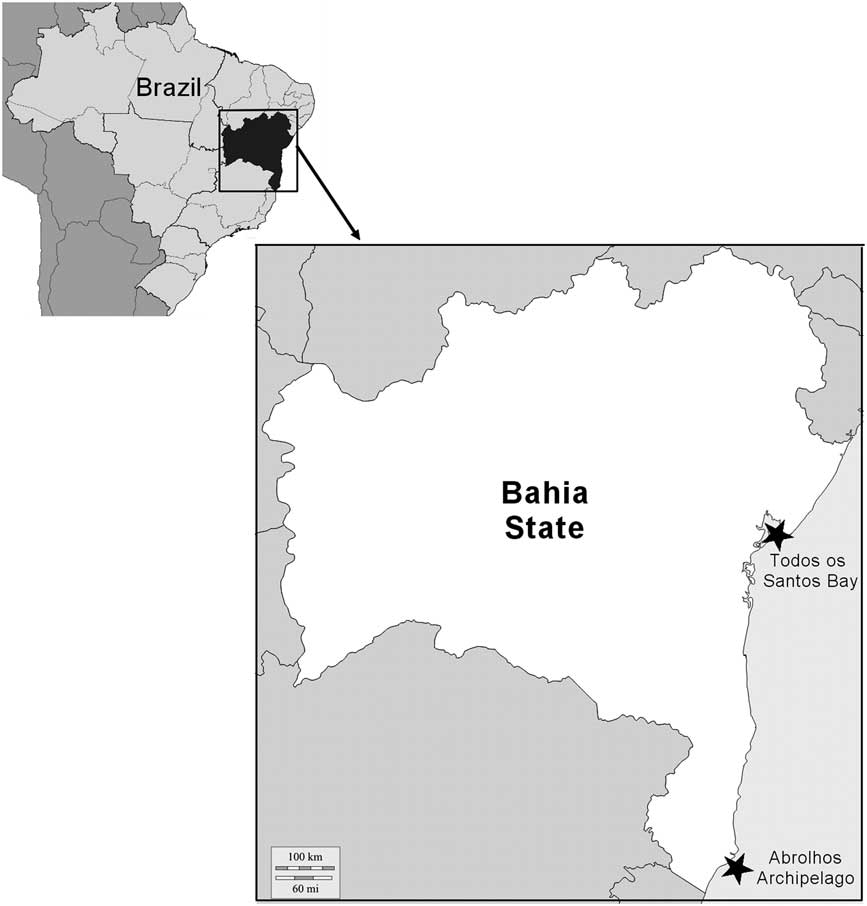
Brazil has a 7.4 thousand km length in coastline extension (CIA 2017). It comprises the most important reef system of the Southwestern Atlantic and is characterized by a high degree of endemism (Castro and Pires Reference Castro and Pires2001). The study areas of this work are the Pedra Alva Reef, inside the Todos os Santos Bay (TSB), in Salvador-BA, and the Sueste Chapeirão located in Abrolhos Archipelago (AA) (Figure 1). Coral core samples were collected by the RECORD Project and Paleotraces Project, the latter being a Brazil-France international cooperation program. The samples are archived in the Rio de Janeiro State University/IBRAG/LARAMG scientific collection. These cores were initially investigated for sclerochronology by Godiva (Reference Godiva2010), who has employed both X-ray image processing, Sr/Ca and U/Ca ratios to reveal yearly density band structures. Latter, Lamounier (Reference Lamounier2015) used 230Th/238U dating to estimate the absolute ages for a subset of the density bands identified by Godiva (Reference Godiva2010). In the present work, we present the radiocarbon ages for these same samples and correlate it with their growth increment and 230Th/238U and 14C results in order to determine the local MRE for the two sites.
Coral core sampling sites location. Pedra Alva reef (Todos os Santos Bay) and Sueste Chapeirão (Abrolhos Archipelago).

MATERIALS AND METHODS
Samples of Siderastrea strellata corals, an endemic scleractinians species from the Brazilian coast, were collected with a pneumatic drill in two sites: (1) Pedra Alva reef (12°52′S, 38°31′W), located inside the TSB, in Salvador-BA, a 50-cm core collected at a depth of 10 m; and (2) Sueste Chapeirão (17°57′S–38°38′W), located in AA, a 53-cm core collected at a depth of 8.5 m. The sampling took place in November and March of 2007, respectively, under IBAMA’s licenses for collecting and transporting material (license number: 283/2006 and 040/2007CGREP).
TSB is located on the coast of the city of Salvador (12º35′–13º07′S, 38º29′–38º48′W) (Manso et al. Reference Manso, Alves and Martins2008) and has been an Environmental Protection Area (EPA) since 1999, as decreed by the Bahia State Government. This region has the greatest biodiversity within the Occidental Southwestern Atlantic Ocean and is the largest bay in Brazil (Cruz et al. Reference Cruz, Kikuchi and Leão2009). The reefs in TSB are located in two sites characterized by different hydrodynamics and anthropogenic impacts: those located outside the bay, called external, are under the influence of waves and the open ocean, while those inside the bay are relatively confined but are under greater anthropogenic influence (Cruz et al. Reference Cruz, Kikuchi and Leão2009). The population of the city of Salvador is estimated to be 2.9 million inhabitants according to IBGE. TSB is affected by surrounding industries, growing population, refineries and three harbors (IBGE 2016). Due to this anthropic influence, the government classified TSB as an EPA for better management of environmental resources (Dutra and Harworth Reference Dutra and Haworth2008; Cruz et al. Reference Cruz, Kikuchi and Leão2009). TBS has two entries, split by the Itaparica Island, the most important being the Salvador channel, responsible for most of the water exchange between the bay and the ocean (Lessa et al. Reference Lessa, Dominguez, Bittencourt and Brichta2001).
The climate is tropical humid according to Koppen classification, and the salinity and temperature inside the main part of the bay are characteristic of open ocean waters varying from 33.0 to 36.7 and from 24ºC to 30ºC, respectively (Wolgemuth et al. Reference Wolgemuth, Burnett and Moura1981). The surface winds are the main drivers for water circulation in the bay (Montenegro et al. Reference Montenegro, Fonseca and Campos1999). Pedra Alva, located 4.9 km from the coast, is the deepest reef inside the bay at 8 m from the surface. In this reef we find 6 different coral species, the dominant being Montastraea cavernosa and a few individuals of the genus Siderastrea that may reach 60 cm in diameter (Cruz Reference Cruz2013).
The AA site (17º20′–18º10′S and 38º35′–39º20′W), at south of Bahia State, was designed at the first National Marine Park in South America in 1968 (Castro and Secchin Reference Castro and Secchin1982). It encloses a group of small volcanic islands, coral reefs, mangroves and tidal channels. The Park covers approximately 91,200 hectares and is composed of two areas: Abrolhos Parcel and Abrolhos Archipelago, excluding Santa Bárbara Island, which is under the jurisdiction and control of the Brazilian Navy (IBAMA 1991). The reefs can be divided in two arcs, one far from the coast and one closer to the coast where strong terrigenous influence is observed.
The local climate can be described by two major regimes: semi-arid tropical weather in at the continent, and Mediterranean regime at the coast (Segal et al. Reference Segal, Evangelista, Kampel, Gonçalves, Politod and Santos2008). For the former, the maximum precipitation occurs during summer (December to February), while for the latter, it occurs during autumn (March to May), having high influence of marine winds. This coral-reef region is characterized by nutrient depleted Tropical Water (TW) of the Brazil Current (BC) (Ekau Reference Ekau1999), with high salinity and temperature, around 36.9 and 22°C to 28°C, respectively (Leipe et al. Reference Leipe, Knoppers, Marone and Camargo1999).
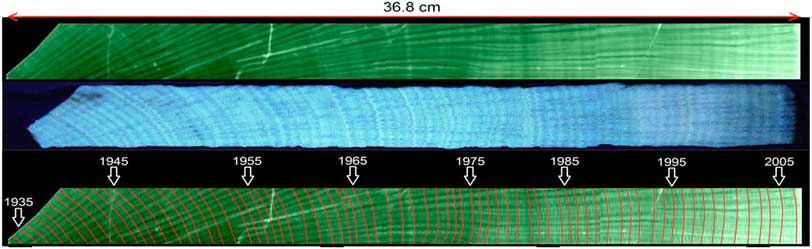
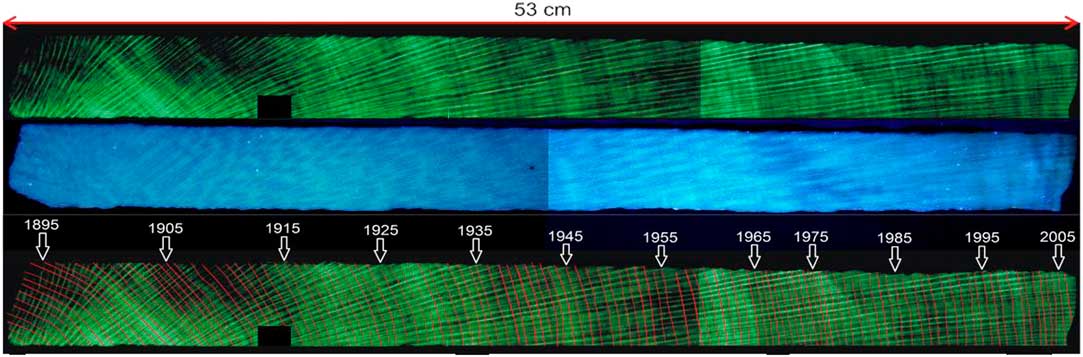
To allow comparison of 14C values and other independent dating techniques, the coral band chronology was determined in two different ways: by sclerochronology and by 230Th/238U dating. The former relies on the counting of individual light and dark density bands. This was achieved by using x-ray and UV imaging performed by Godiva (Reference Godiva2010) at Bordeaux University, France. Specifically, the scopix technique was used to generate high-resolution grayscale contrast from the x-ray image. Thereafter, the luminescence imaging was performed at the Laboratory of Radioecology and Global Changes in Rio de Janeiro State University (LARAMG/UERJ), and is described at Lamounier (Reference Lamounier2015). This technique allows visualization of banding from a black light (or UV light) on a dark background. The final result is a composite of both x-ray and luminescence techniques that can facilitate the appearance of banding, as depicted in Figures 2 and 3.
X-ray (green), luminescence (blue) images and stratigraphic bands of TBS coral core. (Please see electronic version for color figures; source: Lamounier Reference Lamounier2015).

X-ray (green), luminescence (blue) images and stratigraphic bands of Abrolhos coral core (source: Lamounier Reference Lamounier2015).

Seasonal changes in sea surface temperatures and limitations related to image quality may obscure the interpretation of coral growth data (Shen et al. Reference Shen, Li, Sieh, Natawidjaja, Cheng, Wang, Edwards, Lam, Hsieh, Fan, Meltzner, Taylor, Quinn, Chiang and Kilbourne2008). A complementary technique is necessary to certify the ages determined by the sclerochronology technique. Therefore, the Th/U method was used to verify the band counting process. This radiometric technique is based on the natural occurrences of long-lived 238U and 235U radioisotopes, which are quite soluble in the ocean water, while their short lived decay products are not (Walker Reference Walker2005). Th/U measurements were performed in the High-precision Mass Spectrometry and Environment Change Laboratory (HISPEC) of the Department of Geosciences, National Taiwan University (NTU), between May and August 2010, from corals subsamples slabs of ~0.1 mg. Inductively coupled plasma sector-field mass spectrometer (ICP-SF-MS) with sensitivity to detect quantities of up to 30-200 fg of 234U or 230Th and 1-4 ng of 238U was used to quantify the isotopic concentrations. More details on the technique can be found in Shen et al. (Reference Shen, Li, Sieh, Natawidjaja, Cheng, Wang, Edwards, Lam, Hsieh, Fan, Meltzner, Taylor, Quinn, Chiang and Kilbourne2008). The results of selected samples along the coral skeleton are presented in Table 1.
Results of Th/U ages from ICP-SF-MS technique.

In addition, subsamples were analyzed by 14C-AMS in the Radiocarbon Laboratory of Federal Fluminense University (LAC-UFF). Initially, a chemical treatment was made to remove the external layer which may contain impurities. Dilute hydrochloric acid (0.1M – HCl) was added and allowed to react overnight to remove 50% of the external layer. With the aid of a gas-tight syringe, phosphoric acid (85% – H3PO4) was injected into evacuated vials to obtain CO2. Together with the samples, Calcite blanks and IAEA C2 carbonate reference material were prepared as control samples. The gas was purified in a vacuum line using dry ice/ethanol and nitrogen liquid traps (Macario et al. Reference Macario, Souza, Aguilera, Carvalho, Oliveira, Alves, Chanca, Silva, Douka, Decco, Trindade, Marques, Anjos and Pamplona2015). Graphitization was performed using the zinc/titanium hydride method with iron catalyst (Xu et al. Reference Xu, Trumbore, Zheng, Southon, McDuffee, Luttgen and Liu2007). Individual torch-sealed tubes were heated at 550°C for 7 hr in a muffle oven. Graphitized samples were pressed in Al cathodes and measured at the Center for Applied Isotope Studies (CAIS) at the University of Georgia, USA (Cherkinsky et al. Reference Cherkinsky, Culp, Dvoracek and Noakes2010). Calibration was performed following Macario et al. (Reference Macario, Souza, Aguilera, Carvalho, Oliveira, Alves, Chanca, Silva, Douka, Decco, Trindade, Marques, Anjos and Pamplona2015), with the software OxCal v 4.3 (Bronk Ramsey and Lee Reference Bronk Ramsey and Lee2013) using the Marine13 curve (Reimer et al. Reference Reimer, Bard, Bayliss, Beck, Blackwell, Bronk Ramsey, Buck, Cheng, Edwards, Friedrich, Grootes, Guilderson, Haflidason, Hajdas, Hatté, Heaton, Hoffmann, Hogg, Hughen, Kaiser, Bernd Kromer, Manning, Niu, Reimer, Richards, Scott, Southon, Staff, Turney and van der Plicht2013) and considering undetermined ΔR. Sclerochronology based on Th-U results were considered normal distributions of calendar dates within the OxCal model. For Abrolhos samples, growth order was taken into account as a prior and each layer was considered as a phase, first with independent ΔR, then sharing a common ΔR. For TSB we put the data in a single phase. OxCal code is presented in supplementary material. In order to evaluate the offset between the local ocean and coeval global ocean prior ΔR was considered as a uniform distribution from −300 to 300 14C yr (Bronk Ramsey and Lee Reference Bronk Ramsey and Lee2013).
RESULTS AND DISCUSSION
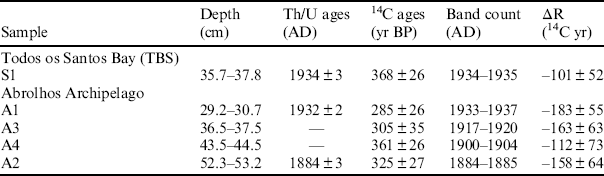
We selected three samples that had been dated by the Th/U technique, plus two samples whose ages were estimated by sclerochronology only. These represent the calendar ages that will serve as references to evaluate the MRE. The 14C ages are presented in Table 2, as well as the depth, Th/U ages and count bands.
Depth, Th/U ages, radiocarbon ages and band count for coral samples.

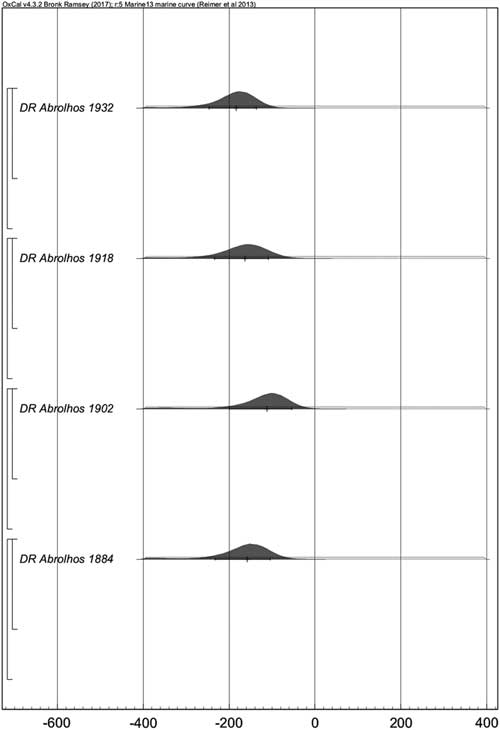
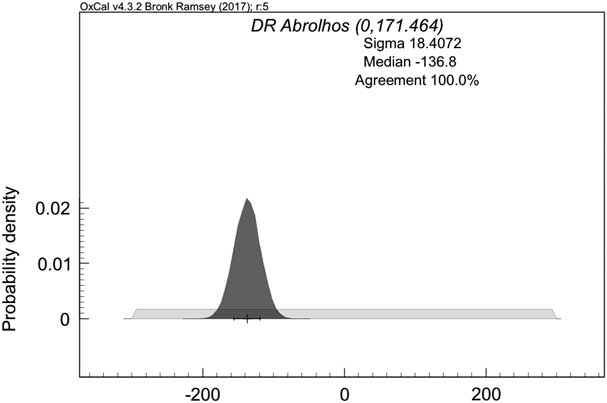
In order to evaluate a possible variation in ΔR over time, our first approach was to calculate individual values for each of the available growth bands for the coral from Abrolhos archipelago. The results show similar negative values (Figure 4), indicating no variation in ocean dynamics from 1884 to 1937 AD. Therefore, we used a common ΔR as a means to improve statistics (Figure 5).
Probability distribution for the ΔR values from Abrolhos archipelago obtained from each of the modelled dates, using OxCal v4.3 Bronk Ramsey (Reference Bronk Ramsey2009); r.5 Marine data from Reimer et al. (Reference Reimer, Bard, Bayliss, Beck, Blackwell, Bronk Ramsey, Buck, Cheng, Edwards, Friedrich, Grootes, Guilderson, Haflidason, Hajdas, Hatté, Heaton, Hoffmann, Hogg, Hughen, Kaiser, Bernd Kromer, Manning, Niu, Reimer, Richards, Scott, Southon, Staff, Turney and van der Plicht2013).

Probability distribution for a common ΔR value from Abrolhos obtained from the modelled dates using OxCal v4.3 Bronk Ramsey (Reference Bronk Ramsey2009); r.5 Marine data from Reimer et al. (Reference Reimer, Bard, Bayliss, Beck, Blackwell, Bronk Ramsey, Buck, Cheng, Edwards, Friedrich, Grootes, Guilderson, Haflidason, Hajdas, Hatté, Heaton, Hoffmann, Hogg, Hughen, Kaiser, Bernd Kromer, Manning, Niu, Reimer, Richards, Scott, Southon, Staff, Turney and van der Plicht2013).

Negative ΔR values are usually related to freshwater influence, because it can introduce exogenous carbon to the marine environment and significantly impact the MRE in estuaries (Alves et al. Reference Alves, Macario, Ascough and Bronk Ramsey2018). On the coast of Rio de Janeiro and Rio Grande do Sul States negative ΔR values are found for archaeological sites in lagoon areas (Alves et al. Reference Alves, Macario, Souza, Pimenta, Douka, Oliveira, Chanca and Angulo2015b; Carvalho et al. Reference Carvalho, Macario, Oliveira, Oliveira, Chanca, Alves, Souza, Aguilera and Douka2015; Macario et al. Reference Macario, Souza, Aguilera, Carvalho, Oliveira, Alves, Chanca, Silva, Douka, Decco, Trindade, Marques, Anjos and Pamplona2015; Milheira et al. Reference Milheira, Macario, Chanca and Alves2017).
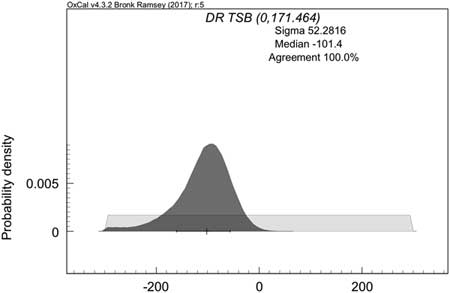
The values ΔR=–137±18 14C yr for Abrolhos (Figure 5) and –101±52 14C yr for TBS (Figure 6)
Probability distribution for ΔR value from TSB obtained from the modelled date using OxCal v4.3 Bronk Ramsey (Reference Bronk Ramsey2009); r.5 Marine data from Reimer et al. (Reference Reimer, Bard, Bayliss, Beck, Blackwell, Bronk Ramsey, Buck, Cheng, Edwards, Friedrich, Grootes, Guilderson, Haflidason, Hajdas, Hatté, Heaton, Hoffmann, Hogg, Hughen, Kaiser, Bernd Kromer, Manning, Niu, Reimer, Richards, Scott, Southon, Staff, Turney and van der Plicht2013).

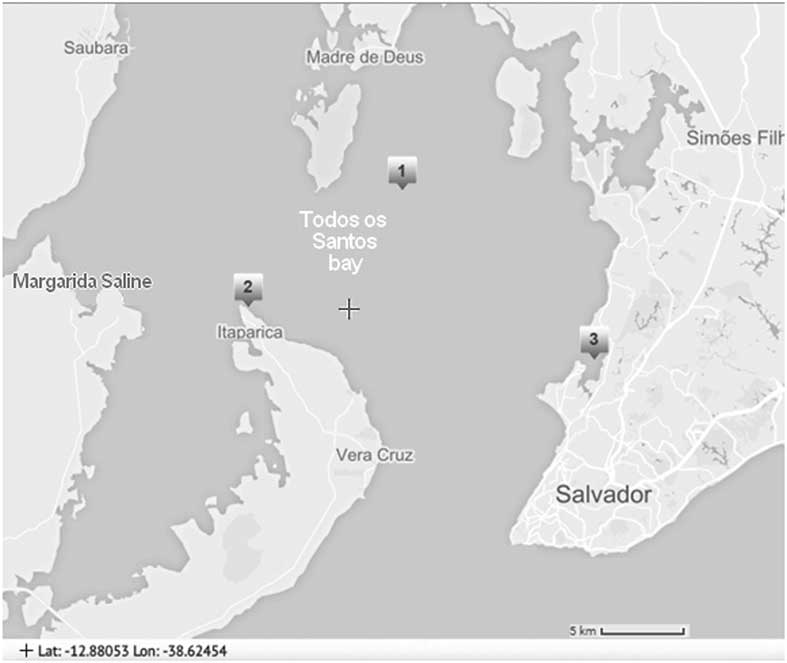
do not agree with the only available value for the coast of Bahia, ΔR=58±26 14C yr (Alves et al. Reference Alves, Macario, Souza, Pimenta, Douka, Oliveira, Chanca and Angulo2015b) for the Itaparica Island (Figure 7). The closest value other than that is for the coast of Rio de Janeiro, with different oceanographic features, therefore not comparable.
Todos os Santos Bay and sampling spots: (1) this work, (2) Alves et al. (Reference Alves, Macario, Souza, Pimenta, Douka, Oliveira, Chanca and Angulo2015b), and (3) Lobato, where the first oil well was installed.

The sampling point for the shell (Anomalocardia brasiliana) measured in Alves et al. (Reference Alves, Macario, Souza, Pimenta, Douka, Oliveira, Chanca and Angulo2015b) is 16 km distant from the coral reef where TSB sample was collected. It was located close to Paraguaçu river, which, with average discharge of 92.5 m3/s, is also the main source of freshwater to TSB (Hatje and Andrade Reference Hatje and Andrade2009). However, the input of marine waters is larger by two orders of magnitude compared to the river discharge into the bay (Leão and Dominguez Reference Leão and Dominguez2000). The competition between freshwater and the marine water input may be responsible for the negative value obtained, but it would not justify a positive value observed in a shell from a location closer to the source of river discharge.
Anthropogenic influence must be considered also. According to the Secretary for Economic Developing of the State of Bahia, an oil well was discovered in 1938, in Lobato, a branch of Salvador (Figure 7), which resulted in the first extraction in Brazil in 1939 (Morais Reference Morais2013). Later, in 1941–1942, additional commercial wells were discovered within TSB. On December 14, 1941, the Candeias wells begun extraction on a commercial basis (Morais Reference Morais2013), culminating in the construction of Landulpho Alves/Marapaipe Refinary (RLAM) in 1949, the pioneer in Brazil. Thus, the major hypothesis is the fossil contamination could have been reflected in the observed ΔR value of Alves et al. Reference Alves, Macario, Souza, Pimenta, Douka, Oliveira, Chanca and Angulo2015b. In that work, the authors used de the bivalve species Anomalocardia brasiliana. This species is considered a natural bio-indicator of Brazilian coastal areas (Tavares et al. Reference Tavares, Rocha, Porte, Barceló and Albaigés1988; Wallner-Kersanach et al. Reference Wallner-Kersanach, Lobo and Da Silva1994; Kehrig et al. Reference Kehrig, Costa, Moreira and Malm2006; Silva et al. Reference Silva, Hatje, Santos, Costa, Nogueira and Ferreira2008) and Martins et al. (Reference Martins, Nascimento, Fillmann, King, Evangelista, Readman and Depledge2005) conducted a study on the oil pollution in TSB using this bivalve. If the mollusk had been affected by oil contamination in collect year, in 1948, the fossil contamination would have decreased the 14C/C ratio in the sample, reducing ΔR value. Since our result is based on a sample from 1934 to 1935, before the beginning of oil extraction, such influence would not be present. To evaluate such hypothesis more recent growth bands of the coral would have to be measured.
The Abrolhos region, close to the open sea, is found in the largest area of the continental platform (Ekau Reference Ekau1999) subject to the Brazil Current. The superficial waters from this current, the Tropical Waters, are poor in nutrients and formed due to the high solar radiation and excess evaporation, with temperatures above 20ºC and salinity greater than 36 (Santos et al. Reference Santos, Lessa, Venancio, Chiessi, Mulitza, Kuhnert, Govin, Machado, Costa, Toledo, Dias and Albuquerque2017). The region experiences strong seasonal winds able to produce turbulence which favor exchange between surface waters and atmosphere since the gases can be more rapidly transferred towards or away from the water surface. Exchange between the upper ocean layers and the overlying atmosphere is relatively fast, with carbon being cycled much quicker than between the surface and deep ocean (Alves et al. Reference Alves, Macario, Ascough and Bronk Ramsey2018). As a consequence the availability of carbon has a dependency of marine residence times on the water column depth. Biogenic carbonates growing near the surface are expected to have different 14C activity compared to those growing at greater depths. Since the corals are not so deep in the water column they are subject to higher concentrations of 14C. There are also large rivers, such as Doce River, with average flow rate of 910 m3/s, discharging in the south edge of Abrolhos bank and Jequitinhonha River, with average flow rate of 280 m3/s, with its mouth 200 km to the north. Additionally, other small rivers close to the bank have dissolved organic matter loads averaging 155 mg/m3 (Leite Reference Leite2012). The freshwater reservoirs are usually shallower than the ocean and often less or not stratified, which enhances CO2 exchange with the atmosphere increasing the input of recently formed carbon species, decreasing ∆R (Alves et al. Reference Alves, Macario, Ascough and Bronk Ramsey2018). Both the exchange between ocean and atmosphere and the freshwater influence can contribute to the negative values found in the region.
This effect of favoring the presence of 14C in surface waters and/or fresh water discharge was observed also in the Con Dao Islands, in Vietnam, 90 km away from the mouth of the Mekong River, where ΔR was estimated to be –74±39 14C yr (Dang et al. Reference Dang, Mitsuguchi, Kitagawa, Shibata and Kobayashi2004). However, at Xisha Islands, located in South China Sea, also in Vietnam, 850 km far from of Mekong River, the ΔR presented less negative or even positive values (ΔR –10±50, 11±40, and 73±60 14C yr) (Southon et al. Reference Southon, Kashgarian, Fontugne, Metivier and Yim2002).
CONCLUSIONS AND FUTURE PERSPECTIVES
In this work, we found negative ΔR values for two different regions on the coast of Bahia state, in Brazil, based on 14C dating of previously Th-U dated corals. For the Abrolhos coral reef bank, fairly constant negative values were found in the period from 1884 to 1937 AD, indicating no variation in ocean dynamics and favoring the presence of 14C for air/sea gas exchange and freshwater influence. For Todos os Santos Bay, a previous study shows a discordant positive ΔR for a sample collected in 1948 and a hypothesis of recent contamination by oil exploitation was raised. Future work includes extending measurements of the TSB core to the period between 1940 and 1950. Considering the distribution of corals reefs, this has a potential to determine the current and on the anthropogenic influences in Brazilian coast.
Supplementary materials
To view supplementary material for this article, please visit https://doi.org/10.1017/RDC.2018.145
ACKNOWLEDGMENTS
The authors would like to thank C.C. Shen from the High-precision Mass Spectrometry and Environment Change Laboratory (National Taiwan University) for Th/U dating of coral samples, Brazilian financial agencies CNPq (Conselho Nacional de Desenvolvimento Científico e Tecnológico, 305079/2014-0, 311354/2016-5 and INCT-FNA 464898/2014-5), FAPERJ (Fundação Carlos Chagas Filho de Amparo à Pesquisa do Estado do Rio de Janeiro, E-26/110.138/2014 and E-26/111.278/2014) and Joint international cooperation Brazil/France - LMI/Paleotraces and RECORD Project - UERJ for their support. This study was financed in part by the Coordenação de Aperfeiçoamento de Pessoal de Nível Superior - Brasil (CAPES) - Finance Code 001.