‘There was a certain man, who used to hunt animals continually every day, until he was gazed at every day.’ Footnote 1
For farmers speaking Botatwe languages in ancient south central Africa over the last three millennia, the adoption of cereal agriculture early in the first millennium and limited cattle-keeping in the second half of the first millennium counter-intuitively supported lively investment in hunting from the eighth through the thirteenth centuries (see Figs. 1 and 2). A series of lexical innovations in the technologies and social import of spear hunting in the late first millennium, including the invention of a new category of celebrated, talented hunters, *-pàd (1/2) [1], sustained subsequent changes in the organization of communal hunting in the first centuries of the second millennium.Footnote 2 After the thirteenth century, novel ideas about the value of hunting motivated Botatwe speakers to reconceptualize *-pàd as an ‘elder’, ‘friend’, and ‘companion’. The complex history of meanings layered upon *-pàd raises questions about how talent in a once-common activity turned some hunters into people of great renown and how such recognition articulated with the dynamics of community life.
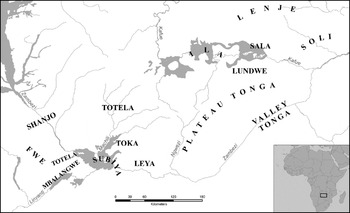
Approximate distribution of extant Botatwe languages, c. 1900.Footnote 3

Linguistic evidence that hunters were celebrated in the late first millennium will not surprise those familiar with anthropological descriptions of central African hunters, with their potent metaphysical powers and distinctive autonomy.Footnote 4 Indeed, it is something of an axiom that hunters hold unique status in African farming societies.Footnote 5 This is particularly true in the southern savannas, where foreign hunter-founders figure prominently in traditions of origin as bringers of civilization, generous givers, powerful magicians, alliance-makers, and, of course, husbands and fathers of the heirs to newly established kingdoms.Footnote 6 With such charters, scholars have traced the spread of novel political ideologies, peoples, and titles to reconstruct regional political histories, in which hunter-founders symbolize both groups of actual political upstarts and hyperbolic ‘ideal men’.Footnote 7
Rather than assume that the symbolic significance of hunters in political charters stems from qualities inherent to their craft, we might ask how and when hunters and hunting developed such significance in the southern savannas. We know the end of this story well – the dramatic cults, powerful guilds, and mythical founders – but know considerably less about how hunters, as practitioners with a particular skill, came to be recognized as ‘ideal men’, embodying the creativity and danger of autonomy, and symbolizing the political capacity to found kingdoms. As a counterpoint to symbolic approaches to savanna hunters, decentralized Botatwe communities bound hunters’ distinction to local politics in a manner that was different from the links developed between hunters and royal dynasties in savanna traditions, raising new questions about who undertook the work of cultivating hunting reputations in early savanna societies and to what ends?
INDIVIDUALS, TALENT, AND COMMUNITY IN PRECOLONIAL AFRICA
Over the last two decades, studies of precolonial societies have transformed our understanding of the relationship between knowledge, power, and community in the deep past. In an early, influential contribution to this scholarship, Jane Guyer and S. M. Eno Belinga argued that the familiar model of precolonial politics, ‘wealth in people’, was best understood as the composition of ‘wealth in knowledge’ by leaders building communities with good prospects for the future.Footnote 8 The shift beyond the accumulative valuation of followers bolstered research already underway on how Africans crafted dependencies through both the control of material resources and the manipulation of speech and knowledge, diffusing power across networks with multiple nodes of authority and diversifying followers’ opportunities for affiliation.Footnote 9 Dynamic histories explore the paths by which leaders and followers invented clans, royalty, guilds, and healing cults around historically contingent ideas about what it meant to be a particular kind of person, such as a skilled drum-maker, a descendant of a divine ancestor, an infertile woman, or a proven hunter.
Underlying this scholarship is the cultivation, recognition, and transposition of individual distinction. The ‘wealth in people as wealth in knowledge’ model explains how reputations for talent intersected with leaders’ political aspirations and scholarship on heterarchical political traditions illuminates how adepts’ investment in their own networks of obligation and dependency could undermine leaders’ efforts to consolidate power. Indeed, such processes may well have contributed to the persistently decentralized character of Botatwe societies.Footnote 10 Yet, this scholarship does little to elucidate the experience of those cultivating reputations before or in the absence of a process whereby control of distinctive talents came to be a source of formal power. While we know a great deal about the politics of knowledge among leaders and groups of followers, we know decidedly less about the cultivation of individual distinction among peers.Footnote 11 This is particularly true of renown below the level of cultural heroes, founder figures, or charismatic and ritual leaders.
These questions open up a methodological dilemma: how do we historicize individual distinction in the deep past with a methodology, comparative historical linguistics, that cannot recover the actions of singular individuals from the past? Though early Botatwe-speaking societies certainly had no vocabulary to articulate a vision of the self in the sense of the autonomous, liberal subject developed in Renaissance Europe, they could and did speak about the relationship between personal distinction based on the uneven distribution of skills and knowledge, the changing contexts of its recognition, and modes of affiliation organized around the principles of obligation and dependency. Reconstructed words provide evidence of how communities talked about people with talents that merited a distinct name over time scales that eclipse the lifespan of any one luminary. The shifting meanings of these words are the residue of earlier debates about how reputedly skilled people were identified, why they were assets, and what they could do as unique kinds of persons. While individuals elude the historical linguist, the history of individualism need not. Importantly, reputation, as a social process, is not merely an academic heuristic. It lies at the heart of regional understandings of the accumulation, storage, and transfer of remarkable capabilities from person to person. By the early nineteenth century, skilled Tonga and Ila craftsmen were presumed to have inherited the talent of an ancestor whose reputation in that craft was still remembered.Footnote 12 Reputation, then, allows us to think about the politics of knowledge in a conceptual framework that follows Botatwe ideas about relationships between individuals, communities, ancestors, and knowledge.
In the context of the small decentralized Botatwe societies, struggles over reputations reveal a deep history of the informal power of local, even seasonal honorables, of primus inter pares.Footnote 13 Though Botatwe-speakers celebrated some talented hunters, *-pàd, we have no linguistic, comparative ethnographic, or archaeological evidence for the early use of such distinction as a basis for the development of guilds or cults of specialists or professionals, as was the case in neighboring societies. Peers’ cultivation, contestation, and commemoration of hunting reputations foregrounds the affective dimensions of hunters’ renown: the excitement of the chase; hunters’ worry over success and their benevolent performances of distribution; dependents’ anticipation, trust, or even ridicule; and remembrances of hunters past.Footnote 14 The histories embedded in Botatwe hunting lexicon illuminate how communities and individuals struggled to define a once-common form of labor as a path to distinction in the face of developments in the material, technological, and political context of hunting over two millennia, from the spread of farming at the turn of the Common Era to the arrival of the caravan trade in the nineteenth century.
HUNTING REPUTATIONS IN ANCIENT SOUTH CENTRAL AFRICA
Though transformations in hunting date to the close of the first millennium, changes in the economic and social salience of hunting and hunters come into focus against earlier developments in Botatwe subsistence strategies. Moreover, reconstructed words indicate innovations developed during the long spans of linguistic stability between divergences and are, therefore, governed by the pace of linguistic change and organized around a periodization developed from the linguistic classification (Fig. 2). As a result, our story begins far deeper in the past, in the Proto-Botatwe era, when the savanna agricultural system was established.Footnote 15
Outline Classification of Botatwe.

Proto-Botatwe-speaking communities diverged from ancestral Bantu speaking societies some three millennia ago in the frontier between the great Congo and Zambezi river basins, probably at the headwaters of the Luapula, Lualaba, and Kafue Rivers.Footnote 16 The remarkable longevity of this proto-language, spanning fifteen centuries from the beginning of the last millennium BCE to the middle of the first millennium CE, attests to the success of its speakers’ settlements. However, continuity did not preclude inventiveness. In the early centuries of the Common Era, Proto-Botatwe speakers incorporated sorghum into an inherited food system of cultivated root, tree, and legume crops and wild produce, fish, and game. Millet probably followed a few centuries later.Footnote 17 As Proto-Botatwe speaking farmers opened new lands to cereal farming, they slowly extended the territory of Botatwe speech southward.Footnote 18 By establishing new settlements away from natal villages and opening their communities to people who did not speak their language, Proto-Botatwe speakers contributed to a process of language change that unfolded across a time scale imperceptible to individual speakers. By the middle of the first millennium, slight shifts in pronunciation, lexis, and grammar distinguished regional speech patterns, marking the divergence of Proto-Botatwe into Proto-Western Botatwe, located southwest of the Kafue floodplain, and Proto-Greater Eastern Botatwe, spoken in the area around the Kafue floodplain. Proto-Greater Eastern Botatwe was a short-lived speech community, spanning only the sixth through the mid-eighth centuries, but its speakers contributed to the diverse subsistence system they inherited from Proto-Botatwe speakers by adopting cattle, though in very limited numbers.Footnote 19
In adopting cereals and small numbers of cattle, the earliest Botatwe farmers incrementally but profoundly reconfigured labor regimes, particularly around the clearing, planting, weeding, and harvesting seasons, and the daily processing and cooking of grain heads. Cereal agriculture created an annual season of scarcity and the fearsome possibility of crop failure. Hunting, fishing, and foraging remained an integral part of food production, supplementing uncertain harvests and protecting crops and herds. Indeed, for Proto-Botatwe and Proto-Greater Eastern Botatwe speakers farming the southern savannas in first three quarters of the first millennium, the distinction between farming and using wild resources was not particularly clear. These early farmers burned the bush to both drive quarry and open fields, cultivated and harvested garden crops and ‘weeds’, and planted traps alongside sorghum stalks, confounding the distinction between collecting and producing food.Footnote 20
While hunting, fishing, and foraging sustained Proto-Botatwe speakers’ earliest experiments in food production, by the second half of the first millennium, their descendants established successful farms throughout the Kafue region.Footnote 21 Indeed, farmers’ achievements underpinned subsequent innovation in the economic and social value of hunting, fishing, and foraging. As part of this innovation, Proto-Central Eastern Botatwe speakers adopted the word *-pàd, ‘celebrated, talented hunter’, in the late first millennium.Footnote 22 The fact that some hunters were more skilled than others was surely nothing new, yet the invention of a word to delineate this category of person was. The distribution and phonological form of this root in languages stretching across the savannas to the northwest, north, and east of the Kafue floodplain demonstrate that speakers of Botatwe, Luban, and Sabi languages innovated the term during a period of contact. In all but Luban attestations, the root is associated with skillful hunting.Footnote 23 In Ruund, an inherited reflex, cipar (7/8), ‘ability, gift, or talent’, suggests an association between talent and the root dating to the emergence of Ruund in the mid-first millennium, thereby supporting the antiquity of a semantic reconstruction emphasizing the talent of *-pàd.Footnote 24 Other attestations connect *-pàd to the social process of recognizing hunters’ aptitude. For example, Soli, Valley Tonga, and Chikunda speak of cipalu (7/8), the celebratory feasting, dancing, and reenactments performed after a successful hunt. The retention of /p/ and distribution in Chikunda and two Botatwe societies that absorbed Chikunda speakers in the nineteenth century suggests that Chikunda borrowed the root from Sabi speakers and carried it west, probably during the Chikunda warlord Kanyemba's expansion along the middle Zambezi in the late nineteenth century.Footnote 25 The semantic domain of the root clearly indicates that their reputation for talent in their craft set *-pàd apart from general hunters, who were designated mufwimi in Botatwe languages, the agentive form of the verb ‘to hunt’, *-gúιm- [2].
The root *-pàd derives from the ancient Bantu verb *-pá, ‘to give’, with the extensive verbal affix.Footnote 26 The extensive affix has been reconstructed on Proto-Bantu verbs with the connotation ‘to be in a spread-out position’.Footnote 27 Thus, the verb literally means ‘to give or send across space’ or ‘to give widely’. In many southern Bantu languages, the extensive affix connotes repetition of an action undertaken on a large scale.Footnote 28 In Ila, the affix invoking habitual, repetitive actions is created by simply inserting –a- before the final syllable to render mwaalu ‘he who repetitively, intensively gives’.Footnote 29 Morphology also reflects the social, discursive nature of ascription: the /–ú/ suffix indicates that the root was used as a verb of quality able to function as an adjective of quality, glossing inelegantly as ‘hunt-ious’.Footnote 30 Further derivation from the verb or adjective of quality produces both the noun of quality, bwaalu (‘huntsmanship’, 14)Footnote 31 and the noun denoting a person who embodied huntsmanship, mwaalu (1/2). If the repetitive, intensive connotation of the extensive affix dates to Proto-Central Eastern Botatwe, *-pàd was the consummate huntsman, both a ‘good shot’ and a ‘generous giver’. The morphology of *-pàd supports this polysemy because the verb's object – what the hunter ‘gives’ – can be both his weapon and the game he distributes. Thus, *-pàd poetically captures in one word fleeting scenes of the mwaalu's craft: his spear thrown across great distances, repeated stabbings of the close kill, the rapid firing of a quiver of arrows, and followers’ expectation of his expansive and repeated munificence in sharing meat.
We can infer what knowledge and skills eastern Botatwe communities used to define *-pàd from the context of technological change accompanying its innovation. Hunters speaking Proto-Central Eastern Botatwe and their Proto-Kafue-speaking descendants invented an elaborate lexicon to talk about spearcraft from the mid-eighth to the mid-thirteenth century, a lexicon that suggests these hunters radically transformed both their hunting technologies and the role of hunting in the local economy. The first example of this evidence is an innovation in Proto-Central Eastern Botatwe, *-weja [3], a mode of hunting with spears, possibly throwing spears. This word was used alongside the inherited term *-gúιm-, ‘to hunt with bows and arrows’. By the turn of the first millennium, then, Botatwe communities living near the vast herds of the Kafue floodplains distinguished between at least two forms of hunting: archery and spearcraft. In Ila, the best documented Botatwe language, *-weja also refers to the hunt for economic success and its use to launch and manage one's social position, precisely the process that could produce a term like *-pàd.Footnote 32
As spearing came to dominate innovation in hunting, Proto-Central Eastern Botatwe speakers developed vocabulary for new types and parts of spears. This efflorescence in spearcraft was likely supported by the development of an intensive smelting and smithing culture from the ninth through the eleventh centuries southeast of the Kafue floodplains, near modern-day Lusaka.Footnote 33 For example, an ancient Bantu word for spear, *-túmò, was reborrowed at this time in the form *-súmò [4], probably because it now carried an iron point. Similarly, Proto-Central Eastern Botatwe speakers followed their neighbors in applying an ancient Bantu term for ‘stone’, *-tádè, to ‘iron, iron ore, and iron bloom’ but converted the root into noun class 9/10 to produce *(i)ntale [5], novel joints of iron taping or wire. Two new spear points date from the eighth to the thirteenth centuries: *(i)mpula [6], ‘spear point’ and *-bèji [7], a ‘barbless point used on both spears and arrows’ developed from the inherited verb, *-bàij-, ‘to carve’. Innovation in spear construction attests to hunters’ knowledge of environmental conditions and the seasonal and daily habits of game because the increasing specialization of spear points required that a hunter know what animals he expected to hunt before he went into the bush.
During the first quarter of the second millennium, speakers of Proto-Kafue, one of the three speech communities that developed out of Proto-Central Eastern Botatwe, used their ancestors’ advances in spearcraft to transform hunting with spears into a large-scale communal activity. In the process, they innovated words for their preferred quarry and the tools and organization of group hunting. As Proto-Kafue speakers settled into the diverse micro-environments pioneered by Proto-Central Eastern Botatwe speakers, they developed terms for antelope species with strict preferences for wetland margins: *mbololo [8] (kudu), *nalufwí [9] (reedbuck), and a borrowed Kaskazi term, *-jóbé [10] (Zambezi sitatunga). This linguistic dynamism suggests intensive exploitation of the gregarious species being named. Innovations in the technology and organization of communal hunting support this conclusion.
Three words help us to understand what Proto-Kafue hunting might have looked like. The first, *cìlà [11], derives from a word for a very large hunting net, *-kìdà, borrowed by Proto-Kafue speakers from speakers of western Bantu languages to the north and west.Footnote 34 The word was probably borrowed into Proto-Kafue from speakers of Luban languages to the north, further supporting the argument that Botatwe and Luban peoples exchanged ideas about how to hunt successfully in the southern savannas in the centuries around the turn of the first millennium CE. When Proto-Kafue speakers borrowed this word, they adopted it into noun class seven without adding a noun class prefix and used it to talk about a communal hunt, rather than a net.
These communal hunts were probably large enterprises; in the early twentieth century, they drew scores and even hundreds of participants, attracting enough attention from conservation officers to be banned by the colonial government.Footnote 35 While beaters chased animals toward an entrapment – a bog, a long net or pitfall, a fire – other hunters waited there, prepared to spear the animals, a classic formation in battue hunting, or hunting with beaters. Proto-Kafue speakers invented a new generic word for hunting entrapments, *-pàndo [12], by combining an older Bantu transitive verb root *-pànd-, ‘to split’, with the deverbative suffix denoting the action, result or instrument of the verb. Indeed, Tonga and Lenje speakers now gloss the root into English referring to the dry season communal hunt itself. In addition to using *-pàndo, Proto-Kafue battue hunting parties also encircled game, such that the bodies of the hunters themselves served as the entrapment, though this method of hunting was distinct enough from using *-pàndo to merit unique vocabulary. Commencing in two facing lines at some distance apart, one line of hunters advanced, beating the animals forward as both lines curved tighter, encircling the animals. As the hunters closed in, they stabbed their prey. While all modern-day Kafue languages refer to this form of hunting as kuoba banyama, it is impossible to reconstruct the entire phrase through the comparative historical linguistic method. It is only with the noun *ibalo [13], ‘circle of hunters in a battue hunt’ deriving from *-bada ‘ring’, that we have a common root that explicitly refers to battue hunting by encirclement, typical of precolonial elephant hunting.
The material culture of the Kafue and Batoka regions dating from the mid-eighth to mid-thirteenth centuries boasts similarly rich innovation in hunting technologies concurrent with an increasingly intense investment in pastoralism along the southern frontier of Kafue settlement.Footnote 36 Ironworking flourished, with new forms of points, ferrules, and end-spikes. The regional faunal record shifts toward higher mortality rates of gregarious antelope species, hippos, and elephants, all species hunted by groups armed with spears. Moreover, fully-gown adults dominate mortality curves. Archaeologists interpret these faunal assemblages as indicative of the emergence of skillful communal hunting practices. Though wild species outnumber domesticated species in the Kalala Island faunal assemblage throughout its occupation, there is a spike in the ratio of wild to domesticates at stratigraphic levels dated from the last quarter of the first millennium into the mid-second millennium, levels that overlap with the Proto-Central Eastern Botatwe and Proto-Kafue periods, before the ratio returns in the fifteenth century to Early Iron Age levels. Finally, butchery patterns within late first millennium and early second millennium assemblages from the Kafue and Batoka regions exhibit a shift from an earlier pattern in which entire carcasses are represented in the assemblage to specific portions of the carcass being brought back to the village. Beginning in the Proto-Central Eatern Botatwe period and continuing through the Proto-Kafue period, quarry hunted in the Kafue and on the Plateau was selectively, wastefully butchered when bagged.
These changes in game consumption raise the question: why hunt more frequently and more wastefully? The development of extravagant butchery practices may simply reflect the success of innovations in hunting technologies. To be sure, if animals were killed in ever greater numbers but only selectively butchered, hunting was no longer a vital source of protein for ordinary people. It had a new value outside of nutrition. Likewise, the development of words to broadly delineate hunters into categories of talented and ordinary, suggests that hunting was no longer a general pursuit strategically employed by farmers. Rather, some hunting, particularly communally with spears, was part of the work of distinguishing oneself, of acting on the full suite of economic and social aspirations Ila speakers came to associate with the verb *-weja.
Innovation in the economic and social value of hunting developed in the context of – and probably contributed to – major transformations in trade at the close of the first millennium. Communities from Shaba to the Tsodillo Hills acquired glass beads and shells through indirect long-distance trade routes linked, ultimately, to the Indian Ocean. Concomitantly, south central Africans increased regional trade to circulate salt, iron, and copper. By 1300, inventive smiths were forging copper currencies to facilitate expanding central African trade. Botatwe hunters circulating the fruits of their labors, innovative hunting technologies, and ideas about the social value of expertise within regional networks of fellow hunters may well have sought to participate in broader regional experiments with novel forms of elitism of the sort Lubans were attempting at Sanga by the eleventh century.Footnote 37 Yet, Botatwe speakers wove the new opportunities enjoyed by *-pàd into older ideas about knowledge and power in a manner that did not hinge on controlling hunters’ status through associations like the guilds and cults that developed among neighboring societies or binding this older form of distinction as a legitimizing force underpinning subsequent ideologies of royalty embodied in the hunter-founder figures of charter myths.Footnote 38 Although future research might date the Botatwe practice of inheriting ancestors’ skills to these early periods of regional experimentation with hunters’ privileged status, Botatwe speakers articulated hunters’ reputations for prowess with lineal politics in a flexible way, as they did with other talents, requiring demonstrated achievement on the part of the prodigy before recognizing the endowment of an ancestors’ skill.Footnote 39
The ‘wealth in people as wealth in knowledge’ concept helps us imagine why local leaders and peers recognized and celebrated distinctive hunters for the meat, skins, security, excitement, and renown they brought to the community. Unfolding outside the familiar regional pattern of specialized professional and ritual institutions holding political power, the recognition of Botatwe hunters’ reputations foregrounds the process of distinguishing peers, a process with strikingly affective power in small-scale communities. Transformations in the meaning of *-pàd after the divergence of Proto-Kafue demonstrate the persistence of the affective stakes for *-pàd and the communities who esteemed them, even as the economic and political basis of hunting reputations drastically changed.
REDEFINING DISTINCTION AND ENDURING RIDICULE IN THE NINETEENTH CENTURY
By the middle of the thirteenth century, Proto-Kafue diverged into familiar Botatwe languages: Tonga, Ila, Lenje, and Sala. Though this thirteenth century divergence marks the latest date to which we can reconstruct words through the application of the comparative linguistic method, linguistic evidence can still tell us something of the subsequent history of the speakers of languages produced by the divergence of Proto-Kafue. While diachronic phonology and historicized distributions yield information about the extent and direction of circulating words, objects, and ideas, we must create careful arguments about the dating of these exchanges by linking them to events described in other historical records, such as the arrival of new languages to the region. Transformations in hunting vocabulary after the divergence of Proto-Kafue elucidate Botatwe experiences during the watershed processes of the late second millennium in south central Africa: the extension of the caravan trade inland and the political upheavals associated with the mfecane.
The geography of trade networks throughout the first half of the second millennium put Botatwe speakers in the hinterland – the supply lands – of trade centers like Ingombe Ilede and Nqoma, and the trade routes that extended from those sites across central and southern Africa. In the last centuries of the second millennium, however, caravan traders transformed regional patterns of ivory circulation and shifted the frontier of direct trade inland. By the eighteenth and nineteenth centuries, many regional leaders and aspiring Big Men had tied their fortunes to ivory and slave caravans arriving from either coast. Among non-participants, the caravan trade wore away at established nodes of authority at all levels of political and social organization, from household heads to royal courts. Slave raids paralyzed small communities of south central Africa even as they provided others with new opportunities for consolidating authority and wealth in the form of slaves and foreign trade goods, particularly guns and cloth.Footnote 40
In the last centuries of the millennium, as Botatwe speakers learned of novel kinds of status materialized in foreign riches that circulated along increasingly prosperous caravan routes, they borrowed terms for a new kind of hunter, the professional elephant hunter, who challenged the older moral visions and forms of material wealth underpinning the status of *-pàd. By the mid-nineteenth century, Bisa and Chikunda nkombalume [14], leaders of highly ritualized guilds of professional elephant hunters, were working in and around the Luangwa and Gwembe valleys.Footnote 41 Speakers of the easternmost Botatwe languages, Soli and Lenje, had long been in close contact with their neighbors to east, so it is not surprising that they were the only Botatwe peoples to adopt the term nkombalume. Both the documentary record and the new meanings Lenje speakers added to *-pàd (below) suggest that skilled Soli and Lenje hunters sought out and achieved status as nkombalume, thereby legitimately extending the hunting lands of the elephant guilds into Lenje and Soli lands.Footnote 42 Lenje and Soli nkombalume probably outcompeted local *-pàd, perhaps by drawing on the specialist knowledge, tools, and trade contacts of the guilds. To the west, Botatwe speakers living along the Machili River and the hook of the Zambezi borrowed a different word for professional ivory hunter: sinyàngá [15]. This word also has its origins in eastern Bantu languages. Originally used in a different noun class with the meaning ‘horn’, the root spread up the Zambezi River with the meaning ‘ivory’, reaching communities west of the Zambezi floodplain. Speakers adopting the root used it to talk about the ‘man of ivory’, sinyàngá, the professional elephant hunter.Footnote 43 Taken together, nkombalume and sinyàngá indicate two distinct zones of intensive professional ivory hunting, each focused on a north-south elephant migration route. Based on the phonology and distribution of attestations, nkombalume spread from the northern Zimbabwe plateau, through the Gwembe, and up the Luangwa River, shifting from a general term for a skilled hunter and brave person to a technical and ritual leader of a professional hunting guild. The sinyàngá who hunted along the corridor west of the Zambezi River and into the swamps of the Caprivi and Chobe in the eighteenth and nineteenth centuries supplied Ovimbundu caravans.
New meanings attached to *-pàd in distinct Botatwe languages indicate the durability of the social and affective capacities of this category of notable, even as the practical and discursive terms in which one was recognized as a celebrated hunter were increasingly tied to the specialization, even professionalization, of the work. Tonga and Ila speakers living just beyond the geographic frontier of professional ivory hunting networks esteemed *-pàd as an ‘elder’.Footnote 44 In fact, early twentieth-century dictionaries first gloss the term as ‘elder’, but add that the ‘proper’ meaning is ‘hunter’ or ‘senior hunter’.Footnote 45 Lenje speakers living on the eastern fringe of the Botatwe area participated in the ivory trade while Tonga speakers in the Zambezi valley inhabited the western periphery of the Luso-African trade networks of the lower Zambezi.Footnote 46 Here, *-pàd was valued as a ‘friend’ and ‘companion’. The Chikunda ivory hunters who appropriated *-pàd to invent a noun for feasts celebrating successful hunts demonstrate that the meaning of *-pàd was being redefined by both Botatwe speakers and neighbors with great stakes in the business of elephant hunting.
What purpose did it serve Botatwe speakers to use the old root *-pàd in a new way that emphasized affection and respect as the criteria of *-pàd's status and the basis of his relationships with those who validated his status? Botatwe speaking communities may have augmented the inherited meaning of *-pàd because older forms of hunting, particularly *-cìlà communal hunts, were no longer stages for performing expertise to build notoriety. Other adept hunters taking greater risks and reaping higher economic returns were inspiring new words and building up extravagant reputations, eroding the material but not the social or affective basis for the status of *-pàd. Strikingly, speakers drew on familiar social imperatives of cooperation and dependency in developing new meanings for *-pàd, but spoke about relationships like friendship that could stand outside the power dynamics of kinship in organizing the flow of *-pàd's meat and the foreign goods exchanged for skins, horns, and tusks.Footnote 47 Indeed, affective alliances like friendships likely facilitated the process by which talented people built up their own personal pools of people and expertise alongside, within, or in the absence of the wealth in people and knowledge composed by lineage heads and ritual specialists, contributing to the decentralization of Botatwe authority. Yet, the political and social turmoil accompanying the ivory and slave trade suggest another historical motive for these semantic shifts, though they could have taken place any time after the divergence of Proto-Kafue in the thirteenth century. Calling on *-pàd as friends, companions, and elders invoked ties of obligation for assistance from esteemed peers with the skill to defend and feed communities and the social position to offer protection from enslavement in the increasingly uncertain, violent context created by the caravan trade.
The insatiable demand for slaves forced central African societies to reconfigure how claims of obligation expressed through the rubric of kinship and related idioms of ascriptive social affiliation mediated relationships between strangers. In the early twentieth century, an Ila man explained the likely outcome of a mere solecism in addressing a stranger: ‘Can I claim to be a member of a strange clan that is not really mine? If I did so, and addressed one as “My fellow-clansman”, wouldn't I be rendering myself liable to be enslaved, (because) they would not acknowledge me as their own?’Footnote 48 If claims to kinship and clanship were a means of securing protection as the slaving frontier reached the eastern Botatwe region by the middle of the nineteenth century, the rejection of such claims opened up the possibility of enslavement.Footnote 49 Though historians of east African slavery have taught us that claims of kinship were a strategy to elide relative degrees of social vulnerability and protect lineage adherents from sale,Footnote 50 those with kin may have actually been more vulnerable, precisely because claims of kinship justified the right and sometimes obligation to transform relatives into debt payments and even commodities. As early as 1855, Livingstone lamented the entrepreneurial acumen of Mambari traders who identified a need for iron hoes among Tonga speakers and, thereby, finally ‘induced’ Tonga speakers to sell their ivory and their children.Footnote 51 Livingstone's observations are echoed in the writings of other travelers and missionaries, who remarked on the sale of mothers, daughters, and sisters into slavery during the second half of the nineteenth century and the first decade of the twentieth century.Footnote 52 Africans living along the Zambezi told their own widely circulating stories about the sale of children by parents, even before birth.Footnote 53 If ties of kinship facilitated the sale of relatives, vulnerabilities stemming from one's status as a relative did not terminate with the sale. Some Bwila used their status as kin to claim the right to redeem relatives but, subsequently, recast the act of redemption as the ‘sale’ of the redeemed to the redeemer. Thus, membership of a kin group, particularly for women and children, created vulnerability at both the moment of sale and even the moment of redemption.Footnote 54
By the middle of the nineteenth century, claims of kinship in the Botatwe region could serve as the basis for both social support and great vulnerability. Creating ties of dependence and claims for assistance from talented people like *-pàd outside the rubric of kinship allowed Lenje, Tonga, and Ila speakers to demand help outside the idiom that was deployed by powerful people to sell ‘relatives’ both locally and to caravans moving ivory and slaves to the coasts. To claim help on the basis of kinship was to underscore the hierarchies of authority inherent to lineality and make oneself vulnerable to lineage heads. To make claims on local notables like *-pàd on the basis of friendship and the responsibility of elders to help solve the problems of the community was to protect oneself with a different form of affective relationship.Footnote 55
In the middle and late nineteenth century, as the frontier of the slave and ivory trades reached into the eastern fringes of the Botatwe speaking area, violence accompanying the political aspirations of the Lozi Litunga ravaged settlements of the Kafue floodplain, the western fringes of the Batoka Plateau, and the Zambezi Valley. Here, too, affective semantic content was added to Botatwe hunting vocabulary. As the Litunga sought to expand his political reach eastwards and restrict Ndebele raids north of the Zambezi, SiLozi speakers added a number of derogatory meanings to words they borrowed from Botatwe speakers to belittle a set of skills that had been highly valued among Botatwe peoples living just beyond the reach of the expanding Lozi polity.Footnote 56 The word *-yala [16] was used on the eastern Batoka plateau to describe a kind of hunting undertaken by encircling game. When Lozi speakers borrowed the verb into their language and used it to make a noun, imayala, they spoke of ‘an unlucky person who always comes back empty-handed from fishing or hunting, etc. …’Footnote 57 Similarly, when Lozi spoke of sibinda, a word shared by Botatwe speakers, they spoke not of hunters but of ‘ungovernability, fig. strong-headed person’.Footnote 58 Finally, Lozi had their own attestation of *-pàd in noun class 3/4, mwalu, which referred to a ‘perplexity, embarrassment, bewilderment’.Footnote 59 The density of derogatory meanings added to Botatwe hunting and fishing vocabulary borrowed into SiLozi is unprecedented in other neighboring languages. Perhaps Lozi ridicule was a dual propaganda, both questioning the basis for the status Botatwe speakers extended to *-pàd, and, therefore, the legitimacy of his influence in Botatwe societies and also bolstering the courage of Lozi fighters skirmishing with Botatwe warriors, many of whom were likely *-pàd, for *-pàd excelled in a set of skills that was transposable from hunting to warfare and depended upon with increasing frequency to protect Botatwe communities from the physical, if not the verbal, attacks of the Lozi.
CONCLUSION
Hunters stand out in the historical consciousness of farming communities of the southern savannas and have attracted much attention from scholars. Yet, hunters’ unique status would have confounded early savanna farmers who integrated the exploitation of game meats, skins, horn, and tusks into the work of protecting the ripening grain heads of the cereals with which they were experimenting. Even after farmers adopted sorghums and millets as the staples of their diet, the distinct status of hunters was not a foregone conclusion to the admirers and dependents who first spoke of *-pàd, the inventive smiths who transformed the tools wielded in the pursuit of game, and the gifted hunters who emphasized the sociality of the hunt, kindled the consumptive desire – even hunger – for meat, and built reputations as talented individuals within the community, living and dead. The ‘wealth in people as wealth in knowledge’ model illuminates the value of such talented individuals to charismatic leaders and lineage heads, but we might well ask what this politics looked like to those cultivating such distinctions. The novel meanings speakers attached to *-pàd suggest that a talented individual like a celebrated hunter could achieve a status and develop personal associations that could bolster or fall outside the control of local political and ritual leaders, highlighting affective dimensions of power, alternative loci of influence and dependency, and additional processes of network-building that teach us about the nature of authority in early acephalous Bantu-speaking societies.
The aspirations of Botatwe hunters and the power of admirers to extend or withdraw their esteem remind us that both individuals and groups struggled over the definition and political force of distinction, with outcomes that varied across central Africa and over time. During the second millennium, the grounds on which some regional hunters claimed unique status shifted to include their association with royal hunter-founder figures, the esoteric knowledge of cults, and the wealth to afford initiation into professional organizations. For Botatwe *-pàd, however, successful claims to distinction yielded decidedly less formal influence, which might have been tied to the power of ancestors to conduct talent through blood ties from an early date, but was certainly rooted in broad community recognition when term *-pàd was adopted. By the nineteenth century, the status of *-pàd shifted dramatically. As ambitious professional hunters and traders carried the ivory and slaving frontiers inland and immigrant armies used their novel military organization to alter local political landscapes, older forms of hunting reputations faced new challenges. While Botatwe communities eventually emphasized the status of elderhood and networks of friends when they spoke of *-pàdú, regional newcomers found in this root a means to appropriate, challenge, and even ridicule this well-trodden path, long smoothed over by older claims to individual distinction.
A deep history of reputation-building focuses attention on the material needs and moral visions of the community at the heart of individuals’ ambitions to define distinction in the early African past. As a historical linguist, I find in the morphology of Botatwe languages an eloquent metaphor encapsulating this productive tension between communities and individuals. Botatwe speakers add the plural prefix as an honorific; for example, a person who is a hunter, mufwimi, may be called bafwimi (lit. ‘hunters’) if he is skilled at his craft. Thus, talent is recognized with the prefix invoking social association: the plural. Perhaps the plural not only indicates the unique worth of an individual with abilities equivalent to that of many men, but also that such social worth cannot be divorced from the aspirations of the numerous people who sustain his claim to this status each time they name him.
APPENDIX: RECONSTRUCTED VOCABULARY AND HISTORICIZED AREAL FORMS
1 *-pàd
 (noun class 1/2) ‘skilled, successful, celebrated hunter’
Distribution in Lunda, Luban, Sabi, Proto-Central Eastern Botatwe; savanna areal; could be as late as Proto-Kafue. Derived from Proto-Bantu *-pá, ‘to give’ with an extensive suffix; also bears suffix for adjective and noun of quality. Combined in some (non-Botatwe) languages with the intransitive, separative suffix –uk to form a verb meaning ‘to hunt’.Footnote 60
2 *-gúιm- (v.t.) ‘to hunt with bow and arrow’ later generic ‘to hunt’
Proto-Eastern Savanna or areal between Proto-Botatwe and Proto-Mashariki. From Proto-Savanna noun *-g
í ‘arrow’.Footnote 613 *-weja (v.t.) ‘to hunt (with spears)’ (tone uncertain)
Proto-Central Eastern Botatwe with borrowing into western Botatwe languages. Etymology uncertain; may be related to *-péjuk ‘to fall’ in the sense of ‘felling’ game either when hit or by hunting with gamepits.Footnote 62
4 *-súmò (noun class 5/6) ‘spear (with iron point)’
Proto-Central Eastern Botatwe; re-borrowed form of an early Bantu word for spear, *-túmò, probably alongside new iron point technologies. Attestations of the original root following spirantization patterns indicating inheritance also exist in eastern Botatwe languages.Footnote 63
5 *(i)ntale (noun class 9/10) ‘iron tape or wire ferrule’
Proto-Central Eastern Botatwe common form. Derives from an ancient Bantu term, *-tádè (5/6), originally meaning ‘stone’ and shifted to ‘iron, iron ore, and iron bloom, iron wire’ in noun classes 7 and 14 broadly across the Bantu languages; this semantic shift also borrowed into eastern Botatwe languages; shift to 9/10 for ‘iron ferrule’ may be unique to BotatweFootnote 64
6 *(i)mpula (noun class 9/10) ‘spear point (iron?)’
Proto-Central Eastern Botatwe common form. Etymology unknown.Footnote 65
7 *-bèji (noun class 5/6 or 11/6) ‘barbless point used on both spears and arrows; lit. “the carver”’
Proto-Kafue innovation from the inherited verb, *-bàij-, ‘to carve’; noun class 11 is the typical class for noun abstracted from verbs in eastern Botatwe languages; agentive suffix added in process of verb to noun derivation.Footnote 66
8 *-mbololo (noun class 1a/2) ‘kudu’
Proto-Kafue common form. Etymology unknown.Footnote 67
9 *nalufwí (noun class 1a/2) ‘reedbuck’
Proto-Kafue. Derives from an inherited Proto-Savanna term for arrow, *-gúί.Footnote 68
10 *-jóbé (noun class 1a/2) ‘Zambezi sitatunga’
Proto-Kafue. Borrowed from Kaskazi.Footnote 69
11 *-cìlà (noun class 7/8) ‘communal hunt’
Proto-Kafue. Borrowed from sources to the north, probably Luban languages. From *- kìdà (noun class 14/6), an older term in equatorial Bantu languages for ‘hunting net’.Footnote 70
12 *-pàndo (noun class 11/10) ‘communal battue hunting barrier or entrapment’
Proto-Kafue. Derives from older Bantu transitive verb root *-pànd-, ‘to split’, with the deverbative suffix denoting the action, result or instrument of the verb.Footnote 71
13 *ibalo (noun class 5/6) ‘ring of hunters in a battue’
Proto-Kafue common form. Probably a semantic innovation with noun class shift from Bantu term *-bada (9/10) ‘ring’, though the antiquity of this root is not established in Bantu.Footnote 72
14 *nkombalume (noun class 9) ‘professional ivory hunter’
Middle Zambezi areal form. Two possible routes of development: (1) less likely a compound of balume, plural of ‘men’ or honorific, with -kom-, ‘to hit, to kill’ (frequently used in noun form to create compounds: e.g. nkoma-bantu ‘murder’, nkoma-mutwi ‘deaf person’ in Bemba) to render nkombalume ‘men who hit / kill, hitmen’; or (2) more likely a compound of -lume, ‘man’ with a verb, -kòmb-, attested in Shona languages and carrying the meaning ‘to bend, esp. metal; to be striking, important, beautiful, strange, valuable’ and used to derive a lexicon tied to the ideals of bravery and fame in hunting, sexual exploits, etc. so that nkombalume were the ‘striking, valuable men’.Footnote 73
15 sinyàngá (noun class 1a/2) ‘professional ivory hunter’
Zambezi areal form. Derives from eastern Bantu root,*- nyàngá, for ‘horn’ with a later shift in meaning to ‘ivory’ and, finally, ‘professional ivory hunter’ upstream from the Victoria Falls.Footnote 74
16 *-yala (v.t.) ‘to hunt by surrounding’
Western Batoka areal form with semantic innovation in eastern Batoka Region. Derives from an older Bantu root, *-jàd- (v.t.), ‘to spread’.Footnote 75
17 *-shuta (v.t.) ‘to angle, fish with hook and line’
Either Proto-Zambezi Hook innovation with spread to Lozi and Botatwe languages along the Zambezi or areal developed in mid- to late- nineteenth century between Botatwe languages and Lozi. Etymology uncertain.Footnote 76
 í ‘arrow’.